Implications
Subclinical ketosis (SCK) in dairy cows reduces the productivity and therefore the efficiency of milk production and the profitability of the dairy farm. Estimating the economic impact of SCK may make farmers more aware of this problem, and can improve their decision-making regarding interventions to reduce SCK. The total costs of SCK in dairy cows were €130 per case per year, and varied from €83 in parity 1 to €175 in parity 3. Costs were 36% from a prolonged calving interval (CI), 24% from reduced milk production, 19% from treatment, 14% from discarded milk and 6% from removal.
Introduction
Subclinical ketosis in dairy cows is a metabolic disorder that occurs in the period around calving. In this period, the energy requirement can exceed the energy intake, which results in a negative energy balance (NEB) (Van Knegsel et al., Reference Van Knegsel, van den Brand, Dijkstra, Tamminga and Kemp2005). The adaptation of cows to an NEB is reflected in the concentration of non-esterified fatty acids and β-hydroxybutyrate (BHBA) in the blood (Leblanc, Reference Leblanc2010). Most studies assumed that cows have SCK if the BHBA level is higher than 1.2 to 1.4 mmol BHBA/l blood, but not have clinical signs of ketosis (Raboisson et al., Reference Raboisson, Mounié, Khenifar and Maigné2014). The average prevalence of SCK in dairy cows obtained from several European countries (Italy, Croatia, Hungary, Poland, Serbia, Slovenia, Portugal, Spain, Germany, Turkey, France, the Netherlands, United Kingdom) ranges from 11% to 49% (Suthar et al., Reference Suthar, Canelas-Raposo, Deniz and Heuwieser2013; Berge and Vertenten, Reference Berge and Vertenten2014).
Several studies showed that SCK can have a negative impact on milk production, reproduction and removal (culling or dying) of cows (Walsh et al., Reference Walsh, Walton, Kelton, LeBlanc, Leslie and Duffield2007; McArt et al., Reference McArt, Nydam and Oetzel2012; Raboisson et al., Reference Raboisson, Mounié, Khenifar and Maigné2014). Moreover, SCK is associated with an increased risk of, for example, displaced abomasum (DA), metritis, mastitis, lameness and clinical ketosis (Suthar et al., Reference Suthar, Canelas-Raposo, Deniz and Heuwieser2013; Berge and Vertenten, Reference Berge and Vertenten2014; Raboisson et al., Reference Raboisson, Mounié, Khenifar and Maigné2014). Therefore, SCK affects farm productivity and profitability. Estimating the economic impact of SCK may make farmers more aware of this problem, and can improve their decision-making regarding interventions to reduce SCK.
Two recent studies (McArt et al., Reference McArt, Nydam and Overton2015; Raboisson et al., Reference Raboisson, Mounié and Maigné2015) aimed to estimate the economic impact of SCK. Using a deterministic model, McArt et al. (Reference McArt, Nydam and Overton2015) estimated the economic impact at $289 per case of SCK. They included only the relation of SCK with metritis, DA and ovarian dysfunction, and therefore might have underestimated the total costs of SCK. Raboisson et al. (Reference Raboisson, Mounié and Maigné2015) developed a stochastic simulation model and included more diseases related to SCK, resulting in an estimated economic impact of €257 per case of SCK. This study, however, did not distinguish between removal risks of cows with only SCK and of cows with SCK and a related disease, which might have led to an over- or underestimation of costs. Furthermore, McArt et al. (Reference McArt, Nydam and Overton2015) and Raboisson et al. (Reference Raboisson, Mounié and Maigné2015) only distinguished primiparous and multiparous cows, while prevalence of SCK and related diseases, milk production, CI, energy requirement and removal risk can differ between multiparous cows (Bar et al., Reference Bar, Gröhn, Bennett, González, Hertl, Schulte, Tauer, Welcome and Schukken2008; Berge and Vertenten, Reference Berge and Vertenten2014; CRV, 2014). Providing information on costs per parity can support farmers to take cow specific decisions. Moreover, it provides insight into the costs per cow to invest for preventing SCK.
Our objective was to estimate the economic impact of SCK using a dynamic stochastic simulation model. This model includes related diseases of SCK, distinguishes between the removal risks of cows with only SCK and of cows with SCK and a related disease, and estimates the economic impact for different parities.
Material and methods
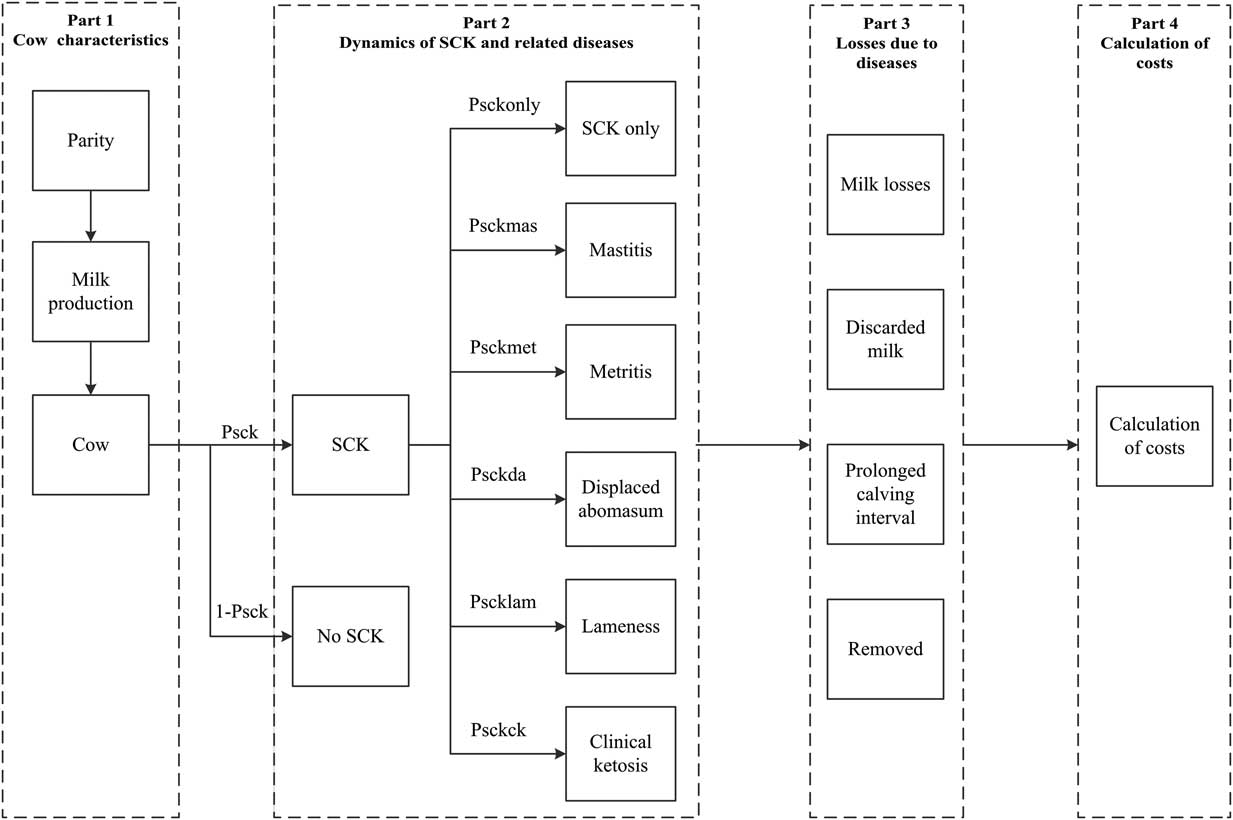
A dynamic stochastic simulation model was developed to estimate the economic impact of SCK for a typical Dutch dairy farm, applying 8 h/day grazing for 170 day/year (Centraal Bureau voor de Statistiek (CBS), 2014). The model simulates the dynamics and losses of SCK and related diseases during the first 30 days after calving for one lactation, and estimates the economic impact related to these diseases. The model contains four parts (Figure 1). In part one, cow characteristics, for example, parity and milk production, are simulated and energy requirements for a healthy cow are estimated. In part two, the dynamics of SCK and related diseases are simulated. In part three, losses due to the diseases in the second part are estimated. In part four, costs of SCK and related diseases are calculated. All four parts are described below and parts one to three are described in some more detail in Supplementary Material S1. All input values in the model were based on literature. The model was developed in R (R_Core_Team, 2016) and was run with 1 000 000 iterations.
Overview of the four parts in the model to estimate the costs of subclinical ketosis (SCK) in dairy cows. P=probability.

Cow characteristics (part one)
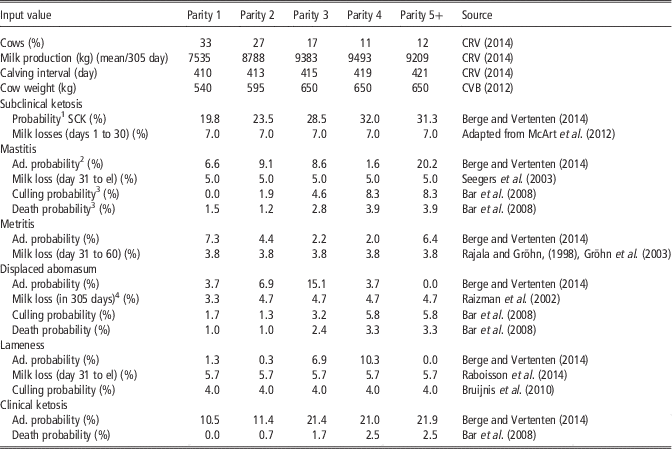
Each cow receives a parity (1 to 5+), which is based on a weighted herd average (CRV, 2014). Based on the parity, the cow receives a BW, a milk production level and a CI (CVB, 2012; CRV, 2014) (Table 1). Milk production level per parity is determined with a normal distribution function. The CI consists of a lactation period (350 to 361 days) and a dry period (60 days). A lactation curve is utilised to estimate the average daily milk production per cow based on weekly milk records (Wood, Reference Wood1967). Net energy requirement for maintenance, milk production, pregnancy and growth in case of parity 1 and 2 is estimated per day (CVB, 2012).
Cow characteristics and probabilities of diseases per parity to estimate the economic impact of subclinical ketosis (SCK) in dairy cows

el=End of lactation period; Ad.=additional probability.
1 Probabilities were obtained and calculated from data of the study Berge and Vertenten (Reference Berge and Vertenten2014).
2 Additional probability of cow getting a disease with SCK were obtained and calculated from data of the study Berge and Vertenten (Reference Berge and Vertenten2014), probabilities were estimated as the difference between the probability of the cow getting the disease with SCK and the probability of the cow getting the disease without SCK.
3 Additional probability on getting culled or died were calculated for the disease.
4 Reduced milk production losses for displaced abomasum were estimated over 305 days but only occurred in months 1 to 4. Daily milk loss (kg/day) was estimated and reduced milk production losses occurred after day 30.
Energy requirement for maintenance was assumed to be 6.7% higher in summer (170 day/year) than in winter (195 day/year), because of grazing (CVB, 2012). The CI of all parities is longer than a year and therefore the summer and winter period of the CI was estimated using the yearly fraction of grazing (170/365). Finally, energy requirements and milk production of a cow are expressed in 365 days using the yearly fraction of the CI (365/CI).
Dynamics of subclinical ketosis and related diseases (part two)
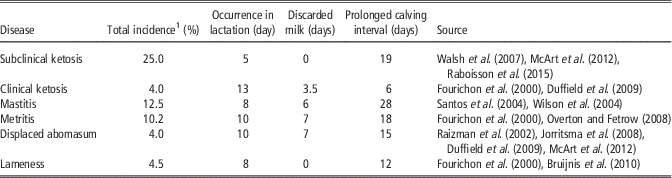
The model includes SCK and related diseases mastitis, metritis, DA, lameness and clinical ketosis occurring in the first 30 days after calving (Table 2). First, based on parity, each cow has a probability to get SCK. Second, each cow with SCK has, based on parity, an additional probability to get mastitis, metritis, DA, lameness or clinical ketosis (Table 1). Although in practice cows might get more than one related disease after SCK in the first 30 days, no data were available about probabilities of multiple diseases after SCK, nor on the interactions of these multiple diseases on production. Therefore, in the developed simulation model each cow could get only one of these related diseases after SCK. The day of occurrence of SCK was set at day 5 after calving (McArt et al., Reference McArt, Nydam and Oetzel2012). Related diseases only occurred after SCK. Thus, a cow could have no disease, SCK only, or SCK and a related disease. Cows without SCK were excluded from further analysis. Probabilities of SCK and related diseases per parity in the first 30 days after calving were computed using data of Berge and Vertenten (Reference Berge and Vertenten2014). Disease incidence at herd level varies across literature. To represent an average incidence rate while accounting for the difference in risk ratio (RR) across parities and across different combinations of diseases, disease probabilities per parity found by Berge and Vertenten (Reference Berge and Vertenten2014) were up- or downscaled to match average disease incidence at herd level found in literature (Table 2). The additional probability to get a related disease because of SCK was estimated as the difference between the probability to get this disease with SCK and the probability to get it without SCK. It was assumed that only cows with SCK could get clinical ketosis. Third, each cow with SCK and a related disease has a probability to get culled or to die on the farm, together called removal. These probabilities depend on the parity of the cow and the related disease, and were based on removal rates in the first 2 months of the lactation (Table 1). In practice, cows that suffered SCK and a related disease may be removed at a later stage of the lactation, for example, because of related fertility problems. No data, however, were available to relate removals at a later stage to SCK. Therefore, in the simulation model the day of removal was set at day 30 after calving.
Disease incidence and consequences on production parameters used to estimate the economic impact of subclinical ketosis and related diseases in dairy cows

1 Total disease incidence in the first 30 days after calving in the herd.
The discrete events on getting SCK, a related disease after SCK and removal from the herd are simulated by using random numbers drawn from uniform distributions.
Losses due to diseases (part three)
Cows with SCK have a reduced milk production (%/day), which is disease specific (Table 1). During the first 30 days of the lactation, each cow with SCK has the same reduced milk production, irrespective of whether the cow has SCK only or SCK and a related disease, because no data were available to differentiate in milk losses in the first 30 days. Cows with SCK and a related disease also have a reduced milk production after day 30 for a period which is disease specific. These cows receive a disease specific treatment. This treatment is based on the average treatment protocols provided by seven veterinarians, who were randomly selected from different clinics in the Netherlands, and on information from literature. If the cow is treated with antibiotics, the milk is discarded for the prescribed days (Table 2). When a cow is removed, she is immediately replaced by a heifer with average production parameters. A new heifer, however, has a lower milk production than a cow from parity 2 to 5+ and, therefore, removal results in milk losses. Cows with SCK that are not removed from the herd have a reduced fertility. Reduced fertility is included in the model by a prolonged CI of the cow (Table 2). It was assumed that the number of inseminations did not change. The dry period of a cow with SCK did not change and was set to 60 days, but the duration of the lactation period was increased. The prolonged CI depends on the (combination of) disease(s). As no data were available on the combined effect of SCK and related diseases on CI, the impact on CI was determined by adding all the extra days of the disease with the largest effect on CI, and half of the extra days of the other disease, which was adapted from the method of Gröhn et al. (Reference Gröhn, Rajala-Schultz, Allore, DeLorenzo, Hertl and Galligan2003).
After summing all the milk losses, milk production and net energy requirement per lactation are determined and converted to an average per year based on the CI of the cow. Milk losses per cow per year are estimated as the difference between the milk production of the cow with and without SCK.
Calculation of costs (part four)
The total costs of SCK (TCsck i ) (equation 1) for cow (i) with SCK are estimated as
 $${\rm TCsck}_{i} \,{\equals}\,{\rm Cmilk}_{i} {\plus}{\rm Ctreat}_{i} {\plus}{\rm Cmilkmd}_{i} {\plus}{\rm Crem}_{i} {\plus}{\rm Cci}_{i} $$
where Cmilk are costs from reduced milk production (equation 2), Ctreat treatment costs, Cmilkmd costs related to discarded milk (equation 3), Crem costs from removal and Cci costs related to a prolonged CI (equation 5).
Costs for reduced milk production are estimated as:
 $${\rm Cmilk}_{i} \,{\equals}\,{\rm ML}_{i} {\times}{\rm MP}{\minus}{\rm FIDL}_{i} {\times}{\rm FP}$$
where ML i is the reduced milk production in kilogram of cow (i) with SCK, MP the milk price per kilogram of milk, FIDL i the reduced feed intake in kilogram DM because of ML of a cow (i) with SCK and FP the feed price per kilogram DM of the diet.
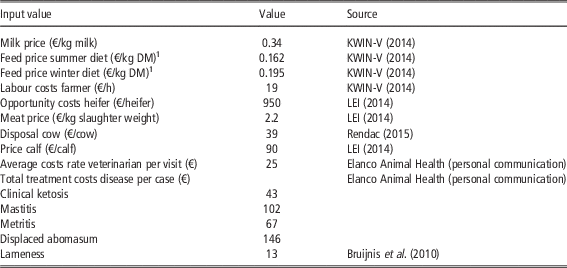
Milk price was based on average price of milk from the last 9 years (KWIN-V, 2014).
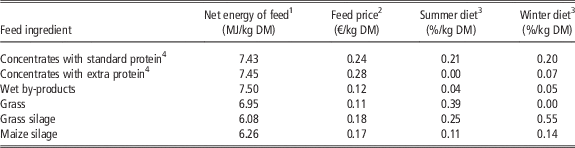
A diet was composed to estimate the costs related to feeding. A diet for the summer and winter period consisted of concentrates and roughage. Roughage consisted of grass, grass silage and maize silage (CBS, 2014). Energy content per kilogram of dry matter feed was estimated for the summer (6.78 MJ/kg DM) and the winter period (6.53 MJ/kg DM) based on a weighted energy content of the feed ingredients (Table 3). Costs of feed were 0.163 €/kg DM in the summer period and 0.195 €/kg DM in the winter period (Table 4). Based on the estimated net energy requirement of the cow and the net energy content of the feed, DM intake per cow per year was estimated for the same cow with and without SCK. It was assumed that the feed intake of the cow was equal to the energy requirement of the cow. Reduced feed intake per cow per year was estimated as the difference between DM intake of the same cow with and without SCK. The energy requirements for maintenance were the same for cows with or without a disease, while the energy requirement for milk changed with a change in milk yield. As a result, cows with SCK were found to have a lower feed efficiency and a higher energy requirement per kg of milk produced.
Dietary composition and feed characteristics used to assess the economic impact of subclinical ketosis and related diseases in dairy cows

1 Vellinga et al. (Reference Vellinga, Blonk, Marinussen, Van Zeist and De Boer2013).
2 KWIN-V (2014).
3 CBS (2014).
4 Average taken from 4 years (Nevedi, 2015).
Monetary values used to assess the economic impact of subclinical ketosis and related diseases in dairy cows

1 Feed price is based on a weighted average of feed composition.
Treatment costs (Ctreat i ) are estimated for cows that had a related disease after SCK. The costs for treatment were based on costs of medication, extra labour for the farmer and the consultation of the veterinarian (Table 4). Cows that are treated receive antibiotics and milk is discarded during this period. All discarded milk is considered waste.
Costs for discarded milk are estimated as:
 $${\rm Cmilkmd}_{i} \,{\equals}\,{\rm Mmd}_{i} {\times}{\rm MP}$$
where Mmd i is the kilogram of discarded milk of cow (i).
Costs of removal (Crem) consist of costs because of milk losses (Cmilkrem) (equation 4) and extra removal costs, because of early introduction of a new heifer.
Costs for milk losses because of removal are estimated as:
 $${\rm Cmilkrem}_{i} \,{\equals}\,{\rm MLrem}_{i} {\times}{\rm MP}{\minus}({\rm FIDrem}_{i} {\times}{\rm FP})$$
where MLrem i is the milk losses in kilogram of cow (i) because of removal, FIDrem i the reduced feed intake in kilogram DM because of MLrem of cow (i) that was removed.
Cows that are removed before the end of parity 5 are assumed to be removed too early, resulting in extra costs for raising extra heifers. Extra removal costs are estimated with a depreciation method (Getaneh et al., Reference Getaneh, Mekonnen and Hogeveen2017). First, the difference between the opportunity costs of a new heifer and the slaughter price of a heifer is estimated. Second, this difference is depreciated over the total amount of milk that is produced by the cow at the moment of removal. For cows that are removed at parity 2+, average milk production levels were assumed for all previous parities.
The opportunity costs of a new heifer is based on the average price of a heifer from the period 2005 to 2014 (LEI, 2014). The slaughter price of a heifer consists of the slaughter weight of the heifer multiplied with the meat price per kilogram slaughter weight. Slaughter weight of the heifer is estimated with an assumed dressing percentage of 60% (Rutten et al., Reference Rutten, Steeneveld, Inchaisri and Hogeveen2014). It is assumed that the meat price per kilogram slaughter weight of a cow with a disease (€1.82/kg slaughter weight) is lower than of a cow without a disease. This revenue foregone is added when the cow is culled and when the cow dies, the slaughter price of the cow is added. Costs for disposal of the dead cow are also included (Rendac B.V., 2015).
Costs for a prolonged CI (Cci i ) consist of milk losses because of a prolonged CI and the difference in annual number of calves (equation 5). Reduced milk production that occurred in the extended period of the CI is allocated to Cci.
 $${\rm Cci}_{i} \,{\equals}\,{\rm MLci}_{i} {\times}{\rm MP}{\minus}{\rm FIDci}_{i} {\times}{\rm FP}{\plus}{\rm Calfd}_{i} {\times}{\rm CalfP}$$
where MLci i is the milk losses in kilogram of cow (i) because of prolonged CI, FIDci i the reduced feed intake in kilogram DM because of MLc i of cow (i), Calfd i the reduced number of calves and CalfP the price per calf.
Total costs of SCK are expressed per case of SCK per year and will be presented in the results as an average with the 5% to 95% percentile between brackets. In addition, the median is given in tables. Costs of SCK were analysed per parity, per different costs contributor and per disease (combination).
Sensitivity analysis
A sensitivity analysis was performed to analyse the impact of changes in input parameters on the economic impact of SCK. Input parameters of the reference situation (Tables 1 to 4) were adjusted to alternative values and the impact of alternative values were analysed separately.
Probabilities of each disease and probabilities of removal of all diseases were adjusted. Probabilities of getting mastitis, or metritis, or DA, or lameness or clinical ketosis were increased and decreased with 50% (increased P per disease), whereas probabilities of removal were doubled (increased P removal).
The RR and removal probabilities of metritis and DA were increased based on values found in literature. The RR of metritis for cows with SCK was increased from 1.4 to 3.3 (increased risk ratio metritis) (Duffield et al., Reference Duffield, Lissemore, McBride and Leslie2009). The RR of DA for cows with SCK was increased from 3.7 to 8.0 (increased risk ratio DA) (LeBlanc et al., Reference LeBlanc, Leslie and Duffield2005). Furthermore, in each parity removal risk of DA and metritis were increased to 23.4% (DA) and to 6.0% (metritis) (increased P removal metritis and DA) (Raizman et al., Reference Raizman, Santos and Thurmond2002; Overton and Fetrow, Reference Overton and Fetrow2008).
Milk price and opportunity costs of a heifer were adjusted. Milk price was adjusted from 0.344€/kg milk to the highest (0.416 €/kg milk) (increased milk price) and lowest (0.269 €/kg milk) (decreased milk price) milk price from the last 9 years in the Netherlands (KWIN-V, 2014). Opportunity costs of the heifer were increased from €950 to €1790 (increased opportunity costs heifer) (Mohd Nor et al., Reference Mohd Nor, Steeneveld, Derkman, Verbruggen, Evers, de Haan and Hogeveen2015).
Results
Simulation results
Total costs of SCK averaged €130 per case per year, with a range between €39 and €348 (5 to 95 percentiles). Most cows had SCK only (61%); for these cows costs averaged €58 (39 to 72) per case per year. Costs of cows with SCK and related diseases that were not removed averaged €222 (110 to 357) per case per year, whereas costs of cows with SCK and related diseases that were removed averaged €812 (335 to 1323) per case per year.
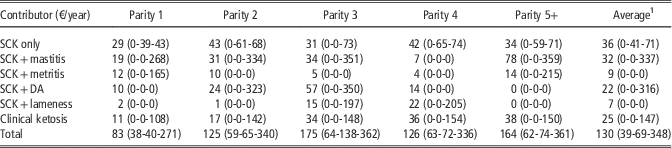
Total costs of SCK per case per year were contributed by: 36% from a prolonged CI, 24% from reduced milk production, 19% from treatment, 14% from discarded milk and 6% from removal (Table 5). Furthermore, total costs of SCK per case per year came from 27% of cows with SCK only, 25% of cows with SCK and mastitis, 19% of cows with clinical ketosis, 17% of cows with SCK and DA, 7% of cows with SCK and metritis, and 5% of cows with SCK and lameness (Table 6).
Average costs of subclinical ketosis per parity per case per year (0.05-0.50-0.95 percentiles) related to reduced milk production, milk discard, treatment, prolonged calving interval and removal in dairy cows

1 A weighted average for all parities was taken which was based on an average Dutch dairy herd composition.
Average costs of subclinical ketosis (SCK) per parity per case per year (0.05-0.50-0.95 percentiles) related to dairy cows with SCK only, and dairy cows with SCK and a related disease

DA=displaced abomasums.
1 A weighted average for all parities was taken which was based on the composition of an average Dutch dairy herd.
Total costs of SCK varied from €83 (38 to 271) per case per year in parity 1 to €175 (€64 to €362) in parity 3 (Tables 5 and 6). Across parities, costs associated with a prolonged CI contributed most to the total costs, whereas costs related to removal contributed least.
Sensitivity analysis
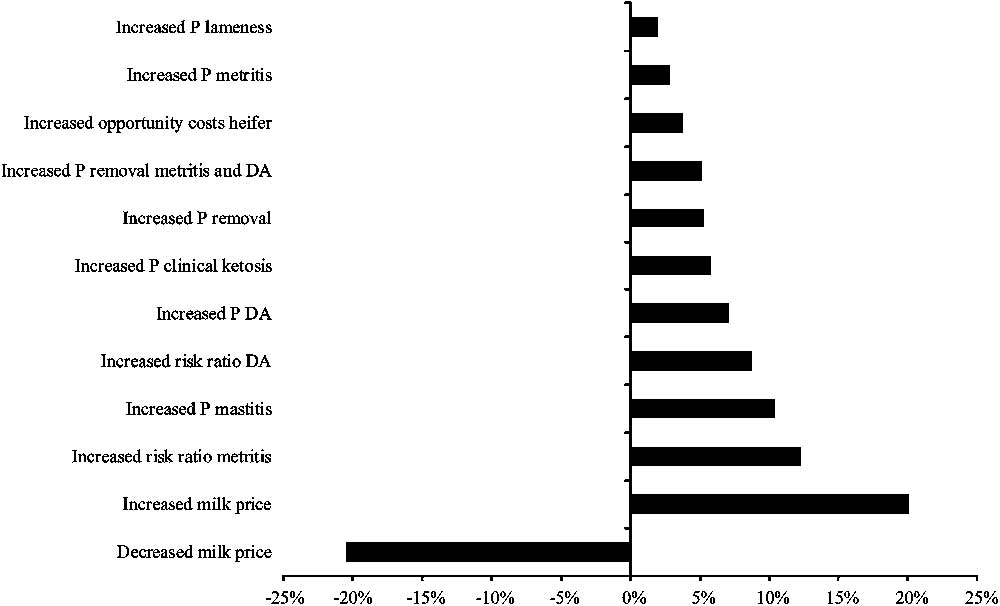
Results of the sensitivity analysis are shown in Figure 2. Increasing the probabilities of mastitis increased the costs of SCK per case per year by 10%, whereas increasing the probabilities of DA increased costs by 7%. A decrease in probabilities of diseases resulted in a similar but opposite effect (results not shown). Doubling the removal probabilities of diseases increased costs of SCK by 5% per case per year.
Results from the sensitivity analyses, showing the effect (%) of a change in input parameters on costs of subclinical ketosis per case per year in dairy cows. P=probability; DA=displaced abomasum.

Increasing the RR of metritis for cows with SCK increased the costs by 12% per case per year, whereas increasing the RR of DA for cows with SCK increased the costs by 9%. Increasing the removal risk of DA and metritis increased the costs of SCK by 5% per case per year.
A higher milk price increased the costs of SCK by 20% per case per year, whereas a lower milk price decreased the costs of SCK by 21% per case per year. An increase in the opportunity costs of a heifer increased the costs of SCK by 3% per case per year.
Discussion
Our objective was to estimate the economic impact of SCK. In our study, total costs of SCK were €130 per case per year, whereas Raboisson et al. (Reference Raboisson, Mounié and Maigné2015) reported average costs of €257 per cow per calving and McArt et al. (Reference McArt, Nydam and Overton2015) $289 per case. In contrast to these two studies, we used dynamic stochastic modelling of five parities, and adjusted the quantification for the costs of removal. In addition, different input parameters also had an impact on the costs. We will discuss these three differences below.
Dynamic stochastic modelling of five parities
By using data from Berge and Vertenten (Reference Berge and Vertenten2014) we were able to estimate the costs for cows in parity 1 to parity 5+. Most studies that estimate the economic impact of diseases differentiate between primiparous and multiparous cows (McArt et al., Reference McArt, Nydam and Overton2015; Raboisson et al., Reference Raboisson, Mounié and Maigné2015) or assume equal probabilities among parities (Halasa et al., Reference Halasa, Nielen, Huirne and Hogeveen2009). Our study, however, showed that costs per cow differ among parities. Grouping parities, therefore, is less accurate and might result in over- or underestimation of the costs. Parity-specific disease probabilities of Berge and Vertenten (Reference Berge and Vertenten2014), however, were derived from data collection in different countries. This could have influenced the results. Because of lack of literature, we were unable to compare the results of cows per parity with other studies.
The stochastic models (Raboisson et al. (Reference Raboisson, Mounié and Maigné2015) and our study) were able to show the range of costs and are therefore potentially more informative for decision makers.
Our model, moreover, showed that most cows with a disease in the first 30 days after calving had SCK only. Costs of cows with SCK only were lower than the average costs of SCK, which resulted in a skewed distribution of the total costs. Costs of cows with SCK and a related disease, and costs of cows with SCK and a related disease that were removed were higher, and therefore affected the total costs of SCK considerably. Because farmers do not directly see the link between SCK and other diseases, this might easily lead to underestimation of the costs of SCK. Therefore, we estimated the mean, and also the 5, 50 and 95 percentiles of the costs of SCK to give a complete overview.
Our model was dynamic, while Raboisson et al. (Reference Raboisson, Mounié and Maigné2015) used a static model. The dynamic approach allowed simulation of milk, reproduction and removal losses over time. Therefore, we argue that a dynamic stochastic simulation model has the potential to be most accurate.
Costs of removal
Removal is the most important aspect that influenced the difference in economic impact of SCK between our study and previous studies. In our study, costs of removal contributed about 6% to the total costs of SCK, whereas in other studies, removal contributed 30% (Raboisson et al., Reference Raboisson, Mounié and Maigné2015) or 34% (McArt et al., Reference McArt, Nydam and Overton2015). Raboisson et al. (Reference Raboisson, Mounié, Khenifar and Maigné2014) did a meta-analysis on the relation between SCK and culling based on three studies in the United States and Canada and highlighted the scarcity of literature on SCK and culling. Differences in the costs of removal between our study and these two studies are twofold. First, the number of cows removed because of SCK was lower in our study. McArt et al. (Reference McArt, Nydam and Overton2015) and Raboisson et al. (Reference Raboisson, Mounié and Maigné2015) used a RR of 1.8 and 1.92 to estimate the number cows that were removed because of SCK. This means that every cow with SCK, with and without a related disease, had an increased risk of being removed. In our study, however, we assumed that a cow with SCK only was not removed, because the peak of milk production of the cow is in prospect and therefore the highest profit. Cows were removed at day 30 after calving. Removal of cows in a later stage of the lactation (e.g. because of reproduction problems due to diseases), could not be included, which might have resulted in an underestimation of removal risk. Relating removal of a cow at a later stage of lactation to a disease that occurred in the first 30 days after lactation, however, is difficult, because removal is influenced by all kind of factors. No data were available to relate removals at a later stage to SCK. Results of the sensitivity analysis, however, showed the importance of improving estimations on removal risks. Including removal at a later stage of the lactation will increase the costs of SCK.
Second, the costs of a removed cow in our study were lower than in the previous studies (McArt et al., Reference McArt, Nydam and Overton2015; Raboisson et al., Reference Raboisson, Mounié and Maigné2015). McArt et al. (Reference McArt, Nydam and Overton2015) and Raboisson et al. (Reference Raboisson, Mounié and Maigné2015) estimated the costs as the difference between the economic value of a calving heifer and the economic value of a slaughtered cow. In addition, Raboisson et al. (Reference Raboisson, Mounié and Maigné2015) added an extra 25% early culling cost. Our removal costs consisted of extra removal costs and milk losses and were on average lower per case of removal (results not shown). Extra removal costs per parity were estimated based on depreciation to differentiate between the five parities. In addition, the opportunity costs of a heifer had an important impact on the results. These costs were higher in France (€1400) (Raboisson et al., Reference Raboisson, Mounié and Maigné2015) and in the United States ($1900) (McArt et al., Reference McArt, Nydam and Overton2015) than in our study (€950), resulting in higher costs.
Input of the model
Incidence of diseases, RR of related diseases when a cow has SCK and prices for the Dutch situation had an important impact on the total costs of SCK. Related diseases in our study were selected based on Berge and Vertenten (Reference Berge and Vertenten2014), who provided probabilities for the diseases mastitis, metritis, DA, lameness and clinical ketosis, gastrointestinal disorder, milk fever and retained placenta. The latter three were not included in our study because the relation between those diseases and SCK are not analysed in many other studies, and because retained placenta and milk fever, can also be a precursor of SCK instead of a consequence (Berge and Vertenten, Reference Berge and Vertenten2014). The relations between SCK and DA, SCK and metritis, and SCK and clinical ketosis are well documented (Raboisson et al., Reference Raboisson, Mounié, Khenifar and Maigné2014). A few studies have analysed the relations of SCK and somatic cell count, retained placenta and subclinical endometritis as included by Raboisson et al. (Reference Raboisson, Mounié and Maigné2015), but those studies did not show a clear relation (Raboisson et al., Reference Raboisson, Mounié, Khenifar and Maigné2014). In addition, Raboisson et al. (Reference Raboisson, Mounié and Maigné2015) showed that those related diseases only contributed 4% to the total costs of SCK. Excluding those diseases from our study, therefore, will not have affected the results. The relation between SCK and mastitis, and SCK and lameness have been analysed only in a few studies with different results (Suthar et al., Reference Suthar, Canelas-Raposo, Deniz and Heuwieser2013; Berge and Vertenten, Reference Berge and Vertenten2014). The contribution of cows with SCK and mastitis, and SCK and lameness was 29% to the average total costs, and therefore have a relative high but uncertain impact on total costs.
The incidence of diseases and RR of SCK with related diseases used in our study were similar to those used by Raboisson et al. (Reference Raboisson, Mounié and Maigné2015). Incidences of diseases, however, vary between countries, regions and farming systems (Suthar et al., Reference Suthar, Canelas-Raposo, Deniz and Heuwieser2013; Berge and Vertenten, Reference Berge and Vertenten2014). Results of the sensitivity analysis showed that an increase or decrease in disease incidence had an important impact on the results, indicating that the costs per case of SCK are likely to vary among farms. The incidence of DA (5%) and metritis (18.5%) and RR of metritis (3.3) and with DA (8.0) for cows with SCK were higher in the study of McArt et al. (Reference McArt, Nydam and Overton2015) resulting in higher costs than in our study. Raboisson et al. (Reference Raboisson, Mounié and Maigné2015) already discussed that the risk ratios of DA and metritis for cows with SCK used by McArt et al. (Reference McArt, Nydam and Overton2015) may have been chosen too high. Reduced milk production because of SCK and related diseases varies between studies (Raboisson et al., Reference Raboisson, Mounié, Khenifar and Maigné2014). Increasing the milk loss in the first 30 days of cows with SCK by 50% had a minor impact on the results (results not shown), and therefore was excluded.
Insight into the dynamics and economic impact of diseases, such as SCK, can support farmers and their advisors in making decisions on interventions to improve farm profitability and the health status at their farm. Average costs per case of SCK from our and previous studies can be communicated to make more farmers aware of these costs. Farm analysis, however, is necessary to estimate the costs of SCK for a specific farm. Current developments in technology and automation in larger farms can facilitate collection of farm-specific data including disease incidences and milk production. For a better estimation of the economic impact of SCK, more information is needed about disease incidence, interaction of SCK with other diseases, cause of removal, reproduction and milk losses.
Acknowledgement
The authors are grateful to Elanco Animal Health for financial support.
Supplementary Material
To view supplementary material for this article, please visit https://doi.org/10.1017/S1751731117001306