Introduction
Fukushima et al. (Reference Fukushima, Fukushima, Morita, Yamashita and Kato1988) were the first to suggest that impaired antisaccade (AS) performance is a neurophysiological marker in schizophrenia. This finding has been replicated many times and inspired others to investigate the presence of this AS deficit in relatives of patients with schizophrenia. Two reviews on this subject have been published (Calkins et al. Reference Calkins, Curtis, Iacono and Grove2004; Levy et al. Reference Levy, O'Driscoll, Matthysse, Cook, Holzman and Mendell2004) and it was found that approximately half of the studies demonstrated a difference in AS performance between relatives and healthy controls; Levy et al. (Reference Levy, O'Driscoll, Matthysse, Cook, Holzman and Mendell2004) reported a mean meta-analytic δ of 0.43 and Calkins et al. (Reference Calkins, Curtis, Iacono and Grove2004) a mean meta-analytic δ of 0.61. The two reviews came to opposite conclusions about the usefulness of AS performance in genetic studies. A possible explanation may be that Levy et al. (Reference Levy, O'Driscoll, Matthysse, Cook, Holzman and Mendell2004) restricted the meta-analysis to studies that used the standard (or step) paradigm and analysed heterogeneity, whereas the meta-analysis performed by Calkins et al. (Reference Calkins, Curtis, Iacono and Grove2004) included studies that used a variety of AS paradigms (as well as averaging across near and far stimuli) and did not evaluate heterogeneity. Levy et al. (Reference Levy, O'Driscoll, Matthysse, Cook, Holzman and Mendell2004) suggested that one of the factors that could account for variability in findings was whether or not symmetrical inclusion/exclusion criteria were used in relatives and controls. To explore this possibility, Calkins et al. (Reference Calkins, Curtis, Iacono and Grove2004) reanalysed the data of Curtis et al. (Reference Curtis, Calkins, Grove, Feil and Iacono2001) according to the method of Brownstein et al. (Reference Brownstein, Krastoshevsky, McCollum, Kundamal, Matthysse, Holzman, Mendell and Levy2003), and came to the conclusion that, in that sample, the same pattern of findings was obtained whether or not symmetrical inclusion/exclusion criteria were used.
In the present study the suggestion of Levy et al. (Reference Levy, O'Driscoll, Matthysse, Cook, Holzman and Mendell2004) is followed and we have also used strict inclusion criteria for both healthy siblings and healthy controls. We closely matched our groups consecutively on age and pre-morbid level of education. We hypothesized that the AS deficits would be independent of age and would also be present in healthy young siblings of patients with schizophrenia.
Method
Subjects
Subjects were 45 patients with a first episode of schizophrenia, mean age 21.71 years (s.d.=3.2). The diagnosis was determined by the Mini-International Neuropsychiatric Interview Plus (M.I.N.I. Plus) for DSM-IV (Sheehan et al. Reference Sheehan, Lecrubier, Sheehan, Amorim, Janavs, Weiller, Hergueta, Baker and Dunbar1998). This interview was also used to exclude affective disorders and substance abuse disorders. Psychiatric history relevant to the inclusion criteria for both relatives and controls was also determined by the M.I.N.I. Plus.
All patients were admitted to the Adolescent Clinic of the Academic Medical Centre in Amsterdam and were treated with antipsychotic medication (41 with atypical and three with typical antipsychotics and one patient was medication naïve). None of the patients included reported having used recreational drugs in the week before testing. We included one patient per family.
Twenty-five unaffected siblings of the included patients were recruited through written correspondence after inclusion of their patient relative. Twenty families were represented by one sibling, one family by two siblings and one family by three siblings. They were screened and considered psychiatrically healthy if they did not have a DSM-IV mood disorder, any psychotic symptom or a substance abuse diagnosis and had not used cannabis more than 10 times in their lifetime. In addition, they were between the ages of 16 and 30, spoke Dutch fluently, had no history of neurological disease or any systemic disease known to involve central nervous system (CNS) functioning, ophthalmologic pathology (e.g. glaucoma, lazy eye), clinically significant head injury, or mental retardation.
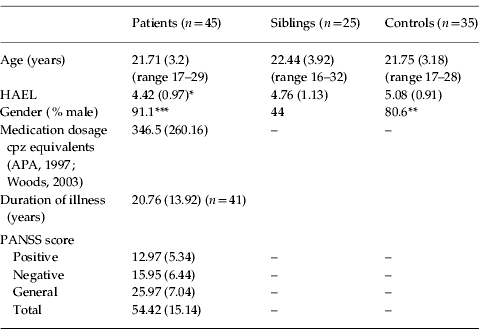
The healthy control group consisted of 36 medically and psychiatrically healthy participants who were recruited from the community by advertisement posters. Thirty-four families were represented by one control and two families by two controls. Inclusion criteria for normal controls were identical to those for relatives, except that potential normal controls were excluded if they had a first-degree biological relative who had ever received treatment for a psychiatric disorder. Demographic variables of the three groups are presented in Table 1.
Demographic variables for the three groups
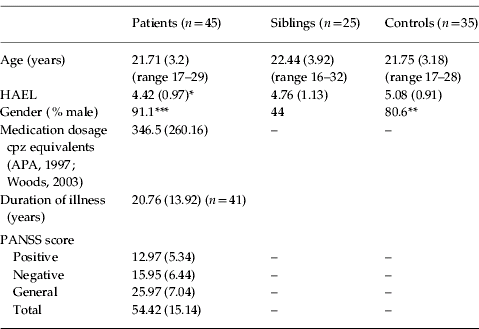
HAEL, Highest achieved educational level; PANSS, Positive and Negative Syndrome Scale.
Values are given as mean (s.d.).
* p=0.01, ** p<0.001, *** p<0.0001.
Written informed consent was obtained. For patients and siblings aged between 16 and 18 years, written informed consent was also obtained from their parents. The study protocol was reviewed by the Medical Ethics Committee of the Academic Medical Centre.
Eye movement assessment
Eye movements were recorded using the double magnetic induction (DMI) method developed by Bour et al. (Reference Bour, van Ginsbergen, Bruijns and Ottes1984, Reference Bour, Aramideh and Ongeboer2000) with a linear recording range between −15° and 15° and accuracy better than 15 minarcs of visual angle. Both horizontal and vertical eye positions were recorded, low-pass filtered (150 Hz, 12 dB/oct, second-order Bessel filter), sampled with a frequency of 500 Hz and computer stored. The visual target was a single, red, circular (0.5° of visual angle in diameter) laser spot of 20 cd/m2 luminance, projected onto the rear of a white translucent screen by means of a scanning mirror device. The subject's head was stabilized with a head tie and a chin rest. Data analysis was performed off-line with a program specially developed in the Department of Clinical Neurophysiology of the Academic Medical Centre, Amsterdam. Calibration of the data was accomplished by asking the subjects to perform saccades to an array of vertical and horizontal targets with 10° of eccentricity. The program enabled quantitative analysis of saccade parameters, including saccade latency, saccade duration, peak saccade velocity, saccade amplitude and saccadic gain. An automatic detection algorithm, based on a threshold detection of eye velocity, was used to mark saccade onset and saccade offset. Saccade latency was defined as the time difference between target onset and saccade onset, saccade duration as the difference between saccade onset and saccade offset, saccade amplitude as the change in eye position in degrees of visual angle between saccade onset and saccade offset, peak saccade velocity as the maximum eye velocity between saccade onset and saccade offset, and saccadic gain as the ratio between saccade amplitude and target amplitude. The automatic saccade detection could be checked afterwards interactively and, if necessary, corrections could be made.
AS task
Subjects underwent a training session of 20 ASs while seated in a chair outside the recording area. We chose to perform 20 practice trials to let patients get accustomed to the eye movement set-up. The longer practice trial ascertained that the patients were at ease when the test trials started.
Prior to the AS trial, the subject was asked to make 35 reflexive saccades to temporally unpredictable targets located randomly in the horizontal plane between −10 and +10°. This session was used to calibrate the data and to determine the mean gain, peak velocity and saccadic latency distribution of visually elicited saccades. The relationships between saccadic amplitude and peak velocity and between saccade amplitude and saccade duration were determined to evaluate whether these relationships fell within the normal limits of healthy controls (Bahill et al. Reference Bahill, Clark and Stark1975). Subsequently, the subject was asked to make 35 ASs. At the beginning of each AS trial: (1) a central fixation point at the gaze straight ahead position was presented. (2) After a random period between 600 and 1200 ms, the laser spot was moved abruptly by the mirror to an eccentric position located 6° of visual angle randomly left or right of the central fixation point. Subjects were instructed to look immediately in the opposite direction at an equal distance to the illuminated peripheral stimulus. (3) After 2 s the spot was projected to the correct AS eye position (feedback signal). (4) After 300 ms the spot was again projected to the central gaze position. An AS had to fulfil the following criteria: (1) the latency had to be larger than 100 ms (no anticipatory saccade), (2) it was the first saccade after the target jump, and (3) the saccade had a negative gain (saccade direction opposite to target direction). AS error rate was defined as the ratio between the number of correct ASs and the number of reflexive saccades towards the target.
Statistical analysis
AS parameters were compared between patients, siblings and unrelated controls by a mixed-effects regression model. We used this model to account for the family relationship between the patients and their siblings, using family number as a random effect. The fixed effect in the model was the group indicator (patient/sibling/unrelated control). With this model we estimated the average differences between the groups of patients, siblings and unrelated controls, and also the within- and between-family variances of the AS parameters. The ratio of the between-family variance to the sum of the within- and between-family variances is the intra-class correlation (ICC), which we used to quantify the similarity between the patients and their siblings. This might be viewed as due to the effect of shared environmental and genetic influences on the AS parameters.
Cohen's d effect size was also reported for comparison with the meta-analyses. Correlation coefficients (Pearson's r) were calculated between AS parameters and medication dosage (cpz equivalents) and Positive and Negative Syndrome Scale (PANSS) scores.
Results
AS errors
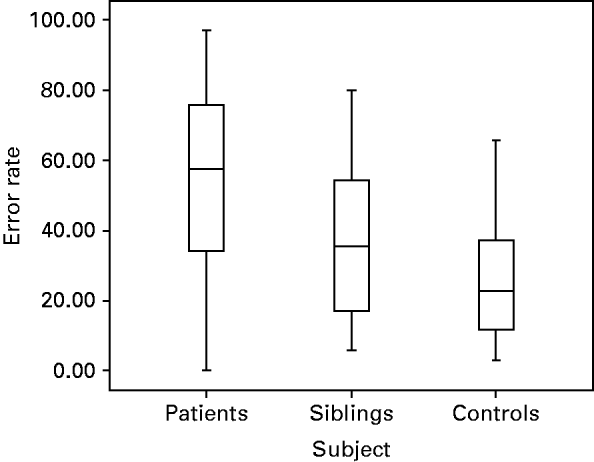
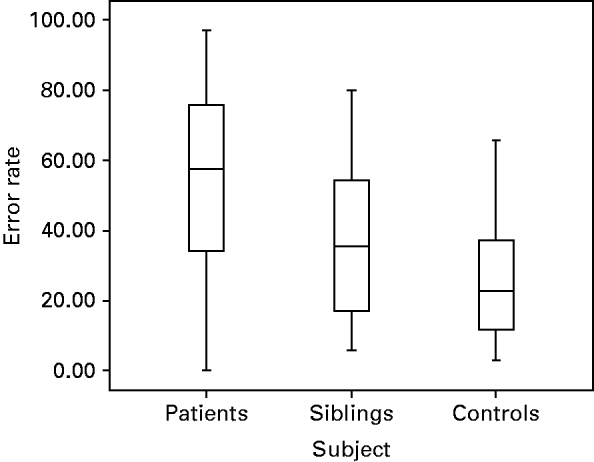
The mean of AS errors was increased in both patients (mean=54.23, s.d.=25.93) and siblings (mean=34.70, s.d.=20.53) compared to healthy controls (mean=25.41, s.d.=17.03). This difference was highly significant (main group effect: F=20.04, df=2, 65.73, p<0.0001). The ICC for error rate was 0.33. Post-hoc tests showed that the mean AS error rate was significantly different between patients and controls (p<0.0001, d=1.29) and between patients and siblings (p=0.002, d=0.81) with a non-significant difference between siblings and controls (p=0.08, d=0.50). Distribution of antisaccade error rate is presented in Fig. 1. We did not find a significant correlation between AS error rate and medication dosage (r=0.1, p=0.52) or PANSS scores (positive scale r=0.21, p=0.21; negative scale r=0.29, p=0.08; general scale r=0.22, p=0.18; total PANSS score r=0.29, p=0.08).
Distribution of antisaccade error rate in the three groups.
AS latency
Mean AS latency was significantly longer in patients (mean=434.92, s.d.=135.85) than in siblings (mean=375.88, s.d.=74.58) and controls (mean=345.53, s.d.=55.19) (main group effect: F=9.84, df=2, 69.40, p<0.0001). The ICC was 0.32. Post-hoc tests revealed that the patient group had a significantly longer mean AS latency than the control group (p<0.0001, d=0.83) but not significantly longer than the sibling group (p=0.06, d=0.50). No significant difference for mean AS latency was observed between siblings and controls (p=0.11, d=0.48).
AS gain
Mean AS gain was higher in siblings (mean=−1.38, s.d.=0.60) than in patients (mean=−0.96, s.d.=0.54) and controls (mean=−1.08, s.d.=0.41) (Main group effect: F=5.48, df=2, 82.05, p=0.006). The ICC was 0.08. Post-hoc tests revealed that siblings had a significantly higher mean AS gain than patients (p=0.004, d=0.75) and higher mean AS gain than controls (p=0.05, d=0.6), suggesting a hypermetric saccade amplitude in siblings. No significant difference in mean AS gain was observed between patients and controls.
Discussion
A large difference was found in AS error rate and latency performance between this cohort of young first-episode patients with schizophrenia, healthy young siblings and matched controls. The differences between siblings and controls did not reach significance. The effect size of the mean AS error rate calculated between siblings and healthy controls corresponds to the outcome of two meta-analyses (Calkins et al. Reference Calkins, Curtis, Iacono and Grove2004; Levy et al. Reference Levy, O'Driscoll, Matthysse, Cook, Holzman and Mendell2004), suggesting that our results are in line with previous studies. However, the low ICC for error rate suggests there is little evidence of shared environmental or genetic factors on error rate variation. Our findings are comparable to a recent study of MacCabe et al. (Reference MacCabe, Simon, Zanelli, Walwyn, McDonald and Murray2005), who used an older and mixed patient and family group and also did not find evidence for antisaccadic performance to be a genetic marker for schizophrenia.
A remarkable finding was that the age-matched sibling group made ASs of hypermetric amplitude compared to healthy controls and patients with schizophrenia, whereas many other studies found hypometric amplitude (Thaker et al. Reference Thaker, Ross, Casady, Adami, Medoff and Sherr2000; Karoumi et al. Reference Karoumi, Saoud, d'Amato, Rosenfeld, Denise, Gutknecht, Gaveau, Beaulieu, Dalery and Rochet2001; Ettinger et al. Reference Ettinger, Kumari, Crawford, Corr, Das, Zachariah, Hughes, Sumich, Rabe-Hesketh and Sharma2004, Reference Ettinger, Picchioni, Hall, Schulze, Touloupoulou, Landau, Crawford and Murray2006). We could not find an explanation for this phenomenon.
As we included a homogeneous group of patients with a first episode of schizophrenia and used strict inclusion criteria for all three groups, variances in the results are not determined by confounders such as age, duration of illness or symptom heterogeneity. Although the results are in accordance with other studies when the measurements of Cohen's d are compared, the ICCs clearly show that there is little evidence for shared genetic or environmental factors. As these shared factors have not been demonstrated in these strictly selected groups, no further evidence can be given for the hypothesis that AS parameters can be used as an endophenotype (Gottesman & Gould, Reference Gottesman and Gould2003) for schizophrenia.
Acknowledgements
This study was funded by Grant 28-1241-2 from the Dutch Health Research and Development Council.
Declaration of Interest
None.