Introduction
Fascioliasis is caused by flukes of the genus Fasciola and is one of the most important food- and water-borne parasitic zoonoses, with a worldwide distribution (Spithill & Dalton, Reference Spithill and Dalton1998). Fasciola spp. mainly parasitize the liver and bile duct of cattle, goats and other ruminants, causing chronic hepatitis, cholangitis, cirrhosis, etc. Fascioliasis causes large-scale mortality among young stock, leading to extreme economic losses to the livestock industry (Lin et al., Reference Lin, Dong and Xue2004).
Fascioliasis, especially fascioliasis hepatica, is prevalent throughout China: north to Heilongjiang province, south to Yunnan and Guangdong provinces, east to Jiangsu and Taiwan provinces, and west to Xinjiang province. The distribution of fascioliasis gigantica is comparatively limited, and occurs mainly in tropical and subtropical regions such as Fujian, Guangdong (Lin et al., Reference Lin, Sun, Chen and Chen1974) and Yunnan provinces (J.X. Chen et al., Reference Chen, Chen, Ai, Xu, Jiao, Zhu, Su, Zhang, Luo, Guo, Lv and Zhou2013). According to the first national survey of major parasitic diseases in 1992, there were 120,000 Fasciola infections of humans (Xu et al., Reference Xu, Yu and Xu1999), and J.X. Chen et al. (Reference Chen, Chen, Ai, Xu, Jiao, Zhu, Su, Zhang, Luo, Guo, Lv and Zhou2013) reported an outbreak of human fascioliasis in Yunnan province.
However, the surveying of fascioliasis in humans and ruminants is a neglected activity. For example, the last sectional survey of bovine fascioliasis in Anhui province was conducted in 1998 (Gu et al., Reference Gu, Shen, Ferre, Kraemer and Gonzaloz1998), and there is no longitudinal study of ruminant fascioliasis in Hubei and Anhui provinces. Moreover, it is unclear whether F. hepatica or F. gigantica causes fascioliasis in Anhui province.
To determine the prevalence of fascioliasis in Hubei and Anhui provinces and formulate control measures that can be implemented by local farmers, we conducted a longitudinal study of the prevalence of fascioliasis in two towns in Hubei and Anhui provinces. We also determined the sequences of the first and second internal transcribed spacers (ITS-1 and ITS-2) of the nuclear ribosomal DNA (rDNA) of adult Fasciola spp.
Materials and methods
Study areas
From May 2013 to May 2014, we conducted a longitudinal study of hircine fascioliasis in Huangshantou town, Gongan county, Hubei province. Huangshantou is located at the junction of Hubei and Hunan provinces at longitude 112.1–112.2°E and latitude 29.26–29.30°N. The north-western section of Huangshantou is characterized by low hills and the south-eastern section by plains, with an average altitude of 33.2 m. These are subtropical areas with four distinct seasons and abundant rainfall. The annual average temperature is 16.4°C with the highest and lowest recorded temperatures of 40.0°C and − 10.9°C. The average annual rainfall is 1400.0 mm, which generally occurs during July to September. Livestock activities include husbandry of pigs, goats, cattle/buffalo and poultry. Huangshantou is home to over 2000 free-ranging goats that generally graze on hillsides, while pigs are typically housed in pens, and cattle/buffalo have been limited to a very small number since 2010. Before 2013, goats usually received two annual treatments with ivermectin and praziquantel (one treatment in March or April and a second treatment in August or September) for preventing and treating helminthiasis. During the present study, goats generally received two injections of closantel sodium, in August 2013 and April 2014.
A longitudinal study of bovine fascioliasis was conducted from August 2013 to September 2014 in Gaoshi town, Wangjiang county, Anhui province. Gaoshi is located in a subtropical area (116°26′–116°55′E, 30°63′–30°26′N) with four distinct seasons and abundant rainfall (1300 mm), which generally occurs from July to September. The annual average temperature is 16.5°C with the highest and lowest recorded temperatures of 40°C and − 6°C. Gaoshi is characterized by plains and low hills. The local livestock activities include husbandry of pigs, cattle and water buffalo, and poultry to a lesser extent. Cattle and water buffalo graze freely on grasslands, whereas most pigs are reared in stalls. Local farmers do not use drugs to prevent and treat parasitic diseases among the >1630 free-range ruminants.
Collection and examination of faecal samples
Four goat farms in Huangshantou (100–200 goats per farm) and six villages in Gaoshi (100–160 cattle/buffalo per village) were randomly selected for analysis. Faecal samples from 50 goats from each farm and 15–41 samples from a total of 152 cattle/buffalo from each village were collected randomly by a local veterinarian at intervals of 2–3 months. Goat faecal samples were collected from the rectum. The majority of bovine faecal samples were collected from the ground around the animals, as we instructed the owners to limit the movements of their animals the evening before faecal sampling, although some samples were obtained from the rectum. All faecal samples were sent to the local County Centre for Animal Disease Control and Prevention within 12 h and stored at 4°C in the laboratory until analysis, which was conducted within 72 h. The age of each animal was obtained according to birth dates of goats and the dentition of the bovines.
Faecal samples (2 g) were homogenized in 15–20 ml of water and slowly filtered through a 50-mesh copper sieve into a centrifuge tube. Water was added to a final volume of 50 ml, and the suspensions were allowed to stand for 30 min. The supernatants were discarded, and the sediments were diluted with 40 ml of water. The suspensions were agitated, and the numbers of eggs were counted using a microscope and a glass egg counter (Liao, Reference Liao1996). Eggs were identified as objects 133–209 μm long × 71–107 μm wide (S.B. Chen et al., Reference Chen, Hasi and Amu2013).
Molecular analysis
From November 2013 to December 2013, the livers of ten goats from farms in the town of Huangshantou, and those of five cattle and five buffalo from slaughterhouses in the county of Wangjiang, were collected and analysed for the presence of adult Fasciola. Individual trematodes were washed thoroughly in physiological saline and fixed in 70% (v/v) ethanol for species identification using DNA sequencing.
Total genomic DNA was extracted from a segment of individual trematodes using the AxyPrep Multisource Genomic DNA Miniprep Kit (Axygen Scientific, Inc., Union City, California, USA). DNA samples were stored at − 20°C. ITS rDNA was amplified from genomic DNA using the polymerase chain reaction (PCR) with the primers BD1 (forward: 5′-GTCGTAACAAGGTTTCCGTA-3′) and BD2 (reverse: 5′-TATGCTTAAATTCAGCGGGT-3′) (Luton et al., Reference Luton, Waller and Blair1992). Each 50 μl reaction contained 25 μl of 2 × EasyTaq PCR SuperMix (Beijing TransGen Biotech Co., Ltd, Beijing, China), 1 μl (100 pmol) of BD1, 1 μl (100 pmol) of BD2 and 1 μl (25–30 ng) of genomic DNA template. Amplifications were performed using an initial denaturing step at 94°C for 5 min; 30 cycles at 94°C for 30 s (denaturing), 55°C for 30 s (annealing) and 72°C for 1 min (extension); and a final extension at 72°C for 7 min. Reactions were performed using a PCR system (Eppendorf AG, Hamburg, Germany). Amplicons were purified and sequenced by Invitrogen (Shanghai, China) using the BD1 and BD2 primers. We identified the species according to differences in 13 nucleotide positions of F. hepatica and F. gigantica (Ali et al., Reference Ali, Ai, Song, Ali, Lin, Seyni, Issa and Zhu2008).
Data analysis
All statistical analyses were performed using SAS software (version 9.2; SAS Institute, Cary, North Carolina, USA). The statistical significance of differences in EPG (egg number per gram faeces) between cattle and buffalo, and sexes of each, were evaluated using the t-test, and differences in the prevalence of Fasciola spp. during different months were assessed using the chi-squared test. The differences in EPG of Fasciola spp. as a function of age, season and location were analysed using one-way analysis of variance. A P value < 0.05 was considered statistically significant.
Results
Seasonality of Fasciola infections
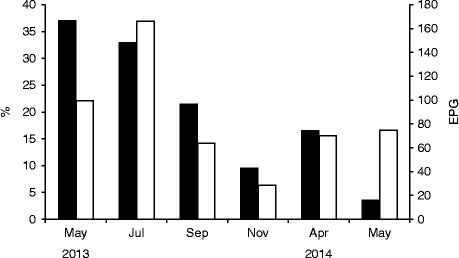
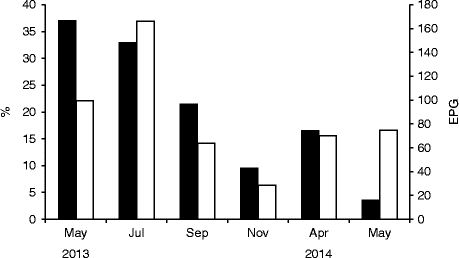
From May 2013 to May 2014, the prevalence of infection of hircine fascioliasis ranged between 3.5 and 37.0%, with a mean EPG of 29.0–166.0 (fig. 1). Prevalence and EPG exhibited downward trends over time, with significant differences. The prevalence and mean EPGs in May and July 2013 were significantly higher compared with those of other months (P< 0.01). The lowest prevalence occurred in May 2014, which was significantly different compared with that of the other months (fig. 1).
The prevalence (%; black bars) of infection and mean eggs/g faeces (EPG; white bars) of Fasciola from faecal samples of goats from May 2013 to May 2014.
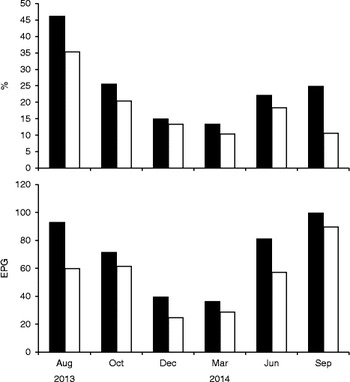
From August 2013 to September 2014, the prevalence of infection of Fasciola in cattle and water buffalo ranged between 13.3 and 46.2% and 10.3 and 35.4%, respectively, with mean EPG values of 36.4–100.0 and 25–89.6 (fig. 2). The prevalence of infection in December 2013 and March 2014 was significantly lower compared with that in August and October 2013, and June 2014. The EPG values in December 2013 and March 2014 were significantly lower compared with those of other months, particularly August 2013 and September 2014 (P < 0.01). The prevalence of infection was greater in cattle compared with that of water buffalo, and there were significant differences between cattle and water buffalo in August 2013 and September 2014.
The prevalence (%) of infection and mean egg/g faeces (EPG) of Fasciola in cattle (black bars) and buffalo (white bars) from August 2013 to September 2014.

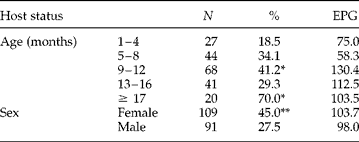
The differences of prevalence and EPG analysed by age, sex and location of hosts were consistent during these months. Here, we show the data for goats in May 2013 and bovines in August 2013. The goats were divided into five age groups as follows: < 4, 5–8, 9–12, 13–16 and >17 months. The prevalence and EPG values increased with age. The highest prevalence occurred in goats after 17 months, and goats aged 9–12 months had the highest EPG values (table 1). Infection was significantly more prevalent in female compared with male goats. The cattle and water buffalo were divided into three groups according to age as follows: < 2 years, 2–4 years and >4 years. There was no significant difference in either prevalence or mean EPG values among these three age groups, the six villages and between sexes (data not shown).
The prevalence (%) of infection and mean eggs/g faeces (EPG) of Fasciola from faecal samples of goats in May 2013, relative to host age and sex: N= number of goats examined.
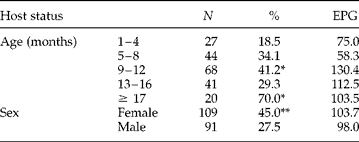
Level of significance with *P < 0.05 compared with 1- to 4-month-old goats; **, P < 0.05 for comparison with males.
Molecular analysis
No Fasciola worms were recovered from goats in Huangshantou, whereas 39 adult flukes were collected from three cattle and two buffalo in Wangjiang. A fragment of approximately 950 bp was amplified from the genomic DNA of each trematode. DNA sequencing showed that 15 and 24 amplicons were 945 bp or 946 bp, respectively. These sequences were deposited in the GenBank database (http://www.ncbi.nlm.nih.gov/genbank) under the accession numbers KJ789332–KJ789345, KJ789346–KJ789365 and KJ789331.
According to the sequence positions of F. hepatica and F. gigantica (Ali et al., Reference Ali, Ai, Song, Ali, Lin, Seyni, Issa and Zhu2008), the different bases present at positions 18, 108, 202, 280, 300, 791, 815, 854, 860, 911, 918, 925 and 926, of all 946-bp and 945-bp amplicons corresponded to those of F. hepatica and F. gigantica, respectively.
Of the 39 worms, 61.5% were F. hepatica and 38.5% were F. gigantica, whereas intermediate forms of Fasciola were absent. The worms harvested from water buffalo were either F. gigantica (58.3%) or F. hepatica (41.7%), and 93.3% of the worms harvested from cattle were F. hepatica.
Discussion
The present study is the first, to our knowledge, to demonstrate Fasciola infection in Hubei province and the presence of F. hepatica and F. gigantica in Anhui province. We found that prevalence and EPG values were higher compared with those reported in other countries (Alasaad et al., Reference Alasaad, Granados, Cano-Manuel, Meana, Zhu and Pérez2008; Dorny et al., Reference Dorny, Stoliaroff, Charlier, Meas, Sorn, Chea, Holl, Van Aken and Vercuysse2011; Zumaquero-Ríos et al., Reference Zumaquero-Ríos, Sarracent-Pérez, Rojas-García, Rojas-Rivero, Martínez-Tovilla, Valero and Mas-coma2013) and those of Anhui and Jiangsu provinces reported by Gu et al. (Reference Gu, Shen, Ferre, Kraemer and Gonzaloz1998). Although the EPG values in goats and bovine species were much lower than the minimum of 500 EPG, which is the recommended level for treatment of animals with anthelmintics (Nginyi et al., Reference Nginyi, Duncan, Mellor, Stear, Wanyangu, Bain and Gatongi2001), it is important, nevertheless, to control this disease in domestic animals because of its zoonotic potential, high prevalence and economic losses to the livestock industry.
Although we did not investigate the intermediate hosts that are present in China, they include several species of snails, such as Lymnaea viatrix, L. columella, L truncatula, Physa acuta, Radix swinhoei and Galba pervia (Gu et al., Reference Gu, Shen, Ferre, Kraemer and Gonzaloz1998). Controlling the intermediate hosts and housing all ruminants is very difficult. Thus, chemotherapy might be the most effective intervention for control of fascioliasis.
The present survey of Anhui province shows that the prevalence and EPG values from June to October were higher compared with those from December to March, which might be primarily due to the influence of weather on the populations of intermediate hosts and the self-regulation of ruminant hosts (Khallaayoune et al., Reference Khallaayoune, Stromberg, Dakkak and Malone1991). These results indicate that Fasciola infection might occur mainly during the rainy season in southern China.
During our investigations conducted in Huangshantou, goats received two injections of closantel sodium (one in August 2013 and a second in April 2014). This intervention was associated with a significant decrease (P < 0.05) in the prevalence of infection, from 37.0% to 3.5% in May 2014. Treatment administered before the start of the rainy season, can reduce the infective source for snails, and treatment from August to September can protect animals throughout the winter months. Therefore, this treatment strategy promises to control Fasciola infection of domestic ruminants effectively.
The present survey of goats and bovine species in these two provinces shows that domestic animals of all ages can become infected. Although we found that the prevalence in cattle was higher compared with that of water buffalo, previous studies (Huang et al., Reference Huang, Lin, Zhou, Chen and Tang1997; Wang, et al., Reference Wang, Zhang and Huang2006) found no significant differences in infection rates between cattle and water buffalo. Therefore, we propose that it is best to conduct mass treatment for all ruminants, including cattle, water buffalo and goats.
Itagaki et al. (Reference Itagaki, Kikawa, Sakaguchi, Shimo, Terasaki, Shibahara and Fukuda2005a, Reference Itagaki, Kikawa, Terasaki, Shibahara and Fukudab) reported the presence of an intermediate Fasciola species in Japan and South Korea, and Lin et al. (Reference Lin, Dong, Nie, Wang, Li, Song, Huang and Zhu2007) reported an intermediate Fasciola species in Heilongjiang province, China. We detected the presence of F. gigantica in Anhui province for the first time. Fasciola gigantica infects mainly water buffalo, and only 1.0% of the Fasciola parasites in cattle were identified here as F. gigantica. These findings are consistent with previous reports of the host ranges of F. hepatica and F. gigantica (Xie et al., Reference Xie, Liu, Yang, Li and Tan2005; Dar et al., Reference Dar, Amer, Mercier, Courtioux and Dreyfuss2012). However, sequence analyses conducted here did not detect an intermediate Fasciola species. Lin et al. (Reference Lin, Dong, Nie, Wang, Li, Song, Huang and Zhu2007) suggest that an intermediate Fasciola species identified in China might have recently spread from Japan or Korea. Because Heilongjiang province is closer to Japan and South Korea than Anhui province, our results seem to support this hypothesis.
Acknowledgements
We thank the veterinary professionals and agricultural workers of Gongan and Wangjiang counties for their assistance in acquiring faecal samples.
Financial support
This project was supported by research grants awarded by the Special Fund for Agroscientific Research in the Public Interest (grant no. 201303037) and Sci & Tech Innovation Program of the Chinese Academy of Agricultural Sciences.
Conflict of interest
None.
Ethical standards
The authors assert that all procedural guides contributing to this work complied with the regulations for the administration of laboratory animals (State Science and Technology Commission of the People's Republic of China, 2011).