Introduction
Low birth weight (LBW; birth weight <2500 g) has long been recognised as a risk factor for subsequent adverse outcomes in physical, cognitive and psychological domains (Marlow, Reference Marlow2004). The incidence of LBW and of preterm birth (birth at <37 completed weeks of gestation) has stabilised in the United States, but continues to increase across Europe (European Foundation for the Care of Newborn Infants, 2011). In Ireland, between 1992 and 2001, there has been a 25.2% increase in the proportion of LBW babies born, now representing 5% of total births, with 0.9% being very low birth weight (VLBW) (Health Research & Information Division, 2012).
Medical advances and better perinatal obstetric and neonatal care have increased the survival rates of these very vulnerable infants who are at greater risk, and studies with longer periods of follow-up are now documenting adverse outcomes continuing into adolescent years and into young adulthood (Goodman & Goodman, Reference Goodman and Goodman2009; Johnson et al. Reference Johnson, Hollis, Kochhar, Hennessy, Wolke and Marlow2010a; McNicholas et al. Reference McNicholas, Healy, White, Sherdian-Pereira, O’Connor, Coakley and Dooley2014). As numbers continue to increase, alongside improved survival rates concerns about the long-term outcomes have risen and the European Foundation for the Care of Newborn Infants have recommended that they become the focus of research (European Foundation for the Care of Newborn Infants, 2011). Methodologically, robust large-scale follow-up studies are now focussing our attention on more distal outcomes, including that of mental health (MH).
The EPICure study established that up to 50% of infants with extremely low birth weight (ELBW; under 750 g) had moderate to severe neurocognitive disability, and longer follow-up studies (up to age 11) documented an increased risk of psychiatric disorders compared with term-born classmates (Johnson et al. Reference Johnson, Hollis, Kochhar, Hennessy, Wolke and Marlow2010a). Although the EPICure study included a small number of infants born in Ireland in 1995, to protect anonymity, none of the Irish data has been presented separately and therefore we do not have any data on the MH outcomes of children growing up in Ireland. Analysis of this cohort examining cognitive and medical outcomes identified higher rates of cognitive and academic difficulties, with no compensatory additional service use (McNicholas et al. Reference McNicholas, Healy, White, Sherdian-Pereira, O’Connor, Coakley and Dooley2014). Apart from this study, there is a lack of long-term follow-up studies of preterm infants in Ireland beyond age 2. This study aimed to examine the MH outcomes of and service use by infants with VLBW(<1500 g) in Ireland in comparison with a normal birth weight (NBW) cohort. The a priori hypothesis was that there would be a higher rate of MH difficulties in LBW infants compared with NBW infants at time of assessment.
Methods
The study population was a retrospectively recruited nested cohort of all children <1500 g born between 1995 and 1996 in a large Dublin Maternity Hospital. The study was conducted between 2006 and 2008 when the children were aged between 10 and 13. From the original sample of 233 VLBW infants identified from the hospital database, 100 (44%) did not survive the neonatal period and six had either severe chromosomal anomalies or had a twin die and were excluded from the study. Of the 127 surviving children, 64 (50%) consented to assessment at follow-up. A reference sample of controls (n=51) consisted of the next NBW infant (birth weight >2500 g) matched for gender.
Ethical approval was obtained from the relevant ethics committees, and parents and the young person gave written consent to participate in the study. They were not part of any other study cohort. Perinatal data were gathered from the medical case notes, and participants were asked about health care use at follow-up. The Strengths and Difficulties Questionnaire (SDQ) and the Developmental and Well-Being Assessment (DAWBA) were used to provide information on the young person’s MH (Goodman et al. Reference Goodman, Ford, Richards, Gatward and Meltzer2000; Goodman & Goodman, Reference Goodman and Goodman2009). The SDQ is a behavioural screening tool with separate questionnaires for parents, teachers and youth (youth self-report, YSR). It allows for the calculation of total difficulties score within the normal, borderline or clinical range, along with five additional domains: (1) emotional symptoms, (2) conduct problems, (3) hyperactivity/inattention, (4) peer problems and (5) prosocial behaviour. The DAWBA is viewed as a valid measurement of psychopathology in children and adolescents (5–17 years), combining interviews, questionnaires and rating scales, and generating ICD-10 and/or DSM-IV psychiatric diagnoses. It was completed online using www.dawba.net by parent and child, and a paper version was completed by the child’s teacher. Cognitive levels were ascertained by the Wechsler Intelligence Scale for Children-Fourth Edition (WISC-IV UK) (Wechsler, Reference Wechsler2004). Socio-economic status (SES) was determined using the National Statistics Socio-Economic Classification User Manual (Rose et al. Reference Rose, Pevalin and O’Reilly2005).
Results
A total of 64 VLBW infants (24 male, 40 female) were recruited to the study with a birth weight ranging from 650 to 1500 g (M=1172, s.d.=219) and a gestational age between 23 and 36 weeks (M=30.0, s.d.=2.67). A total of 46 (67%) of the VLBW survivors were born very preterm (<32 weeks), with 16 (25%) born at <28 completed weeks’ gestation (extremely preterm); 41 infants had documented ultrasound investigations, and 12 had suffered an intra-ventricular haemorrhage. In 41 cases, the case notes also reported that the mother had been offered antenatal steroids; 40 (99.1%) of these were in the VLBW group.
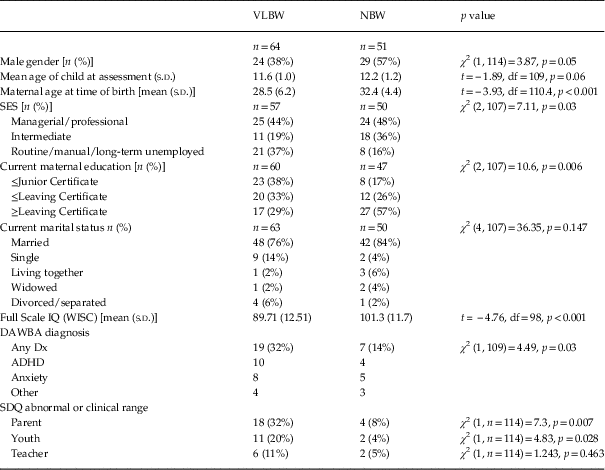
A total of 51 NBW infants were enrolled into the control group (29 male, 22 female). Birth weight ranged between 2523 and 4990 g (M=3696, s.d.=551) and gestational age ranged from 36 to 42 weeks (M=40.1, s.d.=1.2). There were significantly more males in the control group [χ 2 (1, 114)=3.87, p=0.05]. At the time of adolescent assessment, the mean age of the control sample was 12.2 years, which was not significantly different from the mean age of the VLBW sample at 11.6 years (Table 1). However, mothers in the NBW/control group were slightly older at time of birth and had completed more education than the VLBW group (Table 1). There were significantly more routine/manual/long-term unemployed in the VLBW compared with the control group, but no difference in marital status. Five young people from the VLBW group had attended psychology services for counselling in the previous year compared with one of the control group. No one had seen a child psychiatrist and no child was on psychotropic medications in the previous year. Six children had seen a neurologist (four from the VLBW group) and six a community paediatrician in the previous year (three VLBW).
Clinical description of sample: VLBW and NBW participants

VLBW, very low birth weight; NBW, normal birth weight; SES, socio-economic status; IQ, intelligence quotient; WISC, Wechsler Intelligence Scale for Children; DAWBA, Developmental and Well-Being Assessment; ADHD, attention-deficit hyperactivity disorder; SDQ, Strengths and Difficulties Questionnaire.
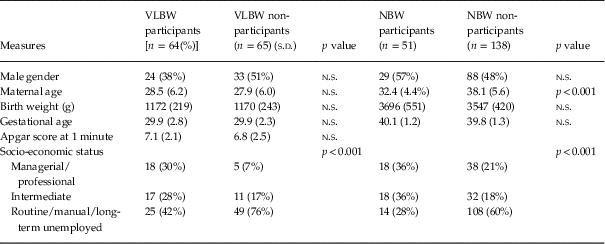
Testing for representativeness in terms of those who agreed to be part of the study and those who declined revealed few differences (Table 2). With regard to the VLBW group, there were no significant differences between participants and non-participants in perinatal measures such as birth weight, gestational age and Apgar score at 1 minute and VLBW participants did not differ from their VLBW non-participants in terms of gender or maternal age. Participating VLBW children had a higher SES than those VLBW adolescents who did not take part in the study (χ 2=20.1, p<0.001) (Table 2).
Demographic characteristics for VLBW and NBW birth cohort representativeness
VLBW, very low birth weight; NBW, normal birth weight.
There were no significant differences between NBW participants and non-participants on measures of gender, birth weight and gestational age (Table 2). Mothers of NBW children who consented to be part of the study were slightly older than those declining (t (228)=4.98, p<0.001) and the participating NBW children had a higher SES than those who did not take part in the study (χ 2=17.1, p<0.001) (Table 2).
Cognitive outcomes
Analysis of the Full Scale Intelligence Quotient (FSIQ) data, available in 54 VLBW cases, revealed that the VLBW participants mean FSIQ score (M=89.71, s.d.=12.51) was significantly lower than that of the NBW participants (M=101.3, s.d.=11.7; t (98)=−4.76, p<0.001) and on all subscales. Within the VLBW group, there was no significant difference between scores for verbal intelligence quotient (IQ) (M=92.04, s.d.=15.03) and non-verbal IQ (M=92.07, s.d.=1.67; t=−4.76, df=98, p<0.001) (Table 1). More detailed cognitive analysis are presented elsewhere (McNicholas et al. Reference McNicholas, Healy, White, Sherdian-Pereira, O’Connor, Coakley and Dooley2014).
DAWBA
The DAWBA was computed based on parent, youth and teacher reports and reviewed by a clinician to establish the presence or absence of a DSM/ICD diagnosis (Table 1). A total of 19 children (32%) in the VLBW group met the DSM-IV criteria for a psychiatric diagnosis, nine male and 10 female. Significantly fewer (14%) in the control group had a DAWBA-generated diagnosis, two male and five female [χ 2 (1, 109)=4.49, p=0.03]. The most common diagnosis was attention-deficit hyperactivity disorder (ADHD), present in 10 (17%) of VLBW and four controls, followed by anxiety disorders, present in eight VLBW and five controls. Other disorders included conduct disorder (one VLBW), depression (one control), Asperger’s syndrome (three VLBW) and two controls had a tic disorder. No child in either of the groups met the diagnostic criteria for oppositional defiant disorder, obsessive–compulsive disorder, psychoses or eating disorder. No child met criteria for an attachment disorder. The SDQ was also completed by parent, teacher and youth and there was a strong correlation between the SDQ total scores and the DAWBA (parent SDQ Spearman’s ρ=0.497, n=105, p=0.001; youth SDQ Spearman’s ρ=0.438, n=100, p=0.001; and teacher SDQ Spearman’s ρ=0.4936, n=98, p=0.001). Subsequent analysis was therefore conducted using the SDQ as a measure of psychopathology.
SDQ
Parents, youths and teachers, all completed the SDQ (Table 1). Nearly a third of the VLBW sample (n=18, 32%) scored either in the abnormal (n=11, abnormal range=17–40) or borderline (n=7, borderline range=14–16) range for SDQ total difficulties score compared with only four (8%) of their NBW peers when completed by the parent [χ 2 (1, n=114)=7.3, p=0.007). From youth report, 11 VLBW (20%) placed themselves in the abnormal (n=4, abnormal range for youth=20–40) or borderline (n=7, borderline range for youth=16–19) range compared with two (4%) of the NBW youth [χ 2 (1, n=114)=4.83, p=0.028). Teacher’s ratings generally indicated less severe problems, with only six VLBW and two NBW children being rated in the abnormal range or borderline range, and with no significant difference between the two groups [χ 2 (1, n=114)=1.243, p=0.463).
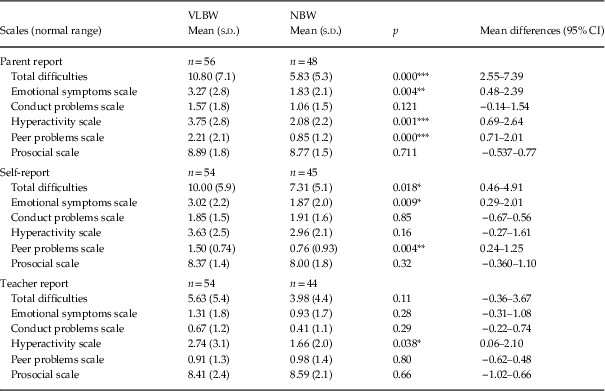
Independent t-tests were conducted comparing the SDQ scores for the VLBW and control group (Table 3). Both the parent and youth mean scores in the VLBW group were significantly higher than controls for total difficulties and on many of the individual subscales. Teachers did not differentiate between the groups, other than on the hyperactivity scale (mean VLBW=2.74, NBW=1.66, p=0.04).
Comparison of mean scores for VLBW and NBW children on the Strengths and Difficulties Questionnaire (SDQ)
VLBW, very low birth weight; NBW, normal birth weight.
*p<0.05, **p<0.005, ***p<0.001.
Predictors of psychopathology
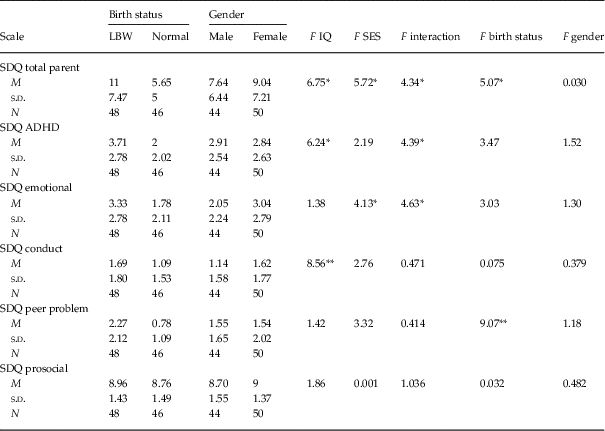
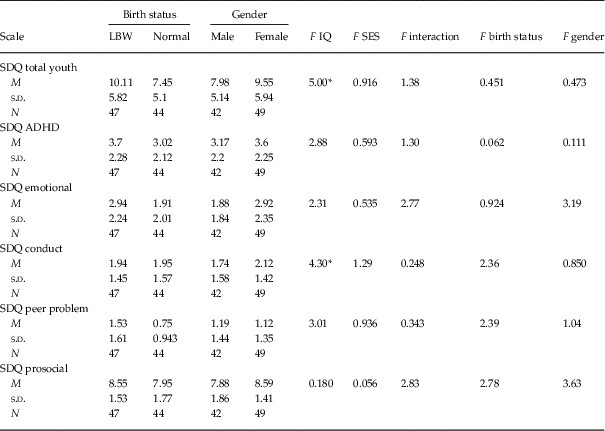
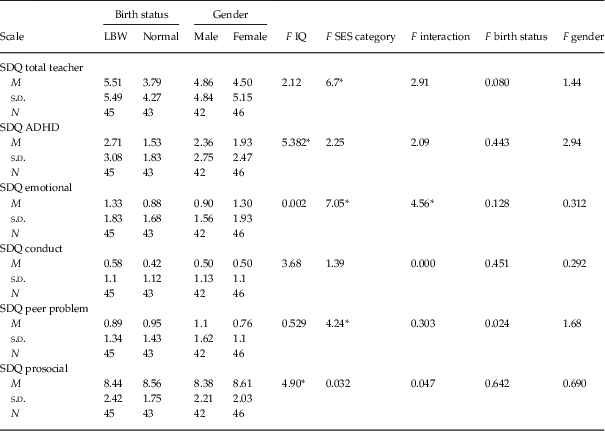
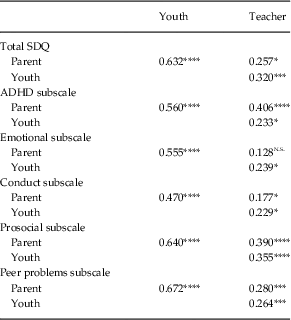
Given that the VLBW had significantly lower IQ and SES scores than the NBW, and given that both of these are known to independently predict MH difficulties, a between group analysis of variance was carried out, controlling for IQ and SES (Tables 4–6). The SDQ was the dependent variable, with birth status and gender entered as fixed factors.
2×2 between group ANOVA for birth status×gender controlling for IQ and SES on parent SDQ subscales and total
ANOVA, analysis of variance; IQ, intelligence quotient; SES, socio-economic status; SDQ, Strengths and Difficulties Questionnaire; LBW, low birth weight; ADHD, attention-deficit hyperactivity disorder.
*p=0.05, **p=0.01.
2×2 between group ANOVA for birth status×gender controlling for IQ and SES on youth SDQ subscales and total
ANOVA, analysis of variance; IQ, intelligence quotient; SES, socio-economic status; SDQ, Strengths and Difficulties Questionnaire; LBW, low birth weight; ADHD, attention-deficit hyperactivity disorder.
*p=0.05.
2×2 between group ANOVA for birth status×gender on teacher SDQ subscales controlling for IQ and SES
ANOVA, analysis of variance; IQ, intelligence quotient; SES, socio-economic status; SDQ, Strengths and Difficulties Questionnaire; LBW, low birth weight; ADHD, attention-deficit hyperactivity disorder.
*p=0.05.
For parent SDQ total scores, there was a main effect for birth weight [F (1, 88)=5.07, p<0.05) (Table 4). Post hoc comparisons using Tukey honest significant difference indicated that the mean score for controls was lower (NBW=5.65, VLBW=11). For parent-rated hyperactivity, an interaction between birth weight and gender was found [F (1, 88)=4.39, p<0.05). After controlling for covariates (IQ/SES), birth weight had a significant effect on ADHD rating in males only (VLBW=4.25, NBW=2.25), with no effect in females (VLBW=2.64, NBW=2.67).
For teachers, SES had a main effect on total SDQ scores, but no other independent variable (birth status, IQ or gender) had an effect (Table 5). The effect of SES was replaced by IQ with respect to the hyperactivity scale, IQ alone contributed a significant effect. On youth-reported measures, IQ alone showed a statistically significant main effect (Table 6).
Inter-rater correlation on the SDQ
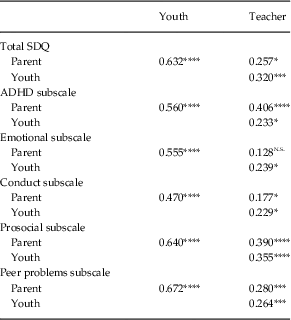
There was a strong correlation between the SDQ total scores of the parent and youth (r=0.623, n=100, p=0.001). However, correlations between the teacher and parent (r=0.257, n=93, p=0.013) and teacher and youth (r=0.320, n=92, p=0.002) were weaker. When this was analysed by the individual subscales, parents and youth generally agreed with each other on all subscales, showing a medium to strong correlation. The teacher rating correlated only on the hyperactivity and prosocial scales (r=0.406, n=93, p<0.001; r=0.39, n=93, p<0.001). The correlations were even higher if the analysis was performed separately within the VLBW group, suggesting that parents of youth with VLBW are much attuned to their difficulties. Parent and youth correlations were especially high on peer-identified problems (r=0.672, n=100, p<0.001) (Table 7).
Inter-correlation matrix for SDQ variables and informants (parent, youth and teacher)
SDQ, Strengths and Difficulties Questionnaire; ADHD, attention-deficit hyperactivity disorder.
*p<0.05, ***p<0.005, ****p<0.001.
Discussion
Inherent problems identified in longitudinal studies include the selective dropouts with the resultant bias and the need to report on representativeness (Johnson & Marlow, Reference Johnson and Marlow2014). The VLBW participants described in this report were representative of the non-participating VLBW cohort with regard to biological variables such as birth weight, gestational age and Apgar scores at 1 minute. Their families were more advantaged socio-economically than the non-participant counterparts. This suggests that any adverse findings in this VLBW cohort may be magnified in the community where the double jeopardy of VLBW and socio-economic disadvantage is more evident.
In this Irish cohort of VLBW children under 1500 g, overall rates of psychological difficulties were higher than their normal weight controls, whether assessed by behavioural screening questionnaire (SDQ) or multi-informant semi-structured interview (DAWBA). Almost one in three (32%) VLBW survivors met DAWBA criteria for a MH diagnosis compared with only 14% of NBW peers. A similar number (32%) were rated by their parents as having abnormal or borderline scores on the SDQ compared with 8% of the NBW group. YSR was also higher in the VLBW group (20%) compared with the NBW group (4%). These findings are similar to a large Norwegian cohort (361 children) with slightly LBW (500–999 g) in which 38% of VLBW had SDQ scores indicative of MH problems compared with 11% of controls (Elgen et al. Reference Elgen, Leversen, Grundt, Hurum, Sundby, Elgen and Markestad2012) and a little lower than the pooled odds ratio (OR) of 3.7 in a recent meta-analysis (Burnett et al. Reference Burnett, Davey, Wood, Wilson-Ching, Molloy, Cheong and Anderson2014). Rates of hyperactivity based on parent/teacher or youth SDQ were higher in the VLBW group than NBW, as was the likelihood of receiving a DAWBA ADHD diagnosis (17% VLBW versus 8% NBW). Several groups have reported an excess of attentional and hyperactivity problems in preterm/LBW survivors in childhood (Whitaker et al. Reference Whitaker, Van Rossem, Feldman, Schonfeld, Pinto-Martin, Tore, Shaffer and Paneth1997) and adolescence (Johnson et al. Reference Johnson, Hollis, Kochhar, Hennessy, Wolke and Marlow2010a; Whitaker et al. Reference Whitaker, Feldman, Lorenz, McNicholas, Fisher, Shen, Pinto-Martin, Shaffer and Paneth2011). In the larger EPICure study of 219 extremely preterm infants also assessed using the DAWBA, and at age 11, the authors found that the LBW children had a specific risk for ADHD inattentive but not for the combined type (Johnson et al. Reference Johnson, Hollis, Kochhar, Hennessy, Wolke and Marlow2010a). We did not find a predominance of inattentive type, perhaps given our smaller sample size. As with other groups, we also did not find ADHD comorbid with conduct disorder supporting the ‘purer neurodevelopmental origin’ model, which is more biologically than socially mediated (Johnson & Marlow, Reference Johnson and Marlow2014). Johnson et al. also reported a higher overall rate (OR 4.6) of emotional disorders, anxiety and autism spectrum disorders, as did this current study (Johnson et al. Reference Johnson, Hollis, Kochhar, Hennessy, Wolke and Marlow2010a). Given that the EPICure cohort had been followed up over time, the authors were able to establish that behavioural problems at 2.5 and 6 years were independent predictors of MH difficulties at age 11, suggesting not only increased prevalence but stability over time (Johnson et al. Reference Johnson, Hollis, Kochhar, Hennessy, Wolke and Marlow2010a). Emerging data from follow-up studies to age 18 (Burnett et al. Reference Burnett, Davey, Wood, Wilson-Ching, Molloy, Cheong and Anderson2014) and population registers where birth status has been recorded (Halmoy et al. Reference Halmoy, Klungsoyr, Skjaerven and Haavik2012) suggest ongoing increased risk into adulthood, at least for ADHD.
Scores on the peer problems subscale of the SDQ rated by both parent and youth distinguished VLBW and NBW children. It is recognised that preterm children and adolescents are more likely to have socialisation difficulties compared with their NBW peers, including an increase in autism (Hack et al. Reference Hack, Taylor, Schlichter, Andreias, Drotar and Klein2009; Johnson et al. Reference Johnson, Hollis, Kochhar, Hennessy, Wolke and Marlow2010b), and they have been recognised by both parents and teachers at age 11 (Elgen et al. Reference Elgen, Sommerfelt and Markestad2002; Johnson et al. Reference Johnson, Hollis, Kochhar, Hennessy, Wolke and Marlow2010a). It was somewhat puzzling that the teachers who participated in this study did not identify any increased peer problems in the VLBW group, given the fact that these were endorsed by parent and youth and would be expected to be more obvious in the school milieu than at home. Teachers may have been aware of the child birth status and so more tolerant of the child’s problems. In addition, the kind of difficulties in peer relationships tapped by the SDQ peer problem scale include lack of a good friend, getting on better with adults than with children and being rather solitary/tending to play alone. These relationship styles may be less evident or problematic when the child is young and in the often relatively structured, nurturing and protective setting of primary school, as in the case of our sample. The social tasks of the adolescent years and of secondary school transition are challenging and it seems that some vulnerable VLBW adolescents become less tolerated by peers and/or more obviously compromised when they have to cope with these increased demands. It may be that teachers may be more astute to social difficulties when this cohort transitions to secondary school. It is interesting that in Rickards’ initial exploration of outcomes of Australian VLBW survivors at age 8 (Rickards et al. Reference Rickards, Kitchen, Doyle, Ford, Kelly and Callanan1993), teachers did not identify socialisation difficulties compared with peers, but reported more social rejection at age 14 (Rickards et al. Reference Rickards, Kelly, Doyle and Callanan2001). However, in this cohort, overall, and unlike most other studies, the teachers did not rate the VLBW sample to have higher MH problems than their normal weight classmates. Similarly to parents, teachers reported higher scores on the hyperactivity scale in the VLBW group, but this difference was only evident in males.
In fact, despite very high correlations between parent and youth on SDQ scores, for both groups, there was poor convergence between teacher and youth and parents. For example, mean SDQ total scores of VLBW cohort was 10.8 when rated by parent, 10.0 by youth and 5.6 by teacher. The EPICure study at age 11 found that parents reported more difficulties than teachers within the VLBW group for certain types of problems; attention, peer and emotional problems, but not hyperactivity where both groups concurred (Johnson et al. Reference Johnson, Hollis, Kochhar, Hennessy, Wolke and Marlow2010a). Teachers reported more conduct problems than parents, perhaps reflecting the disruptive nature of both hyperactivity and conduct problems in the class setting. The study did not have self-report by the adolescent and so it is unclear how these ratings correlate with the adolescents own perspectives. In our study, parents and youth reports showed high concordance, particularly in the VLBW group. Perhaps, parents of VLBW children are very well attuned to their child’s difficulties, are more vigilant and have picked up more subtleties and correctly identified problem areas, such as increased hyperactivity, emotional or peer-related difficulties, which were also endorsed by the child. It is also possible, given their child’s LBW status that parents have anticipated (rightly or wrongly) increased problems and selectively attended to these behaviours, and drew the attention of the young person towards them. It appears that the teacher is not so well attuned, or that the child is behaving differently in a different setting, despite recognising certain core difficulties themselves. Given that it is often the teacher who draws the parent’s attention to difficulties a child is experiencing that are impairing in the academic, behavioural or social environment of school, and that this often leads to onward referral for further assessment and treatment, it is crucial that the teachers are made aware of the increased risk of MH problems in this cohort. Reduced teacher expectations, academic, social or psychological, in VLBW survivors, whatever the reasons, is not justified, and will compromise the child reaching their full potential, depriving them of early intervention, which may have a positive impact on MH difficulties and overall quality of life.
Given this as not a longitudinal study, we are unable to comment on true predictors of increased MH risk. In fact, beyond age 2, there are no longitudinal studies of preterm infants in Ireland, unlike in European countries. However, a number of associations were found. In general, VLBW children have lower IQ scores than peers, as found in this study. We know that IQ is a significant predictor of parent-reported behavioural scores and ADHD (Kuntsi et al. Reference Kuntsi, Eley, Taylor, Hughes, Asherson, Caspi and Moffitt2004; Simonoff et al. Reference Simonoff, Pickles, Charman, Chandler, Loucas and Baird2008). We are also aware of a higher rate of MH problems in families with lower SES from the literature (Miech et al. Reference Miech, Caspi, Moffitt, Entner Wright and Silva1999; Scahill et al. Reference Scahill, Schwab-Stone, Meirkangas, Leckman, Zhang and Kasi1999), and also that within these same families there is a higher rate of obstetric difficulties, LBW and lower IQ (Kramer et al. Reference Kramer, Séguin, Lydon and Goulet2000). These variables may act as risk factors or mediators in the VLBW cohorts as well as NBW groups, suggesting an additional vulnerability.
We found that both IQ and SES had a main effect on parent-rated total and hyperactivity difficulties. Once we controlled for these confounding variables, we found a main effect of birth weight on parent-rated SDQ total scores for both girls and boys, and an interaction effect between gender and birth weight for parent-rated hyperactivity scores. Only in boys did birth weight have a main effect on hyperactivity scores. Other researchers have reported that the higher rate of MH problems within LBW cohorts are strongly linked to IQ status, with some suggesting that once IQ is controlled for, the association attenuates or disappears. For example, in the longer term FU of the Epicure study, once IQ was controlled for, the increased risk of ADHD was no longer significant (Johnson et al. 2010a). In a group of 8-year-old, ELBW survivors, the increased risk for ADHD was also completely attenuated by IQ (Szatmari et al. Reference Szatmari, Saigal, Rosenbaum and Campbell1993). A more recent study using the Child Behavior Checklist (CBCL) in an age cohort more similar to ours (mean age 12.2) examined the complex interplay between birth weight, IQ and SES (Loe et al. Reference Loe, Lee, Luna and Feldman2011). Birth weight predicted total and internalising scores on the CBCL, IQ acted as a mediator between birth weight and attention but not anxiety problems. SES had no effect on pathology, despite the study having a higher proportion of high SES than many studies. Gender-specific analysis were not conducted. A lack of influence of SES and IQ was also reported by Conrad et al. in a similar cohort, based on parental rating; teacher ratings were unavailable (Conrad et al. Reference Conrad, Richman, Lindgren and Nopoulos2010). The authors in this study also reported on a lack of effect of IQ, highlighting the complex interplay of these factors, and also the need for multi-rater evaluations. Although our study benefitted from having information rated by parents, teacher and youth, the relationship between IQ and SES is far from clear.
For teachers, SES showed a more robust effect, with a main effect of IQ for the hyperactivity scores only. Other studies have documented the risk of socio-economic disadvantage and the increased risk of subsequent negative school outcomes; in one report low SES at birth predicted a fivefold increase in school failure at age 9 (Hille et al. Reference Hille, den Ouden, Bauer, van den Oudenrijn, Brand and Verloove-Vanhorick1994). Proximal social risk factors such as family structure, parental involvement and residential stability have also been linked with poorer school outcomes prospectively and were found to be a stronger predictor of school outcomes than perinatal status in 10 year olds (Gross et al. Reference Gross, Mettelman, Dye and Slagle2001). Although the link with SES has already been referred to, it is somewhat surprising, given the teacher sets an academic environment and is focussed on academic achievement, that IQ did not contribute independently to the SDQ scores. Laucht et al. (Reference Laucht, Esser, Baving, Gerhold, Hoesch, Ihle and Schmidt2000) noted that psychosocial risk outweigh the influence of LBW in predicting risk of behavioural problems, and biological insults may increase the specific risk of social and attentional deficits. It is possible that conduct problems are more disruptive in a classroom setting and a teacher will selectively notice (and report) on these, whereas the more subtle and possibly less disruptive social deficits might go unnoticed. In our study, teachers did not pick up on the social difficulties of the VLBW group compared with NBW, and the SES contrary to the suggestion of Laucht et al. had a main effect in teacher ratings of both groups on total SDQ score, emotional and peer issues. In this study, lower SES, rather than IQ or birth weight, was associated with increased recognition. The importance of economic and family factors are accepted and cannot be underestimated, but it is equally important to ensure that preconceived stereotypes in lower SES groups do not obfuscate biological risk.
Much has been written about the need to identify MH disorders early in this vulnerable group and provide accessible services. Other studies have reported that VLBW children use a disproportionate amount of resources, typically medical and educational (McCormick et al. Reference McCormick, Brooks-Gunn, Workman-Daniels, Turner and Peckham1992). Psychiatric hospitalisation and psychotropic medication use has been documented to be higher in LBW cohorts compared with controls upon reaching adulthood (Saigal et al. Reference Saigal, Stoskopf, Streiner, Boyle, Pinelli, Paneth and Goddeeris2006; Lindstrom et al. Reference Lindstrom, Lindblad and Hjern2009; Crump et al. Reference Crump, Winkleby, Sundquist and Sundquist2010). In a Norwegian study of 11-year-olds, only 4% of LBW (<2000 g) children were referred to MH services, despite 40% having abnormal total problems scores on the CBCL and 27% meeting diagnostic criteria (Elgen et al. Reference Elgen, Sommerfelt and Markestad2002). In our sample, despite a similarly high rate of psychopathology, this was not met with a similar rate of service utilisation in either group. No child in our study had seen a psychiatrist or been on psychotropic medication in the previous year, despite the 14 children with ADHD as rated by the DAWBA, a disorder in which psychotropic medication use has a strong evidence base (Action, Reference Action2002). Only six (five from the VLBW group) had seen a psychologist. Regrettably, the study did not ask if a child had received an ADHD diagnosis or prior medication management, but it is of concern that the increased risk for ADHD identified in this study, and consistent with the literature, is not being treated. The failure of teachers to recognise problems and bring them to the attention of parents may account for some of the poor service uptake. There may also be a lack of a clear onward referral pathways for those children identified as having problems or a very conservative view by teachers of their own role in diagnosis and these may be contributing factors in the failure to recognise affected children in their care. Hence, they may be reluctant to stray outside their defined educational role, unless otherwise prompted. It would be interesting to explore further the teachers’ perception of their role in identifying MH issues among their pupils. The overall low take-up of psychiatry or MH services, despite high prevalence within our VLBW study group may reflect an over focus on neurosensory disabilities and only a more recent awareness of the high rates of emotional and social deficits and their implications for service delivery.
Strengths and limitations
The strength of this study is the use of multiple measures, use of diagnostic criteria and multiple informants to establish MH problems in the cohort, and comparisons with non-participants, as recommended by Johnson & Marlow (Reference Johnson and Marlow2014). The DAWBA enabled the collation of information collected from the three sources (parents, young person and teacher). Although no a priori power calculation was made, the authors endeavoured to carefully match each LBW infant with a matched control. The reference group was also well matched on all variables. The children were born between 1995 and 1997 and so these results may be less relevant to children in the new-born intensive nurseries of today than to VLBW contemporaries.
Conclusions
In summary, despite many VLBW survivors reaching their full potential, a significant minority have significant adverse outcomes in psychological domains. Mental health problems were elevated when rated by parent and youth, with a strong agreement between them. The subtle social problems in the VLBW group identified by parents and the young person were not picked up by their teachers. Birth weight status predicted pathology when rated by parent, but was less predictive when rated by youth or teacher. For teachers, there was a general underreporting of pathology, and this was influenced more by SES than actual birth weight status. Likewise, the increased rate of psychological problems was not matched with any increased use in services. This may be because there is a lack of awareness of these services by families and teachers, but also less realisation of the positive consequences from early diagnosis for the children and better support for those diagnosed.
Our results suggest that routine clinical follow-up programmes for VLBW infants are warranted with screening for MH difficulties, especially in those who are socio-economically disadvantaged, as this group are likely being missed at present. Another issue is the relative low prevalence of these VLBW infants among the school-age population, given they account for <1% of all live births, therefore a targeted approach for this group seems more appropriate. Given the increased vulnerability of VLBW survivors to MH difficulties detailed in this report and more widely, interventions such as the enrichment of the neonatal and early childhood environment and early diagnosis and treatment of maternal postnatal MH difficulties should be particularly targeted at VLBW neonates and their families. Specific psychoeducation to teachers regarding these risks is merited. The World Health Organization (WHO) global call to action report, ‘Born too soon’ sets out the significant economic costs of VLBW, and advises on a need for ongoing investment in surveillance, information and service delivery (WHO, 2012). Researchers in this field consider the use of multi-informant screening questionnaires, such as the SDQ used in this study, practical, valid and fit for purpose, thus allowing cost-effective programmes to be part of care provision for this vulnerable group (Johnson et al. Reference Johnson, Hollis, Marlow, Simms and Wolke2010c).
Clinical implications
Significant financial investment and medical advances have led to the happy position of increased survival of infants born with LBW or VLBW. However, these infants are at higher risk for subsequent neurodevelopmental and MH problems, ADHD in particular, in early and middle childhood. This has implications for paediatric and child psychiatry services. Initial investment needs to be met with ongoing surveillance of VLBW cohorts to ensure that disorders are recognised early and children are offered appropriate interventions. Ongoing psychoeducation to teachers might facilitate identification and onward referral and offset the poor uptake of MH services. Developmentally based, longitudinally delivered individualised approach to care may improve medical, psychological and behavioural outcomes along with improving quality of life.
Acknowledgements
The authors are grateful to the children and families, and other researchers who took part in this study.
Financial Support
Funding of the study was by the St. John of God Research Grant Committee, without which the study would not have been possible.
Conflicts of Interest
The authors declare they have no conflicts of interest.
IRB/Ethical Standards
Approved by St. John of God Ethics Committee, and Our Lady’s Children’s Hospital, Crumlin Dublin, Ireland.