Even in the context of a composition as stylistically diverse as Mozart's Die Zauberflöte, the ‘Gesang der Geharnischten’, the ‘Song of the Armoured Men’, is an exceptional piece, highlighting a crucial moment in the dramatic narrative of the singspiel. The abrupt change of texture, the contrapuntal accompaniment and the dark colours of two men singing a hymnic melody accompanied by three trombones create a bizarre effect. The stage directions give the visual context of this scene in which Tamino faces his ultimate trial:
Das Theater verwandelt sich in zwei große Berge; in dem einen ist ein Wasserfall, worin man Sausen und Brausen hört; der andre speit Feuer aus; jeder Berg hat ein durchbrochenes Gitter, worin man Feuer und Wasser sieht, wo das Feuer brennt, muß der Horizont hellrot sein, und wo das Wasser ist, liegt schwarzer Nebel. Die Szenen sind Felsen, jede Szene schließt mit einer eisernen Türe. . . .Zwei schwarz GEHARNISCHTE MÄNNER führen TAMINO herein. Auf ihren Helmen brennt Feuer. Sie lesen ihm die transparente Schrift vor, welche auf einer Pyramide geschrieben steht.Footnote 1
The theatre changes into two great mountains; on one there is a waterfall, from which one hears rushing and roaring; the other spews fire. Each mountain has a grill through which fire and water are glimpsed; where the fire burns, the horizon has to be bright red; and over the water black clouds rest. The sets are rocks, each set closing with an iron gate. . . .Two ARMOURED MEN lead TAMINO in. Fire burns on their helmets. They read to him a transparent inscription, which is written on a pyramid.
With the number three being a central symbol in the rituals of the Freemasons, the choice of key (C minor, three flats) is an allusion to the masonic subtext of the opera, as are the three chords at the beginning of the scene. After six introductory bars a section of imitative counterpoint starts in the strings, based on an ascending, walking subject played staccato. Five bars into the fugal passage, tenor and bass enter with a simple, hymnic melody in octaves. They are accompanied in unison and octaves by three trombones (alto, tenor, bass), flutes, oboes and bassoon. The melody is based on the Lutheran chorale Ach Gott, vom Himmel sieh darein. Although Mozart could easily have written his own melody (and we will see later that he originally did), he chose to emphasize the hymnic character by using a pre-existing religious hymn.
A SEARCH FOR MEANING
The short movement is remarkable for a number of reasons: the strict polyphonic texture is not common in a German singspiel,Footnote 2 the voice leading in unison gives the entire piece a gravity that is also foreign to this genre, and finally, the use of a Protestant hymn in German opera was unheard of at this time.Footnote 3 The extraordinary musical features of the movement have often been attributed to Mozart's study of the music of Johann Sebastian Bach between 1782 and 1791. Indeed, the texture shows some similarities with hymn settings by Bach, and the use of a hymn is also, without question, a familiar feature in many of Bach's compositions.Footnote 4 However, the movement is more than a study in the ‘old style’. The use of counterpoint at this point in the musical drama undoubtedly has a semantic function, as has been noted by scholars. Reinhold Hammerstein suggests that
aber auch die verwendete Satztechnik selbst hat für Mozart symbolischen Charakter. Mitten in einer galanten, ausdrucksbetonten Stil- und Formenwelt weist der strenge Kontrapunkt auf die alte quadriviale Auffassung von der Musik als einer Numerus-Kunst, wie sie noch bei Bach allgegenwärtig ist. Tamino steht vor der letzten schweren Prüfung, vor einer Aufgabe, die bewältigt werden muß; er muß hindurch durch ein strenges Gesetz. Gerade diesen Sachverhalt vermag die strenge Kontrapunktik zu charakterisieren.
the technical procedure that Mozart uses has a symbolic character itself. In the middle of a world of galant expressive styles and forms, the strict counterpoint points to the old quadrivial interpretation of music as an art of numbers, such as can be found everywhere in Bach. Tamino awaits the last trial, an ordeal that must be overcome. He must make his way through a strict law. It is exactly this state of affairs that the strict counterpoint is able to characterize.Footnote 5
Keith Chapin has recently questioned Hammerstein's interpretation of the scene. Although he agrees that the counterpoint signifies the ‘law’, it is not the immutable law Hammerstein proposes but rather a law that is open to updates and changes. Applying Heinrich Christoph Koch's understanding of counterpoint in the Musikalisches Lexikon (1802) to his interpretation of the scene, Chapin suggests that ‘the strict style may symbolize the law of the Temple, but it does not necessarily symbolize the fixity of those laws. Rather, it symbolizes a legality that stands within a fluid tradition, a constitution amenable to interpretation rather than a construal based on original intent.’Footnote 6 Aside from the new ‘accent’ Chapin gives to this scene, it appears indisputable that the instrumental texture refers to the idea of order and law.
In his interpretation of the scene, H. C. Robbins Landon emphasizes the texture's solemn character and the hymn quotation. For him, it is the otherness of the scene's sonic character in relation to both the rest of the singspiel and the religious music of Catholic Austria that prompted Mozart to use it at this point of the musical drama:
In order to underline the musical part of this central. . .scene with the armored men, Mozart chose a kind of chorale prelude using the ancient Lutheran melody of 1524 Ach Gott, vom Himmel sieh’ darein. . . .The solemnity of this part of the opera is thus remotely different from anything in the Austrian and Catholic experience. It is of a Biblical solemnity – and by Biblical I mean literally derived from the Bible. See Isaiah 43/2: ‘When thou passest through the waters, I will be with thee; and through the rivers, they shall not overflow thee; when thou walkest through the fire, thou shalt not be burned; neither shall the flame kindle upon thee.’Footnote 7
Landon's interpretation attempts to reconstruct the perception of this scene by a contemporaneous Viennese listener who had a Christian socialization, knew the styles of operatic and sacred music and even had some knowledge of the Old Testament. A listener with such a background could have heard the scene in this way. However, Landon's interpretation does not explain the choice of this particular hymn.Footnote 8 Mozart could have achieved this ‘biblical solemnity’ by using his own melody – as he did in an earlier sketch for the scene. Even though Landon does not use the actual term, what he describes is the aesthetic category of the ‘sublime’ (‘Erhabenen’). The music's solemnity, the unusual instrumentation, the ‘otherness’ of the Protestant hymn, all these elements contribute to the sublimity of the ‘Song of the Armoured Men’. However, the category of the sublime does not sufficiently explain the quotation of Ach Gott, vom Himmel sieh darein.
The reasons for Mozart's choice have been discussed extensively in the scholarly literature over the past century. The movement has elicited a wide array of interpretations, ranging from the strictly philological to the highly speculative. In this article I summarize some of these interpretations in order to arrive at a new (and, in part, rather old) reading of the scene based on a study of the sources for Mozart's singspiel. I address and reassess three fundamental issues: the compositional models for the movement, the source for the pre-existing material and the compositional process that led from these roots to the music that is now part of Die Zauberflöte. In this inquiry, philological observations will be intertwined with the question of why Mozart used these models.
KIRNBERGER OR NOT KIRNBERGER?
Hermann Abert offered the first extensive study of the ‘Song of the Armoured Men’ in his 1919 revision of Otto Jahn's Mozart biography. He focuses particularly on the pre-existing musical material employed by Mozart and suggests that he might have known the hymn melody from Johann Philipp Kirnberger's treatise Die Kunst des reinen Satzes in der Musik, first published in 1771.Footnote 9 His argument is supported by a characteristic difference between the melody as used by Mozart and Kirnberger, and Luther's original. In both Kirnberger's and Mozart's versions, the second line of the hymn begins on a note a third higher than in the 1524 version (Example 1). Abert also points out that the accompanying sigh motive in Mozart's setting had already been introduced by Kirnberger in his rendition of the chorale Es woll’ uns Gott genädig sein. Finally, Abert suggests that the characteristic ascending fugue subject in quavers which accompanies the chorale in Mozart's singspiel was influenced by Ignaz Franz Biber's Missa S. Henrici (1701), which belonged to the repertory of church music in Salzburg, where Mozart might have encountered the piece.
Melodic variants in versions of Ach Gott, vom Himmel sieh darein by Mozart, Johann Philipp Kirnberger and Martin Luther

Abert's style-critical observations provide the basis for a semantic interpretation of Mozart's amalgamation of musical materials: the layering of Protestant (hymn) and Catholic (mass) elements is interpreted as a commentary by an enlightened composer and a member of a masonic lodge on the division of the denominations; the desired unity would then be mirrored (or even anticipated) in Mozart's music. The ‘Song of the Armoured Men’ could be interpreted, as Jacques Chailley proposes, as ‘the extraordinary attempt at synthesis which, long before the ecumenism of the second half of the twentieth century, Mozart's admirable music illustrates, thus representing, consciously or unconsciously, an idea dear to Freemasonry: the union of the cults and dogmas beyond their particularism, in a sort of philosophic super-religion, which Masonry tried to be’.Footnote 10 Chailley's reading, based on the observations of Abert, is problematic, as it stands or falls entirely on a denominational identification of the two quotations used by Mozart, and at least in one case, this identification is not as indisputable as Abert and Chailley propose. The fugue subject attributed to Biber is rather common in baroque counterpoint, and can be found in various contexts throughout the seventeenth and eighteenth centuries.Footnote 11 Mozart uses a traditional fugue subject that he could have encountered anywhere in the polyphonic repertoire and which cannot be identified as typically ‘Catholic’.
While the Biber mass is a dubious model for Mozart, the observations Abert makes regarding the heritage of the hymn are valid. Mozart could have quoted the hymn from Kirnberger's treatise and if he did so, he might have been inspired by Kirnberger's setting of the chorale Es woll’ uns Gott as well. Mozart scholars agreed with Abert for almost four decades, until in 1956 Reinhold Hammerstein not only refuted a connection with Biber but also questioned the assumption that Mozart could have quoted the hymn from Kirnberger's book, as there was no evidence that Mozart even knew the treatise by the north German theorist.Footnote 12 Instead, he proposed that Mozart either knew the hymn from a contemporary Protestant hymnbook or encountered it in a masonic context. Since Freemasons used some of the psalms in their rituals, it is possible that a psalm-hymn like Ach Gott, vom Himmel sieh darein could have been found in a masonic hymnbook.Footnote 13
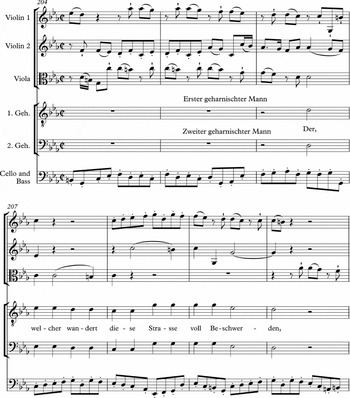
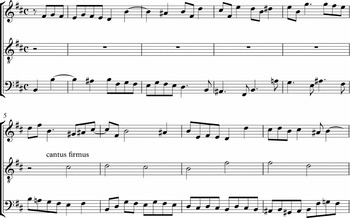
Hammerstein alternatively interprets the style of the movement and its characteristic motives as a result of Mozart's study of Bach's music, which began in 1782 and was fuelled by Mozart's encounter with Baron van Swieten in the same year. This fascination with Bach and his works later deepened during Mozart's 1789 visit to Leipzig, where he heard and studied his music.Footnote 14 Instead of viewing the sigh figures in Mozart's setting as resulting from a reading of Kirnberger's book, Hammerstein points out that an analogous combination of a sigh motive and a walking bass line can be found in the fifth verse of Johann Sebastian Bach's motet Jesu meine Freude, bwv227. The musical connection between the two pieces is indeed striking: the sigh motive is similar, the walking bass ascends in both compositions by a fifth before it falls again and both pieces are settings of a Protestant hymn (Example 2). During his Leipzig visit Mozart attended a performance of Bach's motet Singet dem Herrn ein neues Lied, bwv225, and later studied the part-books of the composition.Footnote 15 Thus, Hammerstein suggests, Mozart might also have encountered Bach's Jesu meine Freude.
Johann Sebastian Bach, Jesu meine Freude, bwv227, movement 9, bars 1–13 (Johann Sebastian Bach, Motetten, Neue Ausgabe sämtlicher Werke, series 3, volume 1, ed. Konrad Ameln (Kassel: Bärenreiter, 1966)). Used by permission

Mozart, ‘Song of the Armoured Men’, Die Zauberflöte, Act 2 Scene 28, bars 204–210 (wind instruments omitted) (Mozart, Die Zauberflöte, Neue Mozart Ausgabe II/5/19, ed. Gernot Gruber and Alfred Orel (Kassel: Bärenreiter, 1970)). Used by permission

In spite of these obvious musical resemblances, Hammerstein's methodology is problematic: he dismisses Mozart's possible encounter with Kirnberger's book because of lack of evidence, but suggests the influence of Bach's motet on Mozart, for which there is similarly no evidence. Moreover, he presumes that Mozart found the hymn melody in an unspecified hymnbook, whether Protestant or masonic. In other words, if we reject the notion that Mozart knew Kirnberger's book, then we must also doubt the composer's encounter with both Bach's Jesu meine Freude and the hymnbook.
However, one feature of the ‘Song of the Armoured Men’ that supports Hammerstein's interpretation is the similarity between Schikaneder's libretto and the original text of the hymn. Luther's fifth stanza uses similar images (fire, trial and purification) as the libretto:

Hammerstein is sure that Mozart (and Schikaneder) must have known the original text and that the composer selected the Lutheran melody in order to create an intertextual relationship between the Protestant hymn and the libretto of the singspiel. According to Hammerstein, ‘The spiritual relationship, however, of the mystery text [Schikaneder's libretto] and the psalm text made by the choice of this hymn cannot be an accident – it is doubtless Mozart's doing’ (‘Die geistige Verknüpfung aber des Mysterientextes mit dem Psalmtext durch die Wahl gerade dieses Chorals kann kein Zufall sein – sie ist zweifellos Mozarts Tat’).Footnote 16 Hammerstein's interpretation has been widely accepted by Mozart scholarship, and a study of the ‘Song of the Armoured Men’ by Richard Armbruster affirms Hammerstein's argument and rules out the possibility that Mozart might have used Kirnberger's treatise.Footnote 17
MOZART'S SKETCHES
The question of where Mozart found the melody for the hymn and his inspiration for the musical realization of the setting may seem to be a minor detail, but it has ramifications for the semantic and dramatic function of the movement. An answer to this question would have to focus on the sources left by Mozart himself. The score of Die Zauberflöte does not provide any information regarding the hymn, but a sketch for the scene of the ‘Armoured Men’ reveals the genesis of Mozart's rendition of the hymn melody. Furthermore, Mozart composed a contrapuntal study based on the same hymn in the early 1780s (k620b = Anhang 78). If the study cannot be counted as a sketch for Die Zauberflöte, it nevertheless helps reveal where the composer found the chorale melody.Footnote 18
The contrapuntal study k620b is written on the recto side of a sheet of paper devoted to a study of counterpoint.Footnote 19 On the verso side are the solution to a riddle canon by Padre Martini (Misericordiam), a fragment of the fugue k375f = 153, the beginning of a fugal exposition in C minor and finally the theme of Martini's canon. The paper Mozart used dates from 1782, the year he moved to Vienna, made the acquaintance of Baron van Swieten and embarked on studying Bach's music.Footnote 20 Van Swieten served from 1770 to 1777 as an Austrian diplomat at the court of Frederick the Great. During this time, he attended concerts in the salon of the Prussian king's sister Anna Amalia, who was a dedicated admirer of Johann Sebastian Bach's music, and he also made contact with Johann Philipp Kirnberger, Anna Amalia's music director and composition teacher.Footnote 21 Upon returning to Vienna in 1777 van Swieten brought with him a large collection of Bachiana and other music from the early eighteenth century.Footnote 22 After Mozart moved from Salzburg to Vienna in 1782, he attended performances of Bach's and Handel's music in van Swieten's house and participated in the performances himself. He also made transcriptions of fugues from Das Wohltemperierte Clavier and arrangements of some of Handel's oratorios.Footnote 23 In a letter to his father from 10 April 1782, the composer reports that he went every Sunday at noon to Baron van Swieten, ‘where nothing is being played but Handel and Bach’.Footnote 24
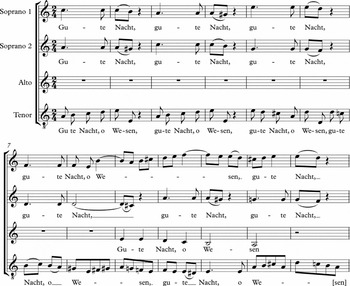
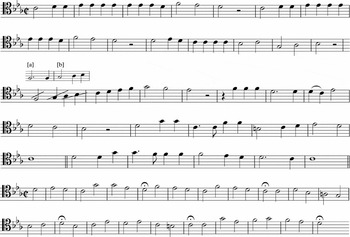
It is clear that the contrapuntal study of Ach Gott, vom Himmel sieh darein is connected to Mozart's exposure to Bach's music, not least because of a texture in which the tenor cantus firmus is embedded in a fabric of imitative counterpoint provided by soprano, alto and bass (Example 3). The first subject is remotely derived from the hymn melody by inversion of the initial four notes, but then continues in free Fortspinnung. Imitation starts in the bass on a weak beat, continues in the alto and is finally taken over by the soprano. The cantus firmus enters only when the alto presents the subject a second time, in bar 4. Mozart abandons this first subject one bar later in favour of another beginning with a long initial note and two descending leaps of a third – easier to handle than the linear first subject and leaving more room for variation and adaptation to the harmonic needs of the cantus firmus. Yet the study is only a fragment: Mozart set only the first half of the hymn melody and sketched the bass entrance of the second half.
Mozart, contrapuntal study k620b (1782) (Mozart, Skizzen, Neue Mozart Ausgabe X/30/3, ed. Ulrich Konrad (Kassel: Bärenreiter, 1998), sketch 35). Used by permission

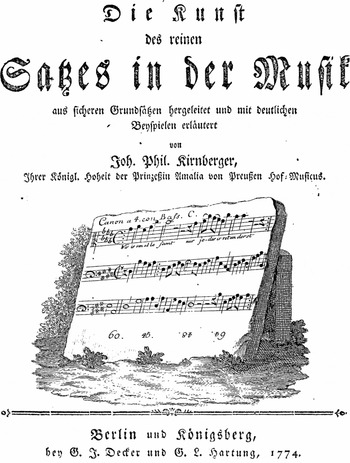
Not only is the study reminiscent of chorale settings by Bach and his circle, but Mozart's choice of the hymn was probably inspired by these earlier composers as well. Bach set the hymn several times, and Kirnberger uses it frequently in his model compositions in Die Kunst des reinen Satzes in der Musik. While Hammerstein doubted that Mozart knew this treatise, evidence to the contrary takes the form of a sketch sheet containing several of Mozart's contrapuntal studies and some of his exercises in Alberti basses.Footnote 25 Most interesting for our purposes are three solutions to a canon by Kirnberger, originally printed on the title-page of his book (Figure 1).Footnote 26 It is not possible to date the sketch precisely, but from his analysis of the paper Ulrich Konrad suggests that it is from 1782.Footnote 27 In other words, Mozart had access to the canon from Kirnberger's title-page in the same year he composed a contrapuntal study based on the very hymn (Ach Gott, vom Himmel sieh darein) that features prominently as a musical example in the book. Even the key and the version of the hymn melody are the same.
Title-page to Johann Philipp Kirnberger, Die Kunst des reinen Satzes in der Musik, volume 1 (Berlin and Königsberg: Decker und Hartung, 1774). This title-page includes the same canon as the original title-page (Berlin: Voß, 1771). Copy in Yale University, Music Library. Used by permission

Could Mozart have found both the hymn and the canon somewhere else? The canon was printed in 1780 in Abbé Vogler's Betrachtungen der Mannheimer Tonschule, as part of a lengthy critique of Kirnberger's book.Footnote 28 Although Vogler quotes and corrects several hymn settings by Kirnberger, he does not include Ach Gott, vom Himmel sieh darein.Footnote 29 Considering how hostile the relationship between Mozart and Vogler had been since their meeting in Mannheim in 1777, it would seem unlikely that he used Vogler's treatise to study counterpoint.Footnote 30 Mozart might have found the hymn in Kirnberger's 1777 edition of Hans Leo Hassler's Psalmen und christliche Gesänge (1607), which contains settings of all seven stanzas with the same version of the melody as Kirnberger and Mozart.Footnote 31 Yet Mozart's study shows no resemblance to the compositions by Hassler based on Ach Gott, vom Himmel sieh darein.
The likelihood that Mozart found the material for his hymn study in Die Kunst des reinen Satzes in der Musik is strengthened by similarities between the fragment and Kirnberger's chorale trio based on Ach Gott, vom Himmel sieh darein, given toward the end of the book's first part (Example 4). Similarities abound, including the initial syncopation on the bass note b, the following half-step and chain of quavers, a second motive based on a falling interval and prominent dotted crotchets (bars 4–5 in Kirnberger and numerous examples in Mozart). While none of these elements is unusual in eighteenth-century counterpoint, their combination in tandem with the chorale suggests Mozart's dependence on Kirnberger's piece.
Kirnberger, Trio on Ach Gott, vom Himmel sieh darein, bars 1–9. Kirnberger, Die Kunst des reinen Satzes in der Musik, volume 1, 238–239

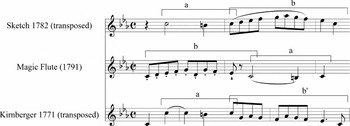
Of course, none of this demonstrates Kirnberger's impact on Mozart's Die Zauberflöte nine years later. The 1782 chorale study was surely not a sketch for the singspiel; rather, it was conceived independently as a study of ‘Bachian’ or ‘Kirnbergerian’ counterpoint. Yet Mozart may have used material from his study or from Kirnberger's book when composing the ‘Song of the Armoured Men’, the first subject of which is similar to that of the 1782 study. The main difference between the two subjects, really variants of the same musical idea, is the leap of a fourth instead of a progression in seconds. Example 5 compares the subjects in Mozart's and Kirnberger's settings. The initial off-beat half-step (a) in the 1782 subject, borrowed from Kirnberger's trio, was shifted behind the quavers (b) in 1791. The walking-bass-line quality of the 1791 quavers may also have been derived from Kirnberger's trio (see Example 4 once more).
Subjects in Mozart's contrapuntal study k620b, Die Zauberflöte and Kirnberger's trio

Mozart put some effort into adapting the chorale melody to the text by Schikaneder, as revealed by two sketches he made for the ‘Song of the Armoured Men’ in 1791 (Example 6).Footnote 32 The first sketch (lines 1–3) is a textless cantus firmus that fits the syllables of the ‘Song of the Armoured Men’. The melody seems to be of Mozart's own invention, a first attempt to set the text to music. The second sketch (lines 6–7) shows the hymn melody as found in Kirnberger's book, but transposed to C minor, the key of its appearance in the singspiel. Mozart's final version in Die Zauberflöte is an interesting amalgam of these two sketches: he uses the rhythms of his own cantus firmus and the melody of the hymn. Only when the hymn melody ends and he needs two more lines to fit the text, does he employ his own cantus firmus.
Mozart, melodic sketch for the ‘Song of the Armoured Men’ (Neue Mozart Ausgabe X/30/3). Used by permission

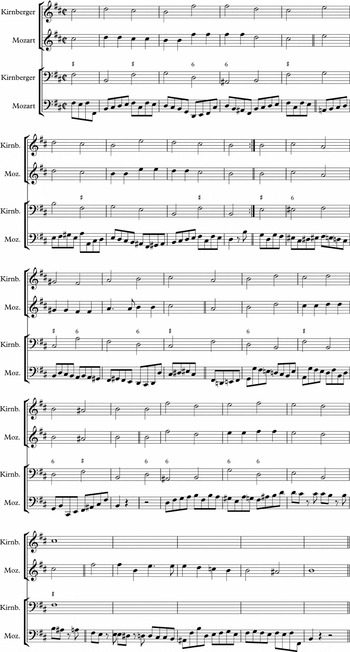
Nothing is known about Mozart's reasons for sketching these two versions of the melody.Footnote 33 Perhaps after writing them he decided to replace them with the hymn melody from his contrapuntal study of nine years earlier. If he used a source for the melody, rather than relying on his memory, then it could not have been the contrapuntal study, because it lacks the complete melody. He could have turned to Kirnberger's treatise once again, and in fact the harmonization of the hymn melody in Die Zauberflöte resembles a four-part setting in Kirnberger's Die Kunst des reinen Satzes in der Musik. Example 7 juxtaposes Mozart's and Kirnberger's melodies and bass lines, leaving out bars where the cantus firmus drops out in Mozart's composition (indicated by double barlines in the example). I do not want to suggest that Mozart simply embellished Kirnberger's setting; he clearly would have been able to compose his own without the theorist's help. However, he not only used the same version of the melody but also based his setting on a similar harmonic conception.
Mozart's and Kirnberger's harmonizations of Ach Gott, vom Himmel sieh darein

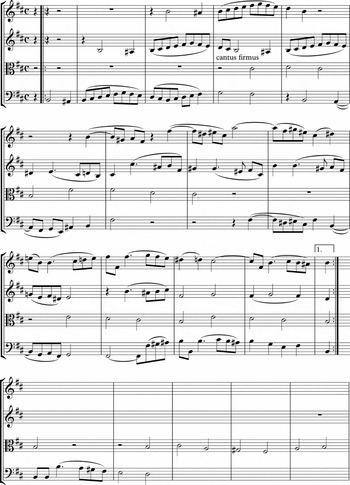
While the evidence suggests that Mozart knew the 1771 first volume of Kirnberger's treatise when he composed his 1782 contrapuntal study, and probably consulted the book again when composing Die Zauberflöte in 1791, there is no evidence that he knew the second volume of Die Kunst des reinen Satzes in der Musik (1776–1777). If he did, he might have noticed Kirnberger's setting of Psalm 51, based on the translation by Moses Mendelssohn. The third section of this setting is a duet for tenor and bass in unison accompanied by a walking bass line, a very similar disposition to Mozart's ‘Song of the Armoured Men’ (Figure 2).Footnote 34 Laurenz Lütteken has already pointed out this similarity, but without noticing the other significant connections between Kirnberger's book and Mozart's composition.Footnote 35 If this movement by Kirnberger was indeed the model for Mozart, it would help us understand the genesis of the 1791 sketches. In seeking to imitate the declamatory quality of Kirnberger's psalm setting, Mozart initially sketched a ‘melody’ similar to Kirnberger's. In a second step, he wrote down the chorale melody from the first volume of Kirnberger's treatise. The third step, the amalgamation of these two melodies, is not documented by sketches but is seen in the final version of the score.
Kirnberger, Psalm 51 from Die Kunst des reinen Satzes in der Musik, volume 2, part 3, 128. Copy in Yale University, Music Library. Used by permission

MUSICAL PURITY
Much is at stake in Hammerstein's suggestion that Mozart found the melody of Ach Gott, vom Himmel sieh darein in a hymnbook, as it forges a textual connection between the singspiel and Luther's psalm hymn. However, if Mozart learned the melody from Kirnberger's book, he encountered it without its text. And the 1782 contrapuntal study does not indicate that Mozart knew the words to the melody he was quoting. Thus he may have learned the text from another source, perhaps a masonic songbook, a contemporary Protestant hymnbook (possibly encountered during his 1789 visit to Leipzig) or even Kirnberger's 1777 edition of Hassler's Psalmen und christliche Gesänge. However, it is methodologically questionable to introduce another deus ex machina. It would be more than a remarkable coincidence if the only Protestant hymn Mozart ever set, in the 1782 study, happened to have a fifth stanza resembling the text of Die Zauberflöte.Footnote 36 If we consult the sources that have actually come down to us, it is most likely that Mozart borrowed the hymn tune from Kirnberger's treatise without being aware of the text connected with it. But the question remains why he borrowed the melody from a theoretical treatise in the first place.
One of the most characteristic features of Mozart's Die Zauberflöte is the composer's mixture of musical styles and genres. Beethoven admired the opera because Mozart uses ‘almost every genre, from lied to chorale and fugue’ (‘weil darin fast jede Gattung, vom Lied bis zum Choral und der Fuge, zum Ausdruck kommt’).Footnote 37 Mozart's eclecticism has a semantic purpose, for he employs musical genres – the folksong-like lied for Papageno, the opera-seria aria for the Queen of the Night and the hymnic setting for Sarastro and his priests – as signifiers in his musical drama. He could have used a hymnic style for the Armoured Men as well, as they are part of Sarastro's world, but he chose otherwise. If the other styles and genres have meanings that are tied to the character's natures, what is the meaning of the chorale?
The answer lies, I would suggest, in Kirnberger's treatise, which develops a theory of musical beauty and purity. The title of the published English translation, The Art of Strict Musical Composition,Footnote 38 is misleading, since the original German title is much broader in meaning: in Die Kunst des reinen Satzes in der Musik the word ‘rein’ can be translated not only as ‘strict’, but also as ‘pure’, and the idea of purity is central to Kirnberger's aesthetic programme. His concept of a ‘pure setting’ means the combination of rule and beauty and even implies ethical purity.Footnote 39 The ideal musical setting for Kirnberger is in four-part counterpoint. He devotes most of the first volume of his treatise to such settings before proposing that all other compositional types – three-part counterpoint, two-part counterpoint and even modern genres like the aria – are derived from it:
Der einfache schlechte Contrapunkt kann zwey- drey- vier- oder mehrstimmig seyn. Man thut am besten, daß man bey dem vierstimmigen anfängt, weil es nicht wol möglich ist, zwey- oder dreystimmig vollkommen zu setzen, bis man es in vier Stimmen kann. Denn da die vollständige Harmonie vierstimmig ist, folglich in den zwey- und dreystimmigen Sachen immer etwas vor der vollständigen Harmonie fehlen muß, so kann man nicht eher mit Zuverläßigkeit beurtheilen, was in den verschiedentlich vorkommenden Fällen von der Harmonie wegzulassen sey, bis man eine vollkommene Kenntniß des vierstimmigen Satzes hat.
Simple, plain counterpoint can be for two, three, four or more voices. It is best to begin with four voices, because it is not possible to write for two or three voices perfectly until one can do so for four voices. Since complete harmony is in four parts, the harmony in two- and three-part compositions must always be incomplete. Therefore it is impossible to judge with certainty what must be omitted from the harmony in the various situations that arise until one has a thorough knowledge of four-part composition.Footnote 40
Not only is the four-part setting the purest kind of music, but a composition should also be based on a simple, diatonic melody set in simple counterpoint.Footnote 41 Moreover, the diatonic melody ideally proceeds in stepwise motion because ‘wherever there are many large leaps in one voice, the line loses its gracefulness’ (‘wo viele grosse Sprünge in einer Stimme vorkommen, da verliert der Gesang seine Anmuthigkeit’).Footnote 42 Thus the most beautiful and pure kind of music is the four-part setting with a diatonic melody in stepwise motion. The basis for this aesthetic paradigm becomes clear in Kirnberger's choice of musical examples, most of which are four-part settings of Protestant hymns. He recommends Johann Sebastian Bach's settings as exemplary models of counterpoint.Footnote 43 In his view, the four-part hymn setting is not merely a foundation for compositional study, but is the basis of every kind of music, even of opera arias:
Jede Arie ist im Grunde nichts anders, als ein nach der richtigsten Declamation gesetzter Choral, da jede Sylbe des Textes nur eine Note hat, welche nach Erfordernis des Ausdrucks mehr oder weniger verziert wird. Der wahre Grund der Schönheit einer Arie liegt immer in dem einfachen Gesang, der da steht, wenn alle zur Auszierung gehörige Töne davon weggenommen sind.
Every aria is basically nothing more than a chorale composed according to the most correct declamation, in which each syllable of the text has only one note, which is more or less embellished according to the demands of expression. The true basis of beauty of an aria always depends on the simple melody that is left when all its decorative notes are eliminated.Footnote 44
Kirnberger provides several examples from operas by Handel (Tamerlano) and Graun (Silla), reducing the vocal part to its underlying hymn-like melody. Even arias with an obbligato instrument can be reduced in this way, for ‘an aria in which the first violin stands above the soprano and has a different melody from the voice is. . .like a chorale setting with the cantus firmus in the alto’ (‘Eine Arie, in der die erste Violin über dem Diskant einen ganz andern Gesang hat, als die Singestimme, ist. . . wie ein Choral in welchem die Hauptmelodie im Alt ist’).Footnote 45 On a small scale, this is what Mozart does in the ‘Song of the Armoured Men’, expanding a hymn tune to an operatic melody. The result, however, still retains its hymnic character and thus clearly displays the purity Kirnberger describes in his treatise.
Schikaneder's text for the ‘Song of the Armoured Men’ emphasizes the ethical purity that Tamino strives for in order to reach a state of enlightenment – and to get his beloved Pamina. In keeping with Kirnberger's aesthetics, no musical genre is more appropriate for depicting the purity addressed by the ‘Song of the Armoured Men’ than the chorale, the purest type of music. If Mozart did in fact study Kirnberger, then the theorist's understanding of the chorale may well have influenced him to choose a Lutheran hymn for this scene of Die Zauberflöte. Mozart could even have been directly inspired by Kirnberger's ‘model setting’ of Psalm 51, an example of the Kunst des reinen Satzes in der Musik, the ‘art of pure musical setting’.Footnote 46
Whether or not Mozart encountered the text of the hymn between 1782 and 1791, his use of the melody is sufficiently explained by his study of Kirnberger's treatise. But the intertextual relationship between the treatise and Die Zauberflöte is complex; it would be the task of another study to elaborate upon these connections by interpreting Die Zauberflöte and its masonic influences from the perspective of Kirnberger's theories. For now, the evidence suggests that Mozart became acquainted with Die Kunst des reinen Satzes in der Musik soon after meeting Baron van Swieten in 1782, solving the riddle canon on the book's title page and studying the contrapuntal hymn settings. This led to his polyphonic study of Ach Gott, vom Himmel sieh darein modelled on a chorale trio by Kirnberger. Mozart presumably also read the rest of the book and familiarized himself with Kirnberger's theories about musical purity. When he composed Die Zauberflöte in 1791, he used the same hymn for the ‘Song of the Armoured Men’ that he treated in his earlier polyphonic study and which features prominently in Kirnberger's treatise. While the contrapuntal texture of the scene emphasizes the otherness of the Armoured Men and the ‘law’ Tamino must follow, the hymn and Kirnberger's model add another layer of meaning by signifying the purity obtained by those who observe the law and follow the ‘path so full of troubles’.