


Introduction
Clark and Wells' Cognitive Model of Social Phobia (Reference Clark, Wells, Heimberg, Liebowitz, Hope and Schneir1995) is probably the best known social phobia model and provides the theoretical basis for cognitive behavioural therapy (CBT) for this condition. There is a body of evidence in support of this model since its creation in 1995, both from research studies (e.g. Wells, Reference Wells2001) and from CBT for social phobia (e.g. Wells and McMillan, Reference Wells and McMillan2004).
Clark and Wells (Reference Clark, Wells, Heimberg, Liebowitz, Hope and Schneir1995) posit that the “. . .core of social phobia appears to be a strong desire to convey a particularly favourable impression of oneself to others and marked insecurity about ones ability to do so” (p. 69). Their Cognitive Model of Social Phobia proposes that when those with social phobia become concerned that they may fail to make their desired impression on others, their attention shifts to detailed observation and self-monitoring. They then use this internal information to construct a negative impression of their public self from the observer perspective, i.e. see an image of themselves as they imagine other people see them. This processing bias prevents individuals with social phobia from collecting evidence against the perceived social danger, maintaining the cycle (Clark and Wells, Reference Clark, Wells, Heimberg, Liebowitz, Hope and Schneir1995).
Attentional bias is also a key feature in other related psychological models of social phobia. Such models include Rapee and Heimberg's Cognitive-Behavioural Model of Social Phobia (Reference Rapee and Heimberg1997), which emphasizes the salient role of an observer perspective bias in maintaining social anxiety, and Kimbrel's (Reference Kimbrel2008) Model of the Development and Maintenance of Generalized Social Phobia, which includes the attentional bias for threat-relevant information as an important part of social phobia maintenance.
Social phobia frequently occurs as a co-morbid condition. A number of studies have reported high rates of social phobia among people with psychosis, estimating rates between 13% and 36% (Bermanzohn et al., Reference Bermanzohn, Porto, Arlow, Pollack, Stronger and Siris2000; Cassano, Pini, Saettoni and Dell'Osso, Reference Cassano, Pini, Saettoni and Dell'Osso1999; Cosoff and Hafner, Reference Cosoff and Hafner1998; Kendler, Gallagher, Abelson and Kessler, Reference Kendler, Gallagher, Abelson and Kessler1996; Pallanti, Quercioli and Hollander, Reference Pallanti, Quercioli and Hollander2004). However, since psychosis is generally considered to be the primary diagnosis and social phobia the secondary, it will often remain untreated (Cosoff and Hafner, Reference Cosoff and Hafner1998; Kingsep, Nathan and Castle, Reference Kingsep, Nathan and Castle2003; Tarrier, Reference Tarrier2005). This can cause an additional burden on people with psychosis, which may seriously impact on their quality of life (Braga, Mendlowicz, Marrocos and Figueira, 2005). In addition, social anxiety can remain present after the florid psychotic symptoms have resolved, causing continued distress and restriction (Birchwood, Reference Birchwood2003).
However, despite these findings, a literature review has indicated that relatively little investigation into the nature of social anxiety among people with psychosis or its treatment has been conducted. Studies exploring the effectiveness of CBT at reducing social anxiety in those with psychosis (Halperin, Nathan, Drummond and Castle, Reference Halperin, Nathan, Drummond and Castle2000; Kingsep et al., Reference Kingsep, Nathan and Castle2003) have shown positive outcomes; however, both had a small number of participants. Birchwood (Reference Birchwood2003) has stated that neither CBT for psychosis nor neuroleptic treatments have shown any consistent effect on co-morbid emotional disorders. He suggests that future treatments for such clients should focus on these disorders, their development and their psychological origins. To this end, a study exploring whether social anxiety comorbid with psychosis is similar in nature to social anxiety as a primary diagnosis, is implicated. This should have particular focus on the aspects of social anxiety that have been effectively manipulated in the treatment of social anxiety, such as imagery and memories.
An image is a cognitive event in which perceptual information is accessed from memory, giving rise to a mental representation equivalent to “seeing in the mind's eye” or “hearing in the mind's ear” (Holmes, Geddes, Colom and Goodwin, Reference Holmes, Geddes, Colom and Goodwin2008; Hackmann and Holmes, Reference Hackmann and Holmes2004). An image is more than a memory as it is an active process in which imagination is able to produce novel combinations such that a memory can take the form of an image but an image does not have to be a memory. Images can therefore provide an opportunity for an individual to create a representation of possible future, present or past events as well as distortions of events. Imagery has been shown to play an important role in a range of psychological difficulties including anxiety disorders (Hackmann and Holmes, Reference Hackmann and Holmes2004).
Hackmann et al. (Reference Hackmann, Surawy and Clark1998) used a semi-structured interview to explore the frequency and content of spontaneously occurring images during episodes of social anxiety. Comparing participants with social phobia to non-clinical controls, they identified that the clinical group gave significantly higher frequency ratings than controls for spontaneously occurring images (77% compared with 47%). Significantly more people with social phobia than controls were judged to have a clear image, to see in an observer perspective, and to have images perceived as negative. The images reported by the social phobia group generally involved visualizing their worst fears about how they appear in social situations; for example, seeing themselves blushing, sweating or shaking profusely, or looking very fat or small.
Coles, Turk, Heimberg and Fresco (Reference Coles, Turk, Heimberg and Fresco2001) explored perspective for imagery in those with social phobia compared with non-anxious controls when recalling memories of low, medium and high anxiety social situations. They found that approximately half the socially phobic participants took a field perspective and half took an observer perspective in high social anxiety situations. None of the participants took an observer perspective in low or medium social anxiety situations.
Hackmann, Clark and McManus (Reference Hackmann, Clark and McManus2000), using a semi-structured interview, found that images in social anxiety are recurrent across a range of situations, are linked to early memories, and are multi-sensory. The authors conclude that their results suggest early unpleasant social experiences may result in those with social phobia developing a negative, observer perspective image of their social selves. This is repeatedly activated in subsequent anxiety-provoking interactions and fails to update with new experiences. In a follow-up to this study, Wild, Hackmann and Clark (Reference Wild, Hackmann and Clark2008) found that memory re-scripting therapy significantly reduced the clarity of, and distress caused by, the associated image.
Morrison et al. (Reference Morrison, Beck, Glentworth, Dunn, Reid, Larkin and Williams2002) explored mental imagery (as opposed to hallucinatory experiences) experienced by clients with psychosis receiving CBT. They found that the majority (74.3%) reported images. These predominantly consisted of images of feared outcomes related to paranoia or traumatic memories (e.g. being physically assaulted or threatened), and were related to hallucinatory voice content (e.g. seeing themselves being murdered or criticized by others).
Morrison et al.'s (Reference Morrison, Beck, Glentworth, Dunn, Reid, Larkin and Williams2002) study, as well as clinical experience with clients with psychosis, suggests that this client group tend to see an exaggerated, threatening “other” rather than themselves from an observer perspective. It therefore seems likely that images related to social anxiety in a psychotic group may also contain similar themes, being strongly influenced by fear and paranoia as opposed to a predominant fear of performance anxiety and loss of social status. Clinical experience with this client group indicates that there may be differences in the way they experience imagery when socially anxious, such as images being focused on exaggerated threats from others (e.g. seeing others glaring at them) rather than seeing themselves. This would contrast with Clark and Wells' (Reference Clark, Wells, Heimberg, Liebowitz, Hope and Schneir1995) Model of Social Phobia, which states, “how social phobics believe others see them has a greater impact on their appraisal of the danger of the situation than the situation itself.” This difference could possibly partly be attributed to residual or schizotypal (sub-psychotic) paranoia. However, Freeman et al. (Reference Freeman, Garety, Bebbington, Smith, Rollinson and Fowler2005) suggested that social anxiety and paranoia could fall on a continuum, with social anxiety being more common and providing a foundation on which increasing concerns about physical threat could occur.
To summarize, previous research and models of social anxiety have indicated that people with social anxiety frequently fear negative evaluation from others and consequent loss of social status. The research has also indicated that people who experience social anxiety will frequently experience images, which incorporate this fear. Particularly common are exaggerated images of themselves (i.e. from an observer perspective) as they fear others see them (e.g. seeing themselves looking very embarrassed, bright red and sweating, or looking shorter or fatter than usual). Studies have also indicated that images can be multi-sensory.
Research exploring imagery experienced by people with psychosis indicates that these images are predominantly seen as if through their own eyes (field perspective), and frequently consist of exaggerated threatening images of others. This could be related to psychotic paranoia. It has been suggested that social anxiety and paranoia could form a continuum.
The aim of this research was therefore to develop and pilot a suitable measure to explore the imagery experienced by clients with comorbid psychosis and social anxiety and to provide preliminary indications as to its nature. The following hypotheses were developed:
1. Participants' images will show themes of negative evaluation from others and loss of social status.
2. Participants' images will be multi-sensory.
3. Images will be distorted, with exaggerated negative elements (e.g. looking shorter, fatter or redder, others looking more threatening).
4. Participants will identify themes of physical threat from others in their images.
5. Typical social anxiety images (e.g. being laughed at or criticized by others, social threats, exaggerated negative images of themselves) will be viewed from an observer perspective.
6. Images that appear more related to paranoia (threats to physical safety) will be viewed from a field perspective.
Method
Ethical approval
Ethical approval for this study was sought from and approved by the Norfolk Research Ethics Committee.
Design
This was an exploratory study, using a semi-structured interview with socially anxious participants with psychosis. It explored the nature of the imagery experienced by these participants when feeling socially anxious. The interview provided rich, detailed information describing the content of images, and the associated emotional responses. Common themes in image content were identified using qualitative template analysis (King, Reference King2008), which makes use of the rich qualitative information obtained. Quantitative numerical data were also provided by the interview, with participants giving rating scores for image perspective, amount of social anxiety and amount of distortion in the image. The interviewer also gave a score for the extent the image appeared to constitute a clear visual picture. However, due to the sample size quantitative analysis would be underpowered. Therefore, the scores are used to consider tentative indications of the relationships between image content, strength of anxiety, image perspective and clarity of image in this participant group, rather than being statistically analysed.
Participants
Participants were all clients of Central Norfolk Early Intervention Service who had consented to participate in a wider study looking at the nature of social anxiety and appropriate treatments. Participants were male and female, aged 14–35 years (age range of the service) and were scoring at a clinically significant level on a measure of social anxiety (Social Interactions Anxiety Scale; Mattick and Clarke, Reference Mattick and Clarke1989). Due to the position of diagnostic uncertainty within early intervention services no diagnoses are available for the participants. However, all participants would have had at least one clinically significant positive psychotic symptom at the point of entry into the service. All participants were receiving regular support from their care coordinator. Exclusion criteria included participants who were currently experiencing positive psychotic phenomena, those unable to give informed consent (i.e. mental health problems, learning difficulties) and those unable to identify an image when interviewed.
Recruitment
All clients of the Early Intervention Service who scored to a clinically significant level on the Social Interaction Anxiety Scale (SIAS; Mattick and Clarke, Reference Mattick and Clarke1989) were invited to take part in the research. Those who were interested were provided with an information sheet and were given the opportunity to consent.
Measures
Social anxiety measure. The Social Interaction Anxiety Scale (SIAS; Mattick and Clarke, Reference Mattick and Clarke1989) was used to identify clients experiencing social anxiety. The SIAS measures social anxiety by asking individuals to rate the extent to which they make affective, behavioural, and cognitive responses to a variety of situations requiring social interaction. It has shown good reliability and validity: the internal consistency exceeding alpha = .88 (Mattick and Clarke, Reference Mattick and Clarke1989), with test-retest reliability at r = .91 and .93 after intervals of 1 and 3 months. The SIAS shows significant positive correlations (rs = .54 – .69) with standard measures of social anxiety (Mattick and Clarke, Reference Mattick and Clarke1989). The SIAS takes approximately 3 minutes to complete.
Selection and development of imagery measure. The interview by Hackmann et al. (Reference Hackmann, Surawy and Clark1998) was selected and permission was sought and granted from the first author to use and develop the measure. The semi-structured interview asks participants to recall social situations in which they felt anxious and describe any corresponding mental images (in any sensory modality) in detail. They are asked to indicate how frequently they experience images in anxiety-provoking situations or while anticipating such situations, rate whether the predominant perspective is one of field or observer perspective, and rate the extent to which the image seems distorted. The information is explored descriptively to provide rich qualitative information on image content and nature. This interview takes approximately 30 minutes to conduct.
The interview was developed for use with this client group through a process of trial, evaluation and development. It was agreed that developments would only enhance or make clearer queries already explored in the original interview, in order to maintain validity and reliability. One development was on supporting participants to understand what was meant by a mental image and differentiating this from a hallucination. This was done by emphasizing the “mind's eye” quality of an image. Other aspects involved including additional clarifying questions to support the reliable collection of data in line with the original Hackmann et al. (Reference Hackmann, Surawy and Clark1998) interview.
Procedure
The researcher (Assistant Psychologist) collected consent and completed a battery of baseline assessment measures, including the imagery interview. The imagery interview was audio recorded, with the participant's consent. Following seven interviews, the first author was given the anonymized recordings of the interviews and the interviewer's summary notes. The author transcribed the recordings and double-rated the interviews to ensure inter-rater reliability and that the qualitative information on the nature of imagery was reported accurately. The author then analysed the data.
Data analysis
Quantitative analysis. Although the number of participants in this study did not reach the number required for statistical analysis, the interview did provide numerical data. These data consisted of the participants' ratings for level of anxiety, image perspective (entirely field, entirely observer, or a mixture of both) and image distortion, and the interviewers' rating for image clarity. These data were used to provide exploratory information on potential interactions between these ratings and image content.
Qualitative analysis. The participants' descriptions of their images were explored using thematic template analysis. This method was chosen in order to explore if there were any shared themes among participants. It also provided important information on the specific differences in image content in this group when compared with the socially anxious group interviewed by Hackmann et al. (Reference Hackmann, Surawy and Clark1998).
King (Reference King2008) recommends the use of template analysis to identify themes within qualitative data. The researcher creates an a priori template of themes that have been identified through previous literature and the hypotheses. For this study, it was hypothesized that participants would show themes of fear of negative evaluation from others and fear of loss of social status. In addition, they would have a negatively distorted impression of themselves (e.g. that they are fatter than in reality). These hypotheses were based on the research into imagery experienced by those with social anxiety. It was also hypothesized that this client group would show themes of physical threat (possibly based on residual paranoia), based on the research into images experienced by those with psychosis. Following the completion of the interviews, the participants' descriptions of their images were studied to establish whether any additional themes could be identified, and a final template for coding the descriptions was developed.
Results
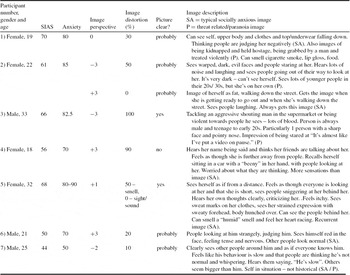
Four females and three males participated in this study. Ages ranged from 18 to 33 years. One person was excluded as they were unable to identify an image when interviewed. The quantitative scores and summarized image descriptions can be seen in Table 1.
Scores for levels of anxiety, image perspective, image distortion, clarity of image and summary description of images

Notes: Image perspective: (–3 = completely field, 0 = switching between perspectives, +3 = completely observer); SIAS: Social Interaction Anxiety Scale; Anxiety: rated at worst moment scale 0–100.
Five of the eight participants agreed to have their interviews recorded (P2, P3, P4, P7 and P7). Therefore, information from their interviews is direct quotations. Information from the other participants was taken from the written summaries recorded by the researcher conducting the interview. P2 elicited an additional image after the interview was complete, so this was recorded in notes by the researcher. The researchers read back their summaries to the participants to ensure they were accurate.
Qualitative thematic template analysis
Fear of negative evaluation from others and loss of social status. All participants identified significant fear of being negatively judged by other people. Central characteristics of the experience of being evaluated were described as people staring, receiving funny looks from people, being talked about and laughed at, and not being liked by people. Identified reasons for negative evaluation included not being seen as equal, not looking right, and coming across as slow. Three participants reported feeling judged because of their mental health problems and feeling abnormal. For example, “Because I'm not . . . mentally healthy. . . so they think I'm acting weird.” (P6); “People think I'm being a loon.” (P4); “They think I've got problems.” (P7). In addition, one participant reported concerns around loss of social status, for example “I think they're just pretending to be my friends.”(P4).
Experiencing an impression or image that is negatively distorted. The second theme identified in the analysis was the apparent negative distortion of the reported image. The distortion was experienced in the visual, olfactory, auditory and tactile sensory modalities. For example, “Seeing sweat marks on her clothes, seeing her strained expression with a sweaty forehead, her body hunched over.” (P5, interviewers words); “Smells cigarette smoke, lip gloss and food.” (P1); “I hear lots of laughing.” (P2); “Feels itchy.” (P5).
Three of the five participants that reported distorted images described distortions as occurring in more than one sensory modality; visual distortions were always present. In addition, one participant reported experiencing a distorted “felt-sense” when experiencing social anxiety. They described this as “It seems as though I am further away from people.” (P4)
Fear of physical threat. Of the seven images reported, three were recounted as having elements of physical threat, both fearing physical threat from others and fearing causing physical threat to others. All three participants described being in fear of other people, or “dreading”, “being intimidated by” or “expecting aggression from” other people when they are in social situations. For example, “When I was poorly [actively psychotic]. . . everyone's faces were warped, they'd all look at me and everything looked so dark, evil, looking at me. That scared me.” (P2). Just one participant reported experiencing an image about harming other people: “. . . I get horrible, intrusive pictures of being violent to people [people he sees as potential threats].” (P3)
Image/impression that everyone is staring at them, knows them or is talking about them. This theme was present in five of the image descriptions. Although there is some overlap with the fear of negative evaluation element already described, there seemed to be a distinct theme around being stared at/talked about and being known by others. Those that described being stared at recounted the image vividly and described the staring as happening overtly, for example, “Sometimes I walk into a shop and the picture is that everyone has just stopped and stared, it's almost like I've put a video on pause.” (3); “People almost going out of their way to look at me, bending their heads.” (P2). One participant described having images of being stared at in anticipation of going into an anxiety-provoking situation.
Image of what might happen in the immediate future. Participants described having images anticipating what could happen to them in the near future; of those reported, the imminent event seemed to be one that would cause embarrassment and humiliation. For example, “Worry that her top/underwear will fall down.” (P1, interviewers' words); “Before going out I would have these images. . . of accidents, you know, things that might happen.” (P2). In addition, another participant reported having an image of the immediate future that did not involve an element of embarrassment, but seemed to be more a rehearsal of what they would do if certain happenings occurred. For example, “My violent thoughts might change to a picture – in my head I might be running through the conversation the woman at the till might have with me, or someone might speak to me, it might be a little picture of people talking to me.” (P3).
Threat perceived as being most strong from certain types of people. Within some of the participants' descriptions there was evidence that they feel more threatened by some people than others. Most participants reporting a person/people-specific perceived threat recounted young people in their early 20s as the most threatening group and as older people never being seen as a threat. For example, “I think they'd always be male [the people in the image], usually the people around me, never old people, always teenagers or younger people up to early 20s, because I get quite scared around teenagers.” (P3). Other groups seen as more threatening were unfamiliar people, big crowds and queues, for example, “My anxiety is usually worse around people I don't know, but I can also feel paranoid with my friends.” (P4).
Initial indications from quantitative data
See Table 1 for image summaries and quantitative ratings. For the purposes of this analysis the images were separated into those that demonstrated themes that could be considered typical of non-psychotic social anxiety and those that are less typical. The less typical images tended to have a stronger physical threat theme and so are being described as paranoia/physical threat images. This is not an indication of the presence of clinical paranoia but rather a qualitative description of the themes present in the image.
Considering the relationship between perspective and image content, of particular interest is participant 2 (P2) who identified two images. One appeared to be a “typical” socially anxious image of herself walking down the street looking fat with people laughing at her, and was from an entirely observer perspective. The other image is of “evil” faces staring at her, and is entirely from a field perspective.
Additionally, participant 1 (P1) described two images and said her perspective switched between field and observer. It is possible that each image could have been from a different perspective. All the images seen from a predominantly observer perspective described by the participants appear similar to “typical” socially anxious images, with themes of embarrassment and being ridiculed by others, and of distorted self-images (e.g. looking fatter or redder). Of the images seen from a predominantly field perspective, one (P7) also seems like quite a traditional social anxiety image, seeing others judging him and feeling smaller than them. However, there is also an element of personal danger (as opposed to social threat) in this image, identified by the associated belief, “the world is a dangerous place”. The image described by P3 involves blood and violence and feeling physically threatened by others (indicated by him attacking others), and is seen from an entirely field perspective.
These initial data therefore tentatively indicate that, in this participant group of people with diagnoses of both social anxiety and psychosis, images of a typically socially anxious nature (as identified by Hackmann et al., Reference Hackmann, Surawy and Clark1998) are more often seen from an observer perspective. Images that seem more influenced by psychosis (and perhaps paranoia) are predominantly seen from a field perspective.
Discussion
From this small sample, the initial indications are that the images experienced by people with psychosis and social anxiety can sometimes be similar to the images identified by Hackmann et al. (Reference Hackmann, Surawy and Clark1998), although this is not always the case. The template analysis found examples of themes of negative evaluation from others and loss of social status in the images of six of the eight participants, supporting the first hypothesis. Five of the eight participants reported experiencing their images in additional sensory modalities to sight (sound, smell and touch), supporting hypothesis two. All participants gave a score indicating that they believe their image is distorted from reality to some extent. In particular, participants 2, 5 and 6 identified seeing themselves as looking fatter, redder or sweatier than they were in real life, supporting hypothesis three, and apparently fitting with Clark and Wells' (Reference Clark, Wells, Heimberg, Liebowitz, Hope and Schneir1995) Cognitive Model of Social Phobia.
However, even when fear of negative evaluation was present, the nature of this sometimes appeared different to that proposed by Clark and Wells' (Reference Clark, Wells, Heimberg, Liebowitz, Hope and Schneir1995) model. The statements by three participants (P3, P4 and P7) indicate that the stigma they experienced as a response to their diagnosis of psychosis can be a significant contributory factor to their fear of negative evaluation from others. P3 stated that he would happily give a presentation in front of thousands of people on a topic he knew a lot about, but feels very uncomfortable in smaller, more informal situations when people might identify him as “different” or know his diagnosis. P4 said she thought others saw her as “a loon”. P7 described the impact of his mental health on how people saw him, saying they thought he was “slow”. This could be perceived as being fundamentally different to the fear of performance anxiety or appearing embarrassed, which characterises social anxiety.
Additional differences in image content were identified in three participants (P1, P2 and P3), with the theme of images seeming more related to fear of physical danger than with anxiety and social threats. This supports hypothesis four. These images may be influenced by paranoia, but further investigation exploring paranoia levels would need to be conducted to support this. It remains unclear whether these clients are actually experiencing social anxiety or whether their anxiety about going out can be fully explained by residual paranoia from their psychotic episode.
With the exception of P7, images that were congruent with typical social anxiety images (i.e. those based on fear of social judgement and relegation) were predominantly from an observer perspective and images congruent with themes identified as being present in some people with psychosis (i.e. threat) were predominantly from a field perspective, supporting hypotheses five and six.
Strengths and limitations of the study
This study was intended as an initial exploratory study into the nature of images experienced by clients with comorbid psychosis and social anxiety. A strength is that it has facilitated the careful adaptation and development of an imagery interview (Hackmann et al., Reference Hackmann, Surawy and Clark1998) for use in a new population. A further strength lies in the study's originality as the first (to the authors' knowledge) to explore the nature of images in socially anxious clients with a diagnosis of psychosis. Currently, this appears to be an area ripe for investigation with significant implications for treatment within this client group.
However, as with all exploratory studies, there are several limitations. The sample size is too small for any generalizations to be made. Additionally, the interview would have benefited from the participants' descriptions of their images being recorded verbatim for the participants who did not consent to audio recording. This would have ensured that none of the information was omitted from analysis. Furthermore, it would have been useful to have separate image perspective ratings for all clients who reported more than one image.
A further issue is that the “images” described by some participants may be examples of memories or psychotic hallucinations, rather that images of possible future or current outcomes as in the images explored by Hackmann et al. (Reference Hackmann, Surawy and Clark1998). Specifically, the images described by participants 6 and 7 would appear to be memories of actual events rather than images. However, through recalling these events the participants were able to provide information on the feelings and interpretations they experienced in the situation, which could be considered to be a form of image (Hackmann et al., Reference Hackmann, Surawy and Clark1998, refer to this as an “impression”). Therefore, the information given by these participants remains valid for use in analysis. Some of the images described by P2 (dark, distorted faces) could be considered to be hallucinations rather than images, particularly as the participant stated she only experienced these when she was acutely psychotic. However, her image of herself as fat walking down the street is a typical social anxiety image.
Theoretical and clinical implications
The majority of participants in this study reported experiencing images when anxious in social situations. Of these, some were congruent with the typical social anxiety images identified by Hackmann et al. (Reference Hackmann, Surawy and Clark1998), and others with the threatening images identified by Morrison et al. (Reference Morrison, Beck, Glentworth, Dunn, Reid, Larkin and Williams2002) as being present in their sample of people with psychosis. Two participants experienced both types of images. This suggests that both beliefs associated with social anxiety (fear of social judgement and relegation) and beliefs associated with paranoia (fear of physical threat) may be contributing to these images, although further exploration into levels of paranoia in this group is needed to support this hypothesis. The presence of a variety of images containing social evaluative and physical threat themes within this client group could support Freeman et al.'s (Reference Freeman, Garety, Bebbington, Smith, Rollinson and Fowler2005) view that social anxiety and paranoia fall on a continuum.
The work of Hackmann et al. (Reference Hackmann, Clark and McManus2000) would suggest that some of these images may be the result of previous incidents in which an individual has experienced social threat. If this is the case, then rescripting may be a useful clinical tool for this group as has been shown for non-psychotic social anxiety (Wild et al., Reference Wild, Hackmann and Clark2008). Further research would therefore be useful to establish whether there is a link with early memories, for which images this is the case, and whether rescripting these images would help to alleviate the social anxiety.
There may be clinical implications if different types of belief are found to be the basis for individual's experiences of anxiety in social situations. For instance, the anxiety based on fear of social judgement and relegation may be successfully treated with an established treatment for social anxiety (e.g. CBT for social anxiety), whereas anxiety based on paranoid beliefs may be more appropriately treated with an established treatment for psychosis (e.g. CBT for psychosis).
Overall, this study has shown that many people experiencing social anxiety following an episode of psychosis will experience intrusive images in social situations. The content of these images will be idiosyncratic and may fit into themes typical of social anxiety or fit with themes including a stronger sense of physical threat. It therefore seems important that when working with this client group therapists ask about the imagery experienced in social situations and include in this assessment questions about the perspective of the image and whether the image is distorted. This may provide opportunities for direct interventions as described by Holmes, Arntz and Smucker (Reference Holmes, Arntz and Smucker2007) or provide information about the specific fears of clients. Further research could usefully explore the origins of these images and interventions to help reduce their impact.



Comments
No Comments have been published for this article.