INTRODUCTION
Ethiopia is one of the most populous countries in Africa (CSA 2011), and among one of 22 countries vulnerable to protracted food crises, breakdown of livelihoods and insufficient institutional capacity to react to such crises (FAO 2010, 2012). A third of Ethiopians live in absolute poverty, meaning they are severely deprived of basic needs including food, safe drinking water, sanitation facilities, health, shelter, education and information (UNDP 2002; USAID 2002). Approximately 85% of the population depends on self-subsistence production of crops, livestock and trees to meet daily needs (Adnew Reference Adnew2004; Bacha et al. Reference Bacha, Namara, Bogale and Tesfaye2011; Ravallion et al. Reference Ravallion, Chen and Sangraula2008).
Agroforestry homegardens are small-scale agricultural systems that deliver multiple products important for food security and livelihoods of rural households in Ethiopia (Admasu & Struik Reference Admasu and Struik2002; Almaz & Niehof Reference Almaz and Niehof2004; Tesfaye Reference Tesfaye2005). These systems are based on traditional knowledge and practices of local communities, gained over long periods of time and adapted to the local environment. Agroforestry homegardens are primarily characterized by a large diversity of plant species and involve multi-purpose management of trees and shrubs in intimate association with annual and perennial agricultural crops (Fernandes & Nair Reference Fernandes and Nair1986; Kumar & Nair Reference Kumar and Nair2004; Peyre et al. Reference Peyre, Guidal, Wiersum and Bongers2006). They are often combined with livestock within the compounds of individual houses, which helps farmers to diversify their household production and financial income (Kumar & Nair Reference Kumar and Nair2004). Thus, the traditional agroforestry homegarden has all the properties of a sustainable agricultural system that helps maintain the natural environment, and provides multiple goods, services and values important for economic viability and social welfare (Schaller Reference Schaller1993; Hansen Reference Hansen1996; Rigby & Caceres Reference Rigby and Caceres2001; Kumar & Nair Reference Kumar, Nair, Kumar and Nair2006).
Agroforestry homegardens have been one of the main agricultural systems for centuries in Ethiopia's Southern Nations, Nationalities and Peoples Regional State (SNNPRS; Admasu & Struik Reference Admasu and Struik2001, Reference Admasu and Struik2002; Tadesse Reference Tadesse2002; Almaz & Niehof Reference Almaz and Niehof2004; Tesfaye Reference Tesfaye, Wiersum and Bongers2010). Since the 1990s agroforestry homegardens in SNNPRS have been changing towards monoculture production of khat (Catha edulis). Khat is a stimulant crop that has been widely used for more than a century in the north-eastern, southern and central parts of Ethiopia as well as the Horn of Africa and Arabian Peninsula (Abebaw et al. Reference Abebaw, Atalay and Hanlon2007; Klein & Metaal Reference Klein and Metaal2010; Gessesse Reference Gessesse2013). Domestic and global market demands for khat have driven up both its price and production in Ethiopia (Ezekiel Reference Ezekiel2004; Klein et al. Reference Klein, Beckerleg and Hailu2009; Ezekiel Reference Ezekiel2010). Over the past decade, export to the UK has increased significantly, and khat has also been smuggled to other parts of Europe and the USA (Klein & Metaal Reference Klein and Metaal2010). At the same time, there has been a strong move towards prohibition of its supply and use in many North American, Arabian and European countries, including the recent outlawing of khat in the UK and the Netherlands (Joanne Reference Joanne2014). There is also general concern that increased khat production could lead to loss of traditional multifunctional farming systems and associated traditional knowledge (Kumar & Nair Reference Kumar and Nair2004; Peyre et al. Reference Peyre, Guidal, Wiersum and Bongers2006; Tesfaye Reference Tesfaye, Kumar and Nair2006).
The social, economic and ecological services and historical importance of this traditional land-use system have been emphasized (Fernandes & Nair Reference Fernandes and Nair1986; Almaz Reference Almaz2001; Admasu & Struik Reference Admasu and Struik2001, Reference Admasu and Struik2002; Tadesse Reference Tadesse2002; Almaz & Niehof Reference Almaz and Niehof2004; Kumar & Nair Reference Kumar and Nair2004; Kumar & Nair Reference Kumar, Nair, Kumar and Nair2006; Tesfaye Reference Tesfaye, Kumar and Nair2006; Tesfaye et al. Reference Tesfaye, Wiersum and Bongers2010). Agroforestry homegardens in SNNPRS may be important for food security and household nutrition (Admasu Reference Admasu and Struik2001; Admasu & Struik Reference Admasu and Struik2002; Almaz & Niehof Reference Almaz and Niehof2004), for biodiversity conservation (Tesfaye Reference Tesfaye2005, Reference Tesfaye2013; Tesfaye et al. Reference Tesfaye, Wiersum and Bongers2010) and maintenance of cultural values (Tadesse Reference Tadesse2002).
However, there is a lack of place-based in-depth studies on drivers of change towards new cash crop monocultures and the decline of agroforestry homegardens. Geist & Lambin's (Reference Geist and Lambin2002, Reference Geist and Lambin2004) framework of complex interactions among proximate causes and underlying forces of land-use change is appropriate for in-depth analysis of the changes in agroforestry homegardens. Causes of land-use change can be proximate (direct or local) or underlying (indirect or root). Proximate causes are local human activities or immediate actions (individual farms, households or communities) that originate from the intended land use and directly affect, in our case, traditional agroforestry homegardens. Underlying driving forces are fundamental social processes that underpin the proximate causes and either operate at the local level or have an indirect impact from the national or global level (Geist & Lambin Reference Geist and Lambin2002, Reference Geist and Lambin2004; Lambin et al. Reference Lambin, Geist and Lepers2003). These driving forces are complex, formed by interactions of social, political, economic, demographic, technological, cultural and biophysical variables (Lambin & Geist Reference Lambin, Geist and Cleveland2007). This framework has been applied to analyse causes of land-use change in tropical regions, including tropical deforestation, agricultural intensification, pasture expansion and urbanization.
Using SNNPRS in Ethiopia as a case study region we identify the main drivers of change in traditional agroforestry homegardens and the potential consequences for local households. What drives farmers to move from traditional farming that provides multiple benefits to their households towards monoculture production of khat? This study is a combination of narrative perspectives of local understanding of land-use change processes and their causes, and an in-depth analysis of drivers. Using qualitative methods we defined the main trajectories of change in traditional homegarden agroforestry and their proximate causes. We then analysed the main underlying drivers of change and the potential consequences of transitioning from the traditional multi-beneficial farming system, towards khat monoculture.
METHODS
Study area
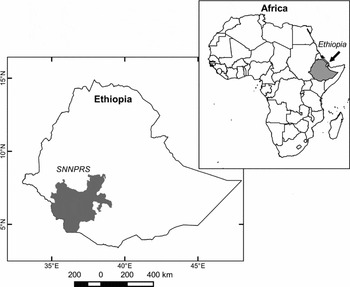
The Sidama zone (5º45’–6º45’ N; 38º15’–39º E) in SNNPRS (Fig. 1) is 6538 km2 in area with a human population of 3.4 million. It is one of Ethiopia's most densely populated areas with an average of 521 persons per km2 (Admasu & Struik Reference Admasu and Struik2002), and over 1000 persons per km2 in some districts, including Shebedino and Dalle. Four kebele administrations (KAs; kebele, the lowest administrative unit in Ethiopia), Hawella Wondo, Gemetto Galle, Cheffa Cenni and Arenfema were chosen for the study. Approximately 93% of the population is rural and depends mainly on traditional subsistence agroforestry homegardens (Bofed 2008).
Map of the location of the Southern Nations, Nationalities and Peoples Regional State (SNNPRS) in Ethiopia (left) and location of Ethiopia in Africa (right).

These homegardens originated mainly from conversion of natural forests to agricultural land by local communities in order to meet their subsistence needs. Using traditional knowledge, farmers modified the native tree species composition by selecting and maintaining some species and planting new species important for household consumption. This meant clearing the undergrowth, which gradually created more space for enset (Ensete ventricosum), coffee (Coffea arabica) and other food crops (Fernandes & Nair Reference Fernandes and Nair1986; Kumar & Nair Reference Kumar and Nair2004; Tesfaye Reference Tesfaye2005). Some scholars claim that the agroforestry homegardens in SNNPRS have sustained the livelihoods of this growing population for centuries (Admasu & Struik Reference Admasu and Struik2001; Tadesse Reference Tadesse2002; Tesfaye et al. Reference Tesfaye, Wiersum and Bongers2010).
There are four types of agroforestry homegardens based on composition and structure of dominant species in the system, namely enset-coffee-maize-khat, enset-coffee-maize, enset-coffee-maize-sweet potatoes, and enset-coffee-maize-khat-pineapple (Tesfaye Reference Tesfaye2005). The focus of our study was on the enset-coffee-maize-khat type of homegarden that is rapidly changing, mainly towards khat monoculture. In the study region, enset has traditionally been important for household food security (Admasu & Struik Reference Admasu and Struik2002; Almaz & Niehof Reference Almaz and Niehof2004), and coffee has been important for generating financial income (Tesfaye Reference Tesfaye2005). However, khat has become an economically important cash crop for rural households.
Interviews and focus groups
To understand the proximate causes of changes that directly impact the traditional land-use practice, qualitative methods were employed. These included key informant interviews, semi-structured household interviews and focus group discussions.
The purpose of the key informant interviews (Crabtree & Miller Reference Crabtree and Miller1992) was to gain informants’ views on changes in agroforestry homegardens. We selected key informants recommended by KA representatives and local agriculture development offices. In the study region, these governmental employees served as contact persons to reach communities in their respective KAs. We first presented the aim of the study and discussed with KA representatives the kind of local knowledge and expertise sought; the key informants then selected were (i) elders who had experience and traditional knowledge, (ii) former members of the selected KAs who actively participated in land distribution/redistribution in 1975 and 1986; (iii) present members of KAs involved in ongoing land registration and certification processes, and (iv) women from local households. The interview manual contained the questions: Are there any changes in traditional agroforestry homegardens? When did the major changes occur in the region? Why and who made the decision regarding change? What were the main reasons for changes? Have households been affected by the changes? Do the changes affect local communities? We conducted 24 key informant interviews, 12 of which were on farms where changes in traditional agroforestry homegardens had occurred.
Qualitative semi-structured household interviews were conducted with 60 respondents (31 women and 29 men) in 40 individual households. The households were proportionally selected to represent poor, medium and rich wealth categories of households, the wealth status derived from in a disaggregated list of each of the selected kebeles (KAs Archive Reference Archives2011). Each household interview was conducted at the respondent's home. Open-ended questions relating to the key issues of our study allowed the interviewees to go deeper into topics they deemed important. The questions included personal history of individual households; total and average farm size; ownership rights; household production; the major changes in land use; the causes and drivers of the changes; how the decisions on land use were made in each household; when and why the decision to change land use was made; and how farmers perceived their decisions and the changes that occurred. The interviews followed a clear structure, but also allowed flexibility, for example, between thematic and dynamic dimensions (Kvale & Brinkman Reference Kvale and Brikman2008). In most cases, husbands and wives were interviewed separately to capture individual understandings of land-use changes and their proximate causes. The interviews lasted on average 60–90 minutes.
Eight focus group discussions (Crabtree & Miller Reference Crabtree and Miller1992) were conducted, with members randomly selected from the KA memberships. Separation of the gender groups provided equal opportunity for women and men to elicit, confront and mutually check perceptions and opinions on the causes of changes in the traditional land-use system. The change in agroforestry homegardens and the causes identified during the household and key informant interviews were brought up to initiate the discussion. All interviewees were informed about the purpose, subjects and reasons of the research, and their participation was voluntary. The presence of kebele managers and local agricultural development agents facilitated the discussions and communication between researchers and respondents. The researcher (MG) moderated the discussion in order to give all participants the same space to articulate their opinions. Each focus group discussion lasted 1–2 hours.
In total, 84 interviews, including key informant (n=24) and semi-structured household interviews (n=60), and eight focus group discussions with 47 participants were conducted. Although the local language in the study area is Sidamifa, most respondents were easily able to communicate in Amharic; thus, the majority of the interviews were conducted in Amharic. Where the local Sidamifa language was used, a translator was employed to translate into Amharic. All interviews were digitally recorded, backed up by field notes and were later transcribed word for word.
Data on farm size, land ownership, and main agricultural and economic activities in the study area were obtained from the archives of the Agricultural and Development Office of the Sidama zone, the Bureau of Finance and Economy, the concerned KAs, and kebele agricultural and development offices. The demographic data were obtained from the archives of national and regional statistics offices. The data regarding distribution of major crops and the area occupied by food crops, cash crops, grazing area and living quarters in the households practising traditional agroforestry homegardens in the1990s and in 2011 were obtained from the archives of the studied kebele agricultural and development offices.
RESULTS
Trajectories of change in traditional agroforestry homegardens
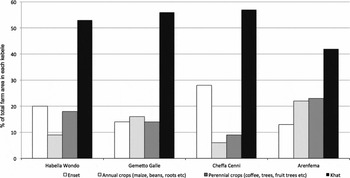
We distinguished three main trajectories of change in traditional agroforestry homegardens. The first was a transition from agroforestry homegardens towards khat monoculture since the 1990s. Only one household out of the 40 studied had begun growing khat for its own consumption in the 1980s, while the rest stated that they started khat cultivation in the 1990s predominantly for trade. Based on the semi-structured household interviews, 38 of the 40 households had increased farm area allocated to khat monoculture since the 1990s, and the area used for the main crops (enset, annuals and perennials, including trees) decreased accordingly (Fig. 2). Land registration and certification in the selected kebeles showed that in 2011 khat, on average, covered more than 50% of homegardens. Thus, dominant components such as enset, maize, beans, roots, tuber, fruit trees (Cordia africana, Albizia gummifera and Millettia spp.) and coffee had gradually declined due to the expansion of khat. Shrinking areas allocated for traditional food crops and grazing land for dairy production resulted in decreased food availability in local communities. Respondents indicated that the present shortage in local food market supply and the increase of food prices were associated with a decline in farm food production. One of the key informants said that ‘Traditionally urban people were coming to our local market to buy food crops at a cheaper price but now the situation is changing and we are going to urban markets for cheaper food’.
Percentage of land area under the major traditional crops (enset, annual crops and perennial crops) and khat in agroforestry homegardens in the four kebele administrations in 2011.

The second trajectory of change was adaptation of traditional agroforestry homegardens to new socio-economic conditions. For example, although most household interviewees characterised khat as a crop that could not be grown together with other crops, one respondent demonstrated his successful experience of intercropping khat with subsistence food crops. He also included beekeeping to diversify and increase the economic benefits from his farm. According to the focus groups and key informant interviews, other farmers had successfully combined khat cultivation with other crops, and this practice might be a way to adopt traditional homegardens to current socio-economic conditions. However, most of the household respondents confirmed that because of the limited association of khat with other crops and the small sized farm they had, khat monoculture was more effective.
The third trajectory was a return to traditional homegardens after practising khat monoculture. One respondent reported that he changed his 20-year old khat farm back to a traditional homegarden after recognizing that his household was challenged by food supply. The key informants reported similar experiences. Returning to traditional farming practice was considered an important means to increase household nutrition and food supply. In the focus group discussions, participants confirmed that some farmers wished to go back to traditional farming, however, they acknowledged a risk of limited household food supply during the transition back to traditional farming.
Proximate causes of change
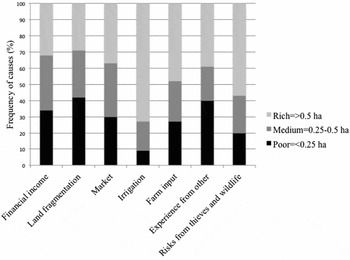
Changes in agroforestry homegardens were the result of multiple proximate factors (Fig. 3). Factors provoking changes in traditional farming that were most frequently mentioned by the respondents during the household and key informant interviews and focus group discussions were (1) higher financial income for households from khat than from traditional cash crops, (2) farm size declining due to farm land redistribution and division, (3) favourable market conditions for khat, (4) access to irrigation important for khat production, (5) limited supply of farm inputs (fertilizer and seeds) for food crop production, (6) positive experience of others in gaining high financial income from khat trading, and (7) increasing losses of food crops due to theft and wildlife.
Frequency of interviewee’s perceived proximate causes of change in traditional agroforestry homegardens by land holding area.

Higher household financial income from khat trading was the most frequently mentioned cause of change regardless of wealth status. One farmer explained the economic importance of khat based on his own experience ‘The maximum income that I ever received for production of food crops from my garden was no more than Birr 2000 per harvest while now I am getting up to Birr 80 000 from the same farm due to cultivation of khat’. According to the respondents, since 1991, during the transition from socialistic to market economy, the government removed subsidies for provision of fertilizers and seeds for food crop production. The financial income from coffee as a traditional cash crop was not enough to cover household expenses, including the government tax for farmland. At the same time, while household financial income from coffee and other crops per unit area was more or less stable, the prices and market demand for khat increased. Since farmers did not consider the risk of seasonal price fluctuations of khat (e.g. low price in the rainy season) a challenge, since the 1990s they have predominantly been growing khat in their traditional homegardens without combining it with other traditional crops.
Decrease of individual farm size due to farmland redistribution to meet the needs of the growing population was considered as the second most important cause of change in the study area. The majority of the studied households had been subjected to land redistribution among community members and among siblings as advance inheritance (intra-household division of land) from father to son during marriages. For example, a poor farmer in Gemetto Galle kebele who had split his 0.25 ha of land among his four sons now used only 0.05 ha. According to KA records (KAs Archives Reference Archives2011), the average household farm size of 1.8 ha in the 1990s had declined to 0.24 ha by 2011 in the study region. According to the interviewees, the minimum size of farmland that can provide sufficient amounts of food for a family of six members was 1.5 ha. Farmers, development agents and KA council members confirmed that shrinking farmland holdings were a cause of changes, it being difficult to mix trees, livestock, and annual and perennial crops on less than 0.2 ha of land. One respondent stated that ‘It is only our number that is growing, not the farm size. Before I was using my whole farm for livestock, enset and crop production, but after sharing it with my two sons when they got married, it became too small for production of both subsistence and income generating crops, therefore I decided to convert it to khat’. As the land holdings gradually became too small to provide adequate amounts of food, especially for poor farmers, khat became a source of higher household financial income.
Another important proximate cause of change, according to the respondents, was a considerably improved market for khat. For example, the number of local and regional markets for khat had increased during the previous decade. The strong trade networks between farmers, brokers and traders of khat also played a role in timely transportation and distribution of khat to the different market centres. The farmers in the study area stated that the price of khat had been increasing, with increasing product proximity to the highway and market.
Access to irrigation was an important factor when it came to the cultivation of khat as a cash crop. This factor was rated as important among the rich farmers, while it was relatively less important for the medium-poor farmers. One rich informant stated that ‘In 2011 I harvested khat three times and the income from khat significantly increased because the land was irrigated’. In irrigated farms, there were 3–4 harvests of khat per year while non-irrigated farms were harvested only 1–2 times. Khat products from irrigated farms gave farmers an advantage during the dry season, farmers were able to sell high quality khat to meet seasonal demand and get a higher price due to the limited supply.
Under reforms towards a market economy, decreased governmental subsidies for fertilizer and quality seeds for food production had had a negative impact on food production by households. Use of agricultural inputs had become unaffordable for most household farms. One of the key informant interviewees said that ‘Our traditional farming is much spoiled by the use of chemical fertilizers and hybrid seeds, therefore it became difficult to improve the productivity of our land using traditional organic fertilizer and local seeds. Besides, the income that we are generating from production of subsistence food crops is inadequate to cover the increasing price of fertilizer and high quality seeds’.
Some farmers who benefited from khat production became examples of wealthy families in their kebele. Interviewees mentioned that khat farmers had been able to improve their living conditions, afford better clothing and improve their social status. Therefore more farmers in these kebele had begun converting their farmland to production of khat regardless of their farm size. One poor farmer in Arnefema kebele said that ‘The positive experience of farmers who receive much more money from khat and now lead a better life convinced me to change my traditional way of farming’.
Some respondents mentioned that, at present, theft and wildlife had stronger negative impacts on household food production than in the past. Respondents rated theft and wildlife (wild pigs, baboons and warthogs) impacts similarly, because both damaged farm products and were difficult to control. Before the 1990s the risk of theft and wildlife damage on individual farms was affordable because of the large cover of food crops over a large number of farms. However, as the area of food crops had declined with the expansion of khat, and consumption of food had increased due to the growing population, the impact of theft and wildlife had become a challenge for farmers who were still maintaining traditional agroforestry homegardens. One of the household interviewees explained ‘Although damages from theft and wildlife are not new in the area, its negative impact on food availability in an individual farm has become more significant now due to the replacement of food crops by khat’.
DISCUSSION
Underlying driving forces of change in traditional agroforestry homegardens
The change in agroforestry homegardens in the Sidama zone has been conditioned and promoted by the increasing market and economic value of khat. The financial income from khat production is mainly challenged by seasonal price fluctuations, particularly the cheap price in the rainy season. Our study shows that farmers had been encouraged to grow khat since the 1990s by the increasing market demand and prices of khat in comparison with the decreasing relative market value of coffee and food crops. The export of khat has increased sharply since the 1990s. Khat's economic importance is greater than other annual and perennial food crops in Ethiopia (Gessesse Reference Gessesse2013). The major expansion of coffee production in Vietnam and Brazil significantly increased the supply of coffee on the world market and resulted in the global coffee crises of 1998 (Osoria Reference Osoria2002). According to the interviews, the global decrease in market price of coffee significantly affected household income and production of this traditional cash crop in the study area as coffee accounted for c. 40% of all traditional crops before the expansion of khat (Bofed 2007, 2008). The farmers considered the production of khat as a livelihood strategy to compensate for declining household income from food crops and coffee (Osoria Reference Osoria2002; Taye & Aune Reference Taye and Aune2003; Belwal & Teshome Reference Belwal and Teshome2011). Following the global coffee crises, average coffee export from Ethiopia dropped from 70 to 35% of total export earnings in 2000, while the official total export income from khat increased by 13%. In Southern Ethiopia the price of khat in the local market increased 500% (from Birr 9 to Birr 45) between 1991 and 2000, which led to the establishment of 20 new khat markets within a 300 km radius (Gessesse & Kinlund Reference Gessesse and Kinlund2008). The demand for khat in Horn of Africa and Arabian Peninsula countries has driven up both price and levels of khat production (Klein et al. Reference Klein, Beckerleg and Hailu2009; Klein & Metaal Reference Klein and Metaal2010; Klein et al. Reference Klein, Metaal and Jelsam2012). Increasing local and foreign market demands have thus contributed to widespread production of khat (Guesh Reference Guesh2012). The Ethiopian government has encouraged the export market of khat, which has become a nationally important export product. For example, the Ethiopian government honoured khat traders for their contribution in securing foreign currency (Gessesse Reference Gessesse2013). Since the 1990s, besides the income generated from tax, the export earnings from khat have increased from US$413 million in 2003/04 to US$7.4 billion in 2009.
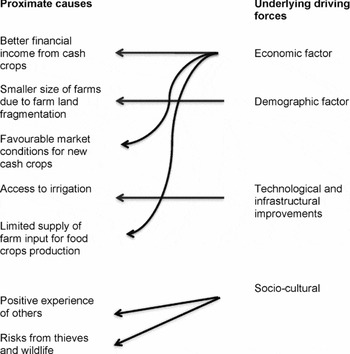
The transition from multifunctional traditional agroforestry homegardens to khat monoculture thus results from individual and social responses to changing local economic conditions mediated by economic factors on national and global levels. Economics has been the underlying driver of change that underpins the change in traditional agroforestry homegardens (Fig. 4).
Changes in traditional agroforestry homegardens in Ethiopia: multiple proximate causes of expansion of khat and decline of traditional land uses operating at local level underpinned by multiple underlying driving forces of change at regional and national levels.

Development of khat cultivation in Ethiopia coincides with governmental policy in favour of a market economy from 1995 (Belwal & Teshome Reference Belwal and Teshome2011). The policy broke the government control over sale of agricultural products and facilitated farmers’ free access to markets and the number of markets for khat increased. Changes in political power have also resulted in changing land ownership rights, land policy and institutions in Ethiopia. For example, ongoing land fragmentation as a result of policy changes has played a significant role in shaping the traditional homegarden agroforestry system by influencing the traditional farm size through land distribution and redistribution.
Human population growth in the Sidama zone has led to the decrease of farm size due to both redistribution of farmland by KAs to meet the need of landless farmers and division of farmland among household family members, predominantly from father to son. At the national level, rapid population growth has been recognized as a major challenge to poverty reduction. Therefore, efforts have been made by the government to reduce the fertility rate to four births per woman by 2010 (Ringheim et al. Reference Ringheim, Teller and Sines2009). For example, the 1993 National Population Policy had a target of increasing the use of contraceptives from 4% in 1990 to 44% by 2015. Controlling population growth through the implementation of the 1993 policy would minimize future land fragmentation in Ethiopia. Risk of theft is also associated with population growth and the limited production of food crops to support the growing food demand in the region. Demographic growth due to a high birth rate and immigration has increased numbers of land users and consumers.
Technological and infrastructural factors at different levels (e.g. road network, irrigation and mobile phones) have also driven land-use change to khat production. Village road networks that connect farms to the main highways have contributed to efficient transportation and trade of new cash crops, and together with farm gate, small kiosk and local market sales have facilitated the khat trade. Expansion of the road network and air transportation had made khat available well beyond the original khat belt. It is now available in Canada, the USA, the UK, and the Netherlands (Ezekiel Reference Ezekiel2010).
The number of consumers and the consumption of khat have been steadily increasing in Ethiopia. Farmers cultivating khat and those involved in processing and trading in the study area have become consumers as well. Both cultivation and consumption of khat including the provision and consumption in small kiosks in the surrounding small villages is a recent phenomenon that has contributed to the cultural shift. In a few decades, khat has evolved from consumption within limited social groups for religious and cultural occasions to a visible and pervasive social habit distributed over all social groups in Ethiopia (Ezekiel Reference Ezekiel2008). Based on data from the focus group discussions, most rural teenagers employed in harvesting, processing and bundling khat have become consumers, their involvement in khat being linked to dropouts of school children in rural Ethiopia (Gessesse Reference Gessesse2013). The drivers of proximate causes of change in traditional practices are numerous (Fig. 4).
Consequences for rural households
Geist & Lambin's (Reference Geist and Lambin2002, Reference Geist and Lambin2004) framework of complex interactions among emerging proximate causes of development trajectories, and the forces of underlying land-use change is a useful approach to systematic analysis of the decline of traditional agroforestry homegardens in Ethiopia. Previous studies on khat expansion in Ethiopia have analysed single factors, for example, the economic importance of khat (Ezekiel Reference Ezekiel2010; Klein & Metaal Reference Klein and Metaal2010; Klein et al. Reference Klein, Metaal and Jelsam2012; Gessesse Reference Gessesse2013). We identified multiple factors that operate at different levels of governance and determined the ongoing expansion of khat and decline of agroforestry homegardens locally. We discovered that only very few farmers have been able to cope by adapting their traditional farming practices to new economic, political and social contexts. Based on our results, we expect that intercropping and patch-cropping of khat in association with traditional agroforestry homegarden crops is an option to maintain the provision of multiple goods, services and values important for local livelihoods, and thus maintain traditional land use. There are opportunities to scale up such an adaptation strategy because it depends mainly on the land-use decisions of local households. However, as our study shows there are multiple factors that have a very strong impact on local strategies, and the majority of farmers have chosen a land use that leads towards a decline in traditional farming. We argue that this kind of qualitative study is needed for a deeper and more robust understanding of the land-use change process for better policy intervention. This is consistent with the need for place-based knowledge production and learning, an emerging tool for transdisciplinary problem-solving research (Angelstam et al. Reference Angelstam, Grodzynskyi, Andersson, Axelsson, Elbakidze, Khoroshev, Kruhlov and Naumov2013; Juujärvi & Pesso Reference Juujärvi and Pesso2013; Singh et al. Reference Singh, Haberl, Chertow, Mirtl and Schmid2013).
The ongoing changes in traditional agroforestry homegardens create both opportunities and challenges for rural livelihoods. Khat production increases the financial income of households and reduces the diversity of the traditional homegarden agroforestry system and the supply of food crops, both in households and local markets. Although financial income from khat is increasing, it is not adequate to cover the recent increasing price of food to meet household nutrition requirements and the income from khat is not fairly distributed among household family members. As the majority of households in the study area are not used to growing khat in association with traditional crops, the high diversity of multi-functional crop types of agroforestry homegardens that are important for socio-economic and ecological stability have been challenged by the monoculture cropping practice (Tesfaye Reference Tesfaye, Kumar and Nair2006).
Land ownership rights and gender power relations are the most important institutional factors in Ethiopia influencing rural development (Bereket 2002; EEA 2002). Land is an important asset for rural people, providing shelter, food, dignity and a means of accumulating resources (Rao Reference Rao2006; Meinzen-Dick Reference Meinzen-Dick2009). Changes in traditional homegardens have led to expansion of men's economic power through the production and trading of khat and reduction of the traditional role of women, establishing a new gender power relationship in rural society. Like in other traditional subsistence food production (Deere & Doss Reference Deere and Doss2006; Torkelsson Reference Torkelsson2007), women have been involved in all homegarden farming activities, in particular processing the main staple food (enset) and dairy products. Women also have responsibility for feeding the family adequately and generating extra cash income for miscellaneous household expenditures by selling surplus food crops and dairy products. However, a cultural taboo connected with khat prohibits women from entering khat farming; they have been completely excluded from its production and trading. The income from khat in the study area is controlled by men and is predominantly spent outside the family to meet men's personal needs in order to strengthen their status; women's access to products, decision making and bargaining power over fair and equal benefit sharing among family members has been reduced. Land-use changes elsewhere have also affected women's roles and access to income (Deere & Doss Reference Deere and Doss2006).
Ethiopian small-scale farming is considered to be the basis for national economic development; the livelihoods of 85% of the rural population depend on production of crops, livestock and trees (Bacha et al. Reference Bacha, Namara, Bogale and Tesfaye2011). Agroforestry homegardens have significantly contributed to economic growth, food security and poverty alleviation (Kabura & Doppler Reference Kabura and Doppler2005). The transition towards monoculture cultivation of khat has adversely affected the economic, ecological and socio-cultural benefits derived from Ethiopia's traditional homegardens (Tesfaye Reference Tesfaye2005; Gessesse Reference Gessesse2013). Understanding the complex relationships between proximate causes and underlying drivers of change is urgently needed for land-use policy intervention and decision making in order to move towards sustainable use of this important traditional practice. The increasing production of new cash crops is widening the gap between ecological, socio-cultural and economical values of the traditional farming system.
CONCLUSION
In Ethiopia, decline of traditional agroforestry homegardens is driven by multiple factors that operate at the local, national and global level. The main trajectory of land-use change, towards khat monoculture, is driving the traditional agroforestry homegarden towards a new type of agriculture that delivers mainly new cash crops. This creates both opportunities and challenges for rural development. Generally, cash crop production increases financial income of households, but negatively affects the supply of food crops to households and rural communities. Khat production challenges the implementation of national policies towards eradication of poverty and hunger. This place-based study is the first attempt to provide holistic understanding of the causes of this land-use change.
Financial, social and cultural support of traditional agroforestry homegardens should be a milestone in any regional program of sustainable rural development designed to maintain the cultural diversity and social stability of rural landscapes. The presence of traditional agroforestry homegardens would be a good practical indicator of success. However, this requires empowerment of stakeholders by development projects that encourage social learning.
ACKNOWLEDGMENTS
We thank the Foundation for Forest and Wood and the Swedish Research Council for Environment, Agricultural Sciences and Spatial Planning (Formas) for funding. We are grateful to Nataliya Stryamets for valuable comments. The field work in Ethiopia was greatly facilitated by the Wondo Genet College of Forestry and Natural Resources (Hawassa University).