1 Introduction
The rapid growth of the Internet and the proliferation of software programs that allow message exchanges between computers have created a new type of communication, Computer-Mediated Communication (CMC). Berge and Collins (Reference Berge and Collins1995) state that what is meant by this term is how people utilize networked computer systems to transfer, store, and retrieve information in an attempt to communicate with each other. CMC can be categorized into synchronous and asynchronous modes according to the degree of time delay between the messages of two interlocutors. The synchronous mode (e.g., instant messaging, Internet relay chat) occurs in real time, whereas the asynchronous mode (e.g., emails, discussion boards) does not. In particular, SCMC, because of its similarity with oral communication, has attracted much attention in the Second Language Acquisition (SLA) field. Features of oral communication, such as short turns, immediacy, discourse informality, and many unnoticed grammar mistakes are also present in SCMC (Kern, Reference Kern1995; Smith, Reference Smith2003b; Sotillo, Reference Sotillo2000). SCMC also shares some features with written communication, such as the amount of lexical density, the lack of intonation, the use of punctuation, and the possibility to monitor language production (Smith, Reference Smith2003b; Payne & Whitney, Reference Payne and Whitney2002; Warschauer, Reference Warschauer1997). In addition, SCMC exhibits some features that are not common in other communication modes, such as use of playful language, a special emphasis on leave-taking and greetings, use of abbreviated language, and use of punctuation, text format, and icons of emotions (i.e., emoticons) (Abrams, Reference Abrams2003; Chun, Reference Chun1994; Darhower, Reference Darhower2000; Negretti, Reference Negretti1999; Warner, Reference Warner2004).
Some empirical evidence so far has supported the pedagogical benefits of SCMC in terms of participation patterns (Beauvois, Reference Beauvois1992, Reference Beauvois1998; Kern, Reference Kern1995; Sullivan & Pratt, Reference Sullivan and Pratt1996; Warschauer, Reference Warschauer1996), quality of discourse (Chun, Reference Chun1994; Sotillo, Reference Sotillo2000; Warschauer, Reference Warschauer1996), and motivation (Beauvois, Reference Beauvois1992; Warschauer, Reference Warschauer1996). Research has also shown that, during SCMC-based interaction, learners draw each other’s attention to linguistic form. To date, Negotiation for Meaning (NfM) (Blake, Reference Blake2000; Blake & Zyzik, Reference Blake and Zyzik2003; de la Fuente, Reference de la Fuente2003; Kitade, Reference Kitade2000; Lee, Reference Lee2002; Pellettieri, Reference Pellettieri2000; Smith, Reference Smith2003a; Tudini, Reference Tudini2003) has been used as a coding system to document the instances of focus on linguistic form during learner-learner interaction. NfM is characterized by instances where there is a problem with message comprehensibility. However, several SCMC studies (Blake, Reference Blake2000; García & Arbelaiz, Reference García and Arbelaiz2003; Kitade, Reference Kitade2000; Lee, Reference Lee2002; Morris, Reference Morris2005) showed that learners draw attention to form in instances where there is no apparent communication problem by correcting their own, as well as their partners’ errors, and by talking about the meanings of words and offering metalinguistic explanations about language forms. Therefore, there is a need for research to account for all those instances where learners draw their attention to form, regardless of whether those instances are triggered by message incomprehensibility.
2 Background literature
2.1 Interaction through SCMC
It is widely accepted that conversational interaction plays an important role in SLA (e.g., Gass, Reference Gass1997; Long, Reference Long1996; Pica, Reference Pica1994) by providing learners with comprehensible input, which is necessary, but not sufficient, for language learning, as well as negative feedback, which helps language development by showing learners what is not permissible in the L2 (Long, Reference Long1996). In addition, interaction can be of value to learners because it provides opportunities to produce output. Swain (Reference Swain1995, Reference Swain2005) proposed three functions of output. First, language production can help learners notice holes in their L2 knowledge, which may lead them to notice the gap between what they are able to produce and what is available in the input (Schmidt & Frota, Reference Schmidt and Frota1986). Second, language production allows them to test their hypotheses against target language norms. Finally, language production can lead learners to reflect on their own and their partners’ output and, thus, increase their metalinguistic awareness.
Motivated by Swain’s output hypothesis (Reference Swain1995, Reference Swain2005), a growing body of research (García Mayo, Reference García Mayo2002; Kowal & Swain, Reference Kowal and Swain1994, Reference Kowal and Swain1997; Lapkin, Swain & Smith, Reference Lapkin, Swain and Smith2002; Leeser, Reference Leeser2004; Malmqvist, Reference Malmqvist2005; Storch, Reference Storch1998, Reference Storch2001, Reference Storch2002; Swain & Lapkin, Reference Swain and Lapkin1998, Reference Swain and Lapkin2001; Williams, Reference Williams1999, Reference Williams2001) has used LREs to capture the instances where learners draw each other’s attention to form. LREs are “instances where learners may (a) question the meaning of a linguistic item; (b) question the correctness of the spelling/pronunciation of a word; (c) question the correctness of a grammatical form; or (d) implicitly or explicitly correct their own or another’s usage of a word, form or structure” (Leeser, Reference Leeser2004: 56). Several studies have shown that LREs and subsequent performance in post-test measures are positively correlated (e.g., Donato, Reference Donato1994; Loewen, Reference Loewen2005; Swain & Lapkin, Reference Swain and Lapkin1998, Reference Swain and Lapkin2001; Williams, Reference Williams2001).
Recent research investigating SCMC-based interaction has mostly focused on NfM instances. Therefore, the study of interaction in SCMC has been motivated by questions such as whether learners negotiate for meaning in SCMC-based tasks and what types of linguistic features attract negotiation (Blake, Reference Blake2000; Blake & Zyzik, Reference Blake and Zyzik2003; de la Fuente, Reference de la Fuente2003; Kitade, Reference Kitade2000; Kotter, Reference Kotter2003; Lee, Reference Lee2002; Pellettieri, Reference Pellettieri2000; Smith, Reference Smith2003a; Toyoda & Harrison, Reference Toyoda and Harrison2002; Tudini, Reference Tudini2003). Findings have revealed that learners in SCMC-based tasks do negotiate for meaning, but that the frequency of this type of talk is less than in Face-to-Face (F2F) communication (Chappelle, Reference Chappelle2004; Tudini, Reference Tudini2003). Lexical misunderstandings, rather than morphological or syntactic, have been reported as the main source of negotiation (Pellettieri, Reference Pellettieri2000; Smith, Reference Smith2003a; Tudini, Reference Tudini2003). As a result of problems with communication, learners may provide each other with corrective feedback at the level of lexis, grammar or orthography (Blake, Reference Blake2000; Iwasaki & Oliver, Reference Iwasaki and Oliver2003; Kitade, Reference Kitade2000; Lee, Reference Lee2002; Pellettieri, Reference Pellettieri2000; Toyoda & Harrison, Reference Toyoda and Harrison2002; Tudini, Reference Tudini2003). Regarding the nature of NfM, at least one study (Smith, Reference Smith2003a) has shown that the negotiation sequence is qualitatively different in SCMC and F2F communication because, in SCMC, turns are not necessarily contingent upon one another.
Less attention has been paid to instances of focus on form when there is no obvious communication problem. Several studies have shown that learners assist each other in language-related episodes that are not triggered by the communication breakdowns that characterize NfM. In García and Arbelaiz (Reference García and Arbelaiz2003), Kitade (Reference Kitade2000), Lee (Reference Lee2002), Thoms, Liao and Szustak (Reference Thoms, Liao and Szustak2005), learners explicitly asked the meaning of words, even when there was no need to repair the conversation. In Blake (Reference Blake2000), learners discussed language-related problems such as how to pronounce a word, how to mark the gender of a verb, and the correct aspect of a verb. Morris (Reference Morris2005) coded and counted instances of corrective feedback in learner-learner interaction. He identified negotiation of form, recasts, and explicit feedback as types of correction, and reported that negotiation of form was the most common type of feedback used by learners to deal with errors. Morris was only concerned with corrective feedback and, therefore, his study did not account for interaction episodes where discussion on formal aspects of the language is not triggered by an error.
2.2 The role of task type
Based on the Interaction Hypothesis (Long, Reference Long1996), several task features were claimed to promote language learning most effectively. Task features such as an information gap, a two-way information exchange, and a single outcome with a convergent goal were the most conducive to language learning (Ellis, Reference Ellis2000; Pica, Kanagy & Falodoun, Reference Pica, Kanagy and Falodun1993). According to Pica et al. (Reference Pica, Kanagy and Falodun1993), because jigsaw tasks meet all these criteria they “can be considered the type of task most likely to generate opportunities to work toward comprehension, feedback, and interlanguage modification processes related to successful SLA” (op. cit.: 21). In a jigsaw, learners have different pieces of information and they are required to share and combine them in order to complete the task.
A similar approach to evaluating tasks with respect to the benefits of interaction is based on Swain’s output hypothesis (Reference Swain1995, Reference Swain2000, Reference Swain2005) and on the consensus in the SLA literature that a focus on form in addition to a focus on meaning is necessary for successful SLA. Following this theoretical stance, tasks that generate more LREs provide better opportunities for learners to benefit from output through noticing, hypothesis testing, and metalinguistic reflection, as well as from subsequent input through implicit and explicit feedback. One of these tasks is dictogloss (Wajnryb, Reference Wajnryb1990), a “procedure that requires learners to reconstruct a short text after listening to it twice” (Ellis, Reference Ellis2003: 341). Swain and Lapkin (Reference Swain and Lapkin2001) predicted that a dictogloss involving the reconstruction of a modeled text would generate more LREs than a jigsaw involving the reconstruction of a picture story. They tested their hypothesis by comparing a dictogloss and a jigsaw carried out by 65 learners from two 8th grade mixed-ability French immersion classes in a pre-test/post-test comparison group design. The study involved, in order of implementation, a pre-test, a training session, a mini-lesson (i.e., explicit information on French pronominal verbs, a short video that modeled what learners needed to do during the tasks, the actual doing of the tasks, and a post-test that contained ‘tailor-made’ dyad-specific items. The results of the study could not demonstrate any task effects with regard to number of LREs. As Swain and Lapkin acknowledged, the sequence of activities in which the jigsaw and dictogloss tasks were embedded could have had confounding effects on the design of the tasks themselves. Furthermore, it is not possible to generalize their results to other tasks that have different content because they only used one instance of each task type.
In the case of online communication, only a few studies have explicitly addressed task effects (Blake, Reference Blake2000; Oscoz, Reference Oscoz2003; Pellettieri, Reference Pellettieri2000; Smith, Reference Smith2003a). Some of these studies (e.g., Blake, Reference Blake2000; Oscoz, Reference Oscoz2003) have tested and confirmed the prediction that jigsaw tasks create the most appropriate environment for negotiation work (Pica, Kanagy & Falodun, Reference Pica, Kanagy and Falodun1993). However, none of them has specifically addressed LREs as an effect of task type.
Given the claims about the importance of focus on form for successful SLA, there is a need to account for all instances of focus on form in learner-learner interaction, regardless of whether or not they occur as a result of a communication problem. LREs constitute an appropriate tool to investigate a variety of instances of focus on form because they capture a broad range of interaction features that can be taken as evidence of focus on form behavior. With respect to the effect of task type on focus on form, the relative handful of studies that have looked at task effects have not addressed the relationship between LREs and task type. Therefore, this descriptive study aims to investigate LREs in an online communication environment by looking at two different task types in an improved design that builds on Swain and Lapkin (Reference Swain and Lapkin2001). The study will address the following two research questions:
(i) Do L2 learners of English produce LREs in SCMC?
(ii) Are there any task effects on the number and/or characteristics of LREs?
3 Method
3.1 Participants
Ten adult intermediate ESL learners from an intensive English language program at a major Southeastern university in the US participated in this study. Participants were from various L1 backgrounds: French, Turkish, Korean, Japanese, and Spanish, and they had been placed into an intermediate-level class by the language program according to their TOEFL scores. Background questionnaires revealed that all participants were familiar with using MSN Messenger, but they were not familiar with collaborative editing software, such as MoonEdit. All but one rated themselves as having normal typing skills out of five levels (i.e., very slow, slow, normal, fast, very fast). The remaining student rated her skill as slow.
3.2 Software programs
One of the two software programs used in this study was MSN Messenger, which is an instant-messaging software program that provides multi-party text chat. The conversation window of the program is divided into two parts: a bottom part to input and send messages and a top part to read messages. In addition to text messaging, the program offers a range of sound and graphic features (e.g., emoticons) that allow users to express their feelings.
The second software program used in this study was MoonEdit, which is a cooperative multi-user text-editing tool developed by Tomasz Dobrowolski. This software allows the co-editing of a shared document in a SCMC environment. It enables the user to host a file for editing, while other users connect to and edit the file concurrently. Each user’s name is listed on the right side of the program in a different color. This color is also used to highlight the parts that are edited by that user. Every cursor movement and text change can be followed from each user’s screen. MoonEdit allows the modification of a previous entry through deletions, additions and corrections, whereas MSN Messenger allows no such changes once the message has been sent. Users of MoonEdit can view the history of changes from an edit session. This is especially useful for teachers who want to monitor the extent to which each student contributed to the document.
3.3 Tasks
In order to address the limitation of using one instance of each task type in the study by Swain and Lapkin (Reference Swain and Lapkin2001), this study used two jigsaw and two dictogloss tasks. An additional jigsaw and an additional dictogloss were administered in a practice session. The picture story for the practice jigsaw task was taken from Rollet and Tremblay (Reference Rollet and Tremblay1975) and the text for the practice dictogloss task was taken from Wajnryb (Reference Wajnryb1990). The jigsaw tasks that were used in the recorded task sessions were based on two eight-picture stories taken from Rollet and Tremblay (Reference Rollet and Tremblay1975).
Two sets of pictures, A and B, were created from each picture story. Form A and Form B included odd-numbered and even-numbered pictures, respectively. The level of cognitive complexity across the picture stories was controlled for by the use of a rating scale. Based on the task-based language teaching literature (Ellis, Reference Ellis2003), three dimensions of cognitive complexity were considered: type of relationship (Brown, Anderson, Shillcock & Yule, Reference Brown, Anderson, Shillcock and Yule1984)Footnote 1, amount of information (Brown et al., Reference Brown, Anderson, Shillcock and Yule1984Footnote 2; Robinson, Reference Robinson2001), and structuredness (Brown et al., Reference Brown, Anderson, Shillcock and Yule1984; Skehan, Reference Skehan2001)Footnote 3. A brief questionnaire including three Likert-scale items (each addressing one of the above-mentioned dimensions) asked respondents to rate the similarity between the picture stories. In a scale ranging from 1 to 5, overall similarity between the two picture stories with regard to cognitive complexity was 4.4 as an average.
The dictogloss tasks included the textual versions corresponding to the picture stories that were used for the jigsaw tasks (see Appendix B). Following Swain and Lapkin (Reference Swain and Lapkin2001), two texts, A and B, were created out of each picture story to control for content. The texts were built based on two native speakers’ spontaneous oral accounts of the picture stories. Their accounts were first tape recorded and then transcribed. Next, the two transcribed versions were merged to create one text for each dictogloss. The merged texts were then slightly modified in order to ensure a comparable level of textual difficulty between texts A and B. Level of difficulty was measured based on two readability text measures: Fog Index (FI), an index of clarity based on number of words and the proportion of three- or more syllable words, and Lexical Density (LD), a measure of the proportion of content words over total number of words. Because a higher number of three- or more syllable words meant a higher Fog Index (FI) score, by eliminating three- or more syllable words, the difference in FI between the texts was minimized. The FI for Dictogloss A was 6.79, and the FI for Dictogloss B was 6.61. The LD for Dictogloss A was 52.20%, and the LD for Dictogloss B was 52.29%.
3.4 Procedure
Four days prior to the study, a F2F practice session for each task type was carried out in order to familiarize participants with the two target task types. A computer-based practice session could not be arranged due to the unavailability of the computer lab. After the practice session, participants were randomly assigned into dyads, and then dyads were separated into two groups. On the day of the study, dyads performed the two target tasks, one jigsaw and one dictogloss, at an on-campus computer lab. The mini-lessons used in Swain and Lapkin (Reference Swain and Lapkin2001) were not integrated into the present study, in order to eliminate their possible attention-enhancing effect. Tasks were counterbalanced in order to control for any possible effects of order of presentation on task performance. Group 1, composed of three dyads, completed Jigsaw A, followed by Dictogloss B, whereas Group 2, composed of two dyads, completed Dictogloss A, followed by Jigsaw B. During the time while one of the groups listened to the text that was part of the dictogloss task, the other group waited outside the computer lab. The computer lab session took about one hour.
During the jigsaw, participants were only allowed to use MSN Messenger. They were instructed to explain the contents of their pictures to their partner, put the pictures in order, and write down the story using MSN Messenger. The pictures were displayed on the computer screen. During the dictogloss, participants used a combination of MSN Messenger and MoonEdit. First, since learners could not carry out practice tasks using MoonEdit and were unfamiliar with the software, the researcher explained the basic functions of the program prior to the administration of the task. Later, participants listened to the text and were instructed to jot down notes to help them reconstruct the original text later on in MoonEdit. Because the existing equipment in the computer lab was insufficient to play audio files, the dictogloss texts were read by the same teacher to both groups at normal speed instead. Special care was taken not to modify the speed to make comprehension easier. Although both software programs were open on learners’ desktops at all times, each of them was allocated for different purposes. Learners were instructed that the final product (i.e., the reconstruction of the story that was read to them) should be completed using MoonEdit. Learners put their notes in the MoonEdit workspace and then collaboratively edited and elaborated the text accordingly. Because MoonEdit does not distribute turns in a chat window and only provides a workspace to work on a document, MSN Messenger was used to mediate the conversation between learners. Each learner sitting at a computer had the following files open for him/her on the computer desktop: instructions for the tasks (a Microsoft Word file), a MSN Messenger chat window connected to their assigned partner’s account, a MoonEdit collaboration window, and a picture file (.jpg format) that contained four of the eight pictures used for the jigsaw tasks. Participants were given 30 minutes to complete each task.
3.5 Data coding
Chatscripts were coded for LREs. An LRE was defined as an episode where at least one of the learners identifies a need or problem about language and resolves it either explicitly, with the use of metalanguage, or implicitly, by means of a recast. This study excluded self-corrections and focused on those instances that occurred as a function of the interaction between the learners.
Two independent raters coded the totality of the data and reached 80% agreement in the identification of LREs. All disagreements between raters were discussed and resolved. The raters then individually sorted LREs into three categories; language focus, verbalization and outcome (see Table 1). Cohen’s kappa scores were calculated for each category to determine the level of agreement between the two raters. For language focus k was .92, for verbalization, .90, and for outcome, .79.
Categorization of LREs

Language focus could be lexical or grammatical. LREs were coded as lexical when learners talked about the meaning or spelling of lexical items, or when they provided recasts on misspelled words. An example of lexical LREs is given below.
Episode 1: Lexical LRE
A: mommy makes jam
A: maybe
…
B: what does jam means?
A: when we eat bread
A: between two bread
B: alright
LREs were coded as grammatical when learners addressed a grammatical issue, such as comparative and superlative forms, plural and possessive markers, possessive pronouns, word order, subject-verb agreement, verb form, and verb tense. The example below illustrates a grammatical LRE addressing the choice of verb tense and the use of articles.
Episode 2: Grammatical LRE
A: I think that he catch a fish
B: Mmmm
B: I don’t think so
B: because
B: he is going to catch fish
Verbalization was further subdivided into explicit and implicit. Explicit LREs included metalanguage without necessarily involving the use of grammatical terms. They often started with a concern of one of the learners, who bid for assistance or made a suggestion on a language-related issue from the point of view of its appropriateness or correctness. Episode 3 illustrates an explicit LRE with grammatical terminology.
Episode 3: Explicit LRE
A: verb tense is not good
B: which one
B:?
A: mama makes
In implicit LREs, language-related issues were addressed without building metalinguistic talk around them. They often involved other-correction in the form of a recast, as in the example below.
Episode 4: Implicit LRE
A: the man is talling something to sombody
B: Your third picture is: the man is telling something to somebody
Finally, outcome was further subdivided into three subcategories following Swain (Reference Swain1998): solved correctly, problem not solved or disagreement about the problem solution (unresolved) and problem solved incorrectly. An LRE was correctly solved when the correct target language form or an appropriate explanation for it was provided. Episode 5 illustrates a correctly solved LRE.
Episode 5: Correctly solved LRE
A: No. he is making barbeqoe
A: the fishes that he catched
B: where is barbeque?
B: I can’t find barbeque
B: he doesn’t have any equipment to making any barbeque
…
A: because on the right top part
A: I got a man that cooking barbeque
An LRE was considered unresolved when learners dropped the topic because they either could not find an answer to the problem or could not agree on a solution. Instances where one learner’s attempt to start an LRE was unnoticed by the other learner were coded as unresolved as well. In Episode 6 below, Participant A tried to bring up a question about his use of a preposition. However, Participant B did not seem to notice this question and the problem was left unresolved.
Episode 6: Unresolved LRE
A: I agree to you.
A: with?
B: let’s go to the French lunch now because they stop serving at 1.15
An LRE was incorrectly solved when the learners agreed on a solution that was not target-like or when they provided an incorrect explanation. Episode 7 below illustrates an incorrectly solved LRE.
Episode 7: Incorrectly solved LRE
A: what does gum mean?
…
B: gum is used when you want to kill someone.
4 Results
This study set out to examine the extent to which learners would generate LREs during SCMC-based interaction and the role of task type in the amount and characteristics of LREs. Table 2 displays the number, mean, median, and standard deviation of the LREs produced by the five dyads in ten chatscripts as a result of the implementation of the two task types. Overall, a total of 25 LREs were identified. Results showed that the extent to which the dyads focused on form was determined by task type. A non-parametric test was used because the normality assumption could not be met. A Wilcoxon signed-ranks test indicated that the number of LREs generated by the dictogloss was significantly higher than the number of LREs generated by the jigsaw (Z = 2.03, p < .05).
LREs by task type

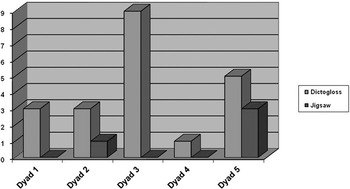
Although all the dyads produced LREs while performing the online tasks, the distribution of these LREs per dyad was uneven, as shown in Figure 1. While three dyads did not create any LREs during the jigsaw tasks, all the dyads created LREs during the dictogloss tasks. In addition, Dyad 3 produced the highest number of LREs during the dictogloss task and contributed most to the high standard deviation for both total LREs and dictogloss LREs.
Number of LREs by dyads

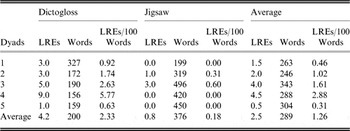
Table 3 displays the number of LREs, the number of words, and the number of LREs per 100 words. The number of words produced by the dyads differed depending on task type. The average number of words produced in the jigsaw (M = 376) was almost twice the average number of words produced in the dictogloss (M = 200). For this reason, LREs per 100 words were calculated by dividing the number of LREs by the total number of words multiplied by 100. This measure standardized LRE scores across dyads and allowed the comparison of the LRE counts of this study with other studies. A Wilcoxon signed-ranks test indicated that the LREs per 100 words were significantly higher in the dictogloss than in the jigsaw (Z = 2.02, p < .05).
Ratio of LREs to amount of learner production

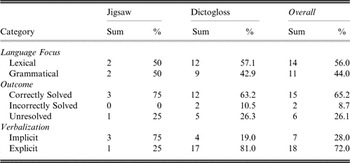
Table 4 provides information about the nature of LREs with respect to language focus, outcome, and verbalization. Considering the language focus of the LREs in both task types, lexical LREs were more frequent than grammatical LREs. In terms of task type, the jigsaw elicited as many lexical as grammatical LREs, whereas the dictogloss elicited more lexical than grammatical LREs.
LREs by Language Focus, Outcome, and Verbalization

Note. The outcome of two dictogloss LREs could not be determined.
LREs were overall more often successfully than unsuccessfully solved. As displayed in Table 4, 65.2% of the episodes were correctly solved by the dyads. Incorrectly solved episodes were in general not very frequent (8.7%), but unresolved episodes, where neither of the dyad members could provide an answer, or which were dropped, were 26.1% of the total. When task type was considered, the jigsaw had the highest percentage of correctly solved LREs (75%) and the lowest percentage of unresolved LREs (25%). No incorrectly solved episodes were identified in the jigsaw. The percentage of correctly solved LREs in the dictogloss task was 63.2% and the percentages of incorrectly solved and unresolved were 10.5% and 26.3%, respectively.
As regards degree of verbalization, explicitness was in general more frequent than implicitness in LREs. Overall, 72% of the episodes were explicit in nature. In terms of task type, the results for the dictogloss and jigsaw almost mirrored each other but showing reverse patterns. In the jigsaw, implicit episodes (75%) were more frequent than explicit (25%), whereas in the dictogloss explicit episodes (81%) were more frequent than implicit (19%).
5 Discussion
The first research question in this study asked about the extent to which L2 learners of English would produce LREs in SCMC-based tasks. Twenty-five instances of LREs showed that learners do produce LREs in a computer-based environment. In terms of LREs per 100 words, learners produced 1.26 LREs on average. This average can be compared to the number of LREs reported in two F2F studies. Swain and Lapkin (Reference Swain and Lapkin2001) and Leeser (Reference Leeser2004) reported higher LRE scores than the present study. When overall LRE score (jigsaw and dictogloss combined) is considered, the average in Swain and Lapkin was 9.0, whereas the average in the present study was 2.5. When only the scores for dictogloss are considered, the average in Swain and Lapkin was 9.2, and 6.5 in Leeser, whereas in the present study it was 4.2. Finally, the average for jigsaw in Swain and Lapkin was 8.8, whereas it was 0.8 in the present study.
On the face of it, there is a considerable difference in the number of LREs between F2F and SCMC. However, one should not be tempted to relate the number of LREs to communication mode. Because both Swain and Lapkin (Reference Swain and Lapkin2001) and Leeser (Reference Leeser2004) did not report on the ratio of LREs to learners’ language production (e.g., words, turns), it is not possible to establish to what extent the difference in number of LREs between F2F and SCMC is related to the amount of language production or to other dissimilar features between the two types of communication. It is not counterintuitive to suggest that learners will have more chances to produce LREs when they talk more. If this is true, then F2F communication has an advantage over SCMC because there is evidence in the literature that the overall amount of talk in F2F communication is more than in SCMC (Lai & Zhao, Reference Lai and Zhao2006). Possibly, the typing that SCMC requires increases production costs and decreases learners’ language production. According to Clark and Brennan (Reference Clark and Brennan1991), “the act of producing an utterance itself has a cost that varies from medium to medium. It takes little effort (for most of us) to speak or gesture, more effort to type on a computer keyboard or typewriter, and the most effort (for many of us, anyway) to write by hand” (op. cit.: 142–143).
The second research question asked whether there were any task effects on the number and/or characteristics of LREs. LREs were significantly more frequent in the dictogloss than in the jigsaw. Swain and Lapkin (Reference Swain and Lapkin2001) hypothesized that the dictogloss task would elicit more attention to form and, therefore, a greater number of LREs. However, the results of their study did not support their claim. The results of the present study do support Swain and Lapkin’s claim. An important difference in task implementation may have caused this inconsistency between the findings of the present study and Swain and Lapkin’s. While Swain and Lapkin gave mini-lessons to learners prior to the doing of the actual tasks, the present study did not. Swain and Lapkin argued that these mini-lessons, in which explicit information about the target structure, French pronominal verbs, was given, could have increased students’ attention to form regardless of task type. In this study, on the other hand, mini-lessons were excluded, with the purpose of being minimally intrusive with learners’ focus on form. The exclusion of the mini-lessons from the present study may have resulted in the elimination of their so-called attention-enhancing effect.
In addition to differences in the number of LREs, results also indicated that the LREs generated by each task type differed with regard to degree of verbalization and outcome. In the dictogloss, learners addressed most of the LREs, 81%, explicitly. In other words, learners explicitly indicated by their use of metalanguage that their focus of interest was the linguistic code. In the jigsaw, three of the four LREs, 75%, were addressed implicitly, that is to say, without building any talk around the linguistic feature that was being addressed. The implicit LREs were reformulations of incorrect utterances of one learner by his/her partner, also known as recasts in the SLA literature. Given the claims about jigsaw tasks and recasts, it is not surprising that most LREs in the jigsaw task consisted of a recast. In jigsaw tasks, learners’ attention is on meaning (Pica et al., Reference Pica, Kanagy and Falodun1993; Swain & Lapkin, Reference Swain and Lapkin2001) and recasts match well with the meaning focus that has been claimed to dominate jigsaw tasks, given that they do not interrupt the flow of communication (Long, Reference Long2007). Regarding task differences in outcome, the results showed that the percentage of correctly solved episodes was higher in the jigsaw (75%) than in the dictogloss (63.2%). Three possible outcomes for LREs were possible in the context of the dictogloss task. LREs could be successfully solved (63.2%), incorrectly solved (10.5%), or remain unresolved (26.3%) due to the learners’ lack of agreement or lack of knowledge. In the jigsaw task, incorrectly solved episodes were not among the possible outcomes. LREs were either correctly solved (75%) or unresolved (25%). At this point, a possible link between the degree of verbalization and the type of outcome can be important. If there is a relationship between them, this could mean that a specific category of verbalization (i.e., implicit or explicit) may be associated with more correctly solved LREs and, therefore, that the task type that triggers more instances of that category of verbalization will bring more correctly solved LREs. This could explain the higher percentage of correctly solved LREs in the jigsaw because the jigsaw also produced a higher percentage of implicit LREs. Further research should definitely investigate the link between correctly solved LREs and the degree of verbalization. Ultimately, the feature that associates with more correct solutions should be more favorable, because any outcome other than correctly solved can be considered a missed opportunity for learning (Swain, Reference Swain1998).
6 Limitations and further research
Researchers and educators should be aware of some key limitations in interpreting the results reported above. The present study was carried out with a small group of ESL learners that was chosen in a non-random way. Greater subject sizes and a random-sampling procedure are needed to generalize these results more confidently to a larger population.
The present study did not use any tests to measure the effectiveness of LREs. Swain (Reference Swain1998) encouraged researchers to test “what learners actually do, not what the researcher assumes instructions and task demands will lead learner to focus on” (op. cit.: 80). To date, tailor-made tests based on the content of specific LREs were used to assess the effectiveness of LREs. However, these tests were not without problems (Loewen & Philp, Reference Loewen and Philp2006). Often, they lacked pre-tests, and the post-tests were not immediate. Future research should certainly test the effectiveness of LREs by paying more attention to fixing some of the weaknesses of tailor-made tests so far, and determining whether the quantitative difference between the tasks translates into greater benefits in terms of SLA.
7 Conclusion
This study has shown that LREs do occur during task-based SCMC. This finding substantiates the claims that SCMC offers potential for learners to attend to linguistic form (Smith, Reference Smith2003a; Warschauer, Reference Warschauer1997) and complements the findings of other SCMC interaction studies that showed that through meaning negotiation learners focus on form (Blake, Reference Blake2000; Blake & Zyzik, Reference Blake and Zyzik2003; de la Fuente, Reference de la Fuente2003; Iwasaki & Oliver, Reference Iwasaki and Oliver2003; Kitade, Reference Kitade2000; Lee, Reference Lee2002; Pellettieri, Reference Pellettieri2000; Smith, Reference Smith2003a; Toyoda & Harrison, Reference Toyoda and Harrison2002; Tudini, Reference Tudini2003). The study has added to our understanding of learners’ focus on form behavior through SCMC by documenting the instances where a form focus did not arise as a result of a communication problem. Given the claims that a focus on form is necessary for successful SLA (Doughty & Williams, Reference Doughty and Williams1998; Long, Reference Long1991, Reference Long1996; Long & Robinson, Reference Long and Robinson1998; Norris & Ortega, Reference Norris and Ortega2000; Swain, Reference Swain1995, Reference Swain2005), it seems that task-based interaction through SCMC meets this criterion for successful language learning.
This study has produced complementary findings to those of other SCMC studies that showed that task type could affect learners’ linguistic behavior (Blake, Reference Blake2000; Oscoz, Reference Oscoz2003; Pellettieri, Reference Pellettieri2000; Smith, Reference Smith2003a). It has provided some empirical support for Swain and Lapkin’s (Reference Swain and Lapkin2001) claim by showing that the dictogloss task, in which the learners used a combination of the MoonEdit and MSN Messenger programs, elicited a higher number of LREs than the jigsaw task, in which learners only interacted through MSN Messenger. Further research should pay closer attention to the following differences between task types with respect to the characteristics of LREs: (a) dictogloss LREs were characterized by explicitness, whereas jigsaw LREs by implicitness; (b) all three outcomes, correctly solved, incorrectly solved, unresolved, could be identified in dictogloss LREs, whereas only correctly solved and unresolved, but not incorrectly solved, could be identified in jigsaw LREs.
Our findings suggest that even commonly used chat software can promote attention to form. Task-based SCMC could be integrated into classes that meet online in a distance-learning environment or in F2F classes that want to take advantage of the motivational or focus on form advantages of SCMC environments. The two tasks used in this study allow for adaptations to meet a variety of classroom needs. For example, a recorded conversation, or lecture, could replace the text-based story used in the dictogloss. Similarly, written input, or fragmented pieces of a conversation or lecture, could replace the pictorial input in the jigsaw.
Appendix A. Task Instruction
Dictogloss Instructions
Now you are going to work in groups of two and you will reconstruct a story together that I will read to you. You will hear the story twice. While I read take some notes – words or phrases to remember the story. You can use either paper and pencil or a MS Word document to take notes (A Word doc is open on your desktop). Please, write it exactly as I tell you and try to use correct English. If you cannot remember the exact words and phrases use other words. Use MSN Messenger and chat with your partner. Use MoonEdit program to write the story itself. Both programs are open on your desktop. Just click on your partner’s name and start chatting.
Jigsaw Instructions
Now you are going to work in groups of two and you will reconstruct a story based on a series of pictures. There will be 8 pictures in total and one of you will have 4 of the pictures and the other will have the other 4 pictures. Without trying to look at each other’s pictures, you will tell your partner what your pictures contain. Then, you need to put the pictures in order and construct a story together. Try to use correct English. Remember putting the pictures in order is not enough you should write the story together. In this task, you will use MSN messenger to talk to your partner. MSN Messenger is open in your computer. Just click on your partner’s nickname and start chatting.
Appendix B. Dictogloss Texts
Dictogloss A
Early in the morning one day, seven o’clock, a little boy goes fishing and he is dreaming about the fish he is going to catch. He sits on the bank of the river, and he catches three fish. At noon, at twelve thirty he makes lunch and he cooks one fish over a fire. Later, he takes the other two fish to the fishmonger and he sells them. The fishmonger gives him two bucks for the two fish. He goes home in the afternoon and says to his dad, “I got two fish, I sold them and I got the money”. His dad says, “Wow, let’s go to the sporting store. I can get you a volleyball or a fishing pole, what do you want?” But the boy says, I don’t wanna have a volleyball and I don’t wanna have a fishing pole. I wanna have a gun.” His dad is unhappy with this idea and says, “A gun?”
Dictogloss B
One bright sunny morning, mama makes some jam. When she puts the jam bottle up on top of the cupboard, Junior is watching and he is pretty curious. Mother gets ready to go the store and Junior asks, “Where are you going?” She says, “I am going to the post office”. Junior waits until his mother is gone and checks to see what his father is doing. His father is reading a newspaper. He looks at the jar, but he is not tall enough to reach there. He takes the chair and puts it by the cupboard, and he gets a stool and he puts it on top of the chair. And he dangerously climbs on top of the chair and the stool to reach the jam. But before he can reach the jam he falls down. He starts crying; his father comes in and asks, “What are you doing here?”