INTRODUCTION
Diagnosed on the basis of kinetic tremor (Benito-León & Louis, Reference Benito-León and Louis2007), essential tremor (ET), a common movement disorder with a prevalence of 4% in adults age ≥40 (Dogu et al., Reference Dogu, Sevim, Camdeviren, Sasmaz, Bugdayci, Aral, Kaleagasi, Un and Louis2003; Louis & Ferreira, Reference Louis and Ferreira2010), is associated with heterogeneous cognitive functioning ranging from normal cognition to dementia [Benito-León, Louis, Bermejo-Pareja, & Neurological Disorders in Central Spain (NEDICES) Study Group, Reference Benito-León, Louis and Bermejo-Pareja2006a; Benito-León, Louis, Mitchell, & Bermejo-Pareja, Reference Benito-León, Louis, Mitchell and Bermejo-Pareja2011; Bermejo-Pareja, Louis, Benito-León, & Neurological Disorders in Central Spain (NEDICES) Study Group, Reference Bermejo-Pareja, Louis and Benito-León2007; Louis, Benito-León, Vega-Quiroga, Bermejo-Pareja, & Neurological Disorders in Central Spain (NEDICES) Study Group, Reference Louis, Benito-León, Vega-Quiroga and Bermejo-Pareja2010a; Louis, Rao, & Gerbin, Reference Louis, Rao and Gerbin2012; Sengul et al., Reference Sengul, Sengul, Yucekaya, Yucel, Bakim, Pazarcı and Özdemir2015; Thawani, Schupf, & Louis, Reference Thawani, Schupf and Louis2009]. While the majority of individuals with ET perform within the spectrum of normal cognition, there is accumulating evidence that they progress to mild cognitive impairment (MCI) and dementia at higher rates than age-matched controls (Benito-León et al., Reference Benito-León, Louis, Mitchell and Bermejo-Pareja2011; Bermejo-Pareja et al., Reference Bermejo-Pareja, Louis and Benito-León2007; Thawani et al., Reference Thawani, Schupf and Louis2009). Identifying the earliest manifestations of cognitive compromise and improving knowledge of cognitive progression in ET is important for diagnosis, prognosis, and treatment.
Toward these ends, examining the variability of performance in normal cognitive function may help identify early patterns of cognitive performance that predict MCI, dementia, or other disease outcomes in ET. In general, cognitive performance is considered to be within normal limits when no lower than 1.0 to 2.0 standard deviations (SDs) below the mean; normal performance is thus frequently defined as performance above a cut-off of −1.5 SD, corresponding to approximately the 7th percentile and extending up through the 99th percentile. Within this very broad spectrum, individuals can exhibit certain performance patterns or relative strengths and weaknesses across the domains of memory, attention, language, executive functioning, and visuospatial abilities (Chamorro-Premuzic, Von Stumm, & Furnham Reference Chamorro-Premuzic, Von Stumm, Furnham, Chamorro-Premuzic, von Stumm and Furnham2011; Salthouse, Reference Salthouse2004). Whether there are identifiable different patterns of performance among individuals with ET considered to be cognitively normal, and whether such patterns have relevance for heterogeneity in cognitive progression or the substrates of future cognitive decline, is not known.
With regard to clinically significant cognitive impairment in ET, executive dysfunction is most often noted (Frisina, Tse, Hälbig, & Libow, Reference Frisina, Tse, Hälbig and Libow2009; Gasparini et al., Reference Gasparini, Bonifati, Fabrizio, Fabbrini, Brusa, Lenzi and Meco2001; Higginson et al., Reference Higginson, Wheelock, Levine, King, Pappas and Sigvardt2008; Kim et al., Reference Kim, Song, Shim, Park, Yoo, Kim and Lee2009; Lombardi, Woolston, Roberts, & Gross, Reference Lombardi, Woolston, Roberts and Gross2001; Passamonti et al., Reference Passamonti, Novellino, Cerasa, Chiriaco, Rocca, Matina, Fera and Quattrone2011) and is thought to reflect alterations in the cerebello-thalamo-cortical loop (Deuschl, Wenzelburger, Löffler, Raethjen, & Stolze, Reference Deuschl, Wenzelburger, Löffler, Raethjen and Stolze2000; Middleton & Strick, Reference Middleton and Strick2000a, Reference Middleton and Strick2000b, Reference Middleton and Strick2001; Montgomery, Baker, Lyons, & Koller, Reference Montgomery, Baker, Lyons and Koller2000). However, cognitive impairment in ET is not homogeneous, and studies have documented deficits in memory, attention, and visuospatial abilities as well (Benito-León, Louis, Sánchez-Ferro, & Bermejo-Pareja, Reference Benito-León, Louis, Sánchez-Ferro and Bermejo-Pareja2013; Gasparini et al., Reference Gasparini, Bonifati, Fabrizio, Fabbrini, Brusa, Lenzi and Meco2001; Janicki, Cosentino, & Louis, Reference Janicki, Cosentino and Louis2013; Kim et al., Reference Kim, Song, Shim, Park, Yoo, Kim and Lee2009; Lombardi et al., Reference Lombardi, Woolston, Roberts and Gross2001; Louis, Reference Louis2010; Louis & Rao, Reference Louis and Rao2014; Mameli et al., Reference Mameli, Tomasini, Scelzo, Fumagalli, Ferrucci, Bertolasi and Priori2013; Sinoff & Badarny, Reference Sinoff and Badarny2014; Tröster et al., Reference Tröster, Woods, Fields, Lyons, Pahwa, Higginson and Koller2002). In fact, in a recent study of ET-MCI, more patients had amnestic (deficient in memory) rather than nonamnestic (deficient in other cognitive domains) presentations of MCI (Cersonsky et al., Reference Cersonsky, Morgan, Kellner, Robakis, Liu, Huey, Louis and Cosentino2018; Collins et al., Reference Collins, Rohl, Morgan, Huey, Louis and Cosentino2017). The presence of amnestic deficits in a subset of individuals with ET aligns with epidemiologic and pathological studies, suggesting that neurodegenerative disorders such as Alzheimer’s disease (AD) or other tauopathies may be more common in ET [Benito-León, et al., Reference Benito-León, Louis and Bermejo-Pareja2006a; Benito-León, Louis, Bermejo-Pareja, & Neurological Disorders in Central Spain (NEDICES) Study Group, Reference Benito-León, Louis and Bermejo-Pareja2006b; Benito-León et al., Reference Benito-León, Louis, Mitchell and Bermejo-Pareja2011; Farrell et al., Reference Farrell, Cosentino, Iida, Chapman, Bennett, Faust, Louis and Crary2019; LaRoia & Louis, Reference LaRoia and Louis2011; Louis, Benito-León, et al., Reference Louis, Benito-León, Vega-Quiroga and Bermejo-Pareja2010a; Louis, Benito-León, Vega-Quiroga, Bermejo-Pareja, & Neurological Disorders in Central Spain (NEDICES) Study Group, Reference Louis, Benito-León, Vega-Quiroga and Bermejo-Pareja2010b; Louis, Babij, Ma, Cortés, & Vonsattel, Reference Louis, Babij, Ma, Cortés and Vonsattel2013; Pan et al., Reference Pan, Lee, Honig, Vonsattel, Faust and Louis2014; Thawani et al., Reference Thawani, Schupf and Louis2009]. The nature and bases of cognitive symptoms in ET, as well as their longitudinal course, are thus seemingly heterogeneous.
This cross-sectional study utilized a cluster-based approach to characterize patterns of cognitive functioning among cognitively normal individuals with ET. Although we do not examine the specificity of cognitive patterns in ET, identifying clusters within an ET population may be useful as it may reveal subclinical patterns of performance that foreshadow the emergence of different types of cognitive impairment and different cognitive trajectories among individuals with ET. Identification of cognitive profiles was accomplished using k-means cluster analysis to group individuals by domain scores (memory, executive function, attention, visuospatial abilities, and language). k-means cluster analysis partitions subjects according to the variables under investigation (i.e., cognitive domain scores) into a given number of clusters such that each subject belongs to the cluster with the nearest mean. A secondary goal was to assess whether these patterns were associated with demographic variables or clinical features such as tremor severity, gait/balance difficulty, and/or depressive symptoms. The current analyses are a necessary first step in determining whether certain cognitive profiles have implications for progression to MCI, dementia, or other disease outcomes. Moreover, they may improve understanding of the bases of cognitive deficits in those with progressive cognitive decline versus those whose cognitive deficits remain relatively static.
METHODS
Subjects
Subjects were assessed using a cognitive test battery designed by a neuropsychologist (SC) as part of COGNET (Clinical-Pathological Study of Cognitive Impairment in Essential Tremor, NINDS R01NS086736), a prospective, longitudinal study of cognitive function in ET. Since July 2014, subjects have been clinically characterized over three assessments (baseline, 18 months, and 36 months); baseline data utilized for these analyses were collected from July 2014 through July 2016. Signed, written, informed consent was obtained upon enrollment from eligible subjects recruited online through study and International Essential Tremor Foundation websites. Subjects met each of the following criteria: (1) diagnosed with ET; (2) age >55 years; (3) no history of deep brain stimulation surgery; and (4) concurrent enrollment as a brain donor and agreement to complete study measures. Yale University and Columbia University Internal Review Boards approved study procedures.
Subjects were excluded from analyses if they fulfilled any of the following criteria: (1) diagnosis of dementia (n = 21), MCI (of any type, n = 35), or cognitive impairment related to substance use, stroke, or other injuries (n = 3); (2) diagnosis of Parkinson’s disease (PD), dystonia, or other non-ET causes of tremor (n = 32), for a final sample size of 148.
In-Person Assessments
Subjects were assessed during in-person study visits consisting of a clinical questionnaire, 19 neuropsychological tests, neuropsychiatric measures, and a videotaped neurological examination. The clinical questionnaire included demographic and clinical data on age, gender, ethnicity, and education as well as questions regarding medication usage, including those with cognition-enhancing, cognition-decreasing, and mood-modulating effects (determined by EDL). Additional questionnaires evaluated mood [Geriatric Depression Scale (range 0–30, higher scores indicate more depressive symptoms; Yesavage et al., Reference Yesavage, Brink, Rose, Lum, Huang, Adey and Leirer1982)], balance [the number of falls in past year and short Activities-Specific Balance Confidence scale (ABC-6; range 0–100, lower scores indicate less balance confidence; Peretz, Herman, Hausdorff, & Giladi, Reference Peretz, Herman, Hausdorff and Giladi2006)], and tremor experience [tremor duration and Tremor Disability Scale (range 0–100, higher scores indicate more disability; Louis et al., Reference Louis, Wendt, Albert, Pullman, Yu and Andrews1999)].
Diagnosis of ET was confirmed by a movement disorders neurologist (EDL) from the videotaped neurological examination using the Washington Heights-Inwood Genetic Study of ET diagnostic criteria (Louis et al., Reference Louis, Ottman, Ford, Pullman, Martinez, Fahn and Hauser1997), which requires moderate or greater amplitude kinetic tremor during three or more tests or head tremor in the absence of PD, dystonia, or other causes. These criteria have been shown to be reliable (Louis, Ford, & Bismuth, Reference Louis, Ford and Bismuth1998) and valid (Louis et al., Reference Louis, Wendt, Albert, Pullman, Yu and Andrews1999). Kinetic or postural tremor was rated (0–3) on 12 items, resulting in a total tremor score (range 0–36, higher scores indicate more severe tremor). For tandem gait assessment in the neurological videotape, individuals were asked to walk heel-to-toe in a straight line for at least 10 feet; the number of steps taken off a straight line was reported.
The cognitive test battery was designed to minimize disadvantage toward ET subjects with moderate or severe tremors by incorporating only tests whose scores had little to no reliance on motor functioning and discounting tremor-related difficulty on those tests requiring motor utilization (i.e., in the Token test, not considering an answer incorrect if a participant touches other tokens in addition to the target token because of their tremor). In addition to assessments of global functioning [Mini-Mental State Examination (Folstein, Folstein, & McHugh, Reference Folstein, Folstein and McHugh1975) and Montreal Cognitive Assessment (MoCA; Nasreddine et al., Reference Nasreddine, Phillips, Bédirian, Charbonneau, Whitehead, Collin, Cummings and Chertkow2005)], participants completed detailed tests across five domains including: (1) memory [California Verbal Learning Test II (Delis, Kramer, Kaplan, & Ober, Reference Delis, Kramer, Kaplan and Ober2000), Wechsler Memory Scale Revised: Logical Memory (Wechsler, Reference Wechsler1987), Wechsler Memory Scale IV: Verbal Paired Associates (Wechsler, Reference Wechsler2008)], (2) executive function [Wechsler Adult Intelligence Scale IV (WAIS-IV) Digit Span Backward (Wechsler, Reference Wechsler1997), Delis–Kaplan Executive Function System: Verbal Fluency Test, Color-Word Interference, Sorting, 20-Questions (Delis, Kaplan, & Kramer, Reference Delis, Kaplan and Kramer2001)], (3) attention [Oral Symbol-Digit Modalities Test (Smith, Reference Smith1982), WAIS-IV Digit Span Forward (Wechsler, Reference Wechsler1997)], (4) visuospatial abilities [Benton Judgment of Line Orientation (Benton, Sivan, des Hamsher, Varney, & Spreen, Reference Benton, Sivan, des Hamsher, Varney and Spreen1994), Benton Facial Recognition Test (Benton & Van Allen, Reference Benton and Van Allen1968), WAIS-IV Visual Puzzles (Wechsler, Reference Wechsler1997)], and (5) language [Multilingual Aphasia Examination: Token Test (Benton, des Hamsher, Rey, & Sivan, Reference Benton, des Hamsher, Rey and Sivan1994), Boston Naming Test (Kaplan, Goodglass, & Weintraub, Reference Kaplan, Goodglass and Weintraub1983)]. Raw scores of these assessments were converted to Z scores using published normative data according to age, gender, and/or education, which offer objective references against which we can compare individual performance, rather than relying on the heterogeneity of the specific sample to provide normative data (Busch, Chelune, & Suchy, Reference Busch, Chelune, Suchy, Attix and Welsh-Bohmer2006). We also chose our approach to enable classification of cognitive performance in relation to the expected level of performance among the “normal” population rather than in relation to sample-specific performance, which may or may not be within normal limits. A disadvantage of this approach is that normative scores are thus based on different samples for different tests rather than from a single sample. Nonetheless, this is the standard approach to interpreting neuropsychological performance in clinical settings. Z scores were considered to be “low average” when between −1.49 and −0.51, “average” when between −0.50 and 0.50, and “high average” when between 0.51 and 1.49. Domain aggregates were calculated using a selection of tests per domain meant to capture heterogeneous cognitive profiles by including tests that measured different subdomain attributes (i.e., incorporating immediate and delayed recall subscores to include both an index of verbal learning ability and a measure of delayed retention and forgetting rates). In the California Verbal Learning Test, both Total Recall and Long-Delay Free Recall were chosen to capture both immediate and delayed recall, but individual trials, Short-Delay Recall, and recognition hits were not included; additionally, number span length of the longest series were excluded for both forward and backward assessments.
Cognitive Diagnosis Assignment
Informants designated by participants were asked to assess functioning across the six Clinical Dementia Rating (CDR; Morris, Reference Morris1993, Reference Morris1997) dimensions (Memory, Orientation, Judgment and Problem Solving, Community Affairs, Home and Hobbies, and Personal Care; range 0–3, higher scores indicate more cognitive impairment) and completed the Lawton Instrumental Activities of Daily Living Scale (range 0–8, lower scores indicate less functional ability; Lawton & Brody, Reference Lawton and Brody1969). Aggregate CDR score was calculated according to informant and examiner impressions. Tremor-related disability was not included in scoring. If an informant was not available, CDR score was calculated according to examiner impression and participant self-report (n = 42, 28.4%).
Cognitive diagnoses (normal, MCI, and dementia) were assigned during a diagnostic case conference with trained experts (EDH, SC) using the CDR (Morris Reference Morris1993), and neuropsychological tests selected a priori for diagnosis of MCI, and clinical judgment, as described previously (Cersonsky et al., Reference Cersonsky, Morgan, Kellner, Robakis, Liu, Huey, Louis and Cosentino2018; Collins et al., Reference Collins, Rohl, Morgan, Huey, Louis and Cosentino2017). Within the group of individuals diagnosed as cognitively normal, subjects were assigned subdiagnoses to capture apparent differences among individuals at a global level, including: fully normal cognition (CDR = 0, z > −1.5 for all scores), test impairment of unlikely clinical significance, test impairment of possible clinical significance, and questionable/isolated functional impairment (CDR = 0.5, z > −1.5 for all scores).
Statistical Analysis
Domain aggregates (mean Z score per each of the cognitive domains) were calculated for each of the study subjects. Domains were first compared across subdiagnoses of this cognitively normal ET sample including those diagnosed with fully normal cognition (group 1, fully normal cognition) and those labeled as having test impairment of unlikely clinical significance, test impairment of possible clinical significance, and questionable/isolated functional impairment (group 2, not-fully normal cognition) using 2-sample t tests. k-means cluster analysis was then performed (Chiu, Douglas, & Li, Reference Chiu, Douglas and Li2009; Souza, Oliveira, Foss, & Tumas, Reference Souza, Oliveira, Foss and Tumas2016; Szeto et al., Reference Szeto, O′Callaghan, Shine, Walton, Mowszowski, Naismith, Halliday and Lewis2015) to identify the extent to which a set of specific cognitive profiles best described the overall sample, and bar graphs were generated, using SPSS 24 (IBM, Aramonk, NY, USA). Analysis was performed at a range of cluster numbers. Mean domain scores were compared across clusters using analyses of variance with Bonferroni corrections for post hoc analyses. For each cluster solution (i.e., two through five clusters), we calculated the number of significant differences in cognitive domain scores across clusters, correcting for multiple comparisons. The ideal cluster solution was defined as that which generated the highest number of significant differences in domain scores across clusters with the largest number of individuals per cluster (Bruehl, Lofland, Semenchuk, Rokicki, & Penzien, Reference Bruehl, Lofland, Semenchuk, Rokicki and Penzien1999; Hauser & Rybakowski, Reference Hauser and Rybakowski1997).
After determining the optimal cluster solution, individual neuropsychological test scores were compared within clusters using Kruskall–Wallis H-tests and between clusters using post hoc Mann–Whitney U-tests (non-normal distributions according to Kolmogorov–Smirnov test).
Demographic and clinical analyses were completed using Kruskall–Wallis H-tests (continuous variables) or Pearson Chi-Square Tests (categorical variables), and post hoc analyses were performed using Mann–Whitney U-tests or Pearson Chi-Square tests, respectively. Frequency of normal cognition subdiagnosis (fully normal cognition, test impairment of unlikely clinical significance, test impairment of possible clinical significance, and questionable/isolated functional impairment) was compared across cluster membership using a Fisher’s Exact Test. Values were considered significant if p < .05, unless otherwise stated. All analyses were performed using SPSS 24.
RESULTS
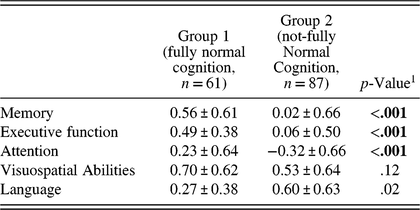
Comparison of “fully normal cognition” to “not-fully normal cognition” (group 1 vs. group 2) showed that memory, executive function, and attention domains significantly differed between these cognitively normal subgroups (Table 1).
Cognitive domain scores according to cognitive diagnosis

Note. Values are reported as mean ± standard deviation.
1 2-sample t test. Threshold corrected for multiple comparisons using Bonferroni correction; p < .01 is considered to be significant (indicated in bold).
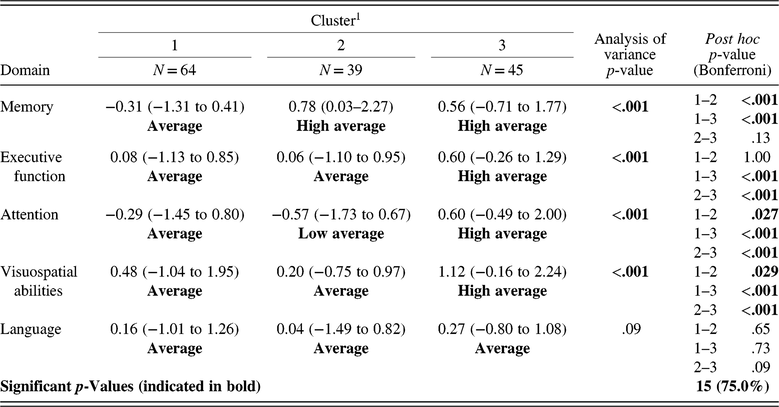
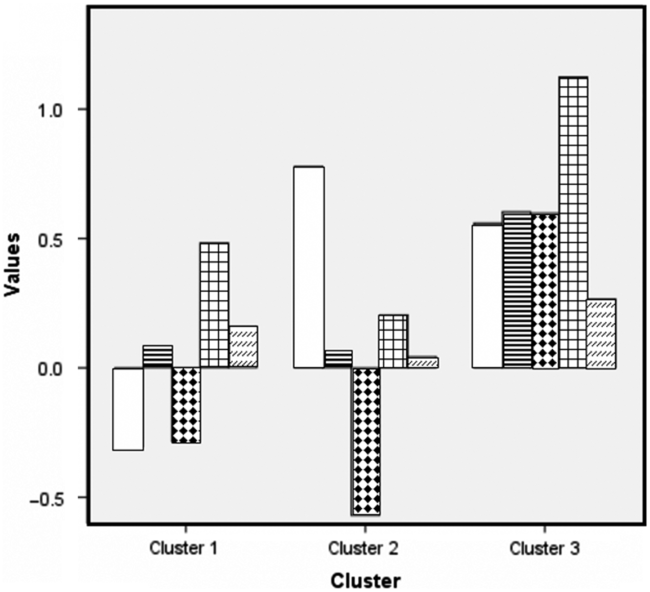
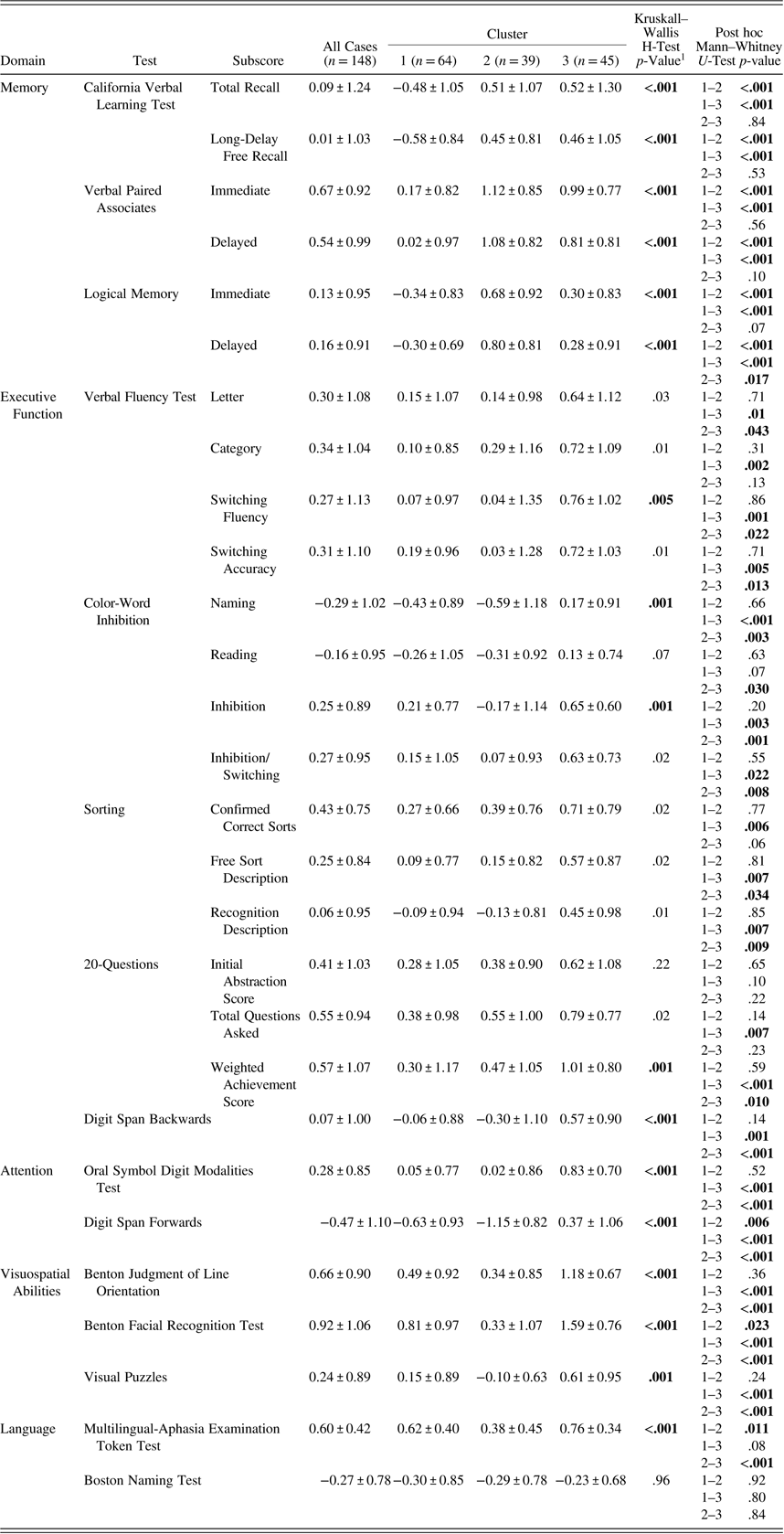
The three-cluster solution yielded the highest number of significant differences in cognitive domain scores (75%) across clusters in post hoc analyses (Table 2, Figure 1). Attention and visuospatial abilities were significantly different across all clusters, while memory and executive function differed only across two. Only language was comparable across all clusters. Cluster 1 (n = 64) was characterized by average performance in all domains, though memory was significantly lower than Clusters 2 and 3; Cluster 2 (n = 39) was characterized by high average memory, low average attention, and average executive function, visuospatial abilities, and language; and Cluster 3 (n = 45) was characterized by high average memory, executive function, attention, and visuospatial abilities, and average language. In comparing individual neuropsychological test scores across clusters, several tests across all domains emerged as significantly different (p < .0083, Table 3).
Comparisons with three clusters

1 Values are reported as mean domain score (range) per cluster.
Comparisons with three clusters. Cluster domain means;  = Memory Aggregate;
 = Executive Function Aggregate;
 = Attention Aggregate;
 = Visuospatial Abilities Aggregate;
 = Language Aggregate.

Cognitive profiles by neuropsychological test scores

Note. Values are reported as Mean ± standard deviation.
1 Threshold corrected for multiple comparisons using Bonferroni correction; p < .0083 is considered to be significant (indicated in bold).
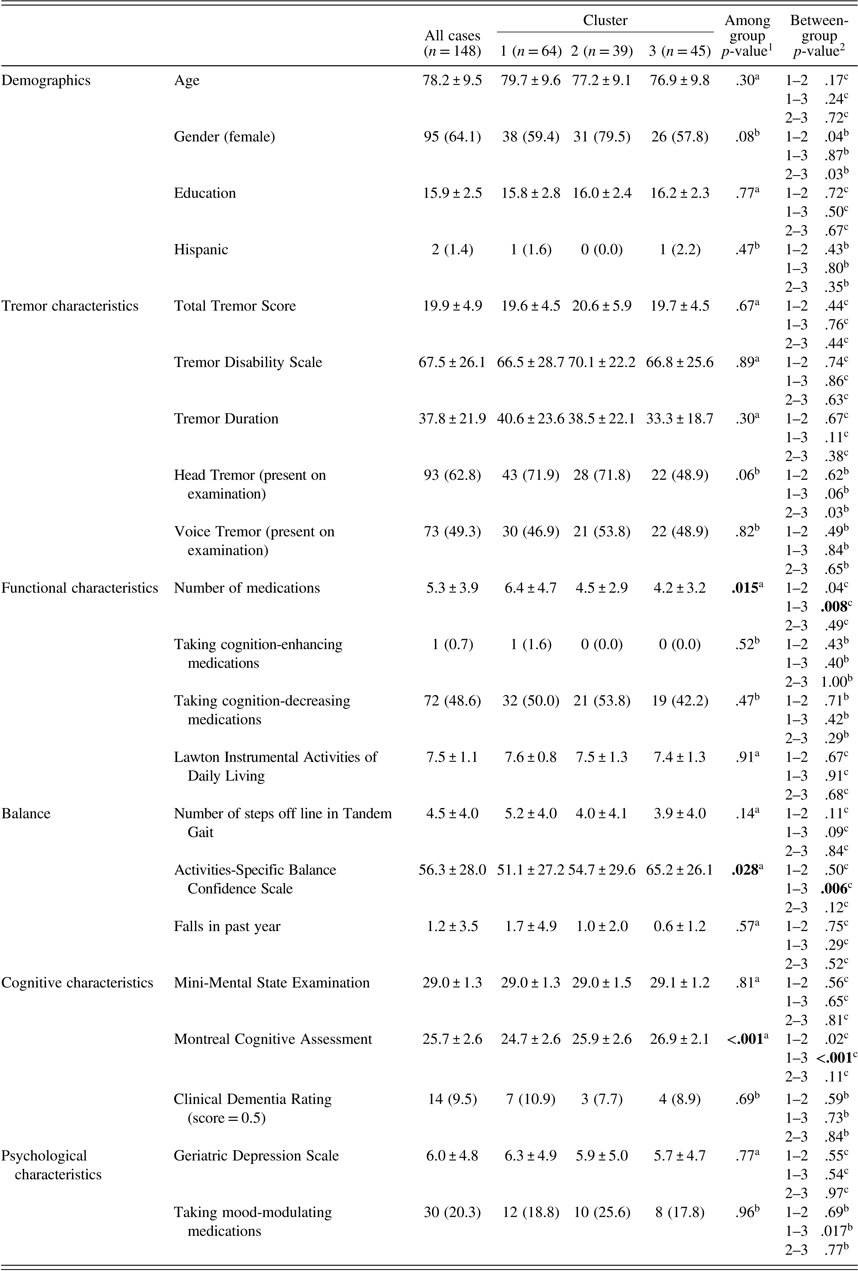
The clusters did not differ according to demographic (age, gender, education, and ethnicity) or tremor (total tremor score, Tremor Disability Scale, tremor duration, presence of head tremor, and presence of voice tremor) variables, nor did they differ with respect to the usage of cognition-decreasing or mood-modulating medications or levels of depression (Table 4).
Demographic and clinical characteristics

Note. All continuous values are given as mean ± standard deviation; all categorical values are given as number (percentage).
aKruskall–Wallis H-test; bPearson Chi-Square Test; cMann–Whitney U-Test.
1 Significant if p < .05 (indicated in bold).
2 Significant if p < .0167 (indicated in bold).
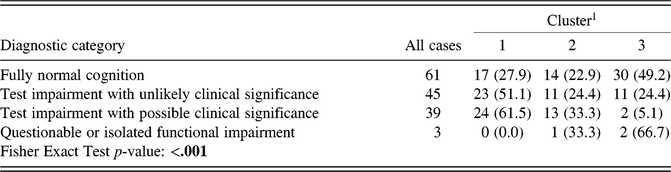
However, the number of medications, ABC-6, and MoCA were significantly different among clusters, with particular difference found between Clusters 1 and 3 (cluster 1 indicating more medications, lower balance confidence, and lower MoCA; post hoc p < .0167) in those variables. Additionally, the frequencies of cognitively normal subdiagnoses (fully normal cognition, test impairment of unlikely clinical significance, test impairment of possible clinical significance, and questionable/isolated functional impairment) were also significantly different across clusters (p > .001, Table 5). Specifically, there were more individuals with fully normal cognition in Cluster 3 (n = 30) than in the other clusters, and more individuals showing impairment of possible clinical significance in Cluster 1 (n = 24) than in the other clusters.
Cognitively normal subdiagnoses across clusters

1 Values are given as number (percentage of diagnostic category).
p-Value significant if < .05 (indicated in bold).
DISCUSSION
Cognitive Patterns
This study aimed to identify patterns of cognitive functioning among individuals with ET who underwent comprehensive cognitive testing and who were assigned diagnoses of normal cognition during clinical diagnostic consensus conference. Subtle cognitive differences in the same domains that appeared to drive cluster formation (i.e., attention, executive function, and memory) were observed even between those classified as “fully normal cognition” and those with test impairment of unlikely clinical significance, test impairment of possible clinical significance, and questionable/isolated functional impairment, lending support to the cluster identities. k-means cluster analysis within this group of individuals indicated that a three-cluster solution best captured differences in patterns of performance across measures of memory, executive function, attention, visuospatial abilities, and language. Between-cluster comparisons of cognitive functions revealed sparing and weaknesses of specific abilities relative to the other clusters. Cluster 1 was average in all domains with a primary weakness in memory (worse than other two clusters), and relative weaknesses in attention (including weakness in some tests with attentional components, such as Immediate Recall memory tests and Color Naming and Reading), executive and visuospatial abilities compared to Cluster 3. Cluster 2 was largely average as well, but had high average memory and primary weakness in the attention domain (worse than other two clusters) and a relative weakness in executive functioning compared to Cluster 3. Finally, Cluster 3 was high average across all domains except language, which was average. Several subscores, such as Logical Memory Delayed, Digit Span Forward, and Benton Facial Recognition Test, were significantly different within and between clusters.
Demographic and Clinical Correlates of Clusters
The clusters were formed using cognitive scores that were standardized and generally adjusted for age, and gender and education when possible. This approach reduces the likelihood that such demographic variables would differ across the clusters, although it is certainly possible that differences could still have arisen. In our current study, the comparability of age, gender distribution, and educational attainment across the three clusters reinforces the idea that the clusters are capturing distinct cognitive profiles rather than differences in overall cognitive functioning secondary to the demographic characteristics of the participants. In particular, it is worth noting that the similarity in years of formal education across groups reduces the possibility that the cognitive advantage in Cluster 3 reflects premorbid cognitive characteristics. Similarly, the clusters did not differ with respect to the use of cognition-decreasing medication. With regard to indicators of overall cognitive performance, Cluster 1 contained the most individuals with subtest impairment of possible clinical significance, while Cluster 3 contained the most fully cognitively normal individuals compared to other clusters. Consistent with this finding, Cluster 1 evidenced lower performance on the MoCA, a global cognitive screening measure, than Cluster 3.
The current study also examined the extent to which cognitive clusters covaried with clinical features of disease. Tremor characteristics including total tremor score, duration, and disability, and presence of head or voice tremor were not different across clusters, consistent with previous work suggesting that tremor severity does not dictate cognitive performance (Passamonti et al., Reference Passamonti, Novellino, Cerasa, Chiriaco, Rocca, Matina, Fera and Quattrone2011). Moreover, objective measures of balance, such as number of falls in past year or number of steps off the line in tandem gait testing, did not differ across clusters. Interestingly, however, subjective ratings of balance confidence did differ, with Cluster 3 reporting better balance than Cluster 1. It is possible that the ABC-6, which has been shown to correlate well with falls and balance impairment (Cho, Scarpace, & Alexander, Reference Cho, Scarpace and Alexander2004; Cumming, Salkeld, Thomas, & Szonyi, Reference Cumming, Salkeld, Thomas and Szonyi2000), may capture subtle subjective changes in balance confidence. Taken together, it appears that measurable differences in cognition, specifically in memory, already exist among cognitively normal ET subjects and covary with subjective balance confidence, consistent with the idea that balance impairment may be a better marker of cognitive decline than tremor severity (Louis et al., Reference Louis, Kellner, Morgan, Collins, Rohl, Huey and Cosentino2017; Louis & Rao, Reference Louis and Rao2014).
Number of medications also differed across clusters, specifically between Cluster 1 and Cluster 3, with Cluster 1 reporting more medication use, though cognition-enhancing and cognition-decreasing medications did not differ across or between clusters. Future analyses may reveal that cognition is more likely to decline among subjects in Cluster 1, as it is characterized by lower global cognitive scores (MoCA), less balance confidence (ABC-6) and use of more medications, measures which are related to cognitive decline in ET (Louis et al., Reference Louis, Kellner, Morgan, Collins, Rohl, Huey and Cosentino2017).
Potential Implications for the Substrates and Course of Cognitive Weaknesses
It is possible that Clusters 1 and 2 each reflect very mild and/or early compromise of specific neuroanatomic networks that may be vulnerable in ET. In contrast, Cluster 3 may reflect a subset of cases in which cognitive functioning and their underlying substrates are relatively robust. Compared with Cluster 3, individuals in Clusters 1 and 2 are largely similar apart from the primary memory weakness in Cluster 1. If indeed the variability in cognitive abilities reflects incipient pathological changes in the neuroanatomic networks that support these functions, several interpretations could be extrapolated. For example, Cluster 2 may be reflective of a fairly “pure” ET cognitive profile (“cortico-cerebellar” or “fronto-thalamic-cerebellar”) as ET-associated cerebellar dysfunction and defects in the cerebellar-cortical loop have been shown to contribute to deficits in attention (Bareš, Husárová, & Lungu, Reference Bareš, Husárová and Lungu2012; Deuschl et al., Reference Deuschl, Wenzelburger, Löffler, Raethjen and Stolze2000; Hanajima et al., Reference Hanajima, Tsutsumi, Shirota, Shimizu, Tanaka and Ugawa2016; Louis, Reference Louis2016; Louis et al., Reference Louis, Vonsattel, Honig, Lawton, Moskowitz, Ford and Frucht2006). Moreover, this pathology does not appear to be directly linked to deficits in the memory domain (Schmahmann & Caplan, Reference Schmahmann and Caplan2006). If this cluster was to represent a “pure” ET group, the relatively intact executive function in comparison to Cluster 1 may be somewhat unexpected. It is possible that restriction of low performance to the attention domain is a product of the specific clusters formed in this sample; it is also possible that the primary profile of “pure” ET is not characterized by significant executive dysfunction. Future longitudinal and clinical–pathological analyses will better inform these questions.
In contrast, Cluster 1 shows relative weaknesses of attention, in addition to memory and executive function. This group may have pathological changes characteristic of ET-specific generation in conjunction with another neurodegenerative disorder (e.g., AD, progressive supranuclear palsy, frontotemporal dementia). Finally, Cluster 3 appears to be an intact, high-functioning group. These individuals may have an inherent resilience to the cognitive change observed in others with ET. This resilience could be reflective of some intrinsic, unmeasured characteristics of this group such as quality rather than quantity of their educational experiences for example (Manly, Touradji, Tang, & Stern, Reference Manly, Touradji, Tang and Stern2003), or it may reflect the particular manner in which ET expresses itself.
Limitations
There are several limitations inherent to the current study. Following the criteria for diagnosing PD-MCI from the Movement Disorders Society (Goldman et al., Reference Goldman, Holden, Ouyang, Bernard, Goetz and Stebbins2015), we selected various tests per domain; unfortunately, some domains had fewer tests than others, which could have affected the domain measurements as some may be more reliable than others. We took an agnostic approach to the cognitive profiles that might emerge in the cluster analysis, grouping neuropsychological tests according to their primary domain. While the domain groupings are thus psychometrically and conceptually meaningful, they may obscure relevant heterogeneity in the cognitive processes measured by tests in each domain. However, as the first study to examine cognitive profiles among cognitively normal individuals with ET, there was not sufficient evidence to group cognitive performance according to particular preclinical disease profiles (e.g., AD profile). Without a non-ET group or another clinical population, we are unable to determine the extent to which these clusters are specific to ET and different than what is seen among neurologically healthy elders. However, the potential utility of these clusters is not dependent on the extent to which they are specific to ET. While the neuropsychological test battery was designed to reduce any effect of kinetic or voice tremor on performance, it is possible that certain tests with rapid verbal or manual responses could be influenced by tremor characteristics. However, this does not appear to be the case, as tremor characteristics were not different among clusters.
Although there was no significant difference in the number of individuals using cognition-enhancing or cognition-decreasing medications across or between clusters, differences in the number of medications or dosage effects could have contributed to the observed differences in cognition. We also did not include a measure of medical comorbidity other than number of medications in our analyses; it is therefore possible that individual cognitive profiles were affected by unmeasured medical comorbidity. However, scores on the Cumulative Illness Rating Scale (range 0–42, higher scores indicate more medical comorbidity), measured at follow-up only, did not differ between clusters after 18 months (Mann–Whitney U-test p-value = .65). It will be vital to assess medical comorbidity in future analyses on this cohort to ensure that other conditions besides ET are not significantly contributing to cognitive decline. Another consideration is that subjects chose to participate in this study on their own volition, thus introducing potential selection bias to the study by enrolling individuals who may have had more subjective tremor- or cognition-related complaints.
Finally, though k-means cluster analysis offers a systematic approach for grouping individuals into clusters according to several characteristic measures (in our case, domain means), this method of unsupervised machine learning can be limited in its utility without a clinical gold-standard for validation. Therefore, future analyses should include pathological or cognitive outcome variables that can guide the modeling and interpretation of clusters with more conclusive clinical outcomes or pathological correlates.
CONCLUSIONS AND FUTURE DIRECTIONS
In this paper, we were able to identify three patterns of cognitive performance in ET subjects diagnosed as cognitively normal. The three clusters differed to some extent from one another with regard to performance in memory, attention, visuospatial abilities, and executive function. Cluster 1 displayed relatively low memory compared to the other two clusters, Cluster 2 displayed relatively low attention, and Cluster 3 performed relatively high across all areas. We were also able to identify clinical correlates of these clusters, in particular that Cluster 1 had lower overall global cognition, less balance confidence, and more medications, suggesting that this cluster may be at particular risk for cognitive progression or functional decline.
With these cognitive profiles now identified, future work can assess their predictive utility for conversion to MCI, dementia, or other disease outcomes. This would not only provide information regarding the progress of cognitive decline in ET but would also provide preimpairment identifiers for clinicians and patients. While speculative, the patterns of performance may map onto different neuroanatomic vulnerabilities in ET. One might hypothesize that individuals in the high-performing group will not develop cognitive impairment, whereas individuals in Cluster 2 may convert only to ET-MCI, but individuals in Cluster 1 may ultimately convert to dementia.
ACKNOWLEDGEMENTS
No conflicts of interest or competing financial interests are held by any of the authors. The National Institutes of Health supported this work (grant number NINDSR01NS086736) but played no role in the design of the study, the collection, analysis, and interpretation of data, or the writing of the manuscript.
CONFLICT OF INTEREST
The authors have nothing to disclose.