1. Introduction
One of the major challenges in care delivery during the COVID-19 pandemic worldwide was the management of hospital capacities, in particular in intensive care. Using a comparative case study approach, this paper examines the extent to which hospital care structures, capacity organisation and crisis management were resilient during the ‘first wave’ of the pandemic in five countries: Denmark, Germany, Israel, Spain and Sweden. The main objective is to gain insights into how to make health care systems more crisis resilient in the future. As little comparative research has been done on hospital care structures, particularly with regard to crisis management, this paper also aims at advancing comparative work in this field.
Resilient health care systems can be defined as those with the ability to prepare for, manage (absorb, adapt and transform) and learn from shocks (Thomas et al., Reference Thomas, Sagan, Larkin, Cylus, Figueras and Karanikolos2020). In the delivery of health care services, adequate crisis response is a combination of several factors including the endowment with and the organisation of (highly) specialised resources, the ability to adapt or transform service delivery rapidly, and the ability to monitor these changes together with the fluctuations in demand and access (Sagan et al., Reference Sagan, Webb, Azzopardi-Muscat, de la Mata, McKee and Figueras2021). In this study, in line with criteria advanced by the OECD, we consider the following key characteristics to assess resilience in the organisation and the management of hospital capacities: (1) resource endowment, and the flexibility and adaptability in the use of these existing resources, (2) planning for responding to surge in demand and the ability to create additional capacity, and (3) the ability to avoid excess idle capacity (OECD, 2020). Effective political leadership and governance crucially influence this transformational capacity (Sagan et al., Reference Sagan, Webb, Azzopardi-Muscat, de la Mata, McKee and Figueras2021).
After this introduction, the article continues by explaining research design and methods of data collection in Section 2. The results of the country studies for the indicators on hospital supply structures and resource endowment, followed by the country-specific responses to the pandemic, are presented in Section 3. The discussion in Section 4 is organised around the key characteristics to assess resilience. Section 5 concludes by highlighting the main findings.
2. Research design and method
We chose Denmark, Germany, Israel, Spain and Sweden as cases because they differ with respect to core dimensions of health care system design: regulation, financing and service provision, thus sharing decision-making power and task responsibilities in different modes among public, private and societal actors (Rothgang et al., Reference Rothgang, Cacace, Frisina, Grimmeisen, Schmid and Wendt2010; Blank et al., Reference Blank, Burau and Kuhlmann2018; Toth, Reference Toth2021). As a social insurance country, Germany's health care system is characterised by a mix of self-regulation, state regulation and competition. Hospitals are owned by public (25%), private non-profit (31%) or private for-profit providers (44% of all hospitals) (OECD 2021b, own calculation). Israel's population is also covered for health care services through social health insurance. Four sickness funds, so-called health plans, are responsible for provision and payment of services. About half of all acute care beds are located in state-owned hospitals, about one-third are owned by the largest health plan, a small share of about 3% are private for-profit (Rosen et al., Reference Rosen, Waitzberg and Merkur S2015). Denmark and Sweden are two Scandinavian countries with state-led health care systems, where the vast majority of hospitals are publicly owned by the provincial parliaments or regions. In the state-led Spanish health care system (Sistema Nacional de Salud, SNS), according to OECD data, only about 44% of all hospitals are public, 16% are private non-profit and 40% private for-profit (OECD, 2021b, own calculation).
The researched method used for this study is a cross-national comparative case study approach, encompassing qualitative and quantitative data to assess resilience of hospital care systems during the first wave of the COVID-19 pandemic. Comparative analysis allows us to examine similarities and differences in responses to the pandemic while being sensitive to context-specific phenomena such as resource capacity, the specialisation and centralisation of the hospital landscape, and governance structures. In this way, we can better understand how structural patterns and particularities shape responses in managing hospital capacity, which responses are context-specific and which may be ‘universal’ as they are applied in different contexts. With a focus on the first wave of the pandemic, despite slight variations between the countries, the study period is largely uniform from a first occurrence in the months of (late) January/February 2020 to a first flattening of incidents in the months of June/July 2020.
The qualitative and quantitative data were collected by country experts – the co-authors of this paper – following a structured questionnaire (Cacace, Reference Cacace2021: Annex) designed specifically for this study. In a first set of questions, experts were asked to describe the hospital care structures and resource endowment before the pandemic. Information was requested on hospitals' capacities in acute care, the level and location (centralised vs non-centralised) of specialisations on pulmonary diseases to treat non-critically ill COVID-19 patients, and capacities in intensive care units (ICU) for severe cases. Also of interest is the degree of centralisation of the hospital landscape. The experts were asked to focus on general and specialised acute care hospitals, so rehabilitation, long-term care and palliative care facilities were excluded from our study. To assess capacity, the number of beds, occupation rates and staff counts were requested. Bed numbers are preferred over the number of hospitals or hospital departments, as the latter vary in size. The number of hospital staff should be reported in relation to the population, hospital beds and inpatient cases. Regarding ICU, experts were asked to distinguish between units for adult patients and paediatrics/neonatology departments, as the latter are not primarily used for the care of COVID-19 patients. In addition, it was of interest whether and in what quality data on occupied and non-occupied intensive care capacities were available to decision makers at the time of the pandemic outbreak. A second set of questions relates to the countries' responses to surge in demand of hospital and ICU care after the pandemic outbreak. Information was requested on whether countries had a coordinated plan for crisis response and how additional capacity for COVID-19 patients was created.
Data sources used by the respondents include academic and grey literature, statistical data from official international and national sources (e.g., OECD Health Statistics, Central Bureau of Statistics) and interviews with stakeholders and policymakers. For presentation in this article, cross-national comparative data were preferred over national statistics whenever available. In merging the case studies, national data were double-checked by using comparative sources, and vice versa. It should be noted, however, that – despite intensive research – data gaps remain. This explains why some aspects in this study can be interpreted in quite some detail for one country but not for another.
The main phase of data collection was carried out between June and September 2020. For the purpose of data validation, two roundtable discussions were organised with the country experts in October 2020 and in December 2020. To increase data trustworthiness, all authors provided feedback on the interpretation of data and analysis. In February 2021, a complete report of the country expert assessment was published (in German) (Cacace, Reference Cacace2021). In spring and summer 2021, the results were presented and discussed at several international conferences. The present article is the result of the subsequent reflections of the research group. For this publication, whenever possible, comparative data for 2019, the year before the pandemic outbreak, were updated using the OECD publication Health at a Glance (OECD, 2021a) and the OECD Health Statistics released on 2 July, and updated on 9 November 2021 (OECD, 2021b).
3. Results
3.1 Hospital care structures and endowment in the pre-pandemic situation
3.1.1 Capacities in acute care
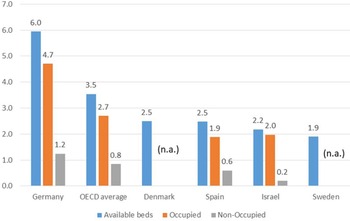
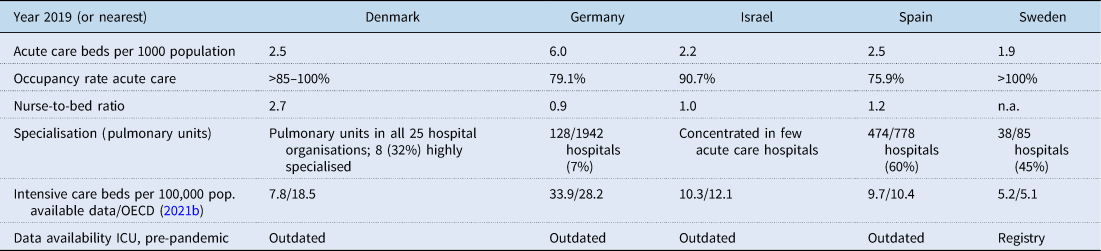
To start with capacities in the pre-pandemic situation, Figure 1 shows the overall rate of available acute care hospital beds per 1000 of population in 2019 (OECD, 2021b). The data show large differences in general availability and occupation of acute care beds among the countries in our study. In 2019, 6.0 acute care beds were available per 1000 inhabitants in Germany, around 70% more than the average of OECD countries (3.5) (OECD, 2021b, own calculation). Far fewer acute care beds per 1000 inhabitants were available in Denmark and Spain (2.5 each), Israel (2.2) and Sweden (1.9). While Germany has one of the highest rates among OECD countries, Sweden has one of the lowest.

Before the pandemic, the average occupancy rate in acute care was 75.9% in Spain, close to the OECD average of 76.2%, and 79.1% in Germany. A much higher occupancy rate of 90.7% was observed in Israel (OECD, 2021a). OECD does not provide data for Denmark and Sweden, but national statistics report high occupancy rates (85–100%) in internal medicine departments in Denmark (Madsen et al., Reference Madsen, Ladelund and Linneberg2014). In Sweden, the occupancy rate of somatic beds was over 100% in 2019, meaning that on average more inpatients were admitted than beds were available, indicating bed overcrowding already before the pandemic (SKR, 2020).
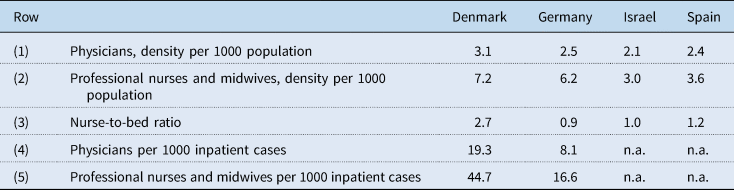
In Table 1, rows (1) to (3) present OECD statistics on physicians and professional nurses (including midwives) employed in general and specialty hospitals in Denmark, Germany, Israel and Spain (OECD, 2021b). According to these data, the density of hospital physicians per 1000 inhabitants is highest in Denmark (3.1). The rates in Germany (2.5), Israel (2.1) and Spain (2.4) are considerably lower. The density of nurses working in hospitals is highest in Denmark as well (7.2), but it is also high in Germany (6.2). In Israel (3.0) and Spain (3.6) far fewer nurses per 1000 inhabitants are available in hospitals. For Sweden, staffing numbers are only available for the health care system as a whole, not specifically for the hospital sector. In Sweden, there were 4.3 physicians and 10.9 nurses per 1000 inhabitants in 2018, slightly above the EU average (OECD/European Observatory, 2021).
Hospital employment in Denmark, Germany, Israel and Spain (2019 or nearest, head counts)

Source: Rows 1–3: OECD (2021b). Rows 4 and 5: Augurzky et al. (Reference Augurzky, Busse, Gerlach and Meyer2020: 32)
An even more revealing indicator of the nursing workforce endowment is the nurse-to-bed ratio, as this indicator better reflects workload. Looking at the nurse-to-bed-ratio, Denmark continues to have the highest staffing rate of nurses per hospital bed (3.0). In Israel there are on average 1.1 and in Spain 1.2 nurses per hospital bed. Nurse-to-bed-ratio in this sample of four is worst in Germany (0.8) changing the position from ‘fairly well endowed’ as long as it is measured per 1000 inhabitants to ‘very poorly equipped’ in comparison.
A look at the ratio of physicians and trained nurses per 1000 inpatient cases based on OECD data and national statistics in rows (4) and (5) of Table 1 (Augurzky et al., Reference Augurzky, Busse, Gerlach and Meyer2020) corroborates this impression, although data are only available for Germany and Denmark. Denmark has 2.6 times as many trained nurses and 2.2 times as many physicians per 1000 inpatient cases compared with Germany.
3.1.2 Specialisation and centralisation
What makes the comparison particularly challenging is that the countries differ in the organisation of specialised health care services and their allocation to the hospital care sector, aspects that are also highly relevant for pandemic crisis management. In Sweden and Denmark, hospitals are networked, integrated systems that also provide specialised outpatient care. Based on government planning, the hospital landscape in Sweden and Denmark has been significantly centralised in recent decades (Anell et al., Reference Anell, Glenngård and Merkur2012; Christiansen and Vrangbaek, Reference Christiansen and Vrangbaek2018). Hospitals tend to be organised as systems or groups, so that some of the hospitals are found in multiple locations. In Denmark, specialist care is distributed according to functions or ‘layers’ across these hospital organisations. In Sweden, due to the high concentration of inpatient care in metropolitan areas, specialised services are not consistently available in remote regions (OECD/European Observatory, 2021).
The hospital care system in the state-led Spanish SNS is characterised by decentralisation. Hospitals are rather evenly distributed, all of the 17 Autonomous Communities (ACs) (and the two Autonomous Cities of Ceuta and Melilla) have at least one general hospital with the full range of specialties available (Bernal-Delgado et al., Reference Bernal-Delgado, García-Armesto, Oliva, Sánchez Martínez, Repullo, Peña-Longobardo, Ridao-Lopez and Hernández-Quevedo2018). Most hospitals are small, and there are only 18 hospitals with more than 1000 beds (Ministerio de Sanidad, 2018). In Spain, specialised care has increasingly shifted from inpatient to outpatient care in recent decades (Bernal-Delgado et al., Reference Bernal-Delgado, García-Armesto, Oliva, Sánchez Martínez, Repullo, Peña-Longobardo, Ridao-Lopez and Hernández-Quevedo2018). Private hospitals have a substantial contribution in the provision of secondary care.
In Germany, according to own calculations based on the Federal Statistical Office, almost 70% of all hospitals are rather small facilities that provide only basic, non-specialised care (Destatis, 2018). German hospitals have traditionally concentrated on inpatient care, while most outpatient specialist care is delivered outside hospitals (Preusker, Reference Preusker2015). In Israel, although all hospitals operate outpatient clinics, most specialised ambulatory care is provided in community-based settings (Rosen et al., Reference Rosen, Waitzberg and Merkur S2015). Regional distribution is not uniform. Larger acute care hospitals are located in the centre of the country; underserved areas are located in the north but particularly in the south of the country (Mendlovic et al., Reference Mendlovic, Gordon, Haklai, Meron and Afek2017).
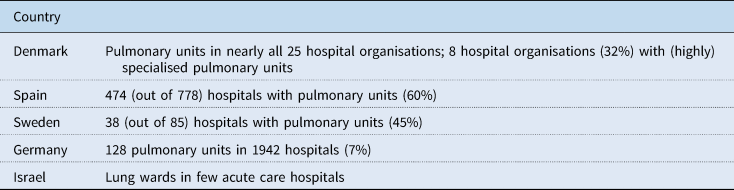
With these differences in mind, we attempt to estimate hospital capacity and regional distribution for (non-ICU) specialised care of pulmonary patients. To estimate the size of specialist departments, staff numbers are not suited as there are major data gaps in the countries considered. An approximation is therefore made on the basis of bed numbers and, if these are not available, the number of units or departments. In Denmark, the country expert reports 25 somatic hospital organisations, many with several physical locations. Pulmonary units are embedded in various departments; in principle, all hospitals have general medical departments that deal with non-specialised pulmonary conditions. Highly specialised pulmonary treatment is mostly provided in three regional hospitals. Five hospitals are specifically designated at the regional specialisation level to deal with complicated pulmonary infections that do not respond to standard therapy. The total number of beds in departments with some degree of specialisation in pulmonary diseases beyond the basic level in Denmark is 360 (eSundhet.dk, 2020). In Spain, pulmonary medicine is represented in about 60% of all hospitals (474 out of 778 hospitals) (MSCBS, 2019). To organise specialist care, hospitals, which are managed by their ACs, are linked to each other: ‘small hospitals with fewer services are clustered to bigger hospitals that provide high-tech services or take over the most complex cases’ (Bernal-Delgado et al., Reference Bernal-Delgado, García-Armesto, Oliva, Sánchez Martínez, Repullo, Peña-Longobardo, Ridao-Lopez and Hernández-Quevedo2018: 23). In Sweden, depending on the statistics available, hospitals are counted as hospital groups (85 groups) or as hospital sites (103 sites) (Vården i siffror, 2020). There are pulmonary departments operating in 38 hospitals, that is about 45% of all Swedish hospital groups (SLMF, 2020, own calculations). In Germany, in line with the federalist political structure, the Länder are principally responsible for the planning of hospital care within their territory. However, planning is also influenced by national quality requirements, by the self-regulating bodies, and by the hospital owners themselves (Preusker, Reference Preusker2015; Klenk, Reference Klenk and Mattei2016). As a consequence, there is no stringent and uniform concept throughout the country for differentiating the various levels of specialisation. Overall, with respect to specialisation in pulmonary diseases, the statistics count 128 departments in 1942 hospitals with a total of 7326 beds (Destatis, 2018). In Israel, specialist services tend to be dispersed throughout outpatient clinics and general acute care hospitals (Rosen et al., Reference Rosen, Waitzberg and Merkur S2015), but, according to the country experts, lungs wards are not broadly available in all hospitals. Table 2 summarises the information on units specialised in pulmonary diseases in hospitals.
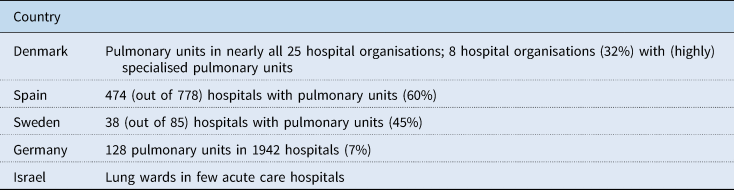
From a conceptual point of view, it should be noted that there is a lack of comparative data and, above all, comparative concepts for describing and measuring specialisation and centralisation. Further research is needed on how these factors can be conceptualised, measured and compared.
3.1.3 Intensive care capacities and data availability
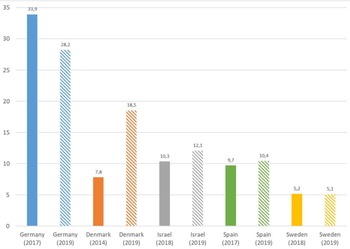
As already noted in the case of specialisation, data on staffing are also highly incomplete in the intensive care area, especially on ICU-trained nurses. For our comparison, we therefore focus on the number of beds to estimate the size of the intensive care sector in the countries. Figure 2 compares the data on intensive care beds that were available at the time of the pandemic outbreak. In order to verify the accuracy of this information, the OECD figures for the year 2019, which only became available in 2021 (OECD, 2021b), are held against it. The latter are shown hatched in Figure 2; they exclusively report adult intensive care beds.

In Denmark, the most recent data available at the pandemic outbreak dated back to the year 2014 and counted 7.8 ICU per 100,000 inhabitants (OECD, 2020). Occupancy rates are not available for Denmark, neither from the OECD nor from national statistics, but – according to the country expert – they are probably high by international standards. In Germany at the time of the outbreak in early 2020, national statistics from 2017 counted 33.7 intensive care beds per 100,000 population with an average occupancy rate of 79% (Destatis, 2018; SMC, 2020). In Israel, the statistics available in early 2020 were from 2018 and counted 10.3 intensive care beds per 100,000 population (MoH Israel, 2020a). Included here is a high proportion of paediatric/neonatal beds – about 1.7 per 100,000 (experts' estimations based on MoH Israel, 2020a) – that are not suitable for treating the mainly adult COVID-19 patients. In Spain, 9.7 intensive care beds per 100,000 population existed in 2017. If paediatric/neonatal beds are factored out, the rate drops moderately to 9.5 (MSCBS, 2019, own calculations). Sweden has maintained a registry on ICU since 2001 that was regularly updated. Accordingly, 5.2 intensive care beds per 100,000 inhabitants existed in 2018 (Hillgren, Reference Hillgren2019). According to own calculations based on SIR (2020), the occupancy rate in 2019 was 80% on average.
Using Figure 2 to verify the accuracy of the data on ICU beds available at the time of the pandemic outbreak (filled bars) with the data provided ex post by the OECD (hatched bars), considerable discrepancies can be observed. Not surprisingly, the gap is smallest in Sweden. To provide an overview on key indicators for resource endowment in hospitals and hospital care structures, Table 3 summarises the results of the country studies.
Summary: resources before the pandemic

Source: own compilation
3.2 Responses to the pandemic
3.2.1 Governance
All countries in the sample have general pandemic or crisis preparedness plans. However, with respect to speed and scope of the spread, COVID-19 was a new challenge for which the preparedness plans were not completely fit to cope. Spain was the first country in our sample that came under pressure from the pandemic. Here, according to the country experts, the response was hampered by decentralised governance and an unprepared national government. The government's first policy recommendations of 10 March aimed to avoid ICU bed overload and system collapse, but more populous ACs' systems were nonetheless overwhelmed [perhaps because ICU stays then averaging 28 days were longer than anticipated (Ojeda, Reference Ojeda2020)]. While the national government released recommendations for primary care planning, centres were still overwhelmed due to historical under-resourcing. By 29 March, the national government's ICU bed advisory commission had succeeded in increasing ICU bed numbers by 73%. The government also instituted and enforced strict social distancing requirements that likely reduced contagion. The asymmetrical federal system meant that ACs managed their hospital systems largely independently, or even through mutual support. It was not until 9 June 2020 that the national government passed legislation requiring that ACs have contingency plans guaranteeing response capacity and coordination among Public Health, primary care and hospital services.
Israel had holistic preparedness plans for national disasters, and had been training the entire system for such events. It is the country that probably developed the most stringent central planning during the pandemic. Here, the communication channel was directly between the Israeli MoH and individual hospitals (Waitzberg, Reference Waitzberg2022). The centralisation of policy and resources by the MoH thus plays a key role in the response of the system; additional capacity was created quickly.
In Germany, the competencies of the Federal Ministry of Health (BMG) were strengthened already at the beginning of pandemic with the first and the second ‘Law on the Protection of the Population in the Event of an Epidemic Situation of National Significance’ (Gesetz zum Schutz der Bevölkerung bei einer epidemischen Lage von nationaler Tragweite) which were passed by the German parliament in April 2020. The increase in power, however, was carefully restricted to the duration of the pandemic. In line with strong federal tradition of the country, there was a constant need for coordination between the federal and state governments during the first wave of the pandemic.
Both Sweden and Denmark developed strong central leadership and close coordination between regional and central levels of government during the first wave of the pandemic. The regions in Sweden, which are also the owners of the public hospitals, took early responsibility for expanding intensive care capacity. This was done in close coordination with the central government, which in turn secured funding for this expansion.
3.2.2 Hospital capacity expansion
To expand hospital capacity, hospitals in all countries, with the notable exception of Spain, received centralised instructions to postpone, as far as possible, all scheduled treatments and surgeries in order to keep capacities free for the care of COVID-19 patients. Of course, also in Spain non-elective treatments were postponed, however, as indicated above, there was a lack of central guidance instructing the hospitals. In Spain, public hospitals adopted a scaling protocol for scheduling elective surgeries, while private and especially private specialised hospitals voluntarily cancelled elective surgeries. Bed availability and numbers increased during late March. The decisions contributing to this change largely were taken at the AC level to meet regionally varying needs (SEMICYUC, 2020). At the peak of the first wave, the hardest-hit ACs were forced to build field hospitals to accommodate patients. On March 21, Madrid established what was claimed to be Europe's largest COVID-19 field hospital, with 5500 emergency beds. The central government granted regional governments some legal control of private hospitals in early March. This is relevant as about 20% of all hospital acute care beds and ICU are in private facilities (Ministerio de Sanidad, 2018: Table 6.2). Yet it appears these resources were not taken up. So, the role of Spanish private hospitals was minor even though it was a central government rule that allowed use of these capacities.
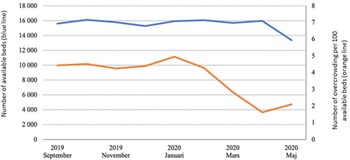
In Sweden, from January 2020 onwards, there has been a large drop in over-occupancy, reflecting that care has been reorganised to make beds available to accommodate COVID-19 patients, as shown in Figure 3. Additional capacity was made available since patients did not seek care to the extent they did before the pandemic (SKR, 2020).
Number of available hospital beds/number of overcrowding per 100 available hospital beds in Sweden between September 2019 and May 2020.
Source : SKR (2020: 20).

In Israel, Sweden and Denmark hospital beds were flexibly opened or closed according to need, based on COVID infection rates as well as current and expected hospitalisation rates. In Israel, after May, 2020, due to criticism on the hold of all elective care, which had many negative effects on access to non-COVID care, hospitals resumed all activities. In Denmark, some regions created specialised departments/clinics for COVID-19 patients (Webb et al., Reference Webb, Hernandez-Quevedo, Williams, Scarpetti, Reed and Panteli2022). These were quickly reintegrated into the regular structure when the COVID-19 caseload declined. Capacity in (the few existing) private facilities was mobilised but – as the first wave was quickly under control – did not have to be used.
In Germany, to increase the capacity of available hospital beds in the pandemic, the ‘Act to compensate for COVID-19-related financial burdens on hospitals and other healthcare facilities’ (COVID-19-Krankenhausentlastungsgesetz) went into effect on 27 March 2020 (Osterloh, Reference Osterloh2020). It provided that hospitals that postpone or suspend scheduled interventions will receive a lump sum of 560 euros per day for each hospital bed that is vacant. Starting 1 July 2020, the flat rate has been differentiated according to case-mix index and average length of stay.
In the very beginning of the pandemic, there was a tendency in all countries to hospitalise all COVID-19 patients. Subsequently, hospital capacity was also created by establishing differentiated patient pathways. In Germany, the guidelines changed quickly (March 2020) towards hospitalizing only more severe cases. As of 1 April 2020, 85% of COVID-19 cases were treated in ambulatory settings, mainly by general practitioners (Webb et al., Reference Webb, Hernandez-Quevedo, Williams, Scarpetti, Reed and Panteli2022). It is interesting to note that the use of mechanical ventilation was high in international comparison, particularly among elderly people (Karagiannidis et al., Reference Karagiannidis, Mostert, Hentschker, Voshaar, Malzahn, Schillinger, Klauber, Janssens, Marx, Weber-Carstens, Kluge, Pfeifer, Grabenhenrich, Welte and Busse2020). Further, using data from the largest German local health insurance funds through the end of July 2020, it was analysed that 10.8% of all COVID-19 inpatient cases were transferred from rather small and less experienced hospitals to more specialised hospitals with more ventilation hours. Among ventilated patients, the figure was 31.9% (Hentschker et al., Reference Hentschker, Mostert, Klauber, Malzahn, Scheller-Kreinsen, Schillinger, Karagiannidis and Busse2021).
In Israel, all COVID-19 patients were hospitalised at the beginning. Until mid-July 2020, hospitals did not have a standard definition of ‘severely’ ill COVID-19 patients, leading to confusion and sometimes also to variations in treatment (Webb et al., Reference Webb, Hernandez-Quevedo, Williams, Scarpetti, Reed and Panteli2022). After harmonisation by the Israeli MoH, individuals were hospitalised, if the diagnosis is positive, and the symptoms are severe, or otherwise advised to remain in quarantine at home (MoH Israel, 2020b).
In Sweden, for more severe cases, it was recommended to visit the emergency room of a hospital; milder cases should rely on video or telephone consultations. Separate access routes for suspected Corona cases were established at both health centres and emergency departments. In Denmark, patients with severe symptoms and positive test were referred to hospital departments specialised in COVID-19 care. Thus, primary care was sheltered from COVID-19 as patients were only allowed to contact by phone/digital consultation. Particularly striking is Sweden's and Denmark's enormous lead in digital doctor–patient communication. While other countries have moved quite quickly to telemedicine and remote consultations, in Germany it first required a change in the health insurance benefit catalogue to allow for adequate reimbursement for teleconsultations (Panteli, Reference Panteli2020; Thomas et al., Reference Thomas, Sagan, Larkin, Cylus, Figueras and Karanikolos2020: 15).
In Spain, the situation was entirely different, as hospitals faced very quickly a situation of overcrowding, so triage decisions were required. By late March, the lack of a national response plan led a hospital in Madrid to release its own guidelines (Herreros et al., Reference Herreros, Gella and de Asua2020). Indeed, lacking any supra-institutional guidance, many centres were triaging ‘on the go’, without any structured protocol at all.
3.2.3 Increasing intensive care capacities
For those countries with outdated data on the number of intensive care beds – basically all countries except Sweden – the goal was to update the database and increasing capacity at the same time. The time frames within which these data could be updated at the time of the pandemic outbreak differ between countries. In Denmark, immediately after the outbreak, the Danish Medical Authority assessed the total capacity in terms of ventilators on 22 March 2020. It stated that there are 433 ICU with ventilator capacity readily available, while reserve capacity was supposed to bring the total figure to 925 ICU (Sundhedsstyrelsen, 2020), or about 16 per 100,000 inhabitants according to own calculations based on OECD population data (OECD, 2021b).
In Germany, data on the number of occupied and non-occupied intensive care beds were available from mid-April 2020 on and have been updated daily and reported publicly from then on. Although levels were high in international comparison, it was intended already from the beginning of the pandemic that intensive care capacities should be doubled. To this end, the government has stipulated that hospitals that create additional intensive care capacity will receive a subsidy of 50,000 euros per intensive care bed. However, no criteria were set for the expansion of capacity, so that even small hospitals that did not maintain appropriate intensive care staff could receive funding.
Israel, Denmark and Sweden have quickly and flexibly adjusted ICU capacity to meet emerging demand based on expected utilisation, current and expected hospitalisation rates, ICU bed occupancy and COVID infection rates (Waitzberg, Reference Waitzberg2022). In the case of Israel, it can be assumed that this was more of an ‘ad hoc’ adjustment, as the Israeli Ministry of Health did not introduce a centrally organised database with up-to-date information on bed occupancy at individual hospitals until July 2020, i.e., at the very beginning of a second wave. However, this expansion effort was made possible because of direct communication between the government and hospital providers. What is more, due to the military situation of the country and its high crisis-preparedness, Israel could draw on the considerable reserve capacities in intensive care.
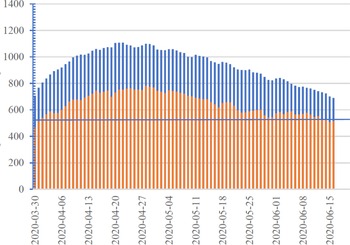
In Sweden, the registry of intensive care beds was changed to daily updates immediately after the COVID-19 outbreak. It is particularly noteworthy, that Sweden was not only able to rapidly expand its overall intensive care capacity to meet demand, but was also able to quickly scale back capacity expansions when COVID-19 cases declined, as Figure 4 shows.
Total capacity and occupancy in intensive care in Sweden (March to June 2020).
Source : SKR (2020: 24), blue/dark bars: total intensive care capacity, red/bright bars: patients in intensive care; horizontal line: average intensive care capacity in 2019 ( = 512 beds with ventilator).

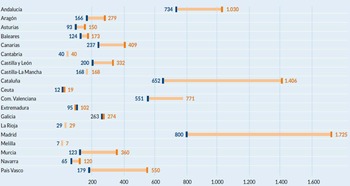
In Spain, data on ICU bed occupancy were provided by most ACs by 29 March 2020 (Ojeda, Reference Ojeda2020). Despite a generally overburdened health care system, a lack of centralised control and, by and large, a lack of interregional coordination, the increase in the number of intensive care beds was substantial. As of 2 April 2020, the Ministry of Health estimated that the number of ICU beds had doubled (Sáiz-Pardo, Reference Sáiz-Pardo2020). What is more, the increase was concentrated in those regions that were most affected by COVID-19, as shown in Figure 5.
Changes in the number of intensive care beds 2017–2020, Spain.
Source: Ojeda (Reference Ojeda2020) based on Datadista (https://www.datadista.com/coronavirus/camas-uci/).

As a result, there was an expansion of intensive care capacity in Spain alongside local demand. This was possible because AC governments monitored the situation and had been warned by the SEMICYUC of the impending crush of patients.
3.2.4 Recruitment of staff
Although this is emphasised only in the Swedish and Israeli case studies, it can be assumed that there was a serious shortage of health care workers in all of the countries studied. This was exacerbated in Spain as a high proportion of health care workers was infected with COVID-19 during the first wave. Here, around 24% of all COVID-19 infected persons were health care workers according to the National Epidemiological Surveillance Network (RENAVE) (ISCIII, 2020); for comparison, this proportion was at 5.2% in Germany (RKI, 2020). To counteract staff shortage, health care providers in all countries cancelled planned treatments, especially surgeries. In addition, personnel were recruited from reserves, including, for example, medical students or retired health care workers. In Germany, the existing regulation defining obligatory lower limits for staffing with trained nursing personnel in ICUs was suspended to allow hospitals to fall short of this limit. To increase staffing levels in Spanish ICU, trained nursing staff were transferred from normal nursing to intensive care. This is possible as there is no legal definition of an intensive care nurse and nurses can be recruited from different areas depending on demand. On 19 March, the government responded to the shortage of health care professionals by hiring, effective immediately, 50,000 new health care workers, including doctors, nurses, resident physicians, recently retired physicians and last-year medical students. Changes in regulation allowed medical school students to graduate early (Urra, Reference Urra2020).
4. Discussion
4.1 Resource endowment and flexibility in the use of existing resources
Regarding resource endowment in terms of acute and intensive care beds, we had two interesting ‘extreme cases’ in our sample: Germany as a very well-endowed country and Sweden as a country with one of the lowest bed densities in the OECD. The German case shows that from a crisis response perspective, the advantage of having a large number of beds shrinks significantly when looking at the rate of available beds. In fact, across all countries, the magnitude of the ‘equipment gap’ decreases significantly when occupied beds are considered instead of available beds.
In Germany's hospital care structures, therefore, the crisis has exposed a key weakness: a high supply of beds, as created by the isolated and decentralised, competition-oriented system of hospital planning in Germany, neglecting outpatient structures, creates an incentive for overprovision of inpatient services (Preusker, Reference Preusker2015; Klenk, Reference Klenk and Mattei2016). Because more surgical procedures are performed in German hospitals compared with other countries, hospitalisation rates are high. This cannot be explained solely by an older population or higher morbidity and thus suggests overtreatment (Zich et al., Reference Zich, Nolting, Schwenk, Pundt and Cacace2019). There is also some evidence of overtreatment in intensive care (Michalsen et al., Reference Michalsen, Neitzke, Dutzmann, Rogge, Seidlein, Jöbges, Burchardi, Hartog, Nauck, Salomon, Duttge, Michels, Knochel, Meier, Gretenkort and Janssens2021), as can be assumed by the high proportion of ventilated COVID-19 patients, especially in the very elderly, compared with other countries. Moreover, even before the pandemic, the high number of beds was not accompanied by adequate staffing.
In Sweden, on the other hand, the pandemic hit a hospital system that had already reached the limits of its hospital bed capacity and where there were significant gaps in regional coverage with hospital care. But even this picture is not complete, as hospital care in Sweden also means that highly specialised services are provided in hospital outpatient departments. Thus, although they provide some insight, the limitations of our comparative data are obvious. Since the structures of hospital care are different – in this case, more outpatient services are provided in Swedish hospitals and also in Danish hospitals compared to Germany, for example – the ratio of hospital care staff to the number of inpatient beds does not fully reflect the actual workload per person.
We also find that the staffing of hospital beds and, in particular, the availability of (highly) qualified nursing staff is a crucial ‘bottleneck’ in all countries. It is a major shortcoming that few data are available on staffing levels, especially in ICU and in specialist departments for pulmonary diseases.
It is assumed that coordinated concepts of specialisation in hospital care, according to which highly specialised, complex services are provided in spatially concentrated hospital structures, are better able to ensure adequate care also for COVID-19 patients (Böcken and Preusker, Reference Böcken and Preusker2021; Greß and Jesberger, Reference Greß and Jesberger2021). In Sweden and Denmark, coordinated efforts have been made to conceptualise the distribution of specialist care in inpatient and outpatient hospital care and to promote centralisation. This has been accompanied by close integration of the inpatient and outpatient sectors. These countries have clear structural advantages that, from the outset, have favoured targeted and rapid navigation of COVID-19 cases through the health system.
In the area of critical care, a high level of preparedness was noted in Israel, especially considering the large number of ventilators in reserve, which were already in stock before the pandemic. However, it is important to note that flexibility and adaptability in the use of these resources – another key indicator of resilience – can only be achieved if decision makers have administrative data on their quantity and availability. In Israel, as in all other countries with the notable exception of Sweden, accurate and up-to-date data on available critical care resources were not available at the time of the pandemic outbreak.
4.2 Response planning and ability to create surge capacity
Effective and participatory leadership with strong vision and communication is at the core of a resilience-building strategy in health systems (Thomas et al., Reference Thomas, Sagan, Larkin, Cylus, Figueras and Karanikolos2020: 16). It should be noted, however, that there may be tensions between the goal of engaging stakeholders at all levels of crisis response and a clear, rapid chain of command. Therefore, differentiated approaches to adapting and applying existing emergency plans are needed (Böcken and Preusker, Reference Böcken and Preusker2021). Centralised pandemic response and capacity management plans were developed quickly in Israel, Denmark and Sweden, but not in Germany and Spain.
The ability to create surge capacity is crucially dependent on the decision-making structures, which are decisive for the ability to scale resources (hospital beds, ICU) quickly up and down. According to our observations, a strong central leadership and close coordination between regional and central levels of government is important. In the Spanish health care system, based on AC planning, intensive care capacities were expanded in those areas in which they were needed. Overall, however, the hospital care system was completely overwhelmed due to the speed and the vehemence of the first wave. In this situation, it was a clear deficit that the coordination between policy-making levels in the decentralised Spanish health system was poor. Another coordination problem in the Spanish health system prevented the successive inclusion of private hospital capacity. Denmark and Sweden, in contrast, responded very quickly; both showed a high degree of flexibility in increasing and decreasing capacity and a rapid reduction in the backlog of elective surgeries. In both countries, strong central leadership and close coordination between regional and central levels of government were activated during the first wave of the pandemic. For this purpose, a quick update on data in ICU was necessary. In other countries, for example in Israel, it took a considerable period of time for this important management information to become available.
Although there were significantly fewer beds available in Denmark for the treatment of COVID-19 patients compared to Germany, these were in more highly specialised departments. These hospitals therefore were better able to provide care for the COVID-19 patients, whereas in Germany transfers between hospitals (from smaller to larger and thus also from non-specialised or less specialised to more specialised hospitals) were necessary. In addition to inefficiencies, this also meant that patients were subjected to significant strain due to transportation.
In government-run health systems, the construction and funding of additional hospital beds was regulated by the government. In Israel, the Ministry of Health approved additional beds by providing the funding. In the competitively structured German hospital system, the Federal Ministry of Health left it up to the hospitals themselves to offer capacity for COVID-19 patients, even if they were not designated to do so because of a lack of pulmonological specialisation. The strong focus on increasing the number of beds at the time of the pandemic outbreak was certainly not optimal to increase resilience. Rather, large sums were spent inefficiently because it can be assumed that staffing shortages did not permit the operation of these additional beds. The flat rate offered as compensation for each free bed in the first wave had unfavourable effects, as this form of compensation disadvantaged large – and more specialised – hospitals (Greß and Jesberger, Reference Greß and Jesberger2021).
In Denmark, followed by Spain and Sweden, most hospitals have capacity to treat pulmonary disease or have easy access to specialised departments, so these hospital systems were well prepared to adequately treat COVID-19 patients. Relative to the large hospital sector, few departments in Germany specialise in pulmonary medicine. Since specialisation concepts are lacking in the German hospital landscape and the degree of concentration of hospitals is low, coordinated deployment of intensive care staff was also not possible during the pandemic, which exacerbated the situation of already scarce staff. In contrast, the concepts of concentration and specialisation in hospital care in Denmark and Sweden enable coordinated deployment of intensive care staff.
With regard to patient pathways, it should be noted that numerous learning steps in capacity management already took place during the course of the first wave of the pandemic. The degree of digital integration and networking between hospitals and between hospitals and other health care providers is also of great importance for the rapid adaptability of the health care system. One effective strategy has been to keep mild cases out of the care system altogether, as has been achieved in Sweden and Denmark through the consistent use of video consultations and telemedicine.
4.3 Avoiding excess idle capacity
A particular example of the rapid adjustment of resources to demand and thus the avoidance of empty capacities is the management of intensive care capacities in Sweden and Denmark. Here, intensive care capacities were built up promptly and then reduced again once the incidence flattened out. The key element here is the foresight to anticipate not only the increase in demand, but also the need to reduce capacity when incidence levels off. A key factor is the excellent data on ICU capacity, which, in the form of the Swedish registry, has provided enormous benefits for timely management of ICU capacity. Sweden was the only country in our sample that had up-to-date information on the number and occupation of ICU beds at the start of the pandemic. Denmark also showed a high degree of flexibility in building and reducing capacity and quickly. Like the two Scandinavian countries, Israel and Spain, immediately after concepts for capacity expansion were developed, also considered how to reduce capacity after the pandemic subsided. No such efforts were reported from Germany. It turns out that effective capacity management depends crucially on the decision-making structures that are critical to the rapid expansion and contraction of resources (hospital beds, ICU) as needed.
To come to the limitations of this study, a first one is that the factors outside the pandemic are different in the countries considered, such as the level of generally available (health) resources before the pandemic. But the level of exposure to the COVID-19 outbreak also differs. Of course, Spain was disadvantaged because it was the first country in our sample to be affected by the pandemic in the first wave. In addition, countries' overall crisis management strategies varied, particularly the severity and timing of strict lockdowns, as illustrated by the Swedish case. In addition, this analysis is limited to the first wave of the COVID-19 pandemic, so the ‘first shock’ was analysed, while the second and third waves had different characteristics and responses.
Another limitation is that the organisation of elderly care and the nursing home sector during the pandemic were not considered in this study, although they are also important for hospital capacity management. Though we clearly recognise the importance of the interaction between health and social care, it was not possible to explore this relationship more deeply in our study. Finally, it should be noted that this study focuses on organisational competencies and the ability to prepare for, manage and learn from shocks as the main parameters for evaluation. Other very relevant metrics would be the costs associated with crisis management in the five countries. Again, these are not assessable within the scope of the study.
5. Conclusion
Looking at the resource endowment and hospital care structures in the countries compared, a first and most important finding is that the overall picture remains incomplete, even after our in-depth investigation. This is partly due to data gaps, but partly also due to shortcomings in the conception and measurement of potential indicators of resilience.
Having this in mind, a first contribution to knowledge is from a conceptual perspective. An appropriate metric for measuring resilience should systematically consider not only the number of available beds but also bed occupancy. A high inventory of acute and intensive care beds provides a ‘buffer’, but it cannot be considered a guarantee of adequate crisis response. The number of available beds is crucial and should therefore also be used to measure resilience.
Further, another decisive factor in the crisis situation is the availability of qualified personnel, especially in intensive care, and the ability to mobilise personnel reserves in the system. For reporting staffing levels, ratios per bed are preferable to ratios per population as an indicator of resilience, as they more accurately reflect actual workload. However, staffing ratios per bed also need to be interpreted with caution, because countries differ in the organisation of specialised health services, in particular, when hospitals also provide outpatient care. In addition, staffing ratios per inpatient case could be made available to provide a more appropriate assessment of resilience. However, these can also become less meaningful if, for example, there is an incentive to increase the number of cases due to a DRG-based remuneration system.
Maintaining capacity is costly, especially in intensive care. A functional equivalent to high bed capacities is rapid adjustment of capacity as needed, as observed in Sweden, or a good preparedness plan, as perceived in Israel. Indispensable to this flexibility in the provision of services is the availability of data on existing and built-up capacity, especially in intensive care, and a robust digital infrastructure. In addition to thinking about increasing capacity, early decisions should be made about how capacity might be scaled back as the pandemic recedes.
A centralised governance structure is crucial for flexibility and adaptability in the use of existing resources and a timely expansion of capacities. In Sweden, Denmark and Israel, this enabled both a rapid increase in intensive capacities and a flexible adjustment when incidences flattened out. Coordinated decisions about resources, referral guidelines and treatment guidelines lead to a better performance, in particular if there is a direct feedback-link between regulators and providers, as in Israel.
However, it is not only important to adapt capacities quickly, regional distribution according to need must also be considered. In Spain, although the country certainly has been hit most severely by the crisis and was overwhelmed by the number of COVID-19 cases, the autonomy of regional and even local governments and providers helped expanding capacities in those areas where they were most urgently needed. If governance is decentralised, therefore, robust mechanisms for coordinating and aligning efforts across governance levels and between areas seem important.
Finally, the extent to which systems succeed in shifting light cases to the outpatient system and keeping physician–patient contacts low, as in Sweden, or even avoiding them altogether, as in the Danish example, is also of paramount importance. This is supported by video conferencing technology. In crisis situations, therefore, the degree of digitalisation of the health care system is also crucial to strengthening the resilience of health care systems in general and of hospital care systems in particular.
It is finally to conclude from the point of view of this study, there is a need for further research on concepts that compare countries, especially on specialisation and centralisation in the hospital sector. To improve resilience, not only to the COVID-19 pandemic, but also with regard to potential other adverse events, the data situation should be significantly improved in all countries, in particular in the intensive care sector. Strong efforts to maintain a robust data base on ICU staff should be made, including, of course, data on nursing staff. The updating of the number and occupancy of ICU beds that began during the pandemic should be maintained or followed up, most likely also beyond our comparator countries.
Conflict of interest
None.