1. The Modern City as a Multicultural Melting Pot
The concept of an urban melting pot has gained much popularity since the seminal contributions of Jane Jacobs.Reference Jacobs1, Reference Jacobs2 In the vein of this literature, nowadays multicultural creativity, innovation and entrepreneurship are often mentioned as critical success factors that spur urban economic development and growth. Lee et al.Reference Lee, Florida and Acs3 argue that entrepreneurship and innovation are often associated with creativity and cultural diversity, so that these factors offer a positive stimulus for new firm formation in an open and competitive economy.
The development of today's business environment, the reinforcement of the SME sector, and the emerging globalising economy have, in recent years, brought cultural, creative and innovative business into a new focus. The emergence of the ‘new paradigm’ of creativity, innovation and entrepreneurshipReference Matheson4 is often ascribed to the perceived international success of the creative sector,5, Reference Poort and Marlet6 as witnessed by Florida'sReference Florida7–Reference Florida9 and Scott'sReference Scott10 seminal work on Creative Industries (CIs) in modern cities. Entrepreneurship and innovation are two intertwined phenomena that are closely associated with a nation's, region's or city's economic growth and wealth. They prompt new forms of productivity and act as engines of continued prosperity and cultural diversity. Entrepreneurship and innovation are often found in the SME sector, while in this sector we also find an abundance of first- and second-generation immigrants with a business-oriented attitude.
Migration is one of the most studied subjects in modern social and behavioural sciences, e.g. in demography, sociology, geography, economics. Several academics speak nowadays of the ‘age of migration’, and this suggests that mankind is structurally ‘on the move’. The age of migration has clearly led to a different population composition of cities in the developed world. Most foreign migrants tend to settle down in urban areas – often in the form of ethnic or language clusters – and create an unprecedented multicultural diversity in most European cities. The position of various new migrant groups in urban areas is sometimes problematic, but there is one field where they tend to be rather successful, namely in small- and medium-sized business. Many foreign migrants appear to possess excellent entrepreneurial skills and are responsible for a flourishing SME sector in many cities. They are known as ethnic or migrant entrepreneurs. Ethnic entrepreneurship, which includes business owners, start-ups or takeovers originating from non-Western countries, including first- and second-generation ethnic entrepreneurs, has become an essential socio-economic dimension of the ethnic minorities’ presence in modern cities (also raising the living standards of ethnic groups) and an important aspect of multicultural urban life. An extensive overview of these phenomena, their backgrounds and consequences can be found in Dana.Reference L. P.11
In today's open world characterized by global competitiveness and unprecedented migration flows, cities become geographic melting pots, with a surprising innovative, creative and cultural diversity – which are competitive assets to improve the socio-economic performance of cities. This megatrend shapes a spectacular new and diverse urban design and lifestyle that favours accelerated economic growth. This new paradigm reflects a trend for a creative, open and globalizing economy with new social, cultural and environmental challenges.Reference Matheson4, Reference Florida8, Reference Peck12 Cities offer through their agglomeration advantages (e.g. local identity, an open and attractive urban ‘milieu’ or atmosphere, use of tacit knowledge, the urban embeddedness of new business initiatives, and access to social capital and networks) a broad array of business opportunities for creative cultures, in which, in particular, self-employment opportunities and SMEs may play a central role in creating new urban vitality.
2. Emerging Migrant Entrepreneurship
2.1. General Trends
As mentioned, the SME sector in modern cities has a relatively large share of migrant entrepreneurs. Their economic position has been extensively studied (see inter alia Refs Reference Kloosterman13–Reference Sahin, Nijkamp and Rietdijk16). They appear to be present in many traditional sectors (such as repair services, cleaning services, hospitality services, and so on). However, the second-generation of migrant entrepreneurs is gradually adopting a different business model, more oriented towards innovation and creative entrepreneurship. Our study aims to map out the critical success (and failure) factors of migrant entrepreneurs who are operating in the more advanced and creative branches of urban economies. Our research will be based on empirical work in Dutch cities. Before describing our approach and the statistical findings, we will first offer a brief sketch of migrant entrepreneurship in the Netherlands.
In an open and global world characterized by an increasing urbanization, modern cities function as the habitat of international migrants and magnets of economic growth,Reference Nijkamp17 in which SMEs are a major source of new employment, economic growth, international competitiveness, business dynamics, creativity, and innovation in the global economy.Reference Lee, Florida and Acs3, Reference Nijkamp17 According to the Commission of the European Communities,18, 71 SMEs are socially and economically important, since they represent by far the majority of all enterprises in the EU, provide around 65 million jobs (67% of Europe's private-sector jobs are in SMEs), and contribute to entrepreneurship, creativity, and innovation.Reference Lee, Florida and Acs3
Entrepreneurship has emerged as a key economic factor, and as one of the most important and dynamic forces shaping the changes in the global economic and social landscape throughout the world (see Ref. Reference Wennekers, van Stel, Thurik and Reynolds19). More than 50% of Europeans would like to be self-employed, while less than 45% prefers to work as dependent employees.20 In the USA, more than 50% of the population prefers to be their own boss, and only 37% prefers an employee status.20 The increasingly vital role of SMEs in innovation – in both regional and national economic and social development and (international) competitiveness – has been widely acknowledged in the economic and entrepreneurship literature.Reference Pavitt21–Reference Cooper and Park24
The notion of entrepreneurial competition was developed more than a century ago by Alfred Marshall.Reference van Delft, Gorter and Nijkamp25 Later, a really path-breaking contribution to the analysis of entrepreneurship from a broad historical perspective was made by Joseph Schumpeter in his book The Theory of Economic Development.Reference Schumpeter26 He addressed in a more explicit way the critical role of entrepreneurs – driven by the gift to innovate and possessed by the dream and will to found a private kingdom – as an important driving force of economic progress in the theory and practice of economic growth and development. Schumpeter's book Business Cycles Reference Schumpeter27 introduced entrepreneurship as the necessary condition to create innovations in a competitive economic system driven by profit motives. The entrepreneur is not a manager charged with routine activities, but a restless seeker – under uncertain conditions – for new combinations and components in his activity portfolio, while leaving behind old production constellations (‘creative destruction’), thus creating discontinuities in economic life. Migrant entrepreneurs – especially second-generation migrants – appear to become increasingly a part of this innovative business life.
Practitioners and policy makers are well aware of the increasing importance of entrepreneurship in our society as a provider of new industrial creativity, innovation performance, and technological change, and as a key player for the well-being of local and regional communities.Reference Jones-Evans and Klofsten28, Reference Bommer and Jalajas29 They have developed various focused tailor-made policy strategies and addressed migrant human capital – including knowledge, institutions, skills, information channels, attitudes, leadership potential, solidarity, cultural values and solidarity – that favour new activities to encourage urban ethnic entrepreneurship, with a view to solving structural unemployment problems among many groups with a distinct cultural identity.Reference van Delft, Gorter and Nijkamp25
Previous research relevant to the ethnic minority's economy and entrepreneurship can be traced back in much of the earlier classic works of WeberReference Weber30 and Sombart.Reference Sombart31 The birth of their concept ‘the stranger as trader’, combined with the social structure (work, family, social life), nationality, mobility and religion, has influenced subsequent empirical (case) studies and writings on ethnic entrepreneurs. Migrant entrepreneurs have become a source of new economic opportunities for regions and cities. But it should be recognized that in various cases significant barriers do still exist (e.g. language and cultural barriers, skill levels, etc), so that a valid and intriguing question is: what are the critical success conditions for ethnic (or migrant) entrepreneurs (see, for example, Ref. Reference Bates, Jackson and Johnson32) in the large urban areas?
Creative migrant entrepreneurship is emerging as one of the most challenging and rapidly growing sectors amongst ethnic minorities and migrants, and has become a popular broader concept – explained within the demand-supply relation (goods and services): ‘what customers want to buy and what immigrants can provide’ – in a modernizing multicultural society and open economy.Reference van Light and Bonacich33, Reference Waldinger, McEvoy and Aldrich34 This new type of entrepreneurship contributes to cultural integration and to a great diversity in entrepreneurship in modern cities.35
2.2. Trends in Dutch Migrant Entrepreneurship
Ethnic entrepreneurs in the Netherlands can be categorized in two groups: namely, Western immigrants originating from Europe (excluding Turkey), North-America, Japan, Oceania and Indonesia; and non-Western immigrants, originating from Africa, Asia, South- and Central-America, and Turkey, not including Japan and Indonesia.36 Over the past few decades, in many urban areas across the Netherlands, a remarkable change has occurred in the overall Dutch demographic and (ethnic) economic determinants of urban development as a result of the large influence of migrants, induced in particular by the rise of ethnic entrepreneurs. Today, first and second-generation migrants in the Netherlands comprise one-fifth of the total Dutch population – that means 3.3 million people with a foreign background from a total 16.5 million Dutch population – and this is expected to rise to 5.0 million in 2050 with a stable position in the job market.37
Most migrants in the Netherlands come from a wide variety of places of origin such as the Mediterranean regions, particularly Turkey (0.7%) and Morocco (0.5%), and Surinam (1.2%), the Dutch Antilles/Aruba (0.3%) and China/Hong Kong (0.1%).36 Many of them were recruited in the 1960s and at the beginning of the 1970s for temporary unskilled/low-paid jobs that could easily be replaced by a succession of sojourners in traditional industries, e.g. shipbuilding, textiles.Reference Waldinger, Aldrich and Ward38
Today, the dominant group of the migrant population (approximately 60%) is formed by the non-Western migrants: Turks, Moroccans and Surinamese immigrants (who belong to either the first generation or the second generation); and the share of Western migrants in Dutch society is approximately 20%.Reference Odé39–Reference de Lange41 There are considerable differences in terms of the demographic composition of the immigrant groups. The Turkish and Moroccan immigrants are rather similar regarding their demographic composition; on average, they have the lowest educational level, are unfamiliar with the Dutch culture and language, and are most often married.
However, Surinamese and Antilleans have, on average, a higher educational level (yet not as high as that of the native population), are more familiar with the Dutch culture and language, and are more often unmarried. Compared with the indigenous Dutch population, all immigrant populations have in common that they are relatively young, and most immigrants of at least 15 years of age are first-generation immigrants.
Immigrants appear to form a heterogeneous group of people with an extreme diversity in terms of skills, education, innovativeness and business attitude. In the past, self-employment has been a source of economic survival (the so-called ‘lifeboat economics’, which refers to Garrett Hardin's Lifeboat Ethics,Reference Hardin42, Reference Hardin43) for immigrants and ethnic minority groups. Historically, migrants had often a specific and isolated position: ‘the stranger is the trader’ (a possible solution to their unemployment situation, by improving their working conditions, while also escaping from discrimination and ‘integration and emancipation’ problems), but nowadays we observe an overwhelming impact of specific migrant groups on the regional and local economy in many host countries.
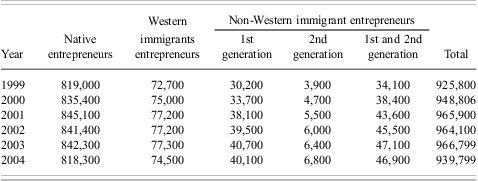
The total number of businesses in the Netherlands has continued to grow from 925,800 to 939,799 (818,300 indigenous entrepreneurs, 74,500 Western entrepreneurs, 46,900 non-Western entrepreneurs) in the period 1999 to 2004 (see Table 1). The share of ethnic entrepreneurs in the total number of entrepreneurs increased from 106,800 (11.5%) in 1999 to 121,400 (13%) in 2004.44 However, within these percentages, the total share of non-Western ethnic entrepreneurs in the Netherlands shows a consistent and strong growth in the period between 1999 and 2004 from approximately 32% (30,200 first-generation, 3900 second generation) to 39% (40,100 first-generation, 6800 second generation), while indigenous and Western ethnic entrepreneurs remained almost constant.

Table 1 shows that, in the last decade, the number of non-Western ethnic firms has considerably increased; in particular, firms owned by the second generation has doubled from 3900 firms in 1999 to 6800 firms in 2004. This means that, in five years, there has been an increase of more than 50% of the second generation starting as ethnic entrepreneurs. They belong to traditional large migrant groups from Morocco, Turkey, Suriname, the Antilles and Aruba entrepreneurs.
In 2004, over 45,000 non-Western migrants entrepreneurs (first- and second-generation) started an enterprise in the Netherlands; that was 12,000 enterprises more than in 1999. In particular, entrepreneurs with a Chinese and Egyptian background (who are small minority groups) often start up their own business, followed by Turks and Surinamese, while Moroccans in the past rarely set up their own firm.
Despite a high start-up rate of non-Western enterprises in recent years, the native entrepreneurs have the highest survival rate, followed by Western entrepreneurs. The survival rate of non-Western entrepreneurs is relatively low, particularly for the first-generation ethnic entrepreneurs, due to low educational and professional preparation including lack of human capital (such as language skills), legal information, limited knowledge of the local culture, insufficient business experience (such as bookkeeping), and lack of entrepreneurial qualifications, e.g. poor design of a business plan, low access to business consultancy, or an inadequate financial plan.Reference Masurel and Nijkamp45 At least 38% of the enterprises started up by non-Western entrepreneurs in 2002 still existed in 2006, while the survival rate of enterprises started up by native entrepreneurs was 62%, followed by Western entrepreneurs of 44%. However, the survival rates of entrepreneurship among immigrants from different cultures and per economic branch also show a high dispersion and differ significantly.Reference Tastan46, Reference Masurel, Nijkamp and Vindigni47
Almost 70% of the non-Western entrepreneurs in the Netherlands originate from Morocco, Turkey, Suriname, the Antilles and Aruba or China/Hong Kong.36 However, within this percentage, the relative growth of the self-employment rate is higher for Turkish immigrants (followed by the Surinamese immigrants) than it is for Chinese immigrants.
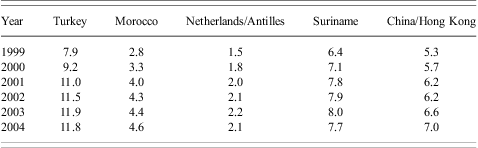
Table 2 shows that the largest group of immigrant entrepreneurs in the Netherlands, from both the first- and the second-generation, originate from Turkey, with 12,300 Turkish firms in 2004, followed by Suriname, with 7700 Surinamese firms in 2004, all of which are more concentrated in large Dutch urban areas.
Number of entrepreneurs (×1000) specified by country of origin (both first- and second- generation), 1999–2004
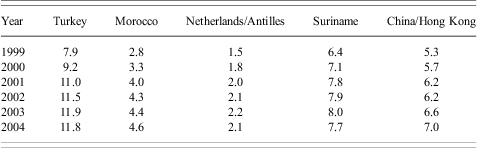
Source: Ref. 44.
However, in the period 1999–2004, the sharpest rise was among Moroccan entrepreneurs: namely, 61%. The number of the Turkish and Antilles entrepreneurs has also strongly increased in that period by 56% and 47%, respectively, while the number of Chinese and Surinamese has grown by 32% and 27%, respectively.36
For a long time, particularly the large Dutch conurbations and cities were places of settlement for major migrant groups of different national and cultural origin, because of higher agglomeration advantages, e.g. a better business environment and employment, which is now an important strategic activity of modern cities and leads to the new ‘urban imperative’. Nowadays, almost 9% of the ethnic entrepreneurs (21% Western ethnic entrepreneurs and 39% non-Western) are concentrated in Amsterdam, one of the four largest cities (called after here ‘G4’: Amsterdam, Rotterdam, The Hague and Utrecht) of the Netherlands. The first-generation entrepreneurs form the largest group of non-Western entrepreneurs in the G4; the second-generation the smallest group.
Table 3 shows that the number of ethnic entrepreneurs in the G4 increased considerably more than the number of indigenous entrepreneurs. Almost one out of every three entrepreneurs in the cities of Amsterdam, The Hague and Rotterdam has an ethnic background, while in Utrecht fewer than one in four entrepreneurs is involved in ethnic entrepreneurial activities. However, in this growth, the number of non-Western entrepreneurs was stronger than the Western entrepreneurs, and the sharpest rise was particularly among the second-generation non-Western entrepreneurs.
Number of entrepreneurs (×1000) specified by group of immigrants in the G4 (1999, 2002 and 2004)

Source: Ref. 72.
The first-generation entrepreneurs are relatively more concentrated in the poor districts in Rotterdam, The Hague and Utrecht – where average house prices are lower than in other districts – than are the higher-educated young ethnic second and third generations. Most of these enterprises are small businesses, mainly oriented towards their own ethnic niche markets – characterized by low barriers of entry in terms of required capital and educational qualifications, their informal nature, less formal ownership, small-scale production, high labour-intensity, and low added value. These businesses are usually in traditional sectors: travel, clothing, hotel and catering sectors are still most popular.36, Reference Waldinger48
The younger generation is, however, more open and is seeking new opportunities outside the traditional sectors and geographical areas – an external market orientation beyond their own ethnic group, which might offer better opportunities to serve target groups outside the original niche. They are attracted to new sectors, such as ICT, marketing, accountancy, global trade, real estate, consultancy, and leisure and recreation management agencies. Thus, they want to expand into high-volume trade by engaging in trade with native entrepreneurs and other ethnic groups. Among the foreign entrepreneurs, the position of the second generation is much better than that of the first generation, because the second generation has been educated in the Netherlands and also participates more intensively in Dutch society. This means that they experience fewer barriers and problems than the first-generation foreign entrepreneurs.
The development of the distribution of the entrepreneurs by group of immigrants is changing and enhancing the image of urban interests in the potential of foreign entrepreneurs (the lead sector for accelerated economic growth) as major attraction forces and sources of strategies for economic growth.
Cities are now pursuing various diversity strategies, which have a strong influence on the self-employment propensities of different ethnic groups,Reference Volery49 in order to maintain the agglomeration opportunities that make cities more accessible for all kinds of minority groups. In this way they can improve their position, satisfy their needs, and offer an attractive business location environment, and better financial activities and business services (by way of absorption and upward economic mobility).Reference Brenner50 This is a major challenge to cities and policy-making bodies, especially in the context of sustainable local development.
It is noteworthy that ethnic entrepreneurs form a rather heterogeneous class. Thus, urban (ethnic) entrepreneurship and diversity policies are becoming segmental and tailor-made activities, in which minority groups and firms may play a critical role. Ethnic entrepreneurship has a variable trajectory with many opportunities, but also with many hurdles and failures.Reference Nodoushani and Nodoushani51 To identify these chances and barriers, more empirical fieldwork is necessary. Therefore, in the next section we will describe the results of a case study on one of the three largest ethnic groups that has had the sharpest rise in the absolute number of non-Western entrepreneurs and a relatively high birthrate: namely the higher-educated young Moroccan entrepreneurs in the ICT, legal services, media, financial, real estate, consultancy and marketing sectors concentrated in the G4 in the Netherlands.
3. Moroccan Entrepreneurs in Dutch Cities: an Exploratory Investigation
3.1. Introduction
Nowadays, the Moroccan entrepreneurs show the sharpest rise in terms of absolute numbers of all the non-Western entrepreneurs, and have a relatively high birthrate in the Netherlands. Many of the survivors appear to be small-sized, relatively young, and active in small (ethnic) niches, and do not always have the expertise and know the right people in order to make the big step towards an external market orientation. The important research question is now: What are the critical success conditions for these ethnic entrepreneurs?
In order to trace the opportunities and barriers for ethnic entrepreneurs, we recently made an in-depth field survey of a limited new set of rather representative Moroccan entrepreneurs in the G4. The G4 have a large share of most of the ethnic groups present in the Netherlands. Our study seeks to analyse the behaviour of the second-generation ethnic entrepreneurs of Moroccan origin in the G4 in terms of their entrepreneurial behaviour – with a focus on their personal and business characteristics and on their motivation and driving forces, which all can explain their entrepreneurship and business performance. Our database stems from a sample of 24 ethnic entrepreneurs of Moroccan origin (8 females and 16 males) selected from a group of creative and innovative ethnic entrepreneurs in the business-related professional service sectors with higher educational level and skills, and who are different from the traditional ethnic niche in terms of their products, services and communication channels. This is a relatively small sample, but in this emerging new market it turned out to be extremely difficult to find more second-generation entrepreneurs who were willing to participate in our interview. Consequently, we will present in the next section a combination of quantitative and qualitative research methods and exploratory results.
3.2. Personal Characteristics of Moroccans Entrepreneurs
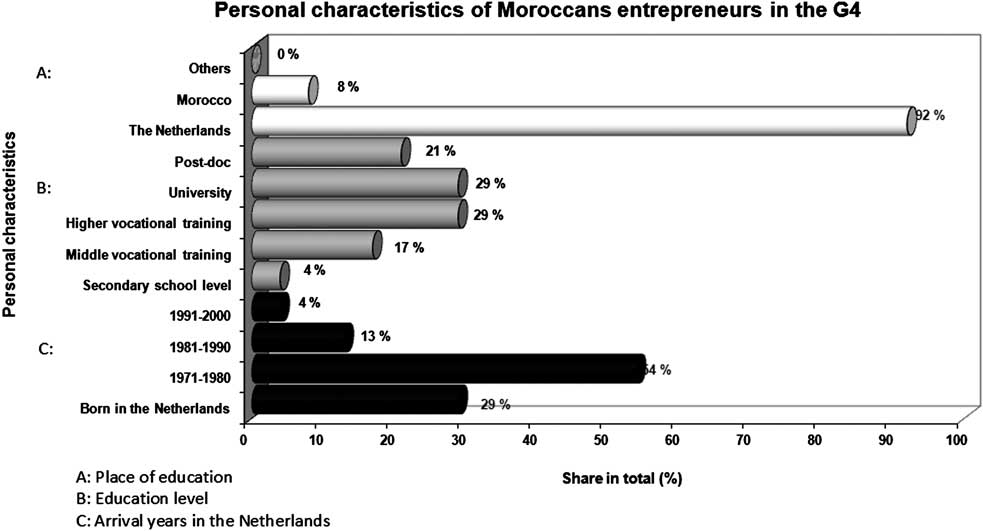
The average age of entrepreneurs of Moroccan origin who participated in the research is between 35–39 years (33%) and they are mostly male (67%). Most of the Moroccan entrepreneurs are married (75%) and have children (37%). When the country of birth is taken into consideration, Figure 1 (see C) shows that the majority of the Moroccan entrepreneurs were born in Morocco (67%) and came to the Netherlands between 1971 and 1980 (54%); while 29% were born in the Netherlands.
Personal characteristics of higher-educated young Moroccans entrepreneurs in the G4.
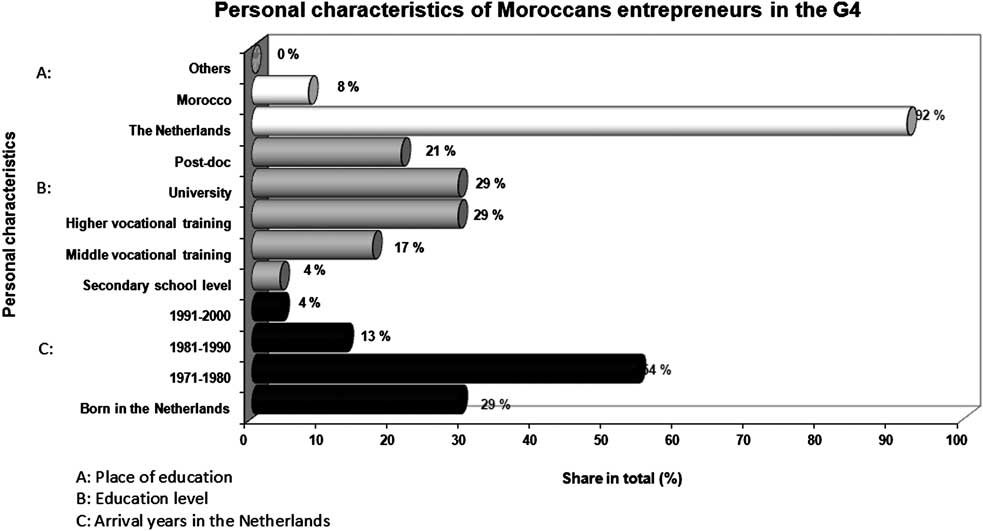
The majority of the Moroccan entrepreneurs (92%) achieved their educational attainment in the Netherlands and speak both Dutch as well English fluently (see Figure 1, A). Depending on their arrival year, which was younger than 12 years (the border between primary and secondary education), and educational attainment in the Netherlands, the majority of the entrepreneurs (70%) fall in the category of the second generation (see also Refs Reference Masurel and Nijkamp45, Reference Veenman52). The majority of the Moroccan entrepreneurs (58%) have a high level of vocational education (HBO) and university education (WO), followed by those with a post-doc level (21%), and the rest had a middle level of vocational education (17%) (see Figure 1, B).
3.3. Motivation and Driving Forces of Moroccan Entrepreneurs
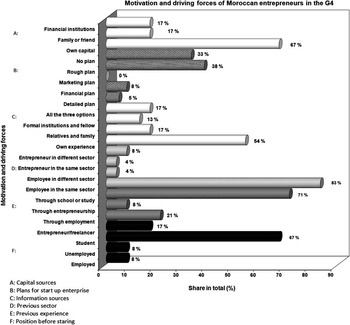
Figure 2 shows that the majority (67%) of the Moroccan entrepreneurs were students before they started their own business, and 17% were already active as entrepreneurs (17%) in their previous position (see Figure 2, E). This shows that unemployment has not pushed the majority to become self-employed as a means of economic survival.
Motivation and conditioning factors of higher-educated young Moroccan entrepreneurs in the G4.

Their previous experience of entrepreneurs through their studies and employment (71%) and, moreover, their obtaining this kind of experience in a similar sector to their own (83%) motivated them to start their own business (see Figure 2, E and F). Depending on their previous experience and sector choice (see Figure 2, D), the main reasons to become entrepreneurs came from the desire to be independent and their own boss, followed by extra income and the ambition to be a leader. More than 75% of the Moroccan entrepreneurs have chosen to be active in a sector similar to that in which they had their work experience and because of the market opportunities and high demand in that sector, while the minority of the entrepreneurs have chosen this sector because of their educational background and interest (hobby).
However, the majority of the Moroccan entrepreneurs (71%) had no or an inadequate business plan to start up their own business (lack of entrepreneurial qualifications) (see Figure 2, B); factors such as sources of capital and information show that 67% of the entrepreneurs have used their own capital, and 54% used their own experience, while 17% obtained information from family and relatives (see Figure 2, A and C). On the other hand, the minority of the entrepreneurs had a very detailed financial plan to start up their own business, and had obtained financial capital and information from formal institutions and fellow entrepreneurs, as well as from family or friends. Although the minority of the entrepreneurs had a family member who is an entrepreneur, factors such as capital and information sources show that entrepreneurs are quite independent of their family or friends.
The current situation in a dynamic economy was evaluated by the majority of the entrepreneurs as attractive, and as having a growing and promising structure with scope for sustainability, specialization, new innovative techniques of services and products and less intense competition. Seventy-one percent of the entrepreneurs mentioned that the share of Moroccans in the sector is increasing, while only 4% claimed that their share is decreasing. Almost 30% of the Moroccan entrepreneurs stated that their total orders had slightly decreased because of the financial crisis and government spending cuts. But they are positive and see this as temporary, because they are convinced that the information and communication technologies (ICTs) will probably always play an increasingly significant role in all industries by supporting their business and marketing strategies and internal and external business processes.
3.4. Business Characteristics of Moroccan Entrepreneurs
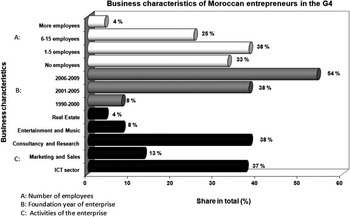
Figure 3 shows that the surveyed Moroccan businesses from the creative industries belong to the following sectors: consultancy and research (38%), ICT (37%), marketing and sales (13%), and real estate and entertainment/music (12%) (see Figure 3, see C). When the foundation year of the enterprise is taken into consideration, the findings show that more than 50% started their own small-sized business after 2006 – mostly in sole proprietorship (88%) with fewer than five employees (38%) – while 8% of the entrepreneurs started their business in 1990 (see Figure 3, A and B). It is very interesting to observe that Moroccan entrepreneurship really took off after 2001, at 38%.
Business characteristics of higher-educated young Moroccan entrepreneurs in the G4.

3.5. Strategic Business Performance of Moroccan Entrepreneurs
Figure 4 shows that the Moroccan entrepreneurs experienced a positive development in their business performance results in the year 2008. Almost 75% of the businesses had an increase in sales, while 8% of the entrepreneurs experienced stable sales results in 2008 (see Figure 4, D). The profit of the previous year shows that 67% of the businesses had a positive profit; while 13% did not see any changes in their profit (see Figure 4, C). In order to stay ahead, and remain competitive under various conditions, they have become very critical and use more formal practices. This formal approach increases the focus on the management of the business, which not only reflects the growing diverse and dynamic business environment today, but also helps to monitor the firm's strategic response to this complexity. More than 50% of the entrepreneurs regularly adapt their organizational growth strategies in response to market and economic conditions (see Figure 4, ad A).
Strategic business performance of higher-educated young Moroccan entrepreneurs in the G4, in 2008.

Sixty-three percent want to provide higher quality and innovative products and services, while 25% want to focus on professionalization (namely improvement in the organizational and management structure and attracting high-skilled employees) and market expansion; the remaining 13% want to focus on specialization to achieve strategic and organizational goals and a better alignment of individual objectives to organizational objectives, in order to improve the performance of the business and to ensure a sustainable competitive advantage with regard to its chosen organizational strategies, in a dynamic environment (see Figure 5, B).
Employees and clients of higher-educated young Moroccan entrepreneurs in the G4.

3.6. Composition of Employees and Clients of Moroccan Entrepreneurs
Figure 5 shows that the Moroccan entrepreneurs are not dependent on customers and labour from their own ethnic group in their business environment, because they do not really offer specific ethnic products or services. More than 50% indicated that their target group is Dutch natives and others (such as particular sectors, firm-size, females, governments, etc), while 42% indicated that they do not have a target group (see Figure 5, B). This applies particularly to Moroccan entrepreneurs in the ICT sector, where their products and services are not related to the needs of a particular (ethnic) group. Therefore, more than 60% of the entrepreneurs mentioned that they actually preferred to hire Dutch employees and 8% of the entrepreneurs do not have any Moroccan employees (see Figure 5, D).
A few Moroccan entrepreneurs (8%) indicated that their target group is Moroccan clients. Therefore, only 21% of the entrepreneurs explained that they needed to have Moroccan employees because of their Moroccan target group (see Figure 5, C).
The composition of the clients also shows that more than 90% of the entrepreneurs have a clientele who consist of 80% native-Dutch and other clients, while the minority of the entrepreneurs (8%) have a clientele who consist of 80% Moroccans and 20% native-Dutch (see Figure 5, A). The overall evaluation is that the majority of our case-study Moroccan entrepreneurs in the creative industries serve a large group of native clients and provide an employment opportunity for 121 people, who are mainly not from their own ethnic group (71% are non-Moroccan employees).
3.7. Participation in Social Networks and Support from Social Capital of Moroccan Entrepreneurs
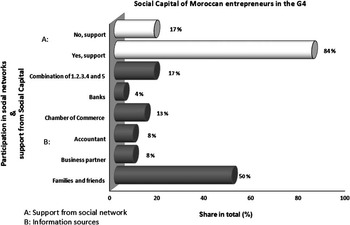
Figure 6 shows that the majority of the entrepreneurs (84%) make extensive use of their own social networks (for information, general information, promotions, shared experiences, recruitment of cheap and loyal labour, involvement in the decision making, cooperation, advice on the amount of crucial resources for the desired growth strategies, the ownership of multiple businesses, and the expansion of their own network) within their own ethnic groups through friendship and shared community of origin in their destination areas (on the local level) (see Figure 6, A). Only 17% of the entrepreneurs make use of formal social networks, and do not really participate in the informal networks (17%) (see Figure 6, B). Nevertheless, they still see the informal social networks as a valuable and important asset, which contributes to increased flexibility in strategic decision making (see also Ref. Reference Rusinovic53), and a central source of ‘social capital’ (see also Ref. Reference Massey54). The relationships among these entrepreneurs, and the interaction and connections within their social networks and their shared values, shared challenges and equal opportunities within specific cities/regions, enable them to commit themselves to each other. These relationships are based on a sense of trust, tolerance, hope and norms of reciprocity among the entrepreneurs.
Present Social Capital of higher-educated young Moroccan entrepreneurs in the G4.

A final remark in the statistical reliability of the results presented in Figure 1–6 is relevant here. The values of alpha coefficient (αi) > 0.6 (0.703; 0.678; 0.751, and 0.622, respectively, for Personal Characteristics (PC), Participation and Support Social Capital (PSSC), Motivation and Driving Forces (MDF), and Business Performance (BP)) showed that the measurement scales used in this research are sufficiently reliable.Reference van Velde, Jansen and Telting55
In general, the empirical results of our case study research shows that the second-generation Moroccan entrepreneurship in the Netherlands really took off after 2001. Nowadays, the higher-educated young Moroccan entrepreneurs are focusing on non-traditional and fast-growing sectors and operate in a volatile environment with continually changing technologies, markets and business strategies, and shifting consumer needs for products and services, which differ widely on the national, regional and local levelReference Boissevain, Blauschkee, Grotenberg, Joseph, Light, Sway, Waldinger and Werbner56 and offer business opportunities on different geographical scales.Reference Razin and Light57
However, the majority of these entrepreneurs still make extensive use of their local informal social networks, with whom they have a strong common interest, and see these as an important and central source of ‘social capital’, which may confine the desire to grow their entrepreneurship only within their local social networks. In the long run, however, the lack of formal commitments and expectations will result in failure to meet the members’ needs (no formalized network structure). This will not help to bridge the gaps that exist between the various ethnic entrepreneurs in their local social network and (other) formal networks, institutions or groups in Dutch society (on the local, regional and national levels), all of which build confidence and lead to increased awareness, knowledge and trust. As PutnamReference Putnam58 stated: ‘a society of many virtuous but isolated individuals is not necessarily rich in social capital’.
Therefore, isolation brings limitations in, for example, network, cooperation, break-out strategies, in particular as local clients are not necessary big spenders; city clients do not visit their area; and fewer new product-market combinations are developed. The isolated (migrant) entrepreneurs do not make use of opportunities from formal organizations, governments, financial institutes and potential partners on the local, regional and national levels, which creates loners in the crowded melting pots; in particular, migrant entrepreneurs do not find it easy to make their way in the complexities of modern society. However, most migrants appear to be proud, work hard, offer good service, have loyal customers and are always open to new markets.
3.8. Challenges and Success Factors Moroccan Entrepreneurs
The majority of our case study Moroccan entrepreneurs (62%) have not faced any problems in running the business that impede growth and success in a challenging and dynamic business environment. However, 38% of these entrepreneurs have to cope with critical problems, which are also quite commonly experienced by native-Dutch entrepreneurs. There are seven main types of issues often perceived as problematic:
(1) a confusing and complex tax structure, overregulation (long delays in getting approval for trade licences and business registration), and government policies (relating to working hours, labour relations and working conditions) which are often overly complex and unclear;
(2) difficulties with the implementation of strategies and formulation of goals: a better achievement of organizational goals is possible, but the operational objectives have to be translated into better and clearly measurable key performance indicators (KPIs) and undertaken actions, which are related to strategic objectives;
(3) the inability to maintain an accurate internal business process and administration;
(4) the difficulty of attracting good and well-skilled employees;
(5) the challenge of offering quality products and services for a broader group of clients and in broader markets (strong competition);
(6) the need to reduce the overall costs; and
(7) the limited access to financial capital from governmental and private institutions that is so essential for continuous business and sustainable development in order to become and remain world-class players in everything they do (to empower their strategic position in the market).
The most important variables that contribute to the success in our case study on Moroccan entrepreneurs are their: (1) growing (new) social network; (2) strong motivation, enthusiasm and persistence; (3) strong reputation of the organization as a high quality and honest firm with a lot of personality and expertise; (4) high-quality of customized services; (5) wide language ability; (6) strengths in business and managerial skills; and (7) higher result orientation. All these variables have to do with improving the quality of management and processes and thus achieving successful organizational results.
A daily preoccupation for these firms is managing real value drivers (quantitative as well as qualitative) behind the business with a continuous strategic planning process, combined with a learning and thinking process for value-creation and achieving organizational results. Thereby, it is important to clearly communicate the KPIs (i.e. empowerment), which brings transparency to the accountability and responsibility of people and leads them to better action-orientation and improvement of strategic planning and to gaining a competitive advantage.
Through improved and intensive communication, knowledge share and exchange, and cooperation, these entrepreneurs can receive early warning of potential problems, and thus can understand better how to improve their business strategy, which reduces ad hoc work, lowers costs and increases profit. Better steering and execution, which, by using specific concepts and taxonomy that everyone is expected to know, helps people to take a consistent business direction, and to consider how to improve things, and to have a better focus on issues that are important for the organization and its shareholders.
4. Statistical and Multiple Regression Analysis
Despite the relatively small sample in our research, it is interesting to pursue some further statistical analysis. Using a multiple regression analysis, a structural relation model can be created on the basis of the following factors: personal and business characteristics (PC and BC), motivation and driving forces (MDF), participation in social networks and support from social capital (PSSC), and strategic business performance (SBP) (see Figure 7). This model is constructed to identify the various relations between the factors. In this respect, several hypotheses can be made, in particular: (1) there is a significant relationship between personal and business characteristics (PC and BC) and business performance (BP); (2) there is a significant relationship between motivation and driving forces (MDF) and business performance (BP); and (3) there is a significant relationship between participation and support from social capital (PSSC) and business performance (BP). Hence, we can specify the following measurement model (in logarithmic form):

Structural relations model.

An ethnic entrepreneur is endowed with human capital PC, which increases the ability to understand how to steer a business in a challenging and turbulent business environment. This may, at a particular stage, lead to a higher BP in growth in employee numbers, sales turnover, and value of capital assets.
The migrants benefit from their previous employment experience before starting their own business, and those who are already entrepreneurs benefit from their years as businessmen or women in similar challenging industries and sectors, MDF, which makes them more highly-orientated towards business growth, and subsequently the achievement of a higher BP.
Naturally, an ethnic entrepreneur will build up, and make an extensive use of, local level personal and social relationship capital, PSSC, to create competitive advantages to further successfully improve their economic and business performance and the related business objectives, BP. Figure 7 depicts the results of the multiple regression analysis.
Figure 7 shows that the PC factor has significant positive relations with PB, and no significant relations with the other factors. The explanation for this is that human capital (such as age, arrival year, level and place of formal education, a very well-integrated individual, business strengths and managerial skills in generating ideas and dealing with people, management styles (e.g. in terms of mutual empowering, collaboration, sharing of information), and language ability) positively influences the entrepreneurs’ ability:
• to be more aware of changes in the business environment;
• to understand how to manage the business;
• to develop and execute effective strategies and related determined objectives;
• to seek informal networks and financial capital;
• to get access to the information necessary to discover, evaluate and exploit (profit) opportunities and possibilities for market expansion in the dynamic business environment (i.e. become more conscious of the reality of the business world); and
• to translate this information into strategic decisions for growth (e.g. decisions to grow, improve and innovate) which shows greater renewal and clarity in their strategies.
It seems reasonable to assume that a higher business performance (e.g. growth in numbers of employees, sales, turnover, value of capital assets) will occur:
• when the entrepreneurs have arrived very young and achieve their high educational attainment in the Netherlands and speak the language very well; have a higher ability to be involved in all areas of business activities;
• think from different perspectives to achieve organizational objectives and innovations without personal and financial consequences;
• are better focused on strategic planning; and
• understand how to manage their business in a dynamic market (high quality of entrepreneurs with knowledge and modern skills).
There is no significant relationship between the BC, and the other factors. From this result it can be inferred that the BC are closely linked to specific business performances, and are more stand-alone.
However, there are several significant relations between MDF, PSSC, and PB, specifically between MDF and PSSC, between MDF and PB, and between PSSC and PB. These factors can be interpreted as mutually-reinforcing pairs.
The success and economic survival, BP, of the entrepreneurs depends not only on their PC. In addition, MDF and PSSC also have a positive relationship with the BP of Moroccan entrepreneurs. This concerns their previous position before starting their own business, the entrepreneur's years of prior experience in a similar (growing and attractive) industry (see also Refs Reference Storey59, Reference Glancey, Greig and Pettigrew60), and the information they receive from social family and relatives. The entrepreneur's previous educational attainments and work experience in the long run (learning-by-doing) in a similar type of business (see also Refs Reference Chell, Hawarth and Brearley61–Reference Schiller and Crewson63), coupled with an innovative and positive entrepreneurial attitude (e.g. being a hard worker, acceptance of risk, loyalty, participating in a strong social network) and motivation (e.g. being ambitious, wish to be their own boss), and strengthened involvement and commitment to the strategy to meet their strategic (personal) objectives, are all dominant predictors of a higher orientation on business growth, and subsequently the achievement of higher business results. In turn, this strong focus will increase the capability of their business to achieve its financial results and strategic goals and objectives.
However, there is also a significant relationship between MDF and PSSC; that is, motivation factors (e.g. achievement, self-confidence and satisfaction, the search for independence, locus of control (pull factors)) and supportive environmental factors (e.g. attractive and growing industry sector, and sources of information and finance) help Moroccan entrepreneurs to exert themselves and create dynamic businesses.
The entrepreneurs (with their motivational driving forces) make extensive use of their informal advisory and mentoring supportive relationships to create competitive advantages, such as informal advice and relevant contacts. These social support (ethnic) networks motivate them to start up their own business, and can help by delivering a number of important resources to overcome the disadvantages and obstacles which the entrepreneurs face that impede growth, success, and personal fulfilment in a challenging and dynamic business environment (see also Refs Reference Fraser64, Reference Wheeler65).
The influence of strong ethnic informal social networks is often intense and reaches further, because these networks are based on (ethnic) business associates, and on family and friendship networks in which these entrepreneurs participate and are an intrinsic part of their lifestyle (see also Ref. Reference Light, Bhachu and Karageorgis66). These networks are strongly involved in their entrepreneurship and still massively influence the decision-making process of these entrepreneurs concerning, for example, self-employment and selection of localization.
They use different functions of their personal and social relationships (informal advisors and mentors, (ethnic) business associates, family and friends) to access important information resources, lower cost via trust, and support in quick and efficient decision making and related collective action in order to successfully further their economic (i.e. mass of potential customers) and business performance and their related business objectives (see also Ref. Reference Hisrich and Brush67), and to identify new opportunities and transform these into new commercial business ideas for market expansion. This creates a challenging social environment to develop and establish (new) networks among these entrepreneurs who are constantly interacting – via information flows between newcomers and settlers (see also Ref. Reference Waldinger68). Such networks generally serve as platforms for further exchange of information, experiences and interests, growth and fruitful cooperation between businesses.
It seems reasonable to assume that what makes Moroccan entrepreneurs more capable of managing their business successfully is:
• when they have been involved for a long time in a similar type of business to that in which they gained knowledge and managerial skills through education and work experience and an increase in their ability to recognize relevant (re)sources (information) to solve problems, supported by reliable environmental factors such as source of (informal) information (channels), contact networks, low-cost financing and cheap personnel, training and skills, customers and suppliers, competition, and dedicated government policies (see also Ref. Reference Boissevain, Blauschkee, Grotenberg, Joseph, Light, Sway, Waldinger and Werbner56), and
• when these entrepreneurs have access to training courses and workshops on entrepreneurial development and improvement.
All these advantages lead to a better focus on the survival and growth (path) of the firms, e.g. in terms of turnover, profit, number of employees,Reference Santarelli and Vivarelli69 and the entrepreneur's satisfaction and expectations.Reference Cooper and Artz70
On the other hand, BP, such as profitability, revenues and sales growth, and the provision of higher quality and innovative products and services, also has a significant influence on MDF.
It seems reasonable to assume that the positive business results obtained by achieving successful strategic goals and objectives make it possible for entrepreneurs, as well as their informal advisors and mentors, to become more enthusiastic and satisfied, and have a better focus on, and, be connected and committed to, the strategic goals and objectives. If they can pro-actively achieve these goals and deliver more and better performances (positive reinforcement), this will also increase the capability of the business to achieve its financial results and organizational goals and related objectives.
5. Conclusion and Lessons
The research described in this article has focused on answering the question: What are the critical success conditions for higher-educated young (and creative) Moroccan entrepreneurs in major cities in the Netherlands? On the basis of field research conducted among 24 prominent Dutch-Moroccan businesses in the high-tech and creative industries, it was possible to discover more about the success factors of the ‘new generation of Moroccan entrepreneurs’ in the four big cities in the Netherlands (the G4: Amsterdam, Rotterdam, The Hague, and Utrecht), which have a rich variety of migrant entrepreneurs. In order to provide a comprehensive answer to this research question, the following variables were considered: human, social and business capital, and the motivation and driving forces of the second-generation Moroccan entrepreneurs in the creative industries.
The new generation of Moroccan entrepreneurs is very well-educated and integrated in the Dutch community (very familiar with the Dutch culture and speak the language fluently). Hence, with their very good previous study and work experience in a similar type of business, coupled with innovative and positive entrepreneurial attitude and motivation, they have the ability to be involved in all areas of business activities, thinking from different perspectives in order to achieve their organizational objectives and innovations without personal and financial consequences. All this contributes to a higher economic and business performance and success level for the younger Moroccan entrepreneurs.
Moroccan entrepreneurship in the Netherlands started mainly after 2001, and there was an enormous increase in start-ups of small-sized enterprises with fewer than five employees after 2006, in particular in the service sectors, such as ICT and consultancy and research.
The critical factors cited as pulling the younger generation of Moroccan migrants to become entrepreneurs are the market opportunities and possibilities, as well as the growing and promising structure of the business environment with scope for sustainability, specialization, new innovative techniques of services and products, and less intense competition in the sector, which all differ widely on the national, regional and local levels and offer many business opportunities on different geographical scales. All these factors are supported by the young entrepreneurs’ reliable social capital in the form of family and friends who provide them with (informal) advice, information, workshops on business development and improvement, and make them more capable of managing their business successfully. However, it is important for these entrepreneurs to realize that in their decision-making process, the (informal) social networks may confine the desire to grow their entrepreneurship only to within the melting pot communities. Therefore, to benefit from potential formalized social capital, diversity and business opportunities demand a high level of interaction and connection within various social networks and between the individuals within and across cities/regions.
The most important factor that contributes to the success of the entrepreneurs is the strong reputation of the organization as a high quality and honest firm with a lot of personality and expertise. To grow a (new) social network requires strong motivation, enthusiasm and persistence, factors that were also cited as critical success variables. In running their business, only a few entrepreneurs faced that impeded growth and success. Their main problems are: overregulation, concerning, for instance, long delays in getting approval for trade licences and business registration; the challenge of implementing strategies and formulating goals; the need to maintain an accurate internal business process and administration; the difficulty in attracting good and well-skilled employees; and their limited access to financial capital.
It became clear that motivation and driving forces and human and social capital have a significant relationship with entrepreneurship business performance, which is linked to success. Thereby, motivation and driving forces have to do with the ability to recognize and get access to the information necessary to discover, evaluate and exploit (profit) opportunities and possibilities, and to integrate this important and crucial information into strategic decisions for growth (namely, thinking from different perspectives and implementing and understanding their business strategies), which all require proactive involvement in all areas of business activities, and yield higher organizational results.
Furthermore, the social capital, based on (ethnic) business associates, family and friendship networks, has to do with helping to deliver a number of important resources for tackling the disadvantages and obstacles, which the entrepreneurs face that impede growth, success, and personal fulfilment; and is also concerned with identifying new opportunities and transforming these into new commercial business ideas for market expansion to successfully further their economic and business performance in terms of profitability, revenues and sales growth, and the provision of higher quality and innovative products and services, all of which also had an significant influence on motivation and driving forces and social networks.
The business characteristics turned out to be stand-alone (i.e. they are not related to the other factors). The research also showed that the motivation and driving forces and social capital form several mutually-reinforcing pairs, which strengthen the business capital to be successful in practice in order to maintain a firm's competitive advantage in today's turbulent and challenging business world.
The general results of our study show that the younger generation of Moroccan entrepreneurs are more open and are looking for new opportunities beyond the traditional markets (economic expansion). They want to expand their market domain through break-out strategies, by offering high quality products and services for a broader group of clients and markets, outside their own indigenous ethnic group.
This research study can help to explain how to achieve a better understanding of the important factors that influence entrepreneurial behaviour and activity, the business entry decision and the creation process, and the conditions for success and other factors that can have an effect on the performance of ethnic entrepreneurs in the Netherlands, within the broader context of entrepreneurship. This has implications for various stakeholders such as other ethnic entrepreneurs, policy makers and business investors in this dynamic and promising business environment.
There are several limitations to the research. One is that the sample size of the research was relatively small. Another limitation is that this research is not a longitudinal panel study. Such studies would be able to better examine the developments and shifts in the relations between human, business and social capital and the motivation and driving forces of the Moroccan entrepreneurs in the services sectors. Further research is necessary on the various success conditions depicted in the relation framework, comparing findings between nations, and between genders.
Peter Nijkamp is a Professor of Regional and Urban Economics and of Economic Geography at the VU University, Amsterdam. His main research interests cover quantitative plan evaluation, regional and urban modelling, multicriteria analysis, transport systems analysis, mathematical systems modelling, technological innovation, entrepreneurship, environmental and resource management and sustainable development. In the past years, he has focused on new quantitative methods for policy analysis and on spatial-behavioural analysis of economic agents. He is the former President of the Netherlands Research Council (NWO). In 1996, he was awarded the most prestigious scientific prize in The Netherlands, the Spinoza Award. He is a member of Academia Europaea.
Karima Kourtit is a researcher and PhD candidate at the department of Spatial Economics at the VU University Amsterdam. In 2007 she received her MBA and MSc in teaching Economics and Business Administration. Her research interests lie in the fields of Creative Industries (CIs), Entrepreneurship, Migration, and Regional and Urban economics.