Many factors have been associated with long-term morbidity and mortality in patients with congenital heart disease (CHD). Reference Alsaied, Bokma and Engel1,Reference Ohuchi, Negishi and Noritake2 As patients with complex CHD are living longer, more attention has now been focussed on improving quality of life. Reference Alsaied, Bokma and Engel1,Reference Bratt and Moons3 Some studies have shown that quality of life in CHD becomes significantly worse with age. Reference Apers, Kovacs and Luyckx4–Reference Uzark, Zak and Shrader6
In evaluating the overall health of patients with CHD, it has been suggested to use cardiopulmonary exercise testing and quality of life measurements in tandem as it has been shown that objective exercise capacity has a correlation with both general health and physical functioning aspects of quality of life but not in other areas of quality of life. Reference Hager and Hess7 Survivors of Fontan are at risk for significantly impaired quality of life, which may worsen with advancing age and has been shown to correlate with exercise performance. Reference Uzark, Zak and Shrader6,Reference Atz, Zak and Mahony8 If assessing exercise performance along with quality of life yields a more comprehensive picture of the patient, then a more accurate depiction of where to focus resources and interventions can be made. We aimed to evaluate the correlation of cardiopulmonary exercise testing performance and other objective data across various domains of quality of life in Fontan patients.
Materials and methods
Patients
After obtaining approval from the Institutional Review Board at Indiana University, we performed a retrospective chart review, looking for all patients in our institution older than 12 years of age with single ventricle anatomy and Fontan physiology, who had undergone metabolic cardiopulmonary exercise testing between 1 January, 2007 and 1 November, 2019, who also had concurrent quality of life survey data available. Our exercise lab obtains quality of life questionnaires before all cardiopulmonary exercise testing evaluations as part of our standard operating procedure. Quality of life scoring was measured using the Peds QL 4.0 and Rand SF-36 survey scoring systems, based on patient age at the time of the survey.
Cardiopulmonary exercise testing protocol and measurements
All patients underwent cardiopulmonary exercise testing using a standard Bruce treadmill protocol. All completed cardiopulmonary exercise testing studies were included for analysis, regardless of the clinical indication for the study. If a patient had undergone more than one study over this time frame, only the most recent study was used. Studies were done for routine surveillance in most cases, although some studies were ordered for increased symptoms. Metabolic data during the treadmill test was collected with a Sensormatics™ V29 (Johnson Controls, Cork, Ireland) metabolic cart using breath-by-breath expired gas collection. Rate of carbon dioxide elimination and oxygen consumption was measured continuously during exercise. A valid peak aerobic capacity test was defined when a patient had a respiratory exchange ratio > 1.05 and either achieved 95% of age-predicted maximum heart rate or stopped due to volitional exhaustion. The variables examined from the cardiopulmonary exercise testing results were percent predicted max VO2, max VO2, VO2 at anaerobic threshold, O2 pulse at VO2 max (ratio of oxygen consumption to heart rate), O2 pulse at anaerobic threshold, VE/VCO2 slope (minute ventilation, CO2 production relationship), VE/VCO2 at anaerobic threshold, VE/VCO2 at VO2 max, VCO2/VO2 at VO2 max (respiratory exchange ratio), baseline oxygen saturation (SpO2), change in SpO2, and presence of arrhythmia. Degree of arrhythmia was categorised as none, isolated premature atrial contractions and/or premature ventricular contractions (rare), <5 beat runs of atrial of ventricular ectopy (mild), sustained atrial of ventricular ectopy (>5 beat runs, sustained), early termination of the cardiopulmonary exercise testing study, and/or treatment required for arrythmia (severe). Echocardiographic data was recorded from the examination most closely related in time to cardiopulmonary exercise testing and recorded variables for analysis included atrioventricular valve regurgitation categorised as none/trivial/minimal, mild/moderate, severe; dominant single ventricle ejection fraction categorised as normal (>55%), mildly reduced (45–55%), moderately reduced (35–45%), severely reduced (<35%); and Fontan connection type (lateral tunnel, extracardiac, or atriopulmonary).
Quality of life surveys
The Peds QL 4.0 survey is a 23-item scoring system designed to be developmentally appropriate for patients up to 25 years old and was used to score quality of life in our patients aged 12–25 years. It is both reliable and valid for distinguishing quality of life in children with both acute and chronic health conditions as well as able to distinguish disease severity within a chronic health condition. Reference Varni, Burwinkle, Seid and Skarr9 Scales within the Peds QL 4.0 address physical functioning, emotional functioning, social functioning, and school functioning.
The Rand SF-36 survey includes eight concepts (physical functioning, bodily pain, role limitation due to physical health problems, role limitation due to personal or emotional problems, emotional well-being, social functioning, energy/fatigue, and general health perceptions). Reference Hays and Morales10 This survey was administered to our patients older than 18 years.
Additional variables
For both the older and younger cohorts, demographic variables were examined for correlation with quality of life outcomes: age (at cardiopulmonary exercise testing), gender (male versus female), dominant ventricle (left versus right), number of cardiac medications, New York Heart Association (NYHA) class, diagnosis of arrythmia, diagnosis of liver disease, and behavioural health diagnosis. Unfortunately, important comorbidities including protein-losing enteropathy, plastic bronchitis, and venous thromboembolism were not included because their occurrence was rare in this dataset, preventing statistical analysis. Behavioural health diagnoses included depression/major depressive disorder, anxiety/generalised anxiety disorder, drug overdose/misuse, and suicide attempt. No patients in the younger cohort had a behavioural health diagnosis.
Statistical methods
Univariate and multiple variable linear regression analysis were conducted to study the relationship between functional health scores and patient characteristics. Using SPSS (IBM Corporation Armonk, NY, USA), a stepwise selection method (predictors with p < 0.2 in univariate models for entry, p < 0.05 for retention) was applied to decide variable inclusion in multiple regression models. Performance estimate, R-square, and adjusted R-square were calculated.
In addition to analysing the relationship on quality of life of VO2 max, O2 pulse at anaerobic threshold, VO2 at anaerobic threshold as continuous variables, another analysis was performed dividing patients into quartiles and halves based on VO2 max, O2 pulse at anaerobic threshold, and VO2 at anaerobic threshold. Using Excel (Microsoft Corporation Redmond, Washington), analysis of variance and student’s t-test were performed to compare quality of life in these groups.
Results
Study population
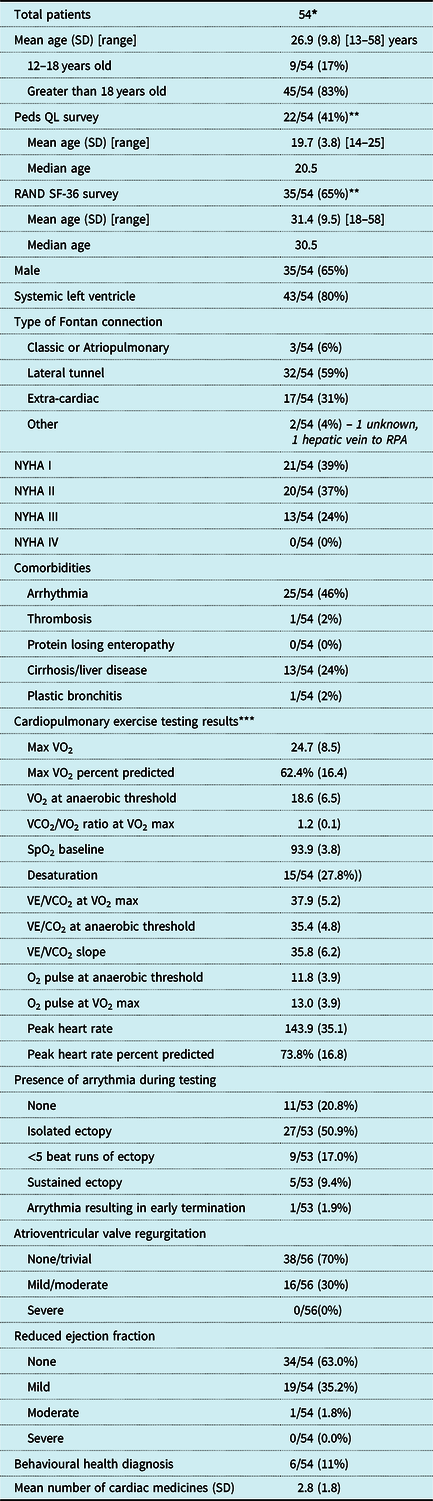
Fifty-three patients met our inclusion criteria and were included in the study. One patient underwent Peds QL at initial cardiopulmonary exercise testing and underwent RAND at a cardiopulmonary exercise testing several years later, and this patient was included twice for a total count of 54 patients. Two patients performed both surveys at a single cardiopulmonary exercise testing. Patients ranged from 12 to 58 years at the time of cardiopulmonary exercise testing, with a mean age of 26.6 years. Twenty-two total Peds QL surveys, average age 19.7, were performed for analysis and 34 RAND surveys, average age 31.4, were completed for analysis. Complete demographics can be found in Table 1.
Demographics

* One patient with lateral tunnel connection performed Peds QL at initial cardiopulmonary exercise testing and RAND at a later cardiopulmonary exercise testing (this patient was included at each cardiopulmonary exercise testing).
** One patient with lateral tunnel connection performed both surveys at a single cardiopulmonary exercise testing date. One patient with extracardiac connection performed both surveys at a single cardiopulmonary exercise testing date.
*** 54 total studies analysed, 1 without rhythm strips available.
Cardiopulmonary exercise testing versus quality of life for younger cohort
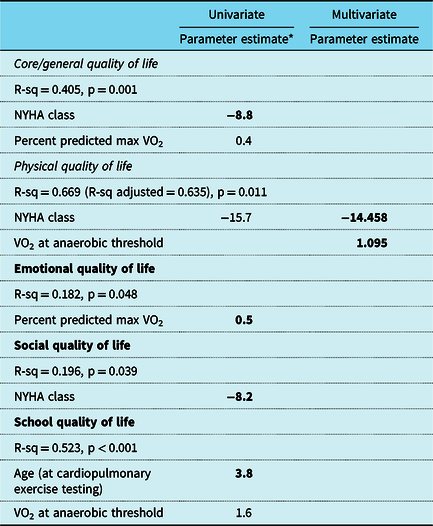
In the younger cohort who undertook the Peds QL, survey domains of core/general, physical, emotional, social, and school quality of life were examined. Table 2 shows correlations between studied factors and various domains of quality of life. For core/general and physical quality of life, having a higher NYHA class was predictive of a lower quality of life and a higher percent predicted max VO2 was predictive of a higher quality of life. Additionally, for physical quality of life, higher VO2 at anaerobic threshold was predictive of higher quality of life. For physical quality of life, a multiple variable model was established with retained variables of NYHA class and VO2 at anaerobic threshold, while no multiple variable model was established for core/general quality of life. For emotional quality of life, higher percent predicted max VO2 was predictive of improved quality of life. For social quality of life, higher NYHA class was predictive of poorer quality of life. For school quality of life, advancing age and VO2 at anaerobic threshold were associated with improved quality of life. Multiple variable models were not able to be established for emotional, social, or school quality of life.
Univariate and multivariable models for quality of life in Peds QL cohort (n = 22). Variables were included in tables if significance p < 0.05 in univariate analysis or part of a multiple variable model with p < 0.05. Variables were considered for multiple variable model if p < 0.2. Model parameters are based on emboldened values representing a multiple variable model if one was obtained or the most predictive univariate model

* Parameter estimate – represents the degree of change in the Summary Score associated with one-unit change in exercise variable.
VO2 = oxygen uptake.
Cardiopulmonary exercise testing versus quality of life for older cohort
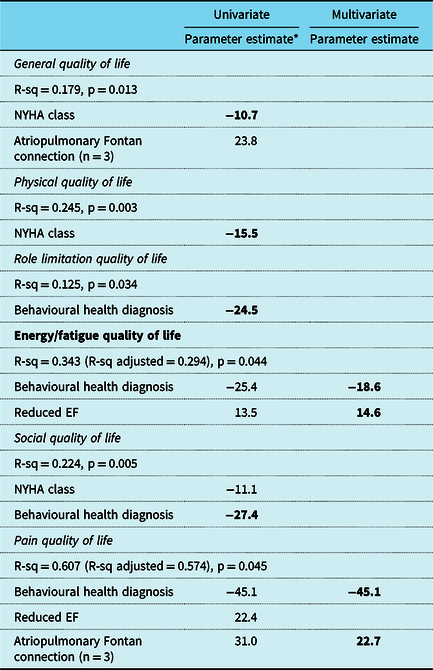
In the older cohort who undertook the RAND survey domains of general, physical, role, energy, social, and pain quality of life were examined. Table 3 shows correlations between study factors and domains of quality of life. For general quality of life, higher NYHA class and atriopulmonary Fontan connection were correlated with poorer quality of life. For physical quality of life, higher NYHA class was associated with worse quality of life. For role limitation quality of life, behavioural health diagnosis was predictive of poorer quality of life. No multiple variable model was established. For energy/fatigue quality of life, a behavioural health diagnosis was predictive of poorer quality of life and a reduced ejection fraction was predictive of higher quality of life and both were retained in a multiple variable model. For social quality of life, both a higher NYHA class and a behavioural health diagnosis were predictive of poorer quality of life, but no multiple variable model was established. For pain quality of life, a behavioural health diagnosis was predictive of worse quality of life, reduced ejection fraction was predictive of better quality of life, and an atriopulmonary Fontan connection was predictive of better quality of life. A behavioural health diagnosis and an atriopulmonary Fontan connection were retained in a multiple variable model.
Univariate and multivariable models for quality of life in RAND cohort (n = 34). Variables were included in tables if significance p < 0.05 in univariate analysis or part of a multiple variable model with p < 0.05. Variables were considered for multiple variable model if p < 0.2. Model parameters are based on emboldened values representing a multiple variable model if one was obtained or the most predictive univariate model

* Parameter estimate – represents the degree of change in the Summary Score associated with one-unit change in exercise variable.
EF = ejection fraction.
Comparison of patients grouped related to performance status
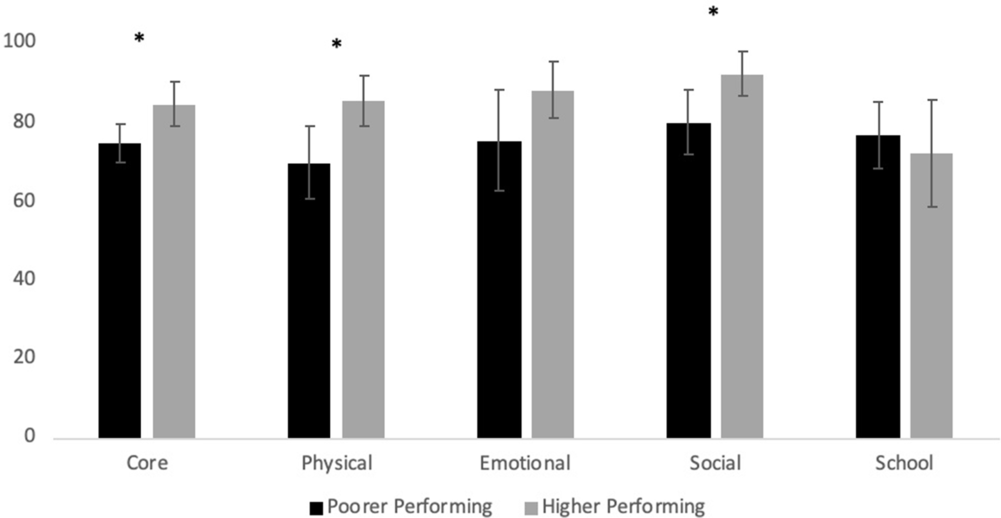
Patients were divided quartiles and halves based on VO2 max, O2 pulse at anaerobic threshold, and VO2 at anaerobic threshold and analysis was performed for each measure of quality of life. In the Peds QL cohort, no significant differences were established based on division into quartiles. As displayed in Figure 1, when groups were divided into halves based on VO2 max, the higher performing group had significantly improved (p < 0.05) core, physical, and social measures of quality of life. When divided based on VO2 at anaerobic threshold, the higher performing group had significantly improved Physical measures of quality of life. There were no significant differences when divided based on O2 pulse at anaerobic threshold.
Patients in the Peds QL cohort as divided into halves based on VO2 max, the higher performing group had significantly improved (p < 0.05) Core, Physical, and Social measures of quality of life.

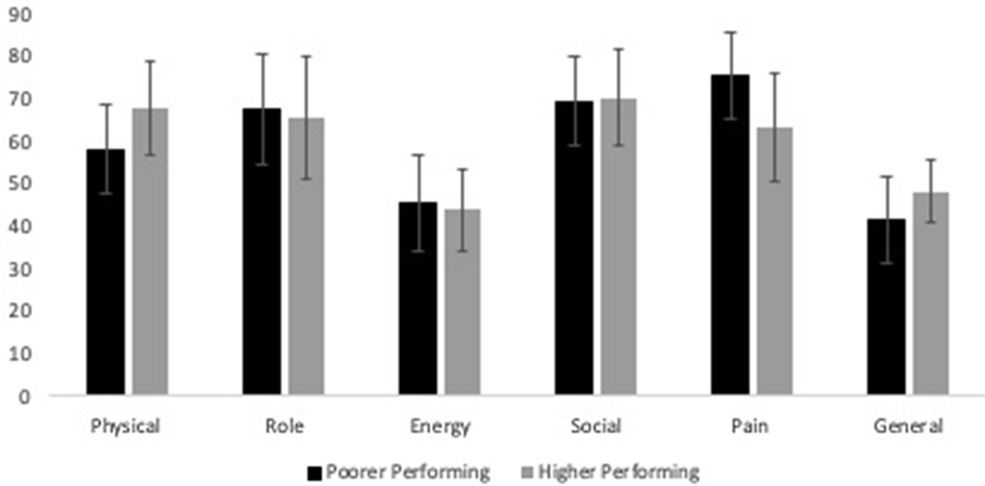
In the RAND cohort, no significant differences were established based on division into quartiles or halves. Groups divided based on VO2 max can be seen in Figure 2.
Patients in the RAND cohort as divided into halves based on VO2 max. No significant differences were found.

Discussion
Assessing the impact of exercise performance on quality of life
As other studies have shown, our study showed correlation between worse exercise performance and poorer quality of life scores, specifically general and physical quality of life, in adolescent and young adult Fontan patients. Reference Atz, Zak and Mahony8 In the younger cohort, poorer exercise performance was also predictive of worse quality of life in the emotional, social, and school domains based on different exercise performance measures indicating the importance of evaluating a broad spectrum of measures exercise performance. A study by Hager et al showed that cardiopulmonary exercise testing performance correlated with quality of life in physical and general domains but not in other domains; however, this study was in the general CHD population and only 8 patients of 149 had Fontan physiology. Reference Hager and Hess7
Cardiopulmonary exercise testing performance was less predictive of quality of life as patients age did not show a regression correlation across all domains of quality of life in patients within the older cohort. As many domains of quality of life were well preserved, this suggests that despite physical limitation, many of our patients are coping and doing well emotionally and older patients are also doing well in areas of general and physical domains of quality of life. It is important to note that a behavioural health diagnosis was predictive of poorer quality of life across multiple domains of quality of life in the older cohort suggesting that behavioural health screening and treatment should be a focus in our patient population.
Echocardiographic data was not as good of a predictor of quality of life as cardiopulmonary exercise testing performance in the younger cohort, and surprisingly, in patients in the older cohort, reduced ejection fraction was predictive of higher quality of life energy/fatigue and pain quality of life. It is possible that selection bias and possibly confounding contributed to this surprising finding. Additionally, only a single patient displayed ejection fraction less than 45%, indicating that significantly reduced ejection fraction had less of an impact on the heart failure phenotype of patients in this study. While it is surprising that reduced ejection fraction was predictive of improved quality of life in some analyses, multiple studies in general adult heart failure literate have shown that heart failure patients with preserved ejection fraction have similar quality of life to patients with reduced ejection fraction. Reference Lewis, Lamas and O’Meara11,Reference Chandra, Vaduganathan and Lewis12
In a large study of several hundred Fontan patients, including a subset of 95 adult patients, Atz et al showed that exercise performance (assessed by percent predicted max work rate) was predictive of physical functioning in Peds QL scores. This study used a multivariate model based on percent predicted maximum work rate and gender to best explain differences in quality of life scores. This study showed that exercise performance accounted for more of the variance in quality of life scores than echocardiographic data or cardiac biomarkers (BNP). Our study corroborates that exercise performance is more predictive than echocardiographic data of quality of life in Fontan patients. Another study by d’Udekem et al showed no correlation between Fontan patients’ quality of life and their exercise capacity; however, this study was with a relatively small number of patients, and patients more often had atriopulmonary Fontans as opposed to our study and the study by Atz et al in which there were more lateral tunnel and extracardiac Fontan patients. Reference Atz, Zak and Mahony8,Reference D’Udekem, Cheung and Setyapranata13 Our study additionally supports that cardiopulmonary exercise testing performance predicts quality of life in physical, general, social, emotional, and school domains; however, this observation was limited to the younger cohort. To our knowledge, our study is the first to use both Peds QL and RAND data together to look at exercise performance across ages in the Fontan population. This is especially useful as Peds QL is only validated to age 25, while the RAND quality of life is validated in patients over 18 years and can be used in older patients.
In our study, worsening NYHA class was the strongest predictor of poorer quality of life across both cohorts. Similarly, Das et al showed that NYHA was a simple measure for assessment of functional status correlating with objective measures of cardiopulmonary exercise testing in Adult CHD patients; however, there was wide variability in measured exercise capacity in each NYHA classification. Reference Das, Young, Niu and Veldtman14 This study concluded that, while NYHA class was a simple measure of cardiopulmonary exercise testing for functional assessment, cardiopulmonary exercise testing is an important tool to identify the source of exercise limitation in Adult CHD patients. Reference Das, Young, Niu and Veldtman14 In another study, Diller et al showed that NYHA underestimates the true degree of exercise limitation in Adult CHD patients and even asymptomatic Adult CHD patients exhibit markedly impaired peak oxygen consumption. Reference Diller, Dimopoulous and Okonko15 Based on this data, Diller et al presumed that it is likely that Adult CHD patients have made lifelong adaptations to their cardiovascular disease and its slow progression, so they are not aware of the true extent of their exercise intolerance. Reference Diller, Dimopoulous and Okonko15 Additionally, Bredy et al showed that Adult CHD patients are often classified as NYHA I despite low VO2, indicating that patients with CHD frequently underestimate their symptoms. Reference Bredy, Ministeri and Kempny16 Our study also provides support to these claims that Adult CHD patients, specifically Fontan patients in our study, make lifelong adaptations to their cardiovascular disease as our results suggest that reduced exercise tolerance does not have as much of an impact in quality of life in the older adult cohort as it does in the younger cohort.
Results in context of treatment
It is important to identify poor quality of life so that earlier referrals to formal exercise programs, cardiac rehabilitation, and psychosocial programs can be made, which may ultimately reduce hospitalisation and optimise medical and psychosocial outcomes. Reference Jackson, Hassen, Gerardo, Vannatta and Daniels17,Reference Mackie, Ionescu-Ittu, Therrien, Pilote, Abrahamowicz and Marelli18 Additionally, as previously discussed, many of our older patients are coping with their cardiac conditions and doing relatively well in emotional, social, and other domains of quality of life. This is an important consideration so that we are both encouraging exercise as well as promoting the pursuit of non-physical interests to maintain emotional and other well-being. As we look longitudinally, it is important to identify patients who may need extra support around the transition of care from childhood to adulthood as post-transfer Adult CHD patients report significantly lower physical well-being and larger decreases in physical functioning quality of life scoring per year after age 19. Reference While, Heery, Sheehan and Coyne5,Reference Uzark, Zak and Shrader6 While these patients would benefit greatly from effective transfer of care, unfortunately, they have been shown to have a particularly high risk for loss of follow-up and poor transition of care. Reference Mackie, Ionescu-Ittu, Therrien, Pilote, Abrahamowicz and Marelli18
The role of cardiac rehabilitation in complex adult congenital heart patients is still a topic of debate and something that is not routinely part of care. It is also a topic of controversy as it is generally very difficult to obtain insurance reimbursement for cardiac rehabilitation if CHD patients have normal ejection fractions. Multiple studies have shown improvement in exercise capacity and quality of life in CHD and Adult CHD populations and Fontan-specific patient populations with initiation of these programs. Reference Duffer, Suppen and Kuipers19–Reference Wittekind, Mays and Gerdes22
Given the relatively small number of Adult CHD patients compared to traditional adult cardiac patients with coronary disease or heart failure, traditional cardiac rehabilitation programs may not meet the specific needs of this complex population. One thought would be to have specific cardiac rehabilitation sites for complex congenital heart patients. Unfortunately, our patient population is often separated and limited by distance. Taking this into consideration, it is reasonable to consider alternative means of connecting with these patients such as telemedicine and using technologies such as activity trackers, to monitor compliance with home rehabilitation programs. Multiple studies have been done to show efficacy of some home-based exercise programs in both Fontan and Adult CHD populations. Reference Jacobsen, Ginde, Mussatto, Neubauer, Earing and Danduran23,Reference Sanberg, Hedstrom and Wadell24
Limitations
Selection bias was a concern in this study as patients who have undergone cardiopulmonary exercise testing are more likely to be those with more consistent follow-up. The contrasting consideration is that patients thought to be doing very well would likely not have cardiopulmonary exercise testing. The group of patients who have their care at a large regional Adult CHD centre may share similar characteristics that are not consistent with the overall population followed by primarily adult cardiologists. This study was not able to completely control for these factors since it is a single institution, retrospective study; however, all patients who underwent cardiopulmonary exercise testing in the selected timeframe were included regardless of indication to get the most complete data possible from the population studied.
Missing data is another limitation which can be difficult to account for in a retrospective descriptive study. Most notably, of the 45 patients over age 18, only 35 performed the RAND survey for unclear reasons and only 10 performed the Peds QL survey, most likely from lack of a standardised testing protocol for patients who qualified in age for both surveys.
A surprising finding was that diminished ejection fraction correlated with improved quality of life in several domains in the older cohort. This is difficult to account for and may be due to confounding or selection bias possibly from closer follow-up of these patients or cardiopulmonary exercise testing performed on a surveillance basis as opposed to a symptomatic basis, although this was not specifically investigated in this study. Additionally, it may indicate echocardiographic parameters of ejection fraction have low utility overall in assessment of these patients and might indicate concerns in estimating this parameter in this population. Atriopulmonary Fontan patients unexpectedly had improved quality of life in the older cohort which could be selection bias since these patients are older and many who may not have done as well have either had conversions or are now deceased.
Conclusion
In conclusion, cardiopulmonary exercise testing was a useful marker for quality of life outcomes in adolescents and younger adults but did not show as a direct correlation in older adults. Different measures of quality of life were correlated with different measures of exercise performance indicating the importance of evaluating a broad spectrum of measures of exercise performance. The lack of correlation in the older adults is likely due to older patients accommodating to their conditions over time. By improving exercise capacity in Fontan patients, perhaps quality of life could also be improved. This highlights the importance of discussing exercise with our patients at routine visits, getting them on exercise regimens appropriate for their heart disease, and possibly cardiac rehabilitation whenever and wherever it might be available. Additionally, many domains of quality of life were preserved in with respect to cardiopulmonary exercise testing performance suggesting that despite exercise limitations patients are coping well in other domains. The role of cardiopulmonary exercise testing and other objective data in predicting quality of life in patients with single-ventricle physiology as well as the relationship between improved exercise capacity and quality of life are incompletely understood and additional prospective evaluation should be undertaken.
Acknowledgements
We are very thankful to the Exercise Physiologists and Echocardiographers who collected data specifically Kevin Pasciak and Mary Kate McKay. Additionally, we appreciate assistance provided by the Department of Biostatistics at Indiana University School of Medicine, specifically George Eckert and Fangqian Ouyang.
Financial support
Funded in part by the Suzanne P. Murphy fund of the Riley Children’s Foundation
Conflicts of interest
None.
Ethical standards
The authors assert that all procedures contributing to this work comply with the ethical standards of the United States guidelines on human experimentation, including the Belmont Report, and with the Helsinki Declaration of 1975, as revise in 2008, and has been approved by the Indiana University Institutional Review Board.