Natural disasters are often accompanied by marked increases in patient numbers, requiring the activation of health service disaster plans to maximize surge capacity. 1 Ensuring sufficient staffing to cope with the increased demand of a disaster is an essential element of preparedness.
Over the past decade, a growing body of literature has cautioned against the expectation that staff will attend work during or following a disaster.Reference Iserson, Heine and Larkin 2 – Reference Fowler, Guest and Stephen 4 Davidson et al found that in deciding whether to come to work, staff weighed their sense of duty and wish to help against the direct threat to their own safety and the safety of their families.Reference Davidson, Sekayan and Agan 5 In surveys of staff willingness to return to work, those with children under the age of 14 years were less likely to return.Reference Buttross 6 More than half of hospital workers indicated they had child care responsibilities to consider, with 63% of these children under the age of 13.Reference Qureshi, Gershon and Sherman 3 Nevertheless, the findings of Davidson et al also showed that once personal and familial responsibilities were taken care of, staff were motivated sufficiently to attend.Reference Davidson, Sekayan and Agan 5
Accommodating the children of health care workers in a safe child minding service should therefore form part of any disaster planning efforts. Anecdotally, this approach was successful at the University of Mississippi Medical Center in the immediate aftermath of Hurricane Katrina.Reference Buttross 6 This service was well utilized by health workers, at any one time providing care for up to 180 children. Unfortunately, an evaluation of this service was not conducted.
The beginning of 2011 is recalled as Australia’s “summer of natural disasters,”Reference Wilson 7 with catastrophic events such as the “inland tsunami” at Toowoomba, major flooding in South East Queensland, and Tropical Cyclone (TC) Yasi occurring within the span of only a few weeks. In North Queensland, TC Yasi saw the activation of hospital disaster management plans at The Townsville Hospital, including the establishment of an emergency child minding service to facilitate the return of staff to work. This report describes the establishment of this service and the results of a brief staff survey that was conducted to gather feedback on the utility and acceptability of the service.
Context
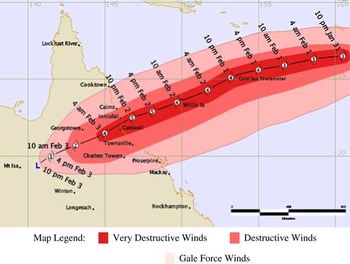
Severe TC Yasi was the largest cyclone to cross the Australian coastline in recorded history. It crossed the coast at Mission Beach after midnight on February 3, 2011, as a category 5 cyclone with wind speeds in excess of 200 km/hour (124.3 mph). Townsville, located 220 km (136.7 mi) south of Mission Beach, experienced the equivalent of category 2 winds. 8 Damage in Townsville was contained to major structural damage to approximately 50 buildings and minor structural damage to approximately 600 buildings. Around 65,000 fallen trees affected road and power lines, and over 200,000 residences and businesses lost power across the affected area for between 2 and 7 days (A Morris, Townsville City Council Emergency Management, written communication, 30 March 2012).
The Townsville Hospital (TTH) is a 500-bed tertiary hospital in north Queensland. A surge in presentations to the TTH emergency department occurred after the cyclone had passed and the TTH mass casualty plan was activated. This included the cancellation of nonessential clinics and discharge of patients not requiring immediate assistance and the establishment of an emergency child minding service. The child minding service was targeted at children of TTH staff to facilitate workplace participation and was the first time the service plan had been activated.
The service was staffed primarily by pediatric allied health, but other allied health, nursing, and assistant staff participated, as did a number of suitably qualified volunteers. The service was located in the Women’s and Children’s area of TTH, and areas such as a large auditorium and a children’s playground were also utilized. The service was available for 8 consecutive days, starting from the day before the cyclone made landfall. In excess of 94 episodes of care were recorded. One month after the cyclone, a formal debriefing session was held based on the observations of the hospital workers and managers involved in the disaster response.
Methods
Three surveys were developed to gather feedback from TTH staff who had placed their children in the care of the service (consumers), TTH staff who had manned the service (staff), and allied health managers whose staff had manned the service (managers). (See Online Appendixes 1-3.) Electronic surveys were distributed in the 2 weeks following TC Yasi. Respondents indicated their agreement with statements on the utility of the service and their satisfaction and confidence with the service on Likert scales. Respondents from all 3 groups were also invited to make additional free text comments regarding their experience with the service. Some consumers and staff could not be contacted owing to the incompleteness of records. Additionally, a formal debriefing was held and records of this meeting were reviewed for further insights into the child minding service. Institutional approval was received for this study.
Results
Use of the Child Minding Service
Overall, approximately 94 episodes of care were provided by the child minding service. Demand dwindled to extinction by day 8 as child care centers and schools resumed operations (Figure 1).
Track and Intensity of Severe Tropical Cyclone Yasi. Image courtesy of Bureau of Meteorology, Australian Government (http://www.bom.gov.au/cyclone/history/yasi). 8

Survey Responses
Of the 37 consumers invited to complete the survey, 16 responded, yielding a 43% response rate. Of the consumers who responded, 75% (12/16) reported finding out about the availability of a child minding service by word of mouth from their line manager or other health service workers. Three consumers (19%) learned of the service by e-mail notification, and 1 consumer (6%) learned of it by seeing temporary signage at the hospital. All consumers responded “yes” in answer to the question of whether the emergency child minding service facilitated their return to work in the immediate post-disaster period. None of the consumers lacked confidence with the service, and all reported that they would use it again in similar circumstances.
Of the 18 staff who manned the child minding service, 14 completed the survey (72%). Responses indicated that 64% of the staff (9/14) volunteered to assist in the service. Eight of the child minding staff (57%) reported that the facilities were adequate, and 3 (21%) felt they were somewhat or very inadequate. Only 1 of the staff members (7%) felt they were adequately resourced with equipment such as toys and games. Most staff (86%; 12/14) reported that they would be happy to work in the child minding service again. Only 1 staff member (7%) was unsure of their willingness to work in similar circumstances, and 1 staff member (7%) indicated that they would not.
The survey was sent to 6 managers, of whom 5 responded (83%). Only 1 manager was required to direct staff to work in the child minding service; the majority of managers had staff volunteer. Managers unanimously agreed that they would support the child minding service in the future.
Benefits of the Child Minding Service
Responses from the consumers were generally positive. Consumers reported that the service enabled their return to work to assist in the hospital’s response. One consumer observed that the child minding service “supported my ability to return to work in the immediate post-cyclone period. Without it I would have had to have taken family leave until school and day care resumed.”
Areas for Improvement
The consensus among both consumers and managers was that increased awareness would increase utilization of the service, enabling more staff to return to work, eg, “just needed to be made public to all staff prior to Yasi’s arrival. Staff didn’t know that it was available… thus, staff were at home looking after kids.”
A lack of suitable facilities was identified by child minding staff, including inadequate or inappropriate physical space and insufficient games or activities to accommodate the numbers and varying ages of children. As stated by one staff member, there were “difficulties managing large numbers in 1-2 indoor spaces.”
Results of the Health Service Debriefing
The service review identified that more detailed and collaborative planning was needed for future events. For example, future planning should include prior selection of appropriate venues that are safe and child-friendly. Additionally, the source, location, and responsibility for other resources (eg, stationery, toys, bedding) need to be identified before an event occurs. Partnerships with relevant services including the kitchen, pediatrics, and cleaning services also need to be developed before the occurrence of a disaster.
Planning should also identify the numbers of staff required, along with clearly defined roles, responsibilities, and reporting lines. Other planning considerations include the development of a manual outlining administration processes for the registration of children and other details of the daily service requirements. Finally, a communication plan for contacting potential service consumers is essential for ensuring maximum utilization.
Discussion
This study reported on the establishment of an emergency child minding service to facilitate the return of staff to work to assist in the TC Yasi response. The feedback received from parents whose children were placed with the child minding service indicated that the service enabled the parents’ return to work. This is consistent with disaster planning literature indicating that lack of child care is a real barrier to attending work. In a survey of emergency medical technicians, 44.3% of respondents listed concern for family members as a reason they would consider not reporting to work. In this same survey, more than one-quarter of respondents reported that their spouse or partner was also expected to report to work in some capacity during a disaster.Reference DiMaggio, Markenson, Loo and Redlener 9
The survey also identified that a lack of effective advertising may have prevented further uptake of child minding. Consumers reported only learning of the service through e-mails, word of mouth, and signage, which may only have been effective had staff already been in to work or spoken with managers who were aware of the service. A hospital-wide survey of staff with children could potentially quantify the demand for a child minding service in the aftermath of a disaster.
A multi-modal communication plan relying on disseminating information through e-mails to work and personal accounts, phone trees, texts, and local and social media would help to raise awareness of the service. Although some breakdowns in communication are inevitable, such as when mobile phone coverage is temporarily lost, adequate planning and the inclusion of redundancies can help to overcome these limitations. This would also be useful with service staffing and rosters. Some major events such as cyclones occur with forewarning; thus, when possible, it would be most effective if the communication plan were activated prior to the event.
The communication plan could form part of broader and more detailed plans for an emergency child minding service. In the TC Yasi response, the concept of the child minding service had been included in the plans but a detailed service manual or “job sheet” had not yet been prepared, nor had staff been provided with appropriate preparation. The service review was able to identify these deficiencies and emphasize areas where adequate planning would benefit future disaster responses.
Many aspects of the service were successful. Staffing at the child minding service posed the fewest challenges, with most staff members volunteering to help—even outside of their rostered shifts. This finding is congruent with those of Davidson et al, who reported that health workers were motivated to return to work provided their families were safe.Reference Davidson, Sekayan and Agan 5
Limitations
This study had several significant limitations. It was a small, single-center study conducted during a single disaster. Although this study was able to obtain feedback from consumers who reported they were able to attend work because of the child minding service, without contacting all staff with children, the true impact of the service on staff attendance remains unknown. These results could also vary with the type of disaster, as previous work has indicated a relationship between the type of disaster and the willingness of staff to attend work. Health workers have consistently reported they would be less likely to attend during a nonconventional disaster such as a missile attack, biochemical threat, or disease pandemic than during a natural disaster.Reference Aitken and Leggat 10 Finally, a more robust measure for obtaining staff feedback could have provided rich data.
Conclusion
The provision of an emergency child minding service undoubtedly facilitated the return to work of staff immediately after TC Yasi. This is likely to have increased the capacity of TTH to respond to the dramatic surge of patients in the days following TC Yasi’s landfall. Because this study was based on a single event, more research is needed to understand the effect disaster type has on the uptake of a child minding service.
Supplementary material
To view supplementary material for this article, please visit http://dx.doi.org/10.1017/dmp.2014.118