Introduction
Although the exchange of support typifies relationships between parents and children across the life span, the consequences of the reversal of support, when adult children become providers and older parents recipients, are unclear. Providing support to an ageing parent may pose a serious challenge to adult children but may also provide an opportunity to ‘give back’ to loved ones. Little is known about the factors which influence whether support provision leads to emotional strain and pressure or to pleasure and satisfaction. Similarly complex are the consequences for elderly parents who, often following a lifetime of provision, find themselves at the receiving end of the parent-child relationship. Do they experience unwanted feelings of dependency or do they value, appreciate and enjoy their children's help and support?
Several studies have found that providing intergenerational support to elderly parents has a small but significant negative effect on the wellbeing of adult children (e.g. Cicirelli Reference Cicirelli1993; Townsend and Franks Reference Townsend and Franks1995). However, within a small overall effect considerable variability may exist; for some adults, outcomes may be positive at least in situations where the parent-child relationship is and has been open and emotionally secure (Merz, Schuengel and Schulze Reference Merz, Schuengel and Schulze2007). Similarly, receiving intergenerational support from adult children appears predictive of better health and wellbeing among ageing parents (e.g. Levitt, Guacci and Weber Reference Levitt, Guacci and Weber1992). Again, however, studies have pointed to possible negative consequences of intergenerational support for elderly parents, as in situations where receiving support engenders feelings of dependence and the loss of autonomy (Silverstein, Chen and Heller Reference Silverstein, Chen and Heller1996). These feelings may also be ameliorated if the relationship with the child is open and secure. In total, such equivocal results suggest that important questions remain regarding the association between intergenerational support and the wellbeing of both the adult child and the ageing parent. The current study investigated this association, paying particular attention to possible moderating factors that might explain why the impact of intergenerational support on wellbeing appears to vary both across studies and across parent-child relationships.
The effects of intergenerational support together with relationship quality have been conceptualised in both sociologically-motivated gerontological research (Koropeckyj-Cox Reference Koropeckyj-Cox2002; Silverstein et al. Reference Silverstein, Conroy, Wang, Giarrusso and Bengtson2002) and attachment-theoretical research on adult children and ageing parents (Cicirelli Reference Cicirelli1993; Marcoen, Verschueren and Geerts Reference Marcoen, Verschueren, Geerts and Baeyens1997). These two literatures converge in suggesting that characteristics of the relationship, such as quality (e.g. Levitt et al. Reference Levitt, Guacci and Weber1992), relationship strain (e.g. Whitbeck, Hoyt and Tyler Reference Whitbeck, Hoyt and Tyler2001), and/or patterns of attachment (e.g. Carpenter Reference Carpenter2001; Cicirelli Reference Cicirelli1993; Crispi, Schiaffino and Berman Reference Crispi, Schiaffino and Berman1997) may compensate for the demands that the parent-child relationship poses in terms of intergenerational support. Relationship quality has been associated with wellbeing and affect balance across generations (Levitt et al. Reference Levitt, Guacci and Weber1992), while strain between adult children and their parents as well as parental dissatisfaction predict lower parental wellbeing. For example, older mothers that had relationship difficulties with their adult children were more likely to report decreased wellbeing (Umberson Reference Umberson1992). Finally, attachment relationships have been shown to moderate aspects of care-giving burden in the context of intergenerational support. Cicirelli (Reference Cicirelli1993) found that stronger attachment was related to less care-giving burden, whereas stronger feelings of obligation were related to greater burden. Indeed, recent work suggests that the impact of attachment relationship characteristics in intergenerational care contexts is strongest for psychological outcomes, such as wellbeing (Carpenter Reference Carpenter2001). In our study, the consequences of intergenerational support for wellbeing and the role of relationship quality have been approached from an attachment theoretical point of view.
An attachment perspective on intergenerational relationships across the life span
Welfare systems have led to a functional differentiation between professional services on the one hand and support by kin on the other (Motel-Klingebiel, Tesch-Römer and Von Kondratowitz Reference Motel-Klingebiel, Tesch-Römer and Von Kondratowitz2005). In countries with a developed system of professional practical help in the households of older people, filial obligations come less to the foreground, even though it has been found that adult children continue to subscribe to filial obligations to some degree (Lowenstein and Daatland Reference Lowenstein and Daatland2006). Still, relationships between parents and children may, in western countries with social welfare systems, be experienced more in terms of affect and emotions.
Attachment theory provides one possible theoretical framework for understanding the impact that intergenerational support in affectively- charged relationships may have on parents and children, because it primarily focuses on relationships that are characterised by seeking and offering comfort, support and emotional security, and their role within the wider realm of affect regulation (Cassidy Reference Cassidy, Cassidy and Shaver1999). Attachment theory has been suggested as a useful theoretical framework not only for the explanation of instinctive caring behaviour for children, but also for the understanding and support of older people who are dependent on care (Steele, Phibbs and Woods Reference Steele, Phibbs and Woods2004). It has been found that attachment relationships are inextricably linked to wellbeing and mental health in both children (Dehart, Sroufe and Cooper Reference Dehart, Sroufe and Cooper2004), and adults (Treboux, Crowell and Waters Reference Treboux, Crowell and Waters2004). Within the theory, the characteristics of intergenerational relationships are examined in three a priori dimensions: direction, penetration and quality (Cassidy Reference Cassidy, Cassidy and Shaver1999; Hinde Reference Hinde1979, Reference Hinde1997).
Direction refers to the asymmetry of the relationship (Bowlby 1969/Reference Bowlby1982) and varies as a function of age (Merz, Schuengel and Schulze Reference Merz, Schuengel and Schulze2008), with one relationship partner generally being perceived as stronger and wiser and being sought out to provide emotional support and protection to the other (Hill et al. Reference Hill, Fonagy, Safier and Sargent2003; Schuengel and Van IJzendoorn Reference Schuengel and Van IJzendoorn2001). Thus, direction reflects the extent to which the balance of providing the other with security, emotional comfort and advice is tipped towards one of the relationship partners. Developmental trajectories normatively produce a pattern in which resources flow from parents to children in early life, but as time passes exchange patterns become more equal or even reverse (Ainsworth Reference Ainsworth1989), for example when the parent's mental and physical state deteriorates because of age and issues with health, while the child gains in knowledge, experience and other personal resources (Colin Reference Colin1996; Doherty and Feeney Reference Doherty and Feeney2004; Merz et al. Reference Merz, Schuengel and Schulze2008).
The penetration dimension reflects the importance and breadth of the attachment relationship in the lives of relationship partners (Cassidy Reference Cassidy, Cassidy and Shaver1999; Hinde Reference Hinde1979, Reference Hinde1997). The more centrally an attachment relationship is integrated in the life of a person, the more important (and penetrating) that attachment relationship is. Penetration refers to the quantitative and practical importance of a relationship in a person's life. Across the life span, the roles that parents and children play in each other's lives may be limited to a few activities or be comprehensive, encompassing for example intergenerational support, high contact frequencies, and help provision in different areas of life.
Relationships also differ in quality. Attachment research has focused on the organisation of behaviours and patterns of interaction (Sroufe and Waters Reference Sroufe and Waters1977). If interactions within a relationship are well organised, the partners will experience more harmony and less conflict, which contributes to greater wellbeing. Furthermore, the harmony with which partners in relationships interact with each other might also determine the extent to which intergenerational support (i.e. direction and penetration dimensions of the relationship) impact on wellbeing among adult children and their elderly parents. Indeed, it is possible that the quality of the relationship may be more important for wellbeing than the actual provision of support.
Dyadic aspects of intergenerational relationships
Most studies that have examined how relationship support impacts on wellbeing have examined either the wellbeing of adult children or that of older parents; few studies have investigated the association between relationship characteristics and the wellbeing in both generations simultaneously. Typically, studies have investigated the costs of providing support to older parents among adult children (e.g. Choi and Marks Reference Choi and Marks2006) or have tested whether receiving support from adult children is beneficial for the wellbeing of elderly parents (e.g. Cheng and Chan Reference Cheng and Chan2006). However, because of the complex interplay between the needs, expectations and experiences of both adult child and older parent in determining the ‘relationship’, it seems likely that patterns of support provision and their consequences for each party will be interdependent. The characteristics of both support-provider and support-recipient contribute to the relationship (Lyons et al. Reference Lyons, Zarit, Sayer and Whitlatch2002), its complexity, and its association with wellbeing.
Research questions and hypotheses
In this study, the principal research question was how intergenerational support provision and relationship quality relate to the wellbeing of two generations. If elderly parents and adult children represent their relationship as high in quality, a lack of balance and reciprocity in the direction of exchanges may be accommodated and thus not affect wellbeing as negatively as in low-quality relationships. High-quality relationships enable partners in the relationship to communicate well and adapt their patterns of interaction flexibly (Merz and Consedine 2009). Consequently, supporting a frail older parent might be less negative for the wellbeing of adult children in the case of high-quality relationships. For their part, parents in high-quality relationships might accept and enjoy filial support, based on the idea of having taken satisfaction in caring for their children when they were younger (Gabriel and Bodenmann Reference Gabriel and Bodenmann2006). Conversely, however, if there are inconsistencies and a lack of internal connectedness in the relationship, reflected by low-quality, both adult children and the parents may face difficulties with the changing direction of intergenerational support, which may be reflected by decreased wellbeing. We hypothesised that intergenerational support is associated with greater wellbeing in both generations when the quality of the relationship is high. If, however, the relationship is experienced as low in quality, we suspect that providing support is more burdensome and less rewarding for adult children and would be experienced as unpleasant by parents.
Similarly, it seems reasonable to suspect an interplay between parents' and children's wellbeing in the sense that if receiving care benefits parents' wellbeing, providing support will be more satisfying and less stressful for their children and beneficial for their wellbeing. Providing support might become burdensome and decrease wellbeing in children if their elderly parents respond negatively to the support. We expected an interplay between the generations' wellbeing. If parents show relatively high wellbeing, given a certain level of support, their children should also be more likely to experience greater wellbeing. However, if parental wellbeing is low relative to other parents receiving the same amount of support, children might experience their role as a support giver as more burdensome, which may be reflected by relatively low wellbeing.
Method
Design and sample
The data for the present study stem from the Netherlands Kinship Panel Study (NKPS; Dykstra et al. Reference Dykstra, Kalmijn, Knijn, Komter, Liefbroer and Mulder2004). The NKPS is a representative survey among individuals living in The Netherlands (N=8,161, 58.1 per cent female, M age=46.43 years, SD=15.13 years). Computer-assisted personal interview schedules took place from October 2002 till the end of 2004 (wave 1). The overall response rate of the first wave was 45 per cent, which is similar to the average response rates of other large-scale family surveys in The Netherlands (Van Gaalen and Dykstra Reference Van Gaalen and Dykstra2006). As a part of the study, respondents were asked questions about their relationship with several family members, including for example, partner and parents. If respondents gave permission, parents themselves filled in a questionnaire reporting about the relationship with their child. This procedure resulted in a total sample of 1,456 dyads, for which data for all study variables from both generations were available.
Respondent characteristics
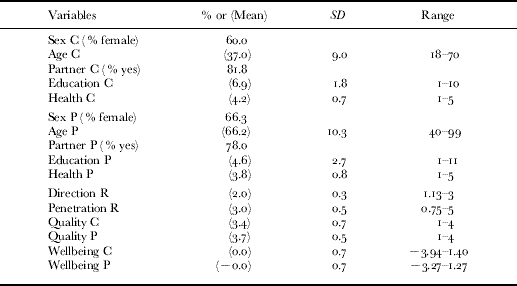
The mean age of respondents from the younger generation, the adult children, was 37.1 years (SD=9.0), 60 per cent were female, and nearly 82 per cent were married or had a partner. On average, the respondents from the adult-child generation had completed upper-general secondary education. The mean age of the parent generation was 66.1 years (SD=10.4), 66 per cent were female, and almost 78 per cent were married or had a partner. Respondents from the parent generation had, on average, completed lower-general secondary education. In Table 1, an overview of the respondents' characteristics can be found.
Socio-demographic and relationship characteristics
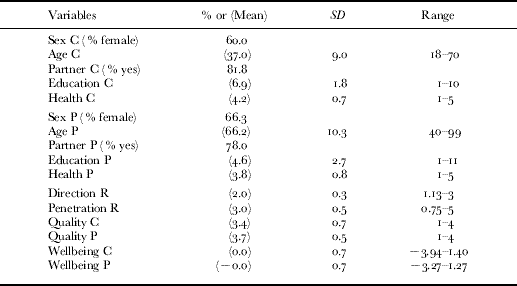
Notes: C=variables referring to child characteristics or variables rated by the adult child. P=variables refer to parent characteristic or variables are rated by the parent. R=variables refer to relationship characteristics and were obtained by combining the childrens' and parents' perspectives. The sample size was 1,456 dyads.
Measures
The NKPS survey was developed by a multi-disciplinary scientific council of representatives from Dutch and international scientific institutes with a strong background in the field of family studies and intergenerational relations. An initial questionnaire was drafted by this council, consisting of items regarding family relationships and support exchange. This was subjected to pilot testing and item analysis and formed the basis for the final survey (Dykstra et al. Reference Dykstra, Kalmijn, Knijn, Komter, Liefbroer and Mulder2004). Because a focus on relationships implies a dyadic perspective, the study included the parent's perspective on the relationship, concerning direction, penetration and quality with his or her adult child and the subjective wellbeing of the elderly parent, as well as the perspective of the adult child on the intergenerational relationship and his or her subjective wellbeing.
Intergenerational support
The two attachment relationship dimensions, direction and penetration, have been used as indicators for intergenerational support. Direction was based on items describing the balance of the relationship between giving and receiving interest and advice, which reflects the respondent's view on which partner more often took the initiative to interact, and which partner relied on the other for advice and interest. This dimension refers strongly to emotional support related to attachment and that is best met through close relationships, for example with family members (cf. Berg and Piner Reference Berg, Piner, Duck and Cohen1990). The answers of respondents to four items from both generations were combined into one scale, to create a more objective measure reflecting the dyadic relationship, not only the perspective of one relationship partner. Cronbach's alpha was 0.60. Direction scores ranged from 1 to 3. A score of 1 was assigned if interest and initiative shown and advice given by the child exceeded that shown/given by the parent. A score of 2 was assigned if both showed equal interest and initiative in one another, and the relationship was balanced in terms of advice exchanged. A score of 3 was assigned if the interest, initiative, and advice by the parent exceeded that of the child. The absolute amount of the interest and advice was therefore not reflected in the score, to differentiate this scale with the items indexing penetration.
Penetration was based on the provision of help with household chores and odd jobs from the adult child to the parent, and two items that measured personal and phone, letter and email contacts. The responses to the two items on help answered by both generations and the two on contact rated by both generations were combined into a scale reflecting the penetration of the relationship from a dyadic perspective; in other words, a total of eight items was used to assess penetration. Cronbach's alpha for the penetration scale was 0.74. For the purposes of this report, scores have been coded such that a higher score indicates more support provided by adult children to their parents.
Relationship quality
Relationship quality was measured with the question ‘Taken everything together, how would you describe your relation with your father/mother or child?’ Respondents of both generations answered this question about the partner from the other generation on a scale from 1 (not great), 2 (reasonable), 3 (good), to 4 (very good). Because quality of the relationship is highly subjective, the perspectives of both relationship partners were not combined into one measure but were added as main effect and interaction with each other to the predictive model. Merz et al. (Reference Merz, Schuengel and Schulze2008) reported on the basis of a factor analysis that judgments of quality are to be distinguished from judgments of direction and penetration, and were strongly associated with judgments of conflict.
Wellbeing
Measures of wellbeing typically consist of a global assessment of various aspects of a person's life (Diener Reference Diener1984). Wellbeing in the current study was measured using five items covering different psychic states, such as feeling depressed, calm and composed, very nervous, miserable and dejected, and happy, all rated on a six-point scale ranging from ‘always’ to ‘never’. Another four items measured how respondents evaluated their life in general, its conditions, if they regarded it as ideal in most ways and would have the same over again, all rated on a five-point scale ranging from ‘strongly agree’ to ‘strongly disagree’. Mean scores for both generations were computed when fewer than three items were missing; Cronbachs' alphas for this scale were 0.86 for the wellbeing of the adult child and 0.85 for the wellbeing of the parent generation.
Health
General health was measured with one question that asked the respondents how they assessed their general health status. Health was used as a control variable because this factor may be a confounder, through its association with both wellbeing and support provision (Silverstein et al. Reference Silverstein, Chen and Heller1996).
Data analysis
Pearson correlation coefficients of the bivariate associations among the study variables were calculated. Hierarchical regression analyses were used to determine the best linear combinations of the relationship dimensions to predict wellbeing in adult children and their parents. The socio-demographic variables and health were entered into the regression models as control variables. In a second step, the attachment relationship dimensions direction, penetration and quality were added to the model. Relationship quality was entered into the regression equation as rated by both relationship partners (i.e. quality from the child perspective and quality from the parent perspective). In a final step (Step 3), variables referring to the dyadic data structure were added to the regression equation. The wellbeing of the other was entered and the interactions between the quality of both perspectives were added to the model to allow for the dependence of scores in the parent-child dyads. Additionally, the interactions between relationship quality and the intergenerational support variables, direction and penetration were entered into the regression equation. For the interaction testing, the variables were centred and then multiplied, as suggested by Aiken and West (Reference Aiken and West1991).
Results
Correlations among study variables
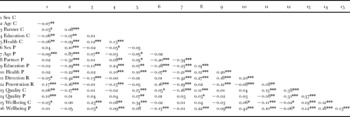
Table 2 presents the correlations among demographic variables for both the adult children and the elderly parent dimensions of intergenerational relationships and for the wellbeing of both generations. Several socio-demographic variables were associated with dimensions of intergenerational relationships and wellbeing. Being married or cohabitating was positively related to the wellbeing of both generations. The wellbeing of the adult child was also associated with the health of the child and with relationship quality, as rated by both the adult child and the elderly parent. For the wellbeing of the elderly parent, similar results were found; higher wellbeing associated with higher relationship quality. Quality of the relationship from the children's perspective was negatively associated with age of both generations, whereas the quality from the parent perspective was not associated with age of both generations.
Correlations among study variables

Notes: C=variables referring to child characteristics or variables rated by the adult child. P=variables refer to parent characteristic or variables are rated by the parent. R=variables refer to relationship characteristic and are obtained by combining child and parent perspectives. Sex and partner are dummy coded, such that 1=female, and partnered.
Significance levels:* p<0.05, ** p<0.01, *** p<0.001.
Predicting wellbeing in adult children and parents
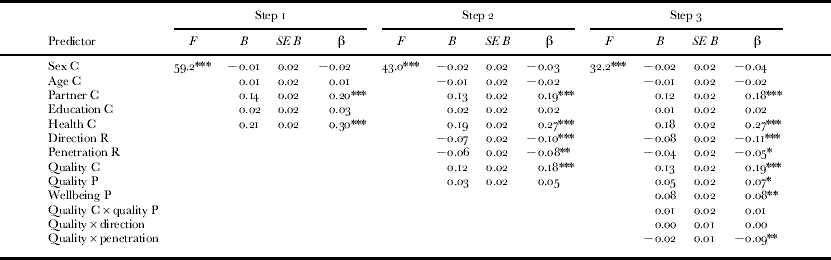
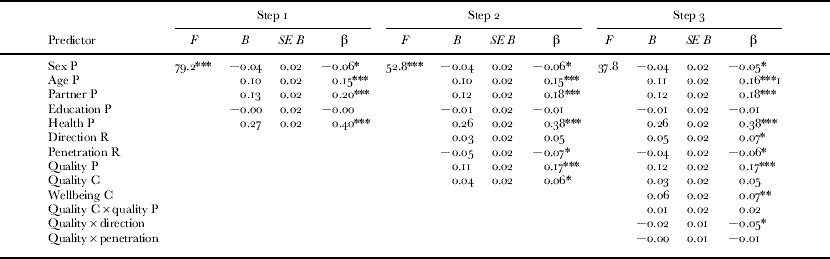
Tables 3 and 4 display the results for the hierarchical regression of wellbeing of the adult child and the elderly parent on control variables, intergenerational support, relationship quality and wellbeing of the other.
Wellbeing of adult children predicted by attachment dimensions and parental wellbeing
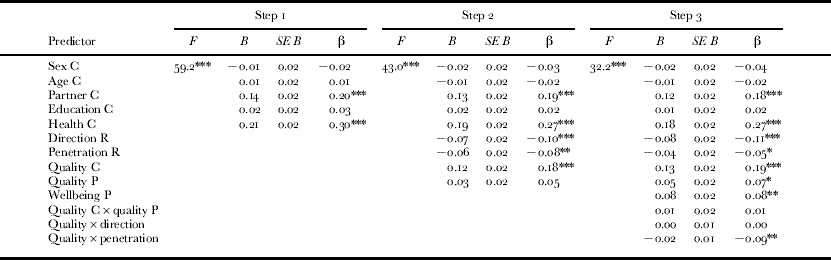
Notes: C=variables referring to child characteristics or variables rated by the adult child. P=variables refer to parent characteristic or variables are rated by the parent. R=variables refer to relationship characteristic and are obtained by combining child and parent perspectives. R 2=0.15 for Step 1; ΔR 2=0.04 for Step 2 (p<0.001); ΔR 2=0.01 for Step 3 (p<0.001). Total R 2=0.20. Sex and partner are dummy coded, such that 1=female, and partnered.
Significance levels:* p<0.05, ** p<0.01, *** p<0.001.
Wellbeing of the adult child
As indicated in Table 3, having a partner and being in good health was associated with wellbeing. The direction of the relationship was associated with the wellbeing of adult childrenFootnote 1 in the sense that providing more emotional support, i.e. providing more advice and showing more interest to the parent and being the stronger and wiser relationship partner, was associated with higher wellbeing. Conversely, higher penetration, that is providing more instrumental support in terms of practical help, was associated with lower wellbeing in adult children. The quality of the relationship, as experienced by adult children and their parents was positively related to children's wellbeing. Furthermore, children's wellbeing was positively predicted by the wellbeing of their parents. The interaction between quality and penetration was negatively related to child's wellbeing. Probing this interaction effect revealed that, contrary to expectation, quality of the relationship was not associated with wellbeing of children when penetration was high (that is, when there was more contact and support given on many life domains), but quality was positively associated with wellbeing when penetration was low.
Wellbeing of the parent
Table 4 indicates that, independent from the effects of parents' age, partner status, health status and gender, direction was positively related to parental wellbeing whereas penetration was negatively related to it. In other words, parents who offered advice and showed more interest in their adult children than they received from them experienced higher wellbeing. Receiving more support in terms of practical help from children was associated with lower parental wellbeing. The quality of the relationship as experienced by parents was found to be positively associated with wellbeing in parents. Furthermore, parents’ wellbeing was positively associated with the wellbeing of their children. The interaction between quality and direction of the relationship was negatively related to the parent's wellbeing. Probing this interaction effect revealed that if the adult child was the stronger and wiser partner and a parent depended on them for advice and emotional support, the parent's wellbeing was higher in cases of better relationship quality.
Wellbeing of parents predicted by attachment dimensions and filial wellbeing
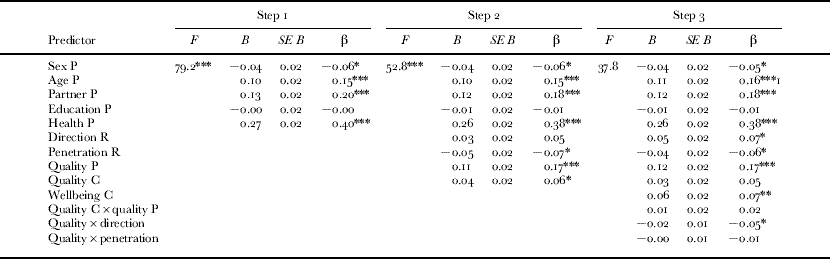
Notes: C=variables referring to child characteristics or variables rated by the adult child. P=variables refer to parent characteristic or variables are rated by the parent. R=variables refer to relationship characteristic and are obtained by combining child and parent perspectives. R 2=0.21 for Step 1; ΔR 2=0.03 for Step 2 (p<0.001); ΔR 2=0.01 for Step 3 (p<0.05). Total R 2=0.25. Sex and partner are dummy coded, such that 1=female, and partnered.
Significance levels:* p<0.05, ** p<0.01, *** p<0.001.
Discussion
Consistent with previous research, intergenerational practical support from a child to a parent in relationships between an adult child and their older parent was associated with lower wellbeing for both generations. In the case of intergenerational support from children to parents, the ‘costs’ for the wellbeing of children were not accompanied by similar gains for the wellbeing of parents. As expected, however, relationship quality appeared to buffer against the negative effects of receiving support for the wellbeing of parents. The lowest levels of wellbeing were found in parents who were at the receiving end of the relationship but experienced the quality of that relationship as poor. However, a buffering effect of relationship quality on the wellbeing of adult children was not found. Below we discuss these results more fully, revisit the implications that attachment-theory constructs may have for support provision in intergenerational exchange contexts, and offer some directions for future research.
An attachment-theoretical view on intergenerational support
Consistent with our attachment perspective, the consequences that patterns of intergenerational support had for the wellbeing of ageing parents and their adult children were not consistent across relationship partners. They varied as a function of relationship characteristics and by dimension of the intergenerational relationship. Providing different kinds of practical support (higher penetration) appeared to challenge the wellbeing of adult children, but a different picture emerged for the balance in the relationship in terms of showing interest and giving advice. Having a relationship tipped more towards providing than receiving more emotional forms of support from parents associated with greater wellbeing in children. As an explanation for the effects of direction on wellbeing, advising their elderly parents and acting as the stronger and wiser relationship partner is most probable when children see themselves as competent and knowledgeable and their parents share this view. Positive self-perceptions and perceptions of important others boost self-confidence and wellbeing. Penetration, on the other hand, is primarily a quantitative index of support exchanged. Highly-penetrative relationships are more central, overlap with a greater number of life areas, and require greater time, commitment, financial resources and effort, which means that there are less resources for other life demands. Indeed, middle-aged children often have to balance competing roles; being an employee, a parent and a romantic partner, and simultaneously caring for an elderly parent has been found to be detrimental to the wellbeing of adult children (Marks Reference Marks1998; Stephens and Townsend Reference Stephens and Townsend1997; Stephens et al. Reference Stephens, Townsend, Martire and Druley2001).
Importantly, however, the quality of the relationship may have effects on wellbeing that moderate the negative impact of support. In our analyses, quality had a stronger effect on wellbeing than either penetration or direction. The effect of quality was, however, not dependent on direction. Thus wellbeing may be highest when the quality of the adult child-ageing parent relationship is high and the direction of support is still predominantly from the parent to the child. Less clear are the reasons for the interaction effect between quality and penetration in the case of the adult children's wellbeing. Quality was not associated with children's wellbeing when penetration of the relationship was high. Perhaps the positive effect of quality for wellbeing is offset in these cases by emotions regarding the apparently needy state of parents who require support in many domains.
The model predicting parental wellbeing revealed an intriguing pattern of similarities with and differences from the model predicting adult children's wellbeing. For parents, receiving more practical support from adult children was negatively related to their wellbeing, independent of their health and family status (cf. Lee and Ellithorpe Reference Lee and Ellithorpe1982; Silverstein et al. Reference Silverstein, Chen and Heller1996). Although receiving support may index needs or functional impairments, it may also elicit unwanted feelings of dependency and leave unfulfilled the parent's desires for autonomy (Baltes Reference Baltes1996), or indeed their desire to continue enacting parental roles. It has been suggested that wellbeing may benefit from being able to continue in parental roles even in later life, as by being consulted for advice, and extending interest in and caring for one's children (Lowenstein and Daatland Reference Lowenstein and Daatland2006; Zarit and Eggebeen Reference Zarit, Eggebeen and Bornstein2002), reflected by the positive effect of direction on wellbeing in the current study. Still being able to provide emotional support in terms of advice and interest to children may be associated with a more reciprocal perception of the relationship that may associate with higher wellbeing in parents (cf. Lowenstein, Katz and Gus-Yaish Reference Lowenstein, Katz and Gur-Yaish2007). Given the mean age of 66 years in the parental sample, it may be that receiving support conflicts with a desire to continue to function as an attachment figure, although received support may also reflect issues with functional impairment that are not captured in our global health measure.
As in the adult-child model, the quality of the relationship was found to be a stronger predictor of parent's wellbeing than was receiving support; high-quality relationships predicted greater wellbeing. As noted, however, relationship quality may also compensate for received support or buffer against the effect that the direction of support has on wellbeing. Indeed, where relationship quality was low, depending on children was more strongly negatively associated with wellbeing. Conversely, if adult children were providing support to their parents, parental wellbeing appeared to benefit in high quality relationships. This pattern is consistent with our suggestion that a shift in the predominant direction of attachment behaviours in the parent-child relationship may not necessarily reduce wellbeing. If elderly parents and adult children perceive their relationship as high quality, the flexibility that is inherent in such relationships may allow for a change in the direction of support without negative consequences (Merz and Consedine 2009). Further research might explore whether this buffering effect of quality might be explained by flexible adaptation of perceived needs in the relationship partner.
Finally, and as expected, our analyses showed that the wellbeing of each party to the relationship was predicted by the wellbeing of the other; greater wellbeing in elderly parents was associated with greater wellbeing in adult children and vice versa. Wellbeing typically reflects a global assessment of various aspects of a person's life (Diener Reference Diener1984), including satisfaction, happiness and the presence of fulfilling relationships. Persons with higher wellbeing can exert a positive influence on their relationship partners, especially in close relationships. Wellbeing and satisfaction contribute to people's resilience and help them cope with various challenges such as providing and receiving support. If the wellbeing is high there seems to be a positive interplay with the other's wellbeing which again can contribute to the own wellbeing. The wellbeing of relationship partners interacts in a positive way and contributes to satisfaction and contentedness.
Conclusions
Through analysis of a large and representative sample of adults from across the life span (aged between 18 and 99 years) and the perspectives of both adult children and their ageing parents, this study has undertaken a genuinely intergenerational examination. By including the perspectives of both partners – the adult child and the elderly parent – on aspects of the relationship, and by allowing for the dependence of perspectives within the intergenerational dyads, we were able to progress the investigation of how relationship parameters moderate the effects of care provision and receipt on wellbeing. Similarly, including the relationship partner's wellbeing in the analyses enabled further consideration of the interplay between the wellbeing of both partners.
This study used an attachment theoretical framework to formulate its hypotheses. Attachment theory systematically links social events and personal experiences in dyads over time, which may help to unlock the dynamics of intergenerational relations, support exchange, and wellbeing in both generations during different phases in the life course. Attachment theory has been shown to be useful to conceptualise the links between intergenerational support and the psychological realm of mental representations of attachment and support giving in specific relationships (Merz et al. Reference Merz, Schuengel and Schulze2007). Contrary to most other attachment research, the size and representativeness of the large representative sample allowed making statements across socio-demographic groups.
These strengths noted, the study is not without its limitations. First, it is worth considering that the nature of the survey data meant sacrificing a gold-standard approach to measuring attachment (e.g. using observation or semi-structured interviews). Compared to mainstream attachment research, the operationalisation of quality was limited to one general dimension. Given the importance of this dimension, future studies might expand the measurement of attachment quality along several dimensions (cf. Carpenter Reference Carpenter2001; Cicirelli Reference Cicirelli1993; Marcoen et al. Reference Marcoen, Verschueren, Geerts and Baeyens1997). The current findings underline the importance of investigating the quality of parent-child relationships across the life span. Similarly, given that health status is a key predictor of wellbeing in later life, in terms of both major illness and functional limitations, future work would benefit from more systematic assessments of the contribution of these characteristics. Finally, although we have argued that relationship characteristics predict wellbeing, the reverse may also be true, and the cross-sectional nature of the study does not permit causal inference. Further longitudinal work will allow for more careful disentangling of these complex influences on wellbeing.
Overall, the current report goes some way towards illuminating the complex associations that relationship characteristics and patterns of intergenerational support have on the wellbeing of ageing parents and their adult children. Attachment theory may be used to enrich and to sharpen the intergenerational support concept and its implications for wellbeing because it highlights the unique and exclusive character of relationships in which one or both partners provide, and/or are expected to provide security and support to the other (Hinde Reference Hinde1997). Deep emotions and affections within attachment relationships are strongly connected in the family context and play an important role within intergenerational support as certain cultural expectations of love, close bonding and solidarity are closely connected to family affiliation (Schulze, Tyrell and Künzler Reference Schulze, Tyrell, Künzler, Nave-Herz and Markefka1989). If intergenerational relationships are characterised by high quality and strong connectedness, the challenges of ageing, such as decreased capacities and increased needs of help, support and care, can be dealt with more easily and with less forfeit of wellbeing and satisfaction on both the adult children's and the parents' sides.
Acknowledgements
The Netherlands Kinship Panel Study is funded by grant 480-10-009 from the Major Investment Fund of the Netherlands Organisation for Scientific Research (NWO), and by the Netherlands Interdisciplinary Demographic Institute (NIDI), Utrecht University, the University of Amsterdam and Tilburg University.