Introduction
On 23 November 2016, the former head of the Iranian judiciary, Ayatollah Abdolkarim Mousavi Ardebili, passed away in Qom, aged ninety-one. Just over a month later, Akbar Hashemi Rafsanjani, former president and head of the Expediency Council, suffered a fatal heart attack. Ardebili and Rafsanjani were two of the most influential clerics of post-revolutionary Iran, and their influence on Iran’s reformist and oppositional politics has been enormous, if controversial.
This article takes a first step in comparatively assessing Rafsanjani’s and Ardebili’s influence on the university system and social science education, addressing several questions that are critical if we are to understand the future of education in Iran without the two ayatollahs as well as the ways both helped produce a young and fragile civil society out of the ashes of war, repression and execution of which they themselves were the co-authors.
In particular, the essay visits Rafsanjani’s Islamic Azad University and Mofid University, a private and explicitly “Islamic” university established by Ayatollah Ardebili in Qom. In contrast to other educational institutions in Qom, Mofid University boasts a mixed-gender campus. As one of the only universities in the country, Mofid has also prohibited the establishment of a local branch of the basij paramilitary often regarded as a vehicle for surveillance and moral policing. After 2009, the school opened its gates to professors from top state universities who had lost their jobs due to political involvement in the Green Movement. How can a university affiliated with such a key member of the political elite so blatantly reject some of the Islamic Republic’s flagship policies of Islamicization, suppression and control, while still describing itself as Islamic?
By investigating this apparent paradox, the article aspires to contribute to the scholarship on education, Islam and authoritarianism in Iran and beyond. In particular, the article seeks to problematize the view that dismisses the value of education in Iran by stressing the overwhelming influence of the theocratic, authoritarian state. In this “Islamicization” argument, educational institutions are sites where the Islamic Republic propagates its political version of Islam, not only in order to close ranks on domestic dissent but also in aid of its regional sectarian ambitions. While seminaries symbolize the state’s efforts in institutionalizing, commodifying and politicizing religion, this argument also sees universities as largely tamed, both in terms of creative, social scientific thinking, and in terms of student activism.
The literature on Islamicization of the social sciences contributes to our understanding of educational reform in Iran, but it fails to explain why some universities systematically exert a higher degree of independence than other institutions, and what impact independence has had on the production of knowledge, social science and civil society in the country.
In this essay, I propose that education can be a key institutional space for the presence and growth of a civil society. Using a broad Gramscian interpretation of civil society, the essay looks at three different factors to categorize educational institutions in Iran, including (1) the capacity and relative social size of institutions of higher learning; (2) the degree of autonomy from political parties and the state; and (3) the degree to which institutions are able to fill their physical spaces with pluralism, free speech, academic debate and critical content.
In the case of Iran, four interrelated factors have increased the autonomy and creative potential of a set of academic institutions which I call Islamic universities, relative to other private universities, the seminary and the state-owned higher education. These are: (1) expanded financial and institutional independence from the state; (2) elite connections of the university management; (3) hiring and support of pedagogically independent teachers; and (4) amalgamation of pedagogical practices and beliefs from the seminary and the modern university.
The first two factors are closely related to the decentralization and privatization of education since the late 1980s, which allowed political cleavages to be diffused across academic institutions, fanning a race to expand the university system generally as well as to influence the identity of individual institutions. Hence, the Islamic university is neither fully private (khosusi) nor state-owned (dowlati). Yet these two factors also remain limited to the degree of autonomy from the state. In order to move beyond the arbitrary will of patrons, autonomy is a necessary but not a sufficient condition for the emergence of civic debate, creativity and innovativeness in the social sciences. Autonomous space still needs to be filled. The article asserts that the third and fourth factors, namely the capacity of Islamic universities to furnish independent ties with seminaries and state universities, at both the faculty and the student level, encourages critical thinking and debate. Therefore, these universities are not just nominally but also substantively “Islamic.”
The article is structured as follows. After reviewing the literature, I delineate three main educational institutions in Iran—the seminary, the secular university and private higher education—and assess their relative degrees of social capacity, independence, activism and critical thinking, arguing that a small set of private, non-profit (“Islamic”) universities boasts a unique degree of autonomy and social scientific potential.
Knowledge and Learning in the Authoritarian State
I’m running late for Dr. Sadegh Haghighat’s graduate class on political thought in Islam. It is nearly 10am, and I still have to walk the last few hundred meters of Mofid University’s pleasant pine-covered entrée. Haghighat gives me a friendly nod as I enter the class and seek out a seat at the back. His classes are much liked among students for their lively, controversial and active debates. In this particular lecture he kicks off by referring to the Economist’s corruption index, which listed Iran somewhere at the bottom end. Students were provoked by this invitation to discuss the state of their country. One student, a man in his late thirties and with a Palestinian scarf around his neck, took to defending Iran, blaming the West for much deeper corruption, but well-hidden and thus immeasurable. He was countered by an eloquent and confident Tehrani girl, blaming the lack of democracy as a root cause for corruption. As the class was coming to an end, I hoped to exchange a few words with the Tehrani girl, pondering on how to subvert the almost organic way in which students had self-segregated on gender lines. But, not only did she preempt my thoughts by walking up to me confidently, but, as our discussion on the nature of the social sciences in Iranian universities developed, other students joined in and started to sharply criticize various well-known intellectuals for their involvement in party politics.
Having studied at the University of Tehran for over two years, I was surprised by this degree of openness, spirit and dynamism on campus, involving both professors and students. Friends had told me about the lively theoretical debates in the philosophy and theology departments, but such direct engagement with current social scientific topics that directly involved the Islamic Republic was new to me. At the University of Tehran, critical students preferred the private space of expensive cafés over the university’s securitized campus. Still, the last place where I expected such discussions to take place was Qom, the hot, slow and conservative heartland of political Shiism in Iran, and certainly not in an institution which prides itself on propagating an outspoken “Islamic” approach to the social sciences.
A large body of scholarship has focused on education, learning and politics in modern Iran.Footnote 1 With the rise of political Islam in the 1960s and 1970s, much of this literature delved into issues of religious authority as it related to processes of religious transnationalism, state-building and colonialism.Footnote 2 Before the 1979 Revolution, state education was castigated as authoritarian: strong top-down managerial control; suppression of student movements and activism; and a preference for the non-controversial hard sciences.Footnote 3 Moreover, Islamic ideologues including Ayatollah Motahhari, Dr. Ali Shariati and Imam Khomeini attacked the seminaries for being conservative, pro-status quo and politically passive.Footnote 4
Simultaneously, the transnational clerical networks that connected Qom’s seminaries with those of Najaf and Lebanon seemed particularly fertile ground for new theological interpretations of political thought, assembling historical experiences with both Islamic and western ideas, and culminating in new forms of “nativist” thought.Footnote 5 “The Islamic Renaissance” is the name Chibli Mellat gives to the period from World War II to the Iranian Revolution of 1979, during which Shia clerical networks in Iran, Iraq and Lebanon showed a unique degree of innovativeness, creativity and cosmopolitanism, particularly in the fields of law and economics. Beyond intellectual history, Michael Fischer argues that institutionalized pedagogical practices endogenous to the seminary is an important element in the constitution of this Islamic Renaissance. For him, the pre-1979 madrasa is “a free university” whose “pedagogical ideal … is posed by its members as a criticism of the secular education system.”Footnote 6
The 1979 Revolution proved a watershed in the development of the seminary. Arjomand has described the revolution as a decisive victory of Islamists over other ideological groups, notably the liberals and the left.Footnote 7 Other scholars have built on this insight to argue that Iran’s seminaries have been reconstituted as puritan institutions in the hands of the political clergy, which employ them as bastions of conservatism and in defense of the status quo.Footnote 8 Mehdi Khalaji even goes so far as to call the Islamic Republic a “regime of religion,” in which religion is “commodified” while being given currency by token of the authoritarian state, functioning as its “central bank.”Footnote 9 This highly mechanistic view of the political role of seminaries ignores the evidence of the dynamic socio-cultural context of seminary cities,Footnote 10 while rejecting out of hand the possibility of agency and intervention from the “periphery.”Footnote 11
Other observers have noted the introduction of a new institutional model, the so-called Islamic university. Islamic universities differ from both regular state education and the seminaries. They are modeled on the modern university in terms of curricula, accreditation, school terms, timetables and teaching configurations, but put a strong emphasis on Islamic identity and courses, and social affinity with the seminary. Islamic universities have been expanding since the late 1980s and are mostly privately owned. Scholarship on Islamic universities in Iran is scarce and not yet generalizable. Research on Al-Mustafa University in Qom has confirmed phenomena observed in seminaries, namely that the authoritarian Islamic state employs these universities to control and propagate a self-interested pro-Iran/Shia philosophy, regularly in strategic competition with Saudi Arabia.Footnote 12 However, Al-Mustafa is also unique in that it only trains foreign students and is under the direct patronage of the Supreme Leader.Footnote 13 Regional political ambitions can thus be expected to play a more immanent role here than elsewhere. As it stands, however, the dominant view sees these Islamic universities as a modern alternative to the seminary in an age in which state propagation of political Islam has to conform to international educational standards.Footnote 14
Finally, scholarship has discussed state education primarily in relation to the efforts to Islamicize textbooks, curricula and the teaching and student cohort after the 1979 Revolution. Some have looked at how Islamic education has been used as a propaganda tool.Footnote 15 But more recently, scholars have looked at how the state’s effort in educating “virtuous believers” seems to have largely failed. They point out that Islamicization has mainly meant a significant increase in the number of classes allocated to religious topics, strict moral policing and the introduction of a range of other rules. However, educational methods remain dependent on memory-based learning, mechanical test-taking and reproduction, and not the forms of creative and liberal discussion that many of the initial proponents of educational reform suggested. Repetitive and rigid learning strategies have combined with a growing market for educational degrees, in effect demobilizing students from the Islamist cause.Footnote 16
In sum, the scholarship of education in post-revolutionary Iran oscillates between looking at higher educational institutions from an authoritarian or a theocratic perspective. On the one hand, proponents of the authoritarian view see strong continuity with pre-revolutionary times in the state’s effort to demobilize students, extend bureaucratic systems and promote the hard sciences.Footnote 17 On the other hand, theocratic analyses see higher education mainly in the light of the Islamic Republic’s efforts to commodify religion and employ it to achieve strategic aims. Both these perspectives emphasize that in pre- and post-revolutionary Iran, an autocratic state limits freedom of expression and social scientific progress, in favor of co-option of educational institutions in the state’s drive for self-legitimization and control.
I assert that despite their important insights, neither the authoritarian nor the theocratic perspectives account sufficiently for counter-movements and the possibility for enduring civil societies at the institutional level. To correct this, the article provides a typology of institutional differentiation of education in the Islamic Republic in order to explain divergent levels of autonomy and openness between academia. In particular, I will argue that the degree of university autonomy is inherently linked to divergent trajectories of institutional development. Moreover, spaces of autonomy do not create their own civil discussions ex nihilo. Civil spaces have to be filled intellectually, pedagogically and ideologically by activists, intellectuals and actors, exogenous and endogenous to this space. In the semi-authoritarian context of Iranian education, this role is assigned to organic intellectuals: actors who have appropriated and amalgamated a repertoire of educational practices and values in order to advance their autonomous claim to power tied to fluctuating limits and party structures. Therefore, the assemblage, importation and amalgamation of pedagogical practices, political beliefs and institutional networks, as well as their status, class and wider social undertones, are central to any understanding of the content of civic spaces in academia.
Institutional Differentiation of Education in the Islamic Republic
Based on three parameters of (relative and absolute) social capacity; degree of autonomy from political parties and the state; and the ability to fill space with civil societies, the Iranian higher education system can be divided into three distinctive categories: seminary, state and private education. Allowing for variation within these categories, I posit that they are nevertheless distinct organizationally, historically and politically.
The seminary
Iran’s oldest continuous form of education has been provided by the seminary, the madrasah or what later would be known as the howzeh-ye ʿelmiyyeh. In the Middle East, madrasah education evolved slowly out of the institution of the mosque. The blueprint, in terms of architecture as well as content, for the later madrasahs was laid by the Sunni Timurids in the fifteenth century, when madrasah building reached a golden age. In terms of capacity, although early madrasahs were erected in Rey, Kashan, Aba, Varamin, Sabzevar and elsewhere, in the post-Timurid period nearly all new madrasahs were concentrated in three cities: Qom, Esfahan and Mashhad.
Shia seminary education is closely related to the body and reproduction of Shia clergy.Footnote 18 By the eighteenth century, this education system emerged as a decentralized, relatively horizontal network in which men with a certain certification of learning (mojtahed) were allowed to make independent legal decisions. Career progression was informally determined in line with age, experience and number of followers. Once a cleric starts gaining followers, he is en route to being ascribed the title of marjaʿ al-taqlid, a “source of emulation”—the highest rank in the Twelver Shia seminaries. Becoming a marjaʿ is a complex process, involving formal components, such as reaching the stage of ijtehād and writing a resāleh, and informal aspects, including popular and peer consent. Notably, a marjaʿ (plural: marāje’) gains fame when his popular base of followers increases. Followers are ordinary believers, following the rulings of their marjaʿ of choice, and are expected to donate a share of their annual salary to him.
During the nineteenth and twentieth centuries, the seminary experienced centralization, consolidation and the introduction of further internal hierarchies intertwined with the formation of the modern Iranian state and more efficient forms of communication and transport. Madrasahs lost power to the larger howzehs of Qom and Najaf, where marāje’ were increasingly attracting followers from all corners of the country.
While the traditional howzeh and madrasah were primarily centers of law, the “Islamic Renaissance” of the 1950s to 1970s saw a growing interest in a variety of new academic topics, including modern intellectual history and economics. On the back of this golden age and institutional change, which combined with a more general growth of Islamism, traditional seminary education doubled from 0.03 percent in the mid-1950s, to over 0.06 percent of the total population in the immediate pre-revolutionary period.Footnote 19 While the seminary thus remained a small institution, a growing number of Islamist students preferred it over state schools for its relative freedom from the authoritarian state.
Immediately after the revolution the number of seminary students increased. Revolutionary fervor, as well as an attempt by some to delay or circumvent war conscription are primary reasons for this growth. However, many did not formally finish their studies, or dropped out to enroll in a modern university.Footnote 20 In 2015 there were over 500 howzehs, with student numbers estimated at 150,000, over half of whom studied in Qom.Footnote 21 Given extensive state investment in this type of education, the popularity of seminary education remains limited.Footnote 22 Indeed, the president of the Iranian Women’s Howzeh proclaimed that “for a population of 75 million this is an exceedingly small and insignificant number”: less than 0.2 percent of the total population to be precise, about triple the pre-revolutionary peak.Footnote 23 As we shall see, seminary education takes up a small share relative to both private and state tertiary education, both before and after the revolution.
The autonomy of the seminary system became severely circumscribed in the post-1979 period, and particularly after the death of Khomeini in 1989. Credited for their subversive innovativeness in the social sciences, the Islamic Revolution sped up processes of institutionalization and state control.Footnote 24 Formal supervision is exercised by the Propagation Office of the Qom Seminaries, which is directly subject to the Supreme Leader. Other institutions, such as the Court for Clergy, put additional pressure on clerics to refrain from open criticism or political deviance. Moreover, periods of pluralism in the howzeh have met with suppression and cooptation, gradually circumscribing the social relevance of political theology and clerical authority. This accounts for both the growth of intellectual clerical reformism in the 1990s, as well as the clerical support for the 2009 Green Movement. An important by-product of this control has been the fossilization of seminary curricula, which have barely changed since the revolution in spite of the major global changes in Islamist philosophy and practice.Footnote 25
Alongside these, perhaps the most significant obstacle to a dynamic civic society in the seminary space has come from within the clerical community. During the 1990s, philosophers and clerics launched a sharp critique of religious and clerical interference in politics, and of political Islam at large, in what came to be known as the two main strands of new religious thinking (nu andisheh-ye dini) and the religious intellectuals (rowshanfekrān-e dini). Discussing these theories is banned in the seminary, and this has only weakened its intellectual position.Footnote 26 Seminarians, professors and students prefer to either stay out of political affairs altogether or engage fully, but without being able to inquire critically into the types of institutions or politics that have been produced in the post-1979 period, as that would necessitate engagement with these new bodies of thought.
In sum, seminaries are not the components in the “regime of religion” that some scholars ascribe to it, because the elements that make up this regime lack strong roots in society. Not only is the seminary much smaller than other institutions of knowledge, but institutionally too its independence has been circumscribed through additional surveillance, etatization and bureaucratization. Moreover, critical inquiry within the seminary and subsequent suppression of their authors and discourses has further delegitimized the seminary as an organic authority. Practically, these obstacles have prevented serious student engagement with the social sciences, while many seminary-educated clerics and professors have opted for replacement positions at modern universities.
The secular or state university
The secular higher education system originates in mid-nineteenth century attempts to modernize the state.Footnote 27 Several modern institutions of higher education were established throughout this century, starting with the Dar ol-Fonun in 1851. These schools remained specialized and limited in terms of capacity. Unable to garner the funds and support necessary to expand higher education substantially, Qajar governments encouraged studying abroad as a second best. Studying abroad had unwanted consequences for the Qajar shahs, however: not only did it cause the spread of western political philosophies, but opposition groups also became increasingly transnational. These factors contributed to the Constitutional Revolution of 1905‒11 and the weakening of Qajar rulership.
A modern state university system was only introduced by Reza Shah Pahlavi in the 1930s. This system was a product of more serious attempts at state centralization after the collapse of the regional political order in wake of World War I, going hand in hand with a stronger assertion of sovereignty vis-à-vis foreign powers. Starting with the foundation of the University of Tehran on 4 February 1935, the university system was thus embedded in both authoritarianism and a shifting nationalist discourse. Simultaneously, Reza Shah took steps to reduce reliance on missionary schools and studying abroad.
Initially, state-provided higher education developed exceedingly slowly. In the academic year 1956‒57 Iran still possessed only three universities, enrolling fewer than 9,000 students—slightly more than the total number of seminary students. The last decade and a half of Pahlavi reign (1963–79) saw a faster rise in higher education. Driven by a state policy package designed to accelerate modernization, called the “White Revolution” by Shah Mohammad Reza Pahlavi, and aided by oil revenues, state higher education grew from around 30,000 in 1966‒67 to 136,289 in 1976‒77.Footnote 28 The private sector also became more heavily involved in the provision of education (see below). In 1967 the Ministry of Science and Higher Education was established, providing a bedrock for the expansion of academia in Iran.
However, even during this period of rapid growth, educational capacity could not keep up with demand, turning into a defining and finally destructive feature of the Pahlavi state’s failure to develop in line with expanding social demands and claims. Primary education remained largely absent from smaller villages, while universities were restricted to the country’s largest cities.Footnote 29 Various reasons have been proposed for why bottlenecks in state education increased towards the end of the shah’s reign, including rapid economic and social change, strong demographic growth, problems with planning and implementation, and a policy preference for military expenditures over socio-economic prerogatives.Footnote 30 In 1961‒62 there were 15,924 university applicants for 5,781 places—an acceptance rate of 36.3 percent. By 1978‒79, the number of applicants had grown to 235,000, of which a bare 12.1 percent found their way into university.Footnote 31
The shortage of places spurred upper and middle-class Iranian families to send their children to the West for further study, aided financially by the extensive availability of government scholarships. Throughout the 1970s, the Iranian student community in the US was the fourth largest foreign student group after Canadians, Chinese and Indians. In 1975‒76, Iranians made up 11 percent of the total foreign student population. By 1978‒79, this number had grown to about 18 percent.Footnote 32 The political activism of the Iranian students abroad played a crucial role in the eventual downfall of the shah.Footnote 33 Comparable to the Qajars, the Pahlavis resorted to promoting studying abroad as a solution to their own developmental issues—an increasingly awkward policy in the context of the Pahlavis’ nationalist and authoritarian state education.
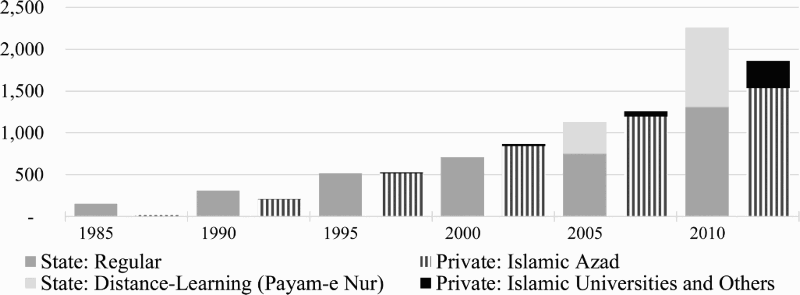
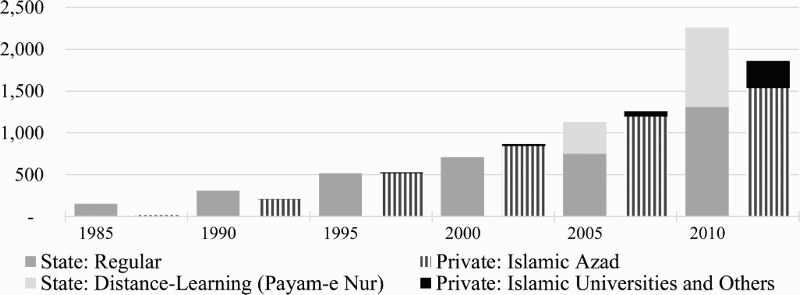
Importantly, the 1979 Revolution and the destructive Iran‒Iraq War (1980–88) did not negatively affect the expansion of the state university system. Between 1982 and 1990, capacity grew at an annual rate of 13 percent, equaling the growth rate of the oil boom years, 1969–78. This growth rate fell slightly during the 1990s, only to increase again to an average of 13 percent during the 2000s. By 2014, 2,712,802 students, or about one in every twenty-nine individuals, were enrolled in state universities, including Payām-e Nur, the distance learning program. Yet even this continual high growth rate has not been enough to bring supply onto a par with demand, necessitating a more serious rethinking of the position of the state and leading to private sector involvement.
While the revolution did not affect capacity growth, it did lead to a rethinking of education and pedagogy. In particular, there was a push to “Islamicize” Iran’s entire educational system. The initial period of reform, often known as Iran’s “Cultural Revolution,” was the most violent and radical. Between 1980 and 1982, universities were closed, curricula redrafted and oppositional elements removed. In 1987, the Islamic Republic made it a legal requirement for universities to educate “a virtuous believer, conscientious, and engaged in the service of the Islamic society.”Footnote 34
Nevertheless, I propose that post-revolutionary state education has largely remained secular despite concerted efforts by the state and clerical establishment to eradicate secularism. The targeted definition of secularism I adhere to here is not related to the content of the classes, many of which focus on Islamic subjects, or the identity of the teacher/student cohort, most of whom would identify as Muslim, but to the incapacity to transfer state universities to an ideal-type space autonomous from and in active, critical and possibly constructive opposition to the authoritarian state, and controlled exclusively by a clerical or religious body. An ideal-type Islamic space would mean both active engagement with politics as well as the ability to question state structures and ideals on the basis of Islamic reasoning. Such Islamicization, even to a limited extent, has failed because state academia could not be shielded from deep political and bureaucratic interference.Footnote 35
Rigid state bureaucracies have tempered spiritual and religious fervor. One symbolic example of this failure of Islamicization is Tarbiat Modares University, a unique and highly regarded graduate-only institute established in 1982 by order of Imam Khomeini as a university with an “Islamic and revolutionary identity” and aimed at training a new cohort of Islamic teachers. A 2007 Strategic Plan still put attracting “revolutionary and religious academic cadres” as its second most important priority—almost three decades after the revolution. It was not an immediate priority for other staff.Footnote 36 While the university’s constitution explicitly aims to “increase the share of scientific products and expand the social sciences,” only three departments focus on social sciences, while as many as fourteen specialize in the hard sciences and engineering.Footnote 37
Why has creating an autonomous “Islamic” space failed for state universities? I argue that the nature of Iran’s modern state structure has made constellations of political opposition, intellectual pluralism and progressive academic debate dependent on the degree of elite competition at the top of the state and the relative ability of individual universities to attract top academic talent.
In Pahlavi Iran, university autonomy was tied to periods of political liberalization or government weakness, including during World War II (1941–46), the Mossadegh period (1951–53), the reform period of 1961 to 1963, and the events surrounding the revolution (1977–80). Next to a temporal aspect, autonomy was also spatially specific, and depended primarily on the status ascribed to particular universities. In Tehran more extensive freedoms were tolerated than in the periphery. The civil societies that were built on the basis of these autonomous spaces were mainly the product of the new Islamic thinking, such as Ayatollah Motahhari, who taught at the University of Tehran in the 1970s, or Ali Shariati, who was based at the University of Mashhad, as well as by a strong left-wing and Marxist culture, both among students and teaching staff.
The degree of state control over state universities has remained similar in pre- and post-revolutionary Iran. However, the more competitive form of state politics in the Islamic Republic, as well as the impetus of revolution, has produced different results from Pahlavi rule.Footnote 38
Firstly, control has mainly emanated from below through the Office for Consolidating Unity (daftar-e tahkim-e vahdat), or OCU. As the name indicates, the OCU was an attempt at creating “unity” among the diversity of student movements, which were torn, often violently, between different political and ideological affiliations. OCU branches were established on university campuses from 1980‒82 onward, and replaced the earlier “Islamic associations” (anjoman-e eslāmi) that had sprung up in the wake of the 1979 Revolution. These organizations were all loyal to the Islamic Republican Party and Imam Khomeini (khatt-e emām), and played a central role in the suppression of various Marxist/communist university groups and the Mojahedin-e Khalq.
The OCU, like most other “emāmi” bottom-up revolutionary organizations, were close to the popular left-leaning statist elites of the new Islamic Republic. This was unsurprising in so far as the statist elites, which were in control of both elected bodies of parliament and government throughout the 1980s, implemented popular social redistribution and welfare programs and a more egalitarian (and non-sectarian) revolutionary foreign policy that the conservative, pro-market elements in the state disagreed with. Throughout the 1980s and 1990s, the OCU played a key role in setting up campus-based policing units (the so-called basij), and mobilizing students for the war effort. After the war, the OCU continued this dual role of student control and mobilization. In particular, the OCU actively supported the presidency of reformist Mohammad Khatami (the Dovvom-e Khordād front), that emerged from within the networks of former statist elites.
This politicization of student activism has not remained limited to Dovvom-e Khordād and the reformist/former statist elite in Iran. More right-wing factions have also attempted to create their own student organizations. The most powerful of these is the Islamic Society of Students (Jāme’eh-ye Eslāmi-ye Daneshjuyān), but over time these organizations have been weakened by internal splits. Scholars have argued that this politicized internal quarreling has contributed to student demobilization.Footnote 39 Indeed, this extreme form of “negative” politicization has kept activism in state universities heavily reliant on party politics.Footnote 40 It has also caused many students who prefer to keep their distance from the state to lose interest in politics. De-politicization has dampened the potential for strong social science scholarship, not only because it has turned many bright students to less political subjects, but more importantly because political awareness and concern is key to any good social science.Footnote 41
Another factor contributing to de-policitization in social science faculties is more social, and has to do with the social prestige and income differential associated with the hard sciences and engineering in Iran. The high social status of the mohandes (engineer) has played an important role in locating student activism in technical campuses, notably the University of Tehran Faculty of Engineering and Amir Kabir University of Technology. Partly, the social activism of engineering students has to do with the elevated levels of autonomy that prestige and upward social mobility can muster. More rational market forces are also at play: brighter students tend to opt for a higher-earning, more employable hard science major.
Control should also be seen in in terms of institutional dependence on state bodies. Scholars have documented the tight control exerted by the Ministry of Science and Higher Education (vezārat-e olum va āmuzesh-e ʿāli, called vezārat-e maʿāref until 1967) during Pahlavi rule, starting with the University of Tehran.Footnote 42 However, several important restructurings have occurred. Firstly, the revolution produced a new agency to screen the members of governing boards, the Supreme Council for Cultural Revolution (SCCR), which is under the Supreme Leader’s control. Secondly, in August 1985, the ministerial responsibility of a number of sciences, particularly medicine, was transferred from the Ministry of Science to relevant ministries. All other sciences remain under the Ministry of Science’s umbrella, which fully determines governing boards. Specifically, the minister of science has a seat on every governing board and selects several members of universities’ scientific boards. These members are screened by the SCCR. Thus, the Ministry of Science exerts direct control over the direction of state universities, although disagreements with the SCCR can and do occur. Therefore, the popularly elected government has a lot of influence over the direction of universities, making state education a highly politicized affair.
One last development merits attention: state distance-learning, or Payām-e Nur. Payām-e Nur was promoted during the Mahmoud Ahmadinejad administration (2005‒13) as a direct competitor to the rapidly growing Islamic Azad University, a private initiative by former president Hashemi Rafsanjani (1989‒97, see below). While Payām-e Nur has played an important role in extending state education, making up almost 30 percent of Iran’s total state university enrollment in 2014, it is disempowering for two main reasons: it limits both physical mobility and academic interaction. The first factor can be particularly damaging to the position of women. While older systems pushed families to accept the student’s physical mobility with the hope of upward social mobility, the distance-learning platform neutralizes this mechanism. The absence of tangible academic space also inhibits the ability of students to interact with one another and their teachers face-to-face.
In sum, Iran’s state universities are controlled by competing state bodies, particularly the Ministry of Science and the SCCR, as well as grassroots youth/party organizations, the dialectic of which tends to produce bureaucratization, standardized curricula and the suppression of student activism beyond the priorities of state elites. Payām-e Nur is a new development that should be regarded with caution for the way in which it redefines student life and mobility.
Private education
So far, the essay has argued that while in state universities constellations of critical thinking and creativity remain heavily tied to the degree of state control and the ability of individual universities to attract student and teaching talent, in the seminary, political passivism, support of the status quo and, since 1979, institutional control, have been key factors. In other words, political opposition in these categories of contemporary higher education is institutionally and state sanctioned. In contrast, I argue that the private university system provides an existing, yet limited model for pluralism and debate. Before analyzing why only a limited number of private universities have been more successful at achieving this, it will be useful to review the historical development of this type of higher education in Iran.
Private education emerged as a direct competitor to state education in the nineteenth century. The first modern elementary school was established by an American Christian mission in Urmia in 1836. In the late nineteenth century, wealthy citizens also started investing in school, many of whom came together in the Council for the Foundation of Private Schools.Footnote 43 After the establishment of Pahlavi rule, the state started supplanting many private initiatives, even as private education expanded rapidly in absolute numbers, particularly from the 1960s onward. While primary and secondary private education gradually declined as a share of total education, particularly when tuition fees were scrapped for elementary and middle schools in 1974, private higher education grew.Footnote 44 As a percentage of total student enrollment, private higher education reached a pre-revolutionary peak of 28.4 percent in the academic year 1974‒75, accommodating 38,463 students. Prominent western universities were one source of enrollment. Beyond academia, some of the most dynamic social sciences originated in private educational groups, financed by industrialists and bāzāris. The Hosseiniyeh-ye Ershād, founded in northern Tehran by Nasser Minachi, was one prominent symbol of this, accommodating lectures, seminars and discussion groups on a variety of subjects.Footnote 45
Initially, the 1979 Revolution caused an imminent collapse of private education. In March 1980 tuition fees for secondary schools were abolished. One month later, Imam Khomeini declared a “cultural revolution” to purge universities of all anti-Islamic elements, including teachers, students, textbooks and curricula, forcing universities to shut their doors for over two years. In Tehran, a large number of private institutions of higher education, including the Iran Free University (Daneshgāh-e Āzad-e Irān), the Advanced School of Commerce (Madraseh-e ʿĀli-ye Bāzārgāni) and the Advanced School of Translation (Madraseh-e ʿĀli-ye Tarjomeh), were merged, nationalized and renamed the Social Sciences Complex (Majtameʿ-ye Olum-e Ensāni), in the early 1980s becoming the Alameh Tabatabai University—still one of the largest social scientific state institutions in the country.Footnote 46
Private education took off again towards the end of the Iran‒Iraq War, as the country was facing an accelerating educational crisis. On the one hand, young men returning from the battlefront were eager to enter university on the basis of their newly gained status as war veterans, which promised social and economic benefits.Footnote 47 On the other hand, the bottlenecks facing pre-revolutionary Iran were far from resolved: total higher education capacity could not keep track of Iran’s rapidly growing population, let alone the exploding demand for higher education.
The provision of private education in the social sciences was shouldered by two types of non-profit institutions: (Islamic) Azad University on the one hand and a handful of specialized Islamic universities on the other. These two types differ in terms of capacity, their relationship to the state, and their ability to foster a civil society.
Islamic Azad University
Hashami Rafsanjani, one of the figureheads of the Islamic Republican Party, first proposed the Islamic Azad University in a Friday sermon on 21 May 1982.Footnote 48 The original board of founders consisted of both statist and bāzāri elements of the political elite, reflecting the broad support the plan had received from leading factions in the state elite.Footnote 49 One reason for this support was the less contentious nature of the university: Islamic Azad started off as a technical university focusing on engineering and the hard sciences—ironic given the more common linking of “Islam” with social sciences and the humanities, not engineering.Footnote 50 This is in contrast to state-owned Tarbiat Modares or Alameh Tabatabai, for example, which were more explicitly focused on the social sciences.
Azad University proved an extremely successful method to quickly and cost-efficiently extend university education across Iran. The university grew so rapidly that for a short period during the early 2000s it boasted a larger student cohort than the entire state-owned university system.Footnote 51 In 2014, Azad University had an enrollment of 1.7 million students—reportedly the third largest university in the world.Footnote 52
There are several reasons why Azad remains more heavily controlled from above than many other private universities. First of all, the board of trustees, which has control over the general direction of this university complex, is politically cross-factional, including not only elements from the cross-factional board of founders, but also a representative of the Supreme Leader, and representatives of the Ministry of Science and Ministry of Health.Footnote 53 This delicate, multi-polar balance at the top of the institution has necessarily led to a careful and sensitive approach to faculty appointments, inhibiting entry of more controversial or critical professors.
Simultaneously, the central role Islamic Azad played in absorbing young returning combatants has led to a variety of preferential, and academically “un-meritocratic,” regulations for war combatants and basij members. This, combined with relative ease of entry and a much more extensive presence in smaller towns than the state system, has made the basij a powerful organization in Azad University, damping student activism and critical debate.
Finally, the rapid expansion of the Azad network has led to a relative depreciation of the value of this institution, and of university degrees more generally in Iran. Many of its branches were built quickly and have not been able to attract the necessary student or teaching talent. Therefore, the quality of education in Azad University, particularly in the social sciences, is often of low standard.
Yet it should be stressed that Islamic Azad has had an enormous impact in changing the face of Iranian society, as it allowed young people across the entire country, even in the farthest away of places, to gain access to university and become mobile, live without parental supervision in a dorm and gain new experiences. This was far from possible before the entry of Islamic Azad, as state education has always had an urban bias. In this sense, Islamic Azad, despite the often weak content of civil society within this institution, has played an indisputable role in changing the face of Iranian society, and has achieved this primarily due to its sheer capacity and geographic spread.
The modern Islamic university
Alongside Azad University, a more “Islamic” private educational system has also developed. I argue that this system of education differs from Azad in its stronger autonomy from the state, its more committed concentration on the social sciences, its preference for quality over quantity and, last but not least, its historical overlap with Islamic pedagogical practices and ideals. Therefore, I have chosen to call this system the modern Islamic university—a label that I hope will intentionally go beyond accusations that education or Islam in Iran can only be subject to the Islamic Republic, rather than fulfilling Islamic ideals. Simultaneously, I do not want to deny the many obstacles and limitations this system faces within the Islamic Republic.
Initial development of the modern Islamic education dates back to the early 1970s, and is closely related to the first experiments of Islamic private educational groups. The Hosseiniyeh-ye Ershād is one example. However, more systematic efforts were made by Abdolkarim Mousavi Ardebili, a scholarly and well-connected cleric who largely shunned direct oppositional politics during Pahlavi rule. Ardebili arrived early in the game, establishing an Islamist-oriented primary and high school before the 1979 Revolution.Footnote 54 It was this early experience in setting up independent schools in an authoritarian context that helped him create one of today’s Iran’s most liberal universities.
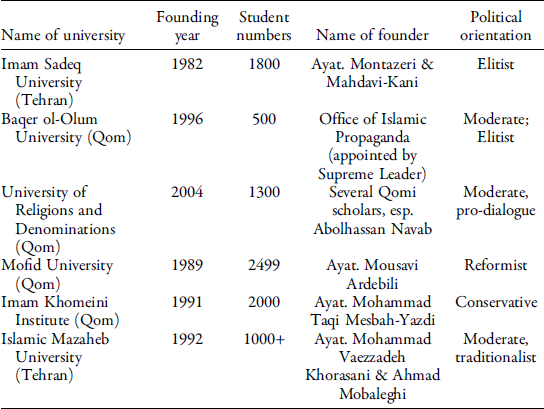
In the early post-revolutionary years, private initiatives beyond Islamic Azad failed due to the sensitivity of the new regime about independent social science teaching. The one major exception was Imam Sadeq University. Through the combined efforts of two powerful clerics, Ayatollahs Hossein Ali Montazeri and Mohammad Reza Mahdavi Kani, and with financial support from the bazaar, Imam Sadeq was established in 1982 on the premises that used to host the Harvard School of Management.Footnote 55 According to Mahdavi-Kani, the concept of Imam Sadeq University originated before the revolution in dialogue with other progressive clerics, as a step towards the realization of an ideal, long-held by Iran’s progressive clergy and Islamist intellectuals, to institutionalize a cosmopolitan, liberal and Islamic approach to social sciences and humanities.Footnote 56 However, in the new Islamic Republic, this highly political project necessarily co-opted more conservative ideologues too. While Ayatollah Montazeri was initially the university’s president, his falling out with core members of the political establishment led to Mahdavi-Kani taking over key responsibilities. Autonomy is confirmed by the degree to which Imam Sadeq has become a family affair, with Mahdavi-Kani’s brother functioning as current president and his son as vice-chancellor.
Imam Sadeq initially focused on teaching philosophy, politics and economics at master’s level. Its early and much-paraded entry into the higher education scene has guaranteed its status as a top elite institution, playing a central role, alongside the University of Tehran, in recruiting members of the political elite.Footnote 57 Its status and elite connections have guaranteed a unique form of autonomy that includes access to the country’s most controversial and free-thinking professors. As an anecdotal example, one of the country’s best-known secular Marxist professors, unemployed and scorned by state university managements, told me that Imam Sadeq actively tried to recruit him for months, but he rejected the offer. In short, Imam Sadeq is beyond petty politics, because the institution is an introduction to state politics itself. There is a strong internal system of checks and control that restricts entry only to top students, faithful to the Islamic Republic, and often with high-up kinship ties.Footnote 58
Islamic private education has not remained limited to the elitism of Imam Sadeq, but it had to wait until higher education provision became liberalized. This process of liberalization is closely related to the end of the Iran‒Iraq War, and the growing relative power of pro-market mercantilists.Footnote 59 Some have claimed that the boom in private universities from the late 1980s onward is the product of “academic entrepreneurs.” While true to an extent, this labeling misses the full picture, especially in the social sciences, which, at least in Iran, is not a marketable field of knowledge.Footnote 60 In particular, the growth of private university initiatives has been a by-product of the fragmentation of authoritarian power structures after the death of Imam Khomeini.Footnote 61 Social science universities were established as political projects, relying on a conjunctural compromise between members of the inner government polity with a variety of scholarly actors eager to influence society from the fringes of the state. In other words, these private, social science universities lie somewhere in the ambiguous space between the strictly private (khosusi) and the statal (dowlati). I will argue that relative autonomy from both market forces and state politics has had a positive influence on the state of social science teaching and learning in these institutions.
First, it is important to establish the capacity and spread of the Islamic university. Geographically, this type of institution remains limited mainly to Qom and Tehran. Table 1 identifies six institutions that can be called models for the Islamic university. Variations of content, history and autonomy are significant, and could lead the observer to classify each of these institutions as unique. Yet I would propose that this set of universities benefits from a similar historical and political trajectory and structural operative framework. The total capacity of these model institutions is about 9,000 students, signifying both these institutions’ preference for quality over quantity and meritocratic student acquisition, as well as continuing restrictions on the size of this educational type.
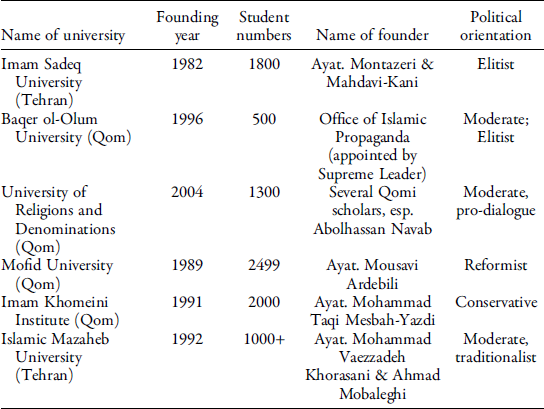
The degree of autonomy of these Islamic universities is determined by three factors: institutional and legal regulations; financial autonomy; and the political position of the founder and his network.
Formal regulations on “non-profit” teaching organizations were first set out in October 1985. The board of founders has to consist of at least five members, all screened by the SCCR, who in turn appoints a board of trustees, consisting of academics, several members of the founders’ board, the institute’s president and, critically, the region’s governor and a representative of the Ministry of Science. The SCCR does not screen the board of trustees, but its members should be “faithful to the Islamic Republic, its constitution and the politics of neither East nor West”—a rather fluidly interpretable formula. Power is delegated even further: this board in turn appoints the university’s head, who holds executive power. Within this diffused power structure, the Ministry of Science cannot interfere directly, and its legal mandate is limited to a supervisory and consultancy position. The non-profit university also has to operate within the regulatory framework set by the Ministry of Culture and Islamic Guidance. Some universities operate on different regulations. The Islamic Mazaheb University, for example, also invites the country’s president onto its board. But in general, despite restrictions and state surveillance, regulations concerning private universities formally allow a modicum of autonomy from the state, providing executive continuation as governments change and party positions shift.
Secondly, Islamic universities rely on a combination of their own investment and saving funds, and charities, putting them apart from state universities, or even the seminary. Of the above list, only the University of Religions and Denominations receives substantial state funding, leading some to accuse it of being a propaganda vehicle against Sunni students.Footnote 62
However, structural power, while important, does not suffice to evaluate autonomy. In non-democratic states that suffer from extensive politicization and weak rule of law, the political position of the institution’s support network as well as its organizational strength keep the dynamics of state politics at a distance. Intrinsically related to political power is university status, which often strengthens relative autonomy by connecting elite networks to the institution. Universities with more powerful backers, such as Mofid, Imam Khomeini Institute or Imam Sadeq, have not only been able to expand their student numbers, but also make internal decisions more freely. Let us briefly discuss Mofid University as a case study in this regard, which, as a reformist and liberal institution, is more open to fieldwork.Footnote 63
Mofid University was established in 1989 by Ardebili, who was then still a “powerful leader.”Footnote 64 After the revolution, Ardebili co-founded the Islamic Republican Party, and became a staunch supporter of Imam Khomeini. He functioned as the country’s chief of the judiciary throughout the 1980s, and played a controversial role in the mass executions of the independent left of the late 1980s. For a while a plan circulated under which Ardebili, Ali Khamenei and Ali Meshkini would have replaced Khomeini in the post of Supreme Leader as a triumvirate leadership council.Footnote 65 But the establishment of Mofid went hand in hand with Ardebili’s surprisingly swift exit from the inner state polity. Not only was the triumvirate proposal rejected, Ardebili also lost his seat in the Assembly of Experts in 1991—an unusual development given his senior religious status. He did not hold any formal posts afterwards.
Ardebili’s sudden fall from state office was a direct consequence of his affiliations with the statist elite, which had lost much of its power by the end of the war. Affected by the general takeover of key institutions by mercantilists, the end of the war and the fall of the Soviet Union, the statist bloc was unable to formulate a clear minimum program around which they could rally and mobilize enough popular support. It was telling that Ardebili’s replacement as chief justice was a staunch conservative.
At the forefront of wiping out oppositional intellectuals and leftist thinkers only years earlier, Ardebili gradually turned to oppositional politics himself, increasingly becoming a defender and protector of critical voices. He retained powerful backdoor connections to the reformist/former statist elite, allowing him to claim a relative autonomy for Mofid University. The university’s board of trustees determines its overall policies and consists of Ardebili’s close political supporters, who lobby for its continued independence. The names of the members are kept secret, but reports suggest that reformist heavyweights like Hashemi Rafsanjani, Khatami and Mir Mousavi have participated.Footnote 66
Growth of private and state education, 1985‒2010 (in thousands)
Sources: Institute for Research and Planning in Higher Education; Payam-e Nur website.
Yet neither Ardebili nor the board of trustees directly interferes in university matters. Ardebili used to visit the site less than once a year. His influence over the university is exercised indirectly, and it is here that Mofid’s organizational strength and independence show themselves. The vice-chancellor, Ardebili’s son, is de facto the most powerful figure in the university, having the final say on job applications, finances, teaching and publications. The current and former vice-chancellors, both educated in the United Kingdom, are sons of Ardebili.
Mofid University’s autonomy has been reflected in several practices that are highly uncommon at other universities. This includes the university’s ability to appoint critical and independent professors, despite their difficult relationship with the state. In the wake of the post-2009 Green Movement crackdown, large numbers of teaching staff were fired from top state universities. Mofid responded by employing several of them, some of them women. Indeed, at the time of this research up to one-third of the Mofid University political science faculty consisted of women—much more than is common in Tehran state universities. Another example where relative autonomy is reflected is the absence of a basij branch on the campus—something unknown in state universities or Islamic Azad. It is to be expected that the absence of such surveillance has positively influenced free discussions and debate in the university, while provoking the anger of more conservative groups in the city.Footnote 67 In short, a political biography and network analysis of the founder are key to understanding the Islamic university and the degree of autonomy it can claim for itself.
Finally, one should consider the ability to make autonomous space conductive to critical thinking and dynamic debate. In the first place, the ability of politically engaged actors without the necessary party connections to function at these universities has been an important feat. In contrast to state universities, where these party connections are fundamental to continued political involvement, Islamic universities invite “independent” thinkers and teachers. While universities such as Baqer ol-Olum, Mofid and Imam Sadeq University invite more liberal, leftist and reformist thinkers, the Imam Khomeini Institute attracts contrarian teachers from the unorthodox, puritanical far-right.
Secondly, the social status and prestige ascribed to older universities secures higher standards and more autonomy. This process is increased by the inflation of university degrees in the Islamic Republic. A good example is Baqer ol-Olum University, which has had increasing freedom of maneuver despite being run by a conservative body subservient to the Supreme Leader. During interviews, teaching staff at Baqer ol-Olum and other institutions expressed the view that the prime reason for this autonomy is that the university has from the start prided itself on only attracting the top seminary students, endowing it with higher expectations for independence. Yet it should also be noted that Azad University and slow state university expansion has devalued private education at large. Iranians tend to value state universities more highly than private universities, and this poses an important obstacle to Islamic universities and their ambition to attract the best social science students.
Lastly, the dynamic relationship between the Islamic university on the one hand and the seminary and the state university on the other has improved teaching and pedagogical methods. Scholarship has investigated pedagogy in pre-revolutionary Shia seminary education, stressing forms of non-western ejtehādi or Socratic liberalism in which teachers spur students to ask controversial questions and enter debates.Footnote 68 Seminary teaching methods were marked by precise textual analysis, establishing deep acquaintance with intellectual traditions and rather informal, horizontal student‒teacher relationships in which “provoking” to debate were central. Such Socratic forms of teaching and learning gained a certain following as the modernizing, authoritarian “educator” state grew. An adapted version of the French model, state education in Iran has deeply unequal teacher‒student relations, in which students are supposed to take notes and restrict questions to “Professor, could you repeat that last sentence please?” These authoritarian methods stood in sharp contrast to the seminary, whose “pedagogical ideal … is posed by its members as a criticism of the secular education system.”Footnote 69
Despite and perhaps because of, extensive consolidation and etatization of clerical institutions after the revolution, there has been no successful move to “modernize” the pedagogical ideal of the seminary and align it with dominant secular teaching methods. The deep embeddedness of the Islamic university in the seminary allows seminarians challenged by current debates and scientific agendas to exit the restrictions of the howzeh and import their teaching methodologies, pedagogical ideologies and interactive repertoires to a more autonomous and liberal context. Of Mofid University’s political science board over half had completed a seminary degree. Indeed, my field notes of the various classes I attended for one term at Mofid University suggest a similar difference. Seminary-trained professors held open-ended lectures, in which students were usually required to have read a certain chapter of a book. This chapter was then collectively problematized page after page, and put into contemporary context. Pure state-university educated teachers, on the other hand, held their classes in the form of a lecture. An informal survey conducted among thirty students confirmed these observations. I asked participants whether they thought teaching at Mofid University is more “dynamic” (puyāyi) than at their undergraduate state or Azad alma mater, to which over two-thirds agreed.
Yet Mofid University professors acknowledged the limitations of the seminary. In the same survey of political science faculty, over 70 percent obtained a doctoral degree at a state university, with the remainder graduating from Islamic universities. I asked professors why they believed a seminary degree does not suffice. Their almost univocal response was that to function in modern academia, acquaintance with modern social scientific theories and methodologies is necessary. Indeed, one of the key focus areas for which Mofid University stands out is the debate on the role of religion in politics. Not only did students tell me this is what they thought was “unique” about the university, but in the multiple classes on this topic that I attended, I noticed this was largely a continuation of the intellectual debates of the 1990s that had since been suppressed in both state and seminary institutions. Several professors (some of whom had positions at the University of Tehran) had published summaries of these debates.Footnote 70 However, published works adhered to strict censoring, and class debates did not.
Lastly, where do Mofid University students stand? Students came from across Iran, and from a variety of class backgrounds. At least two I spoke with were Kurdish Sunnis. In the surveys I conducted up to 80 percent stated that they choose Mofid University for its “high teaching standards” or for its “innovative thinking.” Moreover, Islamic universities attract many seminary students (talabehs). While some Islamic universities still consist exclusively of talabehs, most have now moved away from that model. At Mofid University, only outstanding talabehs were accepted on a full scholarship. Mofid teachers confided that talabehs tend to score higher than average, not only because they already are acquainted with some of the Islamic sources that are used in critiques of the government and state, but also because they study better. In sum, links to traditional and modern education, as well as national prestige, have enhanced meritocratic student acquisition, strengthening and deepening the critical debates and societies formed within the institution.
Conclusion
This essay has attempted to provide a comparative analysis of the degree of autonomy and creativity of different types of education in Iran, specifically as they relate to the social sciences and humanities.
Education in the Islamic Republic is a heavily contested field. Partly this is because teachers, students and academic institutions have had a unique relation to processes of social, political and ideological change in modern Iran. While intellectuals and student societies in Europe and the United States played a key role in the downfall of the shah, the attachment of many revolutionary clerics to the seminary has politicized education in its own way. The university, and what goes on within it, has played a socio-political role far beyond the campus.
The restructuring of education in the post-revolutionary period has produced theorizations that Iran is moving to a theocratic or authoritarian model in which the propagation of Islam, and other forms of student activism, cannot be seen independently from the state and political parties. In response, this essay assessed three main types of education in Iran—the seminary, the state university system and the private university system—and evaluated to what extent these educational institutions can claim a relatively autonomous space guaranteeing an internal civil society connected with larger extra-local processes of socio-political change.
I argued that a vast variety of such civil societies emerged at different points in time in each educational type, occasionally leading to transformative theoretical innovations or social movements. In the post-revolutionary period, a largely unexplored development is the growth of what I called the Islamic university. The Islamic university is a type of private, non-profit educational institute, historically emerging as an Islamic renaissance approach to the social sciences and humanities. In post-revolutionary Iran, the Islamic university has gradually become institutionalized, as converging processes of educational bottlenecks, liberalization and elite bargaining with scholarly actors operating from the fringes of the states required a deeper rethinking of the classic state-centered educational model. Financial independence, institutional autonomy from the state and elite support have carved out an autonomous space for this educational type that set it apart from the state system, the seminary or Azad University.
Moreover, Iran’s Islamic universities enjoy unique ties with both the seminary and the state university, providing a space where intellectuals with biographies of conflict, criticism or disagreement with the state—as scholarly actors with an independent claim to power—can congregate. I have argued that these multiple connections have had a positive effect on pedagogy and teaching styles, and providing for a more dynamic, interactive and liberal model uncommon in other universities.
In this essay, I have chosen to focus on the modicum of freedom that Islamic universities enjoy relative to other educational types, rather than reviewing the significant obstacles that remain. Yet these should not be forgotten, and include continued state interference and control, as well as reliance on political patronage.
In light of the recent passing away of Rafsanjani, Mahdavi-Kani and Ardebili—all of whom founded important educational institutions—a key question remains whether these Islamic universities have a life beyond their founders, or whether state institutions and other interested parties will be able to exert tighter control. The growing national prestige of several of these institutions, together with the further diffusion of power that the death of these senior political figures is likely to bring about, may mean that the Islamic university is here to stay.