Introduction
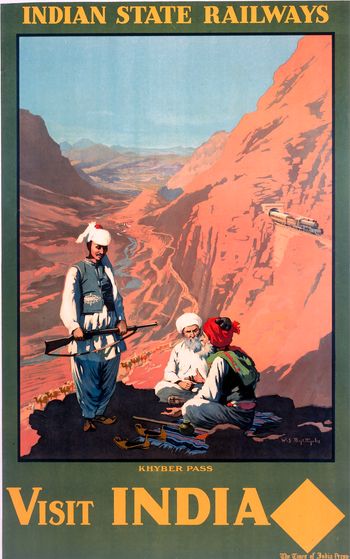
The Indian Railways Promotion Bureau released a series of posters in the 1930s to promote India as a credible tourist destination and the railways as a convenient way to navigate the vast country. A majority of these posters, culled from a collection of lithographic prints produced by William Spencer Bagdatopoulos for the Times of India between 1924 and 1926, were snapshots of familiar Indian vistas.Footnote 1 Posters of the Golden Temple, Taj Mahal, the iconic elephant statue of Ellora, and ghats of Benares, among others, showcased architectural wonders and human forms of the subcontinent. They also served as reminders of the thrilling sights and experiences that India held in its bosom for the enterprising traveller. Only one of these posters featured an actual train or railway line. This distinction belonged to the Khyber Pass Railway—a section of the North Western Railway that spanned 42 kilometres in length and connected Jamrud, a town located just beyond the western limits of Peshawar, to Landi Khana, three kilometres east of the Afghan border. The Indian Railways poster of the Khyber Pass (see Figure 1) presented an image of the Indo–Afghan frontierFootnote 2 that was not particularly inviting, and exciting perhaps only in the most imprudent sense. If anything, with three Pashtun men—a young rifle-bearing male on his feet and two older males seated on a rug, perched on top of a rocky overhang—at its centre and the railway line relegated to one side, the poster foregrounded a sense of precariousness. The camel caravan crawling punily along the banks of a river in the gorge below seemed to reinforce the frontier's reputation as a place that could be traversed but was undeserving of prolonged external engagement.Footnote 3
Indian State Railways ‘Visit India’ poster, Khyber Pass, by William Spencer Bagdatopoulos, about 1930. Source: Science & Society Picture Library, London.

The Khyber Pass Railway became operational in November 1925. It cost the colonial government 52,000 sterling pounds per mile—twice as much as the double railway line completed through the Bolan Pass in Balochistan in 1895—and 2 million sterling pounds overall.Footnote 4 This was a significant strain on an imperial exchequer that was already reeling from allocations made to the military during the First World War and the Third Anglo-Afghan War, a rising demand for gold in India, and a devaluation of the rupee vis-à-vis the sterling.Footnote 5 In comparison, the benefits derived from the Khyber Pass Railway were decidedly modest. The railway line never saw heavy traffic, and an eight-kilometre section between Landi Kotal and Landi Khana was closed down for the repair of tunnels for ten months from March 1928 to January 1929, and then permanently on 15 December 1932.Footnote 6 The construction of the Khyber Pass Railway was hardly a ‘civilizing conquest’. Though imagined as the colonial state's arm of influence, it was at best a half-hearted attempt at filling a spatial void and an unlikely harbinger of colonial governance to the Afghan border.
Despite such apparent failures, the Khyber Pass Railway had a wholly unforeseen outcome. Contrary to its militaristic aims and to what cultural artefacts such as the Indian Railways poster might suggest, interactions it animated between the British colonial government and local Pashtun ‘tribes’ were for the most part of a non-adversarial nature.Footnote 7 Negotiations held between the British government and frontier populations reproduced and rearranged lines of authority among the latter, often portrayed as unchanging or insular in imperial historiography. These negotiations frequently took on a performative quality, wherein each side was aware of the other's lack of sincerity but equally cognizant of benefits to be claimed from taking part in the negotiations themselves. Furthermore, colonial engagement on the railway line embedded British officials in tribal hierarchies. In the uneven legal context of the Indo–Afghan frontier that rested upon indirect, albeit more stringent, methods of control than those in operation in the settled districts of Peshawar Valley, deals struck between British engineers and tribal contractors relied almost entirely on personal trust. Colonial officials tasked with the execution of the project acted as conduits for the transmission of metropolitan regulations and administrative practices. For rentier tribal chiefs and landlords, involvement in the construction of the Khyber Pass Railway presented an avenue to potentially shore up their authority within frontier society. Ultimately, the Khyber Pass Railway occasioned a transfer of sovereign power between local populations and the British colonial government; its history bore tell-tale signs of sovereignty's shifting character on the Indo–Afghan frontier.
What exactly did sovereigntyFootnote 8 mean in the context of the late-colonial Indo–Afghan frontier? I use the term ‘sovereignty’ to refer to a condition of primacy in the rough terrain of legal and extralegal practices that prevailed on the frontier during this period. I invoke these practices as a shorthand for the forms of engagement common to three domains that invited colonial intervention in that geography. The first of these domains concerns colonial interference on the economic right to use land. The second domain pertains to the colonial government's extension of juridical regimes and its attempts to regulate social relations and control the legal status of members of frontier tribes, either as individuals or through their association to categories such as clans or tribes. The third domain implicates the right to territorial control; this may alternatively be seen as the colonial imperative to draw a boundary between government territory and various autonomous enclaves on the frontier. I understand primacy in these three domains to be a reflection of one's sovereign power, and the assumption of such primacy to be an indicator of both the scope of colonial authority and the limits to the autonomy of frontier tribes. Despite their grounding in a WesternFootnote 9 understanding of sovereignty, my choice of domains rests on a collage of state-centric perspectives and colonial policies specifically adapted to meet local conditions. After all, the question of sovereignty on the frontier turned on local customs and also assimilated into it claims staked to sovereign power by messianic authority.Footnote 10 In the realm of practice, this enmeshing of the colonial and the local opened up novel spaces for negotiation and led to hybrid outcomes.
With these considerations in mind, this article interpolates a reading of customary law and sovereign power into a retelling of a history of infrastructure expansion on the Indo–Afghan frontier. I begin by situating the surveys and debates conducted and investments made towards the Khyber Pass Railway in a broader context of political and economic developments from the first two decades of the twentieth century. I then investigate British efforts to mobilize support for railway infrastructure among frontier tribes. This section of the article sheds light on the false promises, veiled threats, and semantic inversions deployed by both parties to extract outcomes that best served their interests. It also emphasizes the manner in which the colonial government braided together policies of local policing and taxation as part of their administrative strategy. After laying a framework of frontier governance and demonstrating how it relied on the co-optation of locals, I move to a discussion of three kinds of contracts forged between the colonial government and members of frontier tribes. Through an analysis of written and verbal contracts and the security bond, I offer three arguments on the operation of sovereignty in the region.
Examining the language and modalities of written contracts, I suggest that sovereignty in the late-colonial Indo–Afghan frontier was partial as well as layered. In the eyes of those members of frontier society who accepted the legitimacy of the colonial state, British sovereignty was beyond question. In the eyes of those who refused to accept colonial rule, the British were only fellow claimants in various domains of sovereign power. Gestures hinting at the transfer of sovereignty, therefore, evoked a range of reactions on the frontier. Often, members of various tribes challenged the signing of contracts by elders, tribal chiefs, et al. Indeed, one may make a similar claim for many parts of British India. It is essential, however, to state this explicitly in the case of the Indo–Afghan frontier. For there, colonial ethnography's imputing of authority onto the village elder, landlord, and tribal chieftain has fed into two reductive claims: that sovereignty was vigorously contested, and that transfers of sovereignty were confident exercises, while simultaneously obscuring minor fluctuations in sovereign power or the contingencies that interrupted its migration and reclamation across domains.Footnote 11 By looking at verbal contracts, I demonstrate that both the colonial government and local populations made use of the twin premises of temporariness and mutability in their transactions. Whereas the former emphasized the temporariness of coercive colonial policies in order to sustain them, the latter deployed this principle to reopen negotiations over concessions of autonomy that the British might have taken to be conclusive. Finally, in tracing exceptions made by the colonial state in its application of the security bond, I argue that the idea of sovereignty itself changed over time along the frontier. Long-drawn parleys played out over authority in several domains, but supreme authority often lay with the stakeholder who could determine which of these domains fell within the bounds of the sovereignty question, and which of them fell without.
The Khyber Pass Railway archive as a heuristic
Before proceeding any further, it is important to clarify that, though I seek to call attention to the non-adversarialFootnote 12 dimension of the colonial encounter on the Indo–Afghan frontier, my arguments derive from roughly the same documents—memoirs, reports to supervisors, official paper trails, and hastily written summaries—which have formed the basis of numerous imperial histories of the region. In fact, the archive on the Khyber Pass Railway—the choice to call documentation on the project the ‘Khyber Pass Railway archive’Footnote 13 is a heuristic one—is oddly similar to the larger imperial archive on the Indo–Afghan frontier in three important ways. First, both archives stand on memoirs, travelogues, ethnographic accounts, and administrative reports that assume a measure of familiarity with one another. To echo Ann Laura Stoler, every one of these documents conceals in its pages a ‘received account’ of past events and shades of the ideology of particular political moments.Footnote 14 Together, they hold forth a vision of the frontier that documents subsequently produced have elided, simplified, as well as exaggerated. Non-official accounts such as Engineer Victor Bayley's Permanent Way Through the Khyber, which effectively serves as a starting point for this article, were less constrained by the rules of formatting and pragmatics of reporting than most texts written by similar people in official capacities during this period.Footnote 15 However, even these documents were not immune to the use of florid but vacuous prose, and racial clichés. Much like their official counterparts, they betrayed the sort of epistemic anxieties that are symptomatic of a colonial mode of knowledge production.
Second, both the Khyber Pass Railway archive and the imperial archive on the Indo–Afghan frontier focus disproportionately on the ‘warlike’, ‘cunning’, and ‘petulant’ male, tribal figure.Footnote 16 Compendium-like reports that attend to the socio-economic activities, attires, and cultural practices of frontier tribes, and take as their points of departure ideas about agnatic allegiance, rank, and political leadership characterize this tendency.Footnote 17 Products for the most part of a pan-India enterprise to generate knowledge about various subject populations after the rebellion of 1857—Nicholas Dirks describes this as the defining action of an ‘ethnographic state’Footnote 18—these reports conjure the imagination of a frontier society that is overwhelmingly male. In recreating tribal genealogies, mapping individuals to families to clans to tribes, and projecting onto such genealogical trees a rigid understanding of tribal loyalty and intractability, their authors emerge almost as intellectual forebears of the structural–functionalist school within social anthropology.
Third, both archives are extremely repetitive. The Khyber Pass Railway archive features diplomatic exchanges between the British and Afghan governments, descriptions of excavation work, dynamite, gradients, catch sidings, and so on, the monotony of which is only ruptured by the odd episode involving a raid or a cattle theft. The imperial archive, on the other hand, reads like congeries of tribal feuds, murders, raids, and skirmishes involving the colonial army. In the case of the latter, this repetitive nature has undoubtedly to do with the colonial fetish for documenting, and communicating between various organs of the government, local conflicts as a way of gaining a fuller understanding of frontier society. British obsession with documenting sometimes even cost the colonial government opportunities to improve relations with frontier populations, as evidenced in this lament from an 1869–70 administrative report:
whereas in the old days raids and forays were of such frequent occurrence that they were regarded as ordinary incidents, and disposed of by local authorities; now the pettiest foray, even the theft of a few bullocks by hill thieves, is the subject of voluminous reports to Government. Our danger now is the fact that, owing to constant demands for reports of various kinds, the large increase of judicial business, and the increased care required in judicial procedure, our frontier officers are crushed with office work, and have little time for friendly personal communication with the border Chiefs.Footnote 19
Despite the similarities noted above, the Khyber Pass Railway archive and the imperial archive differ on one crucial point: the intensity and frequency of violence produced by the colonial encounter. To explore the relatively sanitized corridors of the former, then, is to open up a space for the recovery of a ‘culture of contracts’.Footnote 20 Even when not particularly successful, interventions such as the Khyber Pass Railway led locals to test the limits of metropolitan ideas about colonial governance. In enabling interactions which occurred outside of established power dynamics, they engendered a new kind of political subjectivity on the frontier.
Reading this culture also countenances a radically different imagining of frontier society. By casting contingencies that were a part of the construction and operation of the Khyber Pass Railway in stark relief, such an exercise disrupts a more deterministic view of the frontier as a place where political authority rested with a few individuals, and kinship and religious facility mediated sovereign power. The Khyber Pass Railway, therefore, provides one field—colonial endeavours such as road building, regulation of cross-border trade and the movement of PowindahsFootnote 21 similarly lend themselves to the study of non-adversarial interactions—in which to surrender an obsession with kinship within frontier society and reflect on the contingent nature of sovereignty. It follows that the turn to ‘infrastructural contingencies’—a term set out in the article's title—allows compensation for an imperial archive in which local Pashtun voices are either absent or nearly impossible to track down.
Engineering consent for the Khyber Pass Railway
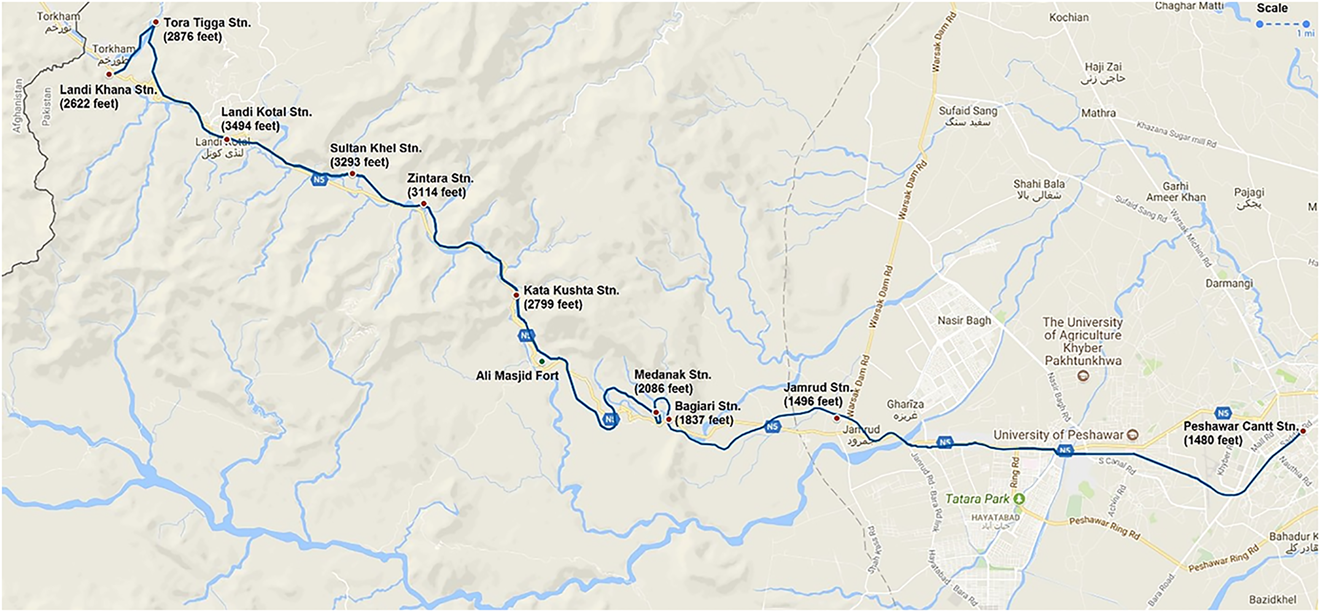
The Khyber Pass Railway (see Figure 2) had a gestation period spanning nearly seven decades. The possibility of a train through the Khyber entered the British imagination in 1857 when Chairman of Scinde, Punjab, and Delhi Railway Company William Patrick Andrew proposed rail routes through the Khyber and Bolan passes. Two decades later, English civil engineer Guilford Molesworth carried out a survey for the construction of a metre-gauge lineFootnote 22 through the Khyber Pass. More surveys followed in the years 1885, 1890, and 1898. However, periodic disagreements with the Afghan Amir in Kabul, the Second Anglo-Afghan War, failure of the Loi Shilman Railway, the First World War, and the downfall of the Russian empire throttled progress. Intermittently, the project was set back by doubts expressed within metropolitan circles on whether the benefits derived from the Khyber Pass Railway would be commensurate with the vast material and human resources required to complete and maintain it.Footnote 23
Alignment of the Khyber Pass Railway on the present-day Pakistan–Afghanistan border; figures in parentheses denote elevation. Source: My Google Maps.

The outbreak of the Third Anglo-Afghan War again drew attention to the difficulties of supplying British troops. The two existing roads in the area only allowed troops to travel in small parties by lorries and, at nearly two sterling pounds per ton, transporting items by the Khyber ropeway from Jamrud to Landi Khana was prohibitively expensive.Footnote 24 In the second half of 1919, Lieutenant Colonel Gordon Hearn's survey demonstrated that a broad-gauge lineFootnote 25 could pass through the Khyber linking the Afghan border by rail to Peshawar and Bombay. Meanwhile, all manner of outrages continued unabated along the frontier. Between April 1919 and March 1920, members of frontier tribes committed 145 raids, killed 32 British subjects, and stole property worth Rs 327,000 in Peshawar district alone. In the nearby Kohat district, they committed 142 raids, killed 117 British subjects, and plundered property worth Rs 526,000 during the same period.Footnote 26 Victor Bayley, an executive engineer with the Railways Department of the Government of India, set foot into such a context in November 1920.Footnote 27 In time, he would oversee the entire project but, upon his arrival in Peshawar, he took charge of the construction of only the upper half of the Khyber Pass Railway. His first task was to convey the railway line's viability to locals who were opposed to it. In the Indo–Afghan frontier of 1920, this meant more or less the entire population of the region.
When British representatives approached frontier tribes to elicit their views on the construction of a railway line through the Khyber, they were met by brandishing rifles. Locals declared that any such project was not just undesirable, but forbidden, as it would impinge upon their independence. The British government itself was divided on both the need to build a railway through the Khyber, as well as the choice of gauge. The secretary of state for India at the time, Edwin Samuel Montagu, was sceptical of the initiative and suggested that a metre-gauge line would be the most sensible choice.Footnote 28 According to estimates, a metre-gauge line would deliver 450 tons of material to Landi Khana daily and take 14 months to complete.Footnote 29 Others like Chief of General Staff Lieutenant General George Kirkpatrick were firm believers in the civilizing power of the railway and saw the high cost of construction as no reason to leave an inferior military position undeveloped.Footnote 30 Senior government functionaries ultimately deferred to the judgement of those serving on the frontier at the time, who consented to laying a broad-gauge railway through the Khyber. A metre-gauge line, they noted, would make the project appear overly military and make it less attractive to civilians. British government officials, therefore, put a commercial spin on the project to make it more palatable to locals. They stressed that a railway line would greatly improve ease of communication, bring higher volumes of essential commodities to frontier towns at Peshawar market prices, and end famine in the Khyber. The more jocularly inclined among them were not averse to suggesting to tribal chiefs that the passing of rich merchandise along a steep gradient would present opportunities for loot.Footnote 31
The flow of higher volumes of commodities to the Afghan border was going to be a massive improvement over the current situation. It promised to reduce local dependence on camel caravans that hauled foodstuff and essential items from Landi Kotal to Jamrud and back twice a week over two days. The civilizing impulse of the Khyber Pass Railway resonated in debates held within legislative circles. In March 1922, responding to Narayan Joshi's suggestion at the Central Legislative Assembly that the Khyber Pass Railway was a drain on resources, secretary of the Foreign and Political Department in Simla, Denys Bray, expressed hope that the railways would ‘develop trade’. He added that it might also enable the Afridis who inhabited the agriculturally unfavourable land around the Khyber to ‘supplement their resources by peaceful employment rather than by their hereditary vocation for looting and rapine’.Footnote 32 Contained within this seemingly ameliorating, political tendency, however, was a hard economic argument. Peshawar and Landi Kotal had witnessed exceptional drought in the year 1921.Footnote 33 ‘The labouring classes [were] finding it very difficult to make both ends meet’ and the British colonial government sought to complete a significant share of the work ‘at a time when labour [was] most easily and cheaply obtainable’.Footnote 34
Local opposition to the Khyber Pass Railway and arguments presented by British officials to counter it are a classic example of the kind of semantic inversions that typified the quasi-colonial relationship between the two parties, on the ground and within the imperial archive, but more so in the latter, where the British enjoyed a monopoly. Both the British colonial government's reasons for building a railway through the Khyber and local rationale for opposing such an initiative had an ‘aggressive-occasional’ and a ‘non-aggressive-quotidian’ dimension. For the British, their ‘aggressive-occasional’ justification concerned the need to reinforce their military on the Indo–Afghan frontier in the event of a clash with the Afghans or the Russians.Footnote 35 The claim that the Khyber Pass Railway would improve market access to frontier towns formed their ‘non-aggressive-quotidian’ justification.
On the part of frontier communities, acts of aggression mainly served to assert their control over the means of coercion and retain a capacity to raid caravans plying along the Khyber. Raiding on the frontier also had a non-aggressive, everyday function. It was an economic activity—a means of defraying costs, levying taxes in exchange for allowing the passage of goods through their territory, and claiming proprietary rights over the lands they inhabited. British legitimation of raiding under a system of tolls and through the formation of salaried patrols, which I discuss in greater detail below, was a testament to this. But how could raiding or similar acts involving the use of force against passing caravans or agrarian populations of the Peshawar Valley be both an aggressive and a non-aggressive act? A distinction drawn between brute and symbolic force by Steven Caton in his ethnography of poetry in a North Yemeni tribe might help resolve this apparent contradiction. Caton argues that the members of the Khawlani tribes of North Yemen were capable of exercising brute force ‘in which blood was spilled and men were killed’.Footnote 36 Still, more often than not, they chose to apply symbolic force. Implicit in this use of symbolic force was an understanding that symbolism could very easily evolve into a violent act ‘when the financial and political stakes were high enough’.Footnote 37 Similar to Caton's view of violence, frontier communities’ opposition to British incursion into their territory, construction of a railway, military outposts, or telegraph poles manifested in a variety of ways. Of these, raiding culminating in a loss of property, physical injury, and murder was the most aggressive—a clear case of the use of brute force, or in some cases the collapsing of symbolic force into brute force.
Correspondence drafted with the express intention of pushing through work on the Khyber Pass Railway as well as the larger imperial archive, unfortunately, jettisoned a layered understanding of tribal violence and resistance in favour of clarity of form and function. Raiding in such a context was a capacious signifier. It rendered bureaucratically legible even those acts that may have aimed to protect tribal autonomy without liquidating their opponents. In deliberations concerning the construction of the Khyber Pass Railway, the seeds of the British semantic victory lay in their ability to empty their own rationale of its ‘aggressive-occasional’ charge and repopulate it with its ‘non-aggressive-quotidian’ valence, while all along focusing squarely on a tribal, specifically Pashtun, proclivity for violence.
Ironically, soon after finalizing the decision to construct the Khyber Pass Railway, the British colonial government extended the combined system of policing and taxation, which they adapted from their historical antecedents and the region's erstwhile rulers, the Mughals and the Sikhs, to the project. In a throwback to what was an essential feature of the Sandeman SystemFootnote 38 in neighbouring Balochistan, the colonial government organized members of frontier tribes into levies or peacekeeping patrols, called khassadar forces. Khassadars kept watch over small sections of important routes, preferably those that passed through their territory and were managed by pacts made between the government and tribal chiefs. They were responsible for their food, clothing, accommodation, and arms, and received a monthly allowance in exchange for their services. The British meanwhile took it upon themselves to levy tolls on the passage of goods through the Khyber Pass, Kohat Pass, and other such routes, and to distribute it among various tribes.Footnote 39 In so doing, they sought to ensure that the flow of commodities through these routes was not interrupted, and provided locals with an incentive to maintain peace.
Understanding how the British colonial government wedded local policing with the collection and distribution of tolls and tailored arrangements to suit multiple local contexts necessitates a recapitulation of the history of this system. After the annexation of Greater Punjab in 1849, the British signed an agreement with Adam Khel Afridis. Under the terms of this agreement, the Adam Khel Afridis would keep the section of the Kohat Pass that ran through their territory open in exchange for an annual allowance of Rs 5,700. By 1853, after a series of claims and counter-claims on the same stretch of territory by the Bangash and Orakzai, the colonial government gave all three groups joint responsibility to safeguard the pass.Footnote 40 Following the rebellion of 1857, there was a rapid increase in the absorption of Pashtuns from the Peshawar Valley into the colonial army. Unlike the Rohilla Pashtuns of northern India, north-west-frontier Pashtuns had not participated in the uprising and the colonial government looked towards the region to reinforce its infantry, cavalry, and foot levies.Footnote 41 While Pashtuns from the upland areas on the Afghan border were not included in the colonial army, they now became a part of the elaborate security infrastructure on the frontier through their incorporation into tribal militias and khassadar forces. In 1878, the British took over the collection of tolls on the Khyber Pass.Footnote 42 Two years later, at a conference held in Peshawar, Afridis and Lowargai Shinwari representatives from Landi Kotal accepted responsibility for the security of the pass and turned over the right to collect tolls to the British. The outcomes of this conference were formalized in an agreement executed on 17 February 1881.Footnote 43 The British granted Afridis and Shinwaris allowances of Rs 87,540 and Rs 9,660, respectively, and instituted a body of riflemen to secure the pass at an annual cost of Rs 87,392.Footnote 44
Such carefully worked-out pacts between the British colonial government and frontier populations came unhinged frequently, as in the aftermath of the Tirah Expedition of 1897–98 and after the Third Anglo-Afghan War of 1919, when ‘the tribal forces … failed entirely, with the exception of the Kurram Militia’.Footnote 45 The British realized that situations of war put the loyalties of militias and khassadar forces to test, by requiring them to choose between the Afghan Amir with whom they had strong historical affinities and a set of foreigners in the colonial government. Regardless, they recognized that informal forces were of immense value on the frontier, particularly for local policing, and moved forward with their policy of engaging khassadars. As railway construction on the Khyber Pass peaked, the colonial government deployed 570 khassadars along the 42-kilometre alignment from Jamrud to Landi Khana at a monthly cost of Rs 19,575.Footnote 46 These khassadars occupied 13 camps and six picket positions. Upon completion of the railway, the British erected four permanent picket posts in the Khyber at a cost of Rs 225,363.Footnote 47
The colonial government's weaving-together of strategies of policing and taxation fulfilled a fourfold objective. Their employment of khassadars was a cost-effective method to ensure security on the frontier. It kept afloat and ‘vivifie[d] the system of tribal responsibility’ and gave frontier populations ‘an enlarged idea of the possibilities of self-government’.Footnote 48 Embracing the responsibility of collecting tolls along important routes enabled the British to bring them under formal taxation regimes. The arrangement also meant that the British could funnel money into local societies and possibly co-opt members of frontier tribes. In keeping with the general pragmatics of their involvement on the Indo–Afghan frontier, British endeavours with regard to policing and taxation contained an immanent contradiction. The systems they adapted devolved authority to local society selectively while superimposing British institutions upon those of a local provenance. The institutional layering so produced matched the stratified security infrastructure peculiar to the region, comprising khassadars at the front, followed by trained trans-frontier scouts and military regulars bringing up the rear.Footnote 49 Crucially, this allowed the colonial government to permeate into tribal institutions while maintaining the charade of a benign presence. Their redacting and regularization of practices that were seen to be archaic but normative standards of behaviour in frontier society were critical to the evolution of systems of rule in this ‘twilight zone’ of empire where they enjoyed limited jurisdictional powers.Footnote 50
The contractual bases of sovereign power and sovereignty
Officials of the British government faced a host of difficulties during the construction of the Khyber Pass Railway, in the allocation of specific jobs, in securing labour to undertake them, and in ensuring a safe environment in which to carry out these activities. The execution of such tasks invariably required the colonial government and local populations to agree to specific terms. In establishing who would hold the right to use land and in what circumstances, what legal provisions would apply to such transactions, what privileges to the possession of weapons locals would need to cede, and so forth, such terms were to provide key stakeholders with adequate grounds for resolving confusion and smoothing over conflicts. The colonial government relied on the contract form to enshrine them. At its most explicit, the contract was an instrument to arbitrate on the economic right to land, articulate labour regimes, and actualize security regulations. Implicitly, however, contracts helped determine what topics were worthy of being negotiated and who, in particular, from frontier society was to bear the privilege of negotiation. Contracts granted participants, and by extension those they claimed to represent, a stake in deciding the state of exception. Even if one were to resist the temptation to understand the contract form in such absolutist, almost Schmittian terms, at the very least, it furthered a logic of exclusion.Footnote 51 In fixing the boundaries of what was normative and what was not, and laying down the exact conditions for the suspension thereof, the contract was a symbolic site for fashioning political subjecthood. Three main types of contracts were in circulation in the Indo–Afghan frontier during this period: written contracts, verbal contracts, and security bonds.
Written contracts
The colonial government used written contracts to secure the right to land along the proposed alignment of the Khyber Pass Railway. Land-tenure arrangements along the Indo–Afghan frontier were intricate. Among the Afridis of the Khyber, collective ownership of forested and hilly lands, called banjar, was common. Cultivated lands, called zmaka or jaidad, were privately owned.Footnote 52 As the second type of land was at a premium, efforts made by the colonial government to acquire them encountered grave opposition. In places where the government could not buy lands, they rented them in perpetuity to give locals a continuing interest in the railway. In one example, the British acquired 709 kanals of land from the Zakka Khel Afridi and paid them an annual rent amounting to one-sixteenth of its assessed selling price. These contracts were often revised, and rents were frequently increased to compensate for the inconvenience resulting from the railway's passage close to villages and for loss caused by encroachment upon pastures to local livestock owners.Footnote 53
In most cases, the periodic revision of rents was based purely upon political concerns. In 1924, the British government paid Zakka Khel Afridis Rs 3,093 as rent for the Danda, Barani, and Ghermumkin sections of land. By February 1926, barely three months after the inauguration of the Khyber Pass Railway, political agent of the Khyber Major H. C. Finnis proposed a trebling of the annual rent to Rs 9,279. The chief commissioner of the North-West Frontier Province swiftly proceeded to support the proposal.Footnote 54 Colonial correspondence conveniently described any additional costs incurred in this manner by the somewhat nebulous term ‘kharcha’, or spending in official-speak. Such fragile understanding between the colonial government and frontier populations rested on the sensitive terrain of social relations within and between various sections of frontier society. Two decades previously, during the doubling of the Khyber road, members of several tribes had come together to accuse some elders from the Kuki Khel and Malikdin Khel Afridi for selling the rights of all tribes for a few hundred rupees. Local clerics attempted to raise an army to burn down the fortification of Malik Zaman Khan—a Kuki Khel Afridi elder they claimed had especially benefited from the contract.Footnote 55 Developments leading up to the construction of the Khyber Pass Railway saw the rearticulation of a similar dynamic and more intense competition between those who were in favour of the project and those implacably opposed to it. Assemblies of elders convened with the endorsement of the colonial government tried to canvass support for the Khyber Pass Railway and, when such initiatives failed, the British held out the promise of rents, embodied in written contracts, to try and win over sceptics.
At the same time as colonial administrators put their right to use land for the Khyber Pass Railway in writing, British engineers utilized the written contract to allot works to locals who were willing to serve as contractors. The primary responsibility of these contractors was to complete tasks such as piling up an embankment, digging a ditch, and so on. Contractors were paid separately for every piece of work completed by them and could employ their own labour. They were also required to protect their labourers from those resisting the construction of the rail line.Footnote 56 The British privileged political influence over qualifications in the selection of contractors and often bargained with several individuals before settling on one. Occasionally, they allowed rival contractors to fight it out, so they could partner with the most influential among them.Footnote 57
When the project started, the British only had to choose from among people who did not oppose the railways. As more and more people withdrew their opposition, they too expected to be rewarded with contracts. To satisfy this demand, the British split up larger engineering works into smaller jobs. However, few contractors in the Khyber had any experience of undertaking moderate to advanced engineering works. This resulted in abuses such as the subletting of contracts to Peshawar-based Hindu businessmen, who themselves were as unqualified as Afridi contractors.Footnote 58 In the case of a particularly complicated work—Kafirtangi, the largest of 34 tunnels between Jamrud and Landi Khana—as many as seven Afridi contractors reassembled their contracts into a larger ‘subcontract’ and passed it on to William Morgan Moylan, an experienced, Lancashire-trained tunnel contractor.Footnote 59 The identity or qualification of subcontractors notwithstanding, subletting was an ideal way for contractors to spread out risks while ensuring that their profits remained the same. Subcontractors paid contractors a commission of 15 per cent on the total payment. This rule applied even in the event of a loss or penalty. If a subcontractor defaulted on the payment of commission, the contractor could rescind the contract and recover the sum from the subcontractor or his property.Footnote 60
The signing of these contracts offers several valuable insights into the nature of sovereignty on the Indo–Afghan frontier. Many Afridi contractors did not know how to read or write and sealed contracts with signet rings from their fingers. These rings typically bore the initials, in Persian characters, of their fathers or grandfathers.Footnote 61 As few courts existed on the frontier to protect or enforce these contracts, written and signed documents did not have any great value themselves.Footnote 62 Instead, it was the act of signing—whether in the form of a printed name or the likeness of a ring—that was important. Bureaucratic acts such as this were not unlike religious rituals in which doing an activity can be more important than the precise nature of the activity, and participation and syntax are often more critical than any tangible outcomes derived from it.Footnote 63 They were also emblematic of the colonial administration's encounter with communities along the frontier. British officers often participated in these acts as wilful connivers and transgressors of metropolitan writs. Engineer Bayley, for instance, thumb marked contracts for Afridi contractors when they themselves refused to get ink on their thumbs. This perhaps formed, on Bayley's part, both an attempt to satisfy the metropole's voracious appetite for written documentation and an admission that such contracts were, ultimately, fodder for meaningless systems of written accountability.
The manner in which contracts were first split to cater to an increasing number of contractors and subsequently reaggregated to complete more difficult tasks mirrored how sovereign power was held in multiple locations on the Indo–Afghan frontier. Concurrently, it was an instantiation of how holders of sovereign power came together at specific times and in specific conditions to resist the imposition of sovereignty by external entities. At first flush, such a reading of sovereignty may appear to reinforce a segmentary lineage-based understanding of tribal society, which suggests that tribes divide into smaller segments or support groups during crises.Footnote 64 However, this view poses the risk of presenting the tribe as an a priori category at the level of which all attempts at monopolizing the instruments of rule were made, or reactions to similar gestures by non-members were articulated. The tribe, in such a view, emerges less as an institution with a crucial mediating role in matters of authority and more as part of a natural order of things on the frontier. Sayyid Baha’ al-Din Majruh's genre-defying work Dzandzani Khamar renders a counterpoint to such a reading of frontier society. Originally written in Persian between 1971 and 1983, under the title Azhdaha-i Khudi, the philosophical narrative operates on various registers. At one of these, the register at which its gleanings are most relevant to the purposes of the present article, it is a discussion of how authority is crystallized at every level of Pashtun society into paternal figures such as the father, chief, and religious leader.Footnote 65 There were, Majruh appears to suggest, multiple bases of authority in Pashtun society and as many ways of configuring sovereign power.
Sana Haroon's recent work in which she challenges the tribe's status as the dominant category for political mobilization on the frontier might lead one to a similar conclusion. Haroon draws attention to two related claims made by proponents of the Jama‘at-i Mujahidin movement: first, that the Pashtun tribe was an ideal social unit and, second, that its religious character made it a model discursive lens through which to refract aspirations of a Muslim nation. One member of the movement, Muhammad ‘Ali Kasuri of the Dar al-‘Ulum madrasa of Deoband in northern India, for example, suggested that, in Pashtun society, ‘there was no need for police or judiciary as crime was dealt with immediately and justly by village-level councils (panchayats), tribal social and political institutions’.Footnote 66 In portraying Pashtuns as a discrete, self-regulating community, Kasuri effectively reproduced colonial ethnography's unproblematized take on the question of tribalism. Contrary to such affirmations about tribes’ internal elegance, there was, in fact, considerable competition over leadership within frontier society, and quite often this implicated external actors. The ownership of land, seniority, and saintly authority also served as important conduits to sovereign power.Footnote 67 As Haroon reveals in her monograph Frontier of Faith, messianic leaders like Faqir of Ipi may not have posed as sovereigns, but crafted their personas in the form of ruler figures.Footnote 68 Kingship, tribal chieftaincy, land ownership, and messianic authority were, additionally, the most common sites for contesting sovereignty, which is why holders of such authority took care to base their judgements on a variety of factors, to sustain their popularity and prevent any loss of legitimacy.
This section of the article has so far addressed the question of how sovereign power was organized within Pashtun society on the Indo–Afghan frontier. However, the internal dynamics of sovereign power are only relevant to this article insofar as they made possible or prevented the negotiation of sovereignty between frontier populations and the colonial Government of India. What transpired, in theory, through the renting of land and allocation of works for the Khyber Pass Railway was a lateral transfer of sovereign rights between stakeholders who already had some claims to property and authority on the one hand and the colonial government on the other. In practice, the specific nature of this transfer was determined by a combination of political and socio-economic motivations, granting sovereignty a contingent quality along the frontier.Footnote 69 It was also partial and layered, as migrations of sovereign power were rarely free from anxiety. Identification with the colonial government resulted in a waning of influence within local populations in some cases. Even as colonial intervention drove a wedge through existing cleavages, for the British, it widened the scope of their own involvement in frontier affairs. In an illuminating example of the latter dynamic, about 18 months after the inauguration of the Khyber Pass Railway, Afridi elders shot a missive to the chief commissioner of the North-West Frontier Province in which they wrote: ‘In the British Territory it is very common that the people in whose limits the Railway line is constructed or who do any service to Government are granted land jagirs and rewards and titles … we expect such favours from the hands of Government.’Footnote 70 By soliciting jagirs or land grants in exchange for services offered during the construction of the railway, signatories to the letter admitted that the British now had a right to arbitrate on claims to land ownership as well as to make land grants.Footnote 71
Verbal contracts
The verbal contract was preferred over the written contract in situations that demanded greater room for manoeuvrability. Of course, the colonial government and members of tribes dithered on many written contracts, making them a powerful metaphor for the pliability of colonial governance on the Indo–Afghan frontier. To borrow from Veena Das and Deborah Poole's wide-ranging critique of the definite, territorialized state form, inconclusive written contracts much like the ‘indeterminate character of margins … break open the solidity attributed to the state’.Footnote 72 However, the very nature of the verbal contract made them riper for manipulation. If the written contract was only occasionally temporary and mutable, the verbal contract reflected these tendencies in a more extreme form.
Labour contracts signed during the construction of the Khyber Pass Railway were for the most part verbal. While written contracts negotiated the provision of specific goods—including gravel for lining embankments, water for curing freshly laid earth, gunpowder for blasting out tunnels, and timber for rails and fishplates—such formal arrangements were deemed unnecessary to procure unskilled labour. The outcomes of this were predictable. Kashmiri migrant labourers who worked on the project received payments as per general standards, but contractors took advantage of difficulties associated with enforcing verbal contracts to sometimes dramatically and retrospectively reduce their food allowances.Footnote 73 The verbal contract was also invoked in urgent situations when even the signing of a rudimentary written contract was either not required or appeared to stakeholders to be a complicated and time-consuming undertaking. In one such instance during the construction of the Khyber Pass Railway, a group of locals approached Victor Bayley and warned him that an under-construction embankment was heading straight for old caves that doubled as grazing grounds for goats in the winter. They also demanded a change of route for the railway. To this, Bayley responded by inviting their leader to a shooting duel. If Bayley were to win, the railway line would follow its original route. If he were to lose, the British would pay to dig a new cave for the goats, but the railway would still proceed along its proposed alignment. Bayley lost the duel, the British paid for a new cave, and work continued on the railway line. The verbal contract struck at the start of the shooting match was thus honoured.Footnote 74 The colonial government, as well as Afridi contractors, had fewer qualms about casting aside verbal agreements they entered into with migrant labourers.
A possible reason for the popularity of the verbal-contract form could have been limited literacy among migrant labourers and local Pashtuns. Gagan Sood and Pedro Machado have made similar claims about eighteenth-century Eurasia and Western India, respectively.Footnote 75 But, in the Indo–Afghan frontier, the amorphous, never-conclusive quality of the verbal contract held an additional advantage for various stakeholders. They could hope to return to them, to find new meanings and anticipate more suitable outcomes. Indeed, on the frontier, verbal contracts and even formal colonial regulations on disarmament, movement of subjects, trade, and so on turned on ideas of temporariness and mutability. As a case in point, in a development unrelated to the Khyber Pass Railway, in October 1898, the government's Foreign Department laid out its official policy in respect of Afridis. It mandated that Afridis should be ‘left to manage their own affairs’, except near the Khyber, where they were to be responsible for ‘preserv[ing] order and security of life and property on roads or railway and within the limits of the Pass’. The British government was to give them allowances for these services and recruit them to militias led by British officers.Footnote 76 Almost three decades later and after trying out several iterations of this policy with varying degrees of success, the colonial government assured Afridis that it would restore their ‘full tribal and territorial responsibility … in return for their allowances, the strengthening of the tribal sarishta [or records] and the re-organization on tribal lines of the Khassadar force’.Footnote 77 The unsettled or temporary character of official policy was an unintended consequence in this particular instance. On other occasions, the colonial government used the same principle to legitimize its use of extraordinary methods. Temporariness, in such cases, allowed the British government to draw out and normalize obligations that were contingent on some kind of agreement with local populations. This enduring provisional state was not dissimilar to a Schmittian ‘state of exception’ that hinges on the condition of urgency, or its ‘paradox … to become permanent’.Footnote 78
In the spatial realm, the colonial government's reliance on temporariness was manifest most clearly in the colonial conception of the Indo–Afghan frontier as a ‘scientific frontier’.Footnote 79 The term was floated in 1878 by then-British Prime Minister Benjamin Disraeli in reference to the science of military strategy on which the government had come to base its frontier policy. Primarily a response to the phlegmatic nature of British expansion in the area, the policy grew in popularity as government officials worked out strategies to protect British India from a possible Russian invasion through Afghanistan. In an eponymous 1880 book, William Patrick AndrewFootnote 80 elaborated upon this idea by calling the Indo–Afghan frontier ‘a haphazard one’ and claiming that the frontier's provisional status was contrived, ‘not by reason of its natural configuration so much as by reason of [British] neglect to improve it’.Footnote 81 The frontier in this vision was a moveable entity that would cease to exist as soon as it became a hard boundary. Whether this was by design or not, deferral in terms of the demarcation of a border and reliance on contingent decision-making were key features of British attitudes toward establishing territorial control over the Indo–Afghan frontier.
Contingencies were an occupational hazard for administrators who managed the construction of the Khyber Pass Railway. Victor Bayley and others like him undertook the preliminary labour to respond to most contingencies. They made a breach in local populations’ unrelenting protests and crafted grounds for operation. The colonial government's dependence on such figures is suggestive of how it not only worked out on an individual level contracts that were difficult to strike at the level of institutions, but also made use of informal mechanisms such as the verbal contract to bypass procedural complications. Lauren Benton has demonstrated how imperial representatives without any formal training in law operated as legal officials and presided over legal proceedings in a multitude of contexts.Footnote 82 By the same token, in the Indo–Afghan frontier, trust brokered at the level of persons through participation in each other's daily lives spilt over to institutions, gradually bringing more and more people within the scope of such dealings. For example, Major Finnis, the political agent of the Khyber, lamented in a contemporaneous letter to the secretary of the chief commissioner that nearly all complaints from the railway department had come from division 1, the section of the railway from Jamrud to Ali Masjid, when the more restive division 2 between Ali Masjid and Landi Khana had generated practically no complaints. The main difference, he suggested, was that Bayley had been in charge of division 2 since the start of the project: ‘[H]e [understood] the local people and his relations with them [were] excellent.’ The original contracts handed out to the locals remained unchanged, and all ‘petty problems were settled quickly on the spot’.Footnote 83 In contrast, in division 1, the executive engineer had been changed four times until June 1923; contractors changed an equal number of times. Two decades before Bayley took charge of the construction of the Khyber Pass Railway, the British credited the maintenance of the road between Jamrud and Landi Khana to its overseer Major Dundee's ‘long residence in the Khyber and his acquaintance with local conditions’.Footnote 84 Representatives such as Bayley and Dundee constituted a phenomenological link between the imperial metropole and communities in lightly administered zones such as the Indo–Afghan frontier. Their intimate knowledge of the local environment and ability to resolve issues informally ranked among their most valuable attributes.
Security bonds
A third kind of contract was signed on the Indo–Afghan frontier around this time in which the emphasis was not so much on completing a certain job or agreeing to pay a sum of money—either in exchange for the right to use land or as compensation for a completed job or damages caused—but on holding members of frontier tribes to standards of good behaviour. Though not explicitly related to the construction of the Khyber Pass Railway, these contracts were one way of creating an environment that was both secure and conducive to infrastructure expansion in the region. They were called security bonds. Under this system, individuals paid a specific amount of money and signed contracts guaranteeing their general ‘good behaviour’ and declaring that they would not commit a ‘murder or culpable homicide not amounting to murder’.Footnote 85 They stood to forfeit those funds in the event of a breach of terms. The British colonial government left the decision to put an individual under a security bond to the deputy commissioner of the North-West Frontier Province, who executed his powers following a personal inquiry or based on the recommendations of a council of elders. Comparable legal instruments such as good-behaviour bonds are a part of punitive mechanisms, among other places, in Australia and some counties in the United States of America today.Footnote 86 There is a vital difference in their applications, however. While magistrates in Australia and select counties in the United States of America issue good-behaviour bonds to individuals after their conviction and based on their character and the severity of their offence, on the Indo–Afghan frontier, security bonds placed compensation temporally prior to the crime, thereby attempting to pre-empt crimes and capitalizing them even before they had been committed.
Both the security bond itself as well as the structures upon which it relied derived in no small measure from the local context. The law bore a striking resemblance to the concept of badal (meaning exchange or compensation) in Pashtunwali.Footnote 87Badal stresses the need for a commensurate and corresponding action in return for a good (nekei) or bad deed (badei).Footnote 88 In terms of structure, by requiring the involvement of a council of elders, the security bond integrated the tribal jirga Footnote 89 into the folds of colonial law. Traditionally, jirgas were organized on the initiative of members of tribes, but the British occasionally convened them to engage with a large number of people. As with so many strategies of statecraft used by the British on the Indo–Afghan frontier, their recognition of jirgas was also a continuation of policies favoured by the region's former rulers.
From across the border, in the 1920s, Afghan Amir Amanullah Khan supplied Afridis with black flags to surround the location of important jirgas. By appropriating the Afridi jirga, Amanullah Khan hoped to play up tribal opposition to British rule at a time when the Afghan and British governments were locked in an attritional conflict along the frontier.Footnote 90 Even in the absence of Afghan meddling, participation in jirgas sometimes eroded the influence of tribal chiefs and elders in frontier society. By 1931, attendance in government-sponsored jirgas had fallen drastically, and attendees rarely voiced their opinion. British correspondence from this period claims that chiefs preferred to work underground rather than attending jirgas, but the British persisted with their strategy of holding them. They organized more jirgas locally, as opposed to in Peshawar, and distributed monies openly to make the process more transparent.Footnote 91 They even called a jirga on the sidelines of the inauguration ceremony of the Khyber Pass Railway. This jirga was to enhance the legitimacy of the railway and that of broader British involvement in the region. The address to be delivered by an Afridi chief was accordingly shared and vetted by the provincial government two months before the date of inauguration.Footnote 92 However, in a move that was typical for the frontier, the speaker used what was meant to be an occasion to acknowledge collaboration between the colonial government and frontier populations to bargain for better terms of engagement. He asked for employment within the colonial army and rewards of land. Instead of being a landmark in the stabilization of relations between the two parties, the inauguration of the Khyber Pass Railway was another in a series of milestones in sovereignty's perennial production on the frontier.
The security bond was one provision in a long list of exceptional legal instruments, or ‘special measures’ necessitated by ‘special dangers’, as noted by Elizabeth Kolsky, which enabled the colonial government to ‘maintain order’ along the Indo–Afghan frontier.Footnote 93 It fit neatly into a legal continuum, at one end of which were punishments such as prolonged detention and execution by hanging. District authorities doled out these punishments freely, overreaching their powers and often with little regard to the actual nature of the crime. At the other end were sanctions that targeted a group for a crime committed by an individual member. On this subject, too, the colonial government was not shy to draw upon local practices. Through bandish or economic blockades that prevented upland populations from visiting markets or pastures located in the foothills and plains and barampta or the surrender of livestock or money as compensation for the loss of lives or property, the colonial government penalized entire villages or tribes.Footnote 94 Specially framed sets of law including the Murderous Outrages Act of 1867 and the Frontier Crimes Regulation of 1872 grounded such provisions and allowed the liberal use of draconian measures. These acts granted the British colonial administration rights to exercise particular kinds of legal authority on local communities and left out of their remit British and European subjects charged with theft, violence, and other crimes.
Kolsky's work on the official response to crimes committed by non-official British and European subjects is illuminating in this regard. In addition to offering an insight into the legal production of race in colonial India, it emphasizes the widespread use of a principle of exclusion in colonial responses to criminality. Following Giorgio Agamben, Kolsky attributes the British government's failure to punish white criminals to a suspension of law in particular circumstances.Footnote 95 She thus presents the exclusion of specific communities—the kind that allowed British and European criminals to escape without punishment—as a major strand of colonial legal regimes. This principle is critical to understanding the operation of legal sovereignty, as a general idea, as law is a point at which political authority and territorial jurisdiction converge, and particularly in the Indo–Afghan frontier, where laws were tailor-made to administer tribal populations. Indeed, on the Afghan border, the principle of legal exclusion went hand in hand with the much larger question of what constituted legitimate political action. As in the archive, so too within law and politics, the colonial government's main claim to sovereign power hinged on its capacity to justify certain actions as part of the previously discussed ‘non-aggressive-quotidian’ register, and others as adhering to an ‘aggressive-occasional’ register. Its ability to embody legal sovereignty depended entirely on the extent to which it was successful in setting the boundaries of the political. If at one time, the question of sovereignty came to be defined cumulatively across several domains, at another moment, it was worked out on the basis of a unitary principle. No single master narrative determined what did or did not pass muster as a political act. Instead, questions of legitimacy and illegitimacy came to be viewed through the optics of relationships between various stakeholders and exigencies stemming from, among others, infrastructure projects such as the Khyber Pass Railway.
The three types of contracts—written and verbal contracts, and security bonds—were not particularly durable instruments, nor was the migration of sovereign powers facilitated by them permanent. As alluded to previously, members of frontier society frequently challenged any concession of political or legal authority made to the British by a chief or elder. Transfers of rights or claims were exercises in expediency. Nevertheless, their effects ran deep. All three contracts propped up certain figures of authority while rendering others less powerful. In so doing, they helped to legitimate British presence on the Indo–Afghan frontier through an appropriation of customary law and local practices.
All three contracts also played out in the backdrop of a broader set of agreements signed between the British and Afghan governments. The Afghan government was a grudging signatory to perhaps the most important of them—the Durand Line agreement, which sketched out Afghan and British spheres of influence in the region. In 1898, five years after the Afghan Amir Abdur Rahman Khan and British representative Henry Mortimer Durand signed the Durand Agreement, a House of Commons member from Eastern Fife, Herbert Asquith, called it a negative agreement. He said:
[a]lthough I do not deny for a moment that the Durand Agreement, carried out as it has been by a visible and physical demarcation by posts and mile-stones, may have appeared not unnaturally to some of these frontier tribes to have been an assertion on our part of something like sovereignty over them … I entirely deny … that the Durand Agreement was anything in the nature of an assumption of sovereign responsibility. The Durand Agreement is a negative agreement.Footnote 96
Indeed it was, at least from the perspective of those inhabiting the frontier, as it tied them to both the Afghan and British spheres without casting light on the specific nature of these connections. To further complicate matters, the agreement failed to address the issue of assumption of sovereignty and left it to be achieved informally, through the cobbling of local alliances and provision of subsidies and levies.
The Afghan government made its opposition to the Khyber Pass Railway known very early. The British, on the other hand, sought to work around the intransigence of their Afghan counterparts by not sharing with them the full extent of the project. They were wary of the Afghan Amir's influence over frontier populations and especially of his ability to stoke passions among the Afridis. Any local rebellion, they agreed, would still be preferable over an official protest lodged against the railway by the Afghan government. As the Khyber Pass Railway neared completion, the Afghan vernacular press described it as a ‘pistol pointed at the head of Afghanistan’.Footnote 97 A Peshawar-based newspaper, Sarhad, claimed that the railway would cause a loss of employment for carriers and transport workers, trigger an increase in food prices, open the way for an influx of Russian propaganda, and lead to permanent British occupation of the area.Footnote 98 The railway may have made only a minor contribution to the hardening of territorial spheres of influence, but it certainly provided a mirror in which to observe the process of frontierization.
For various colonial functionaries, the construction of the Khyber Pass Railway improved their mobility in some places that were hitherto inaccessible to them. The project also sealed off certain spaces for local communities and rendered exclusive the right to move along particular routes, thereby limiting their mobility. Writing on the spatiality of late-modern colonial statehood, Achille Mbembe has termed the division of space into compartments through the establishment of checkpoints and police stations as territorial fragmentation.Footnote 99 Following Mbembe, it would appear that the railway did not ‘open’ the Indo–Afghan frontier for local populations. Instead, it affected a territorial fragmentation of sorts, cloistering locals into isolated places. As the alignment of the railway mimicked older roads rather than bypassing them entirely, this took effect not by the erection of a separate infrastructure of rail lines, bridges, and tunnels, but through an introduction of seasonal and event-based controls on local mobilities. The results of such initiatives to manage space, and mark out territorial sovereignty, were felt in the sphere of labour recruitment. Few if any labourers working on the Khyber Pass Railway were from Eastern Afghanistan—a natural catchment area for labour in previous years.Footnote 100 Instead, as previously mentioned, contractors employed a large number of seasonal Kashmiri migrants. These Kashmiris were in dire need of employment and passed over all manner of goat tracks and mountain paths at the beginning of the winter season to arrive in the Khyber. At one time, Kashmiris filled 13 labour camps along the railway's alignment.Footnote 101 Over and above its societal and institutional effects, the Khyber Pass Railway, then, delimited territorial sovereignty on the Indo–Afghan frontier. The spatial dynamic it precipitated was akin to a hemming-in of places where sovereignty was otherwise strained.
Conclusion
This article demonstrates how local and imperial histories mingled with each other during particular episodes of heightened engagement, as well as over the longer trajectory of the colonial encounter on the Indo–Afghan frontier. It considers interactions between members of frontier tribes and the British colonial state in the context of the Khyber Pass Railway and examines the anxieties that shot through transfers of sovereignty between them. Two reasons underpin the choice of the Khyber Pass Railway as an analytic. First, infrastructures such as these form a fruitful site for examining how the colonial state sought to assert its influence on communities in a manner that emphasized the role of technology and obscured the direct and repeated involvement of political institutions. Second, accounts of their construction and operation resemble proxies for the processual logic of colonial expansion and governance, while their occasional breakdowns reflect the vulnerabilities of the colonial state.Footnote 102
In retracing the history of the Khyber Pass Railway, this article shifts focus from the ubiquitous narrative of insurgency on the Indo–Afghan frontier. Rather, by privileging the ‘non-aggressive-quotidian’ dimension of the colonial encounter over its ‘aggressive-occasional’ dimension, it investigates how the colonial government and frontier populations entered into relationships of exchange. It directs attention to the contingent nature of colonial rule and the rationalizing impulse that underlay specific colonial directives. The cycles of co-optation and collaboration that this article highlights were doubtless interrupted by violent skirmishes, raids, and kidnappings.Footnote 103 However, frontier populations also ceded a measure of sovereign authority by selling and leasing lands to the British colonial government, signing contracts to carry out engineering works towards the Khyber Pass Railway, and taking advantage of subsidies and levies. Similarly, through their absorption into khassadar forces and militias and by participating in government-endorsed jirgas, they contributed to the functioning of administrative systems. British officers, in turn, acted as intermediaries between the colonial government and frontier populations. They helped to broker understanding between uncompromising parties and became entangled in the internal affairs of frontier tribes. It emerges, then, that the act of drawing a false boundary around the archive of the Khyber Pass Railway and distinguishing between two registers of the colonial encounter is a generative one. It unsettles exceptionalizing accounts of the history of the frontier and underscores that colonial forms of rule were negotiated by attritional methods and sometimes with the tacit agreement of members of frontier society. Most crucially, it allows one to go beyond the truism that sovereignty was contested on the Indo–Afghan frontier to unearth the specific terms in which such contests as well as concomitant transactions of sovereign power played out.