The impact of antimicrobial use on antimicrobial resistance within healthcare settings is not straightforward. Reference Tacconelli1 It is highly confused by concurrent factors, such as illness severity, invasive procedures, and length of exposure (ie, time at risk). Reference Harris, Karchmer, Carmeli and Samore2 Indeed, the impact of interventions on antimicrobial use aimed at lowering resistance rates is still a matter of debate. Reference Weinstein3 They are often conducted alongside other infection control measures, Reference Noyes, Slizovskiy and Singer4 and sometimes they result in only short-term, unsustained benefits. Reference Davey, Marwick and Scott5
A better understanding of the dynamics of emergence and spread of resistance may result from a population approach to the association of antimicrobial use and acquisition of resistant microorganisms. In a classic review, Lipsitch and Samore Reference Lipsitch and Samore6 addressed the complexity of the use–resistance relation and theorized that a phenomenon similar to “herd effect” may occur. Thus, patients not using antimicrobials may acquire resistant microorganisms from other patients in antimicrobial therapy.
Although theoretically logical, empirical support for the “herd effect” is lacking. We investigated the association of carbapenem use with the incidence of carbapenem-resistant (CR) gram-negative bacilli (GNB) among intensive care unit (ICU) patients not directly exposed to carbapenems (ie, not using carbapenems).
Methods
Study design
We conducted 2 studies, with ecologic and cohort designs, respectively. This study was approved by the local Committee for Ethics in Human Research. The details for each study are described below.
Setting and period
This retrspective study was conducted in the teaching hospital from Faculdade de Medicina de Botucatu (Botucatu Medical School, city of Botucatu, São Paulo State, Brazil) for the period 2013–2018. At that time, previous to the coronavirus disease 2019 (COVID-19) pandemic, the hospital had 500 beds, 53 of which in ICUs. This study included patients from 2 adult medical-surgical ICUs (16 and 11 beds, respectively). The ICUs were spatially related (neighboring each other), and there was extensive sharing of patient care and healthcare staff between them.
Study participants and outcome of interest
Our primary target population comprised ICU patients who did not use carbapenems during time at risk, that is, from hospital admission until discharge or recovery of CR-GNB from blood cultures. Aggregate carbapenem use (ie, days of therapy, DOT) from all other patients was measured on monthly basis (in the ecologic study) and for each participant’s time at risk (in the cohort study). Our outcome of interest was CR-GNB recovered from clinical cultures (ie, collected upon medical request) or surveillance cultures (ie, oropharyngeal and rectal swabs collected upon admission to the ICU and weekly thereafter). Only patients who did not present CR-GNB in any surveillance or clinical cultures collected previously or upon admission were included in our study.
Ecological study
Monthly aggregate carbapenem use (DOT per 1,000 patient days) was collected from patients’ electronic prescription charts. The aggregate incidence of CR-GNB (per 1,000 patient days) among patients who did not use carbapenems was determined using the microbiology laboratory database, and the previous use of carbapenems was excluded by extensive chart review. We checked all results for duplications, so that each patient was included only once. A linear regression model was applied to test for the correlation of each month’s carbapenem use with a moving average comprising that month and the following month. Stata version 16 software (StataCorp, College Station, TX) was used for statistical analyses.
Cohort study
The cohort was addressed retrospectively. The inclusion criterium for this cohort was admission to one of the study ICUs between 2013 and 2018. In addition to carbapenem use, CR-GNB infection or colonization previously to or upon ICU admission and length of stay of <2 were additional exclusion criteria. Extensive chart review was performed to collect each patient’s data: demographics, comorbidities, described as categories from the International Classification of Diseases, Tenth Revision (ICD-10), 7 as well as aggregated using the Charlson comorbidity index, Reference Charlson, Pompei, Ales and MacKenzie8 invasive procedures and devices, and antimicrobial use. The “carbapenem pressure” for each study patient was counted as the sum of DOT of carbapenem for all other patients in the ICU during that patient’s time at risk. Univariate and multivariable analyses were performed using Poisson Regression models. Selection of variables for the multivariable models were performed as follows Reference Ribeiro, Hamer, Diallo, Kitron, Ko and Weaver9 : an initial model included all variables with univariate P < .10. Variables that presented P < .05 were included in new models until all variables had P < .05. The resulting model was repeated adding all the other variables individually. Those variables were kept in the model if they presented P < .05 or if they changed the risk ratio (RR) of any significant variable more than 10%. Time at risk and the “carbapenem pressure” were forced in all models. The analysis was performed in Stata version 16 software (StataCorp, College Station, TX).
Results
In total, 2,509 patients were admitted to the studied ICUs for 2 or more days. Among them only 579 did not use carbapenem during time at risk and thus met the criteria for inclusion. Among those 579 patients, 110 (19.0%) acquired CR-GNB: 45 (40.9%) acquired Acinetobacter spp, 42 (38.2%) acquired Klebsiella spp, 11 (10.0%) acquired Pseudomonas aeruginosa, 3 (2.7% acquired Enterobacter spp, and 9 (8.2%) acquired other GNB. The most frequent specimens from which CR-GNB were recovered were oropharyngeal/rectal swabs (38%), tracheal aspirates (25%), blood (17%), and urine (10%). The overall incidence of CR-GNB was 11.41 per 1,000 patient days, and the incidence for those not using carbapenems was 2.29 per 1,000 patient days.
Ecologic study
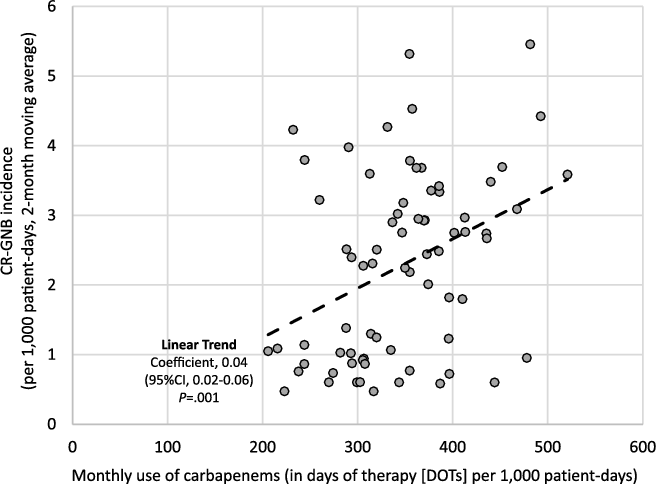
The results of linear regression analysis of the correlation of monthly carbapenem use and incidence of CR-GNB among patients not using carbapenem are presented in Figure 1. Briefly, we detected a positive correlation with a coefficient of 0.04 (95% confidence interval [CI], 0.02–0.04; P = .001).
Results of ecological analysis. Linear regression showing correlation of total monthly use of carbapenems and the incidence of carbapenem-resistant gram-negative bacilli in patients not using carbapenems from two intensive care units in Brazil.
Note. The dashed line corresponds to the linear trend of correlation.

Cohort study
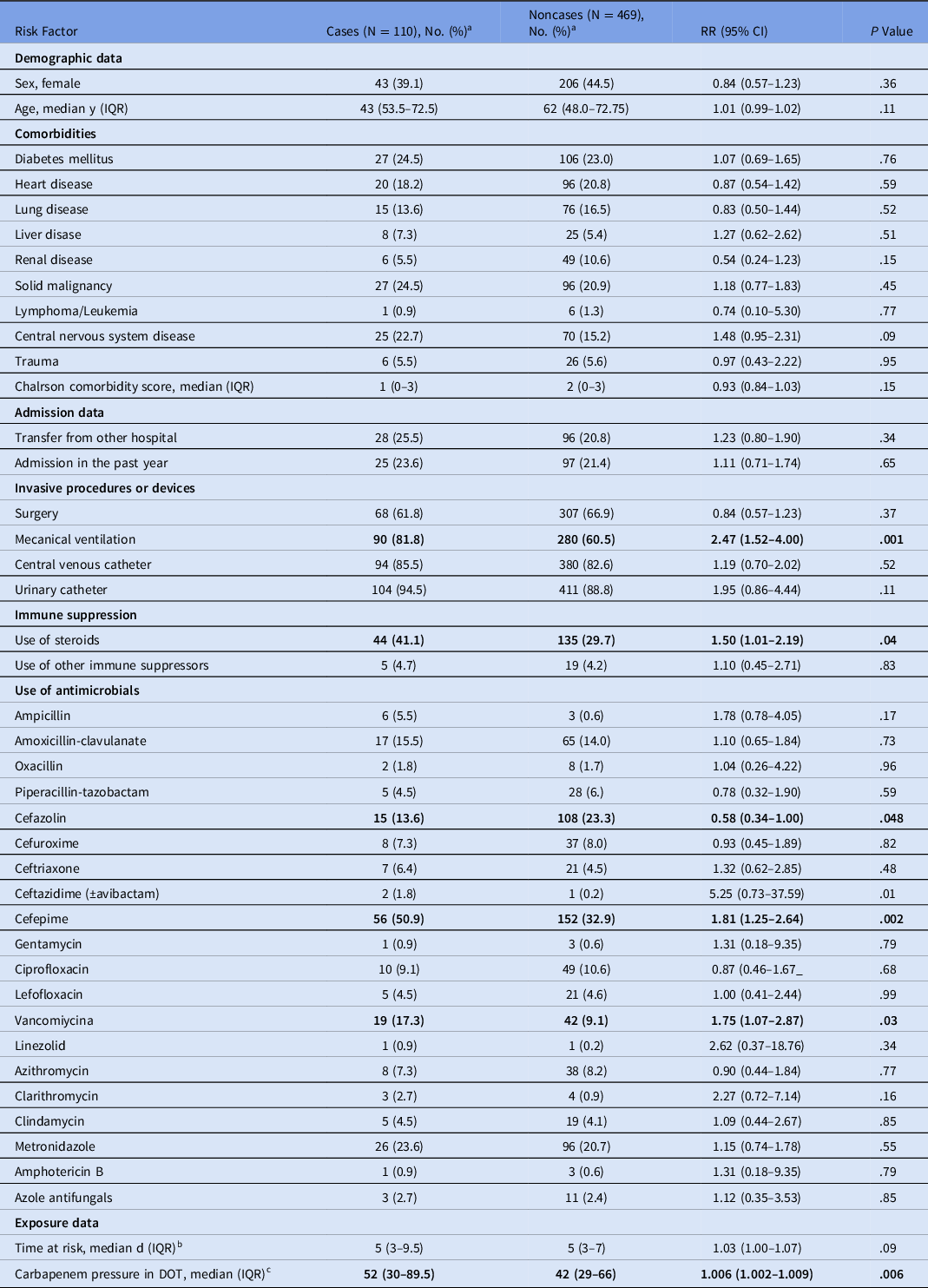
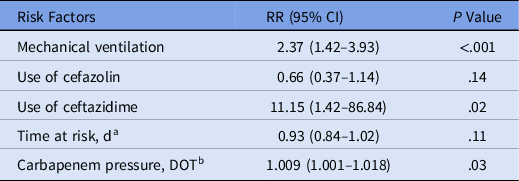
The univariate analysis of risk factors for acquisition of CR-GNB is presented in Table 1, and Table 2 lists the results of the final multivariable model. Notably, the “carbapenem pressure” was associated with the outcome both in the univariate Poisson regression models (relative risk [RR], 1.006; 95% CI, 1.002–1.009; P = .006) and multivariable (RR, 1.009; 95% CI, 1.001–1.018; P = .03) Poisson regression models. Other significant risk factors in the final adjusted analysis were mechanical ventilation (RR, 2.37; 95% CI, 1.42–3.93; P < .001) and the previous use of ceftazidime (RR, 11.15; 95% CI, 1.42–86.84; P = .02).
Univariate Analysis (Poisson Regression Models) of Risk Factors for Acquisition Carbapenem-Resistant Gram-Negative Bacilli in Patients Not Using Carbapenems From 2 Adult Medical Surgical ICUs in Brazil

Note. ICU, intensive care unit; RR, relative risk; CI, confidence interval; IQR, interquartile range. Bold indicates statistical significance.
a Number in parenthesis indicates proportion (%) except when specified otherwise.
b “Time at risk” was counted from the day of admission through the discharge or the collection of blood cultures positive for carbapenem-resistant gram-negative bacilli.
c “Carbapenem pressure” refers to the sum of days of therapy (DOT) of carbapenems of other patients admitted to the ICUs during time at risk for each study subject.
Final Poisson Regression Multivariable Model of Risk Factors for Acquisition of Carbapenem-Resistant Gram-Negative Bacilli in Patients Not Using Carbapenems From 2 Adult Medical Surgical ICUs in Brazil

Note. ICU, intensive care unit; RR, relative risk; CI, confidence interval; DOT, days of therapy.
a “Time at risk” was counted from the day of admission through the discharge or the collection of blood cultures positive for carbapenem-resistant gram-negative bacilli.
b “Carbapenem pressure” refers to the sum of days of therapy (DOT) of carbapenems of other patients admitted to the ICUs during time at risk for each study subject.
Discussion
The term “herd effect” is often applied to imply protection of nonimmune persons against a specific disease when most others in the population are immune (hence the usual term, “herd immunity”), either because of natural infection Reference Ribeiro, Hamer, Diallo, Kitron, Ko and Weaver9 or of mass vaccination. Reference Lahariya10,Reference Fine, Eames and Heymann11 This topic has been a central issue in COVID-19 epidemiology debates worldwide. Reference Redwan12,Reference Tkachenko, Maslov, Elbanna, Wong, Weiner and Goldenfeld13 Less frequently, herd protection has been addressed in other interventions, such as improvements in sanitation and hygiene. Reference Fuller and Eisenberg14 Presently, there is scarce (if any) evidence on herd effect in infection control or antimicrobial resistance studies, except for “one health” approaches of antimicrobial resistance in agriculture. Reference Call, Davis and Sawant15 As stated by Lipsich and Samore, Reference Lipsitch and Samore6 the “herd effect” of antimicrobial use refers to increasing risk of acquisition of resistant organisms by persons exposed to mass use of antibiotics. Those indirect effects may be relevant in preventing the emergence and spread of multidrug-resistant organisms.
We focused on that gap in the epidemiological approaches to antimicrobial resistance within healthcare settings. We were specifically interested in the indirect impact of antimicrobial use on the incidence of CR-GNB, which are hyperendemic in ICUs in Brazil. Reference Labarca, Salles, Seas and Guzmán-Blanco16,Reference Sampaio and Gales17 As expected, Reference Braga, Campos, Batistão, Gontijo Filho and Ribas18 we found not only a massive use of carbapenems but also a relevant incidence of CR-GNB, even among patients to whom carbapenems were not prescribed.
Our findings provide evidence of association of overall use of carbapenem in ICUs on the incidence of CR-GNB infections among patients not using those antimicrobials. Antimicrobial use seems to have an important indirect effect on carbapenem resistance, both from collective and individual perspectives. This finding is in line with current recommendations in epidemiological studies, which stress the relevance of ecologic studies supplemented with individual-level information. Reference Morgenstern19,Reference Wakefield20 This relevant methodological aspect is best suited to analyze effects of exposures that are essentially collective.
The theoretical construct of indirect impacts on acquisition of antimicrobial resistance has been previously addressed regarding colonization pressure, described as a quantitative approach to the exposure to patients harboring multidrug-resistant organisms. Reference Ajao, Harris and Roghmann21 Indeed, previous studies have demonstrated the effect of colonization pressure on the spread of CR-GNB. Reference Castelo Branco Fortaleza, Moreira de Freitas and da Paz Lauterbach22,Reference DalBen, Basso and Garcia23 However, the current approach points to causality as a continuum of factors linking the exposures to the outcomes. Reference Causality24 In a cause-directed acyclic graph, the colonization pressure may be an intermediary intersection between antimicrobial use and the acquisition of an antimicrobial-resistant organism by patients not exposed to the antibiotic of interest. Reference Pearl25 This is the appropriate theoretical construct if we are to propose interventions based on antimicrobial prescription to prevent antimicrobial resistance. Those interventions should aim at the collective, focusing not only on antimicrobial formularies, but also at environmental determinants (eg, inanimate reservoirs, Reference Morgan, Rogawski and Thom26 prior room occupants, Reference Ajao, Johnson and Harris27 and even weather Reference Fortaleza, Caldeira and Moreira28 ). Nonetheless, our results agree with previous studies pointing to the ecologic relevance of antimicrobial stewardship. Reference Tacconelli1,Reference Davey, Marwick and Scott5,Reference Álvarez-Marín, López-Cerero and Guerrero-Sánchez29
Our study had several limitations, mostly due to the observational, retrospective, and the partially ecologic approaches. Reference Harris, Karchmer, Carmeli and Samore2,Reference Wakefield20 We did not directly address interventions on antimicrobial prescription formularies. Also, we did not analyze the impact of colonization pressure or environmental reservoirs. Finally, both the correlation coefficient in the ecological study and the incidence rate ratio in the cohort present modest (though statistically significant) effect. However, in an ICU with a monthly average 346 DOT of carbapenem use, decreasing a single DOT reduces the risk of CR-GNB acquisition among those not using carbapenems by ∼1%. Therefore, interventions aimed at reducing that use are likely to have a beneficial impact on that population (and on those for whom the carbapenem prescription would be prevented). Our study had several strengths as well. We performed an extensive chart review which allowed us to test the effect of “carbapenem pressure” adjusting for patients’ severity, time at risk, and use of other antimicrobials. Also, the simultaneous ecologic and individual-based approaches allowed us to infer causality from a population perspective. Reference Lipsitch and Samore6
In conclusion, total use of carbapenems in the ICU was independently associated with acquisition of CR-GNB by patients who did not use carbapenems. Although further studies (with mathematical models, quasi-experimental approaches or including other environmental confounding factors) are required to validate our findings, we found relevant evidence for a population (“herd-effect”-like) impact of antimicrobial use in the ICUs.
Acknowledgments
This study was part of the PhD thesis of the first author (JSO), with CMCBF as her advisor.
Financial support
N.C.F.M.S. received a student grant from Brazil’s National Council of Scientific and Technological Development (CNPq).
Conflicts of interest
All authors report no conflicts of interest relevant to this article.