Introduction
Telehealth has great promise to improve and even revolutionize emergency response and recovery. By enabling a virtual response to disaster events, telehealth can augment surge capacity while minimizing the logistical and safety issues associated with deploying health care professionals to an affected area.Reference Uscher-Pines, Fischer and Chari 1 Direct-to-consumer (DTC) telehealth services, which only have become widespread in the past two years, may be particularly advantageous in disaster situations given that they provide patients direct and immediate access to health care providers. Direct-to-consumer telehealth services allow patients to request virtual visits with health care providers that they do not have an established relationship with, in real-time, via phone or video conferencing (online video or mobile phone applications).
Despite its potential, telehealth has been underutilized in preparedness and response due to a range of documented barriers.Reference Ajami and Lamoochi 2 A 2014 systematic review found that only 19 articles published from 1980-2013 documented the use of telehealth in actual public health emergencies, although more than 17,000 emergencies occurred during that time period. 3 Federal policy has recognized the unrealized potential of telehealth. For example, the 2015-2018 US Department of Health and Human Services’ (Washington, DC USA) National Health Security Strategy (NHSS) seeks to explore the use of existing telehealth programs to increase surge, improve access to emergency care, and enhance national health security across all phases of disaster.Reference Latifi and Tilley 4
Recent emergency responses that have incorporated telehealth typically have used a provider-to-provider model (where local providers obtain consults from remote subspecialists). 3 There has been no published literature on the use of DTC telehealth in disasters, although two examples of a DTC company donating visits to support local responses to weather emergencies were identified. 5 , 6 Furthermore, little is known about the different roles DTC can play in disaster response and recovery. This report argues that much more can be done to leverage this unique resource; it describes the importance of DTC for disaster response, highlights several potential uses of DTC telehealth across multiple disaster phases (eg, response and recovery), and offers recommendations to spur innovation in this area.
Report
Direct-to-consumer telehealth services generally are provided by private companies and increasingly, by entrepreneurial health systems. Private companies, such as Teladoc (Dallas, Texas USA), American Well (Boston, Massachusetts USA), and Doctor on Demand (San Francisco, California USA), recruit and train physicians to provide consults around the clock in almost all US states. The DTC telehealth industry, which to date has focused on diagnosing and treating routine, minor illnesses, is growing rapidly with more than one million virtual visits provided in 2014. 7 , Reference Uscher-Pines, Mulcahy, Hunter, Burns and Mehrotra 8 This growth has been fueled by patient demand for convenience and expanded access to videoconferencing services on personal devices.
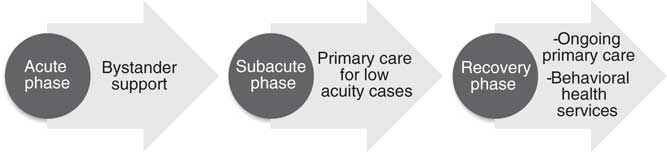
The underuse of DTC for disaster response represents a missed opportunity because these particular services do not face some of the barriers and limitations that have posed problems for other, traditional telehealth offerings in the past. For example, because providers can be accessed through a variety of modalities, DTC services are likely to function, at least in part, when telecommunications infrastructure is impaired. The technology to support DTC is also simple and ubiquitous. In addition, because very large, national (rather than local or regional) networks are already in operation, existing services can be mobilized rapidly to respond anywhere in the US. Direct-to-consumer services are positioned to operate without suspending regular licensing procedures, as is required when out-of-state physicians provide care in a disaster. This is the case because an emergency response can draw upon in-state physicians that work for DTC companies but are physically located outside of the impacted community. Several DTC companies maintain panels of thousands of physicians across a range of specialties who could be tapped for disaster response. Many of these physicians may become willing volunteers upon hearing of a public health emergency affecting their own state or other regions, eager to have a low-risk, low-burden way to serve. Once physicians are mobilized, there is a role for DTC in every phase of a disaster (Figure 1).
Potential Contribution of Direct-to-Consumer Telehealth in Different Disaster Phases.

Bystander Response: Acute Response Phase
Experts have noted that telehealth may not be appropriate in the acute response phase, as it may “get in the way” of the critical work of first responders.Reference Dougherty 9 , Reference Cicero, Walsh and Solad 10 However, DTC could have a role in supporting bystander response, such as directing life-saving actions by untrained members of the general public (eg, cardiopulmonary resuscitation [CPR]). Inspired in part by the heroic actions of bystanders in the Boston Marathon bombing (2013; Boston, Massachusetts USA), the White House National Security Council (Washington, DC USA) is launching an educational campaign to instruct civilians on how to control bleeding and encourage them to be active bystanders in minor and major emergencies.Reference Balch 11 Videoconferencing-enabled mobile phones can be sophisticated tools for dispatcher-assisted resuscitation, enabling dispatchers to see patients and their surroundings and thus act on more information. More importantly, however, videoconferencing with a trained responder can improve the confidence of lay bystanders, thus increasing the likelihood that they will act and do so appropriately. 12 , Reference Bolle, Hasvold and Henriksen 13 Despite the fact that video-based communication with bystanders may improve the quality of prehospital patient care and the majority of emergency calls come from mobile phones, 911 call centers across the US cannot support videoconferencing. 12 In fact, only select markets in the US have the ability to receive text messages.Reference Rolston and Meltzer 14 Unfortunately, DTC services are not yet well-suited to support bystander response. Many services require that customers have an existing account to initiate a visit and have short wait times of several minutes to see a provider. With some minor structural changes, DTC could be a powerful tool to encourage and support actions by the general public in a public health emergency.
Primary Care: Subacute Response Phase
The most obvious role for DTC services is in the subacute response phase in which primary care could be provided directly to patients. In this phase, DTC services could be used to treat patients with minor illnesses and those who require medication refills, thus ensuring that emergency departments (EDs) with limited capacity can focus on the highest acuity patients. Direct-to-consumer services will not only help displaced populations that have lost access to their medical home, but also can help victims who remain in a disaster area and must navigate a compromised or overburdened health care system. Direct-to-consumer services could be offered to victims located in shelters and within communities experiencing high ED volumes as a way to reduce surge.
Behavioral Health Services: Recovery Phase
In the long-term recovery phase (months to years), local health resources and infrastructure may remain compromised, depending on the scale of the disaster. Also, the disaster itself may result in increased demand for certain health care services (eg, treatment for post-traumatic stress disorder). Direct-to-consumer services are beginning to expand into behavioral health, with several companies offering therapy for a range of conditions. These services could be used by victims for months following an event to augment the local health care workforce and ensure that unique disaster-related needs are addressed.
Conclusion
This report has provided a few examples of how DTC may be used to support disaster response and recovery; but to fully exploit this resource, it is imperative to assess when, and in what circumstances, DTC telehealth is most appropriate. This can be achieved through evaluating DTC in full-scale exercises as well as in actual events. Furthermore, if value is proven, it is critical to delineate the role of the government vs the private sector in the delivery of these services and encourage public-private partnerships where relevant. For example, should the federal government (eg, as part of the National Disaster Medical System) develop its own DTC capability, or should it contract with a private company to provide such services? Also, there are critical questions regarding financing (eg, whether physicians should provide charity care or be paid as temporary government employees), liability for providers and bystanders, and licensing and credentialing, depending on the model of choice. Although a great deal of work must be done before DTC telehealth is integrated seamlessly into disaster response and recovery, it has many qualities that make it an ideal tool to enhance national health security. Direct-to-consumer telehealth should be leveraged to make care more convenient and accessible in routine times and to save lives in disasters.