Introduction
Invasive exotic species threaten native biodiversity worldwide and cause significant economic losses in agriculture, forestry and other industries (Vitousek et al., Reference Vitousek, D'Antonio, Loope and Westbrooks1996). Genetic diversity of a newly invasive species is affected by a variety of factors including invasion origin, invasive history and passive human-aided dispersal (Ramstad et al., Reference Ramstad, Woody, Sage and Allendorf2004; Dlugosch & Parker, Reference Dlugosch and Parker2008; Watts et al., Reference Watts, Keat and Thompson2010; Inoue et al., Reference Inoue, Sunamura, Suhr, Ito, Tatsuki and Goka2013). Generally, genetic diversity of an established invasive species is lower in the newly invaded region compared with its native distribution areas (Grapputo et al., Reference Grapputo, Boman, Lindstrom, Lyytinen and Mappes2005; Ficetola et al., Reference Ficetola, Bonin and Miaud2008; Zheng et al., Reference Zheng, Peng, Liu, Pan, Dorn and Chen2013). However, several studies have found that the genetic diversity of invasive species was not reduced due to invasion from multiple sources, or to new colonization of a given area from a large initial introduction (Johnson & Starks, Reference Johnson and Starks2004; Cognato et al., Reference Cognato, Sun, Anducho-Reyes and Owen2005; Wan et al., Reference Wan, Nardi, Zhang and Liu2011; Inoue et al., Reference Inoue, Sunamura, Suhr, Ito, Tatsuki and Goka2013).
The codling moth, Cydia pomonella (L.) (Lepidoptera: Tortricidae), is a key fruit pest in temperate areas worldwide (Shel'Deshova, Reference Shel'Deshova1967; Barnes, Reference Barnes, van der Geest and Evenhuis1991). It infests pome fruits (apple and pear), stone fruits (apricot, plum, peach, nectarine and cherry) and quince, as well as walnut (Barnes, Reference Barnes, van der Geest and Evenhuis1991). Larvae of the codling moth attack various fruits or nuts and can damage a high percentage of the crops if not managed, leading to substantial economic losses (Barnes, Reference Barnes, van der Geest and Evenhuis1991). Due to its broad host range, relatively ample climate tolerance, and developed resistance to varied types of insecticides, the codling moth has achieved a nearly global distribution and is considered to be one of the most successful and the most important pest insects in the world (Bues et al., Reference Bues, Toubon and Poitout1995; Reyes et al., Reference Reyes, Franck, Olivares, Margaritopoulos, Knight and Sauphanor2009; Chen & Dorn, Reference Chen and Dorn2010).
In China, C. pomonella is a serious new invasive species that is mainly distributed in two provinces in the northwest (Xinjiang and Gansu Provinces) and one province in the northeast of the country (Heilongjiang Province). The first reported sightings of the codling moth in China were in 1957 in Korla in the Xinjiang Province, in the northwestern region of the country (Zhang, Reference Zhang1957). It then took about 30 years for the pest to cross the mountains, deserts and unpopulated areas and reach Dunhuang of the Hexi Corridor in Gansu Province, spreading along the string of oases of this corridor to the adjacent sparsely distributed fruit-growing regions of Inner Mongolia and Ningxia Provinces. In 2006, C. pomonella was first reported in MudanJiang, Heilongjiang Province in Northeastern China (Qin et al., Reference Qin, Ma, Zhang, Li and Wang2006). Heilongjiang is about 3000 and 5000 km away from Gansu and Xinjiang, respectively. In China, 90% of the apple trees are planted in seven provinces located between Heilongjiang and Xinjiang Provinces, yet Gansu Province is the only major apple-growing province in which C. pomonella is found. In spite of the considerable distance from Heilongjiang to Xinjiang and Gansu, no occurrence of this pest has been recorded in the large area in between, despite continuous monitoring with pheromone traps in apple, plum, pear, walnut and other fruit orchards, as well as along the highways (Zhang et al., Reference Zhang, Wang, Zhang, Chen, Luo, Wang, Liu, Ainiwaer, Pu, Yan, Guo, Liu, Chen, Zhang, Yang, Xu, Cui and Xu2012).
Despite the economic and ecological threats of the codling moth in the northwestern and northeastern parts of China, the genetic diversity and the origin of the pest in these separate areas of China is still obscure. Populations with different invasion origin may vary in genetic diversity and genetic structure. This is an important aspect to be considered in C. pomonella management. For example, the sterile moths released in area-wide integrated pest management with sterile insect technique (SIT) should have good mating compatibility with females from different origins (Taret et al., Reference Taret, Sevilla, Wornoayporn, Islam, Ahmad, Caceres and Vreysen2010; Vreysen et al., Reference Vreysen, Carpenter and Marec2010). Populations with similar genetic structure should be considered as the same management unit for effective control (Ayres et al., Reference Ayres, Pettigrove and Hoffmann2010). Furthermore, populations with different invasion origin may differ in response to the pheromone used in the mating disruption technique, and may differ in response to the isolates of Cydia pomonella granulosis viruses (CpGV) used to control the pest (Gan et al., Reference Gan, Li, Yu, Wu, Xu, Zhang and Wang2011). A previous microsatellite analysis by our group (Men et al., Reference Men, Chen, Zhang and Feng2013) observed sequential loss of genetic diversity in C. pomonella populations from northwestern China, and found that populations from Northwestern and Northeastern China had a different genetic structure. However, additional research was needed to detail the extent of genetic diversity and the invasion sources of the codling moth populations in China as well as their spread through China. Mitochondrial gene haplotypes were shown to be effective for direct comparison of genetic diversity and invasion sources of an invasive species distributing in different invaded regions (Avise, Reference Avise2000; Roderick & Navajas, Reference Roderick and Navajas2003; Roderick, Reference Roderick, Ehler, Sforza and Mateille2004; Triapitsyn et al., Reference Triapitsyn, Logarzo, De León and Virla2008; De León et al., Reference De León, Sétamou, Gastaminza, Buenahora, Cáceres, Yamamoto, Bouvet and Logarzo2011). In this study, we used three mitochondrial genes to analyze a total of 14 C. pomonella populations collected throughout the main distribution regions in Northwestern and Northeastern China, and samples from nine other countries on different continents were used for comparison. Our objective was to compare the genetic diversity and characterize the origin of populations of this new invasive species from the northwest and northeast of China and to provide basic population genetic knowledge for controlling this pest in the country.
Materials and methods
Insect sampling
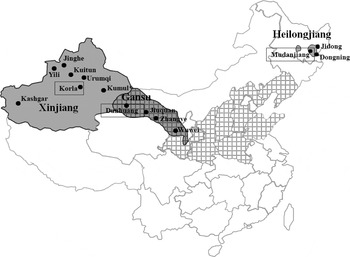
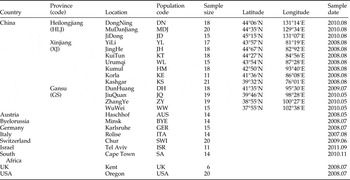
Samples of codling moth were collected from apple orchards in all the three main C. pomonella distribution areas (Xinjiang and Gansu Provinces in the northwest, and Heilongjiang Province in the northeast) of China from 2008 to 2010 (table 1, fig. 1), as done by Men et al. (Reference Men, Chen, Zhang and Feng2013) and Li et al. (Reference Li, Wang, Zheng, Men, Qian, An, Feng, Zhang and Chen2013). In Xinjiang Province, one infested fruit was collected from each fruit tree per orchard and one larva per fruit was used, the distance between sampled fruit trees was at least 5 m, only one 2nd to 3rd instar larvae per tree was used to minimize sibling collection. In the newly invaded Gansu and Heilongjiang Provinces, samples of adults were collected on 5 days each time, with six pheromone traps exposed for 24 h in each orchard (>5 ha) every day, adding up to a total of 30 traps which were hanged on different trees. The distance between each of the six traps was at least 100 m, and only one moth per trap was used for further analysis to minimize collecting sibling samples. Samples collected with the aforementioned methods were used in previous genetic diversity analysis of the C. pomonella populations (Li et al., Reference Li, Wang, Zheng, Men, Qian, An, Feng, Zhang and Chen2013; Men et al., Reference Men, Chen, Zhang and Feng2013). For comparison, C. pomonella samples collected in nine other countries were included in the analysis. Most samples from these countries were obtained from field pheromone trap captures, except the samples from laboratory colonies that originated from Oregon in the USA and Tel Aviv in Israel (table 2). We use the term ‘population’ for C. pomonella specimens sampled from one and the same orchard (sampling unit). All the samples of 14 populations from China and nine populations from other countries were preserved in 10 ml Falcon tubes filled with ethanol and stored at −20°C prior to analyses.
Sampling regions of Cydia pomonella in Xinjiang, Gansu and Heilongjiang Provinces of China. The main distribution areas of Cydia pomonella are indicated in dark gray color, the major apple-growing areas of China are indicated with a grid square, and the overlapping regions of major apple-growing areas and C. pomonella distribution areas are indicated with a grid square in dark gray color. The name of the first reported site of C. pomonella in each of the three provinces is indicated in box.

Sampling information of Cydia pomonella populations from China and other countries.

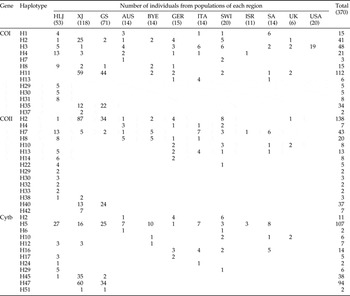
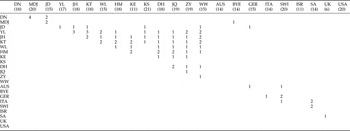
Distribution of Cydia pomonella mitochondrial haplotypes shared by different populations.

The region and population codes are explained in Table 1, number in brackets indicates sample size of each region.
DNA extraction
Genomic DNA was extracted from 8 to 10 mg of insect material using the genomic DNA kit (QIAGEN Company, Basel, Switzerland) according to the manufacturer's instructions. The extracted DNA was eluted in TE buffer and stored at −20°C.
PCR amplification and sequencing of mitochondrial genes
Three mitochondrial genes were used in the analysis. The mitochondrial cytochrome oxidase subunit I (COI) gene was amplified with the primer pairs C1-J-1751 (5′-GGATCACCTGATATAGCATTCCC-3′) and C1-N-2191 (5′-CCCGGTAAAATTAAAATATAAACTTC-3′) (Simon et al., Reference Simon, Prati, Beckenbach, Crespi, Liu and Flook1994), the complete mitochondrial COII region was amplified with primer pairs TL2-J-3037 (5′-ATGGCAGATTATATGTAATGG-3′) and TK-N-3785 (5′-GTTTAAGAGACCAGTACTTG-3′) (Simon et al., Reference Simon, Prati, Beckenbach, Crespi, Liu and Flook1994), while the mitochondrial cytochrome b (Cytb) gene was amplified by forward primer 5′-TATGTTTTACCATGAGGTCAAATATC-3′ and reverse primer 5′-TATTTCTTTCTTAAGTTTTCAAAAC-3′.
All PCR reactions were carried out in a total volume of 50 μl, containing 60 ng template DNA, 0.4 μM each primer, 100 μM each dNTP, 4 mM Mg2+, 10 × PCR reaction buffer with 500 mM KCl and 100 mM Tris–HCl (PH 8.3 at 20°C), distilled water and 2 unit of Taq DNA polymerase (5 U μl-1, Sangon Biotech Co., Ltd., Shanghai, China). PCR reactions were performed on a Bio-Rad S1000TM Thermal Cycler (Bio-Rad Laboratories, Hercules, CA, USA) and consisted of an initial denaturation step at 94°C for 2 min, followed by 35 cycles of 94°C for 30 s, with annealing temperatures of 48°C (COI), 57°C (COII) or 52°C (Cytb) for 1 min and 72°C for 1 min, with a final 10 min extension at 72°C. PCR products were visualized on 1.0% agarose gels under UV light and were directly sequenced with forward PCR primers. All the sequences were read on an ABI 3730 automated DNA sequencer (Applied Biosystems, Foster city, CA, USA).
Data analysis
The obtained mitochondrial gene sequences were aligned by CLUSTALX version 2.0 (Thompson et al., Reference Thompson, Higgins and Gibsont1994). All population genetic parameters including number of haplotypes (N
h
), nucleotide diversity (π) and haplotype diversity (H
d
) were calculated using ARLEQUIN version 3.5 (Excoffier et al., Reference Excoffier, Laval and Schneider2005). The haplotype diversity was based on the formula H
d
= (1 − Σxi
2) n/(n − 1), where xi is the frequency of a haplotype and n is the sample size (Nei, Reference Nei1987). The nucleotide diversity (π) was calculated by
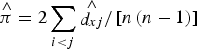 $\mathop \pi \limits^ \wedge = 2\sum\limits_{i \lt j} {\mathop {\mathop d\nolimits_{xj}} \limits^ \wedge } /\left[ {n\left( {n - 1} \right)} \right]$
where
 $\mathop {\mathop d\limits^ \wedge } \nolimits_{xj} $
is an estimate of the number of nucleotide substitutions per site between gene sequences i and j (d
xj
) and n is the number of gene sequences examined (Tajima, Reference Tajima1983; Nei, Reference Nei1987). A two-tailed t test at the significance level 0.05 was used to test whether the differences of haplotype diversity (H
d
), nucleotide diversity (π), proportion of individuals with different haplotypes, proportion of individuals with private haplotypes and proportion of private haplotypes were significant between populations from the three provinces of China and other countries.
Analysis of molecular variance (AMOVA) was performed using the ARLEQUIN version 3.5 software based on the combination of the three gene sequences (Excoffier et al., Reference Excoffier, Laval and Schneider2005) according to the following three models. (A) ‘comparison of variance among populations from the two northwestern provinces of China’. In this model, 11 C. pomonella populations from the two neighboring provinces in Northwestern China were separated into two groups according to province: (1) Gansu (DH, JQ, ZY and WW); (2) Xinjiang (YL, JH, KT, WL, HM, KE and KS). (B) ‘comparison of variance among populations from Northwestern and Northeastern China’. In this model, all the 14 C. pomonella populations from China were divided into two groups according to the separate distribution areas: (1) Northwestern China (DH, JQ, ZY, WW, YL, JH, KT, WL, HM, KE and KS); (2) Northeastern China (DN, MDJ and JD). (C) ‘comparison of variance among populations from Northwestern China (Gansu, Xinjiang), Northeastern China (Heilongjiang) and European countries (Austria, Byelorussia, Germany, Italy, Switzerland and UK)’. In this model, the 20 C. pomonella populations were divided into three groups: (1) Northwestern China (DH, JQ, ZY, WW, YL, JH, KT, WL, HM, KE and KS); (2) Northeastern China (DN, MDJ and JD); (3) European countries (AUS, BYE, GER, ITA, SWI and UK)’. The program NETWORK 4.6.1 to construct the Median-joining networks of mitochondrial DNA (mtDNA) haplotypes based on statistical parsimony (Bandelt et al., Reference Bandelt, Forster and Röhl1999).
Results
Sequence variation
We obtained the COI (435 bp), COII (682 bp) and Cytb (710 bp) sequences from all the 370 individuals analyzed. No insertions or deletions were observed in either of the three gene regions. The COI gene contained 27 variable sites, 18 of which were parsimony informative. The COII gene covered 43 variable sites, 31 of which were parsimony informative sites, while 29 of the 52 polymorphic sites in Cytb gene were parsimony informative. Populations from China contained a total of 20 variable sites in the COI sequences, 27 variable sites in the COII sequences and 29 variable sites in the Cytb sequences, while C. pomonella populations from other countries exhibited 19 variable sites in the COI sequences, 33 variable sites in the COII sequences and 42 variable sites in the Cytb sequences.
Mitochondrial gene haplotypes
We observed 42 haplotypes for the COI gene (GenBank accession numbers are KJ789183 to KJ789224), 43 haplotypes for the COII gene (GenBank accession numbers are KJ789279 to KJ789321) and 53 haplotypes for Cytb gene (GenBank accession numbers are KJ789225 to KJ789278).
Four COI gene haplotypes (H2, H3, H4 and H8) were shared by samples from Northeastern China, Northwestern China and other countries. One COI haplotype (H1) was shared by populations from Northeastern China, Europe and South Africa. One COI haplotype (H11) was shared by populations from Northwestern China, Europe and South Africa. Three COI haplotypes (H29, H30 and H31) were shared by populations from Northeastern China. One COI haplotype (H35) was shared by Populations from Northwestern China. For the populations from northwestern China, Gansu populations share one COI haplotype (H37), whereas no COI haplotype was only found in Xinjiang populations. Two COI haplotypes (H7 and H13) were shared by populations from other countries, but were not found in Chinese populations (table 2). The variable sites of haplotype H1 were included in haplotype AF497838 (GenBank accession number) obtained in European populations, while the variable sites of H2 were included in AF497841, of H3 in haplotype AF497836, of H4 in haplotype AF497842, of H13 in haplotype AF497837, of H16 in haplotype AF497844 and of H28 in haplotype AF497839 (Meraner et al., Reference Meraner, Brandstätter, Thaler, Aray, Unterlechner, Niederstätterc, Parsonc, Zelgerd, Dalla Viad and Dallingera2008).
Two C. pomonella COII gene haplotypes (H2 and H7) were shared by samples from Northeastern China, Northwestern China and other countries. Four COII haplotypes (H8, H13, H14 and H22) were shared by populations of Northeastern China and other countries. Seven COII haplotypes were only reported in Chinese populations, of which two (H40 and H42) were only found in populations from Northwestern China, four (H29, H30, H32 and H33) were only found in northeastern Chinese populations, one (H38) was shared by northeastern and northwestern Chinese populations. Two COII haplotypes (H4 and H10) were only obtained in populations from other countries (table 2).
Two C. pomonella Cytb gene haplotypes (H5 and H12) were shared by populations from Northeastern China, Northwestern China and other countries. Three Cytb gene haplotypes (H17, H24 and H29) were found in northeastern Chinese and European populations. Four Cytb gene haplotypes (H2, H6, H10 and H16) were only found in populations from other countries. Three Cytb gene haplotypes (H45, H47 and H51) were only found in Chinese populations, of which two Cytb gene haplotypes (H47 and H51) were only reported in northwestern Chinese populations (table 2).
A total of 121 haplotypes were obtained with the combination of COI, COII and Cytb genes. Four haplotypes (H2, H3, H4 and H9) of the combined gene were shared among populations from northeastern China, six haplotypes (H23, H28, H29, H34 H40 and H49) were shared among populations from Northwestern China, four haplotypes were shared among populations from different European countries (H54, H79, H83 and H97) (table 3 and fig. 2). One combined gene haplotype (H23) was shared by populations from Northeastern and Northwestern China, two haplotypes (H7 and H22) were shared by populations from Northeastern China and European countries, whereas no haplotype was shared by populations from Northwestern China and other countries. Samples from South Africa shared three haplotypes (H93, H97 and H99) with samples from Europe (table 3 and fig. 2).
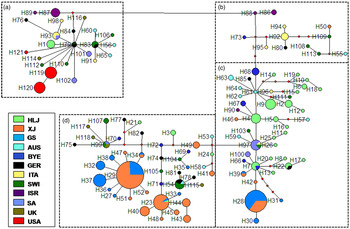
Median-Joining network based on the combination of C. pomonella COI, COII and Cytb mtDNA haplotypes. Each circle represents a haplotype, and the area of a circle is proportional to the number of observed individuals. Colors within the nodes refer to the C. pomonella sampling regions. A, B, C and D indicate the four clades obtained.

Number of haplotypes of the combined COI, COII and Cytb gene shared between populations.

The region and population codes are explained in Table 1, number in brackets indicates sample size of each region.
Genetic diversity
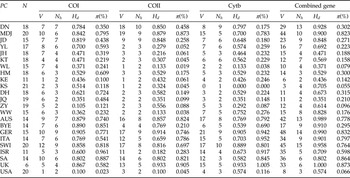
The average number of COI haplotypes over the three populations from Northeastern China was 6.7, ranging from 6 to 7, while it was 3.3 over the 11 northwestern populations, ranging from 2 to 6. For COII, the mean number of haplotypes over the three northeastern Chinese populations was 9.3, ranging from 9 to 10, whereas it was 2.5 over all the 11 northwestern populations, ranging from 2 to 3. The mean number of haplotypes for Cytb over the three northeastern Chinese populations was 6.7, ranging from 5 to 9, whereas it was 3.3 for all the 11 northwestern populations, ranging from 2 to 6 (table 4). For the combined gene of COI, COII and Cytb, the average number of haplotypes for the three northeastern Chinese populations was 10.67, and for the 11 northwestern Chinese populations 4.45 (table 4). Among the 11 populations from Northwestern China, the population from Yili region, which was the first site where the codling moth was found in China, showed the highest number of haplotypes (six for COI, three for COII and six for Cytb) for the three genes (table 4). The seven field populations from the other countries also showed high numbers of gene haplotypes, with an average number of 6.7, ranging from 4 to 9 for COI, an average number of 6.4, ranging from 4 to 9 for COII, an average number of 6.4, ranging from 3 to 10 for Cytb, an average number of 10.29, and ranging from 6 to 15 for the combination of COI, COII and Cytb genes (table 4). Compared with the field populations from other countries, the two laboratory populations from Israel and the USA showed lower numbers of haplotypes for each of the three genes (table 4).
Measurement of genetic variation of 23 Cydia pomonella populations as revealed by three mitochondrial genes.

Combined gene, the combination of COI, COII and Cytb gene sequences; N, sample size of each population; PC, population code; V, polymorphic sites of all the sequences of a gene obtained in samples of each population; N h, number of haplotypes; H d , haplotype diversity; and π, nucleotide diversity.
The haplotype diversity (H d ) ranged from 0.105 to 0.905 for COI, from 0.133 to 0.933 for COII and from 0.000 to 0.933 for Cytb (table 4). Similarly, compared with the northwestern Chinese populations, the three northeastern Chinese populations had higher haplotype diversity for the three genes. The average haplotype diversity for COI over the three northeastern Chinese populations was 0.815, and that over the 11 northwestern Chinese C. pomonella populations was 0.448. The mean COII haplotype diversity over the three northeastern Chinese populations was 0.859, and which over the 11 northwestern Chinese C. pomonella populations was 0.349. For the Cytb haplotype diversity, the average value of haplotype diversity was 0.715 for the three northeastern Chinese populations, and 0.419 for the 11 northwestern Chinese C. pomonella populations. For the combined gene of COI, COII and Cytb genes, the average number of haplotype diversity for the three northeastern Chinese populations was 0.892, and for the 11 northwestern Chinese populations 0.567. The average haplotype diversity of the seven field populations from other countries showed the mean value of 0.853, 0.821, 0.760 and 0.936 for the COI, COII, Cytb and the combination of the three genes, respectively. However, the two laboratory populations from Israel and the USA showed lower average haplotype (table 4).
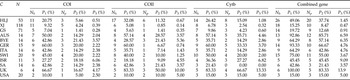
Using a two-tailed t test at the significance level 0.05, we tested whether the differences of number of haplotypes (N h ), haplotype diversity (H d ), nucleotide diversity (π), proportion of individuals with different haplotypes, proportion of individuals with private haplotypes and proportion of private haplotypes were significant between populations from the three provinces of China and the filed populations from other countries (table 5). The results showed that the mean number of haplotypes obtained in populations of Heilongjiang Province in Northeastern China was significantly higher than the respective mean number of haplotypes found in populations from the two northwestern Chinese Provinces, Gansu Province (t = 2.06, df = 26, P < 0.001) and Xinjiang Province (t = 2.02, df = 38, P < 0.001). Heilongjiang Province showed similar number of haplotypes to the field populations of the other countries (t = 2.02, df = 38, P = 0.720). Results of the two-tailed t test at the significance level 0.05 indicated that the northeastern Chinese populations showed significant higher number of haplotype diversity (H d ) (t = 2.00, df = 54, P < 0.001), nucleotide diversity (π) (t = 2.00, df = 54, P < 0.001), proportion of individuals with different haplotypes (t = 2.23, df = 10, P = 0.001), proportion of individuals with private haplotypes (t = 2.23, df = 10, P = 0.031) and proportion of private haplotypes (t = 2.23, df = 10, P = 0.024) than the northwestern populations.
Number and proportion of haplotypes obtained from Cydia pomonella populations.

Combined gene, the combination of COI, COII and Cytb gene sequences; N, number of C. pomonella individuals; N h , number of haplotypes; P 1 = N h /N, proportion of individuals with different haplotypes; N p , number of private haplotypes; P 2 = N p /N, proportion of individuals with private haplotypes; P 3 = N p /N h /N, proportion of private haplotypes.
Haplotype network of the combined mtDNA
The Median-Joining network of the haplotypes can be divided into four major clades (Clade A, B, C and D) (fig. 2). It is interesting that all the haplotypes in Clade A were obtained from samples of the other countries except that one (H1) was found in samples from northeastern China, while all the haplotypes in Clade B were from Central Europe except that one (H50) was in a sample from northwestern China. Most haplotypes from Northeastern China were included in Clade C, whereas most haplotypes from Northwestern China were deposited in Clade D.
Analysis of molecular variance
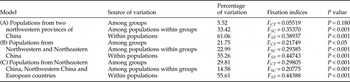
The AMOVA results based on the combination of the three gene sequences showed that there was no significant genetic variance among populations from the two northwestern provinces (Xinjiang and Gansu Provinces). However, significant genetic variances were found among populations from Northeastern and Northwestern China, with around 21.75% of the overall molecular variation explained by the two separate distribution areas of C. pomonella. Furthermore, in the model with populations grouped according to Northeastern China, Northwestern China and European countries, the genetic variance was significant (table 6).
AMOVA based on the combination of COI, COII and Cytb genes to compare the genetic variation among C. pomonella populations using three models.

Discussion
Using three mitochondrial genes, we investigated the genetic diversity of 242 C. pomonella individuals sampled throughout the main distribution areas in China, and 128 samples from nine other countries. Both the populations from Northeastern and Northwestern China shared most of the common haplotypes of the three genes with populations from Europe and other continents. Populations from Northeastern and Northwestern China showed a different population genetic structure, implying different invasion source of C. pomonella in the separate northeastern and northwestern distribution regions.
The geographic origin of the codling moth is presumably Europe, from where it subsequently spread throughout the world along with the culturing of apple and pear (Shel'Deshova, Reference Shel'Deshova1967; Boivin et al., Reference Boivin, Bouvier, Beslay and Sauphanor2004; Franck et al., Reference Franck, Reyes, Olivares and Sauphanor2007; Meraner et al., Reference Meraner, Brandstätter, Thaler, Aray, Unterlechner, Niederstätterc, Parsonc, Zelgerd, Dalla Viad and Dallingera2008; Thaler et al., Reference Thaler, Brandstätter, Meraner, Chabicovski, Parson, Zelger, Dalla Via and Dallinger2008). The first report of this species in China was in Xinjiang Province in 1957 (Zhang, Reference Zhang1957), but its origin was unclear. In the present study, we found that Chinese codling moth populations shared most of the common haplotypes of COI (H1, H2, H3, H4, H8 and H11), COII (H2, H7 and H8) and Cytb (H5) genes with populations from Europe and other continents. Interestingly, the variable sites of seven COI haplotypes in our study were exactly the same as the overlapping regions of the respective seven COI haplotypes obtained in European populations (Meraner et al., Reference Meraner, Brandstätter, Thaler, Aray, Unterlechner, Niederstätterc, Parsonc, Zelgerd, Dalla Viad and Dallingera2008). Together with the shared haplotypes of the three genes between the Chinese and European populations in our analysis, the same variable sites of the COI haplotypes in our Chinese population and in the previously reported European populations indicate that C. pomonella populations in China have the same ancestor as European populations.
We found that the haplotypes of the three mitochondrial genes have a different distribution in Northeastern and Northwestern China. Considering the haplotypes found in Chinese populations, a total of 14 haplotypes (three COI haplotypes, eight COII haplotypes and three Cytb haplotypes) were shared by populations from northeastern, but were not found in northwestern populations. However, seven haplotypes (three COI haplotypes, two COII haplotypes and two Cytb haplotypes) were shared among northwestern populations, but were not obtained in northeastern populations. Moreover, a large number of the individuals from northwestern populations represented the same few haplotypes shared in this region (71 of the 118 individuals from Xinjiang and 66 of the 71 individuals from Gansu had COI H11 and H35 haplotypes, 100 individuals from Xinjiang and 58 individuals from Gansu had COII H2 and H40 haplotypes, and 95 individuals from Xinjiang and 36 individuals from Gansu had Cytb H45 and H47 haplotypes). On the other hand, our results demonstrated that C. pomonella populations from Northeastern China showed significantly higher numbers of haplotypes (N h ), haplotype diversities (H d ), nucleotide diversities (π), proportions of individuals with different haplotypes, proportions of individuals with private haplotypes and proportions of private haplotypes than populations from Northwestern China.
The distance between the northeastern and northwestern distribution regions of C. pomonella in China is 3000–5000 km. Although apple, pear, plum, walnut and other host plants of C. pomonella are widely growing in the area considered to be the potential distribution area of the pest (Wan et al., Reference Wan, Guo and Zhang2009; Zhang et al., Reference Zhang, Wang, Zhang, Chen, Luo, Wang, Liu, Ainiwaer, Pu, Yan, Guo, Liu, Chen, Zhang, Yang, Xu, Cui and Xu2012), so far, we did not find the species in spite of intensive monitoring in different fruit orchards (apple, pear, plum, walnut, etc.) and along the highways. The weak flight capacity, geographical barriers and strictly enforced quarantine measures are considered the major factors responsible for having slowed down the expansion of C. pomonella from the northeastern and northwestern distribution region to the areas in-between (Wan et al., Reference Wan, Guo and Zhang2009; Zhang et al., Reference Zhang, Wang, Zhang, Chen, Luo, Wang, Liu, Ainiwaer, Pu, Yan, Guo, Liu, Chen, Zhang, Yang, Xu, Cui and Xu2012). Together with the different distribution pattern of the shared and private haplotypes in the northeastern and northwestern populations, the phenomenon that a large proportion of individuals from Northwestern China shared some haplotypes implied that the northeastern populations had a different invasion source than the northwestern populations. There is an important land port (Dongning Port) in the C. pomonella distribution regions in Northeastern China. This land port is near the far eastern region of Russia, where the codling moth has been documented (Willett et al., Reference Willett, Neven and Miller2009). The frequent trade between Dongning and the Russian far eastern region may aid the codling moth to invade to the neighboring apple-growing region of Northeastern China. However, both our previous microsatellite analysis and the current mitochondrial analysis show that C. pomonella populations in Xinjiang and Gansu Provinces have a similar population genetic background (Men et al., Reference Men, Chen, Zhang and Feng2013), but which differs from that in Heilongjiang Province. We expect that C. pomonella populations in the northwestern region of China came from Central Asia and spread from the Xinjiang to the Gansu Province (Men et al., Reference Men, Chen, Zhang and Feng2013). Different geographical populations of another serious invasive species, the wooly apple aphid Eriosoma lanigerum, which is damaging apple in different regions of China, showed the same invasion resource based on microsatellite data (Wu, Reference Wu2009).
As in the previous microsatellite analysis (Men et al., Reference Men, Chen, Zhang and Feng2013), we found that the genetic diversity of populations from Northeastern China was similar to that of the native European C. pomonella populations. This can be explained by the more recent invasion history in the northeastern region. Populations in the northeastern regions were first found in 2006 around 9 years ago, whereas the northwestern populations were reported in 1957 around 60 years ago. The new invasive populations could retain fairly high levels of genetic diversity that still reflect that of the source population compared with older populations (Wan et al., Reference Wan, Nardi, Zhang and Liu2011; Inoue et al., Reference Inoue, Sunamura, Suhr, Ito, Tatsuki and Goka2013). With time populations of an invasive species often lose their genetic diversity under selection or drift with range expansion and colonization of new areas (Ramachandran et al., Reference Ramachandran, Deshpande, Roseman, Rosenberg, Feldman and Cavalli–Sforza2005; Herborg et al., Reference Herborg, Mandrak, Cudmore and Macisacc2007; Dlugosch & Parker, Reference Dlugosch and Parker2008).
The codling moth has caused severe damage to apple and pear in the Chinese areas it invaded (Qin et al., Reference Qin, Ma, Zhang, Li and Wang2006; Wan et al., Reference Wan, Guo and Zhang2009). In China, control of the codling moth relied on the use of broad spectrum insecticides, including organophosphate, carbamates and pyrethroids (Bahatiguli, 2009; Zhao, Reference Zhao2011), which are known to select for resistance to several insecticide groups (Knight et al., Reference Knight, Brunner and Alston1994; Sauphanor et al., Reference Sauphanor, Bouvier and Brosse1998; Dunley & Welter, Reference Dunley and Welter2000; Fuentes-Contreras et al., Reference Fuentes-Contreras, Espinoza, Lavandero and Ramírez2008; Reyes et al., Reference Reyes, Franck, Olivares, Margaritopoulos, Knight and Sauphanor2009). In addition, the frequent reliance and use of these insecticides are a constant threat to the environment and to human health. As food safety is becoming a major concern for consumers, the use of environment friendly tactics such as the SIT, mating disruption and the granulovirus will be increasingly required for the integrated pest management of C. pomonella (Bloem & Carpenter, Reference Bloem and Carpenter2001; Krafsur, Reference Krafsur, Dyck, Hendrichs and Robinson2005; Vreysen et al., Reference Vreysen, Carpenter and Marec2010). In this study, we found that the population genetic background of C. pomonella populations in the Northeastern and Northwestern China varies due to different invasion sources. This should be considered before applying new control tactics such as SIT (Bloem et al., Reference Bloem, Mccluskey, Fugger, Arthur, Wood, Carpenter, Vreysen, Robinson and Hendrichs2007; Vreysen et al., Reference Vreysen, Carpenter and Marec2010; Taret et al., Reference Taret, Sevilla, Wornoayporn, Islam, Ahmad, Caceres and Vreysen2010).
Acknowledgements
The authors thank Dr Kathrin Tschudi-Rein and two anonymous reviewers for helpful comments on the manuscript, and Dr Ally Harari, Dr Matthew Addison, Dr Marc Vreysen and other colleagues for providing insect samples. This work was supported by grants of the National Natural Science Foundation of China (grant numbers 31071687, 31272036 and 31471766), The Coordinated Research Project (CRP) (grant no. 16341) of the International Atomic Energy Agency and the National Key Technology R&D Program (grant no. 2012BAK11B03) from the Ministry of Science and Technology of China.