


Introduction
Depression and anxiety are common mental health problems and leading sources of disability, affecting up to one in six of the population (LSE, 2006; Cassano and Fava, Reference Cassano and Fava2002). CBT is often the treatment option preferred by patients presenting with depression and anxiety but there are insufficient resources to deliver it in a timely fashion to all who might benefit from it (Roth and Fonagy, Reference Roth and Fonagy2004; Appleby, Reference Appleby2004) Alternatives to face-to-face (FtF) therapy have been developed that have the potential to address some of the current demand for treatment (Proudfoot et al., Reference Proudfoot, Ryden, Everitt, Shapiro, Goldberg, Mann, Tylee, Marks and Gray2004; see Marks, Cavanagh and Gega, Reference Marks, Cavanagh and Gega2007 for a review of computer-aided psychotherapy). The National Institute for Health and Clinical Excellence (NICE) has recognized the potential of computerized CBT (cCBT) to treat large numbers of patients, both in terms of completion rates and treatment outcomes, and has recommended that cCBT be used as part of the stepped care approach to the treatment of depression (NICE, 2006). In addition, The Improving Access to Psychological Therapies (IAPT) programme also recommends the use of cCBT as part of their overall treatment strategy (IAPT, 2007).
In the development of products and services, the strongest evidence for the effectiveness of cCBT has been gathered under conditions where patients have attended a clinic for treatment; potentially incurring costs, inconvenience and stigma as a result (Kaltenthaler, Parry, Beverley and Ferriter, Reference Kaltenthaler, Parry, Beverley and Ferriter2008). Indeed, all the evidence considered in the NICE technology appraisal Number 51 is from use in the clinic setting. Yet there is considerable evidence that people can adequately help and even cure themselves if given the right guidance and materials with which to do so, even though the active therapeutic factors in effective self-help are not yet well identified (see Gould and Clum, Reference Gould and Clum1993, for an early meta analysis; Bower, Richards and Lovell, Reference Bower, Richards and Lovell2001; Gellatly et al., Reference Gellatly, Bower, Hennessy, Richards, Gilbody and Lovell2007). To further complicate matters, there is a lack of clarity over how much additional human help might be optimal in any self-help or guided self-help treatment option (Gellatly et al., Reference Gellatly, Bower, Hennessy, Richards, Gilbody and Lovell2007). Therefore, a key challenge in the development of clinically effective self-help interventions is the need to minimize clinic resources and professional time, and to more fully explore the space between full face-to-face psychological treatments and completely independent home based self-help options.
The sole NICE recommended cCBT product for the treatment of depression in the NHS is Beating the Blues (BtB). In both randomized controlled trials and in-service evaluation, all utilizing placement in clinic settings BtB has shown itself to be clinically useful. Proudfoot et al. (Reference Proudfoot, Ryden, Everitt, Shapiro, Goldberg, Mann, Tylee, Marks and Gray2004) report a randomized controlled trial (RCT) in which patients were offered BtB plus treatment as usual (TAU) and then compared to a TAU only group. The BtB plus TAU group improved between 2–7 points on the Beck Depression Inventory II (BDI-II) over the TAU only group, although the BtB group showed no improvement in anxiety as measured by the Beck Anxiety Inventory (BAI). In addition, in routine NHS clinical services patients using BtB also showed significant improvement as measured by the 34-item CORE-OM (Cavanagh et al., Reference Cavanagh, Shapiro, Van Den Berg, Swain, Barkham and Proudfoot2006). Similarly, Learmonth, Trosh, Rai, Sewel and Cavanagh (Reference Learmonth, Trosh, Rai, Sewell and Cavanagh2008) reported improvement in both primary and secondary care patients after using BtB as part of a specialist CBT service. This body of research clearly illustrates the viability of a computerized CBT approach. However, one of the remaining challenges in the development of treatments with mass appeal is to move from clinic based cCBT to entirely home based, independent user programs. Blues Begone® is intended as a move in this direction.
Blues Begone® (BBG) is a cCBT program that is designed to be used without any additional human support. It offers 30 episodes of cCBT that can be used for between 15–40 hours depending upon the level of engagement of the user. BBG assesses each individual using the 56-item Purves Depression Questionnaire (PDQ) and then compiles itself into a personalized “Roadmap to Recovery” that is intended to closely reflect the patient's clinical requirements as indentified by the PDQ. This roadmap is further modified, over subsequent sessions, as additional user information is gathered to become more focused on the patient's problems as well as to reflect their progress. The Roadmap to Recovery typically contains up to 304 items. BBG provides 90,000 words of textual information delivered in various forms including web pages, PowerPoint presentations, small information chunks, spoken text, instructions for activities, daily hints and religion specific tips if the user requests it (for Christian, Hindu, Muslim and Jewish religions). BBG offers up to 22 CBT activities such as, thought record, down arrow technique and training on faulty thinking. Many tasks have been modified from paper formats to be more functional and can be easily completed without additional help. Homework assignments are created and monitored by BBG with summarizing and feedback following the scheduled completion. There are 120 talking heads that offer instruction, feedback, encouragement and greetings. There are 20 extensive conversations between animated characters delivering psycho-education and a substantial clinical case illustration that runs over six episodes, extended throughout the program, totalling approximately 60 minutes. BBG has made extensive use of cartoons and dynamic illustration. There are 30 stand alone cartoons and animations that illustrate the key points of each daily agenda. In addition, there are 365 smaller cartoons that are embedded in web pages and other presentations. Very few items are ever repeated in order to maintain a sense of novelty.
A user is recommended to use BBG on most days at roughly the same time of day. Each day their current mood and tension levels are assessed, they are asked about sleep quality, medication use, exercise and activity levels, BBG learns about the user, talks to them using personalized computer generated voices, both with and without talking heads incorporating context aware messages and feedback (Purves and Purves, Reference Purves and Purves2005). Following the completion of each episode the user has the option of moving onto the next episode or repeating the current episode, giving the user complete control over their self-help experience. All users complete the program when they have worked through the 30 episodes. Experience suggests that users take, on average, 8 weeks to work through the whole BBG program, although a user can of course stop at any time without completing the program.
This study reports the first open trial of BBG in the UK National Health Service with primary and secondary care patients. It was hypothesized that BBG would demonstrate a statistically significant change on the primary measures of depression and anxiety. The interaction of symptom severity on these primary outcomes was also investigated. The data were compared to those published on face-to-face CBT and cCBT.
Method
All procedures were approved in advance by The Oxford REC B Ethics Committee no: 06/Q1605/93. The study was conducted in a mixed rural/urban area in the South East of England. Patients were referred directly by their General Practitioner (GP), or other primary or secondary care health professional to the Blues Begone® “Active Self-help Clinic”. All patients were sent an appointment letter and invited to attend an assessment meeting lasting approximately 30 minutes. The purpose of the assessment meeting was to determine suitability and to complete the study questionnaires. On completion of treatment, patients returned to complete a final set of follow-up questionnaires. Patients' GPs were kept informed of their inclusion and progress in the study by letter. Patients continued with any drug treatments they may have been receiving prior to participating in the study. If accepted into the trial, patients were given a CD set of BBG to install on their home computer. Blues Begone® allows users to progress at their own speed through their own program. Therefore, the time taken to work through BBG varies with the individual user. However, an average time for completion is 8 weeks. Consequentially, the researcher scheduled users to return to complete the follow-up questionnaires after 8 weeks. If the time to completion differed from 8 weeks, the researcher accommodated the user and provided an alternative final assessment appointment. Data on the number of hours spent using BBG could not be collected as these data remained on the user's computer in a confidential database. However, user comments suggest that BBG cannot easily be completed in less than 15 hours. Furthermore, each user is free to repeat material as often as required.
Participants
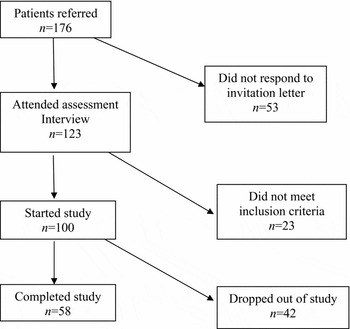
Referrals (n = 176) were received between February 2007 and March 2008. N = 53 patients (30%) did not respond to the invitation letter, n = 123 attended and completed the assessment questionnaires, n = 23 were excluded based upon clinical history obtained at interview, or failed to meet the inclusion criteria. Patients who started the study (n = 100), and therefore yielded at least one data set, were given the BBG program to take home and install on their computer. There were 38 males and 62 females included, aged between 18 and 65 (mean age 36 SD 14); 57% of the included patients were on prescribed medication. In the early stages of the project, patients were invited back to the clinic to complete a second set of questionnaires midway through the program. A total of 49 patients returned for this mid-term interview. Due to staffing problems part way through this study the mid-term interview was suspended. See Figure 1 for an illustration of patient recruitment and attrition.
Patient numbers and attrition

Study exclusion criteria
• Aged less than 18 or more than 65 years
• Dependent on alcohol or drugs
• Psychotic
• Learning disability
• Actively suicidal
• Currently receiving face-to-face counselling or therapy
• Poor command of written English or spoken English
• BDI-II score < 11
• No access to a home computer running Windows XP(tm) or Windows Vista(tm) operating system.
Measures
Demographic information was collected at screening, together with current life problems and medication use. Outcome measures used were the Beck Depression Inventory-II (BDI-II; Beck, Steer and Brown, Reference Beck, Steer and Brown1996); The Beck Anxiety Inventory (BAI; Beck, Epstein, Brown and Steer, Reference Beck, Epstein, Brown and Steer1988); and the Clinical Outcomes in Routine Evaluation Outcome Measure (CORE-OM; Barkham et al., Reference Barkham, Margison, Leach, Lucock, Mellor-Clark, Evans, Benson, Connell, Audin and McGrath2001). BDI-II scores were coded as < 14 minimal range, 14–19 mild depression, 20–28 moderate depression, and 29–63 severe depression. BAI scores were coded as < 10 normal range, 10–19 mild to moderate anxiety, 19–29 moderate anxiety, and 30–63 severe anxiety.
Analysis
Independent sample t-tests were conducted on the total sample of 100 patients and paired sample t-tests of statistical significance on the 58 patients who completed BBG. ANOVA was conducted on clinical severity data to explore the interaction of symptom severity on clinical outcomes. Uncontrolled effect sizes were calculated using the method: meanstart – meanend/SDstart (Shapiro et al., Reference Shapiro, Barkham, Rees, Hardy, Reynolds and Startup1994; Barkham, Gilbert, Connell, Marshall and Twigg, Reference Barkham, Gilbert, Connell, Marshall and Twigg2005).
Reliable change was assessed using methods established by Jacobson and Truax (Reference Jacobson and Truax1991). To place the current data into context, the reliable and clinically significant change benchmarks defined by Westbrook and Kirk (Reference Westbrook and Kirk2005) and followed by Cavanagh et al. (Reference Cavanagh, Shapiro, Van Den Berg, Swain, Barkham and Proudfoot2006) and Learmonth et al. (Reference Learmonth, Trosh, Rai, Sewell and Cavanagh2008) were also used. These authors established that reliable change could be considered to have occurred if a change on the BDI-II or BAI had occurred between 9–11 points (averaged to 10 points overall). In addition, clinically significant change had occurred if the patient's score was taken from that indicative of a clinical population to below the normative population cut-off, defined in the literature as a BDI-II score of < 14.
Intention to treat (ITT) analysis using the last observation carried forward method (Shao and Zhong, Reference Shao and Zhong2003) is a way of correcting for the potential of clinical trials to overestimate treatment effects. Because of the limited number of data points in this home-based intervention study, ITT presents as a very conservative analysis. Of the 100 patients in the study, 58 yielded both beginning and end data and only 7 yielded mid-point but not end-point data. Therefore the ITT analysis required the scores of the 35 participants who only attended the initial interview to have their entry scores carried forward. While there is no means of knowing if these 35 patients actually used BBG or benefited from it (patients may drop out of trials because they have recovered and see no benefit from going on, as well as because of lack of efficacy, difficulty using the product or other reasons), the assumption in this ITT analysis is that they did use BBG and obtained no benefit at all from it.
Results
All 100 assessed patients yielded study entry scores. The mean BDI-II score was 28.1 (range 11–51). The BAI entry mean was 20.0 (range 4–51) and the CORE-OM entry mean was 1.97 (range 0.5–3.39). It was of interest, in the first instance, to determine if the entry level of depression or anxiety was different in patients who completed the program to those who did not. A between subjects t-test was performed on BDI-II and BAI screening data. There were no significant differences, in the assessment data, between the groups who completed or did not complete BBG. A further analysis was performed to determine the effect, if any, of the mid-point interview upon retention in the study and to see if those who dropped out exhibited differential assessment scores for depression or anxiety over those who completed. Out of the 100 included patients 39 patients attended a mid-point interview and also completed BBG; 19 completed BBG but did not attend a mid-point interview; 7 attended the mid-point interview but not the final interview; and 35 were assessed but did not attend either mid-point or final interview. An ANOVA, using assessment scores, with mid-interview attendance as a factor was performed. There was no main effect observed as no group differed significantly from any other.
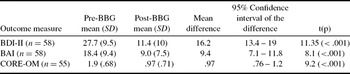
To test for statistically significant differences between pre- and post BBG use scores, paired-sample t-tests were conducted. Table 1 presents the means and 95% confidence intervals for patients completing BBG and yielding a final data set. The primary measure of depression used was the BDI-II. Participants had significantly lower BDI-II scores at the end of BBG use, t (57) = 11.4. p <.001, SD = 10.8, pre-post effect size = 1.69, 95 % CI 13.4 – 19.0. There was also a significant reduction in BAI scores t (57) = 8.0. p < .001, SD = 9.0. ES = 1.0. 95% CI 7.1 – 11.8.and a significant reduction in total CORE-OM scores at study end t (55) = 9.2. p < .001, SD = .79, ES = 1.4, CI .76 – 1.2.
Completers' means and 95% confidence interval for pre and post BBG for the BDI-II BAI and CORE-OM

Using established clinical cut-off points for the BDI-II it was possible to partition the patient data into three groups, which enabled an analysis of the effect of initial depression severity on patient treatment outcome. The three groups were defined as follows: the mild depression group defined in this study as 14–19 (BDI-II mean 16.00); the moderate depression group 20–28 (BDI-II mean 23.5); and the severe depression group 29–63 (BDI-II mean 37). These groups were added to an ANOVA with the dependant variables being BDI-II and BAI at the beginning and end of treatment. There was a main effect of severity of depression. All of the depression categories differed significantly from each other at the beginning (F(2,94) = 163.28. p < .001), but after completion of BBG there was no significant difference between the depression categories (F (2,55) = 2.08. p > .1). Outcomes for the three groups dropped to the following means: (mild depression BDI-II final mean 8.5, with mean change 7.5 points; moderate depression BDI-II final mean 9.4, with mean change 14.1 points and the severe depression group BDI-II final mean 14.4 with mean change 22.6 points. All severity categories improved statistically with the more severe categories making the greatest amount of clinical change, thus illustrating that even severe depression may be treatable with BBG. A slightly different pattern was observed with the analysis of the BAI scores. Data were partitioned into four categories representing different levels of anxiety from the commencement of the study; normal anxiety with scores of 0–9; mild to moderate anxiety with scores of 10–18; moderate to severe anxiety with scores of 19–29 and severe anxiety with scores of 30–63. Data from these groups were submitted to a one way ANOVA, There was a significant difference between the four groups at the beginning of the study F(3,99) = 235.7. p < .001), and there remained differences between the groups after BBG use F(3,57) = 7.9. p < .001). Tukey HSD post hoc tests revealed that the normal, mild to moderate, and moderate to severe groups all differed from each other, while the severe group did not differ from any of the other groups. The normal range group started with a BAI mean score of 6.5 and finished with a mean score of 4.0; the mild to moderate group started with a BAI mean score of 14.7 and finished with a mean score of 5.7; the moderate to severe group started with a BAI mean score of 23.7 and finished with a mean score of 13.8 and the severe group started with a mean score of 36.9 and finished with a mean score of 11.0. These data demonstrate that BBG can also effectively treat clinical anxiety.
Reliable and clinically significant change
Of the 58 patients who completed a final set of questionnaires, 42 (72%) achieved a drop in BDI-II scores of ≥ 10 BDI points. In addition, 36 (62%) also made clinically significant change and might be considered to have recovered from depression because they dropped to a BDI-II score of < 14 where previously they scored > 14 at commencement of the study. For anxiety, 26 (45%) patients achieved a BAI reduction of at least 10 points where their score was initially 10 or more BAI points, and 26 (45%) may be considered recovered from anxiety because their BAI score was below 10 at completion whereas it was 11 or above at the start. Using the same reliable and clinically significant change criteria described earlier, no patients experienced reliable or clinically significant deterioration in symptoms of depression or anxiety since in no case did their scores increase by a figure > 10 BDI-II or BAI points.
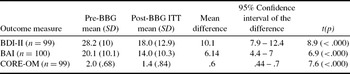
Table 2 shows the means, standard deviation and 95% confidence intervals for the ITT data. The effect sizes were more modest using this form of analysis, BDI, ES 1.0, CI 7.9 – 12.4, BAI, ES 0.6, CI 4.4–7.8, CORE, ES 0.9, CI .44-.75 but reductions in symptom scores on each of the three scales remained significant (p < .001).
Intention to treat analysis showing completers' means and 95% confidence interval for pre and post BBG for the BDI-II BAI and CORE-OM

Discussion
This pilot study demonstrates that Blues Begone®, used as a home-based cCBT treatment package with minimal additional human interaction, may yield worthwhile reductions in clinical measures of depression and anxiety. The sample in this study was drawn from primary and secondary care referrals with limited exclusion criteria. Therefore, while all patients suffered from symptoms of depression as defined by their BDI-II score, many also suffered other co-morbid problems giving rise to a somewhat heterogeneous patient population. The UK estimate of the prevalence of mixed depression and anxiety is 9.8% (NICE, 2004). This study population also suffered high levels of mixed anxiety and depression, with 92% of all patients scoring 10 or above on the BAI. The high levels of depression and anxiety in the general population has prompted government to address this issue by creating more CBT therapists (LSE, 2006; IAPT, 2007). However, this approach, while acknowledging the usefulness of CBT, still relies in large part upon the assumption that many common mental health problems require a course of face-to-face CBT. In the general debate on how to treat large numbers of depressed and anxious people, cCBT is often partitioned alongside guided self-help with the assumption that the patient needs guidance and support in order to benefit from self-help materials. Indeed, in her meta analysis investigation of significant factors in the use of self-help interventions, Gellatly et al. (Reference Gellatly, Bower, Hennessy, Richards, Gilbody and Lovell2007) found that guided interventions yielded superior outcomes to pure self-help (although pure self-help in a research context is not an easily defined concept), suggesting that some human help is needed for better outcomes. Our study endeavoured to restrict patients' contact to monitoring only without any additional input over and above the administration of research questionnaires and necessary telephone contact to arrange appointments. Given the need to collect data, it is difficult to imagine a research setting with no contact at all (postal procedures yielding generally low returns of research data). However, this study illustrated that those patients who received an additional midway meeting did not differ in outcome from those who did not have this midway meeting. This provides further support to the view of Gellatly et al. (Reference Gellatly, Bower, Hennessy, Richards, Gilbody and Lovell2007) that there may not be a simple relationship between quantity of support and clinical outcome. Indeed, that seems intuitively correct; some programs of treatment will require more support and others less so, but the clinical outcomes may be the same. On average, patients given BBG were in the presence of a clinical worker for between 1–1.5 hours in total. Clearly, the last interview could not contribute to the final depression or anxiety scores as measured by the questionnaires, thus the additional value of the face-to-face contact only amounted to between 30–60 minutes of clinical time.
It is of interest to benchmark the data presented here with data from other relevant research. Westbrook and Kirk (Reference Westbrook and Kirk2005) published data on the treatment outcomes of a large CBT service population. These authors were able to provide BDI and BAI data for a heterogeneous population receiving on average 13 sessions of face-to-face CBT. For patients scoring above the normal clinical cut-off at assessment, the BDI entry scores averaged 22.0 with an end score average of 12.4 (mean difference 9.6), with an uncontrolled treatment effect size of 1.15 with 47.9 % reliably improved and 34.5% recovered. The current BBG data (Table 1) compare favourably with those from Westbrook and Kirk (Reference Westbrook and Kirk2005). For patients assessed with the BAI, Westbrook and Kirk (Reference Westbrook and Kirk2005) reported a BAI entry score of 17.0, an end score of 10.6 (mean difference 6.4) and an effect size of 0.54, with 49.5% reliably improved and 31.5% recovered. Again outcomes from BBG (see Table 1) compared favourably with the data from Westbrook and Kirk (Reference Westbrook and Kirk2005).
Cavanagh et al. (Reference Cavanagh, Shapiro, Van Den Berg, Swain, Barkham and Proudfoot2006) reported an open trial of BtB in routine care, where the CORE-OM was used as the primary clinical measure. BtB requires patients to attend a clinic for 8 individual one-hour weekly sessions of cCBT. Paired data were reported for 104 patients (47%) who started the program. CORE-OM scores at intake were 1.88 and at end were 1.27, with a mean difference of 0.61 and a pre-post effect size of 1.0. These data provide a direct comparison between BtB, as used in routine care, and BBG as used in this pilot study. In the current study, patients used BBG at home without either the on-site location resource or the structure of a weekly meeting with any of its attendant benefits. The BBG data compare favourably (see Table 1) to those published by Cavanagh et al. (Reference Cavanagh, Shapiro, Van Den Berg, Swain, Barkham and Proudfoot2006).
Finally, Learmonth et al. (Reference Learmonth, Trosh, Rai, Sewell and Cavanagh2008) have reported work from BtB used in a specialist CBT service that takes referrals from both primary and secondary care. These authors reported BDI-II and BAI for 244 and 252 patients respectively, collected over a 5-year period. At intake, the average BDI-II score was 24.2 and at the end it was 15.8, with a mean change of 8.4 points yielding an effect size of 0.85. For anxiety scores as measured by the BAI the intake score was 20.8 and the end score was 14.9 with a mean difference of 5.9 yielding an effect size of .55. The data shown in this pilot study of BBG (Table 1) compare favourably with those reported by Learmonth et al. (Reference Learmonth, Trosh, Rai, Sewell and Cavanagh2008).
The benchmarking exercise herein offers a comparison between different treatment approaches, and allows further exploration of the space between face-to-face CBT and cCBT, offering only up to 1.5 hrs of professional time during 2 or 3 clinic based appointments. This research suggests that, given appropriate materials, delivered in an appropriate manner, a significant number of patients may be able to largely treat themselves for common mental health problems such as depression and anxiety. Furthermore, BBG seems equally effective, irrespective of the severity of the initial depression presentation. This opens the possibility that the caveat “only for mild to moderate severity”, often placed on the use of cCBT and self-help interventions, may be usefully revised. Future research is aimed at establishing the efficacy of BBG in RCT conditions with larger samples.
Conflicts of interest
Self Help Solutions Inc. the owners of Blues Begone® provided the programs free of charge, Dr David Purves is a co-author of the program and co-owner of Self Help Solutions Inc.
Acknowledgements
The authors with to express their thanks to the volunteers who worked on this project and the patients who used Blues Begone® and allowed their data to be collected for the purposes of research.



Comments
No Comments have been published for this article.