Underground mining is considered one of the most hazardous industrial occupations.Reference Howell, Brown and Atkins 1 - Reference Coleman and Kerkering 3 Worldwide each year, thousands of fatalities occur in coal, hard-rock, and metal mines.Reference Dhillon 4 These incidents deserve attention. In 1898 an underground mining disaster occurred on the Isle of Man; approximately 20 workers died because of smoke inhalation. This is the earliest report found with a scientific approach to a mass casualty incident (MCI) in the mining industry. 5 In 1907, 2 mining disasters were reported, one in the United StatesReference Summers 6 , Reference McGlew 7 and the other in Australia.Reference Kirchgessner 8 In 1909, emergency medical services (EMS) were addressed, suggesting the use of supplementary oxygen by the rescue crew at a coal pit incident.Reference Robertson 9 Moreover, experimental studies were conducted in the mid-20th century regarding the tolerance of rescue personnel to heat and moisture.Reference Lind, Hellon and Weiner 10 , 11 These studies gave rise to modern safety management in the mining sector. A major catalyst for safety-management improvements was the passage of the US Occupational Health and Safety Act, which played a pivotal role in mining safety in North America.Reference Dhillon 4 Despite obvious progress in occupational-health legislation, there appears to be a gap between the understanding of and the need for an acute medical response when mining incidents occur. This gap scaled up to an MCI becomes even more evident, in particular concerning EMS capability. Recently, EMS personnel in Sweden were addressed in a survey regarding underground mining, and the survey confirmed a low preparedness level among the EMS personnel for handling mining incidents. The survey suggested a need for additional education and training.Reference Aléx, Joanson and Lundin 12 Furthermore, the level of EMS infrastructure and preparedness varies substantially among countries. Also, mining conditions show variability in technology and rock characteristics, as well as occupational health legislation and traditions. This variability adds complexity to this review about strategies to handle MCIs occurring in the mining industry.
This integrative literature review explored details from MCIs occurring in the underground mining industry to identify morbidity and mortality and the EMS response to the events and the impact of EMS on victim health outcomes. Details about injury-creating mechanisms were also collected. The information was structured by using the Haddon matrixReference Haddon 13 for comparing human, technical, and environmental factors.
Methods and materials
Literature Search
Scientific reports were systematically selected, according to principles outlined in the guide “Assessing Health Care Interventions.” 14 The guidelines come from the Swedish Agency for Health Technology Assessment and Assessment of Social Services and share essential elements with the PRISMA-P protocol. This approach provided relevance to the aim. Quality aspects were considered 14 and randomized controlled studies were given the highest rank. Nevertheless, randomized studies are not applicable to MCIs occurring in the mining industry as these are primarily descriptive. To gather information relevant to MCIs and EMS, the literature search had to be widened to consider incidental-type studies.
Inclusion and Exclusion Criteria
The primary inclusion encountered a “MCI” occurring in the “underground mining industry” with an incident either primarily described or secondarily interpreted from available data. Unfortunately, reports addressing medical aspects of MCIs were few and consequently the search was widened to include safety aspects and occupational health. This widening of scope did not affect the process, which followed the same formalized routine described in Table 1.
Combination of Terms for the PubMed Search

Reports older than 1980 were excluded. This was justified given modern safety improvements and legislation in occupational health medicine that have introduced important changes. For the same reason, our review was restrained to countries within the European community, the United States, Canada, Australia, and Turkey. Non-English-language reports were excluded.
The literature search was conducted within PubMed (National Library of Medicine, Bethesda, MD). The search was supplemented with a free-text search within PubMed resulting in 4 additional studies; one additional report was found by using the EBSCOHost search engine (EBSCO, Ipswich, MA). The extraction was further supplemented with 2 studies found by using backward searches from lists of references of published reports and one PhD thesis with relevance to the field.
Structure of Event Mechanisms
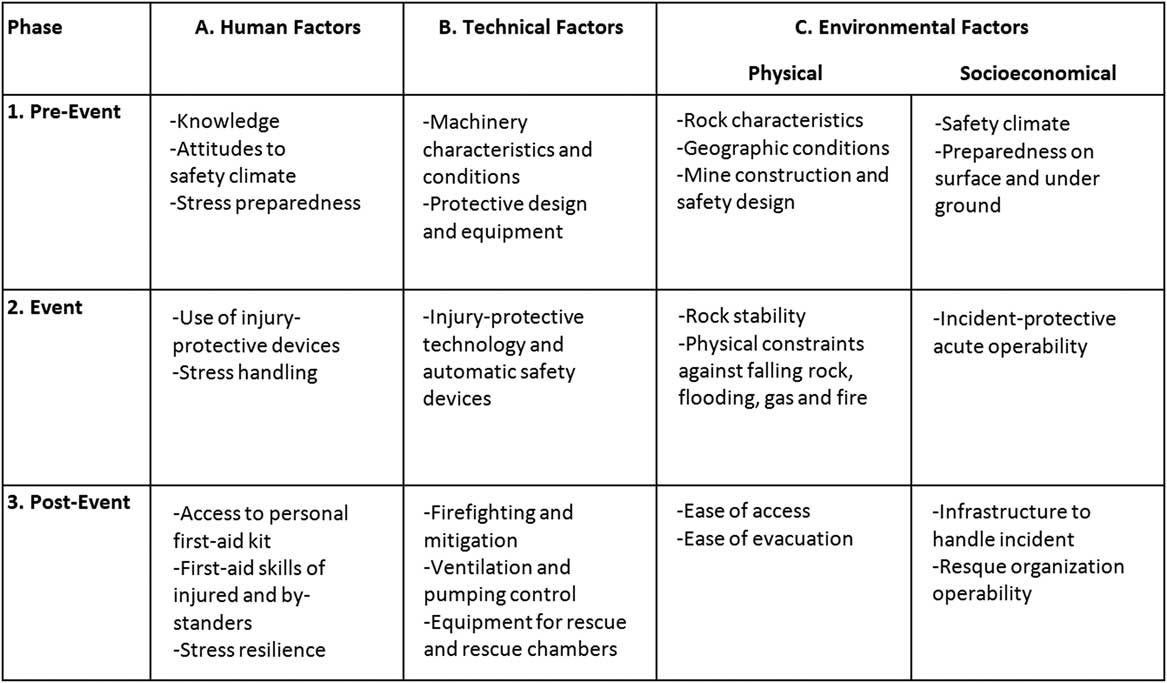
In this study, we applied the Haddon matrixReference Haddon 13 to the complexity of MCIs occurring in the underground mining industry with the ambition to form a structure for review (Figure 1). This matrix provides a structure for describing injury-creating mechanisms and is a well-known and commonly used framework for systematic analyses of various incidents, including car-crash events.Reference Haddon 13 According to the Haddon matrix, the mechanisms are sequentially separated over time versus their contributing factors, ie, human, technical, and environmental. Environmental factors may be further separated into physical and socioeconomic details. The Haddon matrix reveals how a small incident may become amplified and how it can escalate into an MCI if unfavorable factors interact and accumulate over time. Figure 1 shows the matrix and how it was applied to MCIs in the mining industry. For example, prior to an MCI, an individual miner may have a substantial knowledge base regarding safety rules and methods and have a positive attitude toward following these rules. The miner may also be experienced in working underground and have a high stress resistance to hazardous situations. These factors are addressed as A1 conditions. Once an MCI has occurred, EMS and hospital performance are examples of environmental and organizational details in the post-event phase, which are addressed here as C3 conditions.
The Haddon Matrix Applied on Mass Casualty Incidents in the Underground Mining Industry.

Results and Discussion
Screening for Relevance and Quality
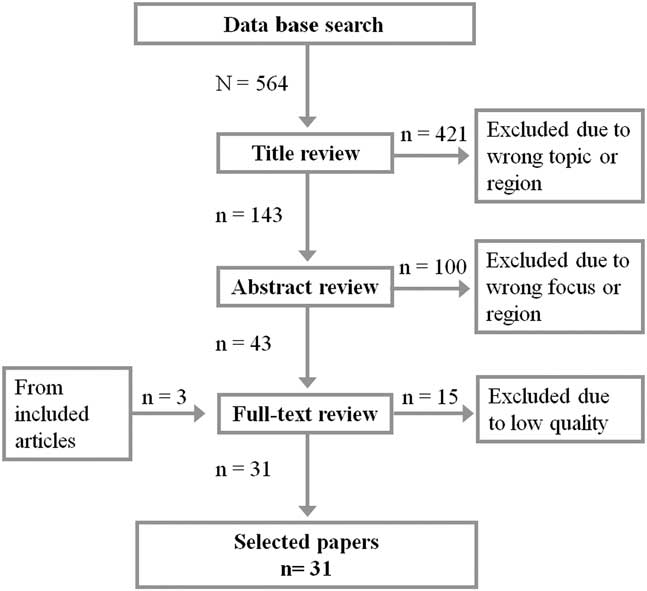
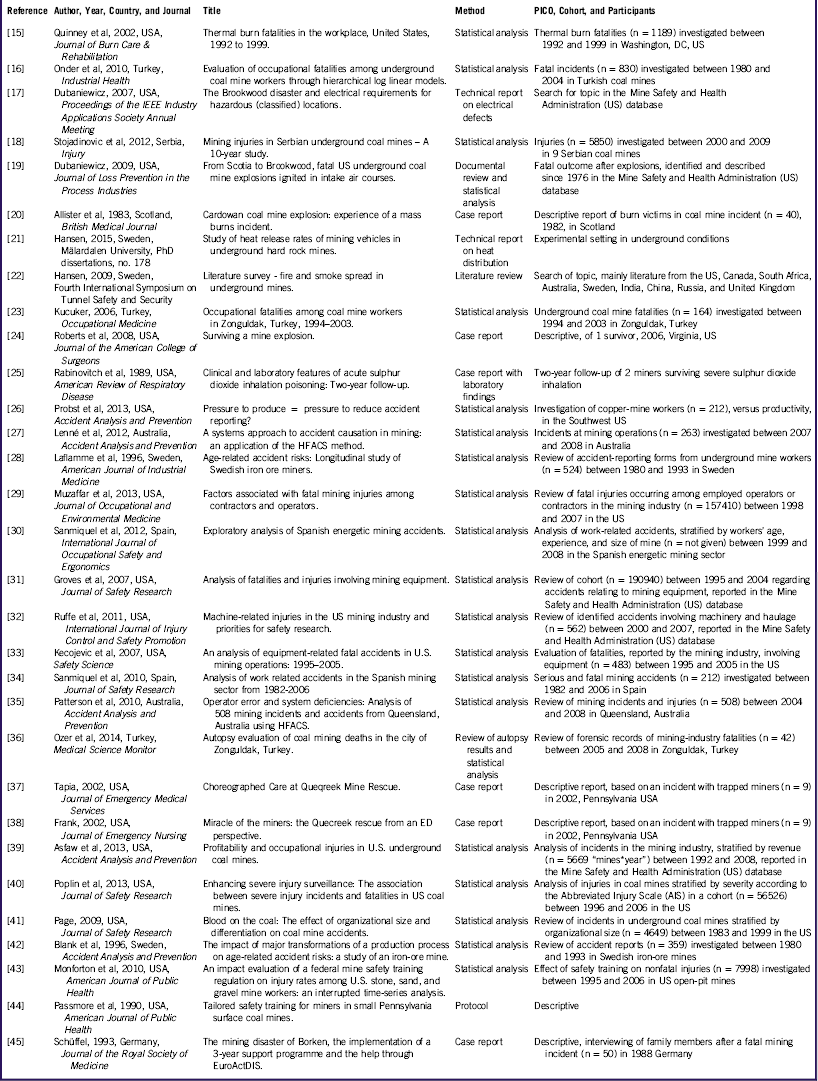
Overall, 564 published studies were identified in the literature search. The number of reports was condensed by using a screening process that evaluated the appropriateness to the aim and grading for scientific quality, respectively. The authors conducted the screening and grading independently and thereafter collectively discussed the findings. Thirty-one reports remained for detailed analysis. The screening array is shown in Figure 2. The list of selected references is shown in Table 2.Reference Quinney, McGwin and Cross 15 - Reference Schüffel 45 The review focused on information relevant to the topic of MCIs occurring in the underground mining industry, EMS, and information interpretable by the Haddon matrix.
Flow Chart of the Literature Search.

Results of the Literature ReviewFootnote a

a PICO, Patient/Problem, Intervention, Comparison, and Outcome.
The Haddon Matrix
The scientific reports were reviewed and structured according to the Haddon matrix.Reference Haddon 13 Rock characteristics will be referred to repeatedly because incidents in the mining industry are often influenced by the type of rock being excavated. In the Haddon matrix, rock characteristics are addressed as a C1 condition. The most obvious difference is seen between soft-rock mining of sedimentary coal versus solid hard-rock mining, typically metal core. The geomechanical characteristics introduce a technical variability exemplified from risks associated with roof scaling, strain, and collapsing rock. Also, the organic nature of coal sediments amplifies risks from gas poisoning, explosion, and fire; these risks are not present in the solid-rock mining industry. This report addressed both soft-rock and hard-rock mining. The rock is an environmental physical characteristic that affects how the mine is constructed; consequently, this environmental factor interacts with technical B1 conditions. Additionally, this environmental and technical interaction may influence the decision to excavate via an open-pit rather than underground.
Injury-Creating Mechanisms Related to Fire and Explosions
A common denominator in many reports was to describe an injury-creating mechanism of which fire, explosion, and toxic gas share the same context and deserve special attention. During 7 years in the 1990s, 47 US miners died from thermal burn injuries in mining incidents.Reference Quinney, McGwin and Cross 15 Many of these incidents occurred in coal mines, again exemplifying a C1 factor of rock characteristics (Figure 1). Explosions in these mines remain a frequent cause of fatalities, having killed hundreds of miners in both EuropeReference Onder and Adiguzel 16 - Reference Stojadinović, Svrkota and Petrovic 18 and the United StatesReference Dubaniewicz 19 over the last 30 years. Methane gas explosion triggered the mass-burn incident in the Cardowan coal mine in Scotland 1982. Approximately 200 people were underground at the time of the explosion, and of these, 40 miners were injured with burns predominating in 36 workers, whereas 6 suffered mechanical injuries from the explosion. The burn injuries were treated conventionally on site, illustrating adequate post-incident managing (A3 factor). Six workers later required advanced treatment at a specialized hospital. In terms of EMS, this Scottish report clearly illustrates the difficulty of caring for multiple burn victims in remote areas,Reference Allister and Hamilton 20 which refers to C3 conditions in the Haddon matrix.
In Sweden, vehicle fires have been shown to be the primary source of underground mine fires;Reference Hansen 21 a typical B1 factor. Furthermore, fuel kept underground at “fuel islands” is an identified obvious risk.Reference Hansen 22 The safety around fuel storage underground may be categorized as a C1 factor and the consequences, in the case of fire, become a B3 problem. Hot and toxic smoke is regarded as a significant threat and may heavily restrict visibility (B3) and interfere with an evacuation.Reference Hansen 21 Smoke elimination by ventilation may be regarded as both a B3 and a C3 factor and the preparedness to do so a C1 detail. The consequences of smoke are clearly illustrated at a fire in a Swedish mine in 2008 where it trapped 8 miners. The rescue personnel could not descend to the victims because of heavy smoke. The trapped miners took shelter in a rescue chamber supplied with compressed air. Despite the chamber being designed for only 6 people, with inadequate air supply for the 8 miners, they were rescued after 3 attempts over a 6-hour period once the fire had been extinguished.Reference Hansen 21 , Reference Hansen 22 The issue around rescue chambers for underground fires relates to both technical and environmental details. Their chosen capacity, for example, number, size, air supply, and location, becomes a C1 factor; their pre-incident technical condition a B1 factor; and their function during the incident and rescue operation become B3 and C3 details, respectively. The awareness of workers knowing where the nearest chamber is located, and their subsequent decision to use the chamber, are also relevant as A1, A2, and A3 conditions.
Injury-Creating Mechanism Related to Toxic Gas
There are various toxic gases to consider at MCIs in the mining industry. Again, a clear distinction is noted between organic gases in coal mines versus gases of inorganic character, a discrepancy related to C1 in the matrix. Methane is an organically generated gas of low endogenous toxicity. Methane gas threats are associated with asphyxia due to accumulated concentrations, but more importantly from explosion and fireReference Dubaniewicz 19 as outlined above. It has been reported from Turkish coal mines, analyzing a 9-year period of incidents, that 11% of all fatalities (n=164) were associated with different forms of gas poisoning.Reference Kucuker 23
Sulfur dioxide is a well-known inorganic gas in the mining industry. The gas may slowly asphyxiateReference Roberts, Bailes and Dedhia 24 and is a prominent and feared airway irritant. Respiratory damage due to sulfur dioxide inhalation was reported in 1985 when 3 miners were exposed and injured.Reference Rabinovitch, Greyson and Weiser 25 The same survey described sulfur dioxide in a Canadian copper mine that was responsible for 1 miner’s death.Reference Rabinovitch, Greyson and Weiser 25 Of interest at that incident, 2 survivors covered their heads with rubber pants combined with emergency oxygen for inhalation. They effectively improvised simple escape hoods, illustrating an outstanding A3 factor. They were rescued after 3.5 hours, but despite their innovative action, they suffered severe airway damage and long-term impairment.Reference Rabinovitch, Greyson and Weiser 25
Toxic gas may also form at combustion with carbon monoxide forming at oxygen shortness and hydrogen cyanide from burning plastic materials. At the methane gas explosion and fire in the US Sago mine in 2006, 14 miners remained trapped and exposed to gas and smoke for 41 hours. All but 1 miner died from airway distress after toxic gas inhalation.Reference Roberts, Bailes and Dedhia 24 This incident highlights the need for B3 preventive strategies and further described a negative C3 consequence associated with a prolonged rescue operation.
Human Factors
It has been suggested that injuries occurring in the US mining industry are underreported.Reference Probst and Graso 26 Human factors, such as skilled-based errors, incorrect decision-making, supervision failure, and violations of rules are some root factors of such mining incidents. These human pre-event factors (A1) may interact with technical (B1) details to cause incidents involving machinery, scaffolding, and electrical equipment.Reference Lenné, Salmon and Liu 27
Age of the miner is a human factor of particular interest. It was found in 2 separate studies that young miners between 18 and 29 years of age were those most frequently injured in SwedishReference Laflamme and Blank 28 and TurkishReference Kucuker 23 mining industries. It was further proposed that young miners were more likely assigned to higher-risk tasks, which combined with a lack of experience, may exacerbate the risk of injuries. From the perspective of the Haddon matrix, these circumstances reflect young miners’ attitudes toward safety and match their self-judged experience to acquired skills (A1) and how these interact with the environmental safety climate within the mining company (C1). Nevertheless, these results do not find support in a US study, contradicting the assumption that lower age equals higher risk. In that study of the US mining industry, the most frequent age of fatal events occurred in the age span of 35 to 43 years for contractors and operators.Reference Muzaffar, Cummings and Hobbs 29 Moreover, a Spanish study concluded that older age groups were more frequently involved in injury events and were more prone to suffer severe injuries than were younger individuals.Reference Sanmiquel, Freijo and Rossell 30
Technical Factors
Three US studies were found, describing injuries relating to machinery and equipment,Reference Groves, Kecojevic and Komljenovic 31 - Reference Kecojevic, Komljenovic and Groves 33 all illustrating B1 mechanisms (Figure 1). Of impact, 41% of all severe injuries (n= 562) involved different types of machinery. This was exemplified by conveyor belts, bolting machines, and haulage equipment.Reference Ruff, Coleman and Martini 32 In one study, underground ore haulage machinery was associated with the highest rate of fatalities.Reference Groves, Kecojevic and Komljenovic 31 In another report, covering a 10-year period in the US mining industry, machinery and technical equipment contributed to fatal outcomes in between 37% and 88% of incidents among annually reported injuries (n=483). The highest rate (22.3%) was seen for haul truck incidents.Reference Kecojevic, Komljenovic and Groves 33 Similarly, a Spanish study indicated that 14% of all serious or fatal injuries (n=212) related to being run over or hit by moving machinery.Reference Sanmiquel, Freijo and Edo 34 In Turkey, 20% of all injuries (n= 164) involved interaction with underground railway traffic.Reference Kucuker 23
Ventilation and control of air flow and air quality are of mandatory importance in an underground mine; all depend on technical equipment and their function. The igniting mechanisms of explosions have been investigated in US coal mines, indicating ventilation systems to be a source of ignition.Reference Dubaniewicz 19 One example described an accumulation of coal dust particles in an air inlet shaft that was ignited by a faulty electric cable.Reference Dubaniewicz 19 This illustrates a typical B1 factor. However, in this particular case, the primary explosion was followed by a secondary explosion that killed all of the rescue personnel.Reference Dubaniewicz 19 The secondary explosion exemplifies a B3 sequence that may have been preventable, which instead contributed to negative consequences in terms of C3.
Environmental Physical Factors
In an Australian report, environmental factors of subsidence and entrapment were identified as the most important precondition variable for unsafe actions.Reference Patterson and Shappell 35 This observation of typical C1 mechanisms finds support in a Turkish study.Reference Kucuker 23 During a 15-year period, 50% to 60% of all reported mining fatalities were due to subsidence, mostly rock falls of different proportions.Reference Kucuker 23 , Reference Ozer, Yilmaz and Evcuman 36 Moreover, a similar conclusion was described from the Spanish underground mining industry, covering a 25-year period, showing subsidence and falling objects responsible for 48% (n=212) of serious and fatal injuries. In 16% of these events, the victim was trapped between or behind objects.Reference Sanmiquel, Freijo and Edo 34
Environmental conditions may interact with technical details, as described for the MCI occurring in the US Quecreek mine in 2002. In that incident, methane gas was ignited and exploded, causing subsidence and flooding in parts of the mine. Nine miners were trapped in an obviously life-threatening situation but were rescued after 3 days.Reference Tapia 37 , Reference Frank 38 The event exemplifies a sequence of a technical B1 factor that escalated into an environmental disaster (C1). However, the accumulation of methane gas may also be considered a C1 factor expected to occur in a coal mine; granted, safety equipment may have helped (B1) to prevent the incident.
Subsidence is a reported catalyst for other hazards. When trapped by rock falls, toxic gases became more difficult to avoid and the combination of these circumstances may be lethal.Reference Roberts, Bailes and Dedhia 24 The US Quecreek mine incident is an illustrative and well-described MCI in these aspects.Reference Tapia 37 , Reference Frank 38 The explosion and subsidence caused massive amounts of cold (13 °C) water to flood the mine. Pumping of 230,000 m3 of water helped to drain the shaft. However, the miners were assumed to be chest deep in the water and to suffer from severe hypothermia. Therefore, heated air (37 °C) was pumped down to the miners via a 6.5-inch diameter communication shaft that was rapidly drilled to access the entrapment. The EMS team also raised concerns that flooding may have created a water-lock entrapment deep underground with overpressure in relation to the atmospheric surface. A pressure differential of this kind has been reported to compromise the safety of the surviving miners.Reference Tapia 37 , Reference Frank 38 This mechanism, a C1 condition, has similarities with decompression sickness of deep-water diving. Consequently, the EMS team proposed a cap be installed at the shaft opening to regulate the pressure change during the rescue operation. Also, decompression chambers were prepared. However, only one miner needed decompression treatment. All of the trapped miners were rescued after 72 hours via another drilled 30-inch wide rescue shaft. The miners were transferred for care at hospitals in the area that had been prepared for optimal treatment of the expected medical conditions.Reference Tapia 37 , Reference Frank 38 The US Quecreek mine incident illustrates several good examples of preparedness (C1), technical operability at rescue (B3), and EMS abilities (C3).
Environmental Socioeconomic Factors
Several studies have investigated how socioeconomic factors such as organizational size and profit-seeking affect injury prevalence. These factors address the safety climate (C1) in Figure 1, but also involve attitudes among the miners to adapt to this climate (A1). Conclusions may be drawn in this context by considering the effects of injuries of annual working hours per miner, geographic location, and other criteria. It was observed that a mine subject to high production demands reported a somewhat decreased rate of injuries. This observation was surprising.Reference Asfaw, Mark and Pana-Cryan 39 These mines were instead found to have a higher occurrence of non-injury events.Reference Poplin, Miller and Sottile 40 It has been shown that smaller mines (by organizational size) had a higher injury rate than larger ventures, probably as a result of a lower ability or interest to invest in the mine infrastructure, safety equipment, and safety activities,Reference Probst and Graso 26 , Reference Sanmiquel, Freijo and Rossell 30 all C1 preventive measures. It was noted that the size of the mother company was an important factor that needs consideration.Reference Page 41 A larger venture may allocate more resources toward safety investments.Reference Probst and Graso 26 Subcontractors in the US mining industry were found to have a 3 times higher risk of being involved in a fatal injury event compared with full-time mining employees.Reference Muzaffar, Cummings and Hobbs 29 The subcontractors’ lack of safety education and experience in working underground was proposed as an explanation for this difference,Reference Laflamme and Blank 28 which may be addressed as an A1 factor in the Haddon matrix. A Swedish study concluded that technology investments with the aim of reducing the number of employees did not have any direct effect on the rate of injured personnel.Reference Blank, Laflamme and Diderichsen 42 It may be interpreted that a presumed negative influence on safety from a higher production rate per miner (A1) may be counterbalanced by more efficient and safer machinery with less required manual interaction (B1).
We found no evidence in the literature confirming or rejecting the notion that governmental regulations (C1) on safety training (A1) for mining personnel have had an impact on the number of injuries.Reference Ozer, Yilmaz and Evcuman 36 , Reference Monforton and Windsor 43 If the provided training only followed federal laws, the training would often miss important specific safety issues of specific mines. In one US study, tailored programs of training were regarded as having a greater reducing effect on injuries than national or federal regulations.Reference Passmore, Bennett and Radomsky 44
Emergency Medical Services at MCIs in Underground Mining
The US Quecreek mine incident was mentioned above but deserves further attention regarding EMS capability. At this incident, 9 miners were trapped as an effect of a methane gas explosion, subsidence, and flooding. A 24-member Special Medical Response Team was formed early to include paramedics, emergency medical technicians, physicians, assistants, and supporting staff.Reference Tapia 37 The individual team members and their knowledge had a direct influence on the rescue operation, illustrating both a pre-event preparedness (C1) and an obvious post-event operability (C3). This was further exemplified by the drilling of a delivery shaft to the entrapped miners for oxygen, heating, and radio communication.Reference Tapia 37 In doing so, the risk associated with air decompression (C2) was also considered. The US Navy prepared 9 mobile hyperbaric chambers (C3) in the event of such treatment.Reference Tapia 37 , Reference Frank 38 Moreover, the 9 miners were suspected to be contaminated with fuel; consequently, decontamination equipment was prepared (C3). An unknown detail at the rescue operation concerned the miner’s physical condition; the miners could have been unconscious or disabled and unable to enter the rescue capsule. The drilled ventilation shaft gave necessary and positive information in these respects (C3). Radio contact further allowed the miners to be remotely triaged and prepare an order of evacuation (C3). On the surface, a heated tent was erected for casualty clearing, emergency treatment, and secondary triage. The miners were then transported to the nearby trauma hospital.Reference Tapia 37 The hospital had been prepared in advance by personnel reinforcement and equipment.Reference Frank 38 All these details had relevance to C1 and C3 factors in the Haddon matrix (Figure 1).
Apart from the US Quecreek mine incident, EMS was briefly referred to in the report following the US Sago mine explosion. Of 14 entrapped miners, only 1 survived after a prolonged rescue operation. Nevertheless, a post-event effort (C3) was described to organize air transport of victims to specialized burn centers.Reference Roberts, Bailes and Dedhia 24
The need for psychological support in both short- and long-term post-incident perspectives (C3) is acknowledged in the literature.Reference Schüffel 45 It is further emphasized that this support needs to include not only the survivors but also the victims’ families, working colleagues, and rescue personnel.Reference Schüffel 45
Limitations
Our study had the ambition to explore information about EMS at incidents in the mining industry. However, the scrutinized literature presented few such examples. In our search, only one MCI, the US Quecreek mine incident in 2002, analyzed the EMS perspective, which was summarized into 2 separate reports,Reference Tapia 37 , Reference Frank 38 both in line with our primary aim. The search was limited to the PubMed database, addressing EMS and MCI in the context of underground mining, which may have restrained the perspectives of this study. Moreover, there was a risk of bias that incidents not resulting in injuries or death are not being reported by the mining industry, or if reported, were not accessible by the described search procedure. Furthermore, underground mining is by tradition considered to be a hazardous occupation which may add a bias of normality.
Conclusions
Our literature review, which focused on MCIs in the underground mining industry, identified a diversity of reports, whereas only very few had relevance to our primary aim of EMS. This negative observation suggests a need for future studies that highlight EMS perspectives in particular. Underground rock excavation is obviously a dangerous environment associated with many unpredictable risks of major impact. The environmental difference between soft-rock coal and hard-rock mining adds a disparity to injuries and their mechanisms. Nevertheless, the Haddon matrix identified several pre-event and post-event actions of great importance for injury prevention and mitigation and rescue preparedness.
Funding
This study had support from the Swedish National Board of Health and Welfare.