INTRODUCTION
Patient satisfaction has become an increasingly important consideration in healthcare over the last several years. Studies have demonstrated that patient satisfaction can decrease anxiety levels and is associated with greater patient compliance, improving patient outcomes.Reference Muraj, Kwan, Wake, Tse and Swanson 1 – Reference Fitzpatrick 4 In the Ontario Cancer Plan 2011–2015, Cancer Care Ontario (CCO) identified the need to continue to assess and improve patient experiences. 5 , 6 It has been demonstrated that improved patient satisfaction and treatment outcomes are reported when patients feel that they have control over their care. 5 Patients with access to tools that assist with communication and assessment of symptoms report feeling empowered, which contributes to better symptom management. 5
Throughout the healthcare community, focus is currently being placed on delivering patient-centred care and incorporating patients’ perceptions into the evaluation of care received.Reference Aerlyn and Paul 7 , Reference Al-Abri and Al-Balushi 8 Internationally, measurement of patient satisfaction is now used as an indicator for evaluation of services and strategic goals.Reference Al-Abri and Al-Balushi 8 , Reference Elaine, Gail and Richard 9
In 2003, well-documented challenges in the radiation therapy environment sparked the exploration of advanced practice (AP) roles for radiation therapists (RTT). Treatment delays, service expansion, health human resource issues in cancer-related disciplines, care gaps, and a desire for quality improvement and innovation led the community to begin examining ways to improve how radiation treatment is provided.
A preliminary examination by the Ontario Radiation Therapy Advanced Practice Steering Committee concluded that there was interest and value in piloting AP roles in radiation therapy. The Clinical Specialist Radiation Therapist (CSRT) Project, under the auspices of CCO, was officially launched in August 2004 following a successful application to the Ministry of Health and Long-Term Care (MOHLTC) for funding of a 2-year pilot project. This initial phase of the CSRT Project was a ‘Developmental Phase’, designed as a pilot to test five proposed advanced roles for RTTs in a variety of settings. A 3-year ‘Demonstration Phase’, also funded by the MOHLTC, ran from 2007 to 2010. After review of results from both the Development and Demonstration phases of the Project, the MOHLTC announced a new healthcare professional role: the CSRT. This new title defines RTTs practicing at an advanced level with enhanced knowledge, skills, abilities and judgement. The MOHLTC also granted funding for the continuation of the work establishing the CSRT roles in Ontario. In its sustainability phase, the project has set out to evaluate additional pilot positions in various centres across the province to assess the transferability of the role from one setting to another. This study is a subset of this broader, province-wide investigation, with the overall aim of examining patient satisfaction of the CSRT role within designated clinical environments.
At the Stronach Regional Cancer Centre, patients requiring palliative radiation therapy are seen in a radiation oncology clinic (ROC) or in the rapid response clinic (RRC). For patients seen in a ROC, an assessment is performed by a radiation oncology nurse at initial consult, the results of which are communicated to the radiation oncologist (RO). The RO then sees the patient to obtain a history, perform a physical examination, provide information on the possible treatment approaches and obtains informed consent for treatment. After the consult, the RO delineates treatment volumes/fields/shielding and approves the treatment plan. The RO also sees the patient at treatment review(s) and follow-up appointment(s).
Patients booked to the RRC are seen by a CSRT at initial consult, who obtains a history, performs a focussed physical examination and provides information regarding radiation therapy. The CSRT then presents the detailed case summary to the RO and recommends a care plan to the RO. The details of the care plan are finalised by the RO and CSRT, and the RO obtains informed consent from the patient. After the consult, the CSRT delineates targets/fields/shielding in collaboration with the RO, and the RO approves the treatment plan. The patient is then seen at treatment review(s) and at follow-up appointments by the CSRT and RO. The CSRT performs telephone follow-up calls at 1 week and 1 month after the patient’s final radiation treatment visit.
METHODOLOGY
A one-point dissemination survey design was used to capture patient satisfaction from two sub-populations of patients undergoing palliative radiation therapy within the same department: (1) those who received care from the CSRT (n=19) and (2) those who received care from other healthcare professionals (HCP) for palliative radiation therapy (n=14). Patient satisfaction levels, associated with the care they received in regards to their radiation treatment, were examined through the use of a modified ‘Patient Satisfaction Questionnaire’ which was originally designed and validated by the Rheumatism Research Unit at the University of Leeds.Reference Hill 10 The modified version was altered to make the questionnaire more generic for use across all clinics and alterations to the demographic portion of the questionnaire were made to remove unnecessary questions (i.e., employment status).Reference Miles, Penny, Power and Mercey 11
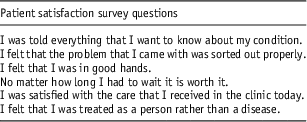
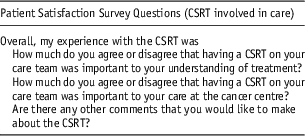
Special considerations were given to the survey design to account for the impact of symptom acuity and anxiety in patients with cancer in a palliative. To reduce the burden of research on the participants, the survey was limited to six questions for patients who were not seen by the CSRT and 10 for patients who were seen by a CSRT (Tables 1, 2). The questionnaire took ~3–5 minutes to complete, and was comprised of questions with Likert point scales. The final question for patients with a CSRT on their healthcare team allowed patients to comment on their experience with the CSRT. These comments were used to gain further insight into patients’ experiences with the CSRT role and identify new themes/areas for future research.
Common patient satisfaction survey questions answered by all participants (n=33)

Patient Satisfaction Survey questions answered by participants who received care from the Clinical Specialist Radiation Therapist (CSRT) (n=19)

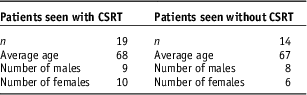
Patients were screened by a study coordinator to determine eligibility. Eligible patients were those who underwent palliative radiation treatment between 5 April 2013 and 14 November 2013 at the Stronach Regional Cancer Centre. As the Patient Satisfaction Questionnaire has only been validated in English, patients who were unable to understand the English language were excluded. Participating patient demographics can be found in Table 3.
Patient demographics

At the time of the patients’ pre-radiation therapy assessment appointment, eligible patients were asked whether they would be willing to fill out a brief survey on the day of their last radiation treatment regarding the care they received. After obtaining informed consent from participants, the study coordinator provided the survey to consented patients on the last day of radiation treatment. At the end of treatment, patients completed the surveys and placed them in a designated drop box located at the registration desk. Two surveys were not completed by patients who felt too unwell to answer the questions.
Survey data was entered onto a spreadsheet by the study coordinator. To compare rated levels of satisfaction between patients who received care from the CSRT and those who received care from other HCPs, an independent samples t-test for two samples of unequal variance was performed on the responses for the six questions answered by both study arms. A confidence interval of 95% was used for analysis of p values. The mean value and standard deviation of responses for all questions were also calculated for both study groups.
RESULTS
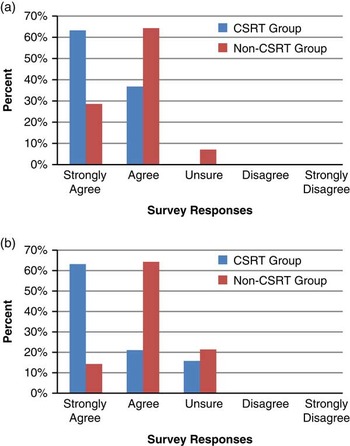
For the six statements rated by all patients, significant differences (p<0·05) were noted between patients who received care from the CSRT and those who received care from other HCPs for two questions: ‘I was told everything that I want to know about my condition’ (p=0·039) and ‘I felt that the problem that I came with was sorted out properly’ (p=0·037) (Figure 1a and 1b).
(a) Scores in response to survey question: ‘I was told everything that I want to know about my condition’. p=0·039. (b) Scores in response to survey question: ‘I felt that the problem that I came with was sorted out properly’. p=0·037. Abbreviation: CSRT, Clinical Specialist Radiation Therapist.

No significant differences (p>0·05) were seen for the following statements: ‘I felt that I was in good hands’, ‘No matter how long I had to wait, it is worth it’, ‘I was satisfied with the care that I received in the clinic today’, ‘I felt that I was treated as a person rather than a disease’.
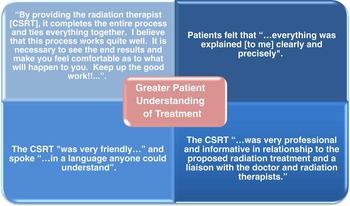
For the CSRT-specific questions, 88·9% of patients rated his/her experience with the CSRT as excellent and 11·1% as good. 44·4% of patients ‘strongly agreed’ that ‘having a CSRT on the care team was important to patients’ understanding of treatment’, and 77·8% of patients strongly agreed or agreed that having a CSRT on the care team was important to his/her care at the cancer centre. Patients who interacted with the CSRT were also asked if there were any other comments they would like to make about the CSRT and provided with an area to provide free-text responses. All comments received were positive and highlighted the impact of the CSRT on improved patient understanding of treatment (Figure 2).
Comments from patients who received care from the Clinical Specialist Radiation Therapist (CSRT).

DISCUSSION
In Canada, CCO has initiated a policy emphasis on person-centred care, the patient experience, and incorporation of patient and family advisors. 12 This strives to give patients a voice which directly shapes the care they receive. This initiative also helps to build strong and sustainable relationships between patients, families, and healthcare providers both at the institutional and community level. 12
At the same time, patients are placing more emphasis on consumer satisfaction when seeking care, therefore it is becoming increasingly important to measure and demonstrate excellent patient satisfaction. This is fuelling more competition among healthcare providers, and has opened the door for the development of research tools and vendor products to help organisations evaluate satisfaction.Reference Urden 13 In addition, the concept of patients as active healthcare consumers has prompted further research that examines both patient satisfaction and the patient–practitioner relationship.Reference Sitzia and Wood 14
This study demonstrates that the introduction of a CSRT in the palliative radiation therapy setting positively affects patient satisfaction with increased understanding of a disease/condition and addressing patient issues/concerns. When a CSRT was involved in the care of a patient, the CSRT spent 30–45 minutes with the patient at the initial consult. This interaction provided another opportunity, in addition to time spent with the RO, for patients to receive information regarding radiation therapy and to ask questions. It also provided patients with another person to contact if they experienced difficulties or required assistance and improved patients’ understanding of proposed treatments and radiation therapy side effects. This additional communication functioned to alleviate patient anxiety, increasing both patient satisfaction and quality of care.Reference McGilton, Irwin Robinson, Boscart and Spanjevic 15
Patients indicated that they felt they were ‘in good hands’ with the CSRT, and there was no significant difference reported between study groups for this question. This demonstrates that patients were confident in the CSRT’s training/abilities. It also highlights that the level of care and service provided by the CSRT was minimally equivalent to the care and service received from the radiation oncology nurse and RO. As part of the implementation process of the CSRT role, CSRTs were required to achieve a minimum level of concordance of 95% with the RO for role-specific tasks to demonstrate competence. The demonstration of concordance and achievement of patient satisfaction levels similar to those of other healthcare professionals is crucial when implementing a new role to ensure adequate training has taken place and that the CSRT has acquired the necessary knowledge, skills and judgement to provide safe, quality care for patients.
Patients from both study groups felt that all HCPs providing care treated them as a person rather than a disease and were satisfied with the care received at their clinic appointment. This demonstrates that patients are receiving person-centred care from the CSRT, which is known to improve patient experiences. 12 This approach allows patients to be more involved in the design, delivery and evaluation of their care, which is important as we move from a provider-centred to a person-centred healthcare system. 12 This aspect of CSRT data collection aligns with provincial healthcare priorities, demonstrating that the creation of new roles can help develop new models of care which are person-centred. This subsequently allows for improvement and delivery of safe, quality care within the current healthcare system.
Future directions of this work include repeating this study over a longer period of time to accrue a larger sample size. This may assist in gaining further insights in patient satisfaction and the role of the CSRT, and would also allow for a more robust analysis of questionnaire data.
As our healthcare system continues to be reshaped, the development of new roles such as the CSRT can assist in achieving and implementing new models of care that align with system priorities. Overall, this study demonstrates that excellent levels of patient satisfaction can be achieved when integrating the CSRT into the model of care for radiation oncology patients. This results in patients having a greater understanding of treatment and more time dedicated to addressing patient concerns, resulting in the delivery of higher quality care in the palliative oncology setting.
Acknowledgements
Thank you to the Radiation Medicine Team at the Stronach Regional Cancer Centre, Cancer Care Ontario and the Ministry of Health and Long-Term Care for their support throughout this project.
Financial support
This research received no specific grant from any funding agency, commercial or not-for-profit sectors.
Conflicts of Interest
None.
Ethical Standards
The authors assert that all procedures contributing to this work comply with the ethical standards of the Tri-Council Policy Statement on Ethical Conduct for Research Involving Humans, the ICH Good Clinical Practice Guidelines and Part C, Division 5 of the Food and Drug Regulations of Canada, and with the Helsinki Declaration of 1975, as revised in 2008, and has also been approved by the institutional Southlake Regional Health Centre Research Ethics Board.