INTRODUCTION
Terebellids belong to a very species-rich group of sedentary polychaetes, widely distributed in most marine benthic substrates, from shallow waters to deep-sea environments (Rouse & Pleijel, Reference Rouse and Pleijel2001). Terebellidae Johnston, Reference Johnston1846 is currently subdivided into three subfamilies: Polycirrinae Malmgren, Reference Malmgren1867, Terebellinae Johnston, 1846 (frequently referred to as Amphitritinae) and Thelepodinae Hessle, Reference Hessle1917 (as Thelepinae) (Londoño-Mesa & Carrera-Parra, Reference Londoño-Mesa and Carrera-Parra2005). However, Nogueira et al. (Reference Nogueira, Fitzhugh and Hutchings2013) carried out a large phylogenetic analysis which resulted in splitting the family Terebellidae into four families: Polycirridae, Terebellidae (=previous Terebellinae), Telothelepodidae and Thelepodidae. Herein, the former proposal will be followed (Read, Reference Read, Read and Fauchald2016).
According to Carrerette & Nogueira (Reference Carrerette and Nogueira2015), this family includes around 300 species belonging to 50 genera. Among the subfamily Terebellinae, the genus Loimia Malmgren, Reference Malmgren1865 currently comprises 28 valid species, of which seven have been recently described from Brazilian and Australian coasts (Carrerette & Nogueira, Reference Carrerette and Nogueira2015; Nogueira et al., Reference Nogueira, Hutchings and Carrerette2015). This genus can be found worldwide, especially occurring in tropical waters (Read & Bellan, Reference Read, Bellan, Read and Fauchald2011), with only two species known from European waters. Loimia arborea Moore, Reference Moore1903a was recorded from the Mediterranean Sea (RESOMAR – French marine stations and observatories network – database, http://resomar.cnrs.fr/bases/index.php; Faulwetter, Reference Faulwetter2010) and from the Irish Sea (Guiry & Guiry, Reference Guiry and Guiry2011). However, these records are doubtful since this species originated from Japan. According to the World Register of Marine Species, validation of these occurrences and species presence beyond Japanese waters is needed (WoRMS, Reference Read and Fauchald2008). Loimia medusa (Savigny in Lamarck, Reference Savigny and Lamarck1818) was previously believed to occur from the Mediterranean to Norway but this species was redescribed by Hutchings & Glasby (Reference Hutchings and Glasby1995) who suggested that its distribution may restricted to the Arabian Sea Region. Due to the lack of accurate literature, many European studies have identified their specimen as Loimia sp. (e.g. Mackie et al., Reference Mackie, Oliver and Rees1995 in the south-eastern Irish Sea; RESOMAR database along the French coasts). Since 2011, one of the authors (JG) regularly found specimens of a giant species of Loimia within Northern Brittany beaches that could not be related to any described species. The present paper provides the description of this new species based on morphological characters and supplemented by molecular data. The geographic origin of the species, perhaps not originating from Europe, is discussed.
MATERIALS AND METHODS
Sampling and morphological analyses
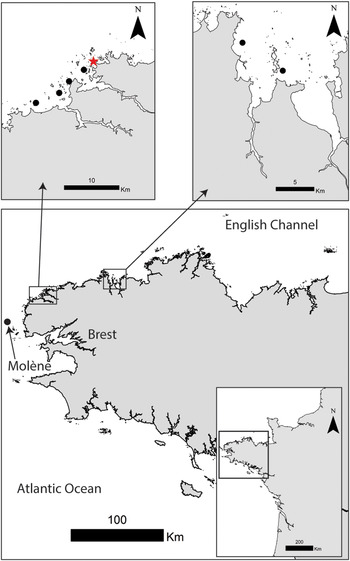
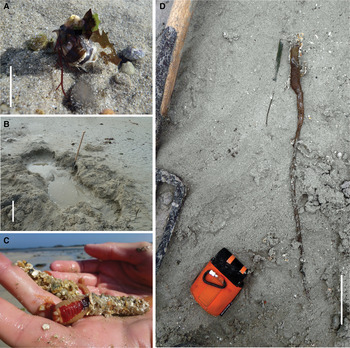
The first specimens of this new Loimia species were sampled in 2011 from intertidal sandy beaches of the English Channel (Brittany, France) (Figure 1) after notification of strange large annelid tubes (Figure 2A) by Michel Glémarec (senior French benthic ecologist from Brest University). Specimens examined in this study were collected in 2011, 2012 and 2016 by hand, using a shovel-fork and a technique called ‘finger tube tracking’ allowing the monitoring of the tube position and changes in direction at any moment (Figure 2B). Live specimens were anaesthetized with 7% magnesium chloride (MgCl2) and photographed using a Canon EOS 600D camera. A small piece of body was removed from several specimens and fixed in 96% ethanol for molecular studies. The main material was fixed in 4% formaldehyde seawater solution, then transferred to ethanol 70% solution for morphological analysis. Preserved specimens were examined under a Nikon SMZ25 stereomicroscope and a Nikon Eclipse E400 microscope, and photographed with a Nikon DS-Ri 2 camera. Total length, length of thorax and width of thorax (10th chaetiger) were measured with the NIS-Elements Analysis software. Drawings were made from pictures using Inkscape software and a Wacom Intuos 5 tablet. Holotype and most paratypes were deposited at the Muséum National d'Histoire Naturelle, Paris (MNHN), other paratypes were deposited in the National Museum Wales, Cardiff (NMW-Z) and in the Colección Estuarina y Marina, Universidad de Antioquia (CEMUA) in Medellín, Colombia. Additional material was lodged in collections of the Arcachon and Brest Marine Stations, in France.
Sampling sites of Loimia ramzega sp. nov. on the Brittany coasts (English Channel, Western France). Dots: presence; star: type locality.

Loimia ramzega sp. nov. (A) Tube opening; (B) Trench required to collect a single specimen; (C) Live specimen in its tube, antero-ventral view; (D) Entire live specimen. Scale bars: A, 2 cm; B, 50 cm; D, 10 cm.

DNA isolation, amplification and sequencing
Sub-samples for DNA analysis were removed from live specimens, placed in ethanol 96% and frozen at −20°C. Extraction of DNA was done with a NucleoSpin Tissue (Macherey–Nagel) kit following the manufacturer's protocol. About 450 bp of 16S and 700 bp of COI (cytochrome c oxidase subunit I) genes were amplified using primers Ann16SF and 16SbrH for 16S (Palumbi, Reference Palumbi, Hillis, Moritz and Mable1996; Sjölin et al., Reference Sjölin, Erséus and Källersjö2005), and polyLCO and polyHCO for COI (Carr et al., Reference Carr, Hardy, Brown, Macdonald and Hebert2011). The PCR (Polymerase Chain Reaction), with 25 µl mixtures contained: 5 µl of Green GoTaq® Flexi Buffer (final concentration of 1×), 2.5 µl of MgCl2 solution (final concentration of 2.5 mM), 0.5 µl of PCR nucleotide mix (final concentration of 0.2 mM each dNTP), 9.875 µl of nuclease-free water, 2.5 µl of each primer (final concentration of 1 µM), 2 µl template DNA and 0.125 of GoTaq® G2 Flexi DNA Polymerase (Promega). The temperature profile was as follows: 95°C/240 s – (94°C/30 s–52°C/60 s–72°C/75 s) *35 cycles (for 16S) or *40 cycles (for COI) – 72°C/480 s – 4°C. PCR-products, which produced light bands after electrophoresis on 1% agarose gel, were sent to the MacroGen Europe Laboratory in Amsterdam (the Netherlands) to obtain sequences, using the same set of primers as used for the PCR. Overlapping sequence (forward and reverse) fragments were merged into consensus sequences using Geneious Pro 8.1.7 2005–2015 (Biomatters Ltd) and aligned using the plugins: MAAFT (Katoh et al., Reference Katoh, Misawa, Kuma and Miyata2002) for 16S and MUSCLE (Edgar, Reference Edgar2004) for COI. For COI, the sequences were translated into amino acid alignment and checked for stop codons to avoid pseudogenes. The minimum length coverage was around 450 bp for 16S and 610 bp for COI. All sequences obtained in this study have been deposited in GenBank (http://www.ncbi.nlm.nih.gov/genbank/).
RESULTS
SYSTEMATICS
Family terebellidae Johnston, 1846
Subfamily terebellinae Johnston, 1846
Genus Loimia Malmgren, 1865
Type species: Terebella medusa Savigny in Lamarck, 1818
GENERIC DIAGNOSIS
Malmgren (1865: 380). Hessle (1917: 170). Hutchings and Glasby (1995: 149–150).
Branchiae on segments 2–4; lateral lappets on segments 1 and 3, 1 and 2/3 (in combination of segments 2 and 3) or 1, 3 and 4; ventral shields from segment 2 or 3; nephridial papillae on segments 3–4 and 6–8; 17 pairs of thoracic notopodia from segment 4; chaetae alimbate, unilimbate, symmetrical or asymmetrically bilimbate, smooth tipped; neuropodia from segment 5, uncini avicular or pectinate with a single vertical series of teeth, arranged in single rows on segment 5–10, in double rows, back to back, up to segment 20, and in single rows along the abdomen; pygidium sometimes with anal cirri or papillae.
Loimia ramzega sp. nov.
(Figures 2–5)
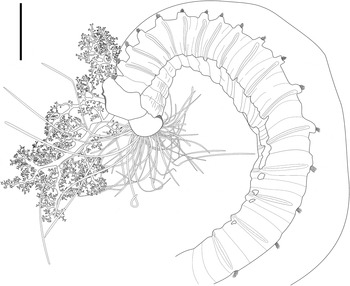
Loimia ramzega sp. nov. anterior part (live specimen), lateral view (holotype MNHN-IA-TYPE 1788). Scale bar: 1 cm.

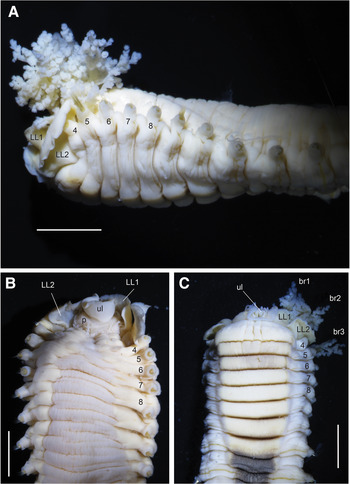
Loimia ramzega sp. nov. (A) Anterior part, lateral view (holotype MNHN-IA-TYPE 1788); (B) Anterior part, dorsal view (paratype MNHN-IA-TYPE 1792); (C) Anterior part, ventral view (holotype MNHN-IA-TYPE 1788). Numbers refer to segments; LL1, first lateral lappet; LL2, second lateral lappet; p, peristomium; ul, upper lip; br1, br2, br3 refer to the three pairs of branchiae. Scale bars: 5 mm.

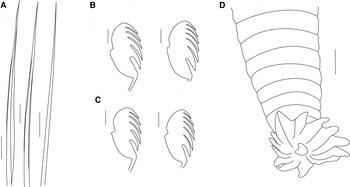
Loimia ramzega sp. nov. (A) Notochaetae from chaetiger 11 (paratype MNHN-IA-TYPE 1790); (B) Thoracic uncini from segment 12, lateral views (paratype MNHN-IA-TYPE 1791); (C) Abdominal uncini from segment 25, lateral views (paratype MNHN-IA-TYPE 1791); (D) Pygidium lateral view (paratype MNHN-IA-TYPE 1789). Scale bars: A 0.1 mm; B, C 25 μm; D 0.5 mm.

TYPE MATERIAL
Holotype: anterior fragment, 139 segments, 254.2 mm long; thorax 58.6 mm long and 15.84 mm wide (MNHN-IA-TYPE 1788); France, English Channel, Brittany, Plouguerneau, Lilia beach (48°37′37.2″N 4°34′08.5″W), intertidal, 23 February 2016.
Measured Paratypes: complete specimen, broken, 165 segments, 241.13 mm long; thorax 65.56 mm long and 13.23 mm wide (MNHN-IA-TYPE 1789), anterior fragment, 41 segments, 68.5 mm long; thorax 63.29 mm long and 13.11 mm wide (MNHN-IA-TYPE 1790); France, location and sampling as for holotype. Anterior fragment, 47 segments, 154.37 mm long; thorax 74.64 mm long and 13.22 mm wide (MNHN-IA-TYPE 1791), anterior fragment, 46 segments, 130.91 mm long; thorax 64.52 mm long and 13.44 mm wide (MNHN-IA-TYPE 1792); France, English Channel, Brittany, Landéda beach (48°36′37.7″N 04°36′24.5″W), intertidal, 25 January 2012.
Other Paratypes: 6 anterior fragments, 6 abdominal fragments, 3 posterior fragments (NMW.Z.2017.002.0001); France, English Channel, Brittany, Landéda beach (48°36′37.7″N 04°36′24.5″W), intertidal, 27 December 2011; one complete specimen (NMW.Z.2017.002.0002), one anterior fragment (CEMUA-POLY-TERE-0100); France, English Channel, Brittany, Landéda beach (48°36′37.7″N 04°36′24.5″W), intertidal, 25 January 2012.
ADDITIONAL MATERIAL
Four anterior fragments and 2 posterior fragments (Arcachon Marine Station Collection); France, English Channel, Brittany, Landéda Beach (48°36′37.7″N 04°36′24.5″W), intertidal, 25 January 2012. One anterior fragment (Arcachon Marine Station Collection), 2 anterior fragments (Brest Marine Station Collection); France, English Channel, Brittany, Plouguerneau, Lilia Beach (48°37′37.2″N 4°34′08.5″W), intertidal, 23 February 2016.
DIAGNOSIS
Gigantic size (max. 650 mm, live), two pairs of lateral lappets on segments 1 and 3; first pair more ventral, second pair more developed and lateral but oblique, with wavy edge. Nine ventral pads from segment 2 (fused on segments 2 and 3), first three pads swollen, next ones decreasing in size. Uncini pectinate with 6 teeth (some with 5 teeth) slightly decreasing in size, in one vertical row. Pygidium with about 14 long conical marginal papillae surrounding anus.
DESCRIPTION (BASED ON HOLOTYPE AND PARATYPES, MNHN)
Tube long and only 17 mm in width, made of shells fragments and small gravels, emerging end with fragments of macroalgae attached, inner surface with strong smooth membrane allowing tube to maintain a hard consistency (Figure 2A, C). In life, body colour pinkish to light green (Figure 2C, D); buccal tentacles translucent; upper lip light pink; first pair of lateral lappets white with blood red margins (Figure 2C); second pair blood red; branchiae blood red; first ventral pad whitish, second one whitish anteriorly and blood red posteriorly, ventral pads from segment 5 to 11 (S5 to S11) blood red and with tiny whitish lateral bands, shields from S12 to end of thorax dark red (Figure 2C). Dorsal posterior part of abdomen with dark spots. Formalin fixed body with brownish lappets, ventral shields from S4 to S11 light brown, others dark brown, dorsal-posterior margin of thoracic segment light orange. In alcohol, body whitish.
Tentacles abundant and long, reaching end of thorax when projecting backward on live specimens (Figure 3), without ridges, with a deep groove. Eyespots absent from very developed tentacular membrane. Upper lip rounded, with free edge, projecting forward. Lower lip small, completely covered ventrally by membrane connecting lappets of segment 1. Lateral lappets discontinuous, 2 pairs on S1 and S3. First pair large, oval, projecting forwards, merged ventrally (originating ventrally), covering upper lip (Figures 3 & 4A). Second pair of lateral lappets the largest, laterally concealing S2, originating ventro-laterally and connected to first ventral shields, anterior margin wrinkled or wavy, dorsolaterally ear-shaped, covering the base of the first and second pairs of branchiae (Figure 3).
Three pairs of arborescent branchiae, long, starting from S2, first pair longest, projecting forward, third pair smallest. Branchiae with thick stalks, and many dendritic branches arranged in five levels (Figure 3). Nephridial papillae, tube-like, from S3–4 and S6–8. Whitish glandular patches, gradually decreasing in size, surrounding the first 11 notopodia (Figure 4B). Sixteen ventral shields from S2, fused on S2–S3 (Figures 2C & 4C), not subdivided, progressively narrower and more indented posteriorly by neuropodia from S12 to S17. Ventral shields more evident in live specimens, appearing as blood red pigmentation (Figure 2C). Abdomen ventrally smooth.
Notopodia from S4, extending through S20. Notopodial lobes well developed (Figure 4B), first notopodia button-like. Notochaetae of three types within a fascicle: long serrated, asymetrically bilimbate; long bilimbate, serrated, with narrow limbs; and slightly shorter alimbate capillaries few in number, around 1:10 relative to long chaetae (Figure 5A). Thoracic neuropodia as ventrolateral belts of uncini, decreasing in width toward the posterior thoracic region. Abdominal neuropodia long, projected posteriorly, with narrow belt of uncini along posterior margins. Thoracic (N = 280–350) and abdominal (N = 90–110) uncini pectinate, arranged in double rows from segment 11, similar in size and shape, with 6 teeth in single vertical row, some uncini with 5 teeth (Figure 5B, C). Uncini long with curved occipitium, posterior process absent, basis concave, anterior process absent, anterior filament long, projected downwards, long and narrow subrostrum, subrostral process absent. Pygidium with terminal rounded anus, surrounded by 14 long, conical papillae (Figure 5D).
VARIATION
One paratype (MNHN-IA-TYPE 1790) with the first pair of lateral lappets showing a deep anterodorsal notch. One posterior part of additional material with only 12 pygidial papillae, but probably two lost. Remaining characters strictly similar to holotype.
DNA
COI and 16S genes were successfully sequenced and published at NCBI GenBank for: holotype MNHN-IA-TYPE 1788 accession number 16S: KY555058 and COI: KY555061; paratypes MNHN-IA-TYPE 1789 accession number 16S: KY555059 and COI: KY555062 and MNHN-IA-TYPE 1790 accession number 16S: KY555060 and COI: KY555063.
ETYMOLOGY
The species name ramzega refers to the gigantic size of this species. In Breton ‘ramzeg’ means titanic, giant.
DISTRIBUTION
Only known from France, English Channel, North Brittany (along 60 km) and from Molène island; on sandy beaches, intertidal (Figure 1).
DISCUSSION
According to Holthe (Reference Holthe1986), the genus Loimia had 16 valid and described species, one subspecies and four synonymized species. However, Read & Bellan (Reference Read, Bellan, Read and Fauchald2011) stating recent newly described species, reported 28 valid species and one nomen dubium. This genus shows a tropical distribution, with only a few subtropical species, and no arctic species. Loimia medusa, the type species described from the Red Sea, has long been erroneously identified in many distant localities, hiding possible new species identifications (Hutchings & Glasby, Reference Hutchings and Glasby1995). Thus, true cosmopolitan species are now a topical subject for debate by marine taxonomists (Hutchings, Reference Hutchings2016). Recently, new species of polychaetes have been identified from supposed well studied localities (Londoño-Mesa, Reference Londoño-Mesa2009; Carrerette & Nogueira, Reference Carrerette and Nogueira2015; Nogueira et al., Reference Nogueira, Hutchings and Carrerette2015). Concerning European waters, no species belonging to the genus Loimia has been officially described, although some specimens originating from the area may have been erroneously deposited in museums under the name L. medusa. Thus, the present description of L. ramzega sp. nov. may offer a local solution for those misidentified species but given the presence of Loimia sp. in the south-eastern Irish Sea (Mackie et al., Reference Mackie, Oliver and Rees1995), there are probably more undescribed Loimia species in Europe (especially small species) and all specimens should be observed carefully. Indeed, a similar exercise has been done by Londoño-Mesa & Carrera-Parra (Reference Londoño-Mesa and Carrera-Parra2005) with specimens initially identified as L. medusa from the Caribbean. These authors found that L. medusa does not occur in the western tropical Atlantic, and that the material identified as L. medusa from the region already belonged to three species; one incorrectly hidden by synonymy, Loimia minuta Treadwell, Reference Treadwell1929, and one new for science, Loimia salazari Londoño-Mesa & Carrera-Parra, Reference Londoño-Mesa and Carrera-Parra2005.
We report L. ramzega sp. nov. for the first time from one of the best known marine ecosystems of the world: the western English Channel. We believe that a species of such size and from an easily accessible habitat could not have been overlooked through 150 years of marine biological study in the area. Indeed, Roscoff and Concarneau Biological stations both founded during the 19th century, and later the Biological Oceanography Laboratory of the University of Western Brittany since the 1960s, have led hundreds of benthic surveys in the area. It is thus very unlikely that the species would not have been noticed before 2011. The main hypothesis for lack of record previous to the 2010s is that L. ramzega sp. nov. could be a non-European indigenous species recently introduced to Brittany. The fact that it has been first identified within two areas with extensive oyster farming of the Pacific Oyster Crassostrea gigas (Thunberg, 1793) (some spat and juveniles being directly imported from marine areas outside France) would support such hypothesis. The question of its area of origin then arises. Another way could be an immigration from southern Europe or Africa. Warming seas with climate change could have brought the species further north. This hypothesis seems unlikely as ‘tropicalization’ of the English Channel is not yet documented, especially in the area (Tréguer et al., Reference Tréguer, Goberville, Barrier, L'Helguen, Morin, Bozec, Rimmelin-Maurya, Czamanski, Grossteffan, Cariou, Répécaud and Quéméner2014), at the opposite of Bay of Biscay (Arias & Crocetta, Reference Arias and Crocetta2016). Indeed, thermal and haline structures in the Iroise Sea hinder dispersal between the Bay of Biscay and English Channel and numerous benthic fauna species find their limit of distribution in Brittany (Le Garrec et al., Reference Le Garrec, Grall, Chevalier, Guyonnet, Jourde, Lavesque, Bonifácio and Blake2016; Gallon et al., in revision). However, because it is so difficult to catch, we cannot exclude the fact that the species may be native from Europe, and when (if) sampled, would have been misidentified under the name L. medusa.
Loimia ramzega sp. nov. is easily identifiable by its very large size, the pigmentation on the ventral shields, and the development of its lateral lappets. Before this record, the largest species within the genus was L. salazari from the Mexican Caribbean, at 221 mm length, but it differs from L. ramzega by having avicular instead of pectinate uncini.
We do not believe that the very large size of L. ramzega represents a reliable example of gigantism. Indeed gigantism is rather known from polar or abyssal environments (Moran & Woods, Reference Moran and Woods2012) and not from intertidal temperate waters. Gigantism that would result from a consequence of a pollution is also dismissed. Indeed, sampling sites are not particularly affected by anthropogenic perturbations. Moreover, no other benthic invertebrate species from these highly diversified benthic communities are oversized in comparison with other sites or adjacent waters.
Species belonging to Loimia having pectinate uncini, and from geographically close regions are scarce. Loimia viridis Moore, Reference Moore1903b, from Massachusetts (USA), has similar shape on first ventral shields, but it differs from L. ramzega sp. nov., by having pectinate uncini with 7–8 teeth, only one type of notochaeta, being symmetrically bilimbate, and with the second pair of lateral lappets transverse to the body axis. Other Loimia species with pectinate uncini differ by combinations of morphological characters (disposition and number of lateral lappets and number of uncinal teeth) as well as by their geographic distribution. For example, L. arborea (from Japan) has lateral lappets on segments 1 and 2/3, and thoracic uncini with 5 (rarely 6) teeth, and abdominal ones with 6 (rarely 7) teeth. Loimia batilla Hutchings & Glasby, Reference Hutchings and Glasby1988 (from Queensland, Australia) has lateral lappets on segments 1 and 2/3, and thoracic uncini with 6 teeth, and abdominal ones with 7 teeth. Loimia bermudensis Verrill, Reference Verrill1900 (from Bermuda) has lateral lappets on segments 1 and 3, and uncini with 5 teeth (rarely 6 very reduced). Loimia decora Pillai, Reference Pillai1961 (from Sri Lanka) has lateral lappets on segments 1 and 2/3, and uncini having 5 teeth. Loimia grubei Holthe, Reference Holthe1986 (from the Philippines) has lateral lappets on segments 1 and 2/3, and thoracic uncini with 5 teeth and abdominal uncini with 6–7 teeth. Loimia triloba Hutchings & Glasby, Reference Hutchings and Glasby1988 (from Queensland) has three pairs of lateral lappets on segments 1, 3 and 4, and uncini with 5 (rarely 6) teeth. Finally, Loimia verrucosa Caullery, Reference Caullery1944 (from Indonesia) has lateral lappets on segments 1 and 3, and uncini with 7 teeth. Thus, none of the species having pectinate uncini have been described from Europe, and L. ramzega sp. nov. is the first such species being described from the region.
Finally, a revision of the genus is ongoing, examining the phylogenetic relationship of the species within the genus based on morphology.
ACKNOWLEDGEMENTS
The authors would like to thank Michel Glémarec, who observed tubes of this species for the first time, and Jerôme Jourde, Sylvain Elies and Nolwenn Quillien for helping to catch the first specimens. We are very grateful to Andy Mackie and Orlemir Carrerette for their advice when we tried to identify this species. Many thanks to Lenaick Menot and Emmanuelle Omnes from Ifremer-Brest for their support with molecular analysis and Patrice Gonzalez from Arcachon Marine Station for his help with submission of sequences in GenBank. Finally, we also thank Andy Mackie and Pat Hutchings, whose comments have greatly contributed to improve the manuscript.