The National Maritime Museum (NMM) holds a substantial collection of papers formerly belonging to the Reverend George Fisher (Figure 1), as well as many of his instruments. About half of this collection consists of papers and workbooks relating to Fisher's later career at the Royal Hospital School, Greenwich (which was housed in buildings that now form part of the NMM site), while the remainder relate to his scientific research while serving as a chaplain in the Royal Navy. The research for this paper has drawn on these papers and on the results of Fisher's voyages to the Arctic under the command of Captain David Buchan in 1818 and Captain William Edward Parry in 1821.
The Reverend George Fisher. © National Maritime Museum, Greenwich, London.

Previous discussions of Fisher's life have largely focused on his astronomical research,Footnote 1 a tendency that derives from the obituary published in the Monthly Notices of the Royal Astronomical Society in 1874. This anonymously written piece concentrated on a limited range of Fisher's research, such as measuring the length of pendulum vibrating seconds to determine the figure of the Earth and his work on the aurora borealis.Footnote 2 Yet the obituary ignored Fisher's early work in which he was the first to study the effects of magnetism on chronometers. This paper examines Fisher's research on this topic and seeks to explain the debate that arose from an article he published in 1820. Fisher's chronometer work has been previously considered by Brooks, who placed the 1820 paper in the context of other contemporary studies of magnetic influence on chronometers.Footnote 3 Brooks did not, however, consider Fisher's later research on the topic. This paper seeks to redress this by looking at his research in the 1830s, which included the possible use of glass balances and balance springs for chronometers.
George Fisher
Fisher was born in 1794 at Sunbury, Middlesex, to James and Henrietta Fisher. His father was a surveyor who died when George was only three years old. At the age of fourteen George took a job with the Middlesex Insurance Company where he gained a reputation as a diligent and hard worker. He also showed scientific talent, and with the support of well-known figures including Sir Humphry Davy, Sir Joseph Banks and Sir Everard Home he was able to enter St Catherine's College, Cambridge, in 1816 to read Natural Sciences. Fisher's period at Cambridge was not an easy one, however: his studies were interrupted by illness and by appointments to two British naval expeditions. As a result he did not graduate with a BA until 1821, gaining his MA in 1825.
Although the two naval expeditions prolonged his Cambridge studies, they had a lasting effect on Fisher's life, leading in particular to his first published article on the effect of magnetism on chronometers.Footnote 4 Fisher also wrote much of the scientific appendix to Parry's journal of his second voyage in search of the North-West Passage, which presented further chronometer observations as well as the results of other experiments that Fisher had undertaken.Footnote 5 His contribution to Arctic expeditions and exploration was formally recognized by the Navy when they named Cape Fisher on the south-western end of Winter Island in Foxe Basin in the Canadian Arctic.Footnote 6 In addition to the published works arising from his Arctic voyages, the NMM collection contains later unpublished work, included in this study to assess Fisher's overall contribution to chronometer research.
The marine chronometer
The chronometer was developed primarily as an instrument for determining longitude. Since longitude is a measurement in the direction of the Earth's rotation, a difference in longitude between two places can be thought of as the difference in their apparent local times as determined by the sun's position. Knowing the times both where a ship is (from the sun) and at some reference point (such as Greenwich) would allow one to calculate the difference in local times and thus the difference in longitude between the current position and the reference. So one way of determining longitude would be to carry an accurate timekeeper, which maintained the time at the reference point. The principle of longitude determination by timekeeper had been understood since the sixteenth century, but it was not until the second half of the eighteenth century that the work of John Harrison, John Arnold and Thomas Earnshaw made it a practical reality.Footnote 7 Overseeing this period of development was the Board of Longitude. This body had been established as a result of the 1714 Longitude Act in response to demands from the public, naval officers, the merchant marine and British commercial interests for a solution to the longitude problem. The act famously followed the loss of around two thousand lives, when part of Sir Cloudesley Shovell's fleet was wrecked off the Scilly Isles in 1707, Britain's worst maritime disaster to that time. Although the cause of the disaster is still debated, it was felt by some contemporary observers that it could have been avoided if Shovell had been able reliably to determine the longitude.
The new board was given funds to support and encourage research into the longitude problem, with a maximum prize of £20,000 for a practical solution, if proven successful to within well-defined limits of accuracy. Ultimately this prize went to John Harrison for his invention of an accurate marine timekeeper, although the board also encouraged and rewarded many others, including the mathematician Tobias Mayer, who produced reliable lunar tables in 1755. With tables like Mayer's, mariners were able to establish longitude by measuring the moon's position with a sextant, or similar instrument, relative to one of the stars listed, using this as a sort of clock to determine the time at the reference point. This was known as the lunar-distance method of longitude determination. The Royal Observatory at Greenwich had been founded principally to put this method into practice. The necessary navigational tables were published annually in the Nautical Almanac from 1766, with each edition incorporating tables for three years ahead.Footnote 8 The board also took on other roles. From 1819, for example, it offered rewards for progress towards the North-West Passage and the North Pole, although only one of these was ever given out, when Parry's expedition reached 113° west in 1820, for which the board awarded £5,000.Footnote 9
The main problem with the lunar-distance method, however, was that a clear night was required for accurate observations and even then the moon could not always be seen, being, for example, invisible at night around the new moon. Moreover, the calculations required to reduce a lunar-distance observation to a longitude were complex and time-consuming. Although reliant on a more costly instrument, the chronometer method thus had the advantage of relative simplicity and reliability, although sufficiently clear weather for an observation of local time was still needed. The importance of testing and improving this new technology for the Royal Navy meant it soon found a place on voyages by explorers such as Cook in the Pacific Ocean.Footnote 10 By the nineteenth century the widespread use of chronometers sustained an age of British naval exploration. Yet the new technology was not without problems. Although Cook was extremely impressed with the timekeeper Kendall number 1 (an exact replica of Harrison's prize-winning H4), donated by the Admiralty to test on his second voyage to the Pacific from 1772 to 1775, he noted that its rate decreased during the expedition.Footnote 11 The rate is the amount by which a chronometer gains or loses time compared to mean solar time. If this rate is constant for a specific chronometer, then with a correction applied to any reading it can be reliably used for determinations of longitude. Conversely, if a chronometer's rate cannot be relied upon (if the rate changes in an unpredictable way), then the problem of accurately determining longitude remains, since there is no way of ascertaining the correction to apply to a specific reading. This was another area in which the Board of Longitude found a role, since as well as offering financial rewards, the board supported British voyages of exploration, in particular by supplying instruments, including chronometers. In these cases the chronometers came with instructions to test their rates during the voyage as part of a continuing programme to assess their reliability.
Ensuring the accuracy and reliability of chronometers was essential. Considerable skill was involved in their manufacture, the ‘elite branch of the British watch making industry’.Footnote 12 Competition between manufacturers was also fierce. John Arnold and Thomas Earnshaw, for example, both published pamphlets criticizing the work of other watchmakers and publicizing inventions that, they claimed, improved the performance of their own chronometers.Footnote 13 Similarly, Thomas Mudge junior was moved to challenge potentially damaging criticisms of his father's work by Nevil Maskelyne, fifth Astronomer Royal, and published two works questioning Maskelyne's assessment.Footnote 14 It is within this culture of competition and constant striving to improve the performance of chronometers, therefore, that one should view the work of George Fisher.
Fisher's first voyage, 1818
George Fisher's contribution to the debate over the accuracy of chronometers began after he was appointed astronomer to the 1818 Arctic expedition. The British government was by then sensing threats from Russia's Arctic explorations, in particular the prospect that Russian vessels might infringe British interests in North America. This perceived threat led John Barrow, second secretary of the Admiralty, to order a major expedition to the Arctic since he had been informed by the whaling captain William Scoresby that retreating ice in the polar regions might allow easier passage there.Footnote 15 Barrow, a well-known geographer, later became principal patron both of Arctic voyages of discovery and of other naval explorations across the globe.Footnote 16 Barrow's proposal for the 1818 expedition had two aims: to attempt to discover the North-West Passage, which would allow British ships easy access to the Pacific, and to reach the North Pole. The search for the North-West Passage was assigned to Captain John Ross and that for the North Pole to Captain David Buchan, with each given two ships to command. Writing in the same year, Barrow boasted that no other polar expedition had ‘been fitted out on so extensive a scale or so completely equipped in every respect as the two which left England this year’.Footnote 17
Having been recommended by the Royal Society, George Fisher was assigned to Buchan's ship HMS Dorothea. His orders regarding the scientific research to be carried out were both broad and extensive, with a strong emphasis on testing the rates of chronometers, particularly in the cold temperatures of the Arctic. Besides this, Fisher was to study and record the variation and inclination of the Earth's magnetic field and test the extent to which it was affected by atmospheric electricity. The Dorothea was equipped with apparatus especially for this purpose. There were also orders to study any currents and tides the expedition might encounter and to take samples and measure the depth of the sea.Footnote 18 Finally, if the expedition succeeded in reaching the North Pole, Fisher was also instructed to supervise the capture and collection of animal, plant and mineral samples, to measure the dip of the horizon with his dip-sector and compare his instruments' performance over ice and sea.Footnote 19
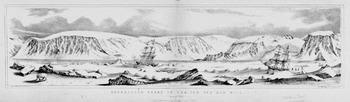
Ultimately Buchan's expedition was unsuccessful. Before the ships set sail, John Franklin, who commanded the second ship on the expedition, HMS Trent, had noted in his journal that he felt they should have had more whalers on board since they had more experience of the polar seas than he and his crew.Footnote 20 As it turned out, the ships ran into difficulty to the north of Norway near the island of Spitsbergen, where they spent the winter. Returning to Britain the following spring, the expedition had failed even to threaten Scoresby's 1806 record for the most northerly latitude reached (81° 31′ north), let alone reach the North Pole (Figure 2). It is unlikely that the mission could have succeeded: the journey is only possible using a modern steel-hulled icebreaker, very different from the 1818 expedition's wooden vessels.Footnote 21 Yet this apparent failure increased the importance of Fisher's presence. As Barrow had explained, even if it failed in the primary objective of reaching the North Pole, the scientific investigations performed during the journey would make the effort worthwhile.Footnote 22
Frederick William Beechey, Expedition Beset in the Ice off Red Hill. June 14th 1818. Both Fisher's ship Dorothea and the expedition's second ship Trent are shown in this image from Beechey's account of the expedition (National Maritime Museum, no. PAD6116). © National Maritime Museum, Greenwich, London.

Indeed, the winter spent on Spitsbergen did benefit Fisher's research. In Frederick William Beechey's account of the voyage, the sole published report, Fisher wrote up the results of many of his experiments. This included detailed research on determining the figure of the Earth through the length of the pendulum vibrating seconds, as well as recording the temperature of the sea.Footnote 23 But it was not for these results that Fisher's work became well known. Rather, it was his research on chronometers, published in the Philosophical Transactions upon his return, which brought him to wider attention.Footnote 24
‘On the errors of longitude’
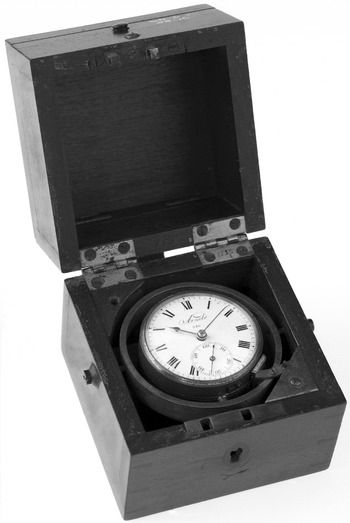
Although Fisher did not identify the specific chronometers he used for his research on the Dorothea, he did note that he had four chronometers made by Arnold (Figure 3), two by Earnshaw and one each by Pennington, Baird and Barraud.Footnote 25 No serial numbers for any of these instruments were given, but in an account of his preparations Franklin itemized the four chronometers on board the expedition's second ship, HMS Trent: Earnshaw 364, Pennington 150, Baird 1733 and Arnold 2149. The last had been given to Franklin by Captain Buchan, and was presumably on test from the Admiralty, as were the Earnshaw and Pennington chronometers.Footnote 26 The Baird chronometer was sent by a Mr Daniel Moore, although no reason is given for this. It is likely that Moore was the barrister of that name from Lincoln's Inn who was a member of the Royal Society (elected in 1810),Footnote 27 as well as secretary of the Geological Society of London.Footnote 28 Most of the chronometers were supplied by the Admiralty on behalf of the Board of Longitude, following the usual procedure of the time.Footnote 29
Chronometer no. 326, by John Arnold and Son, 1797, formerly owned by George Fisher. This is likely to be one of the chronometers referred to in Fisher's notes on the 1818 voyage (National Maritime Museum, no. ZAA0067). © National Maritime Museum, Greenwich, London.

Fisher's published paper began by disproving the received theory that the rates of the chronometers were affected by the ship's motion. He had observed instead that they continued to accelerate despite the ships becoming encased in ice. It was only once Fisher had removed the chronometers from the ships and placed them on land, while the expedition wintered on Spitsbergen, that they began to return to their normal rates.Footnote 30 Instead, Fisher concluded that the chronometer rates were being affected by magnetism, which he could reasonably attribute to one of three different sources. The first was geological magnetism, particularly from basaltic rocks, but these were not common on Spitsbergen where Fisher made his observations, so this possibility could be discounted. The other two factors were terrestrial magnetism and shipboard iron. During the 1818 voyage the Arctic seas would predominantly have been under the influence of dip (the vertical element of the Earth's magnetic field), rather than the relatively weak horizontal force from the Earth's field evident there, so again this would only have been a minor factor. Shipboard iron, however, including stoves, iron rods, chains and anchors, all of which were magnetic due to their manufacture, did seem likely to have a significant influence.
On the expedition's return to England Fisher carried out a series of experiments to test his new theory that magnetic influences affected the chronometers' rates by placing a magnet within the plane of the balances of four chronometers. He varied the position of the magnet for each, concluding that placing chronometers aboard ship should be done with due consideration of nearby magnetic materials that might affect the chronometers and that onshore rating could never be reliable since the subsequent influence of magnetic elements on the ship would alter the rate of the chronometers. Brooks has noted that Fisher's appears to be the first published proposal for rating chronometers in situ, although he suggested that it was probably not the first time such a call had been made.Footnote 31 However, there is no evidence of such a suggestion in the Minute Books of the Board of Longitude before Fisher sent his paper to them in 1820. In response, the Board thanked him for his work and recommended that he present it to the Royal Society, in whose journal it was subsequently published.Footnote 32
The chronometer balance and spring
Fisher's suggestion that magnetic influences could affect the performance of chronometers was perfectly plausible given the methods of construction used. The oscillatory system in a chronometer, the ‘beating heart’ which actually keeps time, consists of a balance which swings under the influence of its balance spring. A typical chronometer balance completes 345,600 of these cycles a day. If it is inconsistent by just eight of those swings it will be inaccurate by up to two seconds by the end of the day and would be considered a poor timekeeper. In most chronometers of Fisher's period the balance had bimetallic rims made of brass and steel for temperature compensation, while the balance spring itself was usually made of hardened steel. Although many other parts in the chronometer's movement were also made of steel, it was these two critical elements that were principally affected by magnetic forces. Any tests using strong bar magnets close to chronometer balances and springs would affect their rate and probably cause irreversible magnetic ‘damage’ to the oscillatory system. Gain or loss of time by a chronometer was not in itself a problem. If it were known that the instrument would gain thirty seconds in a day then that became its rate (+30 s/d); a mariner could apply this to his calculations when checking the mean time for the chronometer. The particular problem that Fisher was observing was an irregularity in the rates. In his case, the chronometer rates were accelerating, rendering any readings from them unpredictable.
However, Fisher's conclusions regarding the changing rates were not shared by Edward Sabine, his fellow scientist on the joint expedition. Sabine had been assigned to Captain Ross's search for the North-West Passage and given the same scientific instructions as Fisher.Footnote 33 To protect against shocks, the chronometers under Sabine's supervision were suspended by steel spiral springs from the ceiling of Ross's cabin, where there would also be less risk of interference.Footnote 34 In his research notes Sabine recorded similar results to Fisher, with the rates of all but one of his chronometers accelerating during the voyage, yet he came to different conclusions.Footnote 35 In a letter to a friend he attributed the chronometers' accelerated rates to rough seas, noting a particularly large wave that struck his ship. He also complained that Captain Ross lit fires in his cabin, causing temperature changes that might also have affected the rates of the chronometers.Footnote 36 The symptoms being observed in these tests were almost certainly attributable to a then unknown phenomenon to which new chronometers were often prone, known as acceleration. This effect is still not fully understood, but many new chronometers accelerate their rate, even when in stable and still environments. This may have accounted for some of the problems encountered in these trials.
Rather than chronometers, Sabine's main research concentrated on the effects on the ships' compasses of magnetism caused by iron. This was of increasing interest to the Royal Navy, particularly after the observations by Matthew Flinders during his voyage to the Pacific in 1801–3. Flinders had found that he obtained varying compass readings at different locations on board his ship and attributed the variations to the magnetic influence of iron in the ship's construction, claiming credit as the first to do so,Footnote 37 although Fanning notes that this had previously been suggested in 1538 by a Portuguese sailor, Don João de Castro.Footnote 38 Sabine's work was published in 1819 in the Philosophical Transactions with another paper in the same volume by William Scoresby, who had come to similar conclusions. Both suggested that the presence of magnetically sensitive materials could have significant effects on the accuracy of compasses.Footnote 39 Such was the interest in this area that two of the captains on the 1818 expeditions, Ross and Franklin, also took notes on the subject. Ross published his thoughts in his account of the voyage.Footnote 40 He and Sabine had argued over the credit for the scientific results of the expedition, hence both published results, while Franklin's went unpublished. Both made similar observations and suggested that compasses should be placed at different locations around the ship in order to determine and eliminate the consequent inaccuracies.Footnote 41 Magnetic influences were to become an even greater problem in the following decades, following the launch of the first iron steamship the Aaron Manby in 1821 and the construction in 1860 of HMS Warrior, the Royal Navy's first iron-hulled battleship, marking the beginning of the ironclad navy. The quest to ensure the accuracy of compasses on the new iron ships resulted, among other things, in a long-standing dispute between Scoresby and the seventh Astronomer Royal, George Airy.Footnote 42
Surrounded by such interest in the effects of magnetism on compasses, it is unsurprising that Fisher considered its effects on chronometers. He was not the first to consider the effects of magnetism on timekeepers. In 1798 Samuel Varley, a London watchmaker and jeweller, had published an article examining the ways in which magnets affected his watches.Footnote 43 Varley observed that he was able to alter the rate of a watch by placing a magnet on its balance, noting ‘that watches of considerable price, and from the hands of excellent workmen, often perform no better than a plain one of inferior workmanship and of much lower price’.Footnote 44 Davies has further suggested that Varley's work was inspired by the performance of the chronometers on Vancouver's expedition to the Pacific between 1791 and 1795.Footnote 45 It is possible, therefore, that Fisher read Varley's work and that it inspired him to apply similar ideas to chronometers. Gould has suggested that the chronometer manufacturer John Arnold senior also performed similar experiments before Fisher, but there is no written account of such work, so Fisher can still be judged the first to link magnetism to the acceleration of chronometer rates.Footnote 46
Other theories
Before Fisher's publication, various reasons had been suggested for the changes in chronometer rates observed by ships' captains. The Board of Longitude received several potential solutions to the problem, most of which it rejected. These included suggestions like that of Robert Warters, who assumed that the problem was caused by temperature variations. Sabine thought the same when he criticized Ross for lighting the stove in his cabin. Warters assumed that there was a certain depth across all the oceans (which he guessed as about twelve feet) where the temperature was constant. He thus proposed regulating chronometers by keeping them submerged at this depth in a sealed container.Footnote 47 Other proposals included mechanical improvements, such as Grimaldi's proposal which claimed to be a ‘simple and mathematical construction’.Footnote 48 His new design had no mainspring, weight chain or line, as a result of which, so Grimaldi claimed, it would not suffer from problems such as the chain breaking or deficiencies in the elasticity of the spring.Footnote 49 Grimaldi's design was tested by the sixth Astronomer Royal, John Pond, who did not consider it an improvement.Footnote 50
Contemporary criticism of Fisher
The differing conclusions from the two 1818 voyages reflect the fact that Fisher was the leading early commentator on the effects of magnetism on chronometers. A number of Fisher's contemporaries soon responded to his published article. One of the first was the mathematician and optician Peter Barlow, who fairly argued that Fisher's results had been obtained by flawed methods, since the bar magnet he had used was so powerful that it would cause a strong temporary derangement of its latent magnetism, leading to a temporary local pole.Footnote 51 Instead, Barlow used a large iron sphere as a magnetic source, and then tested the rates of six chronometers to determine their reaction to its field. Despite criticizing Fisher's methods, Barlow broadly agreed with his conclusions and even ended with a similar recommendation that chronometers should be placed away from large pieces of iron in order to isolate them from the effects of magnetism on board ship.Footnote 52
Criticism of Fisher's work also came from the Arctic expert William Scoresby, the same man who in 1817 had encouraged John Barrow to commission the expedition on which Fisher sailed. Scoresby argued, incorrectly, that the Earth's magnetic field was likely to have a much greater effect on the rate of chronometers than local magnetism.Footnote 53 So although Scoresby felt that Fisher's observations were the result of both local and terrestrial magnetism, he ignored the effects of local magnetism and proposed three ways of eliminating the effects of the Earth's field: (1) use a non-ferrous metal to make the balance (he recommended platinum), (2) free the balances from any magnetism, and (3) give the chronometer a fixed position in relation to the magnetic meridian.Footnote 54 Scoresby felt that his third solution was most likely to succeed completely.Footnote 55 Yet it was also the most impractical, since it required mounting a chronometer in such a way that it could be rotated to keep it aligned in a constant orientation relative to the Earth's magnetic field.
The strongest challenge to Fisher's work came, however, from the American chronometer-maker William Cranch Bond.Footnote 56 Bond felt that Fisher was wrong to claim that a ship's magnetism was fixed, arguing instead from the ‘well known’ fact that ‘a bar of iron … will affect the magnetic needle very differently when placed in different positions as it regards the magnetic equator’. In Bond's opinion, therefore, different headings of the ship would affect a chronometer's rate differently, some accelerating it more than others.Footnote 57 Bond's conclusion bears a striking similarity to Flinders's work on magnetism in compasses. Having recorded 225 ratings (rates before and after a voyage and rate on board) from 133 chronometers, Bond concluded that there was little, if any, change between the mean rates before and after being placed on ships, and that chronometers did ‘not gain in their rates in consequence of being removed to the vessel’.Footnote 58 As Brooks has argued, Bond was somewhat overstating his results since his tests on board ship were not regulated, with little control over the lengths of voyages and cargoes carried. All Bond proved, therefore, was that ‘given a large number of chronometers, there is no systematic difference either gaining or losing in the sea–land rates.’Footnote 59
Brooks has viewed the publication of Bond's article as marking the end of serious interest in the debate over chronometers and magnetism, since he found no mention of the topic in Brewster's 1837 publication, Terrestrial Magnetism, and no new articles in Barlow's entry for the Encyclopaedia Metropolitana (1848).Footnote 60 Fisher's own research seems initially to confirm this, since his scientific findings from Parry's second voyage (1821) made little reference to chronometers beyond the mandatory rate observations. The report in the appendix to Parry's journal concentrated instead on terrestrial refraction and magnetic dip.Footnote 61 Nevertheless, a large amount of material in Fisher's surviving personal papers relate to later investigations into the effects of magnetism on chronometers. Moreover, some of this research was published, while some unpublished material reveals the subsequent involvement of Airy in Fisher's work.
Fisher's later chronometer research, 1832–40
Fisher's subsequent research can be divided into two parts, the first carried out at Portsmouth, the second at Greenwich. The Portsmouth research was published in the Nautical Magazine in 1833 and contained Fisher's observations on a new glass spring designed to eliminate the effects of magnetism.Footnote 62 The research followed experiments in the early 1830s by the well-known chronometer-makers Arnold and Dent, with glass balances and springs. They had hoped that by making these parts non-metallic they would reduce the effects of magnetism. But this proposal had encountered criticism from those who felt that glass was too brittle to be used in a chronometer and would shatter. Yet once their idea came to the attention of Admiral Sir Thomas Williams, he instructed Fisher, then chaplain of HMS Victory in Portsmouth harbour, to make further tests. Fisher's resulting article indicated that he had accidentally ‘tested’ the balance's durability by dropping the chronometer when he first received it. He returned the chronometer to Arnold and Dent to be repaired, but they reported that neither the balance nor the spring had been broken by the fall. Upon its return, Fisher further tested the chronometer's durability by placing it near a cannon and firing the gun. His final test was to fire an entire broadside nearby to see if this had any effect on the chronometer. Fisher's subsequent experiments showed that the glass balance was quite acceptable and had performed as well as any metal balance under the conditions, but without the additional problems caused by magnetism. Concerns that gunfire might affect the performance of navigational equipment increased as weapons became more powerful, and were still salient nearly fifty years later in 1879 when the Royal Navy began tests on Sir William Thomson's new design of compass on HMS Northampton, under the command of Captain J. A. Fisher (no relation to the Rev. George Fisher).Footnote 63
Fisher soon returned his attention to the effects of magnetism on chronometers. His further work in the late 1830s was described in two notebooks in his personal papers in the NMM.Footnote 64 The first concerns tests performed on fifteen chronometers in 1835 for the chronometer-maker Edward Dent, in which the change in their rates was measured during a journey between Hartwell Observatory in Buckinghamshire and Greenwich.Footnote 65 The observatory at Hartwell had been built on the estate of John Lee, like Fisher a Fellow of the Royal Society, as well as a member of the Royal Astronomical Society. Lee was justly proud of his observatory, renowned as one of the best in Britain, well stocked with modern equipment.Footnote 66 The surviving notebooks contain little analysis and are predominantly a set of results giving the serial number of each chronometer and an account of its rate during the journey, showing how it changed over time. The findings were presumably sent to Dent to help with his work.
The second notebook contains the results of experiments to monitor the rates of chronometers in three separate trials. The first involved suspending the chronometers, in the second the chronometers' gimbals were clamped, while in the third Fisher placed the chronometers on pads of wool.Footnote 67 The results were published in the Nautical Magazine in 1837, where Fisher claimed that a solution to the problem of the acceleration of chronometer rates would be ‘one of the most important contributions ever made to nautical astronomy’.Footnote 68 The paper supported a previous article in the Nautical Magazine by Arnold and Dent that had in turn endorsed Fisher's theory of the effects of magnetism. Fisher then revisited his earlier research into the effect on a chronometer's rate of its position relative to the magnetic azimuth, claiming that his results showed that these added up ‘to a very serious amount’. The article concluded by promising more research on the problem, which Fisher hoped to publish in the near future.
However, this research was never published, largely due to the intervention of George Biddell Airy, the newly appointed Astronomer Royal. In 1836 Fisher had sent the results of the experiments described a year later in the Nautical Magazine to Airy for his inspection, but had received no response to his letter.Footnote 69 Having carried out further tests, Fisher noticed some anomalies in his results that he was unable to explain and wrote to Airy for his advice on the matter.Footnote 70 Four days later Airy wrote back with his conclusions, which would have been unwelcome to Fisher, since Airy concluded that the ‘inequalities of these chronometers are more likely to be caused by something mechanical than by magnetism’.Footnote 71 Airy was not dismissing the idea that magnetism could affect chronometers: he published an article on the subject only a year later.Footnote 72 But the Astronomer Royal felt in this case that the evidence did not support Fisher's conclusions. It seems that Fisher and Airy nevertheless became friendly and corresponded regularly. The Astronomer Royal asked for advice on topics as wide-ranging as magnetism in compasses,Footnote 73 terrestrial longitudeFootnote 74 and the need for a Spanish-speaker to translate a book he wished to read.Footnote 75
Yet the correspondence with Airy apparently terminated Fisher's writings on the effects of magnetism on chronometers, although others continued to publish in this area. Gould suggests that the last contribution to the debate was made in 1856 by E. D. Johnson, who patented a magnetic disperser. This invention incorporated a separate one-day movement independent of the chronometer, which rotated the chronometer using a rubber-covered roller, thus averaging out the effects of magnetism.Footnote 76 After Johnson's patent, however, work moved away from the effects of terrestrial magnetism and began to concentrate on the construction of the instruments themselves. The problems of magnetism, however, subsequently became an issue with more portable chronometer watches and precision pocket watches, since these were more likely to be moved into areas of magnetic influence. Following the increasing use of powerful electric motors on board ship and in industry as a whole, a new kind of anti-magnetic watch with non-ferrous balance and spring made its appearance at the end of the nineteenth century. Although no conclusive explanation for the acceleration of chronometers was ever made, it is now generally accepted that the most likely cause has nothing to do with magnetism. A more plausible explanation appears to be the presence of stresses in the hardened steel balance springs introduced during manufacture. These would gradually migrate, changing the spring's elastic characteristics during the first few years of its use.
After these experiments, Fisher's work with chronometers ended. He concentrated on his career at the Royal Hospital School, Greenwich.Footnote 77 His obituary in the Monthly Notices of the Royal Astronomical Society claimed that Lord Auckland, then First Lord of the Admiralty, offered him either the living of Falstone in Northumberland or the chaplaincy and headmastership of the Royal Hospital School. Apparently Fisher accepted the latter offer and became the principal of the school in 1860.Footnote 78 The minutes of the school's Board of Commissioners reveal that Fisher was appointed as headmaster in February 1857 with a salary of £500 per annum.Footnote 79 Fisher had been under consideration for the post for at least one year prior to his appointment, since the Admiralty had asked the board to recommend his salary increase if he were so appointed in February 1856.Footnote 80 By the time of his appointment as headmaster, Fisher had already overseen the building of an observatory for the school and had been able to exploit his close connections with Airy, asking the Astronomer Royal's advice on layout and the equipment to purchase.Footnote 81 In response Airy went so far as to offer new equipment free of charge.Footnote 82 The observatory was opened in 1859Footnote 83 and Fisher observed the solar eclipse of 18 July 1860 from the new building.Footnote 84 Upon his retirement in 1863 Fisher moved to Rugby in Warwickshire, where he died ten years later on 14 May 1873 at the age of 78.
Conclusion
Despite an apparently haphazard career George Fisher made a number of significant contributions to the science of his day. From his early Arctic voyages with Buchan and Parry, through to his time as chaplain on HMS Victory, Fisher contributed in particular to the understanding and design of chronometers. He was the first to test the effect of magnetic influences on chronometers, as well suggesting methods to solve the problem. This paper has also shown that there was more to Fisher's chronometer research than has previously been acknowledged. Whereas it had been assumed that his interest in chronometers ended after his 1820 article, a study of his personal papers shows that he continued his research into the 1830s, still looking for a solution to the problem of magnetism through the use of glass balances and springs. As a result of his published work, several other researchers looked into the possible problems that chronometers might have been experiencing from magnetism. This led to a period of experimentation and interest in the subject that helped to refine and improve the design of one of the most important pieces of maritime equipment of the nineteenth century. Yet because of an obituary that ignored his research in this area, the leading instigator of this movement was not given the credit that he deserved.