Introduction
The Chapada do Araripe is an isolated table mountain located at the confluence of the borders of Ceará, Pernambuco and Piauí States. The Araripe plateau, with an altitude range of 870–980 m (Siebra et al. Reference Siebra, Bezerra and Oliveira2011), comprises at least four different vegetation types, including rainforest patches and also areas of Caatinga, with Cerrado and Cerradão forests (Sampaio et al. Reference Sampaio, Andrade-Lima and Gomes1981).
The epiphytic lichen flora in this Caatinga forest area is dominated by crustose lichens, with Graphis and Polymeridium as the most speciose genera. The Caatinga is a lichen-rich vegetation because of its open structure. The angiosperm diversity is high (Ribeiro-Silva et al. Reference Ribeiro-Silva, Medeiros, Gomes, Seixas and Silva2012), but the lichen diversity of this biome is still largely unexplored (Cáceres Reference Cáceres2007).
The genus Crypthonia was recently described (Frisch & Thor Reference Frisch and Thor2010) to accommodate species of Arthoniaceae somewhat similar to Coniarthonia but with a felty to byssoid thallus. So far 11 species are known in the genus, all with clavate to fusiform, 1–4-septate ascospores.
Two undescribed species of this genus were recently found on Chapada do Araripe in Brazil. Both share the thallus and ascoma organization with the other known species of the genus. They are mainly characterized by their ascospores and chemistry. Crypthonia lichexanthonica has 7-septate ascospores and contains lichexanthone, and C. submuriformis has (sub)muriform ascospores and also contains lichexanthone, but only in the ascigerous areas. A further new species is described from the same area. It has a similar thallus but narrowly fusiform ascospores, and it contains psoromic acid; it belongs to the genus Syncesia. A revised key to all species of the genus Crypthonia is provided.
Material and Methods
Identification and descriptive work was carried out in Itabaiana, Universidade Federal de Sergipe, using a Leica EZ4 stereomicroscope and a Leica DM500 compound microscope, and also in Soest using an Olympus SZX7 stereomicroscope and an Olympus BX50 compound microscope with interference contrast, connected to a Nikon Coolpix digital camera. Sections were mounted in tap water, in which all measurements were also taken. The specimens from this study are preserved in ISE. The chemistry of the type specimens was investigated by thin-layer chromatography (TLC) using solvent A (Orange et al. Reference Orange, James and White2001).
The Species
Crypthonia lichexanthonica A. A. Menezes, M. Cáceres & Aptroot sp. nov.
MycoBank No.: MB 802584
Crypthonia with lichexanthone and 7-septate ascospores 15–19×6·0–7·5 µm.
Type: Brazil, Ceará, Chapada do Araripe, on bark of tree, c. 900 m alt., May 2012, K. A. de Jesus & A. A. Menezes (ISE 15898—holotype).
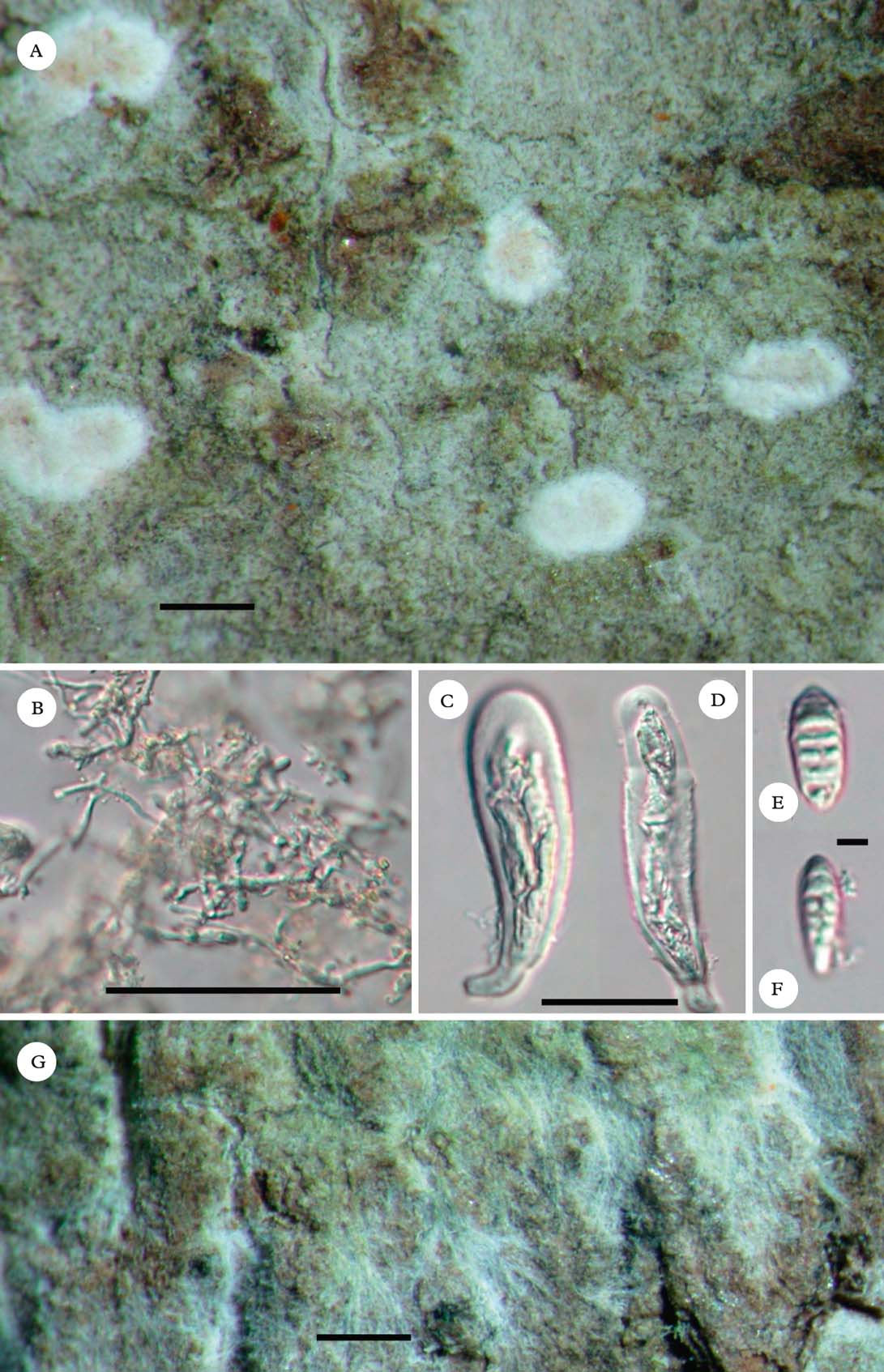
(Fig. 1)
Crypthonia lichexanthonica, holotype. A, habitus; B, hyphae; C, ascus; D, ascus with opened exoascus and still intact endoascus; E & F, ascospores; G, prothallus. Scales: A & G=0·5 mm; B–D=20 µm; E & F=5 µm. In colour online.
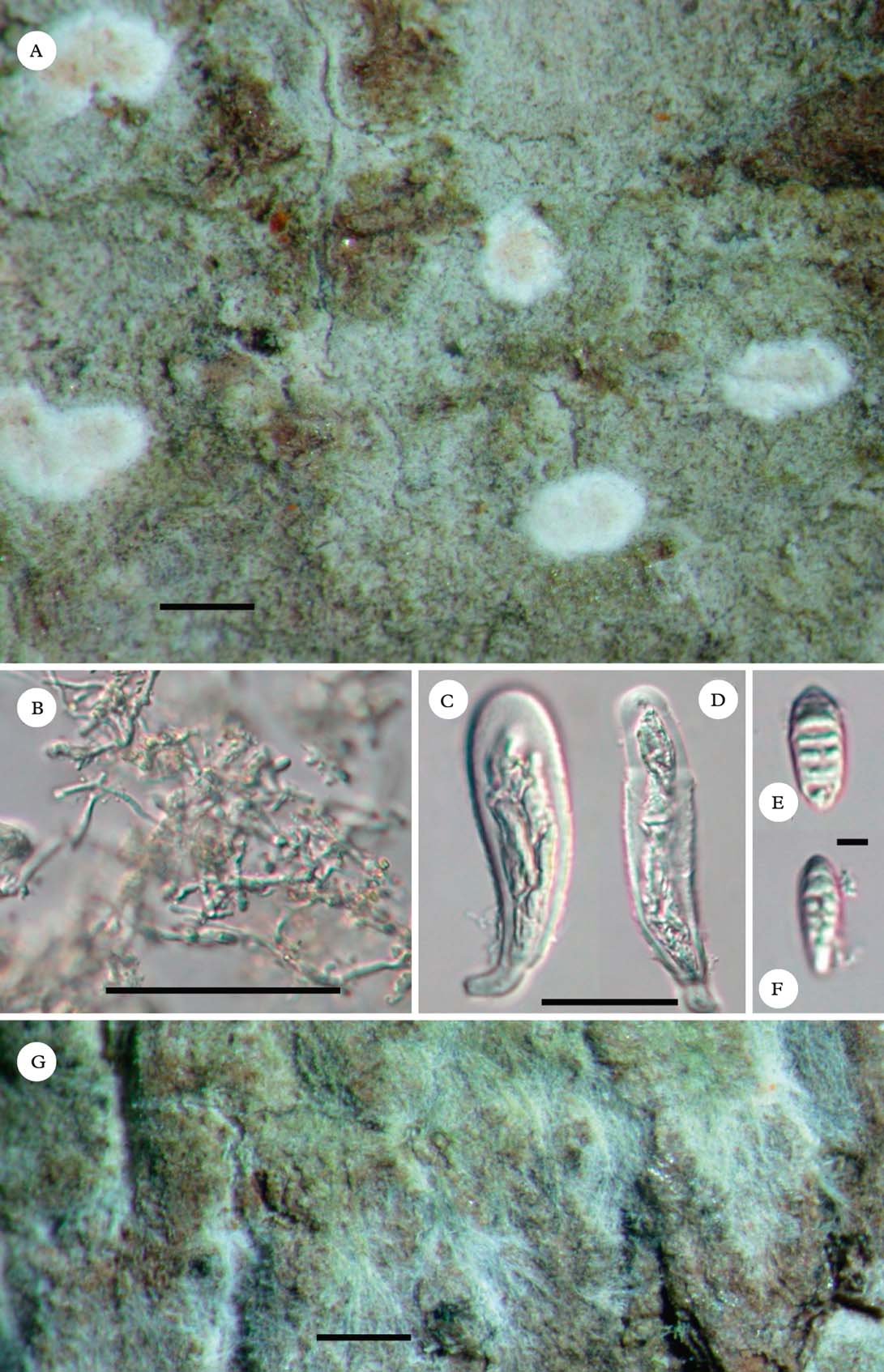
Thallus crustose, byssoid, surface finely granular to felty, not corticate, dull, pale glaucous grey, closely appressed, without hypothallus, surrounded by a white to brown byssoid prothallus. Hyphae c. 2 µm wide, incrusted with hyaline crystals. Algae trentepohlioid, 7–12 µm diam.
Ascigerous structures rounded to elongate or slightly lobate and flattened, 0·3–0·7×0·4–1·5 mm wide, central part (disc) white to cream, margin white. Interascal filaments densely anastomosing and curled, c. 1·0–1·5 mm wide. Hymenium densely incrusted with hyaline crystals, hydrophobic, without gelatine, IKI+ pale blue (hemiamyloid). Asci clavate, 45–55×12–15 µm, thick-walled, sometimes visible from above as pale brownish spots in the ascigerous structures. Ascospores 8 per ascus, hyaline, 7-septate, broadly fusiform, 15–19×6·0–7·5 µm, lumina ellipsoid, IKI+ reddish brown (dextrinoid), wall c. 1·0–1·5 µm thick, ends rather rounded.
Pycnidia not observed.
Chemistry
Thallus and ascigerous structures UV+ yellow, C−, P−, K−. TLC: lichexanthone.
Ecology and distribution
On smooth bark of trees in Caatinga forest. Known only from Brazil.
Discussion
This species differs from all known species of Crypthonia (Frisch & Thor Reference Frisch and Thor2010) by the presence of lichexanthone. This substance occurs in some other Arthoniales, especially in the related genus Cryptothecia. It differs from the following species by the ascospores, which are only transversely septate. The species is very close in aspect to some other species of Crypthonia, such as C. biseptata (Aptroot & Wolseley) Frisch & G. Thor and the species described below, and can only be differentiated when chemistry and internal structures are examined. The thallus is thinner than that of most other Crypthonia species, and as a consequence a distinct hypothallus is not discernible.
Crypthonia submuriformis A. A. Menezes, M. Cáceres & Aptroot sp. nov.
MycoBank No.: MB 802585
Crypthonia with lichexanthone in the ascigerous areas but not in the thallus, and submuriform (4–)7×0–1-septate ascospores 18–21×7–8 µm.
Type: Brazil, Ceará, Chapada do Araripe, on bark of tree, c. 900 m alt., 24 January 2011, A. A. Menezes 701 (ISE—holotype).
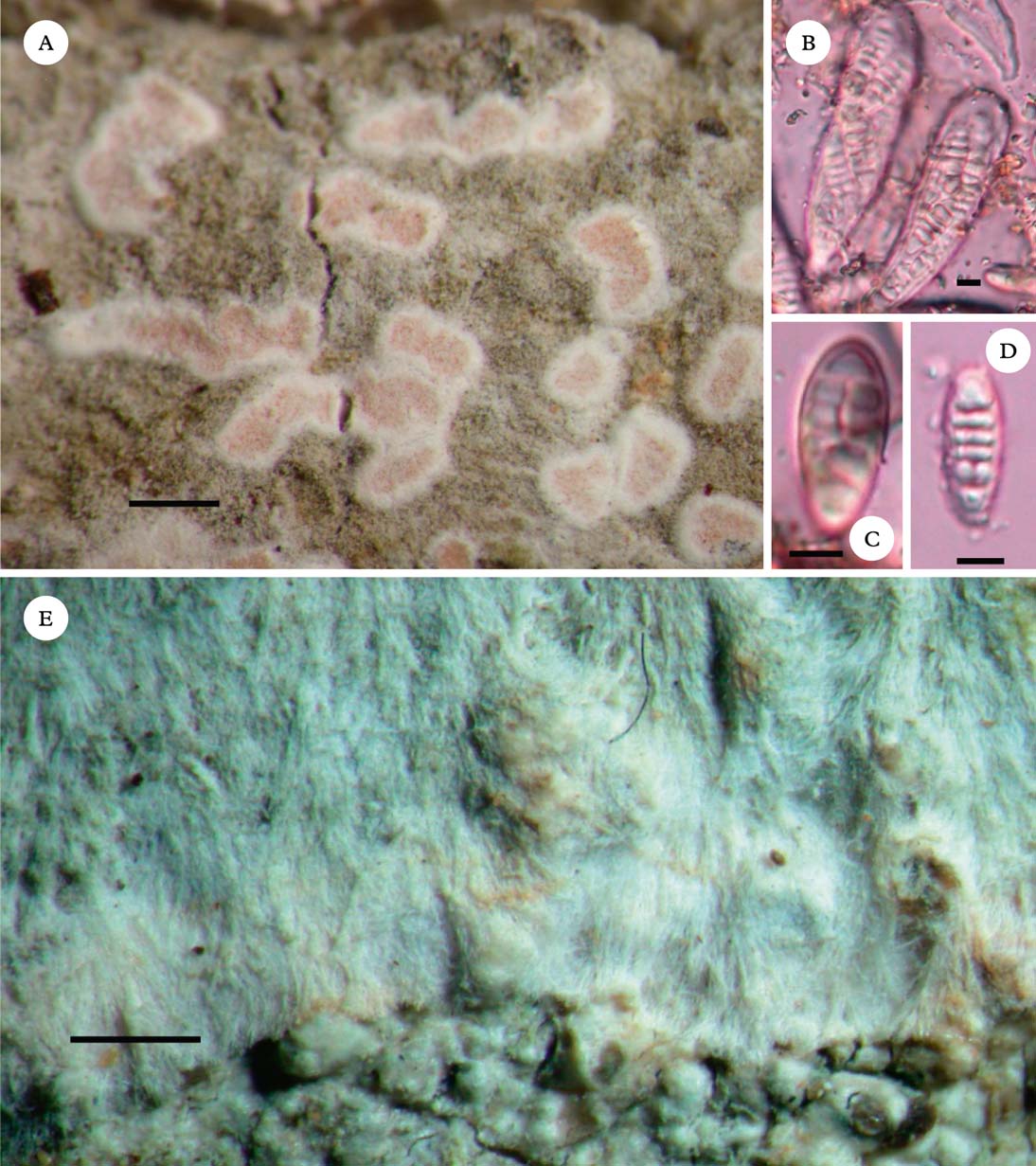
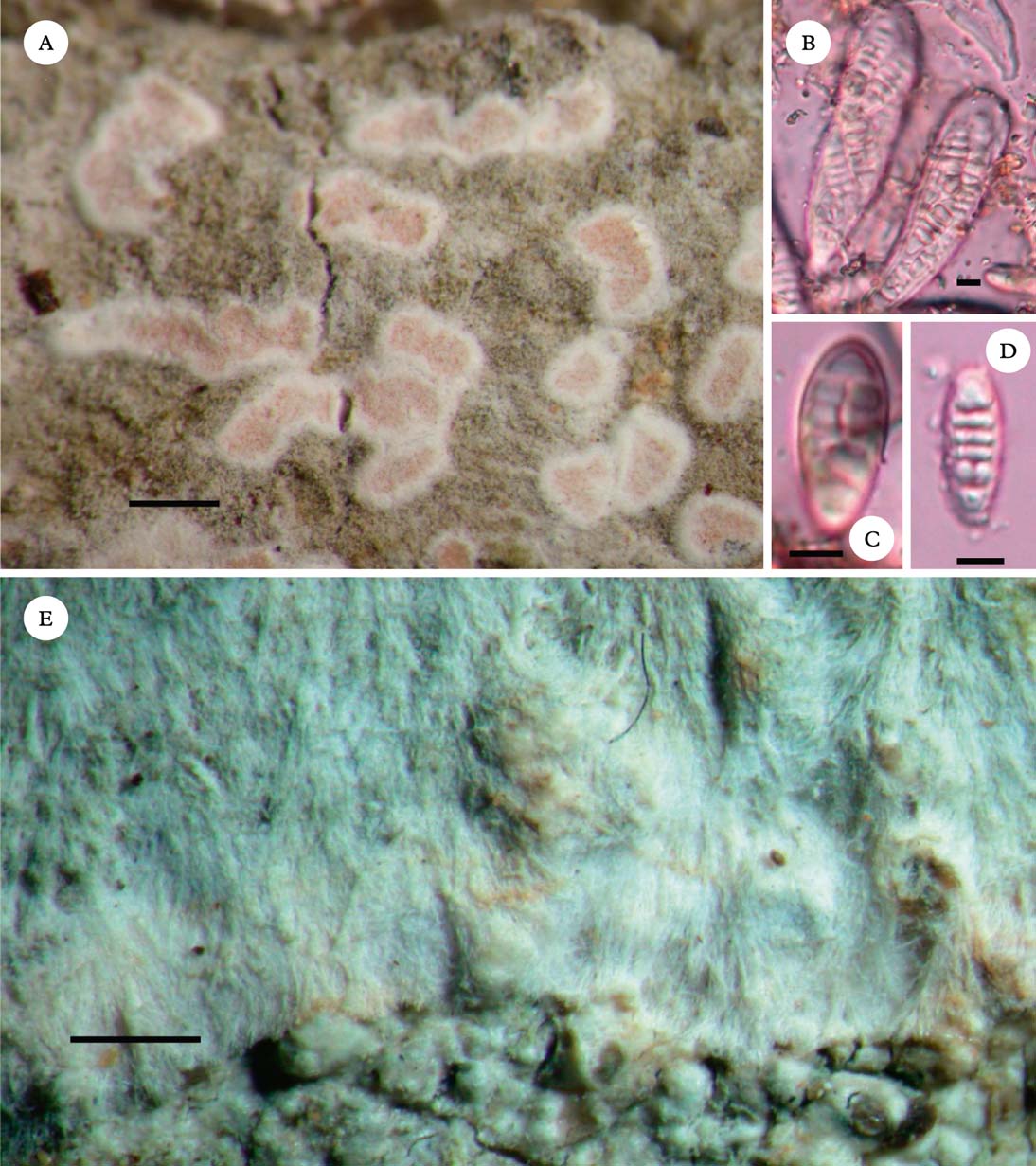
(Fig. 2)
Crypthonia submuriformis, holotype. A, habitus; B, asci; C & D, ascospores; E, prothallus. Scales: A & E=0·5 mm; B=10 µm; C & D=5 µm. In colour online.
Thallus crustose, byssoid, not corticate, dull, pale glaucous green, c. 0·1 mm thick, closely appressed, without a distinct hypothallus but buff to brownish where in contact with the bark, surrounded by a white byssoid prothallus up to 2 mm wide. Hyphae c. 2 µm wide, incrusted with hyaline crystals. Algae trentepohlioid, 7–10 µm diam.
Ascigerous structures slightly raised, rounded to lobate or elongated but usually with irregular outline, solitary or in loose groups, 0·4–0·9 mm diam., surface mauve, flattened, margin byssoid, white. Interascal filaments densely anastomosing and curled. Hymenium pallid brown by incrusted crystals, hydrophobic, without gelatine, IKI+ pale blue (hemiamyloid); epihymenium pale brown; hypothecium hyaline; excipulum hyaline, byssoid. Asci numerous, clavate, with 8 irregularly arranged ascospores which react IKI+ reddish (dextrinoid), 60–75×18·0–22·5 µm, at the top sideways up to 6 µm thick. Ascospores hyaline, submuriform (4–)7×0–1-septate, 18–21×7–8 µm, fusiform, ends rounded, end lumina initially largest, ultimately small (after the last divisions), wall c. 1 µm thick.
Pycnidia not observed.
Chemistry
Thallus UV−, C−, P−, K−; ascigerous areas UV+ yellow, C−, P−, K−. TLC: lichexanthone (only in the ascigerous areas).
Ecology and distribution
On smooth bark of trees in Caatinga forest. Known only from Brazil.
Discussion
This species differs from all known species of Crypthonia by the submuriform ascospores (Frisch & Thor Reference Frisch and Thor2010), and from all species in the genus, with the exception of C. lichexanthonica, by the presence of lichexanthone; in this species it is restricted to the ascigerous areas, while it occurs in the thallus in C. lichexanthonica. The species is very close in aspect to some other species of Crypthonia, such as C. biseptata (Aptroot & Wolseley) Frisch & G. Thor and the species described above, and can be differentiated only when chemistry and internal structures are examined. The thallus is thinner than that of most other Crypthonia species, and as a consequence a distinct hypothallus is not discernible, although the contact area with the bark is usually pigmented. The presence of species with (sub)muriform ascospores in genera in which all other known species have only transversely septate ascospores is not surprising, and a phenomenon now known in many phylogenetically well-circumscribed lichen genera.
Additional specimens seen. Brazil: Ceará: Chapada do Araripe, on bark of tree, c. 900 m alt., 2011, A. A. Menezes 8164, 8170, 8228, 8230, 8296, 8362, 8380, 8415 (all ISE).
Syncesia byssolomoides A. A. Menezes, M. Cáceres & Aptroot sp. nov.
MycoBank No.: MB 801922
Syncesia with psoromic acid, hyaline hypothecium, absence of carbonization and slender 3-septate ascospores 45–50×4·0–5·5 µm.
Type: Brazil, Ceará, Chapada do Araripe, on bark of tree, c. 900 m alt., May 2012, A. A. Menezes (ISE 15897—holotype).
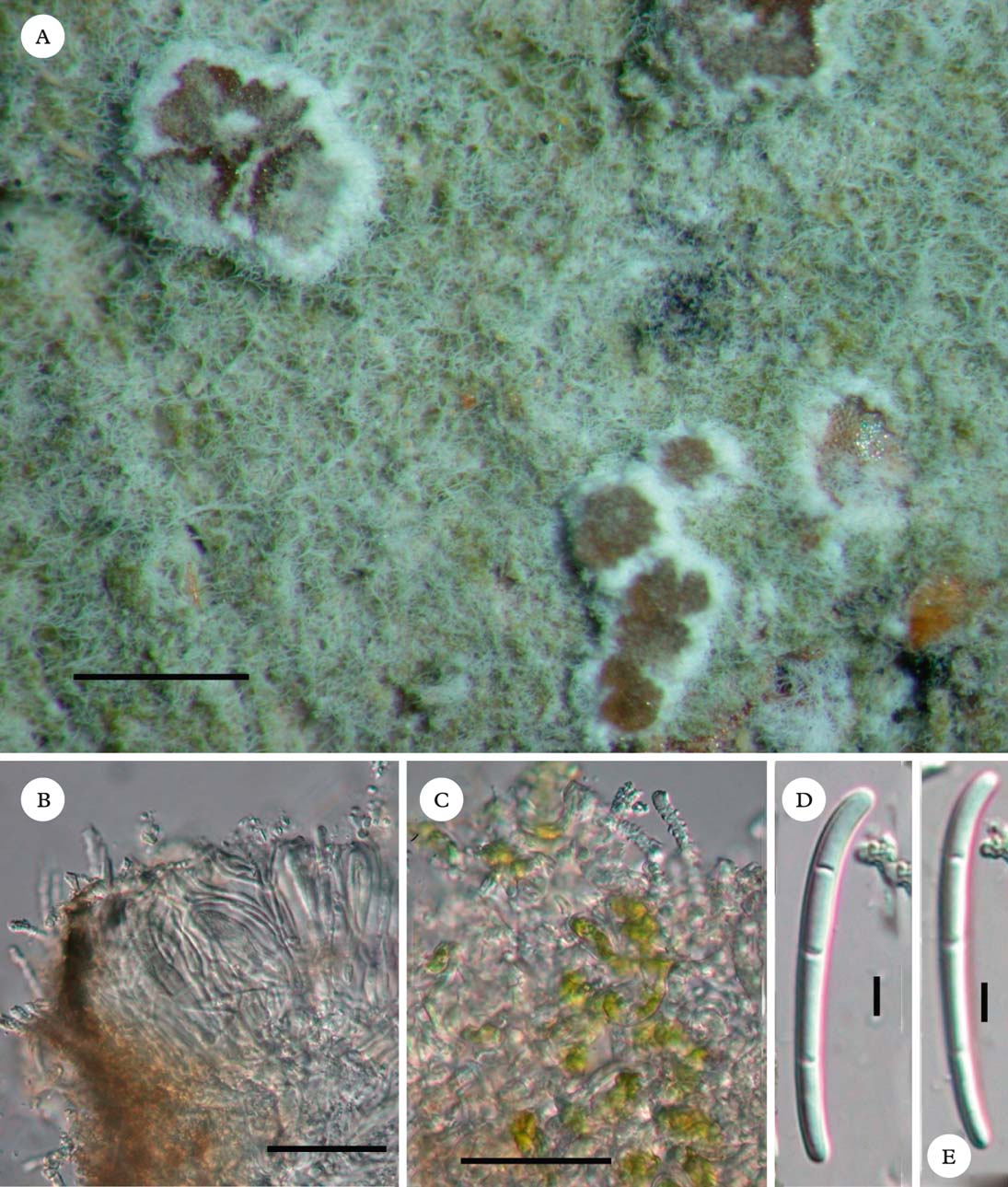
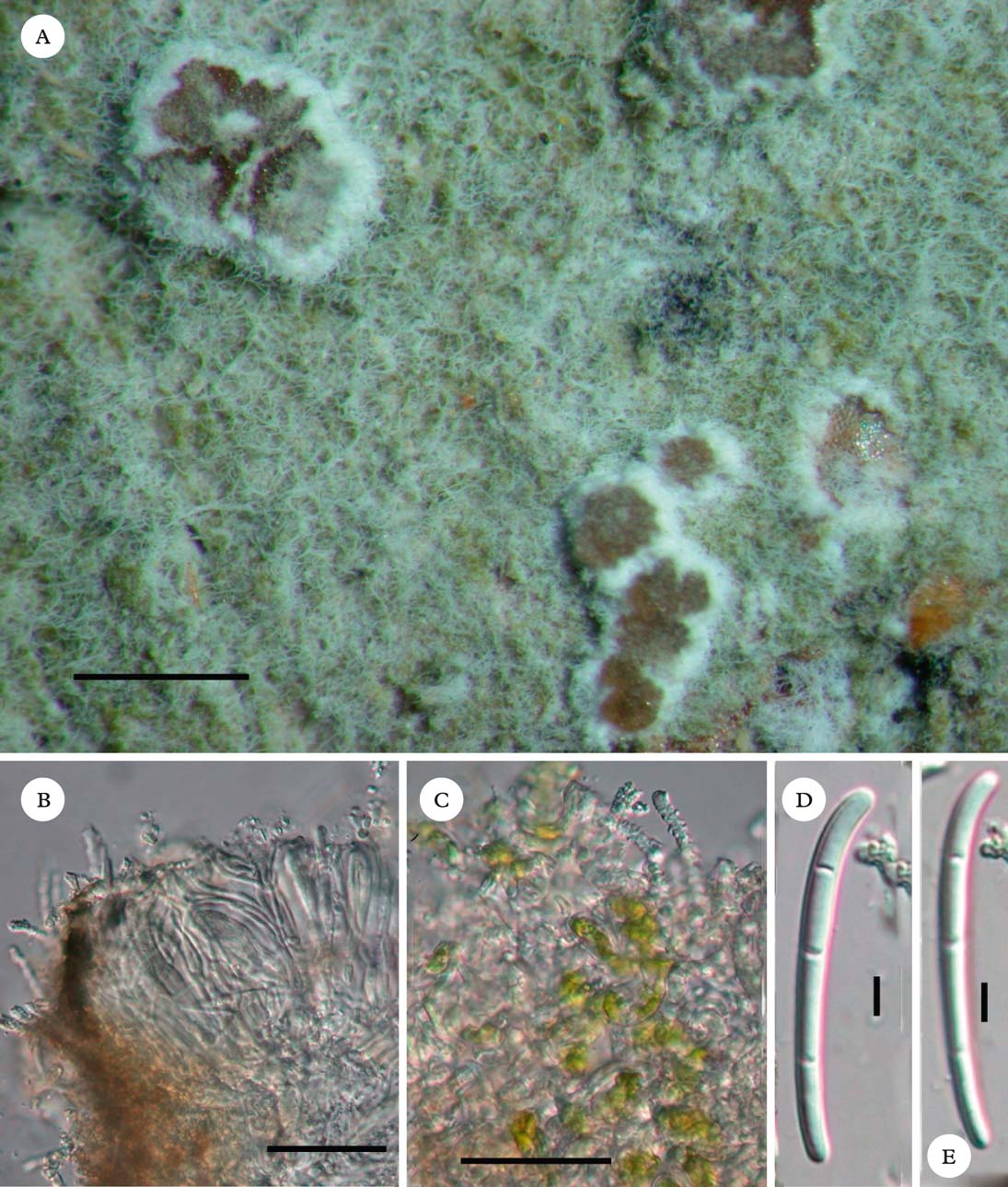
(Fig. 3)
Syncesia byssolomoides, holotype. A, habitus; B, section through ascoma zone; C, algae and hyphae; D & E, ascospores. Scales: A=0·5 mm; B=50 µm; C–F=5 µm. In colour online.
Thallus crustose, byssoid, not corticate, dull, pale glaucous green, c. 0·1 mm thick, surrounded by a brown byssoid prothallus line. Hyphae c. 3 µm wide, incrusted with hyaline crystals. Algae trentepohlioid, 5–10 µm diam.
Ascomata apothecioid, raised, rounded to lobate, solitary or in loose groups, 0·2–0·6 mm diam., surface pale brown, flattened, slightly white pruinose, margin byssoid, white. Interascal filaments branched pseudoparaphyses. Hymenium hyaline, IKI+ blue (amyloid); epihymenium pale brown; hypothecium hyaline; excipulum brownish inside, outside hyaline and byssoid. Asci numerous, clavate, with 8 irregularly arranged ascospores which react IKI+ reddish (dextrinoid), 60–75×15–25 µm, at the top sideways up to 5 µm thick. Ascospores hyaline, 3-septate, narrowly clavate, 45–50×4·0–5·5 µm, curved, ends rounded.
Pycnidia not observed.
Chemistry
Thallus and ascigerous structures UV−, C−, P+ yellow, K−. TLC: psoromic acid.
Ecology and distribution
On smooth bark of trees in Caatinga forest. Known only from Brazil.
Discussion
This species differs from all 22 currently known species of Syncesia by the hyaline hypothecium, a complete absence of carbonization and the presence of psoromic acid (Tehler Reference Tehler1997; Sipman Reference Sipman2009; Ertz et al. Reference Ertz, Killmann, Razafindrahaja, Sérusiaux and Fischer2010; Joshi et al. Reference Joshi, Upreti and Divakar2011; van den Boom et al. Reference van den Boom, Ertz, Brand and Sérusiaux2011). Superficially, it somewhat resembles a Byssoloma because of the byssoid ascoma margins, but differs, for example, in the byssoid thallus. It is with some hesitation that this new species is described here in the genus Syncesia, because the presence of a dark brown to black, nearly carbonized hypothecium is prominent in all described species. However, this seems to be the only major difference between the new species and some other species in the genus.
Revised world key to the species of Crypthonia
-
1 Thallus with pseudoisidia ... 2
Thallus without pseudoisidia ... 4
-
2(1) Thallus with norstictic acid; pantropical ... C. mycelioides
Thallus with psoromic acid ... 3
-
3(2) Hypothallus green; ascomata and ascospores unknown; neotropical ... C. albida
Hypothallus olive-brown; ascomata often present, ascospores 1-septate; palaeotropical ... C. palaeotropica
-
4(1) Ascospores submuriform or transversely 7-septate; with lichexanthone ... 5
Ascospores transversely 1–3-septate; without lichexanthone ... 6
-
5(4) Ascospores submuriform; Brazil ... C. submuriformis
Ascospores transversely 7-septate; Brazil ... C. lichexanthonica
-
6(4) Ascospores 1-septate ... 7
Ascospores (1–)2–3-septate. ... 10
-
7(6) Hypothallus lemon yellow; Ivory Coast ... C. citrina
Hypothallus olive-brown or green ... 8
-
8(7) Thallus with unknown compounds; hypothallus olive-brown; ascospores 10–14 µm long; Philippines ... C. polillensis
Thallus with psoromic acid; hypothallus and ascospores variable ... 9
-
9(8) Hypothallus green; ascospores 7·5–10·0 µm long; Brazil ... C. brevispora
Hypothallus olive-brown; ascospores 11–14 µm long; Reunion ... C. vandenboomii
-
10(6) Thallus with rugulosin; Tanzania ... C. bella
Thallus with gyrophoric or psoromic acid ... 11
-
11(10) Thallus with gyrophoric acid; hypothallus reddish brown; thallus dark olive-green; Brazil (also in NE Argentina: Misiones, Puerto Iguazú, 2013, Ferrari, Aptroot & Cáceres 10607, CTES & ABL) ... C. olivacea
Thallus with psoromic acid; hypothallus and thallus not as above ... l2
-
12(11) Ascospores 10–16 µm long, widest in the upper half; Australia ... C. athertoniensis
Ascospores 16–19 µm long, widest in the middle; Thailand ... C. biseptata
Discussion
Most species of the recently described genus Crypthonia (Frisch & Thor Reference Frisch and Thor2010) are so far known only from their type. The remainder of the species are apparently rare; few collections were cited in the original paper and no new records or new species appear to have been subsequently reported. Here, we have added two new species from Brazil and report a collection of a known species from Argentina. The genus seems to be richest in species in Brazil. It is remarkable that nearly 20% of the species now recognized in this genus are known only from one mountain, the Chapada do Araripe. The species newly described here share much of the thallus and ascoma organization with the other known species of the genus. Especially characteristic is the hydrophobic hymenium without gel, which is a shared character of only the genera Crypthonia and Coniarthonia. Coniarthonia differs from Crypthonia mainly by the crustose thallus and the always red-coloured apothecia. The new species markedly deviate by their ascospores, which have more septa, and they together share the lichexanthone chemistry which is not yet known from Crypthonia, but is rather frequent in tropical members of other genera in the Arthoniaceae.
The Conselho Nacional de Desenvolvimento Científico e Tecnológico (CNPq) is thanked for a research grant to MESC (Processo 501633/2009-0) and for financial support for the collecting trips (CNPq-PPBio/Semiárido Processo 558317/2009-0). The Coordenação de Aperfeiçoamento de Pessoal de Nível Superior (CAPES) is also thanked for a Master's scholarship to AAM and ABXL. The Hugo de Vries-fonds is thanked for travel support to AA. We are grateful to Leo Spier for performing thin-layer chromatography.