


Introduction
This study presents the first test of a key premise of a cognitive model of bipolar disorder (BD) in adolescents. The integrative-cognitive model of BD (ICM; Mansell, Morrison, Reid, Lowens and Tai, Reference Mansell, Morrison, Reid, Lowens and Tai2007) proposes that individuals who experience problematic mood swings may appraise changes in their mood and internal state in extreme, personal, and sometimes conflicting ways. As in cognitive models of other disorders such as panic disorder (Clark, Reference Clark1986), appraisals of internal state are said to determine maladaptive behaviours to attempt to regulate that state, which in turn can worsen or perpetuate these states. In the context of BD, a positive appraisal of an increase in energy or activation (e.g. “when I feel full of energy I am extremely funny and witty”) might lead an individual to engage in “ascent behaviours” to maintain or escalate this activated, high mood, such as increased goal-directed activity, or decreasing sleep. Conversely, a negative appraisal (e.g. “when I get excited I can't control my thoughts”) of the same change in mood state might lead to descent behaviours, such as withdrawing from social contact and reducing activity levels, which would drive mood and energy levels downwards.
Conflicting appraisals of internal states
Appraising the same internal state as both extremely positive and extremely negative is said to be particularly problematic, driving individuals to switch between ascent and descent behaviours and leading to problematic mood changes (Mansell et al., Reference Mansell, Morrison, Reid, Lowens and Tai2007). For example, if an individual appraised feeling really active and energetic as both meaning that their fears and worries would go away and meaning that others would react negatively to them, then they might alternate between trying to maintain their high energy by keeping very active, and trying to reduce their energy levels by withdrawing from activities and other people.
Converging research in adult samples supports the integrative-cognitive model. Beliefs or appraisals about mood states and their consequences, as measured by the Hypomanic and Positive Predictions Inventory (HAPPI), have been shown to discriminate individuals with bipolar disorder (BD) from controls and individuals with unipolar depression (e.g. Kelly et al., Reference Kelly, Mansell, Wood, Alatiq, Dodd and Searson2011), with individuals with BD being more likely to endorse conflicting appraisals of the same internal states than individuals with unipolar depression or controls. Appraisals were found to prospectively predict mood symptoms in non-clinical (Dodd, Mansell, Sadhnani, Morrison and Tai, Reference Dodd, Mansell, Sadhnani, Morrison and Tai2010) and BD samples (Dodd, Mansell, Morrison and Tai, Reference Dodd, Mansell, Morrison and Tai2011). These findings suggest that extreme and conflicting cognitions about mood states are not simply a symptomatic expression of BD, but may be relevant to the development and exacerbation of symptoms.
Research testing the integrative cognitive model has also been conducted in at-risk groups. Adult offspring of BD parents were found to be more likely to endorse extreme appraisals of internal states than offspring of parents with no mood disorder, regardless of their own history of mood episodes (Ruggero, Bain, Smith and Kilmer, Reference Ruggero, Bain, Smith and Kilmer2013). In addition, in a study of adolescent offspring (aged 13–19), adolescents who had a parent with BD and met criteria for any psychiatric disorder scored significantly higher on the HAPPI measure of appraisals than unaffected offspring of BD parents and controls (Pavlickova, Turnbull and Bentall, Reference Pavlickova, Turnbull and Bentall2014).
To our knowledge, no research has investigated the relationship between appraisals of internal states and mood symptoms in younger adolescents (i.e. aged 13–17). It is important to attempt to replicate this research with adolescents to determine whether the cognitive model of BD and associated therapy approach might apply to adolescents. In 2006, the National Institute for Clinical Excellence (NICE) reported that there were no formal evaluations of psychological treatments for BD in children and adolescents. There has been some progress since, but results have been mixed, and as yet no well-established treatments exist (Fristad and Algorta, Reference Fristad and Algorta2013).
Adolescence is a critical period in the development of bipolar disorder. Within a large cohort with an average initial age of 13, the COBY study (Birmaher et al., Reference Birmaher, Axelson, Strober, Gill, Valeri and Chiappetta2006) identified that over a 2-year period, 25% of those with BD-NOS (brief or subthreshold hypomania symptoms) went on to develop Bipolar Disorder I or II. Further, 20% of those with Bipolar Disorder II converted to Bipolar Disorder I. These findings suggest that around age 14–15, symptoms of BD begin to worsen, and that there is a gradual progression from sub-syndromal symptoms to full clinical episodes. These findings underline the importance of studying non-clinical bipolar symptoms in this age group, as they represent a risk factor for the later development of clinical BD.
The present study had three aims: 1) To test whether specific types of extreme appraisals were uniquely associated with distinct clusters of mood symptoms: activation (hypomania) and depression, replicating Kelly, Mansell, Sadhnani and Wood (Reference Kelly, Mansell, Sadhnani and Wood2012); 2) To investigate whether multiple, extreme and contradictory appraisals were associated with mood symptoms and an index of mania history and future risk; replicating Dodd et al. (Reference Dodd, Mansell, Morrison and Tai2011); 3) To test whether opposing appraisals of the same internal states differentiated individuals scoring more highly on an index of future mania risk; in line with Kelly et al. (Reference Kelly, Mansell, Wood, Alatiq, Dodd and Searson2011).
Method
Measures
Measure of appraisals of mood states
Cognitions about mood states were assessed using the Hypomanic and Positive Predictions Inventory (HAPPI; Mansell, Reference Mansell2006). The HAPPI is a 50-item measure of extreme, personalized appraisals of different internal states, for example, “When I get excited about something I have no control over my thoughts”, rated for the past week on a visual analogue scale from 0 (I don't believe this at all) to 100 (I believe this completely). The HAPPI prospectively predicted clinical depression and mania over a 4-week period (Dodd et al., Reference Dodd, Mansell, Morrison and Tai2011). The scale was adapted for young adolescents (available on request). For example, “When my energy levels increase, I can bring about a large rise in my social status” was reworded slightly to “When I feel full of energy, I can make more friends and have more people like me”. Internal consistency was excellent (α = .95). Total scores for “positive appraisals” and “negative appraisals” subscales were the sum of only those items that three independent researchers agreed were clearly positive or negative (rather than ambiguous) appraisals respectively of high-activation states (and not other internal states, e.g. feeling sad) (Kelly et al., Reference Kelly, Mansell, Wood, Alatiq, Dodd and Searson2011).
Mood measures
Depression and hypomania (activation) were assessed using the Internal States Scale (ISS; Bauer et al., Reference Bauer, Crits-Christoph, Ball, Dewees, McAllister and Alahi1991). The depression subscale assesses depressive symptoms (e.g. “I feel depressed”, “It seems like nothing will ever work out for me”) and the activation subscale assesses behavioural and cognitive activation (e.g. “I feel overactive”, “My thoughts are going fast”). ISS activation and depression scores are elevated in manic and depressed patients respectively and are associated with clinician ratings of mania and depression (Bauer et al., Reference Bauer, Crits-Christoph, Ball, Dewees, McAllister and Alahi1991; Bauer, Vojta, Kinosian, Altshuler and Glick, Reference Bauer, Vojta, Kinosian, Altshuler and Glick2000). The ISS has been used widely in adult and adolescent bipolar disorder research. Internal consistencies for activation and depression were .73 and .88 respectively.
Irritability was also assessed using The Affective Reactivity Index (ARI; Stringaris et al., Reference Stringaris, Goodman, Ferdinando, Razdan, Muhrer and Leibenluft2012) developed for children and adolescents, as irritability is common in adolescent depression and hypomania (Stringaris et al., Reference Stringaris, Goodman, Ferdinando, Razdan, Muhrer and Leibenluft2012). The ARI comprises six symptom items (e.g. “I stay angry for a long time”) and one impairment item (“overall, my irritability causes me problems”). Items are rated “not true”, “somewhat true” or “certainly true” with respect to the past week. The scale has a single factor structure, good agreement between parent- and child-report, and is predictive of emotional problems (Stringaris et al., Reference Stringaris, Goodman, Ferdinando, Razdan, Muhrer and Leibenluft2012). Internal consistency was .86.
Lifetime history of (hypo) manic experiences was assessed using the Mood Disorder Questionnaire (MDQ; Hirschfield et al., Reference Hirschfeld, Williams, Spitzer, Calabrese, Flynn and Keck2000). The scale comprises 13 symptom items corresponding to the DSM-IV criteria for (hypo) mania, one question about the co-occurrence of symptoms, and one question regarding their impact. The total number of symptoms was calculated; this score correlates highly with hypomanic personality and represents a useful index of risk for future mania (Udachina and Mansell, Reference Udachina and Mansell2007). Individuals were also stratified into high (HLC), moderate (MLC) and low (LLC) likelihood of caseness according to criteria proposed by Isometsae et al. (Reference Isometsae, Suominen, Mantere, Valtonen, Leppämäki and Pippingsköld2003), as this method maximises the sensitivity of the measure and minimises false negatives (Udachina and Mansell, Reference Udachina and Mansell2007). Individuals met criteria for HLC if they endorsed at least 8 co-occurring symptoms causing minor to serious problems, MLC if they reported at least 8 symptoms that either co-occurred or caused minor problems, and LLC if they met neither criterion. Internal reliability for the symptom items was very good (.78).
Regulation of positive mood states was assessed using the Responses to Positive Affect scale – child version (RPA-C; Bijttebier, Raes, Vasey and Feldman, Reference Bijttebier, Raes, Vasey and Feldman2012). This scale has 17-items assessing dampening (e.g. “think about things that could go wrong”) and focusing (e.g. “think about how happy you feel”) responses. In adults, high scores are associated with hypomanic personality (Feldman, Joormann and Johnson, Reference Feldman, Joormann and Johnson2008) and bipolar disorder (Gruber, Eidelman, Johnson, Smith and Harvey, Reference Gruber, Eidelman, Johnson, Smith and Harvey2012). In young people aged 10–14, low focusing and high dampening were associated with depressive symptoms, whilst high focusing related to hypomanic symptoms (Bijttebier et al., Reference Bijttebier, Raes, Vasey and Feldman2012). Internal reliability for dampening and focusing subscales was good; .70 and .68 respectively.
Impulsivity was assessed using the Behavioural Activation System (BAS) Fun-Seeking Subscale (Carver and White, Reference Carver and White1994). The 4-item scale assesses tendencies to pursue new, rewarding experiences and to act without regard to possible consequences of one's actions (e.g. “I often act on the spur of the moment”). The measure can be used validly with early adolescents (Cooper, Gomez and Aucote, Reference Cooper, Gomez and Aucote2007), has good test-retest reliability (r = .69), and correlates highly with global measures of impulsivity (Carver and White, Reference Carver and White1994). The fun-seeking dimension of impulsivity is particularly relevant to hypomania (Giovanelli, Hoerger, Johnson and Gruber, Reference Giovanelli, Hoerger, Johnson and Gruber2013), and has been found to predict onset of BD (e.g. Meyer, Johnson and Carver, Reference Meyer, Johnson and Carver1999). In the present study, internal reliability was very good (.76).
Participants
In total 98 adolescents aged 14–15 (M = 14.58, SD = .5) participated. Approximately half (58%) were male. Approximately 50% of the sample was White British (49), 14 described themselves as Black African or Afro-Caribbean, 7 as Latin American, 7 as mixed race, 6 as Black British, and the remaining 15 participants belonged to a wide range of ethnic groups. Socio-economic status and IQ data were not collected.
Procedure
Ethical approval was granted by the King's College London Research Ethics Committee. Candidate schools and sixth form colleges were identified through researcher contacts and lists of schools participating in previous research and invited to take part. Participants were recruited through one secondary school in central London. Informed consent was obtained from both pupils and parents. Measures were administered in pen-and-paper format to small groups of pupils. Participants who did not complete at least 50% of the questionnaire items were excluded from analyses (n = 3). No other participants were excluded and no outlying data were removed.
Results
Hypothesis 1: Positive and negative appraisals of activated states will be uniquely associated with different mood symptoms
Two hierarchical multiple regression analyses were conducted with activation symptoms and depression symptoms respectively as the outcome variables. In line with Kelly et al. (Reference Kelly, Mansell, Sadhnani and Wood2012), in both regression models the other symptom cluster was included as a covariate in Step 1, to enable unique predictors of each type of mood symptom to be tested and to control for the correlation between high and low mood symptoms. In addition, gender was included as a covariate in the regression on depression, as the male and female participants differed significantly in terms of average level of depression symptoms. An additional multiple regression analysis was conducted to test unique predictors of irritability symptoms, controlling for activation and depression symptoms in Step 1. Regressions showed significant heteroscedasticity, and dependent variables were negatively skewed. Logarithmic transformations were therefore applied to the problematic dependent variables.
Activation symptoms
The model significantly predicted activation (hypomania) symptoms (F (92, 3) = 13.97, p < .001), explaining 32% of the variance. Depression symptoms (β = .32, p = .002) and positive appraisals (β = .31, p = .005) were significant positive predictors. Negative appraisals were not a significant predictor (β = .13, p = .30).
Depression symptoms
The model significantly predicted depression symptoms (F (88, 4) = 13.89, p < .001), explaining 40% of the variance. Gender (β = .29, p = .001), activation symptoms (β = .28, p = .006) and negative appraisals (β = .45, p < .01) were significant positive predictors. Positive appraisals (β = −.20, p = .07) tended towards a negative association with depression symptoms.
Irritability symptoms
The model significantly predicted irritability symptoms (F (89, 4) = 6.91, p < .001), explaining 25% of the variance. Activation symptoms (β = .25, p = .03) and negative appraisals (β = .46, p < .001) were significant positive predictors. Positive appraisals (β = −.22, p = .07) tended towards a negative association with irritability. Depression symptoms were not a significant predictor (β = −.02, p = .86).
Hypothesis 2: Total scores on the HAPPI will be associated with concurrent symptoms of activation, depression and irritability, and self-reported history of (hypo) mania symptoms, independently of impulsivity and responses to positive mood states
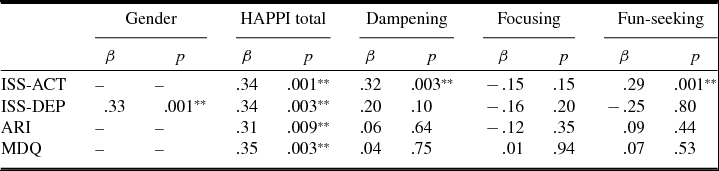
Four regression analyses were conducted with activation, depression, irritability and MDQ symptoms as the outcome variables (see Table 1). In each regression model, total HAPPI score, dampening, focusing, and impulsivity (fun-seeking) were entered into the model. In the regression on depression, gender was entered as an additional covariate. As above, logarithmic transformations were applied to dependent variables.
Multiple regressions on symptom measures, with covariates

Notes: ISS-ACT = activation symptoms, ISS-DEP = depression symptoms, ARI = irritability symptoms, MDQ = mood disorders questionnaire total score. Standardised regression coefficients are presented in the table. ** p < .01. Where – appears, this variable was not entered into the regression.
Activation symptoms
The model significantly predicted activation (hypomania) symptoms (F (93, 4) = 15.01, p <.001; R2 = .40). The HAPPI total score, impulsivity and dampening were significant positive predictors. Focusing was a significant negative predictor.
Depression symptoms
The model significantly predicted depression symptoms (F (90, 5) = 5.59, p < .001, R2 = .25). Gender and the HAPPI total score were the only significant predictors; the HAPPI total was positively associated with depression symptoms.
Irritability symptoms
The model significantly predicted irritability symptoms (F (92, 4) = 3.08, p = .02; R2 = .12). The total HAPPI score was the only significant positive predictor.
MDQ symptoms
The model significantly predicted MDQ symptoms (F (95, 4) = 4.32, p = .003; R2 = .16). The total HAPPI score was the only significant positive predictor.
Hypothesis 3: The interaction between positive appraisals and negative appraisals of activated states will differentiate those scoring at high or moderate likelihood of caseness (i.e. those “at risk of future mania”) from those scoring at low likelihood of caseness
A logistic regression model was tested comparing individuals at high (HLC) and moderate (MLC) likelihood of caseness on the MDQ to individuals at low likelihood of caseness (LLC). The total scores for positive appraisals and negative appraisals of high mood states were standardized, and the standardized scores were entered into the regression model in Step 1. An interaction term was calculated by multiplying the standardized positive and negative appraisal scores, and this product term was entered into the regression in Step 2.
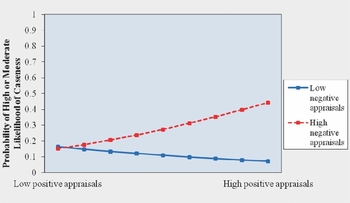
The model significantly differentiated HLC and MLC from LLC (χ2 (3) = 12.30, p = .006). In Step 1, neither positive appraisals nor negative appraisals were significant predictors. The interaction term was added in Step 2, which significantly improved model fit, as assessed by the change in log likelihood, which has a chi-square distribution (χ2 (1) = −5.58, p = .006). Neither positive appraisals (β = .14, p = .68) nor negative appraisals (β = .56, p = .11) were significant predictors, but the interaction term was a significant predictor (β = .60, p = .03, Exp (B) = 1.83). The interaction effect is depicted in Figure 1, and demonstrates that for individuals who endorse high levels of positive appraisals but low levels of negative appraisals, the chance of being in the high or moderate likelihood of caseness group is low. In contrast, for individuals who endorse both high levels of positive appraisals and high levels of negative appraisals, the chance of being in the high or moderate likelihood of caseness group is increased.
Graph depicting the effect of the interaction between positive and negative appraisals on probability of scoring at high or moderate likelihood of caseness on the MDQ (compared to low likelihood of caseness)

Discussion
The present study aimed to identify whether adolescents who interpret internal states in extreme or conflicting ways experience more mood symptoms and whether they might be more at risk for BD. The results indicate that extreme positive and negative cognitions about activated mood states are associated with analogue mood symptoms and mania risk in young adolescents. This finding was robust and remained significant when controlling for impulsivity; a relatively stable construct that relates to overall risk for mood instability and mania (e.g. Meyer et al., Reference Meyer, Johnson and Carver1999; Giovanelli et al., Reference Giovanelli, Hoerger, Johnson and Gruber2013); and responses to affect; which the ICM suggests would be determined by appraisals of internal states. Positive appraisals of activated states related specifically to hypomania symptoms, whilst negative appraisals related to depression and irritability symptoms, replicating Kelly et al. (Reference Kelly, Mansell, Sadhnani and Wood2012). Further, the presence of conflicting appraisals of activated, high energy states significantly differentiated individuals at moderate or high likelihood of caseness for BD from individuals at low likelihood of caseness, converging with adult research indicating that conflicting appraisals relate to clinical BD (Kelly et al., Reference Kelly, Mansell, Wood, Alatiq, Dodd and Searson2011) and suggesting that it is not simply positive appraisals of hypomanic states that are problematic, but instead the extent to which these are in opposition to negative appraisals of the same states. These results provide the first evidence that extreme and conflicting appraisals of internal states relate to mood symptoms and indices of mania risk in young adolescents. Further, the effects of appraisals of internal states were robust and independent of other factors associated with symptoms and mania risk.
These results are important because the participants were young adolescents and below the age at which individuals often experience their first BD episode, indicating that extreme and contradictory appraisals of internal states might be present before significant mood episodes and their consequences such as hospitalization are likely to have occurred, suggesting these extreme appraisals of mood states are not simply “scarring” from previous episodes. Thus, these findings might offer support for the argument that these cognitions play a role in the development of problematic mood swings (Mansell et al., Reference Mansell, Morrison, Reid, Lowens and Tai2007), and are part of the diathesis for BD (Ruggero et al., Reference Ruggero, Bain, Smith and Kilmer2013).
Extreme appraisals and both dampening and focusing in response to positive affect were associated with activation (hypomania) symptoms, suggesting a role for both appraisals and responses in determining mood symptoms. In order to further test the ICM of mood swings in young people, it will be necessary to ascertain the relationship between appraisals and responses to mood changes; including ascent and descent behaviours (Mansell et al., Reference Mansell, Morrison, Reid, Lowens and Tai2007); and whether these relate to mood fluctuations over time.
This research requires replication at other points along the spectrum of bipolar disorder, for example with a sample of adolescents with a bipolar diagnosis. Whilst BD-I is rare in young adolescents, young adolescents are more frequently found to meet criteria for BD-NOS and BD-II, and research suggests that there is a pattern of progression from these diagnoses to BD-I (Birmaher et al., Reference Birmaher, Axelson, Strober, Gill, Valeri and Chiappetta2006). Future research could examine whether the relationship between appraisals and symptoms is replicated in individuals meeting criteria for these disorders, and investigate whether adolescents at the more severe end of the bipolar spectrum tend to endorse more extreme and conflicting beliefs and appraisals of internal states. A further empirical question is when in development these appraisals emerge.
Research is needed to establish why and how these appraisals emerge, if they are not simply a consequence of mood episodes. These appraisals are likely in part to reflect an awareness of genuine vulnerability to mood fluctuations (Mansell, Reference Mansell2007). Adolescents might develop positive and negative beliefs about different mood states based on their own experiences of changes in mood and their consequences, through observing the experiences of parents and others, or through learning from family members about the acceptability of certain emotions and about when and how to regulate positive and negative emotions. Qualitative research focusing on why and how extreme appraisals of mood states emerge would be particularly informative. Longitudinal research with older samples suggests appraisals relate to BD independently of current mood and prospectively predict mood symptoms; replication is required with younger samples.
There are multiple versions of the HAPPI, including the 50-item version used in the present study, which comprises the items from the original pilot list of 104 that best distinguished individuals with BD from healthy controls (Mansell, Reference Mansell2006); a brief 30-item version that includes “catch” and reverse-scored items (Mansell and Jones, Reference Mansell and Jones2006); and an expanded 61-item version designed to also incorporate self-critical beliefs during activated states and appraisals of activated states as confusing and overwhelming (Dodd et al., Reference Dodd, Mansell, Sadhnani, Morrison and Tai2010). In future, direct comparisons of these different versions would provide clarity regarding the items most relevant to BD.
If replicated and extended to clinical samples, these findings may have implications for understanding of interventions for mood swings in young people. Current therapeutic interventions for BD focus primarily on addressing behavioural expressions of mood symptoms or trying to alter the internal state itself (e.g. through medication), and tend not to focus on internal processes such as thinking patterns and beliefs about mood states (Mansell, Reference Mansell2007). Appraisals of intrusions into awareness and internal experiences often represent important targets for cognitive-behavioural interventions, but have been understudied in BD in both adults and children and adolescents. Appraisals of internal states might be useful targets for intervention in psychological therapy for young people experiencing mood swings and BD, particularly where there is ambivalence about making behavioural changes such as improving sleep or reducing activity. For example, a young person might believe that being very active helps them achieve good grades and feel confident around their friends, but also believe that their high moods are impossible to control and lead to other people criticizing or not understanding them. If these conflicting beliefs are not acknowledged and explored, the person might be reluctant to engage in behaviours to reduce their level of activation. Interventions that encourage young people to consider and weigh their beliefs and appraisals of different states against one another, or test out beliefs using behavioural experiments, might therefore be more likely to lead to behavioural change and improved coping. In adult BD, initial evaluations of a CBT approach focusing on appraisals of internal states are promising (Searson, Mansell, Lowens and Tai, Reference Searson, Mansell, Lowens and Tai2012), but this model is yet to be tested with children or adolescents.
This study is limited by its reliance on self-report measures. Objective ratings of mood and functioning from parents or teachers would have been advantageous, and information about adolescents’ parents’ psychiatric history would also have provided another index of risk for BD. Information about diagnosis and psychiatric history was also not collected from participants in this study, so it cannot be determined from this study alone that extreme appraisals relate to child and adolescent BD. Nevertheless, this study advances the existing knowledge on cognitive models of mood swings, by demonstrating that extreme and conflicting appraisals of internal states are associated with concurrent mood symptoms and an index of mania risk in a sample of adolescents aged under-18. Further research is now warranted. If replicated, the findings of this study may have implications for psychological interventions for mood swings and BD in adolescents.
Acknowledgements
This research received no specific grant from any funding agency, commercial or not-for-profit sectors. Conflicts of interest: None. The authors assert that all procedures contributing to this work comply with the ethical standards of the relevant national and institutional committees on human experimentation and with the Helsinki Declaration of 1975, as revised in 2008. Ethical approval was granted by the King's College London Psychiatry, Nursing and Midwifery Research Ethics Committee.



Comments
No Comments have been published for this article.