According to archeological research of the past decades, the beginning of metallurgy in Mesoamerica can be geographically located in West Mexico, a region that encompasses the present-day states of Jalisco, Nayarit, Colima, Guerrero, and Michoacan (as well as smaller portions of neighboring states). These activities seem to have begun around a.d. 600–700 and can be divided into two major phases: (a) a first one, ending around a.d. 1200–1300, that is characterized by the use of copper for sumptuary and ritual objects, with a strong interest in their abilities to produce sound; and (b) a second phase that ended with the arrival of the Spaniards at the beginning of the sixteenth century, in which major technological innovations, such as the use of alloys, permitted the creation of a much wider variation in form, strength, color, and function of artifacts (Hosler Reference Hosler1986, Reference Hosler1988a, Reference Hosler1988b, Reference Hosler and Maddin1988c, Reference Hosler1994, Reference Hosler1997).
Accepting and further expanding the well-known theory about a possible South American origin of West Mexican metallurgy, developed in the early twentieth century (e.g., Arsandaux and Rivet Reference Arsandaux and Rivet1921, among others), Hosler argues that these phases could in fact reflect two periods in the (maritime) contacts between these two distant regions (see also Dewan and Hosler Reference Dewan and Hosler2008). Crucial elements in her argumentation are the fact that the appearance of metalworking in West Mexico occurred some 2000 years later than in Ecuador (1500 b.c.) and that artifacts from both regions show similarities in design, manufacturing techniques, the use of metals and alloys, and social meaning. Furthermore, she refers to pottery styles and the famous shaft tombs that appear to constitute additional evidence for contacts between South America and West Mexico (Hosler Reference Hosler1988b, Reference Hosler1994).
Research of the past decades shows the important role that metallurgy occupied in West Mexican societies and especially in the context of the Postclassic period Tarascan state that developed in Michoacan. In a pioneering work that combines technical analysis of ores and artifacts with information from archaeological, historical, and ethnographical sources, Hosler demonstrates that metals, just like many other materials, were clearly related to supernatural forces. She argues that the latter, manifest in the properties of the various metals and the use of the artifacts, constitutes an important element that influenced the technical decisions of the specialists who combined form and function with the main material characteristics: color and sound. Existing evidence seems to indicate that the majority of the metallurgical production was destined to sumptuous and ritual functions (especially the bells, diadems, discs, pendants, pins, etc.) although the smiths were also very capable toolmakers (Hosler Reference Hosler1994:227–228). According to Perlstein Pollard (Reference Perlstein Pollard1987) the metal goods were not only individual manifestations of social wealth and power but, at the end of the Postclassic period (early sixteenth century), clearly became material expressions of political-religious (state) ideology and were considered crucial in maintaining the existing social order.
Taking into consideration that the ritual and sumptuary functions of metal artifacts in West Mexico have been extensively studied, also including comparatives with other areas in Mesoamerica and South America, the present article focuses on a lesser-known aspect of ancient metallurgy in Michoacan: the sacred origin attributed to the metals and metalworking itself, as portrayed in several indigenous narratives from the post-Conquest sixteenth century that refer to the creation of heaven, earth, and mankind, as well as to the primordial foundation of the altepetl or settlements. The use of colonial sources attributed to the Nahua population of Michoacan and central Mexico, in addition to the existing Tarascan documentation and excellent (recent) research on the Aztec pantheon (especially Olivier Reference Olivier2004 and Reference Olivier, Guernsey and Reilly2006), provides interesting insights into the importance of Tlatlauhqui Tezcatlipoca as the Mesoamerican god of metals.
COSMOGONIES, GODS, AND METALS
Although they present considerable variation when it comes to details, all known Mesoamerican cosmogonies (Nahua, Mixtec, Quiché) share very similar narrative structures that begin with the creation of the gods, the cosmos, the earth, humankind, the sun and cultivated plants, and end with the establishment of the principal altepetl. They also coincide in emphasizing the difficult nature of this enterprise that only achieved success after various failed attempts (Florescano 1999:17–78). The information available on the indigenous visions of creation in the case of Michoacan is limited to just a few sources from the latter half of the sixteenth century. The most extensive ethnohistorical text from the region, the Relación de las cerimonias y rictos y población y gobernación de los indios de la provincia de Mechuacán (abbreviated as the Relación de Michoacán), completed between a.d. 1539 and a.d. 1541, is not among them because it is missing the first part (except for one folio) that dealt with the origins of the gods and the religious cult, as well as the creation of man. The only direct reference to the cosmogonical narrative is given in another section of that source: “these people said that man [was] made [by] the gods from ashes, as was told in the first part” (Alcalá Reference Alcalá and Moisés2000:613).Footnote 1 Fortunately, a relatively detailed version of what appears to be a similar vision was recorded in 1585 by the Jesuit Francisco Ramírez in his Relación sobre la residencia de Michoacán (Ramírez Reference Ramírez and Zubillaga1959:492–494). It was based on oral information provided by the elderly members of the Tarascan nobility more than 60 years after the conquest by Cristobal de Olid and clearly shows the continuities in the indigenous collective memory and belief systems, although the transformations caused by the evangelization are evident.
Showing an interesting coincidence with the Relación de Michoacán, Ramirez's account begins with the observation that the people commented how they had made the gods using eight balls of ashes that were sprinkled with the blood of Curita Caheri (which in the Tarascan language means “great priest”), a messenger sent by the gods of heaven: in a large bowl each ball of ash was turned into one person, which thus led to the birth of four women and four men who, however, were unable to move. When the second attempt was unsuccessful (the males were missing their reproductive organs), the gods of heaven also destroyed the third creation by sending a flood that lasted for five days and covered the land. The reason for their latest discontent was that there were no roads and too many mountains. At this point, the Jesuit explained that it was the goddess of the underworld who gave birth first to the plains and mountains and then (at the request of Cuerauaperi, mother of all the gods) to the trees, plants, and animals. Following this explanation, Ramirez continues with the subject of the flood and notes that a man and woman managed to escape by climbing a high mountain and waiting for the water level to recede. When they made fire with wooden sticks and started cooking a dead deer, they were spied by Cuerauaperi and subsequently turned into dogs by her messenger Curita Caheri, who was then ordered to create mankind for the fourth time. Thus, eight balls of ash were once again turned into four males and an equal number of females. The result received the approval of the gods, who ordered the divine lord of the underworld and his spouse to restore everything that had been destroyed by the flood. The earth was imagined as an unnamed female deity lying on her stomach with her head facing west, her feet facing east, and her arms stretching out to the north and south. To prevent her from falling, the sea god held her head and the mother goddess her feet while two female deities, whose names are not mentioned, grabbed each arm. To complete the creation, the gods of heaven ordered the sun to rise again.
As Cristina Monzón has pointed out, the information on this subject in the Relación de Michoacán, though scarce, confirms the image of the earth as an enormous living sacred entity that shares at least the principal physical features of a woman. It mentions people who were playing “on the back of the earth” and the existence of the Vyranbanecha of the southern hotlands as “the gods of the left hand” (Alcalá Reference Alcalá and Moisés2000:364, 498, 585; Monzón Reference Monzón2005:138–142). Monzón also convincingly demonstrates that two important space morphemes in the Tarascan language are related to two cardinal directions: the west and the east. The first refers to an entrance, whereas the second relates to the lower back portion of an object or living being. When applied to the abovementioned image of the earth and the daily course of the sun, the latter would emerge from the anus (east) and disappear in the mouth (west). It is therefore not surprising to see that gold, which as we know was clearly related to the sun god (probably Curicaueri), was considered to be his excrement: “…and watching that yellow gold and white silver, Hiripan said ‘look brothers, that yellow has to be excrement of the sun which is evacuated.’” Silver in turn was thought to be the excrement of the moon goddess Xaratanga (Alcalá Reference Alcalá and Moisés2000:522; Hosler Reference Hosler1994:229; Monzón Reference Monzón2005:138–142).Footnote 2 In the case of gold, the Nahuas from Mesoamerica's central valleys shared the same belief and used the term teocuitlatl, often translated (not without a sense of humor) as “holy shit.” However, they also used the words tonatiuh icuitl or “excrement of the sun.” Gold represented parts of the sun's body that were deposited in the earth as it passed through the underworld at night (Klein Reference Klein1993:25).
The foregoing, based exclusively on sources from central Michoacan and Mexico, clearly demonstrates that metal was considered a sacred material that emanated from the gods and belonged to them, not only to the major celestial rulers (the sun and moon) but also directly to the earth deity: everything that existed inside and on her body was in fact of a holy nature. Therefore, the exploitation of the resources and the smithing process were enterprises that most likely required permission and guidance from the divine forces, obtained through special rituals performed before, during, and after the metallurgical processes. These ceremonies were likely structured according to a regional variation of the Mesoamerican calendar system (see Beltrán Henríquez Reference Beltrán Henríquez2008) and must have taken place primarily in the mines, production (smithing) sites, and, obviously, also at the final destinations of the metal artifacts (the places where they were eventually kept and/or used). For comparative purposes it might be interesting to consider the case of the iron metallurgy in Africa that was regarded as a dangerous act of creation and therefore required rituals to please the supernatural forces, in particular the spirits of the ancestors (Childs and Killick Reference Childs and Killick1993:325).
The sacred nature of metals is also clearly emphasized in several cosmogonical narratives from the southern metalworking zone (Tierra caliente). The Relación geográfica from Ajuchitlan (near the Balsas River), for example, written in 1579, mentions that the first humans were made of ashes and metals: “It was told that they understood that there was a PRINCIPAL GOD who lived in heaven and had created everything, and that there was to be a final judgment; and that the world had a beginning, and that God created a man and a woman of clay, and that they went to bathe and they came apart in the water; and that he [the god] made them over again, from ashes and certain metals, and sent them to the river to bathe, and that they did not come apart; and that, from those [people], the world began” (Garcés Reference Garcés and René1987:36; see also Hosler Reference Hosler1994:227, 230).Footnote 3 At the beginning of the sixteenth century, the royal chronicler Antonio de Herrera (Reference Herrera1945:161) registered a very similar narrative although in his version the main deity was identified as Tucapacha, “(…) creator of all things, who gave life, and death, the good, and bad harvests,”Footnote 4 who in the sixteenth century became associated with the Christian god (see, for example, Diccionario grande 1991, Vol. II:640). Among the indigenous population the mentioned divine force was thus believed to possess ceramological and, above all, metallurgical skills relating the birth of humankind to the origin of important crafts. The clear association between metallurgy and birth also exists in the cases of ancient Greece and present-day Africa (see Blakely Reference Blakely2006).
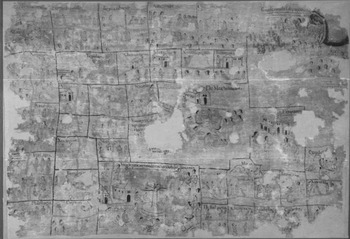
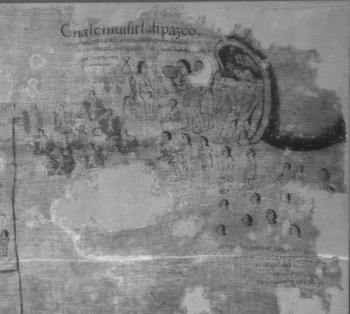
The latter relation is also clearly indicated in another important indigenous source from Michoacan: a large painted cotton cloth known as the Lienzo de Jucutacato or Lienzo de Jicalan, elaborated and used by native metalworkers in a.d. 1565 (see Roskamp Reference Roskamp1998, Reference Roskamp and Zárate2001, Reference Roskamp and Michele2004). According to this document (Figure 1), which contains a combination of pictograms and glosses in the Nahuatl language, the later founders of Jicalan (a settlement located south of Uruapan, at the entrance to the hotlands) were created by their god Tezcatlipoca (generally translated as “Smoking Mirror”) in a chalchiuihtlahpazco or “bowl of precious greenstone” (Figure 2). Similar to the cosmogonical narrative recorded by Ramirez, the glosses indicate that mankind was made of ashes (yn nextlapictli) or blood (yn eztlapictli). Both closely resemble sixteenth-century historical sources from central Mexico, such as the Leyenda de los soles and the Historie du Mechique, which explain how the gods used their own blood and ashes from an earlier failed creation to give birth to humankind in a precious bowl (Leyenda de los soles Reference Velázquez1992:121; Garibay 1979:106; see also Mendieta 1980:78). Another interesting similarity is that in the lienzo, the recently created humans were referred to by seven different terms, thus resembling the well-known central Mexican stories of Chicomoztoc, the seven caves of origin. In the case of Jicalan, the terms also seem to indicate a division into seven different groups: those made of ashes (or blood); those belonging to the house of the arrows, the Toltecs, the Nahuas; those who guard the quetzal feathers, the inaugurators; and those who put lime in their hair.
The Lienzo de Jicalan (photographic archive of the author, courtesy Sociedad Mexicana de Geografía y Estadística).

Detail of the lienzo: the origin in the bowl of precious greenstone (courtesy Sociedad Mexicana de Geografía y Estadística).

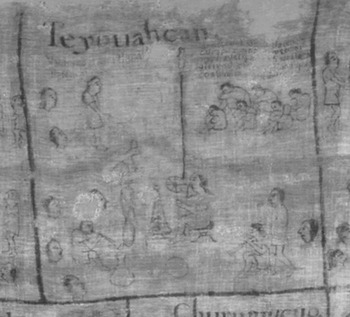
Having left the bowl of precious greenstone and after receiving the order from their god Tezcatlipoca, the humans headed off on a long migration in search of the promised lands where they would found their settlement. The aforementioned deity guided the migrants in the form of his nahual (companion animal), a bird that was characterized by a large orange disc on its head. The presence of Tezcatlipoca was invoked by a special ritual in which music and the offering of food appear to have played an important part (Figure 3). To communicate with the patron deity, the leader of the migrants (Tlatenchicatl, the “lord of the coast”) used a large disk attached to a handle, a special instrument that closely resembles the tlachieloni or optical instrument that Tezcatlipoca used to look into the future. According to the Relación de Texcoco (1582), the later founders of Huitznahuac (in central Mexico) used an identical tool to consult with the same god during their migration from their place of origin (Pomar Reference Pomar and Acuña1986:59, see also Olivier Reference Olivier2004:442–476).
Detail of the lienzo: Tlatenchicatl communicating with Tezcatlipoca in Teyouahcan (courtesy Sociedad Mexicana de Geografía y Estadística).

It is important to observe that in the case of the lienzo, the rituals were also characterized by the presence of an object that in my earlier publications was referred to as a rope or mecatl but instead appears to be a sacred bundle (tlaquimilolli). In the context of migrations and processions, such sacred bundles were generally carried on the back of specially-designated functionaries (teomamaque). They were highly worshipped and contained objects (figurines, gems, pieces of cloth, hair, ashes, etc.) that were directly associated with the principal deities—in this case, most likely with Tezcatlipoca. The offerings were probably made in front of the holy bundle, after which communication with the patron god was established by Tlatenchicatl through his mirror. These bundles also existed among the Tarascan population of the region. The Relación de Michoacán, for example, mentions a sacred bundle dedicated to Curicaueri, the patron deity of the Uacusecha lineage: a piece of obsidian wrapped in a cloth or deer skin (Alcalá Reference Alcalá and Moisés2000:342, 344–345, 448–450, Figure XIII, 481–485, Figure XVII). The Tarascan equivalents of the teomamaque were the “tiuiniecha” or “thiuimencha”, identified as special priests “who carried the gods on their backs” (Alcalá Reference Alcalá and Moisés2000:564–568, Figure XXX).
Olivier (Reference Olivier, Guernsey and Reilly2006:202) mentions two important traditions that refer to the origin of Tezcatlipoca's bundle in Tezcoco. According to a version registered by Bartolomé de las Casas (Reference Casas and O'Gorman1967, Vol. I:644), Tezcatlipoca founded the mentioned settlement and then “(…) alive, he went inside the Sierra Nevada volcano, which is nearby, and that, from there, he sent them the bone of his thigh, which they placed in their temple as their main god, and the Tezcocans gloat a lot because of that; and because of this the mentioned volcano was named Popocatepetl.”Footnote 5 Juan Buatista de Pomar (Reference Pomar and Acuña1986:59) reports that besides precious stones and a cloth with representations of human bones, the tlaquimilolli included a mirror that talked to the later founders of Huitznahuac and guided them to their final destination.
Since the chalchiuihtlahpazco or bowl of precious greenstone was located on the other side of a river or sea, the migrants left their place of origin on the shells of nine huge turtles, guided by an individual who rode on the back of what appears to be a dog. After reaching the shore at Chalchicueyehcan (the present-day region of San Juan Ulúa, Veracruz, on the east coast of Mexico) they traveled west, passing through Nonoalco (Veracruz), Teyouahcan (Tehuacan, Puebla), Cuyuuahcan (Coyoacan, Mexico), Tenuchtitlan (Mexico-Tenochtitlan, the Aztec capital), Xiquipilco (Mexico), and Ayutzinco (Mexico) before finally reaching Tzacapo (Zacapu), located in the northern part of the region that today forms part of the state of Michoacan. Here, the leader of the migrants (Tlatenchicatl) died and was succeeded by his son, simply referred to as Nauatzin (“the noble Nahua”). It is important to note that Zacapu is also directly related to the sacred origin of the Tarascan ruling Uacusecha (Eagle) lineage and their supreme deity, Curicaueri.
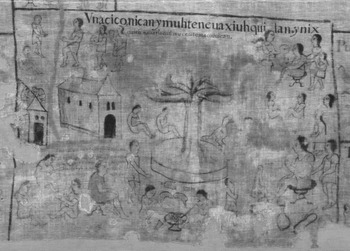
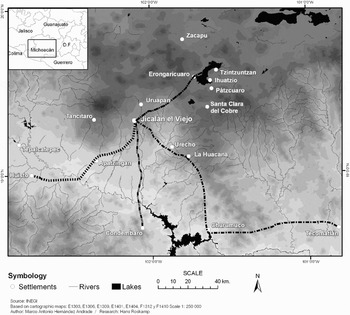
After the demise of Tlatenchicatl, the migrants did not continue in a westerly direction but moved south—through the central Sierra region—to end their quest in the upper part of the hotlands. Here, just about 12 km to the south of Uruapan, Tezcatlipoca ordered the foundation of the altepetl, or settlement, of Xiuhquilan (later called Jicalan), in a place that was characterized by the presence of an enormous tree (Figure 4). It was the same patron-god who also indicated them to start working copper and painting gourds, not before helping them to find the required natural resources (tepoztlalli) and probably also teaching them the necessary technical knowledge. According to the lienzo, the elaboration of copper artifacts was limited to agricultural tools. The founders of Jicalan and their descendants searched for copper ore and other minerals along three main routes that took them to different parts of the vast southern hotlands. The most successful route led in a southeasterly direction, passing through the richest parts of the famous copper belt (Vacanan, Churumucuo, and Xantsiquiyo), and ended in Tecumatlan near the Balsas River (Cutzio, present-day municipality of Huetamo). A second one took the miners due south to the mountain of Cundembaro (also located near the Balsas), while the third route led them southwest, to the banks of the Tepalcatepec River (Figure 5).
Detail of the lienzo: the founding of Jicalan (courtesy Sociedad Mexicana de Geografía y Estadística).

Map of Michoacan showing the mining routes mentioned in the Lienzo de Jicalan.

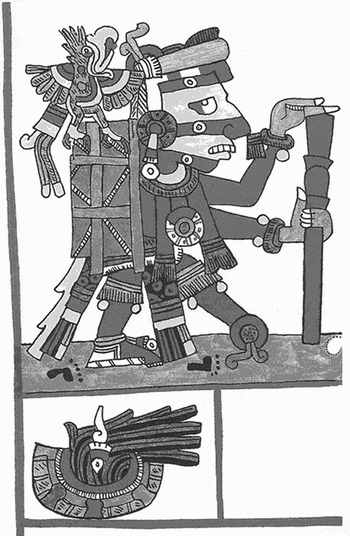
The people of Jicalan believed and expressed in their lienzo that Tezcatlipoca created their forefathers in the distant east, the place of the first and all subsequent sunrises. The same god was also considered responsible for the long migration to Michoacan, the founding of Xiuhquilan/Jicalan, and the initiation of their mining activities, metalworking and the elaboration of painted gourds. The direct relationship between Tezcatlipoca and metallurgy is also confirmed by sources from central Mexico. Ruiz de Alarcón (Reference Ruiz de Alarcón1988:86), for example, mentions tlatlauhqui tezcatl, which means “red mirror,” as an esoteric name for the copper axe (Anders and Jansen Reference Anders and Jansen1993:151; Anders, Jansen, and Reyes García Reference Anders, Jansen and García1993:119). Furthermore, the red (tlatlauhqui) Tezcatlipoca (Figure 6) can be clearly identified as Xipe Totec, “our lord the flayed one” (Olivier Reference Olivier2004:64, 107). According to Juan de Torquemada (1615) the latter was the god of the silversmiths (Torquemada 1976, Vol. III:95, 366–368). However, Bernardino de Sahagún reports that he was the god of the goldsmiths (Sahagún Reference Sahagún1989, Vol. II:576). In the context of Mesoamerica's 365-day calendar (xiuhpohualli), Xipe was venerated, especially in the 20-day period (veintena) of Tlacaxipehualiztli (“flaying of men”) that according to Michel Graulich (1999:279, 306), was celebrated at the onset of the dry season and dedicated to the rising of the sun. The same author mentions the Codex Maggliabecchiano and Codex Vaticano A, which directly associate Xipe's attributes with the god of the sun, Tonatiuh (see, for example, his shield with red and white concentric circles). He also points out that in the Tonalamatl Aubin Xipe is represented in the center of a sun, whereas in the Codex Borbónico this deity is given the calendrical names 1 Dog, 3 Eagle, and 4 Movement. The first is the name of the god of fire, the second could refer to the sun, and the third is the date that corresponds to the first movement of that celestial body (Graulich Reference Graulich1999:315–316). Complementary data are provided by Guilhem Olivier, who mentions an interesting connection between Tezcatlipoca's missing foot and the creation of fire (Olivier Reference Olivier2004:424–427). The author also emphasizes the crucial symbolism of Tezcatlipoca's mirror, which in several sources receives the name tlatlauhqui tezcatl and is translated as “ignited mirror,” a term that was also used to address Xipe. Tlatlauhqui literally means “red” and is the color typically associated with this deity as well as with the sun (Tonatiuh). The author also demonstrates that Tezcatlanextia, another name used for Tezcatlipoca, has been translated as “shining mirror,” “mirror that lets things shine,” and “mirror that lets things appear.” Olivier thus concludes that the mirror may represent the sun and at the same time the primary function of Tezcatlipoca's instrument: foretelling the future (Olivier Reference Olivier2004:464–466).
Representation of Tlatlauhqui Tezcatlipoca in the Codex Borgia (Vié-Wohrer Reference Vié-Wohrer1999, Vol. 2, Figure A2, courtesy Centro de Estudios Mesoamericanos y Centro Americanos, Mexico).

The Lienzo de Jicalan confirms the latter information from the central Mexican sources but also provides additional data. As mentioned above, in cosmogonical terms Tezcatlipoca was clearly associated with the east, the place not only of the first and all subsequent sunrises but also of the creation of the cosmos and humankind, an event in which he himself played the principal role. His nahual, or companion animal, was a bird with a distinctive mark on its head: a red/orange disc that probably indicates the “precious” and “shining” character of this bird. This object might very well be identified as a solar disk or the shining mirror and therefore directly refer to the god's capacity as a foreteller and guide to his worshippers. This interpretation seems to be supported by the fact that Tezcatlipoca's special visioning instrument or tlachieloni was used by Tlatenchicatl and later by Nauatzin, his principal representatives, and leaders of the migrants who used it to communicate and probably also to interpret the signals sent by their patron deity. Furthermore, it is interesting to note that both this tool and the disk on the bird's head are painted in the same color. What seems to be the clearest and most distinctive feature of the lienzo is that Tezcatlipoca is responsible for the origin of mining and the elaboration of copper artifacts. If we combine all the known information, then it becomes clear that Tlatlauhqui Tezcatlipoca or Xipe Totec was a deity associated with copper, silver, and gold: a true god of metals. In the context of a comparative history of religion, interesting similarities can be detected between the belief systems associated with Tezcatlipoca and Hephaistos, the lame smithing deity among the ancient Greeks (see Baumann Reference Baumann and Baumann1936).
It is rather tempting to elaborate the hypothesis that the cult of the mentioned deity would likely have originated in West Mexico, a region characterized by the presence of multiple metallurgical activities. According to Bernardino de Sahagún, the Xipe cult initiated in Tzapotlan, a settlement in Jalisco (Sahagún Reference Sahagún1989, Vol. I:55). Furthermore, Mendieta (Reference Mendieta1980:91) mentions that Tezcatlipoca was a Chichimec god that came with groups migrating from the west. Finally, Pomar (Reference Pomar and Acuña1986:59) points out that the founders of Tezcoco, who—as we have seen—were worshippers of Tlatlauhqui Tezactlipoca, initially departed from the province of Guadalajara (see also Ixtlilxóchitl Reference Ixtlilxóchitl1985, Vol. I:403). Obviously the Lienzo de Jicalan could also be added to the short list of possibly favorable arguments. However, we agree with Olivier (Reference Olivier2004:165) that these written sources do not provide conclusive evidence, as is shown very clearly by the continuing academic discussion about the historical and/or mythical nature of the indigenous narratives, especially the ones concerning migrations and foundations. In this context, the fact that the metallurgists of Xiuhquilan/Jicalan believed to have migrated to Michoacan from a place beyond the eastern coast of Mexico, guided by their patron god Tezcatlipoca (as is expressed in their lienzo), might be interpreted both against and in favor of the mentioned hypothesis of a West Mexican origin. Furthermore, the available evidence clearly indicates that Tezcatlipoca's cult was not restricted to the metalworking zone but was also present in other parts of Mesoamerica. The oldest representations of the deity (Tula, Ixtapantongo, Chichen Itza) apparently date to the tenth century a.d. (Olivier Reference Olivier2004:168–169).
Taking into account that the study of religious cults generally focuses heavily on written sources such as pictorial documents and religious chronicles, Smith (Reference Smith2007) indicates the need for the inclusion of archaeological information and selects several material elements that are related to Tezcatlipoca. The most important and exclusive are the circular obsidian mirrors, of which thirteen specimens have been located in a preliminary inventory of several museum collections. Although the provenience of these objects is uncertain, two mirrors in the collection of the Museo Nacional de Antropología e Historia (MNAH) in Mexico City are attributed to West Mexico (Smith Reference Smith2007, personal communication by Felipe Solis). A third interesting reference comes from Carl Lumholtz who (in the last decade of the nineteenth century) bought an obsidian mirror from a priest in Patzcuaro (Michoacan) who had found it in the nearby parish of Zirahuen (Lumholtz Reference Lumholtz1987, Vol. II:451). Additional interesting findings are reported by Saunders (Reference Saunders2001): obsidian disks in the early colonial atrial crosses in Taximaroa (Ciudad Hidalgo) and San Felipe de los Alzates. This might constitute additional evidence for the existence of Tezcatlipoca's cult in Michoacan and other parts of West Mexico. However, as Smith (Reference Smith2007) points out, more extensive samples from a known and controlled archaeological context are needed to expand our knowledge about the artifacts and their possible relationship to the mentioned deity or other members of the native pantheon. In this sense it is important to emphasize that obsidian mirrors found in Michoacan might be related to Tezcatlipoca but perhaps also to the Uacusecha patron god Curicaueri, although the latter was generally associated with knives made from the same volcanic material. These cutting tools also appear to be related to mother goddess Cuerauaperi and other deities of the heavens (Darras Reference Darras1998:72–76).
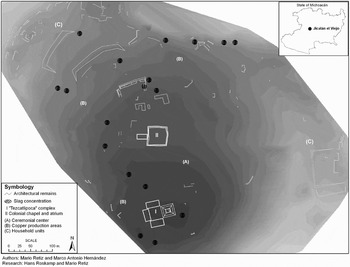
In the case of Michoacan, a promising site for further archaeological research is the old Jicalan (Jicalan el Viejo), founded by the forefathers of the metalworkers who elaborated and used the abovementioned sixteenth-century lienzo. Its archaeological remains still exist near the present-day village of Charapendo, about 12 km due south of Uruapan. For at least the last 120 years the site has been severely affected by agriculture, cattle-raising (combined with severe erosion caused by the elimination of trees and other vegetation), and intense looting. The site measures 0.42 km2 and is made up of an elevated mesa, surrounded by canyons that not only constitute a natural protection but also contain the necessary water resources. A preliminary survey shows that it can be divided into three major zones: (a) a ceremonial center, (b) copper production areas, and (c) household units (Figure 7).
Map of the archaeological site of the old Jicalan, representing architectural remains and slag concentrations.

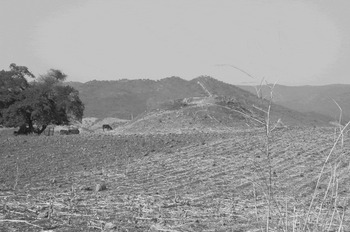
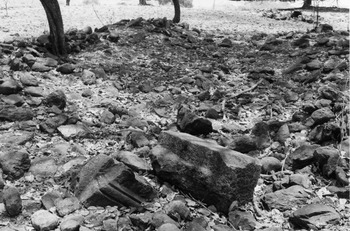
The first zone is located on the highest part of the settlement and consists of a small square pyramid base (22 × 22 m, elevation 5 m) adjacent to what may have been a U-shaped temple complex (now almost completely invisible), formed by three buildings (22 × 12 m each) located around a central plaza. Based primarily on historical information (the lienzo), this complex was probably dedicated to the cult of Tlatlauhqui Tezcatlipoca (Xipe Totec), especially since apparently no other religious structures from pre-Hispanic times are present at the site (Figure 8). Just 175 m to the north there is a larger rectangular structure (24 × 12 m) with an access and a square (42 × 40 m) to the east. Its dimensions and building materials clearly indicate that we are dealing with a small sixteenth-century chapel and its atrium, similar to the Franciscan constructions known from the many famous hospitals in the region (Figure 9). Following a common pattern of evangelization, its location near a pre-Hispanic temple most probably symbolizes the defeat of the old religion by the Christian faith. The available sources indicate that San Francisco became the patron saint of the colonial settlement. The construction and completion of the chapel might have continued until the early seventeenth century, when the settlement was finally abandoned and a new Jicalan was founded very close to Uruapan and Jucutacato, as a result of the congregation politics implemented by the religious orders and the Spanish Crown.
View of the loothed “Tezcatlipoca” pyramid of the old Jicalan, facing south (photograph by the author).

Jicalan: inside view of the sixteenth-century chapel with carved stones, facing the atrium (photograph by the author).

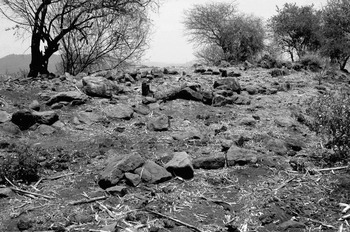
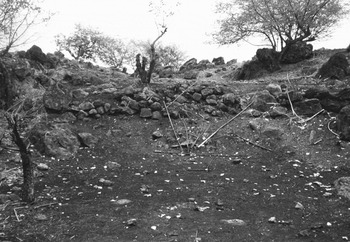
The copper production zones, identifiable by large amounts of slag and stone tools, can also be found in upper central parts of the site, the majority located on the extensive terraces that exist between the religious structures and the household units. The latter occupy the lowest northern and northeastern sections of the settlement (Figures 10 and 11). Hence, it appears that the metallurgical activities were directly associated with the religious units in the higher parts of the site, a finding that is not surprising if we take into account that the lienzo stresses the divine character of copperworking. Furthermore, the probable presence of strong winds would have helped to obtain a better combustion for the smelting process and may have been an additional important factor in the decision to locate the production areas on elevated terrain.
Jicalan: partial view of the terraces in the main habitational complex, facing north (photograph by the author).

Jicalan: one of the few relatively well-conserved terrace walls in the main habitational complex, facing south (photograph by the author).

Among the material remains identified during the preliminary inventory of the site are stone tools (axes, scrapers, grinders, polishers, manos, metates, and molcajetes), obsidian (knives, arrow points), and ceramic fragments (of non-elite household ware). The search for artifacts reportedly extracted by several looters during the past decades was unsuccessful. The preliminary survey and the results of the ethnohistorical research indicate the necessity and possibilities for further studies of the archaeological site. The latter might shed interesting light on the cult of Tlatlauhqui Tezcatlipoca and its association with metallurgy, among many other specific objectives. The special focus on the different aspects of the metallurgical processes and the related religious symbolism should also be taken into account in the case of other similar sites in West Mexico: Itziparatzico (Michoacan) and El Manchón in Guerrero (Hosler Reference Hosler and Eduardo2004, Maldonado Reference Maldonado2006).
FINAL COMMENTS
Whereas modern science allows us to trace metallurgy in West Mexico back in time, possibly to the distant region of South America, the pre-Hispanic and early colonial indigenous specialists themselves interpreted the origin and nature of their activities in a comprehensive vision of the cosmos that was thought to be created and dominated by a large number and variety of divine forces. In fact, as we have seen, the earth itself was considered to be a goddess and thus all the natural resources it contained were also deemed to be sacred. Gold, for example, was the excrement of the sun (Tonatiuh, Curicuaeri) and directly associated with the daily sunrise in the east, as well as with light and heat, both crucial elements in the creation and continuity of the world and human life. By analyzing several sources from central Mexico and Michoacan, it becomes clear that Tlatlauhqui Tezcatlipoca or Xipe Totec was the god of metallurgy and the divine lord of copper-, gold-, and silversmithing. As a creator deity, he was not only involved in the origin of the world and humankind but was directly responsible for the birth of the metalworkers, the search for mineral resources, the opening of mines and metal production settlements and probably also metallurgical technologies. Based on these historical sources, rituals and offerings to Tlatlauhqui Tezcatlipoca (Xipe Totec) must have marked different moments in the search for minerals and their extraction, transportation, and transformation into artifacts for different uses. The archaeological site at old Jicalan seems to confirm this as a pyramid—probably dedicated to this deity—is built on the highest point of the settlement, in a zone with clear evidence of extensive metal production.
Undoubtedly, further research is needed to amplify the preliminary results obtained by the survey in Jicalan and compare the archaeological analysis with the historical investigation. Taking into consideration that the historical sources are limited and will probably not reveal much new evidence on pre-Hispanic metallurgy, archaeology can be expected to play a mayor role in shedding light on the material manifestations of the Tlatlauhqui Tezcatlipoca-Xipe Totec cult in West Mexico and especially in Michoacan. In this context, it will also be necessary to include, in the form of a comparative analysis, other archaeological sites with evidence of metallurgical activities, such as Itziparatzico (Santa Clara del Cobre, Michoacan) and El Manchon (Sierra Madre in Guerrero). This does not mean that additional historical research would be of minor significance. Taking into consideration that many pre-Hispanic settlements related to metallurgy continued to be occupied in the colonial period (most of them only during the sixteenth century), it is necessary to study the continuities and changes not only in the technology and general production of metal artifacts, but also in the sacred symbolism and social meaning of metallurgy. We have seen that in 1579 informants from Ajuchitlan still believed that their forefathers were made of metal. Furthermore, in 1565 Jicalan used a pictorial document in a colonial court to defend its supposed rights to deposits of copper and other minerals, emphasizing the pre-Hispanic and sacred origins of the settlement, its founders, and the exploitation of the natural resources in the southern hotlands. This implies a reconsideration of the generalized idea among many historians that the conquest and colonization of Michoacan led to a rapid and profound acculturation of the indigenous population.
Given (Tlatlauhqui) Tezcatlipoca's presence among the Nahua metalworkers of Jicalan, the question remains whether or not his cult also extended to other groups that in the Late Postclassic period were incorporated into the Tarascan state. The latter appears very likely, especially taking into account that the indigenous cultures of pre-Hispanic and early colonial Michoacan clearly share several basic cultural elements with their Mesoamerican neighbors from central Mexico (see also López Austin and López Luján Reference López Austin and Luján1999:135–140). However, a solid identification of a Tarascan equivalent of Tezcatlipoca is still impossible and thus Corona Núñez's (1986:23–24) observation that it must have been Thares Upeme has to be considered merely a hypothesis. The latter was thrown out of the heavens during a drinking fest of the gods, causing him to limp, a trait that he shared with Tezcatlipoca. To the list of possible candidates we could also add Curita Caheri, a very important deity that—just like Tezcatlipoca (see Olivier Reference Olivier2004:484–485)—played crucial roles in the creation and, above all, the destruction of the first humans and was also the messenger of the eminent conquest by the Spaniards at the beginning of the sixteenth century. We should also not exclude Curicaueri (“he who emerges/rises burning”), the Uacusecha god of fire and sun who was strongly associated with obsidian knives, just like the mother goddess and other deities. Finally, who was the unidentified Tucupacha who used his metallurgical skills to create mankind? The complexity of the central Mexican Tezcatlipoca as the omnipresent deity of metamorphosis and mockery (as shown by Olivier Reference Olivier2004) combined with the lack of sources in the case of Michoacan undoubtedly present interesting but difficult challenges to historians and archaeologists working in the latter part of Mesoamerica. It is hoped that the identification of Tlatlauhqui Tezcatlipoca as a god of metals worshipped by the inhabitants of sixteenth-century Jicalan will stimulate further research on metallurgy and its religious symbolism in West Mexico and other parts of Mesoamerica.
RESUMEN
En años recientes el desarrollo de la metalurgia en el occidente de México ha recibido una creciente atención en el campo de los estudios arqueológicos y tecnológicos. Considerando que los últimos ya incluyen excelentes descripciones y análisis de las funciones rituales y suntuarias de los artefactos de metal, el presente artículo abarca el simbolismo sagrado de los recursos metálicos y del propio proceso metalúrgico de acuerdo a varias narraciones cosmogónicas de los indígenas y otras fuentes pictóricas y alfabéticas del siglo XVI, procedentes tanto de Michoacán como de áreas culturales adyacentes. La documentación disponible claramente muestra el papel crucial que se le atribuía a Tlatlauhqui Tezcatlipoca (Xipe Totec) quien era considerado como señor divino de la metalurgia de cobre, oro y plata. Como deidad creadora no sólo jugaba un papel importante en el origen del mundo y de los grupos humanos sino que también era directamente responsable del nacimiento de los especialistas en metales, la búsqueda de recursos minerales, el establecimiento de minas y fundiciones, así como la invención y desarrollo de las propias tecnologías metalúrgicas. Por lo tanto es probable que hayan existido determinados rituales en su honor que marcaban diferentes momentos en la localización y extracción de las materias primas, su transportación y su transformación final en una amplia gama de artefactos.
ACKNOWLEDGMENTS
I would like to thank the Sociedad Mexicana de Geografía y Estadística (SMGE, Mexico City) for allowing me to publish photographs of the Lienzo de Jicalan (also known as Lienzo de Jucutacato). Additional thanks go to the following colleagues for their valuable help in my initial research and presentation of the results: archaeologist Mario Retiz (ColMich) who assisted me in my fieldwork in Jicalán (financed by the Foundation for the Advancement of Mesoamerican Studies, Inc.) and also elaborated the corresponding cartography; and Marco Antonio Hernández (ColMich) who made the original maps publishable in grey scales. I am also grateful to Dorothy Hosler, Blanca Maldonado, and an anonymous reviewer who made useful comments to improve the manuscript. All possible omissions, faults, and errors remain entirely my own.