INTRODUCTION
The stable isotopic ratios of carbon (δ13C) and nitrogen (δ15N) of bone collagen can be used to reconstruct dietary patterns across time and/or space (DeNiro Reference DeNiro1987). The ratio of 15N to 14N increases with each trophic level and it can be used to identify breastfeeding infants and consumers of high trophic level foods, e.g., aquatic resources (Hedges and Reynard Reference Hedges and Reynard2007). The 13C to 12C ratio in human tissues provides an indication of the consumption of freshwater and marine foods as well as C3 and C4 plants (Richards and Hedges Reference Richards and Hedges1999; Schoeninger Reference Schoeninger2009). Therefore, this approach has been extensively used to examine dietary patterns and change among prehistoric populations, especially during the transitional period between the Mesolithic and the Neolithic (e.g., Tauber Reference Tauber1981; Richards et al. Reference Richards, Schulting and Hedges2003; Lelli et al. Reference Lelli, Allen, Biondi, Calattini, Conati Barbaro, Antonia Gorgoglione, Manfredini, Martínez-Labarga, Radina, Silvestrini, Tozzi, Rickards and Craig2012).
In Lithuania, Antanaitis-Jacobs et al. (Reference Antanaitis-Jacobs, Richards, Daugnora, Jankauskas and Ogrinc2009) published the first study on the diet of prehistoric people based on δ13C and δ15N data. Then, δ13C and δ15N signatures were measured for 18 individuals dating to the Late Mesolithic, the Subneolithic, the Neolithic and the Bronze Age.Footnote 1 In addition, for the construction of a local isotopic baseline, 42 animal samples were analyzed. This very first study came to three conclusions: (1) Mesolithic and Subneolithic people had a diet that largely consisted of freshwater fish; (2) Neolithic Corded Ware culture people had a diet that was mostly made up of animal protein, very possibly of domestic animals; and (3) domestic animals and C4 plants, likely millets, were important food sources during the Late Bronze Age. This research was based on human remains from inland cemeteries, single graves, and wetland deposits. However, in a later study, Piličiauskas et al. (Reference Piličiauskas, Jankauskas, Piličiauskienė and Dupras2017a) analyzed loose human bones from five individuals from coastal Šventoji sites (ca. 3000 cal BC) as well as 28 animal samples, including four freshwater fish, from the modern Curonian Lagoon. In this study a very specific subsistence strategy on the coastline of the SE Baltic was confirmed and attested a reliance on freshwater fish taxa from lagoons and seals. In a follow up study, Piličiauskas et al. (Reference Piličiauskas, Jankauskas, Piličiauskienė, Craig, Charlton and Dupras2017b) conducted stable isotope analysis on specimens from all Lithuanian Stone and Bronze Age sites, including δ13C and δ15N measurements on different bones from the same individuals as well as comparative analyses at different labs, and presented isotopic data on an additional five Stone and Bronze Age individuals and 17 animal and fish taxa.
While these three studies have shown the potential of stable isotopes analysis for reconstructing the dietary composition of individuals from the Mesolithic to the Neolithic in Lithuania, the current dataset is far from complete. In this study we aim to investigate a significant collection of human and animal specimens to form a more substantial dataset in order to more holistically reconstruct the dietary composition of prehistoric populations in Lithuania. This data set includes specimens that were collected during recent fieldwork, previously unstudied specimens from museum collections, and specimens from previously excavated sites, such as the Donkalnis and Kretuonas cemeteries that had not yet been subjected to stable isotope analysis.
An additional goal of this study was to date all available human remains supposedly dating to Stone and Bronze AgesFootnote 2 in Lithuania through radiocarbon (14C) dating and then form a chronology of the specimens subjected to δ13C and δ15N isotope analysis. This would then allow us to better reconstruct the human diet during Stone Age and Early Metal Period in Lithuania based on an absolute chronology. In order to carry out this aim, we dated 16 human remains by accelerator mass spectrometry radiocarbon (AMS 14C) and then obtained reliable δ13C and δ15N measurements for 13 human bone or dentine collagen samples. In addition, 40 animal and fish bone collagen samples were analyzed for their δ13C and δ15N values, which helped us refine the dietary isotopic baseline for the periods in question. For the first time, inland freshwater fish samples (n=10) from Lithuanian Late Bronze Age sites were analyzed and the obtained results allowed us to make a more accurate evaluation on the importance of aquatic protein in human diets during the periods in question.
MATERIALS AND SITES
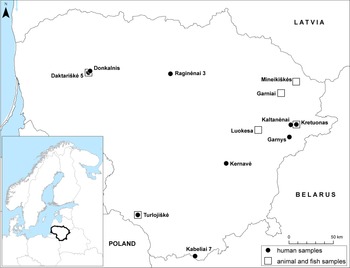
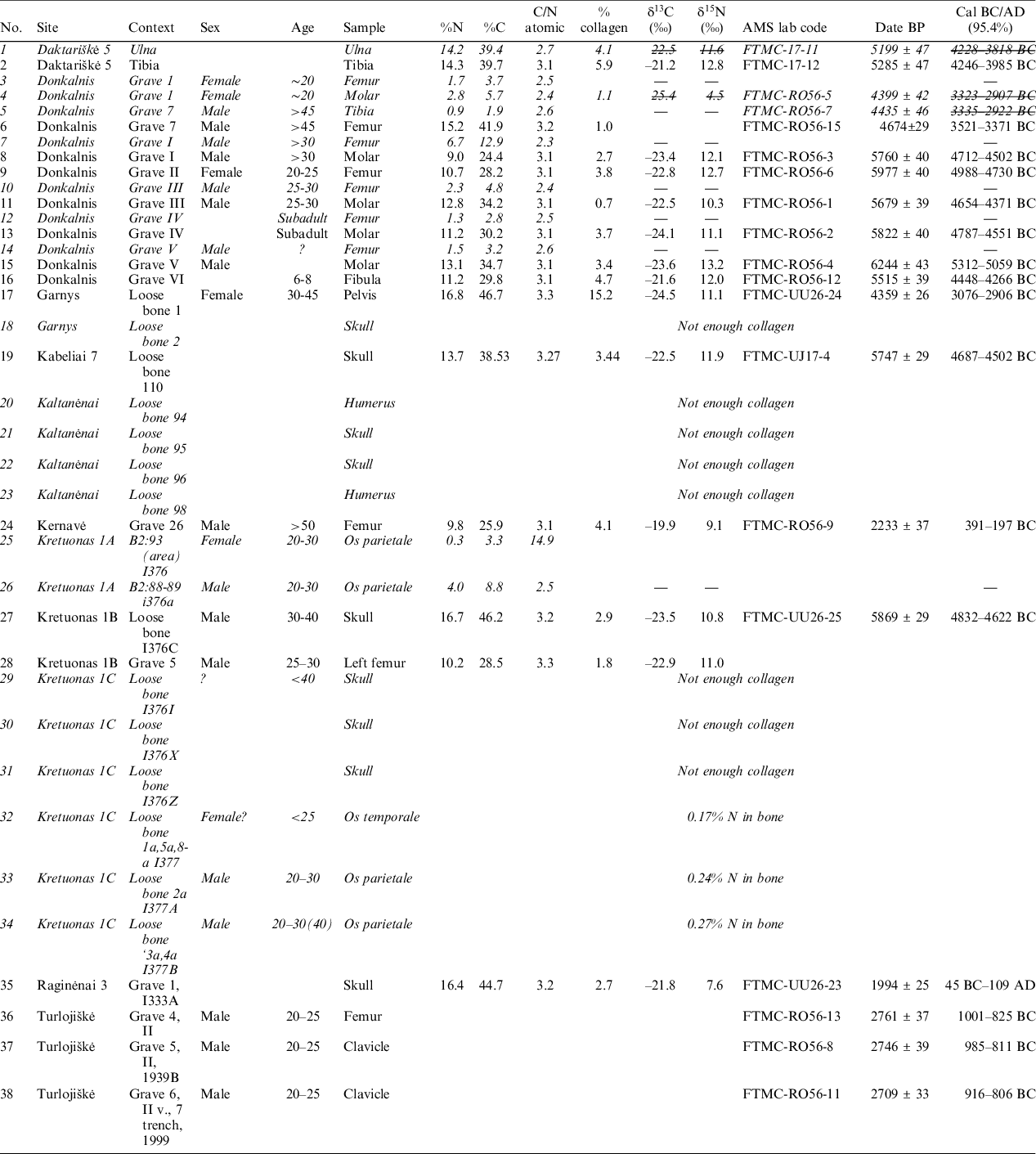
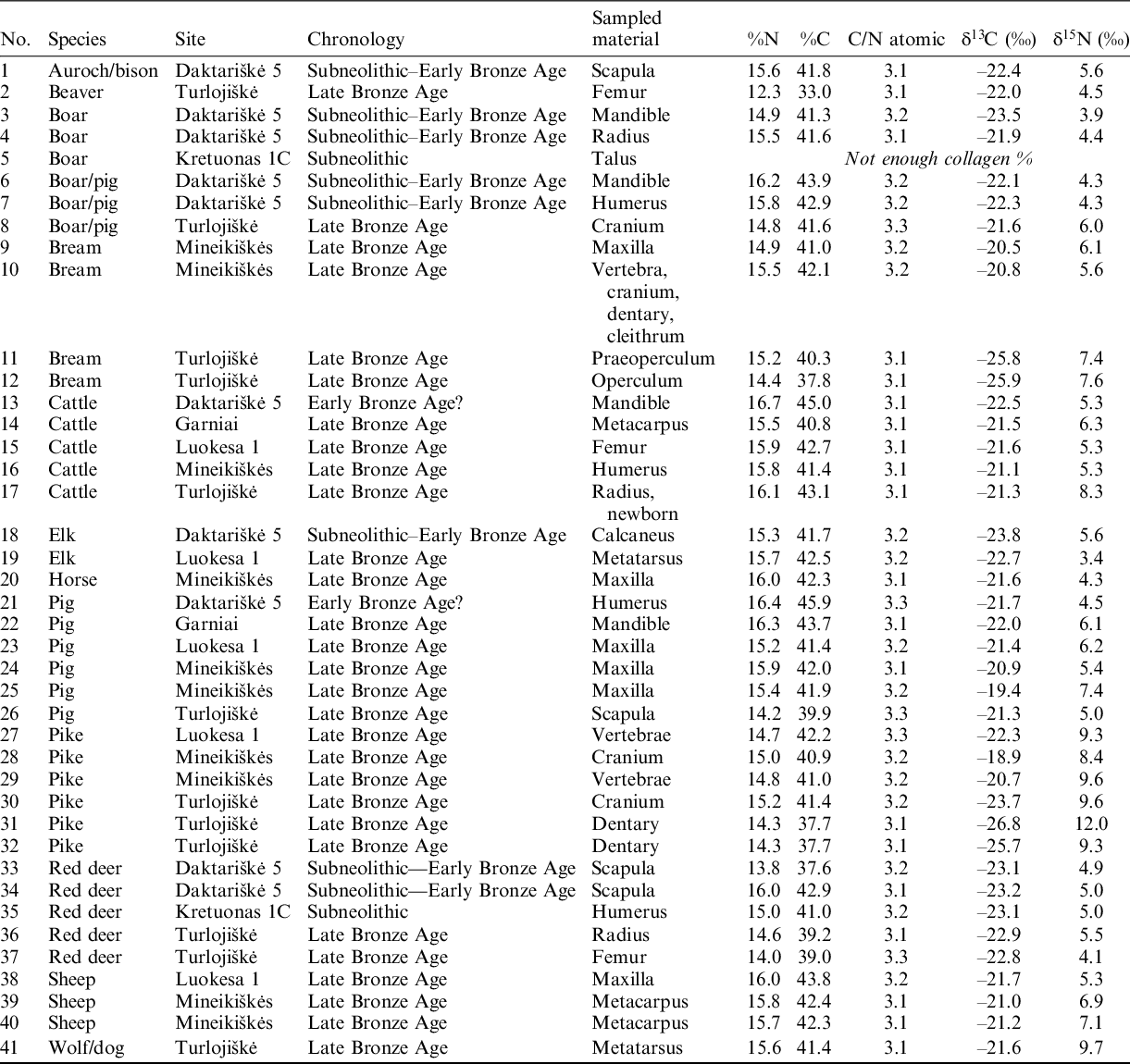
The human and animal bone material analyzed in this study was sampled from 12 Lithuanian sites (cemeteries, dwelling sites, and wetland deposits) dating from the Late Mesolithic to the pre-Roman Iron Age (Figure 1). The human skeletal material was sampled from 10 sites (Table 1; Figure 1) and animal and fish bones were sampled from six sites (Table 2; Figure 1). In the section below, we will provide short descriptions of the sites.
Sites of studied human and animal remains.

δ13C and δ15N bone and/or dentine collagen values and AMS 14C dates for Lithuanian human remains analyzed in the study. Strikethrough measurements are not reliable, while Italic marked samples had poor collagen content.

δ13C and δ15N values obtained from bone collagen for Lithuanian faunal remains analyzed in the study.

Daktariškė 5 is situated in western Lithuania near Lake Biržulis. The higher area of the site was used for dwelling, while the lower area was in a former lake and contains stratified waterlogged refuse layers. During excavations between 1987–1990, an area of 648 m2 was uncovered and more than 11,000 ceramic fragments, 326 flints, 132 amber artifacts, many stone net sinkers, and various bone tools were collected (Butrimas and Ostrauskienė Reference Butrimas and Ostrauskienė2004). In 2016, Piličiauskas continued research at this site by excavating an area of 48.6 m2 and obtained valuable zooarchaeological material. The site was dated to ca. 4450–1600 cal BC through radiocarbon dating (Piličiauskas Reference Piličiauskas2018). Two separate human bones, an ulna and a tibia were identified among the osteological material and have been analyzed for this study (Table 1). In addition, a pig humerus, most likely originating from the Early Bronze Age layer, was also analyzed (Table 2).
During the Stone Age Donkalnis was an island located on Lake Biržulis. It was used as a cemetery and dwelling site during different periods. During excavation in 1981–1982, an area of 1024 m2 was investigated and seven graves were uncovered. However, if the number of graves that were destroyed during gravel extraction are also included, the total number of buried individuals was 14 (Butrimas et al. Reference Butrimas, Kunskas, Česnys, Balčiūnienė and Jankauskas1985; Piličiauskas et al. Reference Piličiauskas, Jankauskas, Piličiauskienė, Craig, Charlton and Dupras2017b). Human bones from graves Nos. 1–7 have been extensively investigated and 14C dated to the Late Mesolithic and Subneolithic in previous studies (Antanaitis-Jacobs et al. Reference Antanaitis-Jacobs, Richards, Daugnora, Jankauskas and Ogrinc2009; Piličiauskas and Heron Reference Piličiauskas and Heron2015; Piličiauskas et al. Reference Piličiauskas, Jankauskas, Piličiauskienė, Craig, Charlton and Dupras2017b; Butrimas Reference Butrimas2019). However, bones from destroyed graves (individuals Nos. I–VI) prior to this study remained unstudied.
Garniai is a Late Bronze Age hilltop settlement situated in northeastern Lithuania. In 2016–2017 an area of 72 m² was investigated and the site was dated to 792–540 cal BC (Čivilytė et al. Reference Čivilytė, Podėnas and Vengalis2017; Podėnas et al. Reference Podėnas, Troskosky, Kimontaitė and Čivilytė2018). Animal bones predominantly of domestic taxa preserved very well at Garniai and some of them were analyzed in our study.
Garnys is a very recently discovered underwater riverine site situated on the Žeimena River, which is in NE Lithuania. During 2017–2020, an amateur diver collected flints, waste bone fragments tools, and Subneolithic ceramics and presented those materials to archaeologists in 2020.Footnote 3 Among the osteological material a human pelvis and several skull fragments were identified. We decided to analyze two human bones in this study because of their likely Stone Age date.
Kabeliai 7 is a multiperiod wetland site situated in southern Lithuania. It was discovered in 1995 during a surface survey, and in 2001 four test-pits were excavated (4.5 m2) (Ostrauskas Reference Ostrauskas2002). In addition to a ploughed archaeological layer situated at the upper part of the site, a waterlogged archaeological layer made of lacustrine sediments was found at the littoral zone of the former lake. The excavations were resumed in 2021 by Gaižauskas and an area of 24 m2 has been investigated in the waterlogged part of the site. Bones were well preserved there while the other finds, i.e., mainly flints and ceramics, date to a wide range from the Mesolithic to the Bronze Age.
Kaltanėnai is another underwater site located on the Žeimena River. In comparison to Garnys, it has a very wide chronology from the Late Mesolithic to the early modern period. The finds have already been discussed (Piličiauskas et al. Reference Piličiauskas, Matiukas, Peseckas, Mažeika, Osipowicz, Piličiauskienė, Rannamäe, Pranckėnaitė, Vengalis and Pilkauskas2020). Eight human bone fragments were collected from the riverbed. Of these, we previously attempted to date four without any success. The bone samples contained N% between 0.06–0.11 due to poor collagen content. For this study we decided to date the remaining four skull and humerus fragments.
Kernavė cemetery is situated in the Neris River valley in eastern Lithuania. In 1989–1991, 1996–1997, and 1996–1997 an area of more than 1900 m2 was excavated and a total of 28 graves were uncovered (Luchtanas Reference Luchtanas1992). Almost all graves (27/28) were cremations with the exception of a single inhumation in grave 26. Human bones from grave 5 were dated to 2518 ± 30 BP; 787–544 cal BC (Piličiauskas et al. Reference Piličiauskas, Lavento, Oinonen and Grižas2011) although the typological dating of the few grave goods from other cremations indicated a pre-Roman Iron Age (Luchtanas Reference Luchtanas1992). An inhumation, No. 26, had no grave goods and its bones were sampled for direct AMS 14C dating as well as isotopic analysis in this study.
Kretuonas 1 is an extensively investigated Subneolithic-Neolithic dwelling site situated in northeastern Lithuania besides Lake Kretuonas. In 1979–1985, 1987–1997, 1999 and 2001 an area of 3216 m2 was investigated and a rich archaeological assemblage including human and animal bones was collected (Girininkas Reference Girininkas2002). In addition to settlement finds, six Subneolithic graves were uncovered, today known as Kretuonas 1B cemetery (Girininkas et al. Reference Girininkas, Česnys, Balčiūnienė and Jankauskas1985). Antanaitis-Jacobs et al. (Reference Antanaitis-Jacobs, Richards, Daugnora, Jankauskas and Ogrinc2009) dated grave 1 and grave 3 from Kretuonas 1B cemetery to 4453–3818 and 4548–4272 cal BC respectively. Piličiauskas et al. (Reference Piličiauskas, Jankauskas, Piličiauskienė, Craig, Charlton and Dupras2017b) attempted to date the remaining graves. However, due to poorly preserved collagen, they succeeded in only obtaining a single new date for grave 5, 5540 ± 35 BP; 4449–4338 cal BC. Furthermore, at Kretuonas 1, numerous loose human bones were found in various areas and layers (e.g., 1A, 1B, and 1C). None of them prior to this study were 14C dated or isotopically analyzed. We believed that this material may provide new valuable information on human diet during the Subneolithic and Neolithic after direct AMS 14C dating and δ13C and δ15N isotope analysis. We also sampled red deer and wild boar bones from Keruonas 1C for stable isotope analysis.
Luokesa 1 is a Late Bronze Age lake dwelling site. Today it is situated in the bottom of Luokesai Lake in eastern Lithuania. In 2000, 2004 and 2007–2011, a total area of 28 m2 was investigated by an international and interdisciplinary team of researchers (see Pranckėnaitė Reference Pranckėnaitė2014 and the other papers in the same volume). According to 14C dates and dendrochronological research, the site was occupied at least for 16 years during 625–535 cal BC (Bleicher Reference Bleicher2014). Pike, elk, sheep, pig, and cattle bones from Luokesa 1 were sampled in this study for creating an isotopic baseline (Table 2).
Mineikiškės is another Late Bronze Age hilltop settlement situated in northeastern Lithuania close to Garniai site (Figure 1). Ten m2 were investigated in 2017 and the site has been dated to 2528 ± 25 BP; 790–547 cal BC (Podėnas Reference Podėnas2020). Similarly to Garniai, fish and animal bones were well preserved at Mineikiškės. Several bream, pike, sheep, pig, horse, and cattle bones (n=10) were sampled in this study for reconstructing an isotopic baseline (Table 2).
Raginėnai 3 is a burial mound cemetery situated in central Lithuania. A single mound with an enclosing stone circle was investigated in 1996 and a human skull fragment was uncovered lying underneath a large stone (Baubonis and Dakanis Reference Baubonis and Dakanis1998). Since a flake from a polished flint axe was also found during the excavations, the researchers suggested that the human skull fragment may have belonged to a Bronze or pre-Roman Iron Age grave. We decided to check this assumption by direct AMS 14C dating of the human skull.
Turlojiškė is a wetland site in southwestern Lithuania (Figure 1). During 1996–2003, a total area of 954 m2 was investigated in the former lake, and at five distinct places with a distance in-between of ca. 0.5–1 km disarticulated human remains which belonged to 6 individuals were uncovered. All six humans were young males and two of them had signs of fatal blunt force cranial injuries (Merkevičius Reference Merkevičius, Zabiela, Baubonis and Marcinkevičiūtė2012; Jankauskas Reference Jankauskas, Schulting and Fibiger2012). Three of them (Kirsna skull, graves 1 and 3) were dated by Antanaitis-Jacobs et al. (Reference Antanaitis-Jacobs, Richards, Daugnora, Jankauskas and Ogrinc2009) to 1196–835, 906–477, and 2290–1544 cal BC. However, the last date (Vs-1097: 3570 ± 130 BP) seemed suspiciously older and had a large margin of error. Therefore, grave 3 was redated to 2730 ± 30 BP; 928–810 cal BC (Piličiauskas et al. Reference Piličiauskas, Jankauskas, Piličiauskienė, Craig, Charlton and Dupras2017b). The remaining three individuals (graves 4–6) were not dated prior to this study, although their δ13C and δ15N values were reported by Piličiauskas et al. (Reference Piličiauskas, Jankauskas, Piličiauskienė, Craig, Charlton and Dupras2017b). We decided to date them by AMS 14C in this study.
METHODS
AMS 14C dating and stable isotope analysis was undertaken at the Centre for Physical Sciences and Technology, Vilnius (Lithuania). Bone samples were pre-treated using acid-base-acid (ABA) followed by gelatinisation (Szidat et al. Reference Szidat, Vogel, Gubler and Lösch2017). Carbon and nitrogen measurements were made using an elemental analyzer (Thermo FlashEA 1112) connected to an Isotope Ratio Mass Spectrometer (Thermo Finnigan Delta Plus Advantage). For 14C, δ 13C and δ 15N measurements of the same collagen aliquot was used. During sampling we preferred the most compact parts of the human skeleton, i.e., tibia and femur bones or molar teeth dentine. In some cases (Donkalnis individuals I, III, IV, and V), the second or even the third sample from the same individual was taken from different skeletal element when the first samples did not meet the collagen quality criteria. All dates in this study were calibrated by using OxCal v4.4. software and IntCal20 atmospheric curve (Ramsey Reference Ramsey2009; Reimer et al. Reference Reimer, Austin, Bard, Bayliss, Blackwell, Ramsey, Butzin, Cheng, Edwards, Friedrich and Grootes2020) and they were discussed with 95.4% probability after calibration.
RESULTS AND DISCUSSION
Chronology of Human Remains
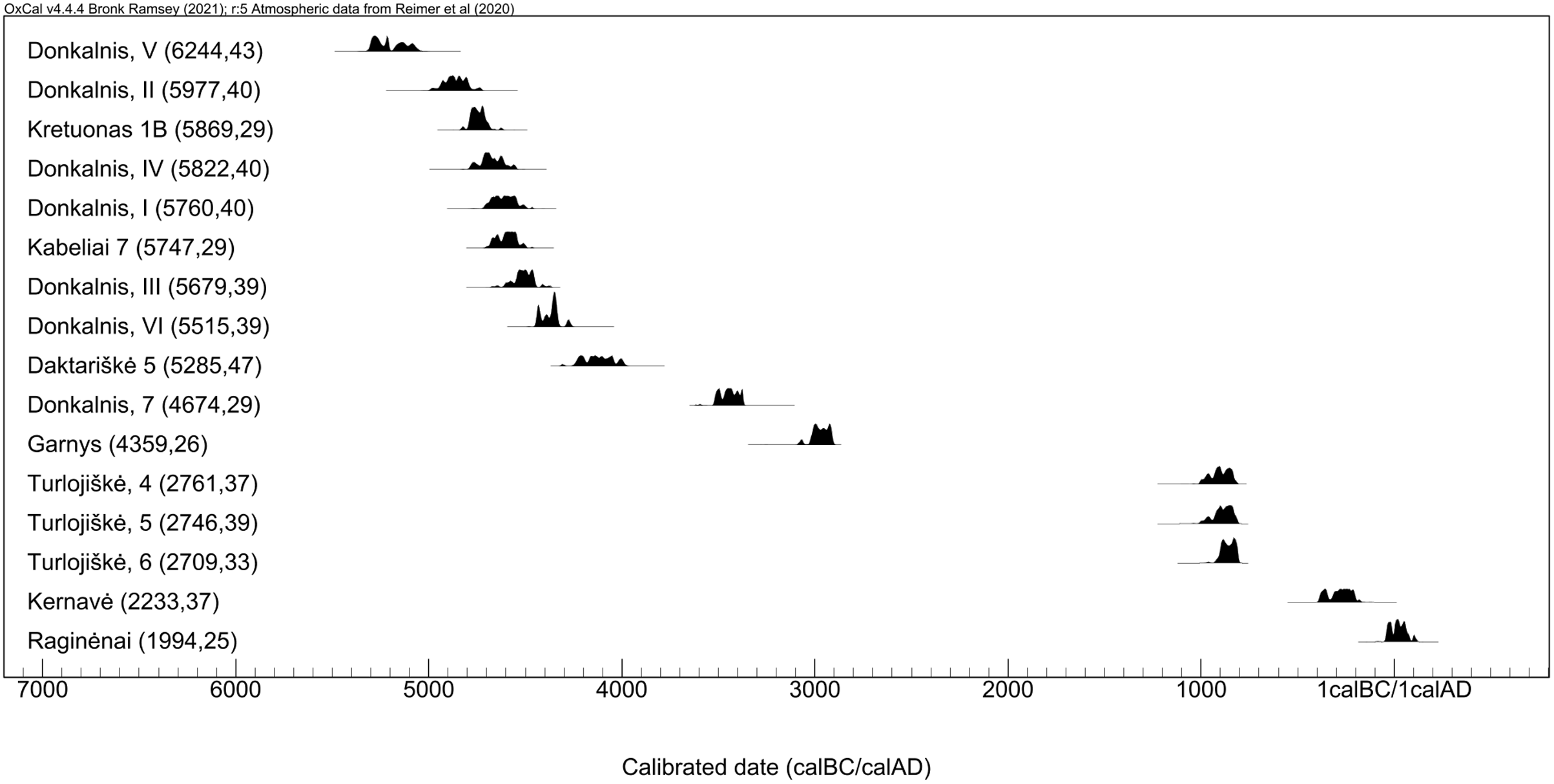
Sixteen of the 36 human samples were AMS dated with success (Figure 2). However, the dating of 20 samples failed due to poor collagen quality, which was indicated by low collagen yield (< 1%), low %N content in bone (0.17–0.27%) or in collagen (< 5.5%), and the C:N atomic ratio outside the acceptable range of 2.9 to 3.6 (DeNiro Reference DeNiro1985; Ambrose Reference Ambrose1990; Van Klinken Reference Van Klinken1999). In some cases, despite poor collagen indications, we measured 14C ages, although the results are not reliable (Table 1). It must be noted that collagen yield in one sample from Donkalnis (III) was lower than 1% (0.7%), but other collagen quality parameters (C%, %N, C:N atomic) met their requirements and we decided to include this sample for further dietary interpretations.
Calibration plot of AMS 14C dates of human remains obtained for this study.

A loose human bone (tibia) from Daktariškė was dated to 5285 ± 47 BP; cal 4246–3985 BC, which is within the site’s chronology defined by previous 14C dates ca. 4450–1600 cal BC. Another human bone (ulna) at the same site had a C:N atomic ratio of 2.7, which is slightly outside the acceptable range of 2.9–3.6. However, the measured 14C date as well as the δ 13C and δ 15N values are very similar to those of tibia bones (Table 1) and this may indicate that both analyzed human bones belong to the same individual.
At Donkalnis cemetery we tried to date grave 1 twice and failed in both cases due to poor collagen content in a femur bone as well as in molar tooth dentine (Table 1). The obtained unreliable 14C date (4399 ± 42 BP; 3323–2907 cal BC) is however somewhat comparable to a recently published date for the same grave––4610 ± 35 BP; 3516–3191 cal BC (Butrimas Reference Butrimas2019). Therefore, with a large degree of confidence it may be assumed that grave 1 from Donkalnis dates to ca. 3300 cal BC and belongs to the end of the Subneolithic.
Another grave from the Donkalnis cemetery where the chronology seemed to be uncertain prior to our study is grave 7. Firstly, the date of an animal tooth pendant kept in a box with a label of grave 7 has been reported as 6220 ± 90 BP; 5374–4939 cal BC (Piličiauskas et al. Reference Piličiauskas, Jankauskas, Piličiauskienė, Craig, Charlton and Dupras2017b). However, it has since been claimed that no tooth pendants were found in grave 7, and a much younger 14C date made on a bear mandible was reported––4290 ± 35 BP; 3012–2875 cal BC (Butrimas Reference Butrimas2019). In both dating attempts, however, animal remains were used instead of human bones. Graves at Donkalnis cemetery were arranged in shallow pits and the burying area also contained numerous settlement materials. Therefore, finds found even in close proximity to human bones do not necessarily belong to that grave. They may belong to other disturbed graves or even originate from settlement waste. To avoid this, we dated a human femur bone (tibia failed) from grave 7 and obtained a third date (4674 ± 29 BP; 3521–3371 cal BC), which appeared to be different from previous dates. Since the δ13C and δ15N data suggests a mixed terrestrial/freshwater diet for this individual (δ13C = −22.6; δ15N = 10.6‰; Piličiauskas et al. Reference Piličiauskas, Jankauskas, Piličiauskienė, Craig, Charlton and Dupras2017b) and the freshwater reservoir effect of the Lake Biržulis is in the order of ca. 200–800 years (Piličiauskas Reference Piličiauskas2018), grave 7 from Donkalnis should belong to the Subneolithic rather than the Mesolithic or Neolithic, as has been previously claimed based on 14C dates of animal remains. The previously dated animal remains were wrongly associated with the grave. This finding is further supported by aDNA data which showed that the Donkalnis 7 individual traces its ancestry from Eastern (30%) and Western (70%) Hunter-Gatherers (Mittnik et al. Reference Mittnik, Wang, Pfrengle, Daubaras, Zariņa, Hallgren, Allmäe, Khartanovich, Moiseyev, Tõrv, Furtwängler, Valtueña, Feldman, Economou, Oinonen, Vasks, Balanovska, Reich, Jankauskas, Haak, Schiffels and Krause2018).
The dating of the destroyed graves I–VI at Donkalnis cemetery proved to be a challenging task. Due to poor collagen content in bone, 4/6 individuals failed to be dated during the first attempt. Only graves II and VI were successfully dated using femur and fibula samples to 5977 ± 40 BP; 4988–4730 and 5515 ± 39 BP; 4448−4266 cal BC, respectively (Table 1). Femur bone samples from graves I, III, IV and V revealed poor collagen content. Surprisingly, the collagen extracted from molar tooth dentine of those individuals met all collagen quality criteria and deranged graves I, III, IV, and V were dated to ca. 5300−4400 cal BC (Table 1). This indicates that collagen better preserves in human tooth dentine rather than bone. All disturbed graves at Donkalnis were therefore successfully dated to the very end of the Late Mesolithic and the Subneolithic. The obtained dates fall within the cemetery chronology defined by previous dates of the other individuals—ca. 6300–3300 cal BC.
A pelvis bone of a 30–45-year-old female found at the underwater site of Garnys has been dated to 4359 ± 26 BP; 3076–2906 cal BC (Table 1). The date points to the very end of the Subneolithic or the Neolithic, if to consider the still unknown freshwater reservoir effect of the Žeimena River. However, an attempt to date the human skull fragment was unsuccessful due to low collagen yield.
At Kabeliai 7 a human skull fragment was dated to 5747 ± 29 BP; 4687–4502 cal BC (Table 1). Similarly, the dated bone belongs to the Subneolithic. Intriguingly, there are almost no Subneolithic ceramics at Kabeliai 7 and therefore the obtained date was unexpected.
In our study, all four attempts to date human bones from the multiperiod underwater site of Kaltanėnai failed due to poor collagen content (Table 1). This failure continues a series of previous unsuccessful dating attempts and strongly suggests that at Kaltanėnai due to unknown reasons the state of preservation of human bones is worse compared to that of the animal remains. Almost all bone tools made of various animal species were successfully dated by Piličiauskas et al. (Reference Piličiauskas, Matiukas, Peseckas, Mažeika, Osipowicz, Piličiauskienė, Rannamäe, Pranckėnaitė, Vengalis and Pilkauskas2020). The human bones at Kaltanėnai belonged to at least two individuals. We can only speculate that the human bones at Kaltanėnai, differently from the animal bones, spent a long time in open air (air graves or ritual items?) before they entered the river.
Grave 26 at the Kernavė cemetery yielded a 14C date 2233 ± 37 BP, 391–197 cal BC, which fits into the expected typological dating of a whole cemetery (Luchtanas Reference Luchtanas1992) although it is a bit later than the date of cremated grave 5—2518 ± 30 BP; 787–544 cal BC (Piličiauskas et al. Reference Piličiauskas, Lavento, Oinonen and Grižas2011). Previous and new AMS 14C dates confirm that the cemetery was in use during the Late Bronze and pre-Roman Iron Ages.
At Kretuonas, similar to the destroyed graves from Donkalnis cemetery, the 14C dating of human remains appeared to be challenging and, in many cases, an impossible task due to poorly preserved collagen. Only two bone samples yielded enough collagen of acceptable quality (Table 1), but since one of those (grave 5 at Kretuonas 1B) has been already dated during a previous study, we obtained only a single new and reliable date, that is of an isolated skull fragment I376C found at Kretuonas 1B—5869 ± 29 BP; 4832–4622 cal BC. The date is only a few hundred years older to previously dated graves 1, 3 and 5 at Kretuonas 1B cemetery (ca. 4550–3820 cal BC; Antanaitis-Jacobs et al. Reference Antanaitis-Jacobs, Richards, Daugnora, Jankauskas and Ogrinc2009; Piličiauskas et al. Reference Piličiauskas, Jankauskas, Piličiauskienė, Craig, Charlton and Dupras2017b). Although the exact location of the dated skull in relation to Kretuonas 1B graves is unknown, considering its 14C date on its own, we would like to suggest that skull fragment I376C originates from a disturbed grave at Kretuonas 1B cemetery. Its AMS 14C date confirms a narrow chronology of the cemetery that has been already noted previously (Piličiauskas et al. Reference Piličiauskas, Jankauskas, Piličiauskienė, Craig, Charlton and Dupras2017b).
A female skull fragment from the Raginėnai 3 burial mound was dated successfully to 1994 ± 25 BP, 45 cal BC–109 cal AD (Table 1), which is slightly later time than previously supposed (Baubonis and Dakanis Reference Baubonis and Dakanis1998). The flint axe flake found in the burial mound was definitely older. It may have been brought to the burial site for ritual purposes.
From Turlojiškė we dated three previously undated individuals to ca. 1000–800 cal BC (Table 1). The obtained dates are in line with previous dating confirming that deposition of human remains at Turlojiškė took place during a narrow time span in the Late Bronze Age (Antanaitis-Jacobs et al. Reference Antanaitis-Jacobs, Richards, Daugnora, Jankauskas and Ogrinc2009; Piličiauskas et al. Reference Piličiauskas, Jankauskas, Piličiauskienė, Craig, Charlton and Dupras2017b).
Animal and Fish Isotopic Data
In total 41 new animal and fish bone collagen samples were subjected to δ13C and δ15N analyses. Only one sample (wild boar from Kretuonas 1C) did not meet collagen quality criteria (Table 2; Figure 3).
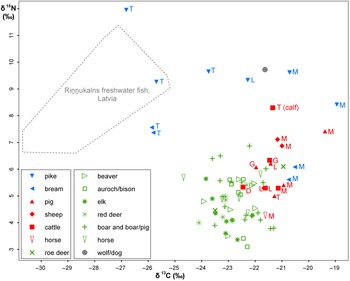
Animal and fish δ13C and δ 15N data obtained in this study (pike, bream, wolf/dog and domestic animals) combined with a previous study (Piličiauskas et al. Reference Piličiauskas, Jankauskas, Piličiauskienė, Craig, Charlton and Dupras2017b; wild herbivores and omnivores). Riņņukalns’ freshwater fish area was defined according to the data published by Schmölcke et al. (Reference Schmölcke, Meadows, Ritchie, Bērziņš, Lübke and Zagorska2016). Site names due to visibility are specified for the new results only for fish and domestic animal samples. D—Daktariškė 5, G—Garniai, L—Luokesa 1, M—Mineikiškės, T—Turlojiškė. Fish samples are marked in blue, domestic animals in red, and wild omnivores and herbivores in green. (Please see online version for color figures.)

The first major faunal group investigated in this study is freshwater fish (n=10)—pike (n=6) and bream (n=4 [Table 2; Figure 3]). In previous dietary studies, stable isotope data from the Subneolithic Riņņukalns site in Latvia was used (Schmölcke et al. Reference Schmölcke, Meadows, Ritchie, Bērziņš, Lübke and Zagorska2016) in order to reconstruct a local baseline. The analyzed fish from Lithuanian inland water bodies yielded moderately variable δ13C (–23.1 ± 2.8‰) and δ15N (8.4 ± 2‰) values. δ13C values of both pike and bream (–23 ± 3 and –23.2 ± 3‰ respectively) appeared to be clearly site dependent. At Turlojiškė in SW Lithuania, δ13C of both pikes and breams varied from –26.8 to –23.7‰. At Mineikiškė, pikes and breams had higher δ13C values from –20.8 to –18.9‰. In the case of δ15N there is a clear inter-species isotopic difference, with pikes on average having higher δ15N values (9.7 ± 1.2‰) compared to breams (6.7 ± 1‰). This is a result of trophic level differences between the species as pike is a predatory fish, while bream feeds on insects, mollusks, and plants (Kottelat and Freyhof Reference Kottelat and Freyhof2007).
Wild herbivores and omnivores analyzed in this study (n=11) have δ13C and δ15N ranges (δ13C = –22.9 ± 0.6‰; δ15N = 4.7 ± 0.7‰) which are consistent with those established in previous palaeodietary studies (Piličiauskas et al. Reference Piličiauskas, Jankauskas, Piličiauskienė, Craig, Charlton and Dupras2017b; Figure 3). Domestic livestock in our study is represented by four species –– cattle, horse, pig, and sheep. In total 15 samples were analyzed (Table 2; Figure 3). One of the five analyzed cattle samples, which belongs to a newborn calf from Turlojiškė, has a higher δ15N value which most likely indicates a nursing signal (Jenkins et al. Reference Jenkins, Partridge, Stephenson, Farley and Robbins2001; Newsome et al. Reference Newsome, Koch, Etnier and Aurioles-Gamboa2006; Figure 3). Meanwhile, the remaining four cattle samples have a narrow range of δ13C (–22.5 to –21.1‰) and δ15N (5.3–6.3‰) values, which are comparable to those of wild herbivores implying that the animals were raised and/or fed on similar foodstuffs as the wild animals (Figure 3). Similarly, a domestic horse from Mineikiškės (δ13C = –21.6‰; δ15N = 4.3‰) does not differ from the wild herbivores and wild horses (see Piličiauskas et al. Reference Piličiauskas2016). This, however, could not be said about sheep and pig. In total three sheep, all dating to the Late Bronze Age, were subjected to δ13C and δ15N analyses (Table 2; Figure 3). Unsurprisingly, the δ13C ranges of all three sheep (–21.7‰ to –21‰) indicate a homogenous diet based on terrestrial C3 plants. However, the δ15N values of two sheep at Mineikiškės (6.9 and 7.1‰) are higher than any of the wild herbivores and sheep from Luokesa 1 (5.3‰). Similarly, one pig at Mineikiškės had higher δ13C and δ15N values (–19.4‰ and 7.4‰ respectively) than any of the wild boars (Figure 3). Possibly a contribution of aquatic foods to the diet of this pig resulted in the elevated δ15N value, but this explanation seems very unlikely in the case of the sheep. Newsome et al. (Reference Newsome, Miller, Magee and Fogel2011) noted that δ15N values are also dependent on aridity, though this is an unlikely factor since climatic conditions were the same at Mineikiškės and Luokesa 1. Both sites are situated at a distance of 70 km and within a similar landscape of the Baltic Uplands. Most likely, differences between wild and some domestic animals are due to differences in their habitat (e.g., Bonafini et al. Reference Bonafini, Pellegrini, Ditchfield and Pollard2013) or because of various potential human manipulations on domestic animal fodder (e.g., Bogaard et al. Reference Bogaard, Heaton, Poulton and Merbach2007; Fraser et al. Reference Fraser, Bogaard, Heaton, Charles, Jones, Christensen, Halstead, Merbach, Poulton, Sparkes and Styring2011; Makarewicz Reference Makarewicz2014).
Human Diet
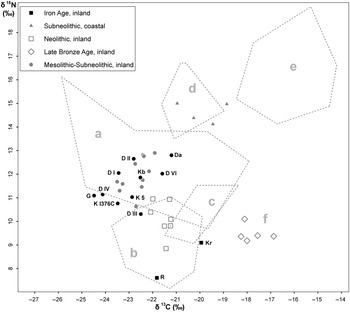
From 38 analyzed human bone and tooth dentine samples only 14 samples yielded reliable measurements (Table 1). All eight Mesolithic-Subneolithic humans sampled from sites in the Lake Biržulis region (Donkalnis and Daktariškė 5) had isotopic data indicative of a diet based primarily on the consumption of freshwater fish protein, although the degree of their importance varied between individuals (Figure 4). The largest proportion of terrestrial food was in the diet of Donkalnis III individual (δ13C = –22.5‰; δ15N = 10.3‰). Stable isotope values of three Subneolithic individuals at Kretuonas, Garnys and Kabeliai 7 were very similar to those from the Biržulis area indicating a contribution of freshwater fish in northeastern and southern Lithuania (Figure 4). Our results further support the hypothesis that freshwater fish was among the most important protein sources for the Mesolithic and Subneolithic hunter-gatherers in the eastern Baltic (Eriksson et al. Reference Eriksson, Lõugas and Zagorska2003; Meadows et al. Reference Meadows, Bērziņš, Legzdiņa, Lübke, Schmölcke, Zagorska and Zariņa2016; Piličiauskas et al. Reference Piličiauskas, Jankauskas, Piličiauskienė, Craig, Charlton and Dupras2017b).
Human δ13C and δ15N bone/dentine collagen values obtained in this study (black symbols) and previously published (gray symbols) by Antanaitis-Jacobs et al. (Reference Antanaitis-Jacobs, Richards, Daugnora, Jankauskas and Ogrinc2009) and Piličiauskas et al. (Reference Piličiauskas, Jankauskas, Piličiauskienė and Dupras2017a, Reference Piličiauskas, Jankauskas, Piličiauskienė, Craig, Charlton and Dupras2017b). Expected consumers’ areas are marked by dotted lines with a trophic level shift of approximately 1‰ for δ13C and 4.1‰ for δ15N. a—consumers of inland freshwater fish (this study), b—consumers of wild herbivores and boars (this study and Piličiauskas et al. Reference Piličiauskas, Jankauskas, Piličiauskienė, Craig, Charlton and Dupras2017b), c—consumers of domestic animals (this study), d—consumers of lagoonal freshwater fish (Piličiauskas et al. Reference Piličiauskas, Jankauskas, Piličiauskienė and Dupras2017a), e—consumers of seals and marine fish (Piličiauskas et al. Reference Piličiauskas, Jankauskas, Piličiauskienė and Dupras2017a), f—farmers with millet (Piličiauskas et al. Reference Piličiauskas, Jankauskas, Piličiauskienė, Craig, Charlton and Dupras2017b), D—Donkalnis, Da—Daktariškė 5, G—Garnys, K—Kretuonas 1B, Kb—Kabeliai 7, Kr—Kernavė, R—Raginėnai 3.

Comparing the Lithuanian freshwater fish isotopic data to those reported from Riņņukalns in Latvia (Schmölcke et al. Reference Schmölcke, Meadows, Ritchie, Bērziņš, Lübke and Zagorska2016) we identified large differences between them. The Lithuanian fish generally had higher δ13C values (–23.1 ± 2.8‰) in comparison to the Latvian fish (–27.8 ± 1.4‰). In several previous studies, however, due to lack of isotopic data from Lithuanian fish, Riņņukalns’ dataset has often been used for constructing a local isotopic baseline (e.g., Piličiauskas Reference Piličiauskas2016, Reference Piličiauskas2018; Piličiauskas et al. Reference Piličiauskas, Jankauskas, Piličiauskienė and Dupras2017a, Reference Piličiauskas, Jankauskas, Piličiauskienė, Craig, Charlton and Dupras2017b). Then it has been suggested that inland southeastern Baltic hunter-gatherers had mixed diets of freshwater fish and forest game, perhaps with a greater contribution of the former. However, given current evidence, an almost exact overlap is seen between Mesolithic-Subneolithic human δ13C and δ15N values and freshwater fish values after adding trophic level shift of 1‰ for δ13C and 4.1‰ for δ15N (Figure 4). This allows us to state, that freshwater fish clearly was the dominant protein source for the most of hunter-gatherers in Lithuania. This finding is strongly supported by organic residue analysis of ceramics which shows that most of the Subneolithic vessels in Lithuania and Estonia were used for processing and storing freshwater foods (Heron et al. Reference Heron, Craig, Lucquin, Steele, Thompson and Piličiauskas2015; Oras et al. Reference Oras, Lucquin, Lõugas, Tõrv, Kriiska and Craig2017).
A male from Kernavė grave 26 dated to the pre-Roman Iron Age, and, differently from the Stone Age humans, yielded isotopic data (δ13C = –19.9‰; δ15N = 9.1‰) which suggests a diet based on the consumption of terrestrial C3 plant and animals (Figure 4). A Raginėnai female dated to the transitional period from the pre-Roman to Roman Iron Age, based on the stable isotope results (δ13C = –21.8‰; δ15N = 7.6‰), demonstrates the most terrestrial diet among all individuals analyzed for this study. The economy of pre-Roman Iron Age people is poorly known, although we may expect that similarly to the preceding Late Bronze Age, animal husbandry and farming were the main means of food production, while the consumption of wild game and fish was negligible (Minkevičius Reference Minkevičius2021). However, unexpectedly both individuals from Kernavė and Raginėnai have lower δ13C values compared to the Late Bronze Age humans from Turlojiškė (Figure 4) indicating that millet consumption probably decreased during pre-Roman Iron Age.
Millet cultivation began in Europe during the sixteenth century BC and spread rapidly during the next two centuries (Filipović et al. Reference Filipović, Meadows, Dal Corso, Kirleis, Alsleben, Akeret, Bittmann, Bosi, Ciută, Dreslerová, Effenberger, Gyulai, Heiss, Hellmund, Jahns, Jakobitsch, Kapcia, Klooß, Kohler-Schneider, Kroll, Makarowicz, Marinova, Märkle, Medović, Mercuri, Mueller-Bieniek, Nisbe, Pashkevich, Perego, Pokorný, Pospieszny, Przybyła, Reed, Rennwanz, Stika, Stobbe, Tolar, Wasylikowa, Wiethold and Zerl2020). A significant increase in bone collagen δ13C values ca. 1500 cal BC in southern Poland has been recently documented and interpreted as a clear sign of increased consumption of a C4 plant—broomcorn millet (Pospieszny et al. Reference Pospieszny, Makarowicz, Lewis, Górski, Taras, Włodarczak, Szczepanek, Ilchyshyn, Jagodinska, Czebreszuk, Muzolf, Nowak, Polańska, Juras, Chyleński, Wójcik, Lasota-Kuś, Romaniszyn, Tunia, Przybyła, Grygiel, Matoga, Makowiecki and Goslar2021). Similarly, a significant consumption of millet has been confirmed via stable isotope data as well as plant macro-remains for Lithuania during ca. 1000–500 cal BC (Antanaitis-Jacobs et al. Reference Antanaitis-Jacobs, Kisieliene and Stančikaitė2002, Reference Antanaitis-Jacobs, Richards, Daugnora, Jankauskas and Ogrinc2009; Pollman Reference Pollmann2014; Piličiauskas et al. Reference Piličiauskas, Jankauskas, Piličiauskienė, Craig, Charlton and Dupras2017b; Minkevičius et al. Reference Minkevičius, Podėnas, Urbonaitė-Ubė, Ubis and Kisielienė2020). However, the cultivation of broomcorn millet in the southeastern Baltic during 500–0 cal BC remains obscured because of widespread cremation of human remains as well as still very few archaebotanical records from settlement sites. In Lithuania, millet grains are sporadically found at sites dating to the 1st millennium cal AD (Minkevičius Reference Minkevičius2021) while stable isotope data confirms C4 plants being of only marginal importance for diet of people of the Roman and Migration Periods (100–700 cal AD) (Simčenka et al. in prep.). However, the isotope data of Raginėnai and Kernavė individuals (δ13C ≤ –19.9‰) suggests that millet consumption had already decreased during pre-Roman Iron Age.
CONCLUSIONS
In this study we presented AMS 14C dates for 15 humans from Lithuanian Neolithic, Bronze Age and pre-Roman Iron Age sites. We dated six individuals from disturbed graves from the Donkalnis cemetery to ca. 5300–4300 cal BC, redated grave 7 from Donkalnis from the previously assumed range of the Mesolithic and Neolithic to the Subneolithic (3521–3371 cal BC), obtained an AMS date for one more individual at Kretuonas cemetery (4832–4622 cal BC), widened the chronology of the Kernavė cemetery by dating inhumation 26 to 391–197 cal BC, dated all remaining undated three individuals at Turlojiškė to ca. 1000–800 cal BC, and obtained the very first AMS 14C dates for the underwater site of Garnys (3076–2906 cal BC) and the Raginėnai burial mound (45 cal BC–109 cal AD). While dating human remains, in 4/5 cases we found that collagen was better preserved and suitable for AMS 14C dating in molar tooth dentine when compared to other bones, e.g., femur. These findings may help to date archaeological humans in the future that have previously failed using bone collagen.
For the first time we measured the δ13C and δ15N values of freshwater fish from Lithuanian prehistoric sites. The results yielded higher δ13C values in the order of 5 ± 6.3‰ than freshwater fish from the site of Riņņukalns in Latvia, which has been referenced in previous paleodietary studies. This finding shifts the interpretation of Lithuanian human stable isotope data, suggesting that for the most Mesolithic and Subneolithic individuals, freshwater food was a main constituent in human diet during this period.
While previous macrobotanical and stable isotope studies have suggested that C4 plants, i.e., millets, become widely used during the Late Bronze Age, our data suggests that millet consumption may have decreased during the pre-Roman Iron Age due to unknown reasons. However, this hypothesis should be verified by future archaeobotanical as well as further stable isotope studies.
ACKNOWLEDGMENTS
This research was financially supported by the Research Council of Lithuania (S-MIP-20-49). ES acknowledges the Lithuanian Institute of History for additional funding during the preparation of this manuscript. We are thankful to Annette M. Hansen and Harry K. Robson for the language editing.