Introduction
Four herbicides are labeled for preemergence control of goosegrass and smooth crabgrass on creeping bentgrass golf putting greens. These include bensulide, dithiopyr, oxadiazon, and siduron (Anonymous 2014, 2016, 2017, 2018a; Callahan Reference Callahan1986; Hart et al. Reference Hart, Lychan and Murphy2004; Patton and Weisenberger 2017). At the rates used on golf putting greens, these herbicides rarely provided residual protection to prevent summer annual grass emergence for more than a few months (Callahan Reference Callahan1986; Dernoeden et al. Reference Dernoeden, Watschke and Mathias1984; Johnson Reference Johnson1994b). Because goosegrass and smooth crabgrass emergence patterns (Chauhan and Johnson Reference Chauhan and Johnson2008; Fidanza et al. Reference Fidanza, Dernoeden and Zhang1996) overlap with creeping bentgrass summer stress, often caused by soil-borne pathogens, insects, heat, and drought (Beard Reference Beard2002; Dernoeden 2000; Miller and Brotherton Reference Miller and Brotherton2020), it may be necessary to reapply these herbicides to maintain season-long control (Chauhan and Johnson Reference Chauhan and Johnson2008; Fidanza et al. Reference Fidanza, Dernoeden and Zhang1996; Kerr et al. Reference Kerr, McCarty, Bridges and Cutulle2018). In the transition zone and areas farther south, goosegrass and smooth crabgrass readily infest areas on golf putting greens where the turf canopy has been compromised due to stress (Miller and Brotherton Reference Miller and Brotherton2020; Samaranayake et al. Reference Samaranayake, Lawson and Murphy2008). These weed infestations are often targeted with hand removal or cutting but they sometimes overwhelm available resources for their control. Of the aforementioned preemergence herbicides, only siduron is safe enough to apply frequently throughout the summer, while the others have been associated with turf and root loss during hot and dry periods (Callahan Reference Callahan1972; Dernoeden et al. Reference Dernoeden, Christians, Krouse and Roe1993; Hart et al. Reference Hart, Lychan and Murphy2004). As a result, they carry labeling restrictions that would prevent their use at frequent intervals or during stressful summer conditions. Siduron has been historically marketed for use at turfgrass establishment (Hart et al. Reference Hart, Lychan and Murphy2004; Kaminski et al. Reference Kaminski, Dernoeden and Bigelow2004; Willis et al. Reference Willis, Beam, Barker and Askew2006), whereas programs to extend the product’s limited soil residual performance to affect season-long summer grass control on golf putting greens have not been evaluated.
Alternate approaches to control summer annual grassy weed infestations on golf putting greens could rely on postemergence herbicides. None are currently registered for use on creeping bentgrass putting greens, but some have shown promise for grassy weed control in other areas or have been assessed for turf tolerance on creeping bentgrass putting greens in published studies (Carroll et al. Reference Carroll, Mahoney and Dernoeden1992; Cooper et al. Reference Cooper, Beck, Straw and Henry2017; Parker et al. Reference Parker, McElroy and Flessner2015). In creeping bentgrass mown to 0.6 cm, fenoxaprop, topramezone, and quinclorac are registered to control goosegrass, smooth crabgrass, or both depending on the product (Anonymous 2013, 2018b, 2019). Henry and Hart (Reference Henry and Hart2004) observed that fenoxaprop at 40 g ai ha−1 injured and reduced turf quality of ‘Penn A-4’ creeping bentgrass putting greens to an unacceptable level. Carroll et al. (Reference Carroll, Mahoney and Dernoeden1992) observed that fenoxaprop applied multiple times at 27 to 45 g ha−1 caused significant discoloration to creeping bentgrass. Quinclorac at 600 g ae ha−1 also significantly injured greens-height creeping bentgrass (Johnson Reference Johnson1994a). Thus, successful application of fenoxaprop or quinclorac to creeping bentgrass putting greens may require frequent low doses to ensure turf safety (Parker et al. Reference Parker, McElroy and Flessner2015). Topramezone has not been evaluated on golf putting greens in peer-reviewed works, but can control both goosegrass and smooth crabgrass at rates from 6.1 to 24 g ae ha−1 in other turf species (Brosnan et al. Reference Brosnan, Breeden, Patton and Weisenberger2014; Cox et al. Reference Cox, Rana, Brewer and Askew2017). Metamifop is an experimental herbicide that when applied in single, high-rate doses was safely used on creeping bentgrass putting greens (Parker et al. Reference Parker, McElroy and Flessner2015) and controlled both goosegrass (McCullough et al. Reference McCullough, Yu, Czarnota and Raymer2016; Parker et al. Reference Parker, McElroy and Flessner2015) and smooth crabgrass (Cox and Askew Reference Cox and Askew2014; Parker et al. Reference Parker, McElroy and Flessner2015).
We sought to evaluate fenoxaprop, quinclorac, siduron, and topramezone in frequent, low-dose application programs compared to metamifop and a higher rate of topramezone applied twice at monthly intervals for grassy weed control based on their performance in previously reported literature. We hypothesized a frequent, low-dose approach would maintain acceptable weed control while imparting turf safety to creeping bentgrass putting greens or extending residual performance. Therefore, field experiments were conducted to 1) evaluate creeping bentgrass, smooth crabgrass, and goosegrass response to these herbicides on golf putting greens; and 2) determine a minimum, and more economical, siduron rate for frequent, low-dose, seasonal programs to control smooth crabgrass on creeping bentgrass putting greens.
Materials and Methods
Creeping Bentgrass and Weed Response to Low-dose Herbicide Programs
A total of five field trials were conducted on creeping bentgrass putting greens as randomized complete block designs with 11 treatments and three replications. Three trials were initiated on June 6, 2016, June 6, 2016, and June 1, 2017, at the Virginia Tech Turfgrass Research Center (TRC; 37.22°N, 80.41°W) in Blacksburg, VA, on ‘L-93’ creeping bentgrass infested with smooth crabgrass (Site 1) or on adjacent areas of a fallow, weedy area of the same putting greens complex in 2016 (Site 2) and 2017 (Site 3). Two additional trials were initiated on June 6, 2016, and June 1, 2017, at the Glade Road Research Facility (GRF; 37.23°N, 80.44°W) in Blacksburg, VA, on weed-free areas of ‘007’ (Site 4) and ‘Tyee’ (Site 5) creeping bentgrass. All five trials were conducted on research putting greens built to United States Golf Association specifications (USGA 2015) maintained at 0.32-cm mowing heights for three sites grassed with creeping bentgrass, and 2.5-cm mowing height for two weedy, fallow sites. All sites were irrigated as needed to maintain desired turfgrass and weed growth. Fertility and plant protectant programs were managed similarly to in-play golf putting greens consisting of 4.9 kg N ha−1 to maintain both healthy turfgrass and weeds. Mean and standard error of one-to-three leaf smooth crabgrass percentage cover at initiation were 10.5 ± 1.2 at Site 1, whereas germination at Site 2 and Site 3 had not occurred by trial initiation. Goosegrass had also not germinated at the time of trial initiation for Sites 2 and 3.
Herbicide rates, application frequencies, adjuvants, and manufacturer information are shown in Table 1. Metamifop and topramezone at 0.0061 kg ha−1 were applied twice monthly, whereas fenoxaprop, quinclorac, siduron, and topramezone were all applied four times every 2 wk (biweekly program) at a higher rate or applied eight times every week (weekly program) at a lower rate. All treatments were applied to 0.9-m by 1.8-m plots using a CO2-pressurized hooded sprayer calibrated to deliver 280 L ha−1 at 289 kPa via two XR6502VS flat-fan nozzles (Teejet Spraying Systems Co., Glendale Heights, IL).
Product name, manufacturer, common name, rates used, application intervals, and adjuvant.

a Quinclorac and topramezone expressed as kg ae ha−1; fenoxaprop, metamifop, and siduron expressed as kg ai ha−1.
b Induce was applied at 0.25% vol/vol with all applications that contained fenoxaprop or metamifop; Dyne-Amic was applied at 0.5% vol/vol with all applications that contained topramezone or quinclorac. Both Induce and Dyne-Amic are adjuvants.
Assessments were conducted at 0, 1, 3, 5, 7, and/or 9 wk after the initial treatment (WAIT) for creeping bentgrass coverage, injury, and quality at three sites; goosegrass cover, control, and shoot density at two sites; and smooth crabgrass cover, control, and shoot density at three sites. At 5 and 9 WAIT, digital image analysis (Field Analyzer, Turf Analyzer; Fayetteville, AR 72701) was used to assess green cover of creeping bentgrass. Field Analyzer settings were low hue from 101 to 107, high hue at 360, low saturation from 11 to 18, high saturation at 100, low brightness from 29 to 31, and high brightness at 100. Grid settings were selected with an X-offset of 20 and Y-offset of 20 to reduce any variable edge effect caused by improper spray overlap. Green cover of goosegrass and smooth crabgrass 9 WAIT were based on line intersect counts using a 0.91-m by 0.91-m grid that contained 240 intersects at 5.72-cm increments. Final shoot density of goosegrass and smooth crabgrass was based on shoot counts per plot and converted to shoots per square meter. All other assessments of creeping bentgrass injury, coverage, and smooth crabgrass and goosegrass cover and control were assessed visually and rated on a 0% to 100% scale where 0 = no injury, coverage, etc. and 100 = complete coverage, plant death etc. (Frans et al. Reference Frans, Talbert, Marx and Crowley1986). Creeping bentgrass quality was visually assessed on a 1 to 9 scale where 1 = minimum turfgrass quality, 6 = minimally acceptable turfgrass quality, and 9 = maximum turfgrass quality (Krans and Morris Reference Krans and Morris2007).
Turfgrass injury and quality estimates over time were converted to area under the progress curve (AUPC) using Equation 1:
 $$\delta = \sum\nolimits_{i{\mkern 1mu} = {\mkern 1mu} 1}^{ni - 1} {\left( {\frac{{({y_i} + {y_{\left( {i - 1} \right)}})}}{2}({t_{\left( {i{\kern 1pt} + {\kern 1pt} 1} \right)}} - {t_{\left( i \right)}}} \right)}$$
where ∂ is the AUPC, i is the ordered sampling date, ni is the number of sampling dates, y is turf injury or quality measurements at a given date, and t is the time in days. The AUPC was then converted to the average per day by dividing the total AUPC by the total number of days in the study similar to the method described by Brewer et al. (Reference Brewer, Willis, Rana and Askew2016). Unlike single-date analyses, this method offers a better comparison of severity and duration of specific response variables over time, and can be useful in situations when turfgrass response is assessed by repeated measures over long study durations. To determine the most severe creeping bentgrass injury caused by each treatment, the maximum observed turfgrass injury and the minimum observed turfgrass quality for each experimental unit was used.
Data were subjected to ANOVA with mean squares separated to assess block, trial, treatment, and trial by treatment effects. The mean square of treatment effects was tested by the mean square associated with trial by treatment (McIntosh Reference McIntosh1983). Appropriate means were separated with Fisher’s protected LSD test at P < 0.05.
Siduron Rate Response Experiment
Two field trials were established on June 1, 2017, and June 2, 2019, to compare siduron rates for season-long smooth crabgrass control and creeping bentgrass response. Both trials were conducted at the TRC on the same ‘L-93’ creeping bentgrass putting green as Site 1 from the previous field trials. Treatments included siduron at 3.4, 6.7, 10, and 14 kg ai ha−1. Each rate was applied biweekly for a total of five applications over 10 wk. Means and standard errors of three-leaf to two-tiller smooth crabgrass percentage cover at initiation were 8.2 ± 1.1 for Trial 1 and 16.3 ± 2.1 for Trial 2. The trial was arranged in a randomized complete block design with four replications and a plot size of 1.8 m by 1.8 m. Treatments were applied with a hand-held CO2-pressurized boom sprayer calibrated to deliver 280 L ha−1 at 289 kPa and equipped with Teejet TTI 11004 nozzles.
Final smooth crabgrass and creeping bentgrass coverage was assessed at 14 WAIT using line intersect counts as described previously. Creeping bentgrass injury and quality were visually assessed at 0, 1, 2, 4, 6, 8, 12, and 14 WAIT as described previously. Creeping bentgrass quality was converted to AUPC per day1 as described previously. Smooth crabgrass density was assessed 14 WAIT as plants per plot and converted to plants per square meter. Data were subjected to ANOVA with sums of squares partitioned to reflect block, trial, treatment, and trial by treatment effects. Mean squares were tested to account for trial effects as previously described, and means were separated using Fisher’s protected LSD test at P < 0.05 applied first to any significant trial interactions or to other effects if trial interactions were not significant.
Results and Discussion
Creeping Bentgrass Response to Low-dose Herbicide Programs
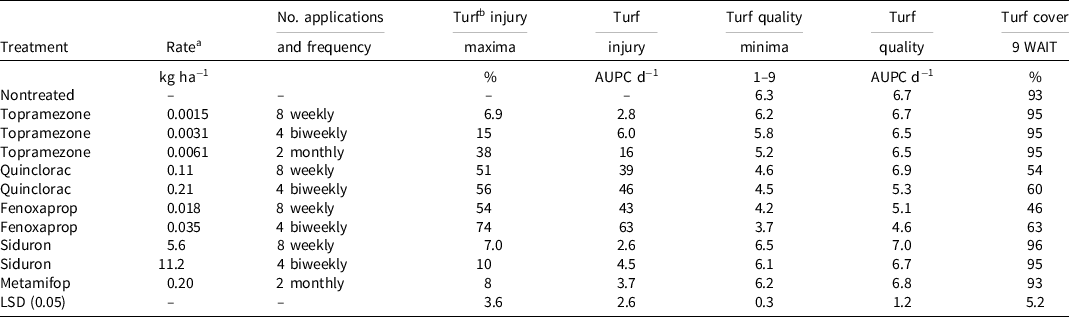
The treatment main effect was significant for creeping bentgrass maximum injury, injury AUPC per day, minimum turf quality, turf quality AUPC per day, and final turf cover at 9 WAIT (P < 0.0001, P < 0.0001, P = 0.0003, P = 0.0010, and P < 0.0001, respectively; Table 2). There was no significant trial interaction for any of the five response variables (P ≥ 0.2111), which allowed data to be averaged over three site years (Table 2).
Influence of herbicide treatment on maximum turf injury, average turf injury per day based on AUPC; minimum turf quality, average turf quality AUPC per day, and final turf cover at 9 WAIT averaged over three site years.c

a Topramezone and quinclorac expressed as kg ae ha−1; fenoxaprop and metamifop expressed as kg ai ha−1.
b Turf refers to ‘Tyee’, ‘007’, or ‘L93’ creeping bentgrass, depending on site, managed at 0.32 cm via daily mowing.
c Abbreviations: AUPC, area under the progress curve; LSD, least significant difference; WAIT, weeks after initial treatment.
Metamifop, both siduron application programs, and topramezone applied weekly or biweekly did not injure creeping bentgrass greater than 15%. This was less than the maximum injury of 38% to 74% caused by both rates of fenoxaprop, both quinclorac rates, and topramezone applied monthly (Table 2). Both Parker et al. (Reference Parker, McElroy and Flessner2015) and Cooper et al. (Reference Cooper, Beck, Straw and Henry2017) reported similar results where multiple applications of metamifop at 0.2 kg ai ha−1 injured creeping bentgrass by less than 10%. Only one previous study has investigated repeated applications of siduron on creeping bentgrass putting greens. Four monthly treatments of 54 kg ha−1 siduron injured greens-height creeping bentgrass by 0% to 36% depending on study site (Johnson and Carrow Reference Johnson and Carrow1993). Research on seedling creeping bentgrass or field-collected plugs suggests that variability in creeping bentgrass response to siduron could be related to cultivar (Reicher et al. Reference Reicher, Hardeback, Yelverton, Christians, Bingaman and Turner2002; Splittstoesser and Hopen Reference Splittstoesser and Hopen1967). Our study evaluated ‘L93’, ‘007’, and ‘Tyee’ creeping bentgrass and none were injured by the novel frequent, low-dose siduron (Table 2). The creeping bentgrass cultivar ‘L-93’ is one of three cultivars that we used for our tolerance studies, and is a relatively tolerant cultivar (Hart et al. Reference Hart, Lychan and Murphy2004; Reicher et al. Reference Reicher, Hardeback, Yelverton, Christians, Bingaman and Turner2002). Our data suggest that frequent, low-dose treatments of siduron reduce injury potential compared to single, high-dose treatments.
Peer-reviewed research has not evaluated creeping bentgrass response to topramezone at greens-height (less than 1 cm) or at topramezone rates below 0.008 kg ha−1. Elmore et al. (Reference Elmore, Brosnan, Armel, Kopsell, Best, Mueller and Sorochan2015) observed that topramezone applied at 0.008 kg ha−1 injured single-plant creeping bentgrass seedlings by 22%, which is slightly higher than the maximum injury observed in our studies by topramezone applied biweekly to mature creeping bentgrass putting greens. Topramezone can cause unacceptable injury to creeping bentgrass if rates are applied at 0.018 kg ha−1 or greater (Brewer et al. Reference Brewer, Willis, Rana and Askew2016). Based on a review of preliminary reports, topramezone has not been evaluated on greens at rates lower than 0.005 kg ha−1, nor at application intervals at 2 wk or less. Unacceptable greens injury was reported for topramezone only when it was applied at rates at or above 0.006 kg ha−1.
Turf injury AUPC per day exhibited similar trends to that of maximum turf injury (Table 2). Fenoxaprop and quinclorac were the most injurious herbicides and deemed unacceptable for creeping bentgrass putting greens if applied weekly or biweekly as in these studies. Fenoxaprop applied weekly, for example, injured creeping bentgrass an average of 43% per day based on AUPC (Table 2). This level of injury is just above the acceptable threshold of 30% and could go unnoticed on golf putting greens that receive routine colorant applications to improve green color. Parker et al. (Reference Parker, McElroy and Flessner2015) and Henry and Hart (Reference Henry and Hart2004) observed that fenoxaprop injured creeping bentgrass by less than 20%, which was lower than the injury caused by our weekly fenoxaprop program. We attribute this lower creeping bentgrass injury to the 3-wk reapplication interval reported by Henry and Hart (Reference Henry and Hart2004) and Parker et al. (Reference Parker, McElroy and Flessner2015). Johnson (Reference Johnson1994a) observed that quinclorac applied at 0.6 kg ha−1 (three times higher than our highest rate) once reduced greens-height creeping bentgrass turf quality by a maximum of 42% to 51%, which is similar to the turf injury AUPC per day caused by both quinclorac frequent, low-dose programs in our studies.
Turf quality minima and average daily turf quality based on AUPC mirrored turfgrass injury, suggesting that quality was primarily influenced by herbicide injury in these studies (Table 2). Only turf treated with metamifop, both siduron programs, and weekly topramezone did not differ from nontreated turf with respect to turf quality minima or average turf quality per day based on AUPC (Table 2). The turf quality reductions caused by quinclorac and fenoxaprop (Table 2) are similar to those observed on creeping bentgrass in other studies (Carroll et al. Reference Carroll, Mahoney and Dernoeden1992; Dernoeden et al. Reference Dernoeden, Bigelow, Kaminski and Krouse2003; Henry and Hart Reference Henry and Hart2004; Johnson Reference Johnson1994a).
All treatments, except those containing fenoxaprop or quinclorac, had 93% or greater creeping bentgrass cover at 9 WAIT (Table 2). The lower turf cover from fenoxaprop and quinclorac may be attributed to herbicide injury that reduced canopy density. Siduron applied at 8.9 to 18 kg ai ha−1 did not cause creeping bentgrass canopy loss in two of three years in work carried out by Callahan (Reference Callahan1972). In the third year of the Callahan (Reference Callahan1972) study, siduron may have exacerbated creeping bentgrass loss from Pythium blight (Pythium spp.).
Across all three tolerance studies, metamifop, topramezone applied weekly, and both siduron programs were the safest treatments applied to creeping bentgrass putting greens. All fenoxaprop and quinclorac programs were deemed too injurious to creeping bentgrass putting greens. Although the exact treatment regimens used in these studies have not been evaluated elsewhere, our results generally align with those in other reports (Callahan Reference Callahan1972; Carroll et al. Reference Carroll, Mahoney and Dernoeden1992; Johnson Reference Johnson1994a; Johnson and Carrow Reference Johnson and Carrow1993; Parker et al. Reference Parker, McElroy and Flessner2015) regarding creeping bentgrass response to the herbicides evaluated here.
Weed Control from Low-Dose Herbicide Programs
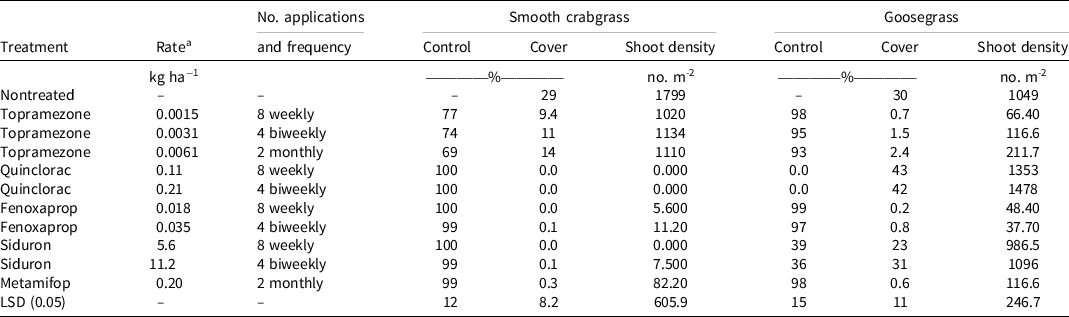
Smooth crabgrass control. The treatment main effect was significant for smooth crabgrass and goosegrass control, cover, and shoot density at 9 WAIT (P ≤ 0.0220). The trial by treatment interaction was insignificant for all five response variables (P ≥ 0.0501), and data for each variable were averaged over three site years (Table 3). All programs containing fenoxaprop, metamifop, quinclorac, or siduron controlled smooth crabgrass by 99% to 100% at 9 WAIT (Table 3). Topramezone controlled smooth crabgrass by 69% to 77% with a slight improvement in control by weekly applications compared to monthly applications.
Influence of herbicide treatment on smooth crabgrass and goosegrass control, cover, and shoot density at 9 wk after initial treatment averaged over three site years.

a Topramezone and quinclorac expressed as kg ae ha−1; fenoxaprop and metamifop expressed as kg ai ha−1.
Although fenoxaprop, metamifop, and quinclorac have controlled smooth crabgrass at higher rates and height of turfgrass cut (Cox and Askew Reference Cox and Askew2014; Dernoeden et al. Reference Dernoeden, Bigelow, Kaminski and Krouse2003; Derr Reference Derr2002; Johnson Reference Johnson1995; Neal et al. Reference Neal, Bhowmik and Senesac1990), only one study has reported smooth crabgrass control on creeping bentgrass greens with any of these herbicides (Parker et al. Reference Parker, McElroy and Flessner2015). In that study, metamifop controlled smooth crabgrass comparably to the current study and fenoxaprop applied thrice at 3-wk reapplication intervals controlled smooth crabgrass by 74%, which is significantly lower than our results from eight weekly treatments. Of 22 peer-reviewed papers we reviewed that reported siduron use in turfgrass, only three assessed siduron use in mature turfgrass systems for smooth crabgrass control (Callahan and High Reference Callahan and High1990; Callahan et al. Reference Callahan, Overton and Sanders1983; Murray et al. Reference Murray, Klingman, Nash and Woolson1983) and none evaluated goosegrass or smooth crabgrass control in creeping bentgrass. These papers generally indicate that siduron applied once or twice per year does not offer season-long smooth crabgrass control.
The weekly and biweekly topramezone programs controlled smooth crabgrass by 77% and 74%, respectively, at 9 WAIT (Table 3). Although no peer-reviewed studies have evaluated topramezone applied to greens-height turf, comparing results of previous work to the current study suggest that either greens-height smooth crabgrass is easier to control or frequent, low-dose treatments are more effective than single, high-dose treatments. For example, Elmore et al. (Reference Elmore, Brosnan, Kopsell and Breeden2012) reported that 50% control of greenhouse-grown smooth crabgrass requires 0.020 to 0.043 kg ha−1 of topramezone, and Brosnan et al. (Reference Brosnan, Breeden, Patton and Weisenberger2014) reported that 0.012 kg ha−1 topramezone applied once to lawn-height tall fescue controlled smooth crabgrass by only 5% to 27% at 9 WAIT. Smooth crabgrass cover and shoot density data mirror trends in smooth crabgrass control with the exception that all topramezone programs had equivalent cover and shoot densities, whereas the monthly program had slightly less control than the weekly program (Table 3).
Goosegrass Control. All topramezone, fenoxaprop, and metamifop programs controlled goosegrass by 93% to 98% at 9 WAIT, better control than provided by quinclorac or siduron programs (Table 3). Fenoxaprop applied at 0.20 kg ha−1 failed to control any goosegrass in a Kentucky bluegrass golf fairway in Georgia (Johnson Reference Johnson1994b), whereas fenoxaprop applied at 0.10 kg ha−1 controlled goosegrass by 40% on a creeping bentgrass putting green in Alabama (Parker et al. Reference Parker, McElroy and Flessner2015). These previous reports show that fenoxaprop can injure goosegrass, especially at greens height, but fenoxaprop was not previously evaluated in frequent, low-dose programs for goosegrass control as it was in the current study. Cox et al. (Reference Cox, Rana, Brewer and Askew2017) observed that topramezone applied twice at 0.0061 kg ha−1 controlled goosegrass by 84% to 92%. This level of goosegrass control is similar to our results for all topramezone programs, even though the topramezone rates for the weekly and biweekly programs are two to four times lower than the rate used by Cox et al. (Reference Cox, Rana, Brewer and Askew2017).
Quinclorac did not control goosegrass at 9 WAIT (Table 3) as it did in other studies (Johnson Reference Johnson1994b). Siduron applied weekly at 5.6 kg ha−1 or biweekly at 11 kg ha−1 controlled goosegrass by 36% to 39% (Table 3). Siduron has been shown to reduce goosegrass germination (Berry and Buchanan Reference Berry and Buchanan1974), but it did not control goosegrass during zoysiagrass establishment (Fry et al. Reference Fry, Dernoeden and Murray1986). Kerr (Reference Kerr1969) evaluated the response of 118 grass species to rates of siduron and found that goosegrass and smooth crabgrass seedling growth was reduced 50% by siduron at 2.2 and 1.1 kg ha−1, respectively, whereas >13 kg ha−1 was required to reduce creeping bentgrass seedling growth equivalently. Kerr’s work agrees with our research in that a large degree of selectivity exists between creeping bentgrass and the two weedy grasses, and that smooth crabgrass is more sensitive to siduron than goosegrass (Kerr Reference Kerr1969). As with smooth crabgrass, goosegrass cover and shoot density mirror the trends in goosegrass control (Table 3).
Creeping Bentgrass and Smooth Crabgrass Response to Siduron Rates
The treatment main effect was significant for creeping bentgrass cover, turf quality, smooth crabgrass control, smooth crabgrass cover, and smooth crabgrass density (P = 0.0172, P = 0.0034, P < 0.0001, P = 0.0152, and P < 0.0001, respectively), and no response variable was dependent on trial (P ≥ 0.0523; Table 4). At 14 WAIT, siduron-treated plots averaged 93% to 97% creeping bentgrass cover compared to 59% cover in nontreated plots (Table 4). The poor cover evident in nontreated plots was caused by weed infestation. Increased creeping bentgrass cover in siduron-treated plots led to a concomitant increase in average turf quality per day based on AUPC (Table 4).
Influence of siduron rate on creeping bentgrass cover 14 WAIT; average turf quality per day based on AUPC; and smooth crabgrass control, cover, and density at 14 WAIT averaged over two years.

aAbbreviation: AUPC, area under the progress curve; WAIT, weeks after initial treatment.
Siduron applied five times biweekly at the tested rates controlled smooth crabgrass by 96% to 99% (Table 4). Siduron-treated plots averaged 0.1% to 1.7% plot cover and between 0.75 and 18.5 smooth crabgrass plants per square meter, whereas the nontreated plots averaged 40% cover and 312 plants m−2 (Table 4). This near equivalence in weed control across all siduron rates would have a substantial economic impact on weed management costs since current market value of siduron ranges from US$36 to US$49 kg−1 active ingredient depending on product and supplier. Past research shows that siduron can provide inconsistent control of smooth or large crabgrass, but none of these studies applied more than two applications of siduron per year (Hart et al. Reference Hart, Lychan and Murphy2004; Willis et al. Reference Willis, Beam, Barker and Askew2006), while we applied all four rates biweekly for a total of five applications. The general safety observed in these trials by creeping bentgrass to siduron is supported by the previous field studies and by other published research (Callahan Reference Callahan1972; Johnson and Carrow Reference Johnson and Carrow1993). Of the herbicides evaluated in this study, only siduron is currently registered for use on creeping bentgrass putting greens in the United States (Anonymous 2014). Siduron was shown to be safe to creeping bentgrass under a wide range of rates and effectively controls smooth crabgrass for the duration of a typical growing season in Virginia. Metamifop and topramezone also show promise for potential use on creeping bentgrass putting greens for goosegrass control. These frequent, low-dose programs offer a novel solution for season-long smooth crabgrass and goosegrass control on creeping bentgrass putting greens.
Acknowledgments
We thank Sandeep Rana, Connor Waters, Caitlin Swecker, Veronica Breslow, Cam Shelton, and Jon Dickerson for aiding in trial establishment, data collection, and site maintenance. This research received no specific grant from any funding agency, commercial or not-for-profit sectors. No conflicts of interest have been declared.