

Introduction
During the last two decades of the Qing dynasty, China's foreign trade grew at a rapid pace, almost quadrupling in the combined value of imports and exports, from 214,238 Haiguan taels in 1890 to 848,842 Haiguan taels in 1911.Footnote 1 During the same period, Chinese engagement with foreign capital markets also reached a new peak as the Qing government increased its foreign borrowing to pay for the Japanese war indemnity, railway construction, and other reform projects.Footnote 2 As a result, foreign bankers’ interest in the Chinese market grew and China became one of the up-and-coming markets for the global spread of international banking.Footnote 3 For example, the German banker August Heinrich Exner, having just returned from a study mission to China sponsored by several German banks in 1887, ended a lecture on Chinese finance with the following remarks:
There remains now nothing for me to do, but to express the wish that, with the opening of that new era of the Far East […] German financiers may succeed in securing for German commerce and German industry new markets and new openings, and that they will take a most prominent share in the distribution of labour throughout the great marts of that far-away country. To gain this aim, it is above all things necessary that we should be on the spot at the right time, in proper force, with as much unanimity as possible, and furnished with the needful knowledge of the country and of its affairs. What has hitherto been done in this direction, is insufficient. May German financial circles learn how to go ahead in that country with the needful energy and smartness, and not let the right moment pass by through undue procrastination.Footnote 4
The first foreign bank branch was established in China in 1845, and the following decades saw a slow growth of foreign, predominantly British, banking houses in Chinese treaty ports.Footnote 5 However, it was only after 1890 and during the last two decades of the Qing dynasty that this newfound enthusiasm for China among foreign bankers led to a more rapid development of foreign financial institutions in China. During this period, China saw an ‘extensive expansion in foreign banking’, with many non-British foreign banks establishing branches in the commercial hubs of the Chinese coast. By the end of the Qing dynasty, foreign banks had established branches or agencies in most of China's major treaty ports, such as Shanghai, Tianjin, and Hankou. This influx led to foreign banks becoming a major presence in the banking sector of China's treaty port economy, where they financed China's foreign trade, provided loans to the Chinese government, and supplied Chinese banks with credit.Footnote 6
In the course of entering the Chinese banking sector, these foreign banks invariably came into contact with the indigenous Chinese banks. During the late Qing dynasty, there were primarily two forms of Chinese banks.Footnote 7 First, there were the piaohao, which operated a countrywide network of branches and specialized in long-distance remittances. Piaohao also issued loans and received deposits. However, they seem to have had limited direct contact with foreign banks.Footnote 8 The second set of Chinese banking institutions were the qianzhuang. These were local commercial banks that provided loans, accepted deposits, and issued their own notes. Qianzhuang played a very important role as suppliers of credit for Chinese merchants involved in China's foreign trade and were also the main business partners of foreign banks in China's treaty port banking sector.Footnote 9 As we will see, qianzhuang received and supplied credit to foreign banks. Given that foreign banks mainly interacted with qianzhuang, the rest of the article also uses the term ‘Chinese bank’ to refer to qianzhuang.Footnote 10
As foreign banks entered China, they had to find ways to access the Chinese banking sector and interact with Chinese banks. This article examines how foreign bankers adapted their business practices to the new business environment in China, how they were integrated into the Chinese banking sector, and what forms of business partnerships with Chinese bankers they entered into. Previous scholarship on the interaction between foreign and Chinese banks in late Qing China's treaty ports has commonly seen foreign banks as dominating the treaty port banking sector, most importantly by controlling the supply of credit within the financial market. For example, writing about Shanghai, financial historian Wang Jingyu has argued that foreign banks ‘controlled Shanghai's financial market and made Shanghai's [Chinese] qianzhuang [banks] their subordinates’. Thus, according to most previous scholarship, foreign banks were not integrated into the Chinese banking sector, but rather imposed their one-sided control over Chinese banks.Footnote 11
Shizuya Nishimura, however, has recently begun to complicate this view. In his study of the seasonality of loans provided by foreign to Chinese banks, Nishimura has suggested that latter were less dependent on foreign banks and loans than previously thought, arguing that ‘dependence […] was not a one-sided affair […] and the power relationship was not always favourable to the lender’.Footnote 12 Building on Nishimura's work, this article aims to further challenge the view articulated in the previous literature by examining the relationship between the Deutsch-Asiatische Bank (DAB), the main German bank active in China between its establishment in 1889 and the First World War, and Chinese banks in Shanghai.Footnote 13 Shanghai was China's most important treaty port in terms of foreign trade at the time, and its importance as a financial centre during the last two decades of the Qing dynasty was rivalled only by Beijing and Tianjin.Footnote 14 While this article focuses mainly on the relationship between foreign and Chinese banks in Shanghai, similar interaction also existed in other major treaty ports.Footnote 15 Thus, understanding the relationship between foreign and Chinese financial institutions in Shanghai is also instructive for understanding the functioning of the banking sector in the larger treaty port economy.
This article demonstrates that Chinese banks were not only less dependent upon foreign banks than has been previously argued, but also shows that they could exploit their relationship with foreign banks in very profitable but hitherto unstudied ways, especially by making use of information asymmetries between foreign and Chinese banks and, to a large extent, controlling how the money they received from foreign banks was used.Footnote 16 Furthermore, this article argues that, far from being able to simply impose their practices and control on Chinese banks, foreign banks were actually integrated into existing business networks by the Chinese entrepreneurs called compradors who managed the foreign banks’ business with Chinese banks. This process required the foreign banks to localize their practices and adapt to the new business environment. Consequently, this article argues that the interaction between foreign and Chinese banks was one of interdependence rather than one-sided control and that Chinese banks often occupied the more advantageous position within this relationship.
Exploring the relationship between foreign and Chinese banks can also help us to understand how Sino-foreign business partnerships and networks contributed to the effective functioning of financial markets in the Chinese treaty port economy.Footnote 17 In his study of associational life in Republican Shanghai, Jeffrey Wasserstrom has observed that Shanghai was divided along many different lines, such as nationality, class, or language, so that it was ‘less a single unified entity than a constellation of separate cities-within-the-city’. According to Wasserstrom, one factor that played an important role in holding Shanghai together, despite these divisions, and allowed it to function and ‘go on’ were associations and transnational networks that consisted of foreign and Chinese actors who crossed the ‘Chinese/foreign divide’.Footnote 18 This necessity of bridging this divide also existed in the commercial sphere of Shanghai and other treaty ports where different Chinese and foreign economic actors, institutions, and practices met. While previous studies of Sino-foreign economic interaction in modern China have furthered our understanding of how this divide was bridged in the sphere of trade and manufacturing,Footnote 19 we still know little about how Sino-foreign financial networks crossed this divide within the financial markets of China's treaty port economy. By tracing how foreign banks were integrated into the Chinese banking sector and into existing Chinese business networks, this article shows how Sino-foreign business networks, comprising both foreign and Chinese actors that could bridge the ‘Chinese/foreign divide’ in the sphere of finance, were formed. It also reveals the importance of Chinese agency and existing Chinese market structures and institutions for these networks. As we will also see, an important consequence of the integration of foreign banks into Chinese banking networks was both that this integration seems to have further encouraged the risky business practices of Chinese banks and that foreign banks shared the risk within the Sino-foreign business network.
This article opens with a discussion of the deposit business of foreign banks, which was an important source of working capital for them. That foreign banks could attract such large deposits from Chinese clients was one of the main reasons why they sought partnerships with Chinese banks, because they had to find a way to employ these deposits profitably in the Chinese banking sector. The article then turns to the compradors of foreign banks, that is, the Chinese managers that acted as the intermediaries between foreign and Chinese banks. Using the example of the DAB's Shanghai comprador, the article shows that working for foreign banks was not the compradors’ main occupation and suggests that, in fact, these Chinese entrepreneurs used their positions primarily to add a connection to a foreign bank to their larger business networks. The third section of this article demonstrates how Chinese businesspeople, working as compradors, could use their connection to a foreign bank and the information asymmetries between foreign and Chinese bankers to generate large profits and attain a competitive advantage. The article concludes by arguing that an interdependent relationship existed between foreign and Chinese banks that led to the formation of Sino-foreign business networks and, by exploring the implications of this relationship for the operation of foreign banks in China, the development of Chinese banking and power dynamics in the treaty ports.
The deposit business of foreign banks
Before we discuss the relationship of foreign banks with Chinese bankers, we must turn to the sources of the foreign banks’ working capital, particularly their large deposit business, which compelled them to find ways of employing this capital in the Chinese banking sector. Before the advent of modern Chinese banks in the early twentieth century, foreign banks generally possessed greater capitalization than their Chinese counterparts. For example, by 1900 the DAB had a paid-up capital of five million Shanghai taels.Footnote 20 In contrast, on average, qianzhuang had only a capitalization of 20–60,000 taels, and piaohao a capitalization of about 100,000–300,000 taels.Footnote 21 Moreover, starting from 1895, the Chinese government regularly paid large amounts of money into the DAB and other important foreign banks for the repayment of loans and indemnities in Europe.Footnote 22 Finally, foreign banks received additional working capital by issuing their own bank notes.Footnote 23 These factors alone meant that foreign banks possessed relatively large amounts of working capital, which incentivized them to employ capital in the Chinese banking sector.
However, the most important factor that led foreign banks to channel capital into the Chinese banking sector seems to have been that they received large deposits. While the DAB also received deposits from foreign sources, most of them were of Chinese origin.Footnote 24 Foreign banks in China operated under extraterritoriality and, unlike Chinese banks, were therefore under foreign jurisdiction and protected from intervention by the Chinese government.Footnote 25 This was especially significant due to the limited development of property rights in China and the tendency of the Chinese state to confiscate assets during crises.Footnote 26 Therefore, foreign banks provided wealthy officials and merchants with the ideal place in which to deposit and hide their funds from the government. Reflecting on the activities of the DAB in China before the First World War, in 1933 the president of the DAB's supervisory board, Franz Urbig, explained that extraterritoriality was the key factor that allowed the DAB to attract Chinese deposits and to accumulate working capital in excess of its stock capital.Footnote 27 Moreover, as an article from the newspaper Shenbao reported in 1935, compared to Chinese banks, for several decades foreign banks had been seen as more trustworthy as well as more reliable due to their large capitalization, which made it unlikely that they would fail and lose their customers’ deposits.Footnote 28
As a result, deposits in foreign banks by wealthy Chinese merchants and officials seem to have been very common in the late nineteenth and early twentieth centuries. During the last decade of the Qing dynasty, the Chinese journalist Wang Kangnian recounted rumours that ‘the merchants and officials of our country have deposited over seventy million Taels with the Hongkong and Shanghai Banking Corporation (HSBC), around thirty or forty million Taels with the Russo-Asiatic Bank, over twenty million Taels with the Yokohama Specie Bank’, with no estimates available for the DAB and other foreign banks.Footnote 29 Several cases of officials who deposited large sums of money in foreign banks were known at the time, probably most famously that of Prince Qing (Qing Qinwang), who was impeached for secretly hiding large sums of money in the HSBC. When the Qing court initiated an investigation of the matter, however, it discovered that the HSBC protected its customers and refused to allow outsiders access to their account books.Footnote 30 The DAB also received similar deposits: shortly after commencing business in China in 1890, a German banker reported that ‘one of the most important mandarins has already paid in a nice deposit’ at the DAB and that others would surely follow his example.Footnote 31 Another example is Sheng Xuanhuai, who in 1897 had deposits worth 402,232 Shanghai taels at the DAB in Shanghai.Footnote 32 Shortly after the 1911 revolution, a Chinese nationalist declaration criticizing the six-country banking consortium stated that ‘half of the silver taels [used by these foreign banks in China] consists of fixed deposits of our merchants’.Footnote 33 While it is difficult to gain a full picture of the extent to which rich merchants and officials deposited their money in foreign banks, they undoubtedly received significant amounts from their Chinese customers. At the same time, the DAB and other foreign banks not only protected these deposits, but most likely also made it possible for numerous officials to hide embezzled money from the state.Footnote 34
However, it was not only rich Chinese merchants and officials, but also Chinese government offices that deposited their funds with the DAB.Footnote 35 For example, after the DAB had established a branch in Tianjin in 1890, the Chinese government made a deposit of over 600,000 taels of government funds at an annual interest rate of 5 per cent.Footnote 36 In 1892, Zhili governor-general Li Hongzhang even remarked that foreign banks were the only ‘reliable’ (kekao), trustworthy banks in Tianjin, implying that he was only willing to deposit government funds with these financial institutions.Footnote 37 As no Chinese bank could offer the same reliability, secrecy, and stability, it was left to the foreign banks to satisfy this demand and, as a result, they received massive deposits from Chinese sources.Footnote 38 By 1895, only a few years after its establishment, the DAB had accumulated 1,473,516 Shanghai taels in deposits, which, at the time, exceeded its paid-up capital.Footnote 39 In 1898, the HSBC—the largest foreign bank operating in China at the time—held deposits of around 95 million Shanghai taels.Footnote 40 This trend continued during the ‘ten years before the fall of the Manchu regime, [when] deposits with the [foreign] banks increased largely’ because of the safety associated with them.Footnote 41 Although the presence of foreign banks remained limited to the treaty ports, Thomas Rawski has estimated that by 1912 they had 29 per cent of all bank deposits in China.Footnote 42 In fact, foreign banks received so many deposits that there were times when they were unable to invest them profitably in the market and had to refuse them.Footnote 43 Therefore, foreign banks had massive quantities of working capital at their disposal. While some of this working capital was needed for the financing of foreign trade, the surplus could be employed in the Chinese banking sector. Other possible uses of the foreign banks’ working capital, such as loans to the Chinese government, were not of a regular nature and therefore the Chinese banking sector was the main outlet for surplus funds.Footnote 44 This is confirmed by the account of a contemporary observer. Referring back to the time before 1911, he explained a few years after the end of the Qing dynasty ‘foreign banks have large deposits, and have large sums passing through their hands, and as there is always a surplus beyond the amount needed for purposes of trade, they are glad to utilize it in the best possible fashion. They supply capital to the native banks […].’Footnote 45
The business networks of the compradors
Given the sheer size of the deposits and other working capital that the DAB and other foreign banks in China received, it should come as no surprise that they should have wanted to invest their working capital profitably in China's coastal banking sector. However, like other foreign firms, foreign banks had difficulties in directly interacting with Chinese firms due to their lack of familiarity with the Chinese language and business environment. Consequently, the engagement of these foreign banks with Chinese banks and merchants was managed and mediated by their Chinese staff, headed by a Chinese manager called a comprador. While historical scholarship has moved away from viewing compradors working for foreign firms mainly as supporters and beneficiaries of foreign imperialism, the notion still mostly prevails that they constituted a specific class or group whose ‘primary capacity’ was their work as a comprador for a foreign firm and whose primary characteristic was their ‘compradorial background’. Any other economic activities engaged in by a comprador have largely been understood as building on their work as a comprador for the foreign firm.Footnote 46 However, as the example of the DAB's Shanghai comprador reveals, it is more useful to think of the bank comprador as simply a position in a foreign bank filled by a Chinese entrepreneur. This position was neither their main occupation nor made up the greater part of their business activities. Rather, taking on the position of bank comprador in a foreign bank was a way for the Chinese entrepreneur to complement their existing network of business enterprises with a connection to a foreign bank.
Before the DAB could open its doors in Shanghai in 1890, a comprador had to be found to manage its business with Chinese banks. Most likely due to his adviser Moritz Kalb’s previous long experience as a merchant working as a co-owner of the British merchant firm Reiss and Co. in China, DAB Shanghai manager Ferdinand Rinkel asked Kalb to find a suitable person for the comprador post. Kalb recommended Xu Chunrong, a merchant and banker he had ‘known since 1872’. In choosing Xu, he was led by Xu's reputation as well as his personal knowledge of and trust in him. In a report to the bank's directors in Berlin, Kalb emphasized that in his previous work as a China merchant, he had had frequent large-scale business dealings with Xu and valued him as a ‘diligent, assiduous and astute man […] with whom I never had even the smallest argument. He always fulfilled his obligations [punctually] on the day, [accurately] to the last cent.’ Kalb also explained that Xu was ‘very influential’, which would be useful for the bank, especially for borrowing money from Chinese banks if necessary. After Rinkel had approved his choice, Kalb drew up a contract with Xu, as was common between foreign firms and their compradors. The contract fixed all of Xu's obligations towards the bank. He also had to provide a guarantee sum of 70,000 Shanghai taels, which was put up by his own firm Da Feng and three Chinese banks. The DAB could terminate the contract at any time, while Xu had to give six months’ notice if he wished to end the agreement.Footnote 47
Xu was a very influential figure in Shanghai's foreign trade and finance. He was born in Huzhou in Zhejiang province in 1839, but his family came from the Zhenhai district in Ningbo.Footnote 48 After spending some time in Suzhou, he moved to Shanghai and, in the 1860s, became the manager of the Da Feng Company, which was owned by the Weng family of Ningbo. Da Feng became one of the first Chinese firms to sell imported foreign woven cloth in China. Reiss and Co. imported British cloth products into China and Da Feng sold large amounts of these imports to Chinese customers. Kalb and Xu must have met through this business partnership. In all probability to further consolidate his relationship with Reiss and Co., Xu became the comprador of the company in 1870. As this position made him responsible for distributing its imported products, it guaranteed his access to these products in his capacity as the manager of Da Feng. The company prospered, creating profits in the order of 30,000–40,000 Shanghai taels a year. As a result, Xu was able to purchase the rank of daotai from the Chinese government, was the head of the Zhenhua Tang Trade Guild for Foreign Cloth (Zhenhua tang yangbu gongsuo) from 1877 to 1905, and became secretary (yidong) of the Shanghai Chamber of Commerce (Shanghai Shangwu Zonghui). Around 1880, the Weng family withdrew its shares from the Da Feng Company and Xu became the company owner and worked as its manager until his retirement in 1905. Despite his later investment in banking, his main occupation remained his work with the Da Feng Company, which he turned from a small enterprise with an original stock capital of 3,000 Shanghai taels into a major trading company with an estimated capital of 200,000 Shanghai taels, according to Kalb in 1890.Footnote 49
It is unclear when Xu became involved in banking, but he had already established seven qianzhuang in Shanghai by 1884, which went bankrupt during the financial crisis caused by the Sino-French War of 1884–1885. However, he subsequently opened several qianzhuang with other influential merchant families in Shanghai. Most importantly, he was connected through marriage to the Ye family, who also came from Zhenhai in Ningbo. The two families together opened four qianzhuang, with a capital of 20,000 Shanghai taels each. Given their common ownership and the fact that each of these qianzhuang bore the character da (meaning ‘big’) in their names, they came to be known as the sida qianzhuang. They became so powerful that their bankruptcy was a major factor in the financial crisis that hit Shanghai after the revolution in 1911. Xu opened two more qianzhuang, both of which had capital of 20,000 Shanghai taels and also bore the character da in their names, with two other influential families. The most important of these was the Xi family from Suzhou, who were also connected to the Xu family through marriage and had a tradition of filling comprador positions in foreign banks. We know that in 1888 the Yuda qianzhuang, one of the four banks opened with the Ye family, had already been established and was a huihua qianzhuang, the most powerful group of qianzhuang in Shanghai, and thus also a member of Shanghai's Money Trade Guild (Qianye Zonggongsuo). As Xu's other qianzhuang had the same capitalization, we must assume that they also became members of the Money Trade Guild.Footnote 50
This sketch of Xu's life shows that he was not primarily a comprador, but had other, more important, business interests in trade and finance before he became the DAB's comprador. Although he worked as a comprador for Reiss and Co., this comprised only a small part of his business activities and he probably only took up the position to reinforce the existing connection between the Da Feng Company and this foreign firm. Moreover, the overview of Xu's business activities also suggests that his network consisted of several layers. At the most basic level, there were the businesses he owned or co-owned. Besides the Da Feng Company, these were the six qianzhuang he co-owned. As these six qianzhuang were all partly owned by Xu und connected by a common character in their name, they were a typical lianhao, a cluster of qianzhuang connected by ownership by the same individual or family which implied close interconnectedness and cooperation.Footnote 51 On a broader level, stemming from Ningbo, Xu belonged to the native-place group or bang of Ningbo merchants who dominated banking in Shanghai during the nineteenth and early twentieth centuries.Footnote 52 While their interconnectedness was likely not to have been as close as those in a lianhao, qianzhuang owned and managed by members of a certain bang would cooperate—‘be less competitive to each other and would take common interest with each other’—in their dealings with qianzhuang not belonging to their bang.Footnote 53 Finally, Xu belonged to several guilds. In terms of his banking interests, this was the Shanghai Money Trade Guild, whose members did not all come from the same native place but nevertheless cooperated, mainly to facilitate the functioning of the Shanghai money market. However, the last two decades of the Qing dynasty saw increased cooperation among guild members so as to maintain their position and control of the money market against the competition of newly established qianzhuang.Footnote 54 Thus, we see that Xu's business network was not only made up of the businesses he owned, but also of two broader layers consisting of qianzhuang he was connected to through his native-place ties and guild membership. Xu and his qianzhuang will have been more closely connected to the qianzhuang belonging to his own bang and, probably to a lesser extent, to the qianzhuang that were guild members than to other qianzhuang in the Chinese banking sector.
As we will see, Xu's decision to become the DAB's comprador was not motivated by the official remuneration that the post offered, but by his wish to gain a connection to a foreign bank for his existing businesses and by the possibility that he would be able to exploit the information asymmetry between himself and the DAB to generate additional profits. As will be suggested later, the addition of a foreign bank to his business network would not only have added these immediate benefits to the basic layer of his business network, but could also have had an effect on its broader layers.
As the DAB's comprador, Xu was responsible for the entire Chinese staff he employed. He also guaranteed and was personally liable for all bills he accepted on behalf of the DAB from Chinese banks and for the cash reserves of the bank, which he managed under the supervision of the German cashier. His staff also evaluated the Chinese currencies and bullion that the bank worked with, such as silver sycee and gold ingots. Apart from Xu, in 1890 the bank's Chinese staff was made up of the second comprador; three shroffs, who handled the money, bookkeeping and other banking matters; one office clerk; four ‘coolies’, and two guards who guarded the premises day and night.Footnote 55 Xu's office and his Chinese staff were located in the same building as all the other offices used by German bankers in the DAB's Shanghai branch.Footnote 56
While Xu was the DAB’s first comprador, Kalb observed that he only ‘practices a kind of supervision’ over the Chinese staff. The actual daily management of the bank's Chinese business was carried out by one Litchitching, who was employed by Xu as the second comprador and who had already worked as comprador for the Deutsche Bank in the 1870s.Footnote 57 Wu Peichu, who was Xu's contemporary and later comprador of the International Banking Corporation, also related that Xu only ‘showed his face’ ‘in the very beginning’ at the DAB and that he tasked Jiang Zhanggong (most likely one of his employees) with carrying out his daily duties as comprador. Although Xu was officially comprador of the DAB until 1910, from 1898 his son—Xu Xingquan—took over his duties at the DAB before officially becoming comprador of the DAB himself in 1911.Footnote 58 That Xu Chunrong was rarely, if ever, present at the DAB and was comprador in name only shows that while he used his reputation and wealth to attain his position, acting as the DAB's comprador was never his main occupation. Instead, he delegated his work at the bank to others, while he must have been occupied with managing the Da Feng Company and overseeing his qianzhuang and other business interests. Thus, both the large size of Xu’s business network and the fact that he seems never to have personally carried out his duties as the DAB’s comprador, having held the position in name only, suggest that rather than mainly seeing him as a comprador, it makes more sense to look at Xu Chunrong as a banker and entrepreneur who also occupied the position of comprador in a foreign bank in order to add a connection to such a foreign bank to his larger existing business network.
Xu received a salary of 250 taels a month, which might be considered relatively high, given that the average annual salary for a bank comprador was around 1,200 taels by the end of the nineteenth century. While some foreign banks, such as the HSBC, paid their Chinese staff a separate salary, the sum Xu received from the DAB also had to cover the salaries of his staff.Footnote 59 As Kalb points out, this left Xu with ‘little or nothing for himself’.Footnote 60 Hao Yanping has shown that in the nineteenth century, besides their salary, the compradors of foreign trading firms received a commission of about 1 to 3 per cent for each transaction; by the end of the nineteenth century, however, this had decreased to between 0.5 and 1 per cent. More importantly, they could earn large sums of money through ‘squeeze’, which was the manipulation of transactions and duties carried out for the foreign firm, for example, by artificially increasing the price of Chinese commodities they purchased for the firm.Footnote 61
However, foreign bankers seem to have believed that the situation for bank compradors was rather different. According to Kalb, compradors working for foreign banks could ‘gain almost no squeezes’, which led him to ask ‘What purpose does it have for him [Xu] to be comprador?’ For Kalb, there were two answers: most importantly, acting as comprador enhanced Xu's reputation and allowed him to have one of his sons, who could later become the DAB's real comprador, trained as a comprador. Second, Xu received a commission for business he did in long-distance drafts between Chinese ports for the bank; this commission, however, was only one-eighth of a per cent. Therefore, there was the possibility that his earnings from this commission would grow should the bank expand to other ports, thus enabling him to engage in business with bills between Shanghai and these ports.Footnote 62 While Kalb's thinking was not completely wrong, a closer look at the work of the comprador and the DAB's interactions with Chinese banks in Shanghai reveals that Xu and other foreign bank compradors did indeed profit in other, more significant, ways from their connection to foreign banks than those known and identified by Kalb.
Foreign and Chinese banks in Shanghai
The primary relationship between Chinese banks and the DAB and other foreign banks centred on the loans that they provided to and received from qianzhuang. Since the 1860s, qianzhuang had used capital provided primarily by foreign banks. This was part of the ‘expansion of credit’ on the China coast.Footnote 63 By providing foreign capital for the qianzhuang, foreign banks fulfilled a function in the banking sector previously carried out by the piaohao. Piaohao not only dominated the business in long-distance remittances, but were also the main providers of capital for the qianzhuang before foreign banks started to do so and continued to issue loans to and partner with qianzhuang thereafter.Footnote 64 Receiving loans from foreign banks was beneficial for qianzhuang not only because of the large quantities of foreign capital they could thus obtain, but also because of its cheapness. Foreign banks were willing to lend their money for 7 per cent per annum or less, whereas the average interest rate on the Chinese coast during the mid-nineteenth century, before the introduction of chop loans, was 12 per cent per annum.Footnote 65
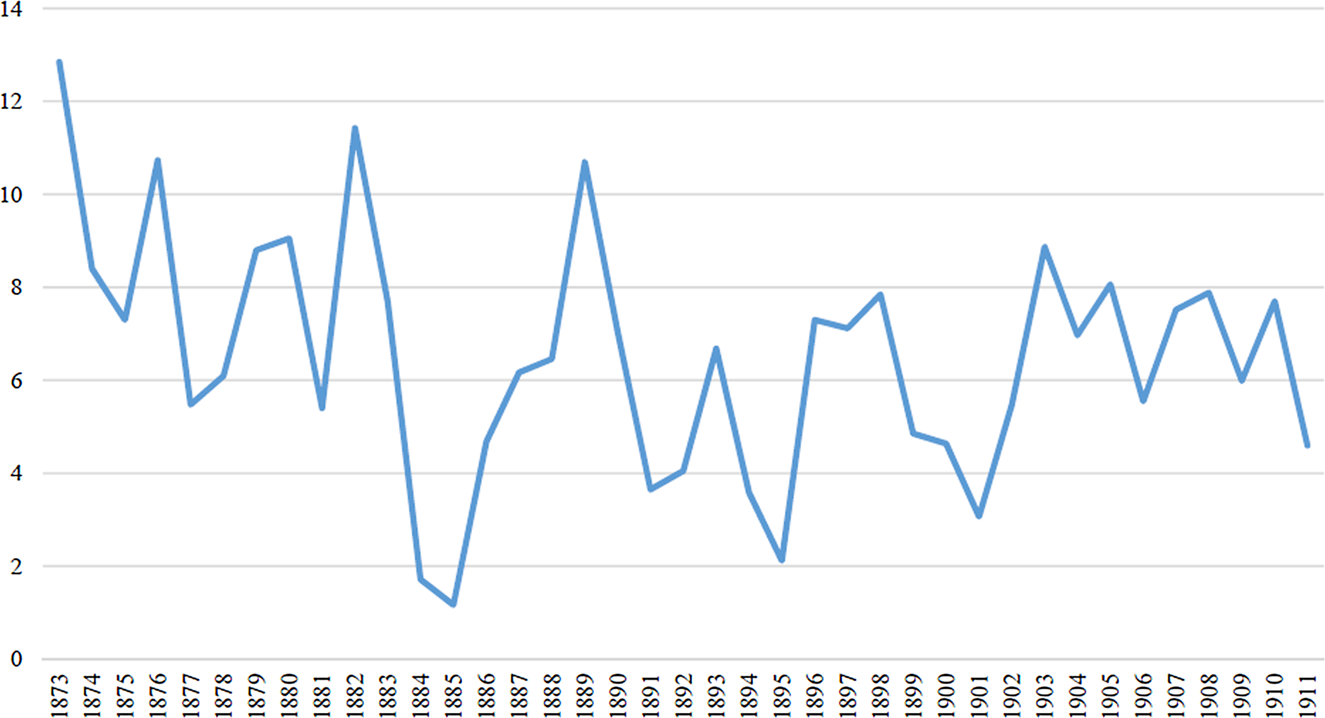
As discussed above, loans to Chinese banks were an important means by which foreign banks were able to employ their working capital and large deposits in the Chinese banking sector. To provide such loans, foreign banks in Shanghai participated in the inter-bank lending system of Chinese banks, mediated through their comprador. In Shanghai, qianzhuang lent money to each other through one- or two-day short-term loans. For this purpose, representatives of the members of Shanghai's Money Trade Guild met twice a day to set the standard market interest rate for short-term inter-bank lending, which was also the standard interest rate for the money market in Shanghai. This market interest rate, called yinchai, reflected the current money supply in Shanghai and normally fluctuated between around 2 per cent and around 25 per cent; between 1873 and 1911 the average yinchai interest rate was around 6.5 per cent (see Figure 1).Footnote 66 The DAB participated in this system through its comprador, who chose which qianzhuang had sufficient credit and then provided them with short-term loans. These loans were repayable after two days, but recallable by the foreign banks at any time. In exchange for the loan, the qianzhuang provided a promissory note, called a zhuangpiao, to the foreign bank that the comprador would accept and mark with his ‘chop’ or seal as proof of his guarantee for the loan. These ‘chop’ loans (chaikuan) did not carry any real collateral. One of their primary purposes was that they were used and passed on to Chinese merchants by the qianzhuang and played an especially important role in the purchase of commodities by Chinese merchants in the hinterland.Footnote 67 Importantly, while the term ‘chop loan’ was commonly used exclusively for loans issued by foreign banks, its Chinese equivalent chaikuan was also used for inter-bank lending between qianzhuang.Footnote 68
Shanghai yinchai interest rate yearly average, 1873–1911, in percentages. Source: Calculated according to data in: Kong, Nankai jingji zhishu, pp. 479–480.

These loans became very important for the business of the Shanghai qianzhuang. The total amount of chop loans provided by foreign banks in Shanghai could reach over 10 million Shanghai taels at any one time and individual qianzhuang sometimes took on chop loans of up to 800,000 Shanghai taels, despite the capital of qianzhuang only amounting to around 20–60,000 taels.Footnote 69 Nevertheless, the importance of foreign bank loans for the qianzhuang should not be overestimated, as loans from other qianzhuang were seemingly equally important to those from foreign banks. For example, in 1896 the Fukang qianzhuang borrowed 92,660 Shanghai taels from qianzhuang in Shanghai and elsewhere, and only 40,910 Shanghai taels from foreign banks. Similarly, in 1907 the Shunkang qianzhuang borrowed 122,069 Shanghai taels from foreign banks as well as 101,865 Shanghai taels from other qianzhuang inside and outside of Shanghai.Footnote 70
As the qianzhuang provided no real collateral for these loans, foreign banks had to trust the ability of their compradors to assess the creditworthiness of the Chinese banks. As previously mentioned, the compradors provided a guarantee sum to the bank, but, given the size and volume of the chop loans provided by foreign banks, these guarantees were not sufficient to cover any potential large default of Chinese banks on their loans.Footnote 71 Therefore, the banks’ security for granting of loans to Chinese banks rested mainly on their personal trust in the comprador's abilities. General differences in business practices between Western and Chinese banks proved to be another complicating factor. Unlike foreign banks, qianzhuang had no large capitalization and primarily engaged in short-term lending ‘that was often associated with extremely high risk’.Footnote 72 In contrast, foreign banks seem to have been comparatively risk-averse. For example, the DAB's instructions for its employees stated that ‘the basic condition of all conducted business is appropriate security for the bank’.Footnote 73 Still, for Kalb, the chop loan business was ‘very profitable and in my view not very dangerous’, as he was certain that Xu would only accept promissory notes from trustworthy banks since he had to guarantee for them.Footnote 74 Nevertheless, apart from their personal trust in their comprador, these loans were unsecured and thus the foreign bankers had to accept the higher risk they represented. Kalb reported that the general interest rate for loans in Shanghai in 1890 was 7 per cent and that it was the comprador who reported the daily market interest rate to the bank and who ‘pledges to gain the best price [in terms of the interest rate] for loans’ the bank was providing to Chinese banks.Footnote 75
However, Kalb was wrong to think that Xu had almost no opportunity to ‘squeeze’ and always reported the correct yinchai market interest rate and returned the best rate available to the bank. On the contrary, foreign bank compradors in Shanghai regularly manipulated the interest rate of the loans they were contracting for foreign banks. According to the famous Chinese banker Qin Runqing, some compradors offered the loans from their foreign banks at interest rates below the market rate, thus allowing themselves and the qianzhuang to whom they lent the money to profit from the margin between the loan's interest rate and the market rate.Footnote 76 More commonly, the compradors paid their foreign banks the interest rate for loans to Chinese banks according to the market rate, but charged the qianzhuang a higher interest rate and kept the difference for themselves. Therefore, the interest rate that the compradors chose to offer on behalf of their foreign banks also invariably had an important impact on the cost of credit in the banking sector, although the yinchai interest rate set by the Chinese banks remained the most important guideline for inter-bank lending.Footnote 77
We do not know the exact extent of the margins that the foreign bank compradors could earn by misinforming the bank about the real market interest rate nor the real rate they offered when issuing chop loans to qianzhuang. However, by manipulating the interest rates, compradors working for foreign banks could definitely generate extra profits, which were most likely much larger than the meagre salary or official commission for long-distance drafts Xu received from the DAB. That foreign bank compradors could benefit in this way from their connection to foreign banks can be explained in three ways. First, foreign banks had little knowledge of the actual inner workings of the qianzhuang,Footnote 78 so a state of information asymmetry existed between the banks and their compradors. Second, the DAB and other foreign banks were excluded from Chinese guild organizations, which reinforced the information asymmetry. Although evidence exists from Tianjin that foreign banks could be represented by their compradors in guilds or chambers of commerce,Footnote 79 there is no evidence that foreign bankers were ever actively involved in Chinese merchant organizations, such as the Money Trade Guild in Shanghai. Consequently, the foreign banks were not included in setting the interest rate for inter-bank lending, which would have allowed them to gain a full picture of the money supply in Shanghai. Finally, although Kalb had no knowledge of the large interest manipulations of bank compradors, even if foreign bankers gained knowledge of such behaviour, they had no alternatives: relying on the compradors and the qianzhuang was the price of access to the Chinese credit market.Footnote 80
If we look at the wider business interests of Xu Chunrong, we can see that Xu could also have benefited from his connection to the DAB in other ways. As he and his staff were in charge of choosing the banks to which the DAB granted loans, the Xu family could have prioritized their own qianzhuang or those qianzhuang that were otherwise connected to them when deciding which Chinese banks would be offered loans.Footnote 81 As a result, when the sida qianzhuang that the Xu family operated with the Ye family and the shengda and yanqing qianzhuang owned by the Ye family went bankrupt during the 1911 revolution, these six banks were in debt to the DAB in the amount of 397,800 Shanghai taels, more than they owed to any other foreign bank.Footnote 82 This suggests that the Xu family had used their connection to the DAB to channel the bank's money to those Chinese banks owned by or closely connected to their family. Furthermore, the Xu family could also have profited from the margin between the interest rate it offered to its own qianzhuang and the interest rate at which those qianzhuang loaned the money to Chinese merchants. Joseph Edkins, the former translator for the Chinese Maritime Customs Service, noted in 1905 that ‘native banks in Shanghai borrow foreign capital at seven per cent and lend it to shop-keepers on shop securities at ten per cent’.Footnote 83 In such a case, the Xu family not only profited from manipulating the market interest rate reported to the DAB, but also indirectly from the profits made by their own qianzhuang when they loaned the money to Chinese customers.
As Wu Peichu later recalled, besides the regular chop loans, there also existed a specific practice among compradors of foreign banks called ‘week bills’ (libai piao). Unlike qianzhuang, foreign banks were closed on Sundays. As the daily clearing process for inter-bank loans took place late at night after the foreign banks had closed, loans that qianzhuang presented for repayment were normally only redeemed for cash on the following day. Therefore, foreign banks only received cash repayments for loans due on a Saturday on the following Monday, after they had opened for business again. This enabled the compradors to loan out the funds they received on Sunday morning for chop loans that had been due on the Saturday. Some bank compradors loaned these funds to the qianzhuang connected to them at no interest. The Xu family, however, was known for charging interest and for loaning these funds to the sida qianzhuang they owned. According to Wu, at the time of the 1911 revolution, Xu Xingquan had lent over 200,000 Shanghai taels due to the DAB as ‘week bills’ to the sida qianzhuang.Footnote 84 As the files of the DAB and other foreign banks make no mention of this practice, it seems that, once again, the compradors used the information asymmetry between themselves and the foreign banks to generate extra profits from the capital they received from foreign banks without letting the foreign bankers know. All the different ways discussed above in which Chinese bankers were able to use their position as compradors to access and use foreign capital to generate profits show that in the business partnership between foreign and Chinese banks, the latter had considerable control over the terms of this partnership and the ways in which the capital provided by foreign banks was used.
Clearly, control over the loans granted by the DAB to Chinese banks gave the Xu family access to vast sums of foreign capital that they could use to generate profits. Not only could they exploit information asymmetries and manipulate the interest rates they paid to foreign banks, but the connection to a foreign bank also helped them to support their other banks. Xu's position as comprador at the DAB provided his family's banks with access to a cheap and abundant source of foreign capital. Importantly, this also suggests that entrepreneurs and bankers like Xu could use their connection to foreign banks to access and use the funds that wealthy Chinese merchants, officials, and government institutions were normally only willing to deposit with foreign banks. Thus at least a part of these deposits eventually found their way into the hands of Chinese banks.
One last aspect of the relationship between foreign and Chinese banks that suggests interdependence rather than one-sided control was the issuing of loans by Chinese to foreign banks. While the relationship between foreign banks and qianzhuang is normally perceived in terms of loans provided by foreign to Chinese banks, Shizuya Nishimura has recently shown that foreign banks occasionally borrowed from qianzhuang, suggesting the existence of an important degree of interdependence between foreign and Chinese banks.Footnote 85 Kalb's report on the Shanghai banking sector supports this conclusion in the case of Shanghai, going so far as to suggest that foreign banks borrowed from Chinese banks even more often than suggested by Nishimura. Kalb reported that it was common for foreign banks to borrow from Chinese banks: ‘Not only does a European bank lend money to the Chinese, but the bank might often find itself in a position where it borrows large sums from Chinese [banks].’ He continued that ‘the Hongkong and Shanghai Banking Corporation often owes the Chinese [banks] large sums’, which was not ‘perceived as a weakness’.Footnote 86 Kalb noted that the DAB already had ‘acquired a splendid reputation’ among the Chinese, so that it could borrow up to 500,000 taels or more from Chinese banks if it wished to do so. He recommended that the directors of the Bank should be as accommodating as possible to Chinese banks, never be late with the repayment of loans, and always ‘go hand in hand with the Chinese’ to maintain the bank's reputation and its ability to borrow from them.Footnote 87 This not only shows that it was common for foreign banks to borrow from Chinese banks, but that inter-bank lending between foreign and Chinese banks involved a high degree of interdependence.
Finally, having examined the relationship between the DAB and Xu Chunrong, we can see that, from the perspective of his business network, Xu integrated the DAB into the family's existing network of businesses. Although their wider business network as a whole seems to have already had a Sino-foreign character due to the connection between the Da Feng company and Reiss and Co., before 1890 Xu's qianzhuang had not had any direct connection to a foreign business. However, by taking up the comprador position at the DAB, Xu connected the qianzhuang he owned with a foreign bank, so that a foreign actor was added to the existing lianhao cluster and a Sino-foreign business network, consisting of the six qianzhuang and the DAB, was formed. This reaffirmed the Sino-foreign character of the family's business network as a whole. The formation of this Sino-foreign business network meant that Xu's lianhao was closely connected to the DAB, which, as we have seen, gave the lianhao of qianzhuang owned by Xu preferential access to the foreign capital of the DAB. This gave them a competitive advantage over other Chinese bankers who lacked such a connection, which was vital, especially given the growing importance of foreign banks in the credit market of the China coast.
At the same time, adding the DAB to his network of businesses not only had an impact on Xu's lianhao, but most likely also on the broader layers of his business network. Given that he was more closely connected to qianzhuang from the Ningbo bang than to other qianzhuang in the Chinese banking sector, it is likely that Xu preferred to channel the DAB's money into these qianzhuang, which would have also given them a competitive advantage. The fact that Xu not only channelled capital into the sida qianzhuang, which were part of his lianhao, but also into the shengda and yanqing qianzhuang owned by the Ye family, which was connected to the Xu family through bang affiliation, seems to confirm this. Indeed, Susan Mann has argued that placing Ningbo merchants in comprador positions was one of the strategies Ningbo merchants used to maintain their control over finance in Shanghai.Footnote 88 Finally, given the increased cooperation among members of the Shanghai Monetary Guild during the last two decades of the Qing dynasty, we can also assume that Xu will have favoured guild members when he selected borrowers for chop loans.
However, besides the advantageous access to foreign capital, the addition of a foreign bank to Xu's business network also changed the risk-taking behaviour and risk sharing within the network. As discussed, compared to foreign banks, qianzhuang were generally prone to risky business practices. Even huihua qianzhuang ‘were involved in speculation and overextension’.Footnote 89 Even though qianzhuang had multiple sources of credit, the lack of the DAB as a source of credit will have had a limiting effect on the risky business transactions in which the qianzhuang connected to Xu could engage. Once the DAB was added to Xu's network of qianzhuang banks, the newly available capital would have allowed the qianzhuang that were now connected to the DAB to expand their business and take greater risks. Indeed, the influx of foreign banks and availability of foreign capital seems to have led qianzhuang to overstretch themselves and take on more risk than they otherwise would have.Footnote 90 Thus, while a close connection to a foreign bank acquired by filling the comprador position had the advantage of easy access to foreign capital, arguably the flipside of this was that it could lead the qianzhuang of all three layers of Xu's business network—the lianhao, bang, and guild members—to take on more risk than they should. Tentative proof of this is not only the eventual bankruptcy of both the sida qianzhuang owned by Xu and the shengda and yanqing qianzhuang connected to him through his bang, but also that the primary debtors of these six Chinese banks at the time of their bankruptcy were the DAB and other foreign banks.Footnote 91 For the Shanghai Money Trade Guild, access to foreign capital also seems to have been a double-edged sword, as it was eventually unable to control the growing misuse of foreign capital by its members.Footnote 92
Before the addition of the DAB to Xu's network of qianzhuang banks, the latter would have primarily shared the risk of their business among each other and with any other qianzhuang they did business with. With the integration of the DAB into Xu's network of Chinese banks and the inter-bank lending mechanism, the DAB now shared in the risk within the Sino-foreign business network it formed with the qianzhuang connected to Xu and the wider Chinese banking sector. While Kalb regarded the chop loan business as safe and the chop loan mechanism between foreign and Chinese banks seems to have generally functioned well before 1911, during the last decades of the Qing dynasty the banking sector on the Chinese coast saw ever-recurring crises and failures of Chinese banks. At times, the foreign banks had to work with and support Chinese bankers to avert a market crash. In 1909 and 1910, foreign bankers even provided loans to stabilize the money markets in Hankou and Shanghai.Footnote 93 Therefore, integration into Chinese banking networks and partnering with Chinese bankers meant that foreign bankers partook in the risk that existed in the banking system and were compelled to cooperate and, if need be, provide additional capital to counter volatility in the financial markets they were now part of. It also meant that during the late Qing dynasty Chinese bankers could rely on the help of foreign bankers when instability occurred in the financial markets. Despite the relative risk-averseness of foreign bankers, the obvious instability of the Chinese banking sector and knowledge among foreigners that the ‘native banking system has been unsound for decades’, was in need of ‘reform’, and that easy access to foreign capital had ‘contributed to the perpetuation of the unsound native banking system’, foreign banks continued the practice of chop loans.Footnote 94 During the late Qing dynasty the need to employ their working capital compelled foreign banks to continue to accept and, in fact, further enable the risky business practices of Chinese bankers. It was only after the financial crash of 1911, which followed the fall of the Qing dynasty, that foreign banks stopped issuing chop loans for several years, only to reintroduce them again, if on a smaller scale, during the Republican period.Footnote 95
Conclusion
This examination of the relationship between the DAB and Chinese banks in Shanghai shows that the relationship between foreign and Chinese banks was one of interdependence and interaction rather than one-sided control. While foreign banks occupied a strong position in the banking sector due to their large capitalization, perceived stability, and the advantages of extraterritoriality, they were dependent upon the qianzhuang and their compradors for employing their working capital in the Chinese credit market. Given that they had no other options for accessing the banking sector, they had to rely on their comprador and Chinese banks to function as their intermediaries. Although they could withdraw their loans from the qianzhuang and stop providing them with credit if they wished, they could never do so permanently, because of this dependence. On the other hand, while the qianzhuang certainly received large amounts of capital from foreign banks, they also had a multitude of other credit sources and were not completely dependent upon their foreign creditors, as they could also borrow from other qianzhuang and from the piaohao. Moreover, the owners of the qianzhuang, such as Xu Chunrong, could use their position as compradors in foreign banks to generate extra profits for themselves through the exploitation of information asymmetries and to channel cheap foreign capital into the qianzhuang connected to them. Using their connection to foreign banks, the qianzhuang could take advantage of the superior legal position and capitalization of these banks, and access and use the large working capital of the banks, particularly the capital that Chinese merchants, officials, and the Chinese government had been depositing in the foreign banks because they were unwilling to place it directly with the qianzhuang. Finally, the flows of capital between foreign and Chinese banks was not one-directional, as foreign banks also often received loans from Chinese banks.
The above discussion of the dynamics between foreign and Chinese banks in Shanghai also suggests that foreign banks, like the DAB, could not impose their practices on the Chinese banking sector, but were rather integrated into existing banking networks and structures, thus forcing them to adapt and localize their practices upon entering the Chinese banking sector. First, by granting loans to the qianzhuang, the foreign banks found themselves adopting a previous practice of the piaohao, and had to adapt to the riskier practices of Chinese banks and provide loans without any real collateral. Secondly, through their cooperation with their comprador, they were integrated into existing business networks and market institutions, such as the inter-bank lending mechanism. Thirdly, as foreign banks were barred from the Money Trade Guild of the qianzhuang, they had no direct influence on fixing the interest rate for inter-bank lending and, apart from their occasional assistance in stabilizing the money market, they were essentially reduced to passive providers of capital that had to accept the conditions of the market and the information their compradors provided them. Thus, far from controlling the banking sector on the China coast, foreign banks had to integrate themselves into the structures of existing credit markets and adapt their own practices to the new business environment. Furthermore, their access to the banking sector always remained limited due to institutional barriers, such as their exclusion from Chinese guilds.
The examination of Xu Chunrong's business network has shown how Sino-foreign business networks consisting of qianzhuang and foreign banks were formed. The addition of the DAB to Xu's network of banks provided the qianzhuang connected to him with preferential access to foreign capital. While offering a competitive advantage, this direct access was also problematic as it seems to have further encouraged the risky business practices of the qianzhuang. For foreign banks, integration into Chinese banking networks meant that they shared the risk within this network and needed to cooperate with Chinese bankers and support them to maintain the stability of the financial market. This involvement of foreign banks in the sharing of risk once more shows the need for adaptation to the business practices common in the Chinese banking sector.Footnote 96 An important consequence of the influx and integration of a growing number of foreign banks and the cheap capital they provided to the Chinese banking sector was the decrease in the cost of money—the average yearly yinchai interest rate in Shanghai declined from 7.3 per cent between 1873 and 1889 to only 5.9 per cent between 1890 and 1911.Footnote 97
Thus, the picture that emerges from our exploration of the interaction between foreign and Chinese banks in Shanghai is that of an interdependent relationship between foreign banks and qianzhuang which required the DAB and other foreign banks to adapt to the new business environment in China. Moreover, the Chinese actors in this relationship wielded significant and far-reaching control over the terms of the business partnership, as they had the power to decide which Chinese banks, and under what terms, the DAB and other foreign banks could provide loans. They were also able to withhold and to manipulate information about the terms of the business transactions between the foreign and Chinese banks. Therefore, for German and other foreign bankers, the expansion of their business into China was invariably accompanied by localization and adaptation to the Chinese business environment. The result of the development of this interdependent relationship and the integration of foreign banks into existing Chinese business networks was the formation of Sino-foreign business networks, consisting of both foreign and Chinese actors, which could thus bridge and operate across the ‘Chinese/foreign’ divide in the financial sphere. It was these Sino-foreign business networks that made it possible for the financial markets of China's transnational treaty port economy to function. Finally, this interdependence between foreign banks and qianzhuang in the Chinese banking sector also explains, to some extent, why the entry of modern foreign banks into China failed to trigger the kind of Schumpeterian ‘creative destruction’ that might have eradicated the old and supposedly inferior structures of the qianzhuang.Footnote 98 Rather, despite differences in their institutional structure, these banks continued to exist as foreign banks needed them to facilitate their operations in the Chinese banking sector. Even when modern Chinese banks, which were modelled after Western banks, arose in the Republican period, they did not replace traditional Chinese financial institutions but followed the practice of foreign banks in working with them.Footnote 99
Beyond the realm of banking, the relationship between foreign and Chinese banks in the treaty port banking sector can also tell us more about the interplay between information and power in modern China's treaty ports. Christopher Bayly has stressed how the ability to use ‘native informants’ and to access and control indigenous ‘information systems’ could determine the success or failure of British conquest, rule, and the maintenance of colonial power in South Asia.Footnote 100 In China, those Chinese working for foreign companies as compradors fulfilled the role of informants and provided foreign entrepreneurs with necessary market information.Footnote 101 While this use of informants allowed bankers and other foreign entrepreneurs to operate their businesses in the treaty ports, the relationship between foreign and Chinese bankers shows that foreign access to and control of Chinese information systems nevertheless remained limited, whether that was due to their lack of understanding of Chinese banks or their inability to participate in Chinese guilds.Footnote 102 As the examples of the manipulation of interest rates or the practice of ‘week bills’ show, the information asymmetries thus created could be used by Chinese entrepreneurs to employ the unique resources foreigners acquired due to their institutional advantages and special position in the treaty ports, such as the large amounts of working capital foreign banks were able to accumulate from Chinese sources, for their own gain. As a result, power asymmetries between foreign and Chinese actors, created by the legal, institutional, or technological advantages enjoyed by foreigners in the treaty ports, could be balanced by information asymmetries tilted in favour of Chinese actors.Footnote 103 Rethinking the interplay between power and information in the treaty ports along these lines complicates views that see Sino-foreign power relations in the treaty port economy as inherently dominated by foreign actors and further supports recent research which argues that relations between foreigners and Chinese ‘were by no means always weighted in favour of the former’, and that economic advantages stemming from Sino-foreign interaction in the treaty ports ‘were divided less unequally than has frequently been claimed’.Footnote 104