Introduction
Food security has become a global issue, seriously threatening developing countries owing to fast-growing human populations and a declining availability of land for agriculture (Chai et al., Reference Chai, Qin, Gan and Yu2014). Intercropping systems clearly have the potential to increase the long-term sustainability of food production under low inputs in many parts of the world (Brooker et al., Reference Brooker, Bennett, Cong, Daniell, George, Hallett, Hawes, Iannetta, Jones, Karley, Li, McKenzie, Pakeman, Paterson, Schöb, Shen, Squire, Watson, Zhang, Zhang, Zhang and White2015). Intercropping has been shown to produce higher and more stable yields in a wide range of crop combinations with minimal use of inputs such as fertilisers and pesticides (Lithourgidis et al., Reference Lithourgidis, Dordas, Damalas and Vlachostergios2011). Smallholder farming and scarcity of land mainly for African and Asian farmers on the one hand and consideration of sustainability, resource use efficiency and yield stability for American and European farmers, on the other hand, have led to a great diversity of intercropping systems (Knörzer et al., Reference Knörzer, Müller, Guo, Graeff-Hönninger, Piepho, Wang and Claupein2010). A biodiversity-based paradigm for sustainable agriculture is a potential solution for many of the problems associated with intensive, high-input agriculture and for greater resilience to the environmental and socio-economic risks that may occur in the uncertain future (Jackson et al., Reference Jackson, Pascual and Hodgkin2007). Thus, it is crucial to study, improve and develop existing and alternative cropping systems for better production and efficient resource use.
The commonly studied intercropping usually involves two species: the major cereal and the associated pulse. Increasing the number of component crops may help improve spatial and temporal complementarity of the cropping system, thereby enhancing resource capture and use over a growing season. The possibility of increasing intercropping advantage from a three-component association involving maize, mungbean and common bean, in comparison to a two-component system is shown in a previous study (Worku, Reference Worku2014). An increased amount of radiation capture under cereal–pulse intercropping and improved radiation use efficiency at least by the pulse component have been shown to contribute to the advantage of growing crops in association (Coll et al., Reference Coll, Cerrudo, Rizzalli, Monzon and Andrade2012; Liu et al., 2018; Tsubo and Walker, Reference Tsubo and Walker2004). The efficient use of solar radiation is one of the major criteria for obtaining yield advantage through intercropping and it is more reliable compared to the high variability that is possible in the supply of water and nutrients (Awal et al., Reference Awal, Koshi and Ikeda2006). The abundant radiation available over the tropics and subtopics presents an excellent opportunity to increase its use for better crop production (Awal et al., Reference Awal, Koshi and Ikeda2006). This makes it imperative to devise strategies that allow capture and use of radiation as fully and efficiently as possible within a given growing season.
In maize–pulse intercropping systems, the magnitude of the intercropping advantage usually depends on the level of contribution by the pulse component. However, the pulse components perform generally poorly due to the dominating nature of the maize crop. One of the important production constraints in relay intercropping systems is the competition for light, and in a cereal–legume system, the cereal often shades the legume strongly inhibiting its productivity (Raza et al., Reference Raza, Feng, van der Werf, Iqbal, Khan, Hassan, Ansar, Chen, Xi, Shi, Ahmed, Yang and Yang2019c). For instance, in maize–soybean intercropping, the amount of radiation available for the pulse dropped by up to 90%, and as a result grain yield fell by as much (Tsubo and Walker, Reference Tsubo and Walker2004). Similarly, in a maize–cowpea association, light interception by cowpea is reduced by up to 63% leading to an associated 62% loss in productivity (Ewansiha et al., Reference Ewansiha, Kamara and Onyibe2014)). Proper management interventions could help balance resource availability among the components and lessen the pressure on the pulses. Interventions that can boost the performance of the associated pulse without marked loss on the productivity of the dominant species could help improve the efficiency of the cropping system (Coll et al., Reference Coll, Cerrudo, Rizzalli, Monzon and Andrade2012; Liu et al., Reference Liu, Rahman, Song, Yang, Sua, Cui, Bu and Yang2018). Defoliation of the uppermost two maize leaves at silking enhanced grain yields of both components, and hence total intercropping advantage in maize–soybean relay intercropping through improved nutrient uptake and balanced nutrient use (Raza et al., Reference Raza, Feng, van der Werf, Iqbal, Khan, Hassan, Ansar, Chen, Xi, Shi, Ahmed, Yang and Yang2019c) and enhanced light distribution (Raza et al., Reference Raza, Feng, Khalid, Iqbal, Meraj, Hassan, Ahmed, Chen, Feng and Wenyu2019a,b,c). However, the influence of lower maize leaf removal on light interception and use, components performance and cropping system efficiency is not addressed for a sequential intercrop system.
Response to row orientation may vary depending on location (Borger et al., Reference Borger, Hashem and Pathan2010), season (Sarlikioti et al., Reference Sarlikioti, de Visser and Marcelis2011) and availability of other growth resources (Anda and Stephens, Reference Anda and Stephens1996). Under a maize–common bean intercropping system, row orientation has shown negligible effects on fractional interception, radiation use efficiency and intercropping advantage (Tsubo and Walker, Reference Tsubo and Walker2004). On the other hand, the fraction of light intercepted at a North–South (NS) orientation differed from EW orientation by 10–23% in different seasons (Sarlikioti et al., Reference Sarlikioti, de Visser and Marcelis2011). Also, there is a tendency for improved light infiltration in the morning and afternoon under EW orientation compared to NS in maize–common bean intercropping (Woomer and Tungani, Reference Woomer and Tungani2003). Anda and Stephens (Reference Anda and Stephens1996) observed reduced yield under the EW orientation in sugar beet (Beta vulgaris) due to more severe water stress compared to the NS rows.
Numerous reports are available on patterns of radiation interception and use under various management options that involve two-component cereal–pulse intercropping systems (Barker and Dennett, Reference Barker and Dennett2013; Gou et al., Reference Gou, van Ittersum, Simon, Leffelaar, van der Putten, Zhang and van der Werf2017; Liu et al., Reference Liu, Rahman, Song, Yang, Sua, Cui, Bu and Yang2018; Raza et al., Reference Raza, Feng, Khalid, Iqbal, Meraj, Hassan, Ahmed, Chen, Feng and Wenyu2019a,b,c; Tsubo and Walker, Reference Tsubo and Walker2004), but such information on a three-component association is lacking. Therefore, the purpose of this study was to evaluate the radiation capture and radiation use pattern for a three-component intercrop system as influenced by leaf removal and row orientation and was designed to address the following hypotheses:
-
1. Sequential intercropping would increase the amount of captured radiation through improved spatial complementarity and extended total growth duration thereby contributing to intercropping advantage,
-
2. Simultaneous sowing of the principal maize crop with mungbean and later with common bean would not compromise either radiation capture or use efficiency of maize by that allowing to maintain its performance,
-
3. Sequentially planted common bean would help capture the improving light availability towards the end of the season due to senescence and later, the harvest of maize and
-
4. Maize leaf removal and optimum row orientation could enhance radiation capture and use of the sequentially sown pulse depending on weather and crop management thereby improving its contribution and intercrop efficiency.
Materials and Methods
The experiment was conducted during the 2013 and 2015 cropping seasons in southern Ethiopia at the Farm Center of Hawassa University (7°05′N and 38°30′E; altitude 1660 m.a.s.l.). The site falls under the moderate to cool moist mid-highland agroecological zone with a mean annual rainfall of 801 mm. The mean minimum and maximum seasonal temperatures were 14.4 and 26.4 for 2013 and 15.0 and 27.8 for 2015, respectively, showing a slightly warmer 2015.
Total rainfall for the entire 6-month intercrop duration (planting to physiological maturity) was 759 mm for 2013 and 592 for 2015. The year 2015 had lower and poorly distributed rainfall, which was lesser by 22 and 26% compared to 2013 and the long-term average, respectively. The drastically reduced rainfall amount and poor distribution in 2015 were mainly attributed to the strong El Niño effect experienced in the country. This prompted the application of one irrigation on the sequentially intercropped common bean during the seed filling phase. The last component, common bean, suffered from moisture shortage during both years though it was much more severe in 2015. Sequentially intercropped common bean received much higher rainfall (92 mm) in 2013 compared to 2013 (34 mm) during its reproductive period.
The treatments were made from a combination of two factors (row orientation and maize leaf removal) plus sole stands of the components. The two factors had two levels each: East–West (EW) and NS arrangement for row orientation and no leaf removal (intact) and leaf removal for maize canopy management. The combinations were applied on maize–mungbean–common bean sequential intercropping and on sole maize plots. The sequential intercropping involved simultaneous planting of maize and mungbean followed by common bean after mungbean was harvested. Moreover, sole crops of maize and the two-component pulses in sequence were grown. The following were the treatments:
-
1. Sequential intercropping + EW orientation + Intact,
-
2. Sequential intercropping + EW orientation + Removed,
-
3. Sequential intercropping + NS orientation + Intact,
-
4. Sequential intercropping + NS orientation + Removed,
-
5. Sole Maize + EW orientation + Intact,
-
6. Sole Maize + EW orientation + Removed,
-
7. Sole Maize + NS orientation + Intact,
-
8. Sole Maize + NS orientation + Removed,
-
9. Sole mungbean followed by sole common bean + EW orientation,
-
10. Sole mungbean followed by sole common bean + NS orientation,
-
11. Sole haricot bean followed by sole mungbean + EW orientation.
The last treatment was used for the computation of land equivalent ratio (LER) for common bean.
Intercropped maize and mungbean, sole maize, first sole mungbean and first sole common bean were planted on 14 May 2013 and on 13 May 2015. Planting was delayed by about 3 weeks in both years, due to replanting in 2013 and due to the late onset of rain in 2015. A hybrid maize cultivar BH 540 was used in 2013 while the cultivar Shone hybrid was sown in 2015. The cultivar change was made because of the observed susceptibility of BH540 to disease and lodging. Cultivars Sunaina and Ibbado were used for mungbean and common bean, respectively.
The intercropping was an additive type where components were grown with their sole crop densities, i.e. 41,666, 333,333 and 250,000 plants ha−1 for maize, mungbean and common bean, respectively. The inter-row and intra-row spacings for both sole and intercrops were 80 cm × 30 cm for maize, 40 cm × 7.5 cm for mungbean and 40 cm × 10 cm for common bean. In 2015, intercropped mungbean had 80 cm × 3.75 cm spacing to have a single mungbean line between successive maize rows in order to allow independent cultivation of intercropped maize and mungbean. Nitrogen and phosphorus commercial fertilisers were applied in the form of urea (46:0:0) and diammonium phosphate (18:46:0) for intercropped and sole maize plots at the rates of 64 kg N ha−1 and 46 kg P2O5 ha−1, respectively. The sole pulses received 9 kg N ha−1 and 23 kg P2O5 ha−1 as side dressing before planting. Intercropped pulses did not get additional fertiliser other than that given to intercropped maize.
The first intercropped component, mungbean and its sole counterpart were harvested on 23 and 17 August 2013, respectively. Intercropped mungbean was harvested by uprooting the plants carefully not to damage the standing maize crop. Common bean was sown on 26 August 2013, underneath maize on plots, where mungbean was harvested 3 days earlier after a shallow cultivation of the moist soil between the rows. The sole counterpart was planted on 22 August 2013 following the harvest of first planted sole mungbean 5 days earlier. The sequence of events was similar for the 2015 season too, with a slight variation on dates (see Supplementary Figure S1, available online at https://doi.org/10.1017/S0014479720000307).
Maize leaves below the ear were removed on designated treatments 2 days after common bean emergence to improve light distribution for the sequentially intercropped common bean. Accordingly, all the leaves below the ear except the one subtending to the ear were removed 40 days after silking, at the start of dent reproductive phase.
The entire intercropping system took 193 days in 2013 and 189 days in 2015 (Figure S1). The co-growth period of maize with common bean amounted to 47 days in 2013 and 34 days in 2015 while the overlap of the two pulses with maize reached 148 and 120 days, in that order.
Data collection and analyses
Biomass and grain yields of all intercrop and sole components were determined from an area of 7.68 m2 (1.6 m × 4.8 m), which consisted of two rows for maize and four rows for the two pulses on each plot except for the intercropped mungbean in 2015 where two rows were harvested. Grain moisture content was determined as a difference between fresh seed weight and dry seed weight in a forced air ventilated oven and was adjusted to 13% for maize and 11% for the pulses.
Light interception of the crops was measured in 2013 using the SunScan Canopy Analysis System (Delta-T Devices, Derbyshire, UK). Incident photosynthetically active radiation (PAR) on top of the canopy was measured with the beam fraction sensor (BF2) of the system. The 1-metrer long quantum sensor was used to measure the amount of PAR incident at different strata: below maize canopy but on top of the intercropped mungbean and common bean canopies for the intercropped maize and at ground level for intercropped mungbean and common bean and their corresponding sole crops.
The interception data were collected between emergence and physiological maturity at an interval of 11–16 days for all components in the association and their sole counterparts. Measurements were made between 11:00 am and 1:00 pm local time. Fractional light interception (f) was determined as follows (Ewansiha et al., Reference Ewansiha, Kamara and Onyibe2014):
 $$f\,{\rm{of \,intercrop \,system }} = 1 - {{{\rm{PAR\,\,beneath\,\,entire\,\,canopy}}} \over {{\rm{Incoming\,\,incident\,\,PAR}}}} f\,{\rm{of \,intercropped \,maize }} = 1 - {{{\rm{PAR\,\,below\,\,maize\,\,canopy\,\,but\,\,above\,\,pulse\,\,canopy}}} \over {{\rm{Incoming\,\,incident\,\,PAR}}}} f\,{\rm{of \,sole \,crops }} = 1 - {{{\rm{PAR\,\,beneath\,\,sole\,\,canopy}}} \over {{\rm{Incoming\,\,incident\,\,PAR}}}}$$
Received daily shortwave radiation at the site was estimated from daily sunshine hours record taken from a nearby weather station using the following equation (Allen et al., Reference Allen, Pereira, Raes and Smith1998):
 $${R_s} = \left( {{a_s} + {b_s}{\rm{}}{n \over N}} \right){R_a},$$
where R s , shortwave radiation; n, actual duration of sunshine; N, maximum possible duration of sunshine hours; n/N, relative sunshine duration; R a , extraterrestrial radiation; a s , regression constant (at n = 0) and a s + b s, fraction of extraterrestrial radiation reaching the earth on clear days (n = N).
Radiation use efficiency was determined as a ratio of aboveground biomass to cumulative intercepted PAR, i.e.
 $${\rm{RUE }} = {{{\rm{D}}{{\rm{M}}_{{\rm{tot}}}}} \over {{\rm{CIPAR}}}},$$
where RUE is radiation use efficiency in g MJ−1 PAR, DMtot is total dry matter harvested at physiological maturity and CIPAR is cumulative intercepted PAR from emergence to physiological maturity.
Amount of intercepted PAR (IPAR) at any given sampling date was determined by the following equation:
 $${\rm{IPAR }} = {R_s} \times f \times {\rm{ }}0.5,$$
where R s , amount of incident shortwave radiation on the sampling date; f, fractional interception, and 0.5 is PAR fraction of R s .
The CIPAR during the growth period was estimated by summing up the intercepted radiation at the consecutive samplings as follows:
 $${\rm{CIPAR = }}\mathop \sum \nolimits^ n[\left( {{\rm{IPA}}{{\rm{R}}_{n - 1}}} \right) + \left( {{\rm{IPA}}{{\rm{R}}_n}} \right)/2({t_n} - {t_{n - 1}})],$$
where IPAR n−1 is IPAR at sampling time t n−1 and IPAR n is IPAR at sampling time t n .
The efficiency of the intercropping system was analysed using the LER method (Mead and Willey, Reference Mead and Willey1980):
 $${\rm{Total \,\,LER = }}\sum\limits_{i = 1}^n {Ymi} /Ysi = \sum\limits_{i = 1}^n {LERi}, $$
where Ymi and Ysi are intercrop and sole crop yields of component i, respectively. Thus, total LER is the summation of relative yields (partial LERs) from n component crops. The sum of sole yields from two consecutive sole crops was used for standardisation of the pulse components (Worku, Reference Worku2014) in order to account for differences in cropping duration.
Leaf removal and row orientation effects on components performance were tested by a combined analysis of variance using the fixed-effects model of the Statistical Analysis System (SAS, 2000, version 8e). The F-test was used to check for homogeneity of error variances between the 2 years (Gomez and Gomez, Reference Gomez and Gomez1984). Mean separation for main effects was obtained by Fisher’s least significant difference (LSD) test whenever effects were found significant from the analysis of variance test.
The economic advantage of the treatments was assessed by calculating net benefit as a difference between gross benefit and production cost (Raza et al., Reference Raza, Feng, van der Werf, Iqbal, Khan, Hassan, Ansar, Chen, Xi, Shi, Ahmed, Yang and Yang2019c). The gross benefit was calculated as a product of grain price and grain yield adjusted downward by 20%. The production cost involved expenses for the purchase of inputs, land preparation, sowing, weed and pest control, defoliation, harvesting and threshing.
Results
Components performance
Row orientation, leaf removal and cropping system had no significant influence either on total biomass or on grain yield of maize (Table 1). The year 2015 had significantly higher grain and total biomass yields than 2013 in spite of the lower and poorly distributed rainfall. However, variation in precipitation mainly occurred more in terms of delayed onset and early cessation, allowing maize to grow in a fairly moist environment in both years.
Effect of maize leaf removal and row orientation on grain and biomass yields of components in maize–mungbean–common bean intercropping in 2013 and 2015

Data are means with n = 12; means within a column followed by different letters are significantly different at p < 0.05.
* Mungbean was harvested before leaf removal.
Biomass and grain yields of mungbean did not vary between orientations, whereas intercropping reduced both significantly. Intercropped biomass and grain yields in 2013 exceeded those in 2015.
In common bean, removing maize leaves increased grain yield and total biomass compared to intact plots (Table 1). Significant leaf removal × orientation effect showed 96% more grain (p = 0.03) and 63% greater biomass (p = 0.04) yields in EW compared to NS orientation under defoliated plots while yields were similar under intact plots irrespective of orientation (Figure 1a,b). Also, leaf removal × year effect significantly influenced grain yield (p = 0.02) and total biomass (p = 0.02), whereby both responded positively to leaf removal in 2013 but not in 2015 (Figure 2c,d). Intercropping reduced grain yield and total biomass compared to the sole stands (Table 1).
Leaf removal × row orientation effects on (a) grain yield and (b) total biomass yield; leaf removal × year effects on (c) grain yield and (d) total biomass yield of intercropped common bean.

Fractional light interception of (a) intercropped and (b) sole maize from emergence to physiological maturity. EWI, East–West intact; EWR, East–West removed; NSI, North–South intact; NSR, North–South removed.

Fractional interception
Intercropped and sole maize plots had shown similar f trends with the peak occurring from silking to the mid-seed filling stage (Figure 2a,b). Leaf removal below the ear reduced f of maize under both cropping systems, irrespective of orientation. The effect of row orientation on maize f was neither large nor consistent under both cropping systems.
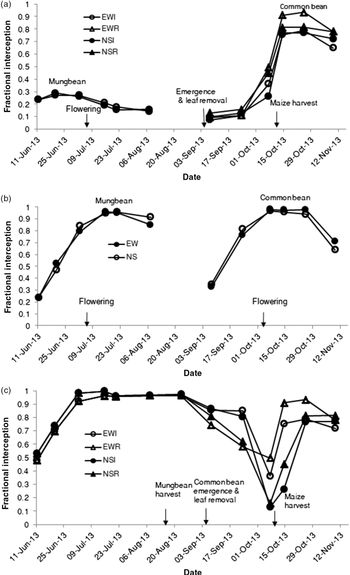
Intercropped mungbean had larger f before flowering, which declined progressively afterwards (Figure 3a). On the other hand, common bean f was substantially improved during the reproductive phase due to maize harvest. Mungbean attained a maximum f of 0.29 while common bean achieved full interception (f > 90%) about 2 weeks after maize harvest.
Fractional light interception of (a) intercropped mungbean and common bean, (b) sequential sole crops of mungbean and common bean and (c) maize–mungbean–common bean intercropping from emergence to physiological maturity. EWI, East–West intact; EWR, East–West removed; NSI, North–South intact; NSR, North–South removed; EW, East–West; NS, North–South.

The difference in f between row orientations was not apparent for intercropped mungbean, but the EW orientation enhanced f for intercropped common bean under leaf removed maize (Figure 3a).
Sole crops of mungbean and common bean had similar f trends, both achieving full interception at about flowering (Figure 3b). Row orientation had no discernible effect on f of both pulses under sole cropping.
The intercropping system attained full interception earlier than the corresponding sole crops (Figure 3c). It had also maintained maximum interception for a longer duration.
Intercepted amount
Total interception during the growing season was 596 MJ m−2 PAR for intercropped maize and 611 MJ m−2 PAR for sole maize (Table 2), with a mean interception ratio of 0.98 (Table S1). Intercropped mungbean and common bean intercepted much less with an interception ratio of 0.31 and 0.61, respectively. Intercepted light was reduced by leaf removal under the intercrop and sole maize stands, but it was improved in common bean under EW and NS orientations (Table 2).
Amount of intercepted PAR by the intercrop, associated components and their sole counterparts under maize–mungbean–common bean intercropping in 2013

Data are mean of three values per sampling; MA, maize; MB, mungbean, CB, common bean; subscripts IC and SOL denote intercropped and sole, respectively; MA-MB-CB, maize–mungbean–common bean intercropping; SIR, seasonal incident PAR throughout the intercrop duration.
Sequential intercropping captured the largest radiation amount (1039 MJ m−2 PAR), compared to any of the sole crops, which constituted 70% of seasonal incident PAR (Table 2). The corresponding values for the sole stands were 41% for maize, 29% for mungbean, 34% for common bean and 63% for mungbean–common bean. There were no appreciable differences between row orientations and between leaf removals for intercepted light by the intercrop system.
Radiation use efficiency
Maize had the highest mean radiation use efficiency (3.19 g MJ−1 PAR) followed by mungbean (1.49 g MJ−1 PAR) and common bean (0.96 g MJ−1 PAR), under intercropping (Table 2). Maize utilised captured radiation with a similar efficiency under both cropping systems (Table S1). Intercropped mungbean used intercepted light 1.6 times more efficiently than its corresponding sole crop, while the opposite happened in common bean.
Differences in RUE between row orientations were neither large nor consistent in maize and mungbean (Table 2). Common bean under defoliated maize in EW orientation had the highest RUE than the other combinations.
Cropping system efficiency
Maize partial LER did not vary between the leaf removal schemes and row orientations (Table 3). Mungbean had also similar partial LERs between the row orientations, but partial LER of common bean increased under EW orientation and under defoliated maize. Significant leaf removal × orientation effect influenced partial LER of common bean (p = 0.01) and total LER (p = 0.04), showing that removing leaves increased both in EW but not in NS orientation (Figure 4a,b).
Partial and total land equivalent ratios (LERs) as influenced by maize leaf removal and row orientation in maize–mungbean–common bean intercropping in 2013 and 2015

Data are means with n = 12 except mungbean with n = 6.
* Mean of row orientation was used since it was before leaf removal; means within a column followed by different letters are significantly different at p < 0.05.
Leaf removal × row orientation effects on (a) common bean partial land equivalent ratios (LERs) and (b) total LER; leaf removal × year effects on common bean partial LER (c); row orientation × year effects on total LER (d).

Partial LERs of the two pulses and total LER in 2013 exceeded those in 2015. Significant leaf removal × year (p = 0.02) and row orientation × year (p = 0.02) effects indicated that maize leaf removal and EW orientation were advantageous in 2013 but not in 2015 (Figure 4c,d).
Economic benefit
The intercrop treatments had greater costs than any of the associated sole crops during both years (Figure S2). All the intercrops gave better net benefit than any of the sole counterparts during the wetter year of 2013 (Figure S2). Also, the intercrop grown under the combination of defoliated maize and EW orientation had shown the highest economic advantage over the remaining treatments. However, the intercrops had similar net benefits and performed no better than the best performing sole maize stands, in the drier year of 2015.
Discussion
Productivity of the principal crop, maize, did not suffer from its association with the two pulse components sequentially (Table 1). This is because intercropped maize has captured as much radiation as the corresponding sole crop and also used it with similar efficiency (Table 2). As the dominant component, maize contributed the largest share (73%) to the total intercropping advantage. This is in agreement with its highest captured radiation and maximum radiation use efficiency. In addition to its structural advantage in terms of height and root system, the poor competitive ability of the first component, mungbean, helped to maintain its performance (Worku, Reference Worku2014). Moreover, the sequentially intercropped common bean had minimal impact on maize because the fully developed maize remained dominant during the establishment and subsequent growth of common bean. Temporal niche complementarity between intercropped species that arise from growth complementarity over time (Bedoussac and Justes, Reference Bedoussac and Justes2010; Dong et al., Reference Dong, Ming-Ming, Wei-Ping, Xing-Guo, Wang, Christie and Li2018) and differences in sowing and harvesting times (Dong et al., Reference Dong, Ming-Ming, Wei-Ping, Xing-Guo, Wang, Christie and Li2018) contribute to intercropping advantage. Maize, a C4 crop, had the highest radiation use efficiency (3.19 g MJ−1 PAR) under intercropping, which was at par with its sole counterpart (Table 2). In previous studies, RUE of intercropped maize remained the same to the corresponding sole crop under maize–common bean (Tsubo and Walker, Reference Tsubo and Walker2004), increased under maize–soybean (Liu et al., Reference Liu, Rahman, Song, Yang, Sua, Cui, Bu and Yang2018) and decreased under maize–wheat (Gou et al., Reference Gou, van Ittersum, Simon, Leffelaar, van der Putten, Zhang and van der Werf2017) association, which could be due to differences in row configuration, planting density and species composition.
Mungbean contributed to raise intercropping efficiency through the interception of infiltrated light and improved RUE (Table 2). Intercropped mungbean captured 9% of seasonal incident radiation and used it 1.6 times more efficiently than the sole stand. However, mungbean performed poorly during intercropping primarily due to very little captured radiation as it was grown under progressive shading from maize (Figure 3a). Shading had become acute during podding and seed filling stages depressing the harvest index. In such a system, the cereal dominance in terms of height leads to a critical reduction in total radiation and water acquisition by the shorter component (Vrignon-Brenas et al., Reference Vrignon-Brenas, Celette, Piquet-Pissaloux, Corre-Hellou and David2018). Mungbean used captured light with better efficiency allowing it to contribute more to the performance of the system. Management options that help increase light interception during the critical reproductive phase could improve mungbean performance.
The contribution of common bean to the intercropping efficiency came from an increased amount of captured light in two ways. First, by capturing filtered light under maize canopy and second, by extending the use of the season after maize harvest (Figure 3a,c). Moreover, the harvest of maize made the incoming radiation fully at the disposal of common bean. This was especially important as it coincides with the growth phase that is most sensitive to light availability. Maize leaf removal also complemented sequential planting by allowing common bean plants to establish a greater canopy by the time maize was harvested. These circumstances allowed intercropped common bean to intercept 2.3 times as much as that in mungbean (Table 2). Given the improved light environment and the accompanied greater interception, its productivity was not as large as expected. This could be due to low radiation use efficiency, caused by terminal water stress. Timely planting and the use of short-cycle varieties could be options to ensure the relayed pulse mature without facing undue stress.
Maize leaf removal had no significant influence either on the intercrop or the sole crop yields of maize though it caused a modest reduction on light interception (Tables 1 and 2). The number, stage and position of leaves removed may determine the degree of influence on maize performance. Raza et al. (Reference Raza, Feng, Khalid, Iqbal, Meraj, Hassan, Ahmed, Chen, Feng and Wenyu2019a) and Liu et al. (Reference Liu, Yang, Liu, Guo, Xue, Xie, Ming, Wang, Hou and Li2020) reported yield improvement in maize by removing two uppermost leaves around silking due to enhanced light distribution to the more competent leaves. However, a severe leaf removal (50%) at 25 and 35 days after silking (Shekoofa et al., Reference Shekoofa, Emam and Pessarakli2012) and four and six top leaves at silking (Raza et al., Reference Raza, Feng, Khalid, Iqbal, Meraj, Hassan, Ahmed, Chen, Feng and Wenyu2019a) caused a significant yield loss in maize.
In common bean, leaf removal under EW orientation, increased grain yield, total biomass and partial LER, and also raised total LER (Figures 1a,b and 4a,b). Such increments could be attributed to the increased amount and better utilisation efficiency of radiation in plants grown under defoliated maize in EW orientation (Table 2). Similarly, leaf removal led to increments in grain yield, total biomass and partial LER in common bean, and in total LER during 2013 compared to 2015. This could be because of more efficient use of the larger captured light under the defoliated plants in a wetter than a drier environment. Raza et al. (Reference Raza, Feng, van der Werf, Iqbal, Khalid, Chen, Wasaya, Ahmed, Mohi Ud Din, Khan, Ahmed, Yang and Yang2019b,c) obtained an increased yield and greater partial and total LER from maize–soybean intercropping due to improved light distribution by removing two uppermost maize leaves. Thus, proper maize leaf removal can be practiced to improve the efficiency of the intercropping system without affecting the principal crop yield.
The row orientation effect on light interception was not large though there was a slight improvement under NS orientation for maize and sole pulses and under EW orientation for intercropped common bean (Table 2). The EW orientation improved total LER in the wetter year of 2013, with a similar tendency in common bean partial LER (p = 0.15). Row orientation has negligible effects on f and RUE under maize–common bean intercropping (Tsubo and Walker, Reference Tsubo and Walker2004). On the other hand, there is a tendency for improved light entry in the morning and afternoon under EW compared to NS orientation in maize–common bean intercropping (Woomer and Tungani, Reference Woomer and Tungani2003). According to Sarlikioti et al. (Reference Sarlikioti, de Visser and Marcelis2011), fractional interception at NS differed from EW orientation by 10–23% in different seasons. Thus, row orientation effects could be inconsistent and variable depending on location (Borger et al., Reference Borger, Hashem and Pathan2010), season (Sarlikioti et al., Reference Sarlikioti, de Visser and Marcelis2011), measurement time (Woomer and Tungani, Reference Woomer and Tungani2003), availability of other growth resources (Anda and Stephens, Reference Anda and Stephens1996) and crop management.
The intercrop combinations gave mean intercropping advantages of 47% in 2013 and 29% in 2015, which were substantial given the conservative approach used to estimate LER and the depressed yield from common bean due to terminal drought (Table 3). The intercropping advantage was first contributed by the spatial complementarity that allowed greater capture of infiltrated light through the sequential growth of the two pulses. Because, the sequential association of the two pulses with maize allowed the intercrop to attain full interception earlier and to maintain it longer due to greater combined canopy size (Figure 3c). Second, the extended use of the season by common bean for 6–7 weeks allowed further interception and use of incoming radiation. As a result, sequential intercropping captured the largest amount of seasonal incident radiation compared to any of the sole stands including the double pulse crops (Table 2). The abundant radiation available over the tropics and subtopics presents a great opportunity to increase its use for boosting crop production (Awal et al., Reference Awal, Koshi and Ikeda2006) and such types of cropping systems can offer the advantage of exploiting the resourcefully.
The intercrop system had shown better biological efficiency during both years but was more profitable in 2013, mainly because of better contributions from the associated pulses (Table 3, Figure S2). Lack of greater net revenue in 2015 was also contributed by the greater cost of production for the intercropping systems. Maize leaf removal required a small expenditure while there was no additional cost for choosing between the row orientations. The cost may not be as such prohibitive to smallholder farmers as leaves can be fed to cattle. Intercropping advantage as identified by LER may not necessarily lead to economic benefit due to the cost-intensive nature of intercropping, generally. On the other hand, intercropping by smallholder farmers could be advantageous as long as there is sizeable biological efficiency, because it could diversify the food source and contribute to balanced nutrition, improve yield stability and engage family labour.
Conclusion
The experiment has shown that sequential intercropping raised intercropping efficiency by increasing seasonal radiation capture through spatial complementarity, extended cropping duration and improved radiation use efficiency. The cropping system allowed the attainment of higher fractional interception and its maintenance for a longer period compared to any of the components under sole stands. While it could be possible to ensure capture of significant seasonal radiation from a double sole crop of the pulses, the presence of a C4 crop like maize helped to raise intercrop performance through greater RUE. The cropping system allowed sequentially planted common bean plants to get adequate light at the critical reproductive growth phase, after maize harvest. Furthermore, leaf removal and EW orientation increased available light for common bean contributing further to its performance. The results also showed that leaf removal and EW orientation had synergistic effects and both exerted a positive influence on performance under favourable weather conditions. Total LER values of 1.47 in 2013 and 1.29 in 2015 had revealed greater biological efficiency for intercropping during both years though it was more profitable in 2013. Thus, the cropping system could be adopted under timely onset of the rainy season using EW row orientation while leaf removal can also be practiced depending on weather conditions and convenience. Further research aimed at assessing the effects of seasonal variation on light interception and use of the intercrop system is worth considering.
Supplementary material
For supplementary material for this article, please visit https://doi.org/10.1017/S0014479720000307.
Financial support
Financial support for this study was provided by the Norwegian Agency for Development Cooperation (NORAD) and the Ministry of Finance, Ethiopia.