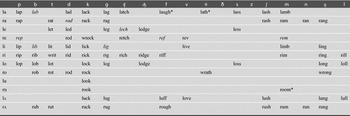
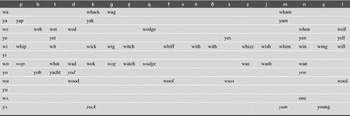
This article is about some very short words: the permutations for monosyllables in common use in standard British English having the phonetic pattern: single consonant + short vowel + single consonant. It is similar, therefore, to my article ‘Consonantal beginnings’ (ET80), in which I looked at what pairs of consonantal sounds could be found at the beginnings of English words. The pronunciation is to be taken as that given in the OED for British English.
The vowels here are those of hat, let, pit, hot, shook and rub. The schwa vowel does not appear, as the only monosyllabic words containing it are weak pronunciations, as of was or have. For the consonants, the voiced version of ‘sh’, as in the middle of vision (phonetic symbol ʒ) is absent, as there are no normal English words of this pattern that begin or end with it. This does not seem to be from any intrinsic phonetic difficulty, as native English speakers who can speak French, for example, do not seem to find anything strange in pronouncing French words like tige or jupe or, to take one that both begins and ends with that sound, juge. Consonantal y, as well as h, r and w, appear only as opening sounds and ng only as a closing one. Where there are homophones, such as jam and jamb, I have given only one of the words.
To refer to the sounds, I have mostly used alphabetic representation, occasionally adding IPA symbols. I felt that, with the limited range of the topic, things would be clear that way both for phonetic experts and non-experts alike. I apologize to any phoneticians who may be irked by the inexactitude. With the IPA system, it is perhaps regrettable that the symbols ʧ and ʤ look as if they refer to two consonants each. Clearly, the word itch has only one consonantal sound, as has edge. We are not concerned here with details of pronunciation either. So, for example, whereas some speakers make the ‘i’ sound in chill slightly, but markedly, different from that in chin, here the ‘i’ sound, as with the other vowels, is taken to be the same for all the words containing it, whatever the preceding or following consonant.
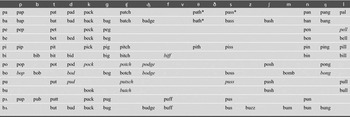
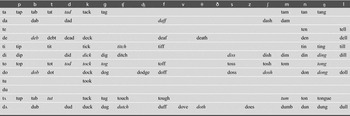
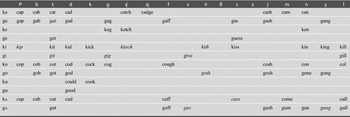
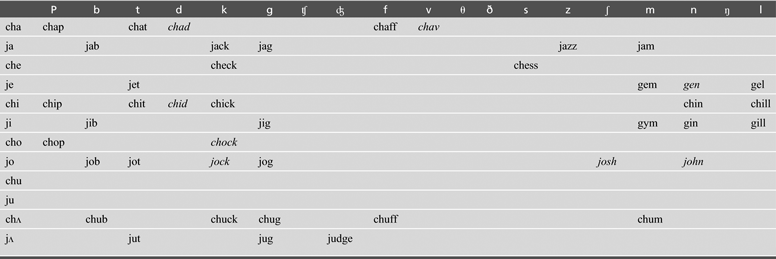
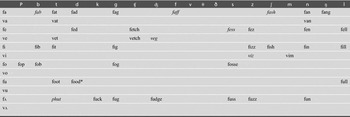
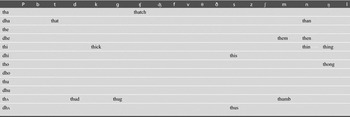
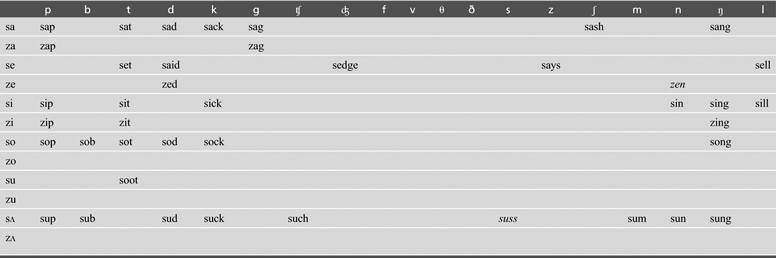
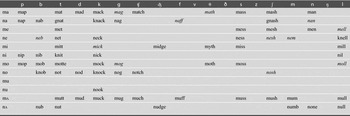
In the tables, the words are divided into ‘normal’ (Roman type) and ‘dubious’ (italic). The latter are judged dubious for various reasons: slang (shill), infantile (tum), abbreviation (deb), too foreign (kitsch), part of a two-word expression (ding) and so on. You may think I have been too strict in some cases to judge a word ‘dubious’ or not strict enough not to in others. To decide whether a word is in common use or should be counted as a genuine word, I have simply used myself as the test-bed. I have not included proper names, acronyms or words of technical jargon. You are free to disagree with any inclusions or exclusions. An empty box does not imply there is no word beginning with that combination of sounds. There is no *sull, for example, but there is sully. The concern here, then, is solely with monosyllabic words beginning and ending with the sounds indicated. An asterisk indicates that the vowel is pronounced long by some speakers, as in path. I have counted wh- as sounding the same as w- in words such as whim, though I am aware that some speakers prefer to distinguish between them.
When it comes to the opening consonant, there is one special case: the voiced version of ‘th’ (phonetic symbol ð). Words beginning with that sound are of a limited group. Here they are represented by that, than, them, then, this and thus. A native English speaker hearing a word beginning with that consonant will know instinctively that it will not be a common noun or a descriptive adjective, for example. It is therefore a subconscious aid to understanding. It is unlikely, then, that a new verb or common noun could come into English beginning with that sound. Apart from that, there is no outright reason why any of the blanks should not be filled. This article will look at what seem to be the preferences for English and whether there are any particular reasons why English has not, at present anyway, the words gom, chack, leb or mip. For some potential words, it might just be a case of phonetic overload: having back, bag and pack already, could we really cope with a pag as well? For others, aesthetic factors may come into play. Perhaps the absence of any ‘ch?tch’ words is because the English ear simply does not like the quick repetition of that sound. A voiced equivalent exists, though, in the word judge.
There are some striking cases. For example, the only word of this pattern that ends with the voiced ‘th’ is with. Dictionaries also offer the pronunciation of with with the unvoiced ‘th’, the OED suggesting it is less standard. That is why it appears twice in the tables that follow. It is perhaps, though, the contrasts p/b, t/d, k/g that provide the most interesting cases, as they are the sounds that produce the sharpest and shortest of these words, whereas the nasals, fricatives, liquids and sibilants produce softer or longer ones. The tables appear on pages 37–47.
p/b

t/d

k/g

ʧ/ʤ
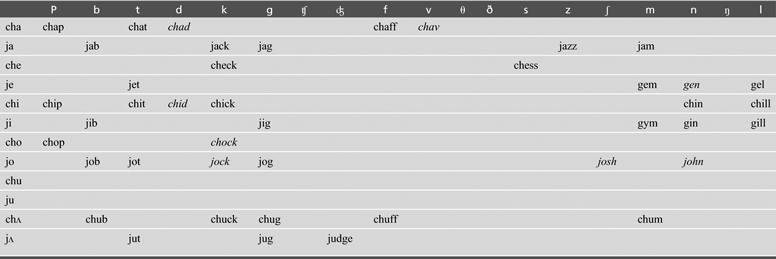
f/v

θ/ð

s/z
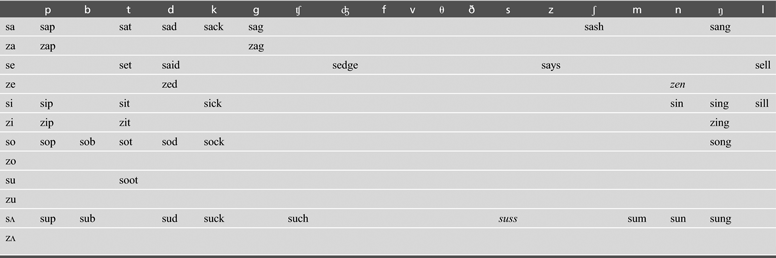
ʃ

h

m/n

l/r

w/y

I wondered whether this exercise would be more valid if it included long vowels, and even diphthongs, as well. It was not so much that the amount of information might then be daunting that I decided against it, as that there are reasonable doubts whether standard British English really has pairs of short/long vowels. To have included the ‘long’ vowels might then have seemed to imply a matching relationship between such pairs. For teaching English as a foreign language, one could propose short/long pairings along the lines of cat/car, let/hair, slip/sleep, lot/law, book/zoom, and cup/fur. That is expedient, but is there really the same relationship between the vowels of cat and car as between those of slip and sleep? I would say not, and would acknowledge that the pairing cup/fur was stretching things a little. It seems to me, then, that the pronunciation of the sequence C + short V + C is a sufficiently independent phenomenon and that the presence in English of the word pick, for example, need not be considered phonetically in relation to that of peak.
One might wonder, too, whether it was valid to distinguish monosyllables of the form C + short V + C from those beginning or ending with more than one consonant. We may not have *lut or *lus, but we have glut and lust. Is it not enough, then, to say that English accepts the sequences /lʌt/ and /lʌs/ even though there are no words consisting solely of those sequences of sounds? Granted, when we speak we pause between words only rarely, but the monosyllables of the type I have proposed here (C + V + C) can be heard individually, with silence before and after them. I think, then, that there is an important phonetic difference between being able to begin or end a monosyllable with a particular single consonant and that consonant's launching or being launched by another within a monosyllabic word. So I would say that the existence of rub in English is not necessarily phonetically validated by that of grub nor the possibility of *fiss by that of fist.
For those of you with a competitive streak, here are the winners in some categories (counting only the ‘normal’ words). For opening consonant – h; closing consonant – t; opening C + V – wi; closing V + C – it; for the vowel alone – a. For initial unvoiced/voiced pairs, such as pat/bat or tuck/duck, the winner, again excluding ‘dubious’ words, was p/b with 25, well ahead of t/d and k/g with 15 each, and with s/z, f/v and ch/j (= ʧ/ʤ) miles behind, with only 6, 3 and 3 respectively.
Of the 36 possible pairings of initial unvoiced/voiced consonants, there are 14 that do not produce any pairs of words of the pattern tuck/duck. For example, for ch + a there is chap, chat and chaff, and for j + a there is jab, jack, jag, jazz and jam, but there is no chab, chack, chag, chazz, cham, jap, jat or jaff. There are some C + V beginnings that make a drastic contribution to that total of 14, however, in producing no words at all. Examples are zo- and vo-, and the ch/j (ʧ/ʤ) pairing gives no words with the ‘shook’ vowel following them. Again, the cause does not seem to be intrinsically phonetic, as in some accents of northern England, ones in Yorkshire, for example, a word such as chuck is pronounced with the vowel of standard British English shook. The cause may, then, have more to do with an opposition between the ‘shook’ and ‘rub’ vowels in such contexts, for it provides the fewest pairs of words where that is the only difference, namely: look/luck, put/putt, book/buck, could/cud, took/tuck, rook/ruck, and room (pronounced with a short vowel)/rum. This contrasts with the opposition of e and i, for example, where there are 30 such pairs.
Of unproductive initial consonants, you only have to look at the last pages of an English dictionary to see that the language does not favour words beginning z-. For our words, there are only 7, and some of those only just squeezed into my classification of ‘normal’. It may be relevant that, when people want to invent a nonsense word in English, z is favoured, as in ‘the planet Zorg’. German goes the opposite way, which avoids words beginning with an unvoiced s, and where a word beginning with the spelling ‘s + vowel…’ indicates a voiced sibilant, there being many such words, unlike the few ‘z-’ words of English. This sound does not fare much better in final position either, there being only 9 such words in the tables, with five of those being the grammatically ‘special’ words says, was, has, does and his, spelled with an ‘s’ rather than a ‘z’. More surprising, perhaps, is that these tables produce only five words beginning with ‘v’.
For the other initial consonants, that do not form unvoiced/voiced pairs, we might note there are no words ending ‘-ng’ or ‘-v(e)’ for m/n, but a good number for l/r. For the semi-vowels w/y, there seems to be no problem following ‘w’ with its vocalic equivalent ‘u’ (the ‘shook’ vowel), as we have wood, woof and wool. The equivalent for y would be words beginning ‘yi-’, but I rejected the only candidate in my dictionary, yid. The next best, adding a consonant, is the golfers' affliction, yips. We could compare this with classical Latin, whose orthography does not distinguish between the consonantal and vocalic value of these two sounds, writing them, in upper case, as ‘V’ and ‘I’. There are several Latin words beginning ‘VV-’, such as VVLGVS, meaning ‘the common people’, whose first syllable sounds close to the English wool, but for ‘I-’, although there are Latin words beginning ‘IO-’, ‘IV-’ and ‘IA-’, such as IAM (sounding like the English word yam), there are none beginning ‘II-’.
Among vowels that reject following consonants, the ‘shook’ vowel is notable. It seems to allow only t, d, k, sh, m, and l after it. A long u, by contrast, as in loom, does not allow k after it for this pattern of words (C + V + C), but adds many more, as with hoop, tooth, soothe, moose, lose, louche and moon. Excluding voiced ‘th’ as a following consonant, the other vowels are reasonably tolerant. Anything goes after a. For e, there is no ‘-ng’ and rev is borderline. For i, maybe tiff is slightly slangy. For o, there is no following ‘v’, and we should note that, apart from the dubious guv, rev and chav, the ‘normal’ words ending with the sound ‘v’ are spelled ‘-ve’, as in dove, give, shove, live, love, have. For ʌ (the ‘rub’ vowel), doth is marginal, as being an old form. The opposition between the ‘shook’ and ‘rub’ vowels has already been mentioned, so that in every table that has ‘-ull’, you will find it for either the ‘shook’ vowel or the ‘rub’ vowel, but never both.
There are other orthographic features that reveal themselves more clearly in tables in this way. For example, all these types of words that end in the sound ʤ are spelled ‘-dge’. By contrast, if we replace the short vowel with a long one or a diphthong here, there are no ‘-dge’ spellings, but only ‘-ge’, as in barge, forge, rage, surge and gouge. For ʧ, the spelling ‘-tch’ outnumbers ‘-ch’ by 20 to 4. Yet ‘-tch’ does not follow a long vowel or a diphthong. The nearest you get is aitch, but that does not begin with a consonant. The spelling ‘-ck’ outnumbers ‘-k’ but, if we discount yak and wok as perhaps a little too foreign, we see that all the ‘-k’ spellings are preceded by ‘oo’, as in look, took, cook and so on. By contrast, there is no ‘-ck’ if a long vowel or diphthong precedes. There is only ‘-k’ or ‘-ke’, as in stake, broke, fluke, reek, talk or lurk. This may be why, when a native English-speaker sees, on the menu in a French restaurant, the spelling ‘steack’, it looks particularly odd.
The reasons, of course, that certain combinations are more likely than others with these monosyllables can, for some cases, be found in the history of the language. But to approach the topic from that angle would be a quite different type of study. We must recognize also that people's deliberate and subconscious choices of pronunciation, and thus the development of the sound of the language, will not be much influenced by a knowledge of its history. In modern English, none rhymes with run. To know it used not to will have no effect on the pronunciation of the language. So, if it looks as if a new word, or a new style of pronunciation, may be coming into use, only a few demented historians of language will argue against it on the grounds that it does not follow accepted patterns. If some new technology, for example, invented something it wanted to call a ‘sov’, it would be irrelevant to object that this combination of sounds was historically anomalous. Indeed, if ‘sov’ became current, it could lead to other words ending in ‘-ov’ and thus change the phonetic character of the language. To imagine otherwise would be rather like thinking that a composer of music would decide not to write in a certain way, as it would not follow the apparent development of music up to his time.
Here are a few more statistics. When the same sound begins and ends the word, as with pip or cook, the stop consonants come out top: 7 each for p/b and t/d, and 4 for k/g. The rest provide very few. We have loll and lull for l. There is only judge for ch/j. Perhaps the abnormality of faff is related to its sense. There is clearly an onomatopoeic influence in shush and for the nasals we have only mum, none and the dubious nan (only as a familiar word for grandmother, I think, as the Asian bread seems to have a long vowel). When the word begins with an unvoiced consonant and finishes with its voiced equivalent or vice versa, there are far fewer: pub, bap, debt, dot, keg and cog. For the sibilants, says seems an exceptional case and that may be why in humorous writing you often find it spelled sez as in ‘sez ’oo?'.
I have dealt with patterns that are not represented or are poorly so. Here, then, are some examples of easily feasible, but non-existent, words. I am not going to include those that are heard, but did not even make it into my ‘dubious’ status, such as comic book exclamations, like bam. There are also a good number that exist as proper names or abbreviations of them, such as Pam, Bess, Ted, Kev, Geoff, Chas, Vic, Seb, Madge, Med, Ned, Len, Ross, Liz and Yop, all of which sound quite normal for English and might, in other circumstances, have been common nouns or verbs. So, how about, as potential newcomers to the language: goss, codge, chood, jeth, vem, fosh, thack, zeb, soll, ked and, of course, mip?
I attempted above vaguely to claim that the preferences the language seems to have, within these types of monosyllabic words, are a distinctive feature of English, having a particular influence on its overall phonetic character, but I have not really been able to find a convincing phonetic or historical argument to support my position. It may be that it cannot either be supported or refuted. For the moment, it is just a feeling I have. My interest in such words goes back to a conversation I had many years ago with an Italian man in a hotel in Athens about the sounds of English and Italian. While we agreed on the clarity, fluidity and musicality of Italian, nearly all of the words in which end in a vowel, I said I was glad to be a native speaker of a language that could end some of its shortest words abrubtly with an energetic b or g. I said I thought it gave strength and vitality to the language. He was not so sure.
 MICHAEL BULLEY studied Classics and Linguistics at the Universities of Edinburgh and London. He then spent twenty-odd years teaching Classics in state education in England. In 2002, he qualified as a teacher of English in French national education. He now works as a freelance in Chalon-sur-Saône. He has appeared many times in ET and has contributed articles to other journals on Classical, linguistic and philosophical topics. Email: michael.bulley@orange.fr