Introduction
A long and intensive study of lichens in the south-east part of the Noord-Brabant Province (the Netherlands) resulted in multiple interesting taxonomic novelties (e.g. van den Boom Reference van den Boom2004, Reference van den Boom2015; van den Boom & van den Boom Reference van den Boom and van den Boom2009). Recently, a collection was found growing on a medium-sized trunk of Fraxinus excelsior. It was thought to be a species of Catillaria A. Massal. because it presented paraphyses with black tips, a feature typically found in this genus, as well as relatively small and hyaline 1-septate ascospores.
The first genetic data from the type species of Catillaria, C. chalybeia (Borr.) A. Massal., was provided by Bendiksby & Timdal (Reference Bendiksby and Timdal2013), who showed that this species is closely related to the genera Solenopsora A. Massal. (type species S. requienii A. Massal.) and Lopadium Körb. (type species L. pezizoideum (Ach.) Körb.), forming a monophyletic clade outside the main group of Lecanorales Nannf. Miadlikowska et al. (Reference Miadlikowska, Kauff, Högnabba, Oliver, Molnár, Fraker, Gaya, Hafellner, Hofstetter and Gueidan2014) identified this clade as Leprocaulales Lendemer & B. P. Hodk., an invalid name due to the lack of a description or diagnosis in Lendemer & Hodkinson (Reference Lendemer and Hodkinson2013), where this clade was shown to include also samples identified as Halecania alpivaga (Th. Fr.) M. Mayrhofer (the type species of Halecania M. Mayrhofer) and Speerschneidera euploca (Tuck.) Trevis. (the type species of Speerschneidera Trevis.).
According to the genetic results obtained by several authors (Andersen & Ekman Reference Andersen and Ekman2005; Reese Næsborg et al. Reference Næsborg R, Ekman and Tibell2007; Ekman et al. Reference Ekman, Andersen and Wedin2008; Lee et al. Reference Lee, Lee, Hur, Andreev and Hong2008; Kistenich et al. Reference Kistenich, Timdal, Bendiksby and Ekman2018), the traditional concept of the genus Catillaria is not monophyletic. Several species belong in unrelated families according to Miadlikowska et al. (Reference Miadlikowska, Kauff, Högnabba, Oliver, Molnár, Fraker, Gaya, Hafellner, Hofstetter and Gueidan2014); namely Catillaria alba Coppins & Vězda, C. aphana (Nyl.) Coppins, C. corymbosa (Hue) M. Lamb, C. croatica Zahlbr. and C. scotinoides (Nyl.) Coppins in Ramalinaceae, C. contristans (Nyl.) Zahlbr. in Pilocarpaceae, C. erysiboides (Nyl.) Th. Fr. in Psilolechiaceae, and C. modesta (Müll. Arg.) Coppins in Lecideaceae. Kelly et al. (Reference Kelly, Hollingsworth, Coppins, Ellis, Harrold, Tosh and Yahr2011) produced molecular data from specimens identified as C. nigroclavata and later Guttová et al. (Reference Guttová, Zozomová-Lihová, Timdal, Kučera, Slovák, Piknová and Paoli2014) obtained data from other samples identified as C. lenticularis, but they could not provide any hypothesis about their placement at the family level.
Three species of Catillaria have been described from Australia and Tasmania recently and from the type locality only: Catillaria austrolittoralis Kantvilas & van den Boom (Kantvilas & van den Boom Reference Kantvilas and van den Boom2013) and C. laevigata P. M. McCarthy & Elix (Elix & McCarthy Reference Elix and McCarthy2018), two saxicolous species with a rimose or areolate thallus, containing argopsin or pannarin; C. gerroana P. M. McCarthy & Elix (McCarthy & Elix Reference McCarthy and Elix2017), which lacks these chemical compounds and has ascospores of (9–)11.5(–15) × (3.5–)4.5(–5.5) μm. Another saxicolous species, C. ulleungdoensis S. Y. Kondr. et al., was recently described from South Korea; it has a weakly developed thallus and rather small apothecia (0.15–0.3(–0.55) mm diam.) (Kondratyuk et al. Reference Kondratyuk, Lőkös, Tschabanenko, Moniri, Farkas, Wang, Oh and Hur2016). Catillaria patteeana D. P. Waters & Lendemer has brown apothecia with an opaque white to light brown margin and is sorediate (Waters & Lendemer Reference Waters and Lendemer2019). Two corticolous species, C. praedicta Tretiach & Hafellner and C. subpraedicta M. Brand & van den Boom, known from Mediterranean areas and Lanzarote (Canary Islands) respectively, have multispored asci.
In the present work, the taxonomic identity of the new samples found with Fraxinus in Noord-Brabant is resolved.
Materials and Methods
Morphological study and literature
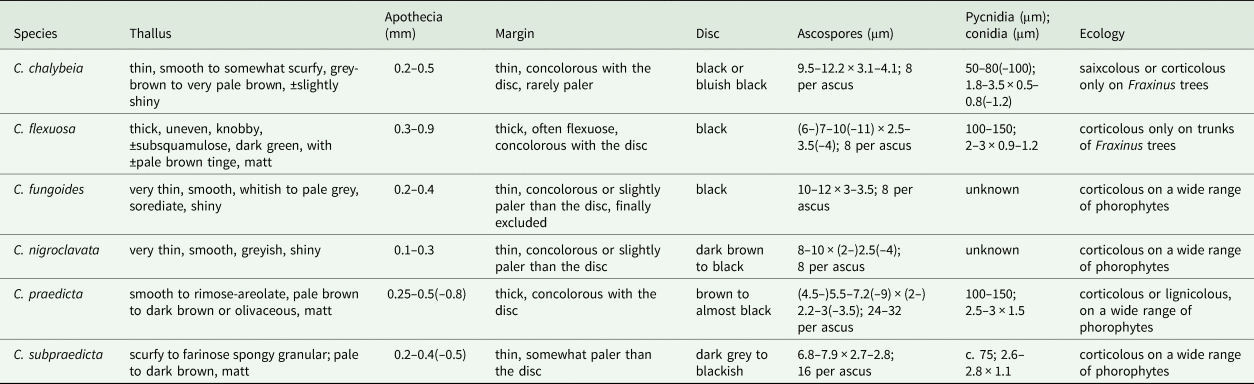
All specimens collected were studied by conventional macro- and microscopical techniques after mounting hand-cut sections of the material in tap water. Amyloid reactions were tested using Lugol's iodine solution (K/I). Accompanying specimens were identified. Photographs of habitus and microscopic characters are provided for the new species. Voucher specimens are kept in the herbarium of the first author and some specimens, including the holotype specimen, have been deposited in the herbarium of the Botanischer Garten und Botanisches Museum Berlin-Dahlem (B). Differences between corticolous species of Catillaria s. str. are summarized in Table 2 (data obtained from Kilias (Reference Kilias1981), Tretiach & Hafellner (Reference Tretiach and Hafellner1998), van den Boom & Etayo (Reference van den Boom and Etayo2001), Smith et al. (Reference Smith, Aptroot, Coppins, Fletcher, Gilbert, James and Wolseley2009), van den Boom (Reference van den Boom2010); and from corticolous Catillaria chalybeia specimens in this study).
Phylogenetic studies
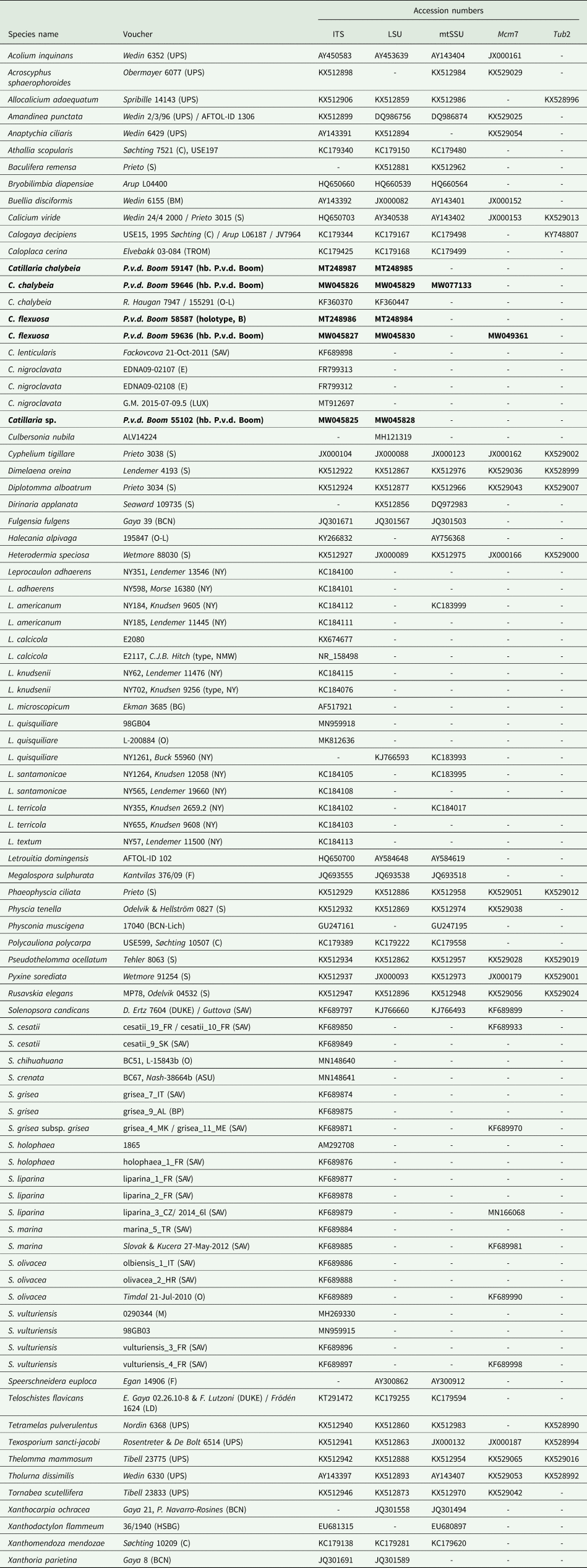
Total DNA was extracted from dry specimens employing a modified protocol based on Murray & Thompson (Reference Murray and Thompson1980). PCR reactions (Mullis & Faloona Reference Mullis and Faloona1987) included 35 cycles with an annealing temperature of 54 °C. The primers ITS1F and ITS4 (White et al. Reference White, Bruns, Lee, Taylor, Innis, Gelfand, Sninsky and White1990; Gardes & Bruns Reference Gardes and Bruns1993) were employed to amplify the ITS rDNA region (ITS), LR0R and LR5 (Vilgalys & Hester Reference Vilgalys and Hester1990; Cubeta et al. Reference Cubeta, Echandi, Abernethy and Vilgalys1991) were used for the 28S rDNA region (LSU), mrSSU1 and mrSSU3R for the mitochondrial small ribosomal subunit (mtSSU), and finally MCM7-709for and MCM7-1348rev for the DNA replication licensing factor (Mcm7). PCR products were checked in 1% agarose gels and positive reactions were sequenced with one or both PCR primers. Chromatograms were checked, searching for putative reading errors, and these were corrected. BLAST (Altschul et al. Reference Altschul, Gish, Miller, Myers and Lipman1990) was used to select the most closely related sequences from the International Nucleotide Sequence Database Collaboration public database (INSDC; Cochrane et al. Reference Cochrane, Karsch-Mizrachi and Nakamura2011). Two independent datasets were built. The first alignment comprised sequence data of ITS2, LSU, mtSSU and Mcm7 (exons only) from the samples analyzed. Also included were homologous sequences from other species in the Leprocaulaceae and Catillariaceae families retrieved from public databases, and representatives from the orders Caliciales and Teloschistales, using Bryobilimbia diapensiae (Th. Fr.) Fryday et al. as outgroup because of its external position relative to these clades. The purpose of this analysis was to ascertain whether or not the newly generated sequences belong in Leprocaulales, as several species of Catillaria have been combined into different families and orders in the past. In addition, tub2 sequences available from the species in the alignment were incorporated, making a total of five partitions. Sequences (Table 1) came mainly from Gaya et al. (Reference Gaya, Högnabba, Holguin, Molnar, Fernández-Brime, Stenroos, Arup, Søchting, van den Boom and Lücking2012), Lendemer & Hodkinson (Reference Lendemer and Hodkinson2013), Guttová et al. (Reference Guttová, Zozomová-Lihová, Timdal, Kučera, Slovák, Piknová and Paoli2014) and Prieto & Wedin (Reference Prieto and Wedin2016). Each partition was aligned in MEGA 5.0 (Tamura et al. Reference Tamura, Peterson, Peterson, Stecher, Nei and Kumar2011) with its Clustal W application and then corrected manually. The final alignment included 126/266 (ITS2, n = 59), 251/652 (LSU, n = 44), 339/602 (mtSSU, n = 43), 217/443 (Mcm7, n = 27) and 217/624 (tub2, n = 15) variable/total sites. The aligned partitions were loaded in MrBayes v.3.2.6 (Ronquist et al. Reference Ronquist, Teslenko, van der Mark, Ayres, Darling, Höhna, Larget, Liu, Suchard and Huelsenbeck2012), where a Bayesian analysis was performed (data partitioned, GTR + G model for all partitions, two simultaneous runs, six chains, temperature set to 0.2, sampling every 100th generation) until convergence parameters were met after 1.27 M generations, standard deviation having fallen below 0.01. Finally, a full search for the best-scoring maximum likelihood (ML) tree was performed in RAxML v.8.2.12 (Stamatakis Reference Stamatakis2014) using the standard search algorithm (same partitions, GTRCAT model, 2000 bootstrap replications). The significance threshold was set above 0.95 for posterior probability (PP) and 70% bootstrap proportions (BP).
Species names, voucher specimens and GenBank Accession numbers of sequences of Catillaria and related taxa used in the phylogenetic analyses. Samples in bold were sequenced in the present study. Sequences were obtained mainly from Gaya et al. (Reference Gaya, Högnabba, Holguin, Molnar, Fernández-Brime, Stenroos, Arup, Søchting, van den Boom and Lücking2012), Lendemer & Hodkinson (Reference Lendemer and Hodkinson2013), Guttová et al. (Reference Guttová, Zozomová-Lihová, Timdal, Kučera, Slovák, Piknová and Paoli2014) and Prieto & Wedin (Reference Prieto and Wedin2016).

The second alignment included only ITS sequences of Leprocaulaceae and Catillariaceae (using Catillaria lenticularis as outgroup because of its external position outside Catillaria s. str.). The purpose of this analysis was to resolve the different species in Catillaria s. str. and compare their intraspecific variability with that observed in other species of these families. Sequences (Table 1) came mainly from the same sources. The sequences were first aligned in MEGA 5.0 and then subjected to GBlocks (Castresana Reference Castresana2000) to remove 345 ambiguously aligned sites, resulting in a new dataset with 204/458 variable sites among 44 sequences. This alignment was loaded in MrBayes v.3.2.6, where a Bayesian analysis was performed (data not partitioned, GTR + G + I model, two simultaneous runs, four chains, temperature set to 0.2, sampling every 100th generation) until convergence parameters were met after 0.2 M generations, standard deviation having fallen below 0.01. A full search for the best-scoring ML tree was performed in RAxML v.8.2.12 using the standard search algorithm (data not partitioned, GTRGAMMA model, 2000 bootstrap replications). The significance threshold was set again at 0.95 for posterior probability (PP) and 70% bootstrap proportions (BP).
Results and Discussion
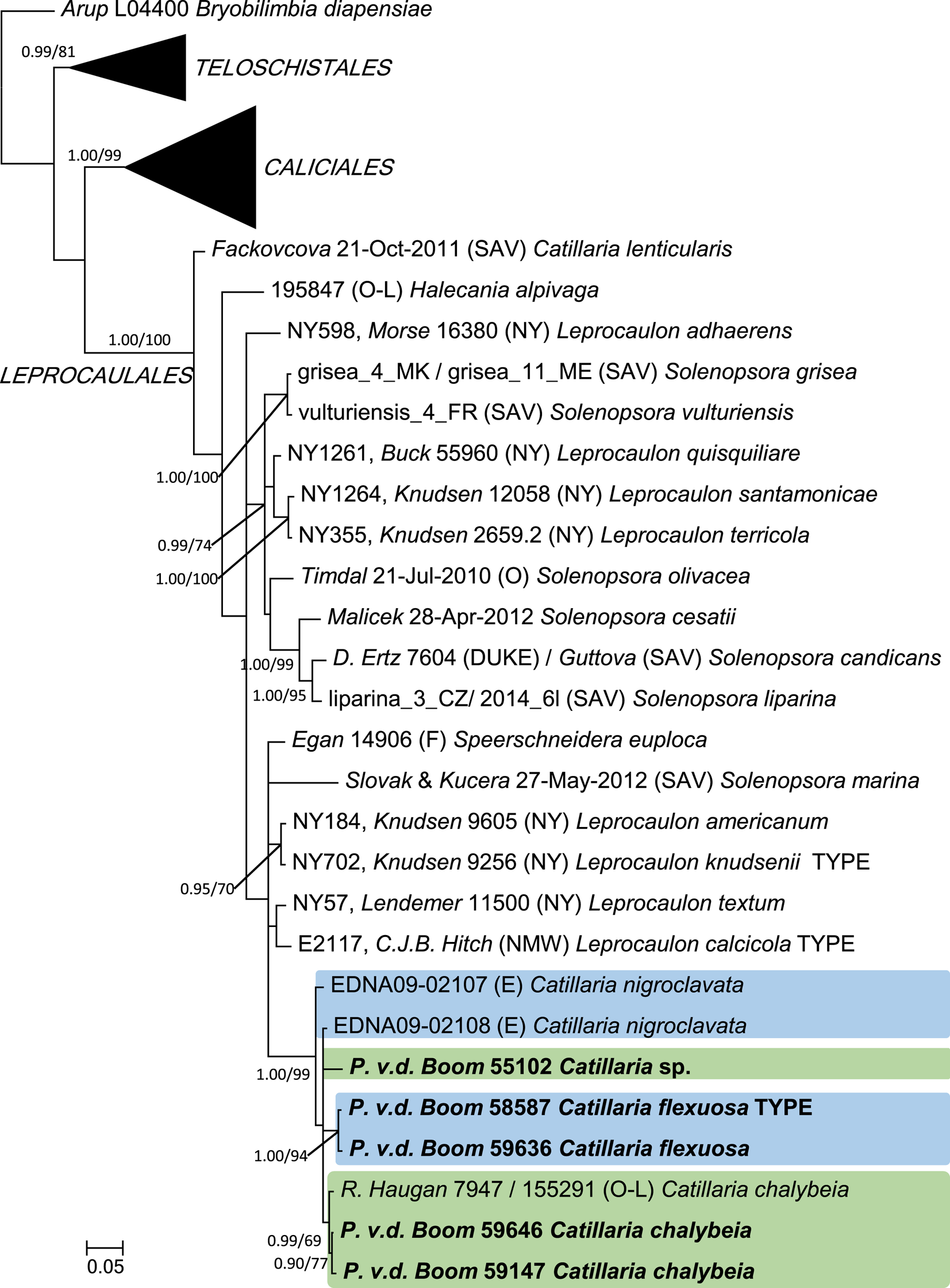
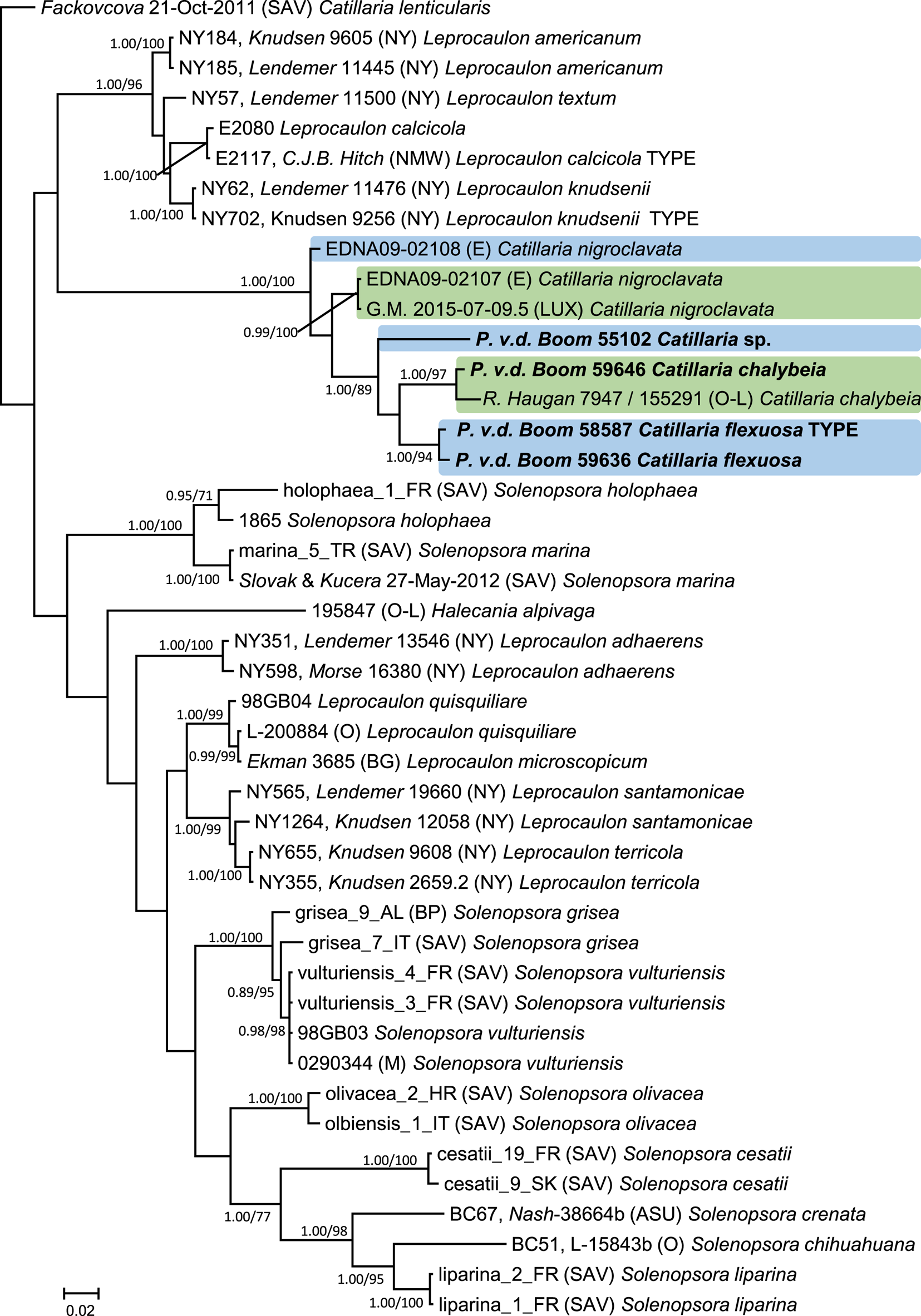
According to the present phylogenetic studies (Figs 1 & 2), the specimens studied are closely related to Catillaria chalybeia, the type species of Catillaria, represented by sequences obtained from saxicolous (R. Haugan 7947/ O-L-155291) and corticolous (P. v. d. Boom 59147, 59646) samples. A saxicolous collection found on the Azores Islands (P. v. d. Boom 55102) seems to be unrelated to the other lineages, being c. 60% similar in ITS, (475/782 bp identical), or 90% if a large 250 bp insertion in the ITS1 region is excluded, and is provisionally identified here as Catillaria sp. A third clade is composed of sequences of two collections with flexuose apothecia and differences of only 1.5% between them (11/784 bp), but both being c. 91% similar to sequences of C. chalybeia (712/781 bp). Regarding LSU, the three lineages differ in c. 2–3% (10–20/645 bp different), with a very low intraspecific variability (2/645 bp variable sites in both C. chalybeia and the clade with flexuose apothecia). In turn, all these samples are related to specimens identified as C. nigroclavata (G.M. 2015-07-09.5 (LUX), EDNA09-02107 (E) and EDNA09-02108 (E)), although the ITS sequence of EDNA09-02108 (E) seems to differ in up to 4.5% (21/477 bp) from the other two, maybe indicating that they come from different taxa. While the exact identity of C. chalybeia needs to be further confirmed by checking additional collections and appointing an epitype, the specimens with flexuose apothecia clearly represent a distinct taxon, a new name for which is proposed here.
A 50% majority rule ITS rDNA-28S rDNA-mtSSU-Mcm7-tub2 consensus phylogram of the family Catillariaceae (with a selection of species from the orders Teloschistales and Caliciales, as well as Bryobilimbia diapensiae as outgroup) obtained in MrBayes from 23 925 sampled trees. Nodes were annotated if supported by ≥ 0.95 Bayesian posterior probability (PP) (left) or ≥ 70% maximum likelihood bootstrap proportions (BP) (right). Sequences newly generated in this study are in bold. In colour online.

A 50% majority rule ITS rDNA consensus phylogram of the family Catillariaceae (with a selection of species from Leprocaulaceae, as well as Catillaria lenticularis as outgroup) obtained in MrBayes from 1500 sampled trees. Nodes were annotated if supported by ≥ 0.95 Bayesian posterior probability (PP) (left) or ≥ 70% maximum likelihood bootstrap proportions (BP) (right). Sequences newly generated in this study are in bold. In colour online.

All these species form a significantly supported clade that is considered here to be the core of Catillaria. Unfortunately, the genetic limits between Catillaria and the closely related genera Halecania, Leprocaulon, Solenopsora and Speerschneidera are not clear enough, probably due to the incomplete genetic data from most collections analyzed (Table 1). Synonymies between some of these genera cannot be rejected and, in this case, Catillaria (A. Massal. 1852) should be the priority name. In the present analysis, C. lenticularis seems to be unrelated to the core of the genus Catillaria. The limits between the families Catillariaceae and Leprocaulaceae are not clear either, maybe also being synonyms, in which case Catillariaceae (Hafellner Reference Hafellner1984) should be given priority.
Taxonomy
Catillaria flexuosa van den Boom & P. Alvarado sp. nov.
MycoBank No.: MB 835063
Distinguished from Catillaria chalybeia by the dark green, relatively thick thallus, up to 0.4 mm, continuous to weakly rimose, areolate, with knobby granules, sometimes becoming subsquamulose. Apothecia 0.3–0.9 mm diam., often flexuose; smaller ascospores, (6–)7–10(–11) × 2.5–3.5(–4) μm, larger pycnidia 100–150 μm diam., and differing conidia, ellipsoid, 2–3 × 0.9–1.2 μm.
Type: The Netherlands, Noord-Brabant Prov., S of Veghel, S of Zijtaart, Fraxinus trees (medium size) along road, grid ref. 45-56-51, 51°35.3′N, 5°32.5′E, 10 m, 12 August 2019, P. van den Boom 58587 (B—holotype; hb. van den Boom—isotype). GenBank Accession nos: MT248986 (ITS rDNA), MT248984 (28S rDNA).
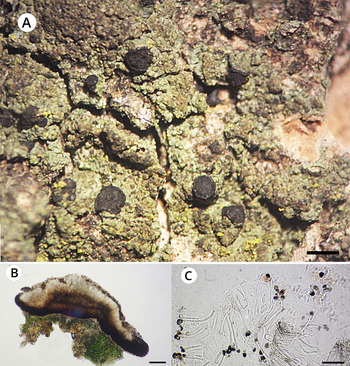
Catillaria flexuosa (holotype, P. van den Boom 58587). A, habitus. B, section of apothecium. C, paraphyses and some ascospores. Scales: A = 1 mm; B = 100 μm; C = 20 μm. In colour online.

Thallus relatively thick, up to 0.4 mm, continuous to weakly rimose, areolate, with knobby granules, sometimes becoming subsquamulose, growing in patches up to 1 cm wide, dark green, often with a brownish tinge, matt; prothallus not present; photobiont chlorophycean, cells 5–15 μm diam.
Apothecia abundantly present, 0.3–0.9 mm diam., flat, rarely slightly convex; proper margin conspicuous, presenting as a small rim especially in young apothecia, often flexuose, especially in mature apothecia (30–60 μm wide), persistent, somewhat shiny; disc black, matt; true exciple dark brown to blackish, sometimes with greenish pigments, mainly in young apothecia; hymenium 40–50 μm high, not presenting oil droplets; epithecium dark brown to greenish black, mainly in young apothecia, without crystals, K−; hypothecium dark brown, K−; paraphyses simple to rarely sparingly branched, 1–1.5(–2) μm wide, septate, apices dark brown to blackish, widened, 3–6 μm diam.; asci cylindrical-clavate to clavate, 8-spored, Catillaria-type, with a uniformly blue apical dome in K/I, 35–40 × 8–12 μm; ascospores ellipsoid, (6–)7–10(–11) × 2.5–3.5(–4) μm, 1-septate, thin walled, often with oil droplets, not or only rarely slightly constricted at septum.
Pycnidia often present, immersed to somewhat erumpent, 100–150 μm diam., dark brown to blackish; conidia ellipsoid, hyaline, 2–3 × 0.9–1.2 μm.
Chemistry
No chemical compounds detected by TLC. No crystals in thallus or apothecia.
Etymology
The epithet refers to the habitus of the apothecia.
Ecology and distribution
This new species is frequent in the type locality, growing on bark of wayside Fraxinus excelsior trees. It has a rather small distribution, being known from only five localities in the area, in the east of the province of Noord-Brabant. Other lichen species occurring at the type locality include Candelaria concolor (Dicks.) Stein, Candelariella reflexa (Nyl.) Lettau, C. vitellina (Hoffm.) Müll. Arg., Catillaria nigroclavata (Nyl.) Schuler, Phaeophyscia nigricans (Flörke) Moberg, P. orbicularis (Neck.) Moberg, Physcia adscendens H. Olivier, P. caesia (Hoffm.) Fürnr., Physconia grisea (Lam.) Poelt and Xanthoria parietina (L) Th. Fr. In addition, several lichenicolous fungi were found, including Arthonia epiphyscia Nyl. (very rare in the Netherlands), A. parietinaria Hafellner & A. Fleischhacker and Lichenochora weillii (Werner) Hafellner & R. Sant.
Notes
The morphological features of Catillaria chalybeia are described in detail by Kilias (Reference Kilias1981), who chose the lectotype from a collection found by Borrer, on tiles and flints, housed in BM. The thallus is usually 80–200 μm thick, rimose-areolate to verrucose-areolate, areoles 0.1–0.4 mm wide, sometimes very poorly developed, beige to olive-brown, dark brown to black, often slightly shiny, and the prothallus is often not present or dark brown to black. Apothecia are usually 0.2–0.5 mm diam., constricted at the base, the disc dark brown to black, excipulum black at outer rim, paler at inner side, asci 30–50 × 10–15 μm, ascospores 9.5–12.2 × 3.1–4.1 μm, pycnidia 50–80(–100) μm diam., and conidia bacilliform, 1.8–3.5 × 0.5–0.8 (–1.2) μm. Kilias (Reference Kilias1981) listed many records from all over Europe.
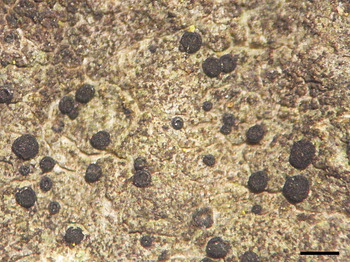
Catillaria chalybeia is commonly found growing saxicolous in the Netherlands, Belgium and Luxemburg (Diederich et al. Reference Diederich, Ertz, Stapper, Sérusiaux, Van den Broeck, van den Boom and Ries2020), but in the present work it was also found corticolous (Fig. 4). Many saxicolous collections from the study area have been checked; they usually grew on brick and on schist, always appeared with a thin, smooth, rimose areolate, greyish to greyish brown slightly shiny thallus, and apothecia that are up to 0.5 mm diam., roundish, without a flexuose margin, often clustered, some slightly deformed. Corticolous specimens differ somewhat in thallus colour, with a more brownish tinge.
Catillaria chalybeia (corticolous, P. van den Boom 59192), habitus. Scale = 0.5 mm. In colour online.

Catillaria flexuosa could be easily confused with C. chalybeia but differs by its matt, relatively thick greenish thallus, larger apothecia (up to 0.9 mm wide) often with a flexuous margin, smaller ascospores, and somewhat thicker conidia. In the field, C. flexuosa as well as the corticolous C. chalybeia form small and scattered inconspicuous patches, not exceeding 1 cm in width, and with no more than a few patches on isolated tree trunks.
Catillaria nigroclavata is also very common in the distribution area of the new species and both grow close to each other, and with C. chalybeia. Catillaria nigroclavata has much smaller apothecia, measuring c. 0.1–0.3 mm diam., and a very thin to immersed thallus with a greyish tinge. It is often found widely scattered on tree bark, but also on branches. Catillaria fungoides Etayo & van den Boom is also common in the studied area. Its apothecia resemble those of C. flexuosa but they have a thin, somewhat shiny thallus, and characteristic abundant black soralia; further differences to the aforementioned and to Catillaria praedicta Tretiach & Hafellner and C. subpraedicta M. Brand & van den Boom are provided in Table 2. In the field, C. flexuosa can be easily confused with Amandinea punctata (Hoffm.) Coppins & Scheid., a species with quite similar apothecia but with a more conspicuous, greyish thallus and brown ascospores.
Comparison of the main characters of the six known corticolous Catillaria s. str. species. Information obtained from Kilias (Reference Kilias1981), Tretiach & Hafellner (Reference Tretiach and Hafellner1998), van den Boom & Etayo (Reference van den Boom and Etayo2001), Smith et al. (Reference Smith, Aptroot, Coppins, Fletcher, Gilbert, James and Wolseley2009), van den Boom (Reference van den Boom2010) and the present study.

Additional specimens examined
The Netherlands: Noord-Brabant: SSW of Erp, S of Keldonk, Rad to Diepers, Fraxinus trees (medium size) along road, grid ref. 51-16-14, 51°35′N, 5°35.1′E, 10 m, 2019, P. & B. van den Boom 59120 (hb. v. d. Boom); W of St Oedenrode, S of road to Olland, road to Bobbenagelse Brug, corticolous on Fraxinus tree, grid ref. 51-14-34, 51°34.1′N, 5°25.8′E, 10 m, 2019, P. van den Boom 59211 (hb. v. d. Boom); N of Uden, De Maashorst, Menzel, Menzelsch Veld, Koudenoord, roadside Fraxinus trees along field, grid ref. 45-36-34, 51°41.9′N, 5°35′E, 15 m, 2020, N. Ettema & P. van den Boom 59636 (hb. v. d. Boom); Veghel, NE of city, W of road to Mariaheide, Fraxinus trees along small road, just outside housing estate, grid ref. 45-56-13, 51°37.55′N, 5°34.3′E, 10 m, 2020, P. & B. van den Boom 59644 (hb. v. d. Boom).
Catillaria chalybeia (corticolous), specimens examined
The Netherlands: Noord-Brabant: W of St Oedenrode, S of road to Olland, road to Bobbenagelse Brug, on Fraxinus tree, grid ref. 51-14-34, 51°34.1′N, 5°25.8′E, 10 m, 2019, P. van den Boom 59147 (hb. v. d. Boom); Breugel, Eind, near crossing to centre of village and road to Lieshout, roadside trees (Tilia and Fraxinus), on Fraxinus, grid ref. 51-25-35, 51°31.2′N, 5°31.4′E, 2019, P. & B. van den Boom 59192 (hb. v. d. Boom); Veghel, NE of city, W of road to Mariaheide, on Fraxinus trees along small road, just outside housing estate, grid ref. 45-56-13, 51°37.55′N, 5°34.3′E, 10 m, 2020, P. van den Boom 59646 (hb. v. d. Boom).
Catillaria chalybeia (saxicolous), selected specimens examined
The Netherlands: Noord-Brabant: Eindhoven, NNW of Geldrop, road to Urkhoven, on brick of culvert, grid. ref. 51-46-31, 51°26.0′N, 5°32.2′E, 20 m, 1993, P. & B. van den Boom 13805 (hb. v. d. Boom); Valkenswaard centre, churchyard since 1887, tombstones of concrete, brick, schist etc., on schist, grid. ref. 57-14-25, 51°21.1′N, 5°27.5′E, 20 m, 2009, P. & B. van den Boom 43474 (hb. v. d. Boom); Eindhoven centre, churchyard, gravestones of concrete and schist, on schist, grid. ref. 51-44-15, 51°27.1′N, 5°27.5′E, 20 m, 2014, P. & B. van den Boom 51920 (hb. v. d. Boom).
Catillaria sp. (saxicolous), specimen examined
Portugal: Azores: Faial, W side of island, NNE of Praia do Norte, Baia da Ribeira das Cabras, coastal area, some scattered trees, outcrops and walls with volcanic stones along field, on volcanic stone, 38°36.72′N, 28°45.74′W, 35 m, 2016, P. & B. van den Boom 55102 (hb. v. d. Boom).
Arthonia epiphyscia, specimens examined
The Netherlands: Noord-Brabant: S of Veghel, S of Zijtaart, Fraxinus trees (medium size) along road, grid ref. 45-56-51, 51°35.3′N, 5°32.5′E, 10 m, 2019, P. van den Boom 58591 (hb. v. d. Boom); N of Uden, De Maashorst, Menzel, Menzelsch Veld, Koudenoord, roadside Fraxinus trees along field, grid ref. 45-36-34, 51°41.9′N, 5°35′E, 15 m, 2020, N. Ettema & P. van den Boom 59640 (hb. v. d. Boom).
Acknowledgement
We would like to thank Harrie Sipman (Berlin), who provided TLC analysis.
Author ORCID
Pieter P. G. van den Boom, 0000-0002-1929-2088.