Introduction
Smoking remains the largest single preventable cause of premature death and illness worldwide (Shafey, Erikson, Ross, & Mackay, Reference Shafey, Erikson, Ross and Mackay2009; World Health Organisation, 2009). In countries such as Australia, Canada, the United Kingdom and the United States, most smokers want to quit and have previously made an attempt, yet a typical smoker who seeks treatment rarely manages more than 3–4 weeks of abstinence (Aveyard et al., Reference Aveyard, Brown, Saunders, Alexander, Johnstone, Munafò and Murphy2007; Hyland et al., Reference Hyland, Borland, Li, Yong, McNeill, Fong and Cummings2006). There is a pressing need to find better ways of helping smokers to stop.
Currently the most effective method of helping smokers to stop involves face-to-face behavioural support combined with medication such as nicotine replacement therapy (NRT), buproprion or varenicline (Brose et al., Reference Brose, West, McDermott, Fidler, Croghan and McEwen2011; Department of Health, 2010; Kuehn, Reference Kuehn2008). However, even in England where there is a universally available behavioural support programme and national guidance for General Practitioners to refer patients to it at every opportunity, the vast majority of smokers do not use face-to-face support during a quit attempt (National Institute for Health and Clinical Excellence, 2006; West & Brown, Reference West and Brown2012). The internet could be an ideal medium for helping those people who do not wish to engage in face-to-face behavioural support (Graham, Cobb, Raymond, Sill, & Young, Reference Graham, Cobb, Raymond, Sill and Young2007; Saul et al., Reference Saul, Schillo, Evered, Luxenberg, Kavanaugh, Cobb and An2007). In a nationally representative survey, approximately 70% of smokers reported using the internet at least once a week and almost half were interested in using an online smoking cessation intervention in the future if it was proven to help with stopping (Brown, Michie, Raupach, & West, Reference Brown, Michie, Raupach and West2013). Internet support also has the potential for increasingly wide reach and extremely low cost per user (Swartz, Noell, Schroeder, & Ary, Reference Swartz, Noell, Schroeder and Ary2006).
The potential effectiveness of internet-based smoking cessation interventions has been the subject of three recent meta-analyses (Civljak, Sheikh, Stead Lindsay, & Car, Reference Civljak, Sheikh, Stead Lindsay and Car2010; Myung, McDonnell, Kazinets, Seo, & Moskowitz, Reference Myung, McDonnell, Kazinets, Seo and Moskowitz2009; Shahab & McEwen, Reference Shahab and McEwen2009). These all reported significant efficacy overall, but also considerable heterogeneity between the different interventions. Moreover, there was little evidence relating to long-term abstinence (6 months or more) with biochemical verification of smoking status. It is not clear which included components account for the differences in effectiveness, as internet interventions have often been presented as ‘black boxes’ with limited description of their content (Crutzen, Reference Crutzen2011; Michie, Reference Michie2008; Strecher, Reference Strecher2008). In order to establish the components critical to an effective intervention, it is necessary for researchers to report transparently on the content of new smoking cessation websites.
‘StopAdvisor’ is a new smoking cessation website and in order to promote transparency we have published in detail about both the content and development of the website (Michie et al., Reference Michie, Brown, Geraghty, Miller, Yardley, Gardner and West2012). We used an open-source web-development platform (www.lifeguideonline.org). The development was informed by 19 theoretical propositions identified from the PRIME theory of motivation (West, Reference West2006), 33 evidence- or theory-based behaviour change techniques, 26 web-design principles and nine principles from user-testing. The website mimics an expert Stop Smoking Advisor who recommends a structured quit plan and offers on-going tailored support through a combination of tunnelled sessions and interactive menus. ‘Tunnelled’ refers to the navigational format and describes a structure in which the user is directed through a series of, often tailored, pages with little navigational control over the content. In an uncontrolled pilot study StopAdvisor demonstrated promising short-term efficacy: at 8-weeks post-enrolment, 20% of all participants both reported sustained 4-week abstinence and verified their status by way of either a saliva cotinine level of <15ng/ml or a saliva anabasine level of <1ng/ml for users of medication (Brown et al., Reference Brown, Michie, Geraghty, Miller, Yardley, Gardner and West2012). The website was used frequently (the mean number of log-ins per participant was 6.4) and a majority of participants rated the website positively on satisfaction ratings. On the basis of these promising pilot results, a trial of the long-term efficacy of StopAdvisor is being conducted with participants randomised to the offer of StopAdvisor or a static brief-advice control website.
In spite of socio-economically disadvantaged smokers being often less familiar with the Internet (Stoddard & Augustson, Reference Stoddard and Augustson2006), the pilot study also indicated that StopAdvisor was similarly effective and acceptable to users across the social spectrum. The implication is that typical access inequalities were successfully mitigated by the user-testing conducted with a panel of socio-economically disadvantaged smokers during the development of StopAdvisor. However, the robustness of this finding needs to be evaluated within an adequately powered trial. The efficacy of interventions across the social spectrum is important because disadvantaged smokers want, and try, to stop as much as other smokers but find it more difficult (Kotz & West, Reference Kotz and West2009). Additionally, there is a clear demand among more disadvantaged smokers for an effective website that has been proven to help with stopping – for example, in a nationally representative survey, approximately half of smokers who work in a routine and manual occupation reported being likely to use a website that has been proven to aid cessation (Brown et al., Reference Brown, Michie, Raupach and West2013).
Methods and design
Study design
The study design consisted of a two-arm randomised controlled trial with participants randomised to the offer of the interactive intervention (intervention condition) or a non-interactive website (control condition). Assessment is performed at baseline (immediately before allocation to one of the two conditions), then at two, four and seven months after enrolment. The study was approved by the ethics committee of University College London (2808/001) and the International Standard Randomised Controlled Trial Number Register (ISRCTN99820519).
Intervention
The development and content of the website has been described in detail elsewhere (Michie, et al., Reference Michie, Brown, Geraghty, Miller, Yardley, Gardner and West2012). Briefly, the development was informed by 19 theoretical propositions identified from PRIME theory, 33 evidence- or theory-based behaviour change techniques, 26 web-design principles and nine principles from user-testing. The theme of the website is based on the success of the NHS Stop Smoking Services and is intended to simulate an expert Stop Smoking Advisor who is both a ready source of useful information and a guide to help the smoker through the process of stopping using a structured quit plan. Tailored support is offered for up to a month before quitting and through until one-month post-quit. The website is presented on a standard template and employs a hybrid navigational architecture combining choice of content from menus and tunnelled exposure to key messages (http://www.lifeguideonline.org/player/play/stopadvisordemonstration).
Control
The control is a one-page static website that presents brief and standard advice, with none of the presumed active ingredients of the interactive website (http://www.lifeguideonline.org/player/renderpage/stopadvisordemonstration?pid=quitsmoking). The advice offered on the control site about the timescale for setting a quit-date is equivalent to that on the interactive site: smokers are encouraged to use medication, obtain medication within a fortnight, and set a quit date within two weeks of obtaining medication or deciding not to use it. By offering equivalent advice on quit dates, the average time since quit date at follow-up should be comparable between smokers from both conditions.
Adjunctive treatment
Smokers in both conditions are encouraged to use medication, to consult their doctor if they have concerns about their medication, and to use the NHS Stop Smoking Services if the support they receive from the website is considered to be ineffective. There is a telephone number and email given to participants to use if they need further assistance.
Randomisation
Upon navigating to the enrolment website, participants provide consent, contact details and complete baseline measures. Participants are then randomly allocated to one of the two conditions. The randomisation is at the individual level using randomisation software built into LifeGuide. Once allocated to a condition, the participant's email address is locked to that website to minimise risk of contamination.
Inclusion and exclusion criteria
Participants are only eligible for inclusion if they are: adults from the UK who smoke every day, willing to make a serious quit attempt, willing to use a stop-smoking website which sends email reminders, willing to be followed up at two, four and seven months, able to provide informed consent, and able to be contacted by email and telephone.
Withdrawal of participants
Participants are informed that they may withdraw from the study at any time without giving a reason. Unless they withdraw consent they are followed-up irrespective of smoking outcome or protocol violation. Participants that cannot be followed up will be regarded as having resumed smoking unless they are known to have died or moved to an untraceable address, in which case they will be withdrawn from the analysis.
Participant adherence
Both websites require a log-in, which allows an individual's use of the website to be monitored and recorded. Use of stop smoking medication and other support is assessed by self-report at relevant follow-ups.
Timing of assessments and procedures
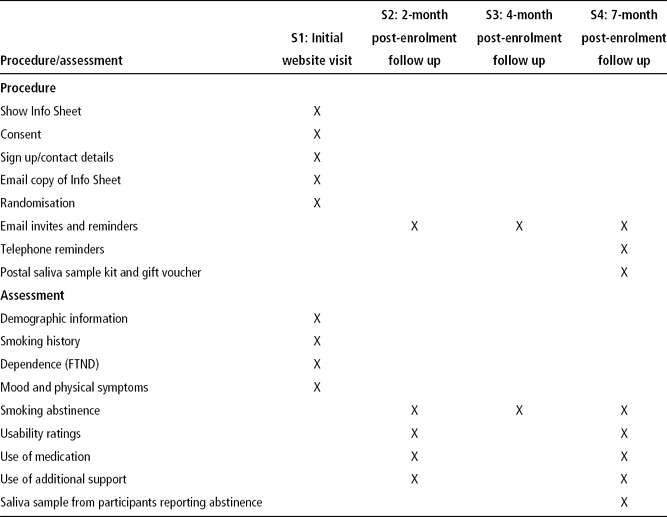
The timing of assessments and procedures are shown in Table 1. Participants are recruited via an advert that invites smokers to take part in a study comparing online support tools and includes a link to the study website. After navigating to the website, interested participants are asked to browse through the trial information pages. If they are eligible and click to indicate that they consent to taking part in the trial, they are asked to complete the baseline questionnaire. Otherwise they are asked to navigate away from the website. Consenting participants then complete the baseline questionnaire after which they are randomly allocated to either the intervention or control website. Both websites advise participants to set quit dates within one month of enrolment. Subsequent assessments take place at two, four and seven months after enrolment and allocation.
Study schedule/flow chart of procedures

Efficacy parameters
Primary
Russell Standard 6-months sustained abstinence (RS6), defined as self-report of not smoking more than five cigarettes in the previous six months and not smoking in the previous week, verified by a saliva cotinine level of <15ng/ml at seven months follow-up (West, Hajek, Stead, & Stapleton, Reference West, Hajek, Stead and Stapleton2005) or by a saliva anabasine level of <1ng/ml in those recording a saliva cotinine level >14ng/ml and who also report using nicotine replacement therapy [2]. The final follow-up at seven-months post-enrolment ensures that participants are at least six months post-quit; both control and intervention websites advise upon quit dates within one month of enrolment. Six months of abstinence is endorsed by both the Cochrane review group and NICE as a sufficient basis for estimating long-term abstinence. Inclusion is by intent to treat and participants whose smoking status cannot be determined are considered to be continuing smokers (West et al., Reference West, Hajek, Stead and Stapleton2005).
Secondary
The intervention and control groups are also being compared on a number of secondary measures including: 1) Point-prevalence abstinence, defined as a self-report of not smoking in the previous 7 days at 7 months follow-up, verified by saliva cotinine or anabasine; 2) self-report of abstinence in the previous 4 weeks at 2 months post-enrolment; 3) self-report of abstinence in the previous 3 months at 4 months post-enrolment; 4) self-report of a serious quit attempt in the previous 7 months at 7 months post-enrolment; 5) satisfaction ratings of the website (Strecher, Shiffman, & West, Reference Strecher, Shiffman and West2005) at 2 and 7 months post-enrolment; 6) quantitative indices of website interaction, such as number of log-ins and page views. By definition, those classified as successes according to RS6 will also be classified as successes according to the secondary outcome measures 1–3.
Measures
Baseline
Immediately after participants consent to take part in the study and provide contact details, the following variables are assessed: age, gender, ethnic group, National Statistics Socio-Economic Classification (NS-SEC), educational level, marital status, number of children, maternity status, Fagerström Test for Nicotine Dependence [44], the Mood and Physical Symptoms Scale to assess tobacco withdrawal symptoms [45], daily cigarette consumption, age at smoking initiation, time since last quit attempt, longest duration of quit attempt, self-efficacy and previous use of medication.
Outcomes to be measured at follow-up
All initial follow ups are collected via an online questionnaire to which participants are invited by email. At 7-months post-enrolment, participants failing to respond to email invitations and reminders are also followed up using all other available contact details. All follow-up invitations and contacts are structured according to evidence-based methods for maximising response rates (Edwards et al., Reference Edwards, Roberts, Clarke, DiGuiseppi, Pratap, Wentz and Kwan2002; Free et al., Reference Free, Knight, Robertson, Whittaker, Edwards, Zhou and Roberts2011).
At 2-months post-enrolment, the following measures are taken: self-report of any smoking in the previous 4 weeks, satisfaction ratings of the website (Strecher et al., Reference Strecher, Shiffman and West2005), use of medication (Balmford, Borland, Hammond, & Cummings, Reference Balmford, Borland, Hammond and Cummings2011) and use of additional support. At 4 months a self-report of any smoking in the previous 3 months is obtained. At 7 months, the same variables are assessed as at 2 months with the exception that the self-report of smoking behaviour covers the previous 6 months and specifically the previous week. Participants are also asked if a serious quit attempt was made since enrolment. Participants who report complete abstinence during the previous week at 7 month follow-up are asked to use a cotton dental roll to provide a saliva sample and post it back to a laboratory for analysis. They receive a £20 gift voucher to reimburse them for their time.
Sample size
The prime determinants in deciding the sample size for this trial was that alpha and beta (1-power) would be 5% for the projected effect, whilst also ensuring reasonable power to separately assess cessation in two socio-economic subgroups. A projected effect size of 3% difference between intervention and control conditions (i.e. 8% vs. 5%) was considered realistic and feasible within the Russell Standard framework. It is smaller than that observed with face-to-face behavioural support but is clinically meaningful and potentially cost-effective (West & Stapleton, Reference West and Stapleton2008). A total sample size of at least 4260 smokers (2130 per condition) is therefore required to detect an effect size as low as 3% on the primary outcome measure. In the event of there being evidence that the intervention effect is moderated by socio-economic disadvantage, the trial will have 80% power to separately detect 3% intervention effects in two sub-samples of at least 2130 each.
Recruitment
Recruitment began in December 2011 via adverts on the Department of Health's (DH) smoking cessation portal (‘Sign up now for online quitting help. Researchers at University College London are currently evaluating some new online stop smoking tools. Click here to find out more about their study and how you can get involved’.). The DH portal receives hundreds of thousands of hits per year. On the basis of the uncontrolled pilot study, in which 204 participants were included in the study within 4 days of placing the advert on the DH portal (Brown et al., Reference Brown, Michie, Geraghty, Miller, Yardley, Gardner and West2012), it was conservatively estimated that recruitment will be completed within 12 months. The recruitment rate, especially with regards to the numbers of socio-economically disadvantaged smokers, is being monitored carefully and if necessary, the rate will be boosted by also placing the advert on relevant employee mailing lists and social networks.
Likely rate of loss to follow-up
In smoking cessation trials, participants who resume smoking are frequently lost to follow-up and those lost to follow-up will have almost certainly continued, or returned, to smoking (Foulds et al., Reference Foulds, Stapleton, Hayward, Russell, Feyerabend, Fleming and Costello1993). As recommended by the Russell Standard, this potential bias will be addressed by using an intention to treat analysis, in which smokers lost to follow-up will be counted as continuing smokers. Of the studies included in a recent meta-analysis of internet-based smoking cessation interventions the rate of loss to follow-up varied substantially; the range was 6% to 61% at approximately 6 months following enrolment (Shahab & McEwen, Reference Shahab and McEwen2009). Since the present study uses evidence-based methods for enhancing response rates, it is assumed that the figure will be toward the lower end of this range and estimated to be no more than 20%. This estimate is supported by the 17% loss to follow-up obtained during a pilot study of the website (Brown et al., Reference Brown, Michie, Geraghty, Miller, Yardley, Gardner and West2012). Withdrawals or drop-outs will not be replaced.
Data analysis and management
Smoking cessation rates measured by the primary outcome in the intervention and control conditions will be compared using the Chi-square test. Given the large sample sizes, a continuity correction will not be included. To guard against potential bias due to chance imbalances in the distribution of predictive baseline characteristics, the two conditions will also be compared using a logistic regression model, adjusting for all baseline characteristics. The associated odds ratio and 95% confidence interval will be calculated. Comparisons on secondary outcome measures will be by Chi-square / logistic regression or analyses of variance depending on the scale of measurement.
All variables with the exception of cotinine and anabasine are collected online and entered automatically into a MySQL database. From this database, a user-specified Excel file will be downloaded, and subjected to basic processing and re-coding. Once the saliva samples have been analysed for cotinine and anabasine, the resultant datasets will be merged on the basis of participant IDs that will have been included on the postal saliva sample kits sent out to participants. On completion, data will be analysed blind to intervention allocation by the trial statistician using the PASW Statistics 18 package (SPSS Inc., Chicago).
Subgroup analyses
The study is expressly designed and powered to assess whether the efficacy of the intervention is moderated by socio-economic disadvantage. This assessment will be done by a logistic regression focusing on the interaction between condition and socio-economic disadvantage, adjusting for baseline characteristics. Socio-economic disadvantage is complex and indicated by a number of variables. For the primary measure, individuals will be classified into one of two groups – i) individuals who have never worked, are long term unemployed or are from Routine & Manual occupations according to the NS-SEC self-coded method and ii) other occupations. A secondary measure will also be assessed where smokers are classified according to whether or not they received post-age-16 educational qualifications. Moderation by other potentially important factors (e.g., baseline demographics, smoking characteristics, interaction with the programme, use of other support and medication during the trial) will also be assessed by statistical interactions.
Discussion
StopAdvisor has been developed to be attractive and effective across the social spectrum on the basis of PRIME theory, empirical evidence, web-design expertise and user-testing with disadvantaged smokers. In a pilot study, StopAdvisor demonstrated sufficiently promising efficacy and usability to warrant further evaluation (Brown et al., Reference Brown, Michie, Geraghty, Miller, Yardley, Gardner and West2012). This paper reported the protocol of a randomised controlled trial to evaluate the efficacy of StopAdvisor and determine whether it translates across the social spectrum.
Concerns about the proposed trial design might include the relative intensity of the two treatments and the resultant potential for greater attrition in the control condition. In that case, results might be biased by the use of an intention to treat analysis that assumes those lost to follow-up are smoking. However, trials of internet-based smoking cessations interventions have actually shown that control conditions involving less engagement do not typically result in lower follow-up rates (Shahab & McEwen, Reference Shahab and McEwen2009). Furthermore, the current trial will use evidence-based follow-up methods that resulted in similarly low attrition between two conditions in spite of a considerable difference in treatment intensity and engagement (Edwards et al., Reference Edwards, Roberts, Clarke, DiGuiseppi, Pratap, Wentz and Kwan2002; Free et al., Reference Free, Knight, Robertson, Whittaker, Edwards, Zhou and Roberts2011). A similar concern relates to the possibility that participants in the control condition would be more likely to seek other support. To militate against such differences, the use of additional support will be assessed at follow-up and the moderating effect of this support on efficacy will be analysed.
Descriptions of content in previous research have been insufficiently detailed to allow the field to progress quickly and understand the large heterogeneity of effect between different interventions (Crutzen, Reference Crutzen2011; Michie, Reference Michie2008; Strecher, Reference Strecher2008). By contrast, the current study is one of the first evaluations of an internet-based smoking cessation intervention that is committed to the public sharing of intervention content, which is underlined by the use of an open-source development platform and transparent reporting of the development process (Michie et al., Reference Michie, Brown, Geraghty, Miller, Yardley, Gardner and West2012).
StopAdvisor is a complex intervention that has been developed on the basis of evidence, theory, user and web design input and with the primary intention that the website should be maximally effective. As a consequence, the proposed trial of the first version of the website against a static brief advice control website is pragmatic. In the event that the website is effective, the trial will demonstrate that StopAdvisor is more effective in helping smokers to stop as compared with the types of websites that are typically used by smokers who are currently searching for online support in England (static websites with brief cessation advice). However, it will not identify which particular components of StopAdvisor were responsible for this effect. A future part of our programme of research is to identify the causal components in a series of fractionated factorial designs, which will allow the first version of StopAdvisor to be refined and optimised (Collins, Murphy, Nair, & Strecher, Reference Collins, Murphy, Nair and Strecher2005; Collins, Murphy, & Strecher, Reference Collins, Murphy and Strecher2007). A pragmatic RCT is a necessary first step in this process: the fact that the trial has been conducted with a detailed and transparent reporting of the development and content of the website allows future optimisation.
Acknowledgements
The StopAdvisor team, besides the authors, includes: Judy Joseph (collaborator on development of LifeGuide code for StopAdvisor); Matthew West (graphic designer); Claire Dowie (writing consultant for StopAdvisor); Antonia Shahab (interviewer for user-testing); and Daniel West (collaborator on debugging). We thank the communications team at the Department of Health for sharing useful materials and offering exceptional support particularly with recruitment, and ABS Labs for collaborating and agreeing to analyse the saliva samples for cotinine and anabasine at cost.
Financial support
The project is funded by a grant from the National Prevention Research Initiative (G0802035). The Funding Partners relevant to this award are (in alphabetical order): Alzheimer's Research Trust; Alzheimer's Society; Biotechnology and Biological Sciences Research Council; British Heart Foundation; Cancer Research UK; Chief Scientist Office, Scottish Government Health Directorate; Department of Health; Diabetes UK; Economic and Social Research Council; Engineering and Physical Sciences Research Council; Health & Social Care Research & Development Office for Northern Ireland; Medical Research Council; The Stroke Association; Welsh Assembly Government.
Conflict of interest
JB has received an unrestricted research grant from Pfizer. LS has received an honorarium for a talk and travel expenses from a pharmaceutical company that makes smoking cessation products to attend meetings and workshops. JAS formerly acted as adviser to the manufacturers of smoking cessation medications, for which he has received remunerations and hospitality, and conducted clinical trials with support from the manufacturers of smoking cessation medications. RW undertakes research and consultancy and receives fees for speaking from companies that develop and manufacture smoking cessation medications (Pfizer, J&J, McNeil, GSK, Nabi, Novartis and Sanofi-Aventis). He also has a share of a patent for a novel nicotine delivery device. SMichie, AG, SMiller, LY and BG have no conflicts.
Ethical standards
The authors assert that all procedures contributing to this work comply with the ethical standards of the relevant national and institutional committees on human experimentation and with the Helsinki Declaration of 1975, as revised in 2008.