Introduction
Health and sociocultural measures co-vary across populations. For example, social support and one’s social network influence multiple differential outcomes, including morbidity, fertility, cognitive decline and mortality among older adults living in different cultures and societies (e.g. Horman, Reference Horman1989; Johnson, Reference Johnson1996; Al-Kandari, Reference Al-Kandari2001a; Chou & Chi, Reference Chou and Chi2003; Okamoto & Tanaka, Reference Okamoto and Tanaka2004; Shin et al., Reference Shin, Kim, Park, Lee, Huh and Lee2008; Gadalla, Reference Gadalla2009; Muramatsu et al., Reference Muramatsu, Yin and Hedeker2010). When older participants – from cultures as diverse as the Pacific Islands, Asia, the USA and the Middle East – report larger and more active social networks, they also tend to self-report better well-being and greater health (Lu & Chang, Reference Lu and Chang1997; Shin et al., Reference Shin, Kim, Park, Lee, Huh and Lee2008; Gadalla, Reference Gadalla2009; Muramatsu et al., Reference Muramatsu, Yin and Hedeker2010; Lino et al., Reference Lino, Portela, Camacho, Atie and Lima2013; Al-Kandari & Crews, Reference Al-Kandari and Crews2014a, Reference Al-Kandari and Crewsb; Benmarhnia & Zunzunegui, Reference Benmarhnia and Zunzunegui2014; Wicke et al., Reference Wicke, Güthlin, Mergenthal, Gensichen, Löffler and Bickel2014; Al-Kandari & Crews, Reference Al-Kandari and Crews2016).
Family, especially close family, provides valuable support to older adults whose cognitive and physiological health declines with increasing age. Among samples of middle-aged women and men in the metropolitan areas of the United States, those who reported more frequent visits from, and greater direct contact with their children experienced more social interactions and better health than did their counterparts (Spitze & Logan, Reference Spitze and Logon1990). Similarly, those who were less often visited and had only infrequent contact with their children had significantly shorter life spans than did those who were visited more often. In Kuwait, the number of children residing with their elderly parents was significantly associated with better health and well-being of their parents – an effect attributed to their greater provision of social support, compared with non-resident children (Al-Kandari, Reference Al-Kandari2011).
Support from immediate family and other relatives moderates multiple aspects of health, including how status incongruity affects chronic disease, for example hypertension, among the elderly (Dressler, 1990). In summary, across populations, social support from friends and relatives promotes social and psychological well-being and overall life satisfaction, while reducing stressors on older adults, thereby improving their health and self-perceptions of health.
Middle Eastern societies, specifically in the Arabian Gulf countries such as Kuwait, differ from Western cultures in their patterns of social networking and support (El-Haddad, Reference El-Haddad2003; Al-Kandari, Reference Al-Kandari2008, Reference Al-Kandari2011; Barakat, Reference Barakat2013). In Kuwaiti and other Arabian Gulf societies, tradition provides social solidarity and internal cohesion within the family. All family members depend on all others following a well-defined social system based on families within society. Sociological and biodemographic research reports greater cultural value for social support in general within Arab society, particularly for the elderly in the Middle East, than in most Western settings. Kuwaitis support strong extended family structures with high fertility, male sex/gender preference, consanguineous marriage and respect for family elders as heads of the family (El-Haddad, Reference El-Haddad2003; Al-Kandari, Reference Al-Kandari2007, Reference Al-Kandari2010; Barakat, Reference Barakat2013). Each of these values strongly supports familial social support and networking, values that resonate across all aspects of family and social life, particularly those of older Kuwaitis. In Kuwait, social networks and relationships vary by sex/gender and age (Barakat, Reference Barakat2013). Following traditional kinship and family relationships, women have less social freedom than men do, and sons and daughters are dependent on and subordinate to family members who are older than themselves throughout their lives. These traditional modes of family relationships and social networking probably affect the health of all Kuwaitis.
Spousal support and health
Immediate family members (i.e. spouses, parents, children and grandchildren) tend to provide different types and amounts of support than do more distant relatives (i.e. aunts, uncles, cousins) and friends. Thus, the degree of kinship influences the quality of social and emotional support. Consequently, the quality of support probably is a more important determinant of social support than social network size. When the perceived quality of social support and perceived and actual support are distinguished, and when the amount of support is determined, the most important source of support for older adults is determined to be one’s spouse (Sarason et al., Reference Sarason, Sarason and Pierce1990). Spouses provide a range of practical, psychological and emotional support, most importantly companionship, providing information, aid in locomotion and health assistance. During one’s senescent phase of life, a spouse becomes the most reliable and constant source for multiple types of support. It has been well-documented that the loss of one’s spouse is among the most stressful events experienced in one’s lifetime (Carnelley et al., Reference Carnelley, Wortman, Bolger and Burke2006). Spousal loss is associated with higher self-reports of loneliness and increased stress (Nalungwe, Reference Nalungwe2009, p. 12). Bereavement itself is a significant risk factor for the death of the surviving spouse (Espinosa & Evans, Reference Espinosa and Evans2008). Loss of a spouse significantly reduces the survivor’s social networks (Haessler & Willis, Reference Haessler and Willis1990); this consequence has been labelled the ‘widowhood effect’ (Elwert & Christakis, Reference Elwert and Christakis2008).
A fairly consistent finding across cultural settings is that married men are in better health and live longer than do unmarried men, which provides strong confirmation of a model that spousal support aids men in maintaining their health with increasing age (Wyke & Ford, Reference Wyke and Ford1992; Barron et al., Reference Barron, Foxall, Von Dollen, Jones and Shull1994; Gliksman et al., Reference Gliksman, Lazarus, Wilson and Leeder1995; Crews & Li, Reference Crews and Li2011). A recent meta-analysis of marital status and health among those 65 years old and older showed that the relative risk of death for widows was 1.11 (1.08–1.14), and for those divorced or separated the risk was 1.16 (1.09–1.23), compared with those who were married (Manzoli et al., Reference Manzoli, Villari, M Pirone and Boccia2007). In general, older men and women with a spouse report fewer health-related somatic symptoms and self-rate their health (current and over the past year) as being better than do those without a spouse; they also have lower blood glucose levels and lower blood pressure, both systolic and diastolic (Tanno et al., 2013). Elders living with a spouse also report less stress and depression, and greater life satisfaction (Holt-Lunstad et al., Reference Holt-Lunstad, Wendy and Brandon2008). Multiple reports show the effect of positive spousal support on health and well-being among older persons across human populations (Wyke & Ford, Reference Wyke and Ford1992; Barron et al., Reference Barron, Foxall, Von Dollen, Jones and Shull1994; Gliksman et al., Reference Gliksman, Lazarus, Wilson and Leeder1995; Taqui et al., Reference Taqui, Itrat, Qidwai and Qadri2007; Ostwald, Reference Ostwald2009).
This study determined the association between self-perceptions of health and social support among Kuwaitis who were 60 years old and older, who either were or were not currently living with a spouse. Results from these analyses will verify the influence of one’s spouse on one’s self-perceived and physiological health among the oldest Kuwaitis. This research specifically examines how having a spouse associates with self-reports of social support (SS), frequency of contact (FOC) and strength of relationship (SOR) with family and friends, religiosity (REG), somatic symptoms, health status (current and in the last year), systolic (SBP) and diastolic blood pressure (DBP) and serum glucose levels.
To determine the influence of spouses on elderly Kuwaitis, a series of inter-related hypotheses were explored. The first hypothesis tested was that both Kuwaiti men and women living with a spouse will self-report significantly (p<0.05) greater SS and FOC with their family, relatives and friends. The second hypothesis was that both women and men living with a spouse will show significantly lower SBP, DBP and blood glucose/diabetes, while also self-reporting fewer somatic symptoms and better health currently and during the past year than will those living without a spouse. By assessing both perceptions and physiological components of health, this research reflects both emic and etic aspects of spousal support among older Kuwaitis and explores possible variations between self-reports and quantitatively assessed health. The last hypothesis was that living with a spouse influences social support and health, and spouses and social support independently and interactively influence the health of older Kuwaitis.
Methods
Quantitative methods were used to conduct this study. A single questionnaire was designed to elicit self-reports of social interactions, support and networks, along with health symptoms and self-reports of current health and somatic symptoms (questionnaire available from the first author). All of the interviews were conducted in Arabic. Translations from existing English surveys to Arabic were completed by the first author. In addition, blood pressure, glucose and anthropometric measurements were obtained from each participant. This study is part of a larger project supported by Kuwait University and approved by the University under IRB Number OS03/04.
Sample
Of 1571 older adults aged 60 years and older receiving health care from the government-sponsored elderly mobile unit services, 1427 participated in this research (472 men and 955 women). Out of the original 1571 individuals, 144 were excluded because they were not available when the mobile care unit arrived to obtain data, leaving 1427 respondents. The average age of the sample was 77.12 years (SD=9.41). These 1427 respondents represented all six mobile care units covering the six governorates served by the Ministry of Social Affairs in Kuwait. All participants in this study were receiving monthly general health and social services follow-up (e.g. measurements of SBP/DBP, blood glucose, pulse rate, estimates of social needs and additional services as needed) due to government-established need. The study was limited to those 60 years old and older receiving health care from these mobile units. Rarely were both spouses from a household included in the sample; only the person receiving care from a mobile unit was included. Therefore, the sample does not represent all persons 60 years old and older in Kuwait. Residents of different governorates represent different sociocultural backgrounds and economic situations.
Nurses working in the Social Affairs Ministry obtained all data during a regular monthly visit to each participant’s home. After reviewing study protocols, they obtained informed consent and signatures on required permissions. Social Affairs nurses completed all interviews in the participant’s home. They recorded the respondent’s self-reports on the sociocultural and health interviews and made blood pressure, glucose and anthropometric measurements. All interviews were conducted in the evening, before the usual dinner hour. In most cases, elderly respondents were able to participate completely in research interviews and had known the interviewer over multiple years. Before nurses visited the respondents’ homes for interviews, they were trained in all study protocols by the first author. As nurses, they were already well-trained and competent in measuring blood pressure, blood glucose, pulse rate and general physical characteristics for clinical purposes. As part of this research, they were trained in techniques for obtaining sociocultural data. All of the study respondents participated in the interviews. However, each respondent was assisted, as needed, by their closest relative currently at home, who was commonly a spouse, but often another relative who was familiar with the respondent’s health, social and cultural status. The participants always independently confirmed all responses. To best promote the validity of the responses, the interviewers elicited the answers directly from each respondent, while any assisting person only aided the respondent by clarifying questions and responses.
Sociocultural and biodemographic data
Each participant self-reported their age, education, family income, number of living children, number of children living in their household and whether their husband/wife was living. They also responded to a series of widely validated social scales comprising a sociocultural questionnaire.
Religiosity (REG)
Degree of religiosity was determined using a one-item scale: ‘What is your level of religiosity in general?’ Participants reported their religiosity on an 11-point scale by circling a number from 0, not religious, to 10, very religious. This self-report scale shows temporal stability, and both concurrent and factorial validity in other samples (Abdel-Khalek, Reference Abdel-Khalek2007, pp. 213–214), with a one-week test–retest correlation of 0.91.
Social Support Scale (SSS)
The questionnaire included a Social Support Scale (SSS) developed by Zimet et al. (Reference Zimet, Dahlem, Zimet and Farley1988) and previously used to assess elderly people’s social support in both Kuwait and elsewhere (Al-Kandari, Reference Al-Kandari2001a, Reference Al-Kandarib; Al-Mutiri, Reference Al-Mutairi2000). Minor modifications were made to the scale to better fit the experiences of elderly Kuwaitis. Included in the SSS are twelve sentences with 6-point Likert-type scale responses, ranging from strongly agree (6) to strongly disagree (1). The SSS includes questions such as the following: ‘There is a special person who is around when she/he is in need’; ‘There is a special person with whom she/he can share joys and sorrows’; ‘Her/his family really tries to help her/him’; ‘She/he gets emotional help and support she/he needs from her/his family’; ‘Her/his friends really try to help her/him’; and ‘She/he has a special person who is a real source of comfort to her/him’. This scale shows high overall internal consistency with an alpha coefficient of 0.87 (Al-Kandari, Reference Al-Kandari2001a, Reference Al-Kandarib).
Frequency of Contact scale (FOC)
All respondents self-reported their frequency of contact with members of their social network in daily life. The social networks of respondents included children, brothers, sisters and cousins from both the father’s and mother’s siblings, along with any other relatives or friends with whom the participants had recent contact. There was a separate score for each category of relatives and friends. The FOC survey question asked the following: ‘How often do you have contact with your children, cousins, brothers, sisters, cousins from you father’s siblings, cousins from your mother’s siblings, other relatives, and friends?’ This question, regarding each of the potential contact persons, was answered on a 5-point Likert scale ranging from always (Reference Al-Kandari5) to never (Reference Abdel-Kalek1). As with all scales included in the questionnaire, the FOC scale had high internal consistency with an overall alpha coefficient of 0.84, and content validity (Al-Kandari, Reference Al-Kandari2011).
Strength of Relation scale (SOR)
Respondents also reported how strong they felt their social networks and relationships were in their daily lives. The SOR scale included the same relatives and friends as did the FOC scale. The SOR measures the respondent’s perceived social support. It asks, ‘What is the strength of your relationship with your children, cousins, brothers, sister’s cousins from father’s siblings, cousins from mother’s siblings, other relatives, and friends?’ This question, regarding each of the potential contact persons, was answered on a 5-point scale ranging from very strong (Reference Al-Kandari5) to poor (Reference Abdel-Kalek1). The SOR scale also exhibited high internal consistency with an overall alpha coefficient of 0.85, and illustrates content validity (Al-Kandari, Reference Al-Kandari2011).
Health assessments
Blood pressure
Systolic (SBP) and diastolic blood pressure (DBP) were measured for all respondents. All measurements were made by nurse interviewers using an aneroid sphygmomanometer (desk model). Systolic pressure was recorded as the first Korotkoff or the onset of sound. Diastolic pressure was recorded as the fifth Korotkoff phase or complete disappearance of sound. Blood pressure was measured three times during the home visit, at the beginning, middle and end. The first measurement occurred after about ten minutes of conversing with the respondent explaining the purpose and methods of the research, signing the informed consent forms and relaxing with the participant while talking about daily life. The second blood pressure measurement was completed following completion of the sociocultural questionnaire portion of the interview. The final measurement was taken after completing all interviews, responding to any questions and just before leaving the home. The average of all three blood pressure readings was used for all analyses. During the blood pressure measurements, participants were seated (if able) or lying down, with their left arm supported at heart level.
Blood glucose
A small sample of blood to assess glucose was obtained from each respondent following the final blood pressure measurement. Almost all home visits occurred in the evening before the dinner hour. Thus, assessed blood glucose concentrations were normal non-fasting.
Self-reported health
In addition to physiological assessments and sociocultural questions, all respondents self-reported on aspects of their current and past health and current symptomology:
(1) Two one-item self-report health scales. Two health self-report rating scales were scored on an 11-point scale with 0 equalling poor and 10 excellent. One question requested an assessment of current health relative to their same-age cohorts; the second asked the same question, but requested the respondents to compare their current health with their health one year earlier. A two-week test–retest reliability assessment of these self-rating scales achieved an alpha coefficient of 0.89 for current health and a coefficient of 0.92 for health over the past year (Al-Kandari, Reference Al-Kandari2011).
(2) Somatic Symptoms Inventory (SSI). As spousal support, assessed by the presence or absence of one’s spouse in the household, is the main independent variable being investigated, self-reported somatic symptoms were among the main dependent variables of interest. The SSI was developed by Abdel-Kalek (Reference Abdel-Kalek2003b) to inventory the health of Arab respondents in Kuwait. He included physical/organic symptoms representing 60 categories, all scored on a 4-point Likert-type scale (0=none, 1=some, 2=much, 3=always). The SSI had high internal consistency (alpha coefficient of 0.92) within the current sample and has been reported in a different sample of Kuwaiti elders (Abdel-Kalek, Reference Abdel-Kalek2003a, Reference Abdel-Kalek2004).
Statistical analysis
Data entry and analysis were done using SPSS version 21. To test the hypothesis that spouses significantly influence the social and physical health of elderly Kuwaitis, differences between those with and without a spouse in social support (i.e. SSS, FOC, SOR, REG) and health assessments (i.e. SBP, DBP, glycaemia, SSI, self-rated current health, health over the past year) were compared for statistical significance differences between those living with or not living with a spouse, using t-tests. Further, joint and independent associations of having a spouse, total reported social support, FOC, SOR, REG, age and sex with assessed health (SSI) were tested using multivariate regression with an interaction term to estimate the joint effect of spouse and social support. A p-value of 0.05 was accepted as indicating a statistically significant association.
Results
Spouses and social support
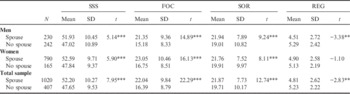
The SSS, FOC, SOR and religiosity scales were compared for participants with and without a spouse by sex (Table 1). Among all participants, those living with their spouse reported significantly greater social support, more frequent contact and greater strength of their social relationships with relatives, friends and other contacts than those living without a spouse. Conversely, those without a spouse self-reported having greater religiosity than those with a spouse. When men and women were assessed individually, no significant trend was observed towards religiosity from having spouse.
Level of social support among Kuwaiti citizens aged 65–89 years with and without spouse living with them by sex

SSS, Social Support Scale; FOC, Frequency of Contact; SOR, Strength of Relation; REG, religiosity.
*p<0.05; **p<0.01; ***p<0.001.
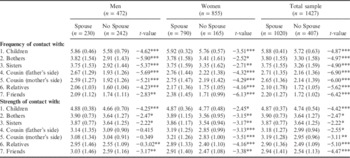
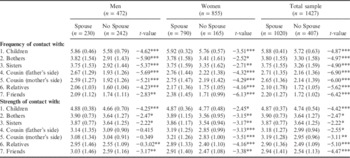
Table 2 compares men and women for their frequency and strength of social contacts in their daily social life by the presence or absence of a spouse living with them. The results were generally the same for women and men, although no significant difference between those living with or without spouse was observed in SOR with cousins from either their father’s or mother’s siblings.
Frequency and strength of social contact in daily life (mean (SD)) of Kuwaiti men (N=472) and women (N=955) aged 60–89 years with and without spouse living with them
*p<0.05; **p<0.01; ***p<0.001.
Spouses, social support and health
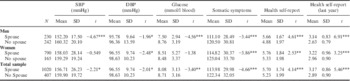
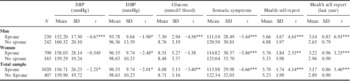
Significant differences between those with and without a spouse were observed for all physically assessed (SBP, DBP, glycaemia) and self-reported (somatic symptoms, current health and health in the past year) aspects of health (Table 3). Those living with a spouse showed lower SBP, DBP, glycaemia and self-reported fewer somatic symptoms. Additionally, they self-reported better current health and health in the past year than did those living without a spouse. Similarly, significant results were observed for men alone across all health measures. However, among women, having a husband was not significantly associated with either SBP or glycaemia. Overall, having a spouse was positively associated with better health in this sample of older Kuwaitis.
Measured and self-reported health of Kuwaiti citizens aged 65–89 years with and without spouse living with them by sex
SBP, systolic blood pressure; DBP, diastolic blood pressure
*p<0.05; **p<0.01; ***p<0.001.
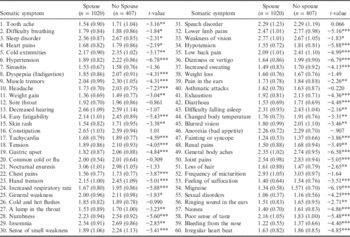
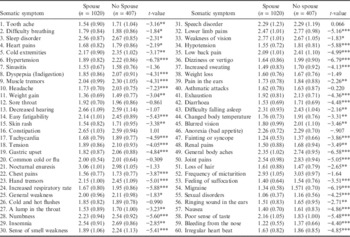
Of the 60 items included in the SSI, participants with a spouse reported fewer poor health symptoms than those without a spouse (Table 4). Of the 60 items, 48 (80%) differed significantly (p≤0.05); of these, 29 differed at the p≤0.001 level between those with and without a spouse.
Self-reported somatic symptoms of Kuwaiti citizens (N=1427) aged 60–89 with and without spouse living with them by sex
*p<0.05; **p<0.01; ***p<0.001.
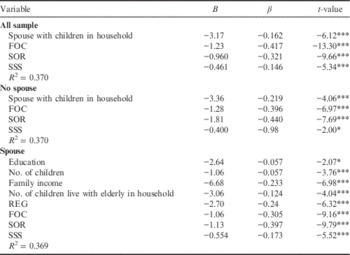
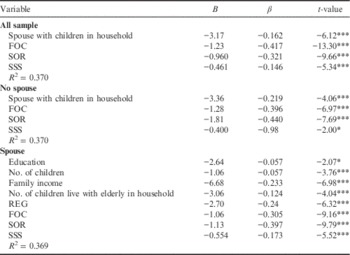
As a final step in these analyses, multivariate regression was used to explore the joint effects of SSS, FOR, SOR, children living with the participant, number of children and religiosity on somatic symptoms in the full sample and between those living with and without a spouse (Table 5). The number of children living in the same household, along with greater FOC, SOR and social support, significantly and independently predicted somatic symptoms in the total sample and in each sex, separately. Additionally, social support, education, family income and religiosity were significantly and independently related to somatic symptoms among those with a living spouse compared with those without a spouse.
Multivariate analysis of the joint effects of social support factors on somatic symptoms inventory (SSI) for Kuwaiti citizens (N=1427) aged 60–89 with and without spouse living with them
*p<0.05; **p<0.01; ***p<0.001.
Discussion
These results lead to the conclusion that having a spouse is a significant benefit to many aspects of older Kuwaitis’ daily lives, including their health, well-being and, importantly, their social support and network size. Conversely, lack of a spouse promotes greater social isolation in daily life. Respondents with a spouse reported experiencing more frequent social support along with greater frequency of contact and stronger relationships within their social networks. Andersson and Sundstrom (Reference Andersson and Sundstrom1996) reported that elderly people living without spouses have less social support. Also, at that late stage in life, most couples share social activities. Thus, death of either spouse will probably lead to loss of social activities along with less social support in other areas of daily life.
Elderly Kuwaitis living without a spouse reported greater religiosity. Religion may be called upon as a source of comfort following the loss of a spouse. Religiosity probably buffers multiple stressors, as it is linked to psychological states and emotions among people seeking ways to limit their emotional suffering (McCabe, Reference McCabe2010). Perhaps, as Ghufran and Ansari (Reference Ghufran and Ansari2008) suggested, older adults whose spouses are living ‘… may also be conscious about their death, but since they have not faced the death of their spouses, the fear is not so evident. Hence, [older] people who still have not experienced the death of their spouses are not found to take shelter in religiosity’ (p. 179). This result was observed among the Kuwaiti men in this sample who did not have a spouse as they showed greater religiosity. A similar association was not observed among the Kuwaiti women in the sample, possibly reflecting traditionally higher religiosity among women in Kuwait, who tend to be more conservative. Thus, loss of their spouse may not lead to changes in women’s already high religiosity.
In Kuwait, and this older age sample in particular, most men and women without a spouse have usually lost their spouse through death. Spousal loss decreases the social network of, and support for, the surviving spouse, thereby promoting somatic symptoms and illness among older adults, a process described as the ‘bereavement of widowhood’. Repercussions from loss of one’s major caretaker include reduced social contacts leading to increased isolation.
High blood pressure and blood glucose can be major health problems at all ages, and they increase with age. Participants 55–89 years old residing with a spouse showed significantly lower systolic and diastolic blood pressure and blood glucose levels than did those without a spouse (Table 3). This association was observed among both men and women, except for diastolic blood pressure among the latter. Lack of a spouse may be more stressful on elderly Kuwaiti men than on women. This may be because elderly Kuwaiti men are more dependent on their wives in their daily life. A possible general truism across Arab and Middle Eastern cultures is that a man’s wife takes care of his major needs and is his closest social support and main caregiver in later life. Loss of a spouse may particularly affect men at older ages because they also lose their co-workers when they retire, along with relatives and other friends when these contacts retire or die. This also may partly explain the general observation that men tend to die shortly after their wife does; it may also explain why widows tend to live longer than widowers (Hemstrom, Reference Hemstrom1996; Mineau et al., Reference Mineau, Smith and Bean2002; Kolip, Reference Kolip2005). In traditional Kuwaiti culture, as in other Arabian Gulf countries, women are generally more responsible for their husbands’ care, needs and the household than are men for their wives’ care and needs. A wife is responsible for preparing her husband’s food, cleaning and arranging his clothes, and attending to his hygiene and general care. Given her traditional activities within the household in support of her husband, the death of one’s wife dramatically alters the surviving widower’s life. In the absence of this vital social support, spouses may experience social stress that may promote increased blood pressure and somatic symptoms (see Leahy & Crews, Reference Leahy and Crews2012).
Having a spouse is associated with fewer self-reported somatic symptoms and better self-reports of current and recent health. Across a range of 60 somatic symptoms, participants living with a spouse reported significantly fewer frequencies of 48 symptoms; 26 of these differences were significant at p≤0.001 (Table 4). Losing a spouse is an immediate risk to health, and to life, as emotional stress increases physiological arousal by altering hormonal balance (Wittstein et al., Reference Wittstein, Thiemann, Lima, Baughman, Schulman and Gerstenblith2005), increasing one’s allostatic load, particularly at older ages (Leahy & Crews, Reference Leahy and Crews2012). In general, loss of spousal care and sociality may increase the risk of illness (see Iwashyna & Christakis, Reference Iwashyna and Christakis2003), while related bereavement and stress promote declining nutrition (Rosenbloom & Whittington, Reference Rosenbloom and Whittington1993), thereby increasing allostatic load on the survivor.
Across Arabian Gulf populations, the oldest adults, particularly men, are accorded the greatest respect by their more youthful relatives and countrymen throughout society (Audah, Reference Audah1986). In Kuwait, support for older persons in their social lives is provided by society, along with kin, family and friends. Although all are important sources of social support, across social settings one’s husband or wife is the most important source of support for most people in later life. The data reported here document how important spouses are for social support and the continuing health of older Kuwaitis, whether men or women. Different types or elements of social support (e.g. emotional, companionship, informative) probably influence health at older ages; however, data on these sub-categories are not available. The current data show that social support is an important and major dynamic in the health and well-being of elders. Receiving high-quality psychological and emotional support comes not only from one’s spouse, but also from close relatives and friends. Still, a major element for the good health of older people in later life is their spouse.
Older adults with highly supportive friends, relatives and spouses have fewer health issues compared with others who report less support (Al-Kandari, Reference Al-Kandari2001a, Reference Al-Kandarib; Reference Al-Kandari2011; 2012; Al-Kandari & Crews, Reference Al-Kandari and Crews2014a, Reference Al-Kandari and Crewsb, Reference Al-Kandari and Crews2016). This study shows that a spouse provides high-quality social support in later life for Kuwaiti elders. The closest person to any elderly person is his/her spouse. Spouses share sensitive issues, emotions and their private lives. This may be especially true for health-related issues. Thus a spouse can provide support that rarely comes from others. This research shows that spousal social support is a major buffer from stressors and physiological dysregulation in health among older Kuwaitis, as it is among other populations (see Cohen & Wills, Reference Cohen and Wills1985).
These results show that losing a spouse is a critical time in an older person’s life in Kuwait, as it is in other countries. The analyses also support a suggestion that the social welfare system may need to improve its services for isolated elders without a spouse or any extended family support. Mobile health units in Kuwait are provided to elders to aid in maintaining their health and providing social support in general. Additionally, social welfare institutions throughout Kuwait are making multiple efforts to achieve their goal of providing proper care for all Kuwaitis. However, these mobile care units are not focused on critical social support issues of the elderly subsequent to a spouse’s death. Programmes are directed towards improving services for the elderly who need these mobile units, especially when they are facing a critical change in their life, such as their spouse’s death.
Institutions could be established within Kuwait to serve older citizens across critical aspects of their lives by concentrating specifically on issues important to maintaining social contacts and interactions that may improve their health. As a wealthy nation, establishing such institutions should not present a major financial problem for Kuwait. The government can easily offer sufficient funding to provide high-quality technical, logistical, medical and social support to the ageing population. Institutional structures could design programmes and practices to aid older Kuwaitis in maintaining an active social life and regular activities. Kuwait is able to provide its elderly population with the help they need to be physically active, exercise regularly and maintain healthy lifestyles. Physical activities and exercise aid the elderly in being and staying healthy. The social system can aid isolated elders in the proper use of medication and dietary essentials, especially following the loss of their partner, to prevent their health from deteriorating. Various institutions also may provide the elderly with opportunities for social participation and engagement in general social life. Such institutions could easily be founded in each of the six governorates in Kuwait and provide an alternative source of care and services for the older population in Kuwait.
There are limitations to the data examined in this paper. It is a cross-sectional relational study of how living with or without a spouse and social support is associated with health outcomes. Included in the sample are a range of elders 60 years old and older, living in all regions of Kuwait. However, the sample does not represent all of the elderly citizens in Kuwait, but only those in need of, or at least receiving, services from mobile health units. When age is statistically controlled, a significant positive relationship is observed between social support and elderly health; but still, additional research is necessary to confirm these results. For example, neither data on duration of marriage, nor on the amount of time that had passed since the death of the spouse, were included in the dataset. Furthermore, assessments of older people’s health at younger ages were also not available. Consideration of these additional issues and variables in future research may provide a clear assessment of the significant role spouses play in the health of their ageing partners.
Acknowledgment
This paper was funded by Department of Research, Kuwait University. The authors would like to thank Kuwait University for their support.