In one of his later reflections on opposition, Arthur Onslow, Speaker of the House of Commons under George II, recalled how the uncovering of the Atterbury Plot in 1722 had worked to fix ‘Mr Walpole's interest and power’. The seriousness of the conspiracy, which would have seen local Jacobite risings co-ordinated with the landing of invasion forces in Scotland and south-west England, has been disputed by some historians.Footnote 1 Walpole, Onslow said, nonetheless pursued the plot with ‘great skill and clearness’, using it as the pretext to levy a tax of £100,000 on the estates of Catholics, though ‘but very few of them were engaged’ in the conspiracy. The tax in turn led to a proposal that Protestants should also be obliged to swear loyalty to George I in order to identify all non-subscribers and force them to register their estates. The result was that ‘the whole nation almost, men, women, and children’ flocked to the ‘places where the Quarter Sessions were’ to take the oaths of allegiance, supremacy, and abjuration. Onslow witnessed the oath-taking at first-hand and it was, he said, ‘a strange as well as ridiculous sight to see people crowding to give a testimony of their allegiance to a Government, and cursing it at the same time for giving them the trouble of so doing, and for the fright they were put into by it’. Onslow viewed the whole exercise as counter-productive, making the king's government ‘appear tyrannical and suspicious’. The experience led him to reflect ‘what little use to a Government the imposition of oaths to it has ever been’.Footnote 2
Onslow was not alone among contemporaries in seeing the imposition of oaths in 1723 as, at best, an exercise in futility, and, at worst, an operation which diminished the reputation of George I's government.Footnote 3 Historians have generally followed these hostile contemporary reports in their assessments of the exercise. In his Whigs and hunters: the origin of the Black Act, E. P. Thompson echoed Onslow in regarding Walpole as opportunistically exploiting the fears provoked by the Atterbury Plot further to secure his grip on power. For Thompson, the act which governed the administration of the 1723 oaths was part of the same suite of repressive Hanoverian legislation as the infamous Waltham ‘Black Act’ of the same year.Footnote 4 Paul Langford viewed this episode instead as the last gasp of what he described as ‘the farce of state oaths’. For Langford, the ‘pernicious’ practice of mass public oath-taking was finally rendered ‘ridiculous’ through what for Walpole's administration would be a ‘chastening’ exercise in canvassing public loyalty.Footnote 5 A more positive perspective on the 1723 oaths has recently been offered by Mark Knights, who has argued that ‘the subscriptions were testimony of an inclusive, consensual, society but one in which the representation of loyalty was as important as popular participation’.Footnote 6 Knights's comments are supported by Hannah Smith's work on the Georgian monarchy which has stressed the importance placed by communities on drafting and presenting loyal addresses to the crown, as in the wake of the Atterbury Plot in 1722.Footnote 7
Although there is now a significant amount of scholarship dealing with oath-taking in both early modern England and Europe, with the exception of the pioneering work of Simon Dixon on Devon, the oaths imposed in 1723 have attracted relatively little attention from historians.Footnote 8 This article seeks to extend that research by exploring the political ramifications of the oaths, in particular as they related to women. It will endorse Knights's argument that the need to demonstrate public loyalty to the Hanoverian dynasty was a key motivation for imposing the oaths. However, it will also suggest that the role of these oaths in legitimating the Protestant succession was combined with the aim of pressurizing political opponents and stifling dissent. The discriminatory aspects of the 1723 oaths were a consequence of their development from earlier anti-Jacobite and anti-Catholic measures, measures, importantly, which had targeted women as well as men. The political aims of the Oaths Act were, though, combined with financial goals which demonstrated the connections between the Oaths Act and the legislation it had sprung from, the Catholic Taxation Act. All of these objectives were brought together in the most striking feature of the 1723 oath returns – the very high number of women subscribers present on the records. While women had appeared on oath returns before, the scale and consistency with which they featured in 1723 was unprecedented. It will be argued that the frequent presence of women on these oath returns was not accidental. Rather, the conscious decision to tender the oaths to women as well as men was driven not only by financial concerns, the desire to harvest money from both male and female property holders, but also by a desire simultaneously to monitor and represent feminine loyalty to the Hanoverian dynasty. This was itself prompted by the contentious history of women's involvement in politics in the early years of the eighteenth century. The 1723 oaths also indicate broader shifts in the representation and organization of popular loyalty in the early modern period. This exercise in surveying women's loyalties through the imposition of oaths would not be repeated. As Langford argued, the 1723 oaths represented the last instance of state-directed mass political oath-taking in England. However, this article contends that the ‘death’ of the ‘state oath’ was not a result of the ineffectiveness of this exercise. Indeed, in the short term, the 1723 oaths arguably achieved their political and financial goals. Instead, mass oath-taking ended as a result of the changing role of the state oath itself and the emergence of alternative means of representing public loyalty, namely the loyal or humble address.
I
By the early eighteenth century, the practice of tendering oaths of loyalty to the nation was a well-established political practice. Beginning with the oath of supremacy of 1534 as a means of testing public support for Henry VIII's break from Rome, mass oath-taking really came to the fore during the English Civil Wars. Intended to facilitate military, political, and economic mobilization for the parliamentarian cause in particular, oaths and solemn tests such as the Protestation of 1641/2 and the Vow and Covenant and Solemn League and Covenant of 1643, required people in parishes across England to agree to sometimes deeply contentious religious or political positions. (The Vow and Covenant of 1643, for example, broke with tradition in containing no promise to protect the king's person or estate.)Footnote 9 Renewed in the wake of the revolution of 1688/9, oath-taking became a means of legitimating the change in the royal succession. The largest of these post-revolutionary exercises in canvassing public loyalty, the Association of 1696, was imposed in the aftermath of a Jacobite plot.Footnote 10 Similar circumstances led to the tendering of oaths of loyalty to George I in the latter half of 1723. On 27 May 1723, the same day that the king gave his assent to the bills of pains and penalties for punishing Francis Atterbury and the other Jacobite plotters, the Catholic Taxation Bill and the 1723 Oaths Act were approved. The former statute imposed a tax of £100,000 upon English Catholics with a flat sum determined for each county to raise and with those liable defined as any who refused the oaths of allegiance, supremacy, and abjuration.Footnote 11 The measure provoked significant opposition in parliament from both tories and whigs. Onslow, then whig MP for Guildford, voiced his opposition to the tax for persecuting individuals on the basis of conscience.Footnote 12 Thomas Lutwyche, tory MP for Callington, Cornwall, alluding to the lack of Catholic involvement in the conspiracy, spoke against the bill as making ‘one man suffer for the crime of another’.Footnote 13 Eveline Cruickshanks has argued that the strength of opposition to the measure explains why the government delayed re-introducing the bill, first discussed in November 1722, until May 1723, hoping that it would have an easier passage now that many MPs had returned to their constituencies.Footnote 14 The Oaths Act emerged only as a by-product of the debate on the Catholic Taxation Bill. As Onslow later noted, it seemed to have been created as a result of Lutwyche's argument that, in fairness to loyal Catholics, the oaths should be tendered to Protestants as well, so that all non-jurors should share the burden of this levy.Footnote 15 The most contentious aspect of this suggestion seems to have been whether the measure should apply to Scotland as well as to England. The proposal may have been deliberately provocative. Contemporary press reports implied that the suggested amendment was part of an unsuccessful attempt to ‘clog’ the Catholic Taxation Bill and prevent it from becoming law.Footnote 16
Ultimately, the separate Oaths Act which received the royal assent would cover both kingdoms. Although this article focuses on subscription in England, there is surviving evidence relating to the imposition of the oaths in Scotland and, indeed, North America as well.Footnote 17 The Oaths Act required both men and women over the age of eighteen to take the oaths of allegiance, supremacy, and abjuration before 25 December 1723 or register their names and property in court. Failure either to subscribe or to register would result in the forfeiture of an individual's estate. So, although the act notionally required all men and women to swear who had not previously done so, the punitive aspects of the law suggested that it was targeted at property holders.Footnote 18 That it was broadly interpreted in this way by local officials is also indicated by quarter sessions instructions published in the press and by the numbers of individuals subscribing to these oaths (discussed below).Footnote 19 The act was enforced not only through the subscription process but also by incentivizing informing on those who failed to register: informers would receive one third of any estate sequestered with the remaining two-thirds going to the crown. Even for those who subscribed, the legislation came with a price attached: subscribing to the oath was charged at 3d with an additional shilling charged for issuing a certificate confirming that an individual had sworn.Footnote 20
The substance of the Oaths Act was not particularly novel: the texts of the oaths had been taken from earlier legislation and, as the research of Rachel Weil has shown, the use of informers was a feature of a number of post-1688 laws against Catholics and ‘disaffected’ persons.Footnote 21 Unlike these measures, though, the oaths legislation required the general public to prove their loyalty, not just those suspected of being papists or ‘disaffected persons’. The 1723 oaths were subscribed at special Midsummer and Michaelmas sessions of the peace and the records of subscription can generally still be found in surviving local quarter sessions records.Footnote 22 The returns for 1723 are not on the same scale as those for the Association of 1696 in defence of William III. (There is nothing to compare with the reputed 70,000 names on the Suffolk Association roll.)Footnote 23 Nonetheless, returns for several counties stretch into the tens of thousands, with the largest identified so far being those for Devon and Exeter which contain close to 27,000 names. As they were organized as special sessions of the peace, often held at inns or even private residences around the county, individuals sometimes needed to make fairly lengthy journeys to subscribe, a fact noted in contemporary accounts which referred to people trudging ‘fifteen to twenty miles’ to swear.Footnote 24 As a result, in order to identify individuals clearly, some returns (such as those for the City of London and Cheshire) feature not only details concerning the subscriber's place of residence, but also their occupation and marital or social status.Footnote 25 The most striking aspect of the 1723 returns is the frequent presence on rolls of large numbers of women subscribers, accounting for 44 per cent of names on the return for the city of York for example.Footnote 26 Both features of these returns – the high numbers of women signing and the extraordinary level of detail about subscribers on some rolls – are, it will be suggested, a product of the combined financial and political aspects of the Oaths Act.
II
The revenue-raising potential of the oaths legislation was noted in the press. On 16 November 1723, the Weekly Journal or Saturday's Post carried a report of an
ingenious Cobler, a great Politician, [who] has made a remark, that the Papists have no Cause to complain of the Tax of 100000L, rais'd upon them for their refusing to take the Oaths, since more than twice that Sum will be levied upon Protestants, for taking the same Oaths, which he makes out by this Calculation, that allowing, that four Million of Persons in the whole Kingdom have taken them, the Sum of 15 Pence which every one is obliged to pay for the Oath and Certificate, amounts to two hundred and 50 thousand Pounds Sterling which, tis hoped, will be applied towards paying the Debts of the Nation.Footnote 27
The figure of four million was, from the evidence of surviving returns, a gross exaggeration. A very rough estimate of between 200,000 and 250,000 total subscribers in England, though, appears reasonable.Footnote 28 It is difficult to calculate what the revenue from this exercise would have been, as we cannot tell how many individuals paid 3d as compared to 15d for swearing and having a certificate produced. In contrast to the records of payment for the £100,000 levy on papists’ estates, which do survive, similar records for the Oaths Act have yet to be located.Footnote 29 One possibility is simply that payments were meant to ensure that the costs of this extensive administrative exercise were covered. We can see, however, that in some areas, a great deal of work was put into recording both subscription and payment. The City of London returns indicated by the name of the individual whether they had paid (marking either 3d or 1[s]:3[d] for those who had also paid for a certificate). To aid identifying subscribers, the return for each session was accompanied by a tabbed index. Those who had not subscribed were listed with the initials ‘N. S.’ beside their names. Later sessions, from 17 December 1723 onwards, had an alphabetically organized list of ‘queries’ with many of the names within crossed out, presumably when the query had been resolved, indicating that non-subscription was carefully followed up.Footnote 30
The London returns give the impression of a city administration which had a very good idea of who should subscribe, who had or had not done so, and who had paid what amount. The receipts of payments for subscription also survive for the city and these reveal not only that fairly substantial sums of money were being raised through the process of swearing (the receipts include tallies ranging from just over £30 to £38 for each list) but also that the individuals listed here chose predominately to pay the higher fee both to swear and receive a certificate. The largest of these lists, for 23 December 1723, includes over 1,000 names.Footnote 31 Given that the word of an informer could potentially lead to the forfeiture of an entire estate, there was obviously a clear incentive for property holders to acquire written evidence of subscription. Although no other returns have been identified with the same level of detail concerning payment, the considerable amount of information on other rolls or the numbering of subscribers, as on the Westminster returns, suggests a significant effort was being made to determine who had subscribed and what payment each subscriber had made.Footnote 32 The importance of acquiring a certificate for property holders is also testified to by the survival of these certificates in local archives amongst records relating to property transactions.Footnote 33
We cannot say definitively whether the Oaths Act was primarily intended as a form of taxation by other means without a firm sense of what the total income from subscription was. It is clear, however, that subscription to these oaths could be turned to political as well as financial advantage by the Hanoverian regime. The fine detail in some returns about individual subscribers’ status, occupation, and residence, coupled with the reliance of the act on informers for enforcement, all pointed to a statute that was designed to survey the political loyalties of George I's subjects very closely. This level of scrutiny is evident too in the contemporaneous local records made of papists and their estates, with even the names of ‘reputed’ Catholics holding little or no real or personal property being recorded.Footnote 34 Some assessors such as Bennett Metcalf of Cheap ward, London, also worked as assessors of the Land Tax, facilitating the identification of wealthy Catholics (the Land Tax was levied at a double rate on papists’ estates).Footnote 35 In a broader sense, some of the oath returns suggest a move towards creating an official, fixed identity: in the Exchequer rolls names were adjusted that had been misspelt (deliberately or otherwise) and known aliases were recorded as well alongside given names.Footnote 36 Here, perhaps, we can see a connection between the oaths legislation and the infamous Waltham Black Act, as both laws sought to penetrate beneath disguised or simulated identities.Footnote 37
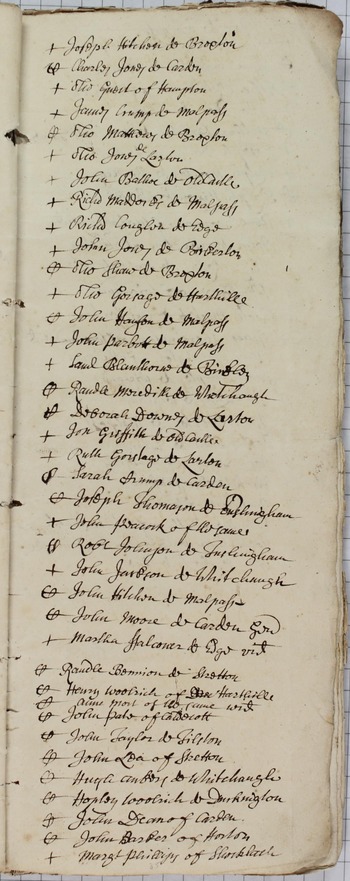
These attempts to identify individuals, however, also indicate some of the ambiguities surrounding the marital and occupational status of women in early modern England highlighted in recent work by Amy Erickson.Footnote 38 For example, though the majority of women listed on the York return were either identified as widows (37·4 per cent of women subscribers), spinsters (26·8 per cent), or married (34·5 per cent), nine female subscribers (1·3 per cent) were listed with no statement regarding their marital status. Even larger numbers of women (771) where only their place of abode was indicated can be found on the Cheshire returns, amounting to approximately one third of all women subscribers.Footnote 39 The York return even provides two interesting instances in which women are listed either with an occupation (the ‘Eliz. Aldridge Baker’ who subscribed on 21 December 1723) or with a male title (‘Cornelia_ayley[?] Esq.’ who took the oaths on 19 December).Footnote 40 Of course, such identifications hang on the vagaries of early modern palaeography.Footnote 41 It is worth noting, however, that seventeen women feature in the freedom registers for York during the reign of George I, the majority with occupations ranging from merchant to milliner ascribed to them.Footnote 42 Given that York was a freeman borough, the admission of women on to the registers could also be taken as an indication that these women were viewed as having at least some of the attributes of citizens.Footnote 43 Given too the regularity with which other women were identified as ‘widow’, ‘spinster’, or ‘wife of’ on these oath returns, it seems unlikely that the lack of such a description was simply a result of scribal error or oversight. Instead, it may indicate, as may marks suggesting that payment had been made for a certificate of subscription, that these were economically significant women whose other roles took precedence over identification via their marital status in certain contexts (Figure 1).Footnote 44
Cheshire 1723 oath return, Cheshire Archives and Local Studies, QDR 3, p. 35, 28 Aug. session. Image reproduced with permission of Cheshire Archives and Local Studies.

This level of scrutiny also clearly placed considerable pressure on the politically disaffected. In the case of two English non-jurors, Richard Welton, curate of a non-juring congregation in Whitehall, London, and Thomas Brett, a non-juring bishop, renewed demands to swear loyalty to the Hanoverian dynasty led both to consider emigration to North America.Footnote 45 While Welton and Brett refused to subscribe, others who were directly implicated in Jacobite activity did swear and their submissions were reported in the contemporary press. Lord North and Grey had had extensive contact with Atterbury, and had even travelled to Rome to meet the Pretender in 1721. North and Grey was arrested and committed to the Tower following the discovery of the Atterbury and Layer Plots in 1722. He was released in October 1723, paying bail of £20,000 plus four sureties of £10,000.Footnote 46 On 30 November 1723, the British Journal reported that Lord North and Grey had taken the oaths in the Court of Chancery.Footnote 47 The Chancery rolls for 1723 have not been identified but the signature of North and Grey's wife, Maria Margerita, can be found on the Exchequer roll for 23 November.Footnote 48 Another aristocratic Jacobite, Peregrine Osborne, second duke of Leeds, was also reported to have taken the oaths in the court of King's Bench around the same time.Footnote 49 Simon Dixon has noted that in Devon, a county with a significant number of Jacobite activists, leading supporters of the Stuart dynasty such as the wonderfully named Sir Copplestone Warwick Bampfylde also took the oaths.Footnote 50 Such subscriptions might be read as evidence that Jacobites felt little qualms in taking ‘forced’ oaths imposed by an illegitimate regime (Bampfylde, for example, had pledged his loyalty before in 1715). Yet, however men such as Bampfylde viewed their subscriptions, their public submission represented a propaganda victory for the Hanoverian monarchy. Press reports of this kind delivered the impression of a Jacobite cause being cowed into submission by the administration of oaths of loyalty.
The press also emphasized the unavoidability of subscription. Newspapers regularly reproduced the Oaths Act as a reminder of its obligations.Footnote 51 In addition to this, the next sessions’ dates for subscription were frequently printed.Footnote 52 As well as making clear who should take the oaths and when and where they could be taken, the press also emphasized the lengths that the authorities would go to ensure that individuals had subscribed. As the Daily Journal reported on 15 October, illness and infirmity would not be an obstacle:
Several Persons of Quality being Bed-ridden, and otherwise incapable of attending the Session to take the Oaths appointed by Law, we hear that the Justices of the Peace have determined to adjourn the Sessions to the Houses of such Persons, to the End they may avoid the Penalties inflicted by the Statute for neglect.Footnote 53
In Surrey, evidence survives of assistance being given to blind inhabitants to ensure that they could also subscribe.Footnote 54
Yet, as well as the evidence of the oaths legislation being used to pressurize opponents of the Hanoverian monarchy and to scrutinize the loyalty of the public in general, mass subscription across the summer and autumn of 1723 was also reported as a great show of public support for the Protestant dynasty. The press frequently alluded to the large numbers of subscribers who flocked to take the oaths. The Daily Journal stated that the crowds that gathered at Hicks Hall and the Guildhall to subscribe the Middlesex rolls were so great ‘that the ordinary Business of the Sessions was obstructed’. The London Journal claimed that ‘upwards of 3000’ had subscribed in Gloucestershire, Herefordshire, and Worcestershire. Not all of these accounts of mass swearing necessarily conveyed a sense of popular enthusiasm. The British Journal reported that the City justices were occupied from five in the afternoon to midnight on Christmas Day, 1723, taking subscriptions, implying that many in London had left it to the very last minute to sign.Footnote 55 Reports of subscription focused not only upon the great and good, including Robert Walpole himself, but also on the social range of subscribers, the ‘Great Numbers of Persons of all Ranks’.Footnote 56 Though reports of subscription by observers such as Onslow often dwelt on the lack of public enthusiasm for the exercise, the image generally presented in the press was of the nation as a whole, from great peers to lowly smallholders, rushing to declare their loyalty to George I.Footnote 57
By 1723, however, mass oath-taking was not the only means through which to demonstrate popular loyalty. The oaths to George I were preceded by many loyal addresses, expressing public disgust at the Jacobite plotters and assuring the monarch of their faithfulness.Footnote 58 As with oath-taking, loyal or humble addressing was by 1723 a well-established political practice but of a more recent vintage, originating as it did during the Cromwellian Protectorate (a fact often invoked to discredit addressing as an activity). Related to but distinct from popular petitioning, loyal addresses increased in number during the post-Restoration period.Footnote 59 As with oaths and petitions, addresses were also ‘subscriptional texts’ (as Mark Knights has described them) which drew at least part of their claim to speak for particular groups and communities from the testimony of their subscribers.Footnote 60 Addresses were issued from political constituencies, English counties, and boroughs, but also from other types of communities, such as dissenting churches.Footnote 61 Even addresses from counties and boroughs often included the broader category of ‘inhabitants’ as well as local officials and freeholders amongst their subscribers.Footnote 62 In this way, addresses, promoted through the official press such as the London Gazette, both provided the Hanoverian state with the image of a loyal public, and offered groups and individuals the opportunity to demonstrate their loyalty and in turn win concessions from the state. In some cases, this exchange of monarchical thanks for expressions of public gratitude was realized in the conferring of honours upon the addressers, as in the case of Felix Feast, one of the sheriffs of London, who was knighted for presenting an address to the king on 2 December 1723.Footnote 63
III
If it is evident that part of the purpose of the oaths legislation was, in conjunction with these loyal addresses, to demonstrate popular support for the Hanoverian dynasty (and by extension Walpole's government), the contemporary value of surveying and representing the loyalty of Georgian women still seems unclear. In a 1716 edition of his Freeholder, Joseph Addison had claimed that a ‘States-woman’ was ‘as ridiculous a Creature as a Cott-Quean. Each of the Sexes should keep within its particular Bounds, and content themselves to excel within their respective Districts.’Footnote 64 The ‘particular Bounds’ of the female sex, according to the gender norms of the early eighteenth century, were represented by the domestic sphere of home and hearth, not the world of public politics. One possibility is that the large number of women subscribing was simply an unintended consequence of some ambiguous and ill-thought-out legislation. This was not unprecedented. In the 1640s, a number of parishes had included women as well as men on oath returns in part because of a lack of precision in the orders given for subscription.Footnote 65
Some oath-taking by women during the Civil War, however, can be linked to other pieces of evidence which suggest that these subscriptions were ‘self-conscious’ assertions of ‘citizenship’.Footnote 66 Scattered instances of this kind can be connected with more extensive evidence of female political assertiveness in the early modern period, such as mass petitions produced by women.Footnote 67 Though petitioning from women on political and religious matters remained controversial, late seventeenth-century petitions on issues connected to women's economic roles were given a hearing by parliament. Philip Loft has suggested that parliament's readiness to accept such petitions indicates the degree to which women's involvement in the economy was seen to give them some rights to political representation.Footnote 68 As will be shown later, the decision to tender the 1723 oaths to women may have been a similar acknowledgement that women's importance to holding and administering property accorded them some of the attributes of citizens. Addison's comments too were part of an established satirical tradition mocking women's political interventions, a genre which Sharon Achinstein has demonstrated was not merely ridiculing the supposedly outlandish possibility of feminine political activism but also channelling male anxieties about womens’ actual political interventions.Footnote 69
The explanatory act of March 1724 which sought to clarify the earlier oaths legislation nonetheless suggested that it was confusion rather than political assertiveness which had led large numbers of women to subscribe the previous year. The explanatory act made clear that women were not expected either to swear or to register their estates.Footnote 70 But whereas in previous oath-taking exercises, women's signatures and marks had only appeared on the returns in a few parishes, in 1723 women consistently appear on returns in very large numbers. Moreover, if the authorities had not intended women to sign, we might anticipate seeing subscriptions from women fall off dramatically after the first few sessions. Analysis of the York rolls indicates that the largest percentages of female subscribers actually came in the later sessions, on 21 November (where women constituted over 70 per cent of subscribers) and 19 December (where they represented just over half).Footnote 71 As we have also seen, both the national and the local press made strenuous efforts to publicize the initial orders that both men and women should sign, and, as will be shown later, the press also paid particular attention to reporting the subscription of women. It will be argued that these subscriptions and reports were not the product of confusion or legislative ambiguity but were the result of a deliberate campaign to scrutinize and harness both the political and economic resources of women in early Georgian England.
One clear motivation for women to sign was to protect their property rights. As Rosemary O'Day has noted, married women under the act could lose two-thirds of their jointure and be left unable to act as executrix of their husband's property through refusing to sign.Footnote 72 The same logic applied to unmarried women who might inherit property from their family or, in the event of getting married, would need to be able to demonstrate that any dowry or portion could legitimately be transferred to a future husband. Viewed in this way, women property holders and those women who could realistically stand to hold or administer property in the future also presented a sizeable constituency of individuals who could be made to pay for oath certificates. That this might have been the intention of the legislation was suggested by one of the most critical newspapers of the time, the True Briton, sponsored by the dissolute peer and sometime Jacobite, Philip, Lord Wharton. In its 12 August issue, the True Briton published a presumably spurious letter sympathizing with the plight of women now required to take the oaths and producing a petition ‘from all the Rich Unmarry'd Women of Great-Britain’ demanding repeal.Footnote 73 Other papers critical of the Hanoverian regime, such as Nathaniel Mist's Weekly Journal, also reprinted letters purporting to come from female property holders terrified of losing their estates if they refused to swear.Footnote 74
While the satirical intent of Mist's Journal and the True Briton was clear, the available evidence indicates that securing their property rights was a key consideration for women in taking these oaths. On 28 November, the earl of Aylesford wrote to the earl of Dartmouth with news that:
the Lawyers at London, are of opinion, that all Persons are obliged to take the oaths, as well those who have an Interest in Land, as those who have not, apprehending that those who refuse or neglect, will lie under an incapacity to take an Estate hereafter tho’ at present they dont dream of any such good fortune… – My wife will go to Warwick & swear, for fear of the worst.Footnote 75
Similar considerations may have led the duchess of Ormond, wife to the exiled Jacobite second duke, to swear to ensure the protection of her jointure.Footnote 76 The letters of Cassandra Brydges, first duchess of Chandos, reveal discussions amongst gentlewomen themselves about the issue. Brydges's mother considered making over her estate to her son in the hope of avoiding having to subscribe only to receive legal advice against pursuing this strategy. Brydges also reported the similar case of a female friend with responsibility for a ‘very much burthened estate’ who had resolved to take the oaths after much diligent searching of scripture.Footnote 77 However, as the numbers of women subscribing indicate, it was not just gentlewomen who took the oaths in order to protect their property. Evidence from surviving subscription certificates corroborates this view. (Some certificates, for example, survive as part of relatively modest marriage settlements.)Footnote 78
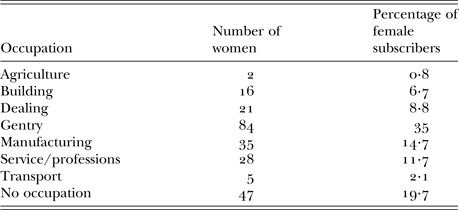
It was not only women who currently held property who were threatened by the legislation. The Oaths Act also encouraged those women for whom inheriting or administering property was only a mere possibility to swear as well. Analysis of the oath returns for the city of York reveals that 34·5 per cent of the 690 women subscribing were married (only 3 per cent less than the percentage of widows subscribing). In York, however, the wives of gentlemen (those marked as ‘Gent’ or ‘Esqr’) made up the largest occupational or status group (35 per cent), indicating the importance of securing property rights (see Table 1). However, the same return also included the subscriptions of wives of labourers as well as gentlemen and, in the case of nearly 20 per cent of the married women, their husbands’ occupations cannot be identified from either the oath return or contemporary freedom registers.Footnote 79 The total number of subscribers in York (1571) was only a small proportion (12·6 per cent) of the estimated total population of the city (12,000), suggesting the way in which it was seen as applying primarily to property holders.Footnote 80 There is considerable overlap between the names appearing on the oath return and on the city freedom registers, suggesting a significant link between subscription and citizenship: of the ninety-seven men who subscribed the oaths at the first two sessions, fifty-two can be identified with some certainty on freedom registers and another fourteen may also have been freemen.Footnote 81 However, the number of men signing (881) was also less than half the estimated turnout in the 1722 election.Footnote 82 This suggests subscribers formed another sub-set within the York population, including those who might anticipate inheriting, acquiring, or administering property in the future (women and poorer subscribers), and those connected to freemen by blood or marriage, as well as property-owning, enfranchised males. A striking example that nationally these concerns stretched down the social scale is provided through press reports of the subscription of celebrated eighteenth-century courtesan, Sally Salisbury. As the Daily Journal reported on 7 December 1723:
Yesterday Morning the famous Mrs. Sally Salisbury was brought from Newgate to the Court in the Old-Bailey, [Salisbury was already in prison for her assault on John Finch, son of the earl of Nottingham] where she took and subscribed the Oaths appointed by the late Act of Parliament, she being in Possession of a small real Estate.Footnote 83
The evidence from the 1723 oath returns gives further weight to Amy Erickson's findings relating to the importance of women to property-holding arrangements in early modern England, especially in acting as executrixes.Footnote 84 In the early modern period, of course, property rights were intimately connected, both intellectually and legally, with political rights. For married women though, the principle of ‘coverture’ could be seen to weaken claims to citizenship drawn from the ownership or administration or private property. The presence of wives subscribing with their husbands on oath returns might imply that the legal notion of ‘feme covert’ was being deployed to absolve married women from personal responsibility on the grounds that they were dutifully following the example of their spouses.Footnote 85 This might suggest that questions of political allegiance were marginal to women's decision to swear, or, for married women especially, that responsibility for making these decisions could be devolved to their husbands. Those papers that saw comedic potential in the government requiring women to swear certainly sought to portray feminine discourse about the oaths as apolitical and ill-informed, little more than genteel ‘Tea-Table’ chatter.Footnote 86
Yet, whatever the content of women's actual discussions about the oaths (and the letters of Cassandra Brydges indicate that these involved considered decisions concerning swearing made on the basis of legal and moral advice), the evidence from subscription patterns does not indicate that all married women simply followed the example of their husbands in swearing. Women on the York rolls can be found signing at completely different sessions from their spouses. For example, Thomas Spooner, a mercer, took the oaths on 11 October but his wife Dorothy did not subscribe until 19 December.Footnote 87 Faith, the wife of Samuell Geldert or Geldart, cook, subscribed on the same day as Dorothy, while her husband signed much earlier on 24 October.Footnote 88 We can also find instances of young, single women subscribing to the York return, apparently without any other family members. Rebeckha Blackbeard, who also took the oaths on 24 October, was baptized on 15 September 1700 at All Saints, Pavement, York. Her father George Blackbeard, admitted as a freeman of York in 1697, had died in the city gaol in 1701. Her mother Susan or Susanna was buried in March 1718 and her uncle, John, and grandfather, James, both freemen like her father, were probably also dead by the summer of 1723. Certainly, no other individuals named Blackbeard appear on the return.Footnote 89 Some of the spinsters subscribing to the oaths may have been even younger than the threshold of eighteen stipulated by the Oaths Act. If the Lennox Bawtry who took the oaths on 24 October was the same Lennox Bawtry baptized at Bossall, Yorkshire, in 1706, she may only have been seventeen at the time of subscription.Footnote 90 Evidence of women subscribing independently from men can also be found on other returns, such as that for Romsey in Hampshire where all the women subscribers were listed together.Footnote 91
Rather than providing evidence of women's political submission to men, the 1723 oath returns arguably represent a response to women's political assertiveness. As with earlier attacks on female activism, satirical mock petitions and mock addresses from women reflected male anxieties prompted by women's contemporary public interventions. The same edition of the True Briton which had lampooned the oaths legislation as a tax on rich women also acknowledged another rationale for including women as well as men within the terms of the act:
Our wise Administration justly call'd to mind the fatal Instance of a certain Island, where the Women murder'd the Men [a reference to the Classical myth of the Lemnian Women]; and therefore, thought it prudent and necessary, for the security of our happy Establishment, to oblige them to take those Oaths which are the Bulwarks of the Protestant Succession.Footnote 92
The True Briton's reference to feminine violence was made more pointed by an allusion to a recent riot at Cripplegate. This had prompted one lawyer, the paper claimed, to argue that the terms of the Riot Act should be extended to apply to women ‘and that it should be Felony for Twelve Females to meet together, and not disperse on the Reading of the Proclamation’.Footnote 93 The Cripplegate riot of July 1723 was provoked by an election bonfire celebrating the appointment of Sir John Williams as alderman for the ward. During the rioting, the crowd was reported to have shouted ‘No King George, No Hannoverian [sic] Proclamation [a reference to the Riot Act].’ Though four men (John Lant, Richard Ayres, David Kite, and John Ambler) were tried for the riot, the trial report also mentioned the presence of women at the bonfire. Although the trial report said nothing about the direct involvement of women in the riot, it was not uncommon for criminal trials of this period to underplay women's involvement because of contemporary understandings of feminine criminal responsibility.Footnote 94
As the work of Nicholas Rogers in particular has shown, the Cripplegate riot was only one of several anti-Hanoverian disturbances in which women played a prominent part. Both the Salisbury Court ‘mughouse’ riots of 1716 and the Bridgewater riots of 1721 were noted for the participation of women.Footnote 95 The government's sensitivity to the threat of popular disorder was indicated in George I's royal proclamation issued after the uncovering of the Atterbury Plot and echoed in the loyal address for Westminster and Middlesex, which specifically mentioned the need to suppress riotous behaviour in the capital.Footnote 96 Besides violent action, women also used speech to denounce the Hanoverian regime: Jennine Hurl-Eamon has noted that as many women as men were bound over for seditious words in London in the period 1689–1719.Footnote 97 Simon Dixon has suggested that the prominence of women in anti-Hanoverian political activity might also explain the high numbers of women subscribers on the 1723 oath rolls.Footnote 98 A desire to monitor and manage the loyalties of Georgian women could also have influenced subscription patterns in some places. The presence on the roll for Winchelsea, Sussex, of signatures of both male office-holders and their wives suggests that it was felt necessary to determine the loyalty not only of public officials but also their spouses.Footnote 99 In focusing upon women as well as men, the 1723 oaths legislation also followed the pattern of earlier measures against Catholics and ‘disaffected persons’ imposed after the '15 which gathered details of female as well as male ‘papists’ and potential Jacobites.Footnote 100
The political activity of women in early Georgian England was not, though, as the work of Elaine Chalus has shown, limited to the obviously transgressive, whether riotous activity or seditious speech. Women played an active part in the relatively open and highly contested electoral politics of the age of Queen Anne. Though excluded by custom from casting their votes in parliamentary elections, women acted as de facto canvassers and election agents or endorsed the votes of male electors.Footnote 101 The prominence of women as supporters of the high church clergyman Henry Sacheverell indicated that the political affiliations of women in the early eighteenth century lent towards the tory party and even Jacobitism.Footnote 102 Evidence suggests that the 1723 oaths were employed to encourage women to display their support for the Hanoverian monarchy instead. Press reports of subscription to the 1723 oaths certainly gave prominence to the presence of both male and female subscribers. On 10 August, the British Journal reported that ‘Several Persons of Quality of both Sexes’ had appeared at Hicks Hall to take the oaths at the Middlesex Sessions, while the Weekly Journal stated that many ‘Ladies of Quality’ had also done so on the same day in Westminster.Footnote 103 Across the autumn and winter of 1723 further reports appeared in the press of subscriptions by persons of ‘All Ranks and both Sexes’.Footnote 104 Just as attention had been given to subscription by prominent male figures, so newspapers also widely reported the subscription of significant women. That Sarah, dowager duchess of Marlborough, and the princess of Wales took the oaths occasioned much comment.Footnote 105 It was perhaps not only the status and political influence of these two women that attracted press attention but the fact that neither were Walpole loyalists. Indeed, Richmond Lodge, where Princess Caroline subscribed, had formed an alternative court for disaffected whig politicians.Footnote 106 Their subscriptions might then serve as useful evidence of a political rapprochement with Walpole. The example of these two women did not necessarily persuade others to follow suit – the duchess of Chandos felt that the princess had ‘set a bad precedent’ by swearing – but in the absence of other printed guidance for women, press reports of this kind may have provided female subscribers with some reassurance.Footnote 107 Whatever women's private misgivings about the oaths, for Walpole's government, these reports gave the impression of both sexes falling in behind the Protestant succession, an especially important image given, as we have seen, the clear participation of women in anti-Hanoverian political activity in the very recent past.
IV
The 1723 oaths provide a valuable snapshot of the importance of women politically and economically in the early eighteenth century. Behind the contemporary ‘patriarchal platitudes’, to use Phil Withington's phrase, was a society in which women were integral to property-holding arrangements and in which their formal political exclusion was counter-balanced by their importance to informal social and economic networks.Footnote 108
Nevertheless, the 1723 oaths represented an unrepeated exercise in testing the allegiances of a significant section of the female population. The ‘state oath’, as Paul Langford noted, had had its day. Contrary to Langford, however, this was not because the experience of 1723 was particularly ‘chastening’ for Walpole's whigs. In the short term, the Catholic Taxation Act and the oaths were relatively successful, at least in political terms.Footnote 109 However, this success was not without cost. Kathleen Wilson has noted how the revelations of the Atterbury Plot and the judicious management of its prosecution by Walpole forced the whigs’ opponents largely to abandon the dynastic issue, instead focusing their critique on corruption and the threat to individual liberty.Footnote 110 Exercises which could be presented as both politically oppressive and ruthlessly acquisitive readily fed into these opposition narratives. The ‘state oath’, as Paul Langford argued, was difficult to accommodate with a contemporary understanding of political life as primarily organized around the ideal of voluntary association. This was acknowledged in contemporary sermons urging the public to take these oaths. For John Jackson, rector of Rossingham in Yorkshire, it was self-evident that ‘all Civil Power’ was ‘originally founded in the Agreement and Consent of the People who are to be rul'd by it’. The government of George I was due obedience because it was established on just such a basis with a head of state guided by and ruling within the limits of the law.Footnote 111 Equally, while Cassandra Brydges's letters indicate that oaths could continue to provoke cases of conscience, appeals either to moral reasoning or to the threat of divine punishment for false swearing appear to have become more muted. Certainly, for the veteran whig Sir Richard Cocks, political choices in this situation were directed not by solemn oaths but by rational interest, guided by the law. As Cocks argued in his charge to the Gloucester grand jury at their midsummer sessions in 1723,
if it were possible for me to believe, that King George and his Family were Papists, and the Pretender and his Family were Protestants, I believe I should be sooner for the Pretender, than for King George; and this I may lawfully say, for all my Oaths. For a Papist is, as I have demonstrated to you before, incapable of inheriting or possessing the Throne by our laws, made upon the truest Reason and consummate Wisdom of the Nation.Footnote 112
Even the clergy could be found arguing that over-scrupulousness and excessive moral self-examination were to be avoided. The subject's chief obligation, as the title of one sermon of 1723 made clear, was The duty of studying to be quiet and to do our own business.Footnote 113
Evidence such as this seems to support historians, such as Christopher Hill, who have argued the oath's power declined markedly over the early modern period. In this view, the oath's waning ability to awe was a signifier of broader processes of secularization and modernization.Footnote 114 However, even critics of the oaths such as Onslow did not propose eliminating oath-taking from all aspects of British public life and, as John Spurr has shown, the spiritual power of the oath continued to be recognized even as religious pluralism came to be accepted in the late eighteenth and early nineteenth centuries.Footnote 115 Instead, rather than simply becoming a cultural anachronism, the imposition of oaths of loyalty to the public en masse ended because the purpose of these devices had already changed by the late seventeenth century. From being used in the Civil War to mobilize the public politically and militarily, after the revolution of 1688 oaths were used predominately to project public loyalty. By 1696, these exercises in mass oath-taking were combined with the issuing of loyal addresses.Footnote 116 These devices had the advantage of ostensibly being the spontaneous product of popular support for the monarchy. Of course, such exercises were often perceived as being just as directed and manipulated by the political centre as state oaths.Footnote 117 But they also presented further opportunities for women to engage in the public sphere of political life. The presence of women on oath returns may have offered implicit testimony to women's political and economic power, but it remained an overtly transgressive insertion of the feminine into the normatively masculine public sphere. As John Walter has argued, the taking of oaths by women ‘challenged one of the fundamental assumptions of early modern political culture that it was male, married, propertied householders who claimed a public political identity and that their household dependants were subsumed within that identity’.Footnote 118 More informal modes of political legitimation, namely the loyal address, could represent individuals without necessarily seeming to confer such a public identity. The formally disenfranchised could be included in the capacious description of addresses coming from the ‘inhabitants’ of a locality as well as its electors. As emotional texts which spoke of the community's love for their monarch, they could also be more obviously accommodated with supposedly feminine qualities.Footnote 119 As Mark Knights has noted, such informal means of representation prompted disputes over what constituted ‘legitimate’ public opinion but it was, nonetheless, through such vehicles for conveying popular affection that the ‘truest reason and…consummate wisdom’ of parliament could also determine the sense of the nation.Footnote 120 By the nineteenth century, subscriptional texts, in the form of mass petitions in support of the abolition of slavery, had become vehicles for articulating women's own sense of their status as citizens.Footnote 121 Oath returns offers more ambiguous evidence regarding early modern women's political consciousness. Were women who subscribed separately from their husbands exercising their political independence or simply seeking to protect their family's property (possibly at their spouse's behest)? The returns alone cannot tell us.Footnote 122 These signatures and marks nonetheless testify to the growth and vitality of ‘subscriptional genres’ in the early eighteenth century and to the acceptance of a broad ideal of representative government which might even include women, if only largely indirectly.Footnote 123
Occupations/status of spouses of married women on York oath roll (1723)

Sources: York City Archives, F12 fos. 140v–149r; ‘Admissions to the Freedom of York: Temp. George I (1714–27)’, in Register of the Freemen of the City of York, ii: 1559–1759, ed. Francis Collins (Durham, 1900), pp. 211–28, www.british-history.ac.uk/york-freemen/vol2/pp211-228.