INTRODUCTION
The Gorgon from the pediment of the Temple of Sulis Minerva at Bath is one of the most famous and captivating works of art from Roman Britain. It also remains one of the most challenging to interpret. Carved in the first century a.d. by craftsmen most likely from northern Gaul,Footnote 1 it has often been held up as the epitome of ‘Romano-Celtic’ art, ‘the perfect marriage of classical standards and traditions with Celtic taste and native inventiveness’, as Jocelyn Toynbee put it.Footnote 2 Yet, in making the Gorgon the iconic image of Roman Britain, scholarship has lost sight of the role it plays as the centerpiece of a temple pediment. The pediment of the Temple of Sulis Minerva is dominated by imagery invoking imperial might, perhaps not surprising for a building erected not long after the Roman conquest of Britain. How does the Gorgon connect with the rest of the pediment's iconography?
This paper will argue that there are demonstrable links between the Gorgon and contemporary monuments in Gaul and Spain which imitate the iconography of the Forum of Augustus in Rome. By putting the Gorgon into this wider context, without losing sight of the elements which make it unique, we can move beyond discussion of ‘Celtic’ art and reach a better understanding of how the Gorgon and the pediment as a whole functioned to connect the Romano-British religious site of Aquae Sulis to the wider world of the Empire.
THE PEDIMENT OF THE TEMPLE OF SULIS MINERVA
The Temple of Sulis Minerva was constructed in the late Neronian or early Flavian period, as part of the initial Roman-period monumentalisation and sacralisation of the area surrounding Bath's hot springs. It stood in a walled precinct, into which was also incorporated the reservoir of the site's principal hot spring; adjacent to this precinct was the substantial bath complex fed by the spring. The temple pediment may have been visible from afar above the walls of the precinct; however, visitors would have obtained an unobstructed view of the temple and its ornamentation only as they entered the precinct through the main entrance in its east wall. Around 30 m ahead of them was the start of the temple podium steps. With podium, columns and pediment, the temple would have risen at least 12 m above the floor of the precinct. The temple in its first phase was a tetrastyle building in the Corinthian order, with the columns rising to a height of c. 8 m (based on the diameter of the bases).Footnote 3 The building was c. 9 m wide (as shown by the width of the tympanum), and probably no more than 14 m long.Footnote 4 It stood on a podium at least 1.2 m, but possibly up to 2 m, high.Footnote 5 A flight of steps descended from the top of the podium to the paved surface of the temple precinct.
Although today the pediment is fragmentary, enough remains for the general scheme to be reconstructed (fig. 1). The reconstruction now commonly accepted is that of Ian Richmond and Jocelyn Toynbee, which finally superseded Lysons’ drawings from the early nineteenth century (fig. 2).Footnote 6 At its centre is the head of a male Gorgon, mounted on a large circular shield and surrounded by two concentric oak wreaths. On either side, winged Victories standing on globes support the shield. Below the shield to the left is a strange helmet, with ears attached to its sideguards and a zoomorphic peak, possibly intended to be a dolphin or other marine creature; there are no known exact parallels, either iconographic or archaeological, for this helmet.Footnote 7 A star sits in the apex of the pediment.
The surviving portions of the temple pediment. (Photo: E.H. Cousins; © Bath and North-East Somerset Council)

Reconstruction of the pediment by Richmond and Toynbee. (Richmond and Toynbee Reference Richmond and Toynbee 1955 , pl. XXVII; © Cambridge University Press)

Richmond and Toynbee conjectured that the owl visible to the right, on the other side of the shield, may have been standing on a second helmet, symmetrical with the zoomorphic helmet on the left. They suggested that a torso draped with seaweed visible beneath the Victory in the right-hand corner formed part of a Triton blowing on a conch shell, whose tail would have fitted into the pediment's corner; they placed a second Triton in the parallel position in the opposite corner.
This reconstruction by Richmond and Toynbee was, in the words of Barry Cunliffe, a ‘detailed and reasoned account unlikely to be superseded’.Footnote 8 Indeed, it has not been; nor is it the intention to try to do so here, other than to offer a reminder that the Tritons they depict in the corners are mostly conjectural, while the clenched hand visible to the lower left of the owl remains an arguable objection to the reconstruction of a helmet beneath. The owl may instead have been perched on the wrist of an unknown figure; this was the reconstruction suggested by Lysons in the nineteenth century.Footnote 9 Apart from this, the general layout of the pediment, as shown in F.A. Child's illustration accompanying Richmond and Toynbee's article (with the addition of a block uncovered in 1983), is accepted. It is arguable, however, that a fully compelling analysis of the iconography and effect of the pediment — and in particular the central Gorgon head — has not as yet been offered. This paper will focus first on the surrounding figures before turning attention to the Gorgon, followed by a consideration of the composition and the role of the pediment as a whole.
The first thing to stress is the Roman-ness — even the imperialness — of the majority of the elements on the pediment. The central shield with the Gorgon's head is flanked by two winged Victories standing on globes. Little remains of either Victory, but enough is present to assure us that they are of a standard iconographic type, with drapery flowing out behind them, sandaled feet and globes criss-crossed with lines marking the paths of the planets. Richmond and Toynbee declared that the ‘Victories on globes symbolise Sulis-Minerva's universal conquest of sickness, just as Minerva features as conqueror of death in Roman funerary contexts’,Footnote 10 an observation which Cunliffe repeated without criticism.Footnote 11 This interpretation, however, can hardly be justified. The image of Victory standing on a globe was introduced to Roman iconography by Augustus after the Battle of Actium and, more than any other Victory-type, was inextricably linked to the person of the emperor and to imperial military victory right up until Late Antiquity.Footnote 12 Indeed, Victories on globes appear frequently in military contexts in Britain. It is surely in the light of this connection that we must see the Bath Victories; there is no reason to ascribe to them a radically different connotation. The Victories on the pediment of the Temple of Sulis Minerva are symbols of imperial might.
The Victories are not the only elements on the pediment associated with imperial iconography; the oak wreaths which encircle the Gorgon were also closely linked with the image of the emperor. Coronae civicae made of oak leaves were awarded in the Republican period to soldiers who rescued a comrade in battle; however, after one was bestowed on Augustus by the Senate in 27 b.c., they increasingly became, in the words of Paul Zanker, ‘tokens of monarchical rule’; for later emperors, the oak wreath had turned into simply ‘an insigne of power, completely removed from its original meaning [and] oak leaves became widely understood as synonyms for “Augustus”’.Footnote 13 Martin Henig also points out that coronae civicae are frequently found on coins struck under Vespasian, roughly contemporary with the Bath pediment.Footnote 14
The final element of the pediment which is possibly linked to imperial iconography is the star at its apex. Henig has argued that the star references either the deified Julius Caesar or a deified emperor, in his view most likely Claudius.Footnote 15 Stars in general by the end of the Republic were ‘a well-recognized, though not standard, attribute of divinity’, particularly on coinage.Footnote 16 Meanwhile, in the Hellenistic East, stars had become symbols not only of gods but also of deified kings.Footnote 17 Early in Octavian's reign, the star became an emblem attached to statues of Julius Caesar and on coinage depicting not only Caesar but Octavian as well.Footnote 18 As time went on, however, Caesar seems to have become more closely linked with the image of the comet (shown with a tail) which supposedly appeared shortly after his death, not a star simply indicating divinity.Footnote 19 Overall, it does not seem proven to me that stars became inevitably linked with the imperial cult, despite Weinstock's attempts to link the Julian star with later radiate crowns and the connection between Sol and the emperor.Footnote 20 The pediment star (and another one like it from the sanctuary precinct) seems likely to be linked to divinity, but cannot be proven to be imperial in tone.Footnote 21
Nevertheless, the pediment obviously has Roman imperial power as a central theme. With this understood, what might this choice of theme reveal about the original intentions and message of the designers of the temple in the first century? The answer to this question depends to some extent on who was the driving force behind the first-century construction of the temple and reservoir, and why. In the absence of any dedicatory inscriptions, this becomes a controversial topic.
Henig has come to think that the ‘patron’ behind the construction was Togidubnus, the client king of Rome known to us from Tacitus and from epigraphy, commissioning a new sanctuary at the end of his reign at the edge of his expanded kingdom.Footnote 22 In this model, the imperial iconography of the pediment is to be understood as ‘the introduction of a new world order’ by a Briton embracing Roman rule, and as ‘an elegant compliment to the Roman achievement by a friend and client of both Claudius and Vespasian’.Footnote 23 Cunliffe and Davenport, on the other hand, see the provincial government as the likely instigator. They speculate that the decision might have been made ‘in the aftermath of the Boudiccan rebellion. To lavish such care and expense on one of the great shrines of the western Celtic fringe might have been designed to be an act of reconciliation, the careful conflation of the native deity with the Roman Minerva representing the new spirit of partnership.’Footnote 24
An unusually powerful and wealthy local figure (whether or not Togidubnus), or a man or men connected to the provincial government (whether or not acting in their ‘official’ capacity), are by far the most likely possibilities for the patrons of the sanctuary. Aquae Sulis at this early period is not — and indeed would never become — an urban environment with a sufficiently large population to provide enough wealthy men of ordinary rank to fund an undertaking as large as the sanctuary. The suggestion of Togidubnus, however, should be treated with caution. Henig's conviction that Togidubnus’ kingdom was expanded to encompass the area around Bath — a considerable distance from his centre of power at Chichester — is not truly supported by Tacitus, whose sentence ‘quaedam civitates Cogidumno regi donatae’,Footnote 25 appearing as it does immediately after Tacitus’ discussion of the conquest of Britain, is much more naturally interpreted as the sole and original bestowal of client-kingship on Togidubnus by the Romans,Footnote 26 rather than a later expansion as a result of continued loyalty, as Henig would have it.Footnote 27 Ptolemy does list Bath as part of the territory of the Belgae;Footnote 28 however, his tribal attributions generally seem suspect and possibly arbitrary, while the coin evidence more likely places the site among the Dobunni.Footnote 29 The temple of Neptune and Minerva at Chichester, known from an inscription,Footnote 30 and built by the local guild of smiths with the sanction of Togidubnus, is also sometimes cited as a demonstration of Togidubnus’ interest in Minerva and a parallel in support of his involvement at Bath.Footnote 31 Apart from the fact that it is not a true parallel — there is no evidence that Togidubnus supported the Chichester temple financially, while a group like a guild is very unlikely to have been the driving force at Bath — caution is necessary about reading too much into what is likely to be a coincidence. Togidubnus’ involvement in a temple to Minerva at his known power base is one thing, but does not prove his involvement in another temple to the goddess outside his likeliest sphere of influence.
In some respects, the Togidubnus theory should be approached carefully precisely because it is tempting. Since he is one of the few powerful Britons at this period known to us by name, it is easy and often convenient to suggest him as the force behind major monuments found through archaeology, from Fishbourne Palace to Bath, and to forget how little we actually know about him and his actions; in doing so, however, we run the risk of inadvertently ascribing to him a greater role in the province's early history than he might have had. It is important to remember how thin our written sources for the period are. If the sanctuary's patron was a member of the British elite, it is not impossible that Togidubnus was that person, but likewise the mere fact that we know his name and no other does not rule out the existence and involvement of a local figure, closer to Bath, who is unrecorded in our sources.
Whoever it was who funded the sanctuary, they were well connected enough to harness the significant resources and organisational capabilities necessary for such an undertaking at such an early date. The impetus to build the Great Bath in particular must have come from people thoroughly immersed in Roman ways of life; the engineering requirements of the reservoir are extremely high and likely to be beyond the capabilities of local groups at this date, while the use of craftsmen from Gaul would indicate the patron(s) were connected to inter-provincial networks rather than merely intra-provincial ones. If the patron held official rank, a man such as Gaius Julius Alpinus Classicianus, procurator of the province immediately after the Boudiccan revolt, offers a potential model (although Classicianus himself is too early to be a valid possibility): a member of the Gallic nobility, presumably wealthy and well connected in the North-West provinces, yet whose family history and own career both demonstrate commitment to Rome.Footnote 32
Henig and Cunliffe and Davenport, although they differ on the identity of the patron, agree on the general principles behind the sanctuary. It is an olive branch, a sign of peaceful Romanisation and an attempt to portray the incorporation of Britain into the Empire in a positive light, through the joining of separate British and Roman goddesses and religious traditions into a syncretic whole. Although one should not automatically assume that Roman rule in the provinces was always a negative thing to be met with resistance by the ‘natives’, nonetheless it must be noted that if the site of the hot springs was considered sacred by the local population before the Romans arrived, then the transformations made in the first century would have rendered the valley unrecognisable to those who knew it before. The harnessing of the water of the King's Spring alone involved a massive engineering project, encasing a formerly wild spot with lead and concrete and moving so much earth that, if there was any Iron Age activity at the spring, the Roman period activity has destroyed every trace of it.Footnote 33 When this is combined with the construction of the massive bath-houses, temple and many other monumental structures, it seems more likely that we have here an imperial power placing beyond question or challenge its appropriation of an indigenous sacred spot, rather than coming to a harmonious understanding with earlier tradition. The imperial iconography of the pediment — iconography not just imperial, but indeed military, with symbols of victory and conquest — then becomes a part of this appropriation and a reminder of the means by which this land was incorporated into empire. This does not, of course, mean that the sanctuary remained a symbol of domination throughout its history — indeed, the later votive evidence tells a complex story of ritual integration and cultural negotiation. In its foundation, however, we almost certainly see an imperialist act.
The triumphal iconography of the pediment and the commitment to Roman imperialism which it implies, strengthen, in my view, the probability that the instigator(s) of the sanctuary were connected to the provincial government. This explanation of the pediment, however, fails to incorporate the central Gorgon, and therefore must be incomplete.
THE GORGON
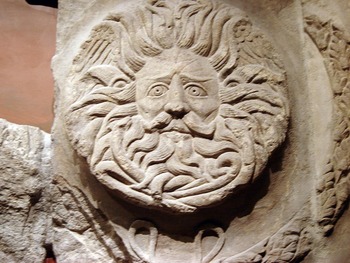
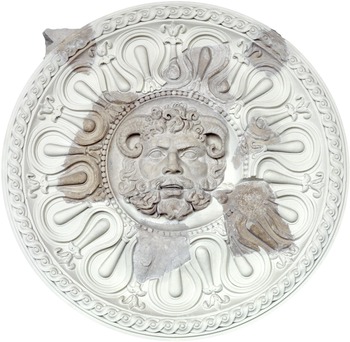
From the time of its discovery in the late eighteenth century, the Bath Gorgon has been both a challenging and a deeply arresting image for scholars of Roman Britain. It is now almost universally described as a variant of the classical image of the Gorgon, with snakes in its hair and wings at the side of its head (fig. 3);Footnote 34 in the century following its discovery in 1790, however, there was often great resistance to this identification, due to the figure's maleness. Antiquarians suggested alternatives ranging from the SunFootnote 35 to the ‘Serpentine or Cherubic Diadem’ (supposedly a divine symbol from the East).Footnote 36 One Victorian scholar, George Scharf, suggested that the head was in fact a personification of the Hot Spring,Footnote 37 a hypothesis also adopted by H.M. Scarth, an important figure in the nineteenth-century antiquarian community at Bath.Footnote 38
The Gorgon from the temple pediment. (Photo: E.H. Cousins; © Bath and North-East Somerset Council)

Although Scharf denied the head was a Gorgon, his Hot Spring theory foreshadowed the consensus which emerged in the twentieth century, that the head is best understood as a careful conflation of Minerva's attribute of the Gorgon with a water god's face symbolising the sacred waters of the nearby spring.Footnote 39
More importantly, in the twentieth century the Gorgon came to be seen not only as a powerful work of art, but indeed as one of the most — if not the most — iconic images of Roman Britain. Toynbee, as noted earlier, saw it as ‘the perfect marriage of classical standards and traditions with Celtic taste and native inventiveness’.Footnote 40 No praise was too high for its unknown creator. Haverfield declared in the Victoria County History for Somerset that ‘Here for once we break through the conventionality of the Roman Empire, and trace a touch of genius’.Footnote 41 Elsewhere he went even further: ‘Whatever its precise original, the head is perhaps the most remarkable product of Roman provincial art in western Europe. Its marked individuality and astonishing vigour are hardly less extraordinary than its technical features.’Footnote 42 Even R.G. Collingwood, notoriously harsh on Romano-British art in general,Footnote 43 was impressed by the Gorgon and saw in its vigour proof of the sophistication of its creator: ‘The Bath sculptor was a man of high education, deeply versed in the technique of his art and coolly skilful in the execution of it. His Gorgon is barbaric for the same reason that Caliban is barbaric — because its creator was a skilled artist, and wanted to make it barbaric, and succeeded.’Footnote 44
Yet, in making the Gorgon the iconic image of Roman Britain, scholarship has lost sight of the role it plays as the centrepiece of the pediment. If this is indeed the premier expression of Romano-Celtic art, a piece which epitomises both the religious and artistic syncretism between native and Roman, how does it fit in with the rest of the pediment, which, as has been seen, is defined primarily by Roman iconography and ideology? To answer this question, it is necessary to put the Gorgon back into the wider context of similar images in Roman art, particularly provincial art. Is the Gorgon in fact a unique image, and if not, what connotations might its category of images convey?
THE ROUNDELS OF THE FORUM OF AUGUSTUS AND THEIR PROVINCIAL COUNTERPARTS
Other instances of Gorgons or Medusas in Romano-British art, for instance on mosaic floors or jet pendants, are all considerably later than the Bath Gorgon and thus of little use in understanding its original context. When searching for comparative material for the Gorgon, Richmond and Toynbee turned primarily to the heads of Medusa and sea-goddesses from the Severan Forum at Lepcis Magna,Footnote 45 possibly because they considered the pediment to date most likely to the third century.Footnote 46 In doing so, however, they neglected an entire series of parallels which are much closer both stylistically, geographically and chronologically: namely, the roundels ultimately derived from the Forum of Augustus which are found in first- and early second-century contexts at multiple urban sites in the western provinces, in particular Gaul and Spain.
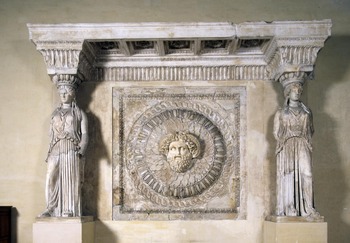
Before examining this provincial material, however, we should take a brief look at the archetype: the Forum of Augustus. The format of the Forum, with the Temple of Mars Ultor at one end, and the sides lined by porticoes displaying statues from Roman history (and of the Julio-Claudian family), is well known and does not need extensive reviewing. The focus here is on the attic of the porticoes, where shields, or clipei, bearing heads of Jupiter Ammon (and possibly other deities)Footnote 47 were framed between standing caryatids (fig. 4). Zanker, following Vitruvius, has argued that both the caryatids and the shield-heads are to be related to themes of triumph and victory.Footnote 48 It is also possible that the shields in particular are intended to evoke memories of the shields Alexander the Great hung on the Parthenon.Footnote 49 Irrespective of whether Vitruvius’ understanding of caryatids as the humiliated women of conquered nations should be taken at face value, it is certainly true that the overall atmosphere and function of the Forum of Augustus was one of triumph and victory, with the Temple of Mars Ultor used by the Senate, by imperial decree, as the place for deliberating both wars and claims for triumphs.
Portico attic of the Forum of Augustus. (Photo courtesy of the Sovrintendenza ai Beni Culturali di Roma Capitale, archive of the Museo dei Fori Imperiali)

Apart from the general motif of a head placed inside a shield roundel, the heads of Jupiter Ammon from the Forum do not necessarily bring to mind the Gorgon from Bath. The heads display none of the interest in circularity and patterning which defines the Gorgon: the outline is most certainly that of a head, rather than a circle, and the style, unsurprisingly, is marked by high-quality classical realism. However, as we move to adaptations of the Forum of Augustus in the western provinces, the parallels become clearer.
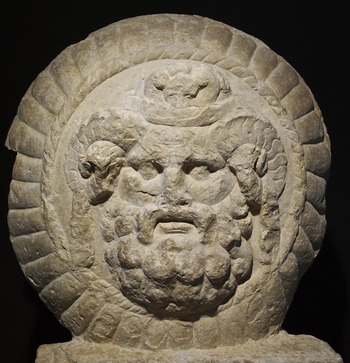
There are several examples of urban centres in Gaul and Hispania imitating to greater or lesser degrees the iconographic programme of the portico attics of the Forum of Augustus; in some cases, the architectural context is well understood, while in others we only possess relatively contextless fragments of roundels. In the latter category are fragments from Caderousse and Vienne,Footnote 50 both of which depict the head of Jupiter Ammon on a clipeus (figs 5 and 6). Also in Narbonensis, a clipeus has been found at Arles with very elaborate vegetal decoration and a central head which, while resembling the Ammon-type, in fact appears to be a type of river or water deity;Footnote 51 he possesses pointed ears in lieu of horns, and a dolphin and a crocodile are visible in his hair (fig. 7).Footnote 52 A fragment of a second clipeus, sadly lacking the central portion, was found in the same excavation.Footnote 53 The context for these fragments is a little better understood. They seem to have been part of the decorative scheme of a rectangular plaza (there is no evidence of a roof) built against one end of the forum; the plaza was capped at least at one of its ends by a curved exedra furnished with niches, and it is possible that it had a temple along its west side.Footnote 54 The clipei were found during the excavation of the known exedra, although they were not in position and we cannot know exactly what building they were ornamenting. Despite the clipei and the possible temple, the layout of this area, as far as we understand it, does not seem to mirror closely the layout of the Forum of Augustus.
Head of Jupiter Ammon from Caderousse. (Photo: Jean-Lucy Maby © Musée Calvet)

Head of Jupiter Ammon from Vienne. (© Musées de Vienne)

Head of a river god from Arles. Location currently unknown. (Photo: Espérandieu Vol. IX (Reference Espérandieu 1925 ), no. 6731)

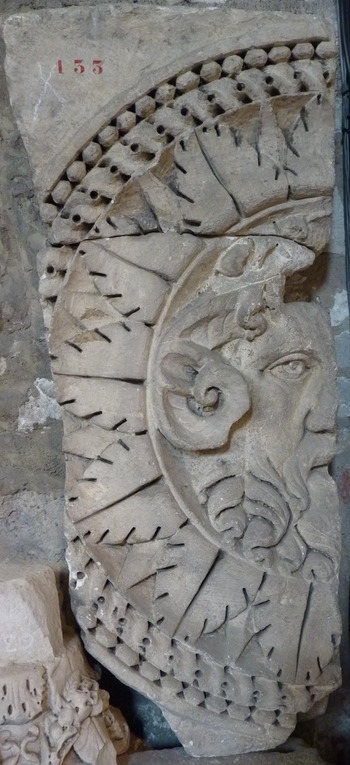
Somewhat clearer with regard to context — although by no means completely secure — are a series of fragmentary roundels from Avenches (ancient Aventicum), Switzerland, the capital of the Helvetii (fig. 8).Footnote 55 These were found in association with the temple known as La Grange-des-Dîmes, located well within the urban environment of Avenches;Footnote 56 the temple's decoration has been dated, primarily on stylistic grounds, to the Flavian period.Footnote 57 P.D. Horne's reconstruction, now generally accepted,Footnote 58 reconstructs the temple as fundamentally Romano-Celtic in plan (i.e. with an ambulatory around a central cella), but with a classical-style pronaos, including columns and a possible pediment.Footnote 59 The placement of these clipei in relationship to the temple is not entirely certain. It has generally been assumed that they formed part of the architectural decoration of the temple itself, rather than of surrounding Forum of Augustus-style porticoes.Footnote 60 The most recent reconstruction by M. Bossert, which synthesises earlier work, argues that the roundels were placed in the attic of the temple's ambulatory.Footnote 61 If this reconstruction is correct, then their placement in the frontal view of this temple is the closest example known to the placement of the Gorgon at Bath. An alternative suggestion, put forward by Monika Verzàr and accepted by Horne, placed the roundels on the facing of the temple platform;Footnote 62 given the fact that all other clipei of this type whose contexts are known were placed at elevation, this reconstruction seems less likely.
Clipei from Avenches. (a) Probable river god; (b) Jupiter Ammon. (© AVENTICUM – Site et Musée romains d'Avenches)

The roundels themselves seem to show several different deities, including Jupiter Ammon and a probable river god.Footnote 63 It has been suggested that a third roundel may have been of Medusa, since the edge of the shield (the only extant part) recalls closely the edges of the Medusa clipei from Mérida (see below);Footnote 64 however, the connection is tenuous and we certainly cannot assume that there were Medusa clipei at Avenches. The style of the Avenches clipei is overall rougher than the examples from Narbonensis, with the heads carved in a less naturalistic and more geometric manner.
There is no firm evidence for other clipei in the style of the Forum of Augustus in this region, but edges of similar roundels have been found at other Swiss sites, particularly Geneva and Versoix;Footnote 65 Verzàr suggests that these may have been part of similar decorative schemes at these sites, or perhaps another nearby (with Nyon being an attractive possibility);Footnote 66 without the central portions of the roundels, however, this cannot be confirmed.
Moving away from Gaul, further examples of the clipeus decorative element are to be found in Spain, particularly in two of the three provincial capitals, Tarragona and Mérida. In Tarragona, fragments of clipei depicting Jupiter Ammon have been found associated with the so-called Provincial Forum. Around 50 fragments have been found so far,Footnote 67 which would allow at the least four or five clipei to be reconstructed. The Forum most likely had as its focus a temple to the imperial cult;Footnote 68 the suggestion made by T. HauschildFootnote 69 that the clipei formed part of the attics of porticoes leading to the temple, along the lines of the Forum of Augustus, is now widely acceptedFootnote 70 (although so far no evidence of caryatids has been found).Footnote 71 Stratigraphic evidence strongly supports a Flavian date for the complex, rather than the Julio-Claudian date put forward by earlier scholars on the basis of textual evidence for a Julio-Claudian temple to Augustus,Footnote 72 although D. Fishwick, relying heavily on the textual evidence, has argued that a Julio-Claudian dating should perhaps be accepted for the temple, if not the complex as a whole.Footnote 73 In either scenario, however, the clipei will date to the first century a.d.
The two most complete clipei both depict Jupiter Ammon (fig. 9); the overall appearance of the head is the same, although there are a few noticeable stylistic differences between the two.Footnote 74 E.M. Koppel has suggested that another fragment of a face may possibly belong to a clipeus depicting Medusa;Footnote 75 as at Avenches, however, this identification is far from certain. On the other hand, on comparison with Mérida (see below), the certain presence of at least two types of borders for the clipei suggests that there may have been more than one type of face.Footnote 76
Fragmentary clipeus from Tarragona. (© Museu Nacional Arqueològic de Tarragona)

The best-attested provincial articulation of the Forum of Augustus, however, is to be found at Mérida, where almost all the elements of the archetype at Rome have been identified. Here, in the principal forum of the colony, porticoes with attics of caryatids and clipei depicting both Jupiter Ammon and Medusa flank the sides of a plaza leading to a temple of the imperial cult (the so-called Temple of Diana);Footnote 77 it also seems likely that there was, at the least, a sculpture group of Aeneas and his family leaving Troy.Footnote 78 The general date of the temple and porticoes seems to be Julio-Claudian, making it slightly earlier than most of the other examples discussed here.Footnote 79
As at Tarragona, there are a few different identifiable ‘types’ for both the Jupiters and the Medusas, not differing greatly in appearance but showing minor stylistic modifications (fig. 10);Footnote 80 this is most likely due to the work of different workshops, rather than chronological variation.Footnote 81 Among other variations, the borders of the Medusa clipei are surrounded by vegetal motifs of three types: laurel wreaths, oak wreaths and floral scrolls.Footnote 82 On the Jupiter Ammon clipei, however, the egg-and-dart style decoration extends right to the edge of the shield.Footnote 83
Clipei from Mérida. (a) and (b): Clipei of Jupiter Ammon in two different styles. (© Archivo Fotográfico MNAR/Lorenzo Plana and Archivo Fotográfico MNAR/Miguel Ángel Otero); (c) and (d): Clipei of Medusa surrounded by coronae civicae. 10d shows the snakes knotted under Medusa's chin. (© Archivo Fotográfico MNAR/Miguel Ángel Otero and Archivo Fotográfico MNAR/Ana Osorio)

What are the implications of these sites and their iconography? The fact that they are part of the same phenomenon or trend has been generally accepted and the meaning behind that trend widely debated.Footnote 84 As discussed above, both the iconographic scheme and the functions of the Forum of Augustus emphasised themes of triumph and victory; in addition, the Forum of Augustus is entwined with the Augustan period's larger interest in linking itself to both the mythological and historical past. This is seen not only in the famous statue groups of early figures tied to both Roman heritage and the Julian gens specifically, but also more broadly in the shields’ possible links to Alexander and the imitation of Greek artistic elements such as the caryatids.
How much of the message of the original space can be transferred to its imitations in the Western provinces is a different question. It is likely that the connotations changed in a provincial context, with the very fact of imitation of a space from Rome becoming more important than the original space's meaning. As Verzàr puts it when discussing the clipei specifically:
En conclusion, alors qu’à Rome, au Forum d'Auguste, les clipei étaient en rapport direct avec des événements historiques et présentaient aux yeux du citoyen de glorieuses conquêtes en les symbolisant par une tête d’Ammon et par des représentations de princes barbares portant les torques, leur contenu iconographique ne pouvait être la même pour les habitants de Tarragone et d'autre villes provinciales. Il eut manqué tout son effet. En province, ce programme fut consciemment transformé en représentation abstraite du pouvoir du nouvel Empire.Footnote 85
In conclusion, although at Rome, in the Forum of Augustus, the clipei were in direct relationship with historical events and presented glorious conquests to the citizen's eyes by symbolising them with a head of Ammon and through representations of barbarian princes wearing torcs, their iconographic content could not have been the same for the inhabitants of Tarragona and other provincial towns. It would have lost all its effect. In the provinces, this programme was consciously transformed into an abstract representation of the power of the new Empire. (trans. author)
Both Verzàr and others following her have gone further, arguing that in provincial imitations of the Forum of Augustus a frequent and direct link can be seen with the imperial cult, with roundels almost universally appearing on or near cult temples.Footnote 86 This connection, however, was based on (1) Verzàr's mistaken interpretation of the temple at Avenches as dedicated to the imperial cult and (2) her tendency to argue for connections at other sites where none is likely.Footnote 87 Despite the fact that Verzàr's theory has been occasionally put forward by others,Footnote 88 there is no reason to believe that Forum of Augustus-style decoration was directly linked to the imperial cult.
What the roundels certainly are is part of what might be called ‘a visual language of empire’, which seeks to incorporate the public civic spaces which they adorn into the wider web of ‘Romanitas’. The temples to the imperial cult at Tarragona and Mérida, although not the cause of the roundels, are thus nonetheless correlated, with both the homage to the Forum of Augustus and the worship of the emperor serving to bring the centre of imperial power out to the periphery.
IMPERIAL IMAGES: THE GORGON AND THE PEDIMENT
Having now discussed these provincial echoes of the Forum of Augustus and the role they played in connecting the provinces to the capital, it is time to turn back to the Gorgon. A strong argument can be made that the contemporary trend of provincial imitation of the Forum of Augustus did play a role in the creation of the Gorgon image. As one moves away from the Forum of Augustus clipei and into the provinces, the stylistic similarities between the Bath Gorgon and the Jupiter Ammon clipei become more striking. With the exception of the fragment from Caderousse, the provincial material demonstrates less interest in three-dimensionality and a greater interest in making the head and hair reflect the circularity of the shield shape. The clearest parallels to Bath are the clipei from Mérida. Although the style of the carving is far more ‘classicised’, the Mérida Jupiter Ammons can be divided into the same concentric circles of face and hair as the Bath Gorgon, with the moustache and beard of the face blending into the hair in much the same way as well. Meanwhile, the oak wreaths on some of the Medusa clipei recall the coronae civicae of the Bath pediment; the Medusas themselves, though the classicised female faces are far distant from the Gorgon, do show snakes knotted under the chins in much the same manner (fig. 10).
If the Gorgon can be linked to clipei of this type, the head begins to make more sense within the context of its pediment. As pointed out above, discussion of the imperial tropes on the pediment does not take the Gorgon into account; however, the connotations of the clipei — their place in the ‘visual language of empire’ — serve to bring the Gorgon into unity with the other images on the pediment. Instead of being an iconographic anomaly, it can be seen working together with the other elements like the winged Victories and the coronae civicae to visually define the temple as in a Roman space and symbolic of the Roman Empire.
At the same time, the image's blending of a Gorgon with a spring deity is intimately concerned with Aquae Sulis’ own sense of place. The unique qualities of the Gorgon serve to ground the pediment's more general imperial imagery in the specifics of this particular site. Aquae Sulis is special and sacred precisely because of its geographical characteristics: its sacredness could not possibly be transferred elsewhere, because it is rooted in the landscape and the springs which can only be found here. The pediment, including the Gorgon, thus serves to acknowledge these distinctive aspects of the sanctuary, yet at the same time to incorporate it iconographically into the wider network of empire.
This concern with place which brings about the transformation of the head of the roundel into a hybrid Gorgon-spring deity helps to remove a potential stumbling block to seeing the Bath Gorgon as connected to the Forum of Augustus imitations, namely that the head shown is not Jupiter Ammon, the deity depicted most frequently on the roundels and the one seen on the closest stylistic parallel at Mérida. There are other points which mitigate this objection further. Many sites, including the Forum of Augustus itself, have evidence that Jupiter Ammon was not the only deity figuring on the shields, even if he does dominate our surviving corpus. Medusas are certain at Mérida, possible at Tarragona and Avenches, and have even been suggested at Rome itself;Footnote 89 Avenches may also have river-gods. Most tellingly, the clipeus from Arles is very clearly part of the series and very similar in general appearance to the bearded Jupiter Ammon type, but it definitely depicts a river god, rather than Jupiter Ammon, thus demonstrating that the Ammon image was potentially mutable.
Thomas Blagg has argued, convincingly to my mind, that the pediment was most probably carved by craftsmen from northern Gaul.Footnote 90 The distribution of Forum of Augustus imitations does not overlap with the territory which may have produced the sculptor(s); Avenches is the northernmost instance. This lack of overlap, however, highlights an important point which has been overlooked in discussions of the pediment focused on the artist and the artist's origin. The iconography of the pediment cannot be linked to iconographical trends specific to North-East Gaul and the Rhineland; the ‘flavour’, as it were, of the pediment comes more from the Empire's centre. The winged Victories, coronae civicae, etc. are not provincial reworkings of Roman models: they are the Roman models themselves. The same can be said for the very fact that the temple possessed a sculptured pediment at all, making it unique among the temples of the North-West provinces. The Temple of Sulis Minerva and its iconography may have been carved by someone rooted in the North-West, but it was designed by someone whose visual and architectural lexicon came from the more deeply established portions of the Empire, and who not only had a familiarity with the urban spaces of the Western Empire nearer the Mediterranean (perhaps even with Rome itself), but was indeed thoroughly immersed in them and drew on them as a matter of course.
Whether the carver and the designer were the same individual (which perhaps seems unlikely) is not necessarily material. Whether one hand or multiple were responsible, the merging of style and iconography from different continental sources demonstrates the complexity of the inter-provincial links which came together in the creation of Bath as a sacred space in the Roman period. The Bath Gorgon is, as has always been known, a syncretic image. But it is not merely a syncretism between two simple concepts, ‘Roman’ and ‘Celtic’; rather it brings together a multiplicity of threads from a multiplicity of places, from the conceptual to the technical, and from the local to the empire-wide.
ACKNOWLEDGEMENTS
This paper stems from my doctoral research on Roman Bath, and I am grateful for the support of my supervisor, Professor Martin Millett, and of Dr Caroline Vout for my work on the iconography of Bath in particular. The paper was also improved by the comments of the two anonymous referees. Parts of my argument were presented to the 2014 Classical Archaeology Research Seminar at the Faculty of Classics, Cambridge, and at the 2015 seminar on Gaul and Britain at the annual meeting of the AIA in New Orleans; I am grateful to the participants of both for their comments.