Introduction
Traditionally, the microscope has been the ‘gold standard’ for middle-ear surgery,Reference Preyer1–Reference Akyigit, Sakallıoglu and Karlidag3 but improvements in technology, such as fibre-optics and high-definition video, have made the endoscope a viable alternative.Reference Preyer1
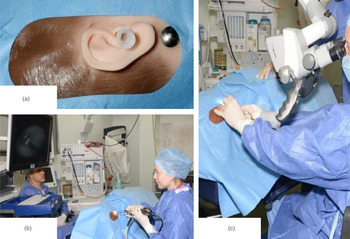
The main advantage of the endoscope is a wider field of view, as well as the ability to visualise structures from different angles, to see around corners (using angled endoscopes), and to adjust magnification by simply advancing or withdrawing the probe.Reference Akyigit, Sakallıoglu and Karlidag3 Conversely, microscopy provides a linear view that is restricted by a narrow external ear canal (Figure 1). Experienced endoscopic surgeons report shorter operative times.Reference Akyigit, Sakallıoglu and Karlidag3 Furthermore, patients experience less operative morbidity,Reference Patel, Aiyer, Gajjar, Gupta, Raval and Suthar4 faster post-operative recoveryReference Akyigit, Sakallıoglu and Karlidag3 and a more favourable cosmetic outcome with endoscopic approaches.Reference Pothier5,Reference Tseng, Lai, Wu, Yuan and Ding6
(a) Image demonstrating the position of the ‘Bradford Grommet Trainer’ within the external ear canal of the manikin. (b) Image showing a participant inserting a ventilation tube using an endoscopic approach. (c) Image showing the arrangement for the traditional microscopic technique.

Despite established advantages, there is resistance to the widespread adoption of endoscopic ear surgery. One of the most commonly cited disadvantages of endoscopic ear surgery is the ‘one-handed’ approach, which is perceived as challenging to learn.Reference Pothier5,Reference Martellucci, Pagliuca, de Vincentiis, De Virgilio, Fusconi and Gallipoli7,Reference Iannella and Magliulo8 Combined with the relatively recent emergence of the necessary technology, this perception has resulted in fewer teaching opportunities, and is a barrier to the widespread adoption of endoscopic ear surgery in the UK.Reference Kozin and Lee2
Attempts have been made to assess the learning curve of endoscopic ear surgery, but studies are retrospective,Reference Iannella and Magliulo8 or they ‘chunk’ evidence to facilitate comparison with the microscope over different time intervals.Reference Doğan and Bayraktar9,Reference Tseng, Lai, Wu, Yuan and Ding10 Thus, these studies fail to directly compare the endoscopic approach with an operating microscope. There are few examples of research assessing the overall rate of learning in order to estimate the point of curve plateau,Reference Feldman, Cao, Andalib, Fraser and Fried11 despite a method using non-linear regression to fit an inverse curve being described by Feldman et al. in 2009.Reference Feldman, Cao, Andalib, Fraser and Fried11
This study aimed to directly compare endoscopic and microscopic middle-ear surgery by analysing novice surgeons performing myringotomy and ventilation tube insertions using a surgical simulator. The study attempted to answer the following questions: (1) how does the rate of learning differ when a novice surgeon is trained to perform a middle-ear surgical procedure using an endoscope as opposed to a microscope?; (2) is there any difference in final proficiency when performing middle-ear surgery using an endoscope or a microscope?; and (3) is the learning curve a justifiable reason for resistance to adopt an endoscopic approach for middle-ear surgery?
Materials and methods
Design and participants
This was a multi-centre, prospective study, using data collected over six sessions at the Prince Charles Hospital (Cwm Taf University Health Board), Morriston Hospital (Swansea Bay University Health Board), Wrexham Maelor Hospital and Ysbyty Gwynedd (both Betsi Cadwaladr University Health Board). Ethical approval was granted by the Cardiff University School of Medicine Research Ethics Committee.
Participants were surgically naïve medical students recruited via advertisement through Cardiff University ENT and surgical societies, and the Swansea University medical placement team. Participants completed a questionnaire detailing year of study, gender and handedness, and declared any formal endoscopic or microscopic training.
Surgical groups and procedure
Participants were randomly allocated to either the endoscope group or microscope group. A senior ENT specialist demonstrated each procedure using the appropriate equipment. Participants wore surgical gowns and gloves, and were assisted by ENT operating theatre staff to perform 10 consecutive ventilation tube insertions on the simulator using either a Storz 4 mm, 0-degree rigid endoscope or a Zeiss otomicroscope.
The chosen simulator was Jesudason and Smith's (2004) Bradford Grommet Trainer,Reference Jesudason and Smith12 which was the preferred low-fidelity ventilation tube insertion trainer in a recent review.Reference Mahalingham, Awad, Tolley and Khemani13 Two disposable auricular temperature probe covers are arranged in series; the membrane of the internal cylinder is pulled taut by the second probe cover, acting as the tympanic membrane. The simulator was inserted into the right ear of a manikin and draped for enhanced realism. The right ear was chosen for comparison of the otomicroscopic technique with the potentially more challenging side used for endoscopy, thus minimising bias towards endoscopic ear surgery.
Instruction, demonstration and assessment was consistent with the procedure as classically performed in vivo. The tympanic membrane (of the simulator) was visualised using the assigned technique. An incision was made using a myringotome in the antero-inferior quadrant and a ventilation tube was inserted using aural forceps.
Outcome measures
The primary outcome measure was trial time, which started when the participant was handed the myringotome, and ended after either a successful insertion or a fail. Failure was defined as an ‘irretrievable drop’ of a ventilation tube, either into the middle ear or outside of the surgical field. ‘Retrievable drops’ onto the surgical field were also measured. These outcome measures are considered to be a surrogate marker of proficiency.
Trial time was used to calculate the rate of learning using the slope of the resulting learning curve, and the ‘asymptote’, which represents the best potential operative time following infinite attempts.
Statistical analysis
A non-linear regression model was used to calculate comparable learning curves, where the time taken was assumed to be a constant ‘best performance’ time plus a term inversely proportional to the number of practice attempts. The full model is given in equation 1. The mean number of ventilation tube drops was calculated for each attempt within the groups. The Wilcoxon rank-sum test was used to determine significance. No failed attempts were included in the calculation of the mean time for each attempt. Bootstrapping was performed within each group to give an approximate 95 per cent confidence interval for the ‘best performance’ time and learning rate. All analyses were performed in R statistical software.14
 $$time\lpar attempt\rpar = a + \displaystyle{b \over {attempt}}$$
Results
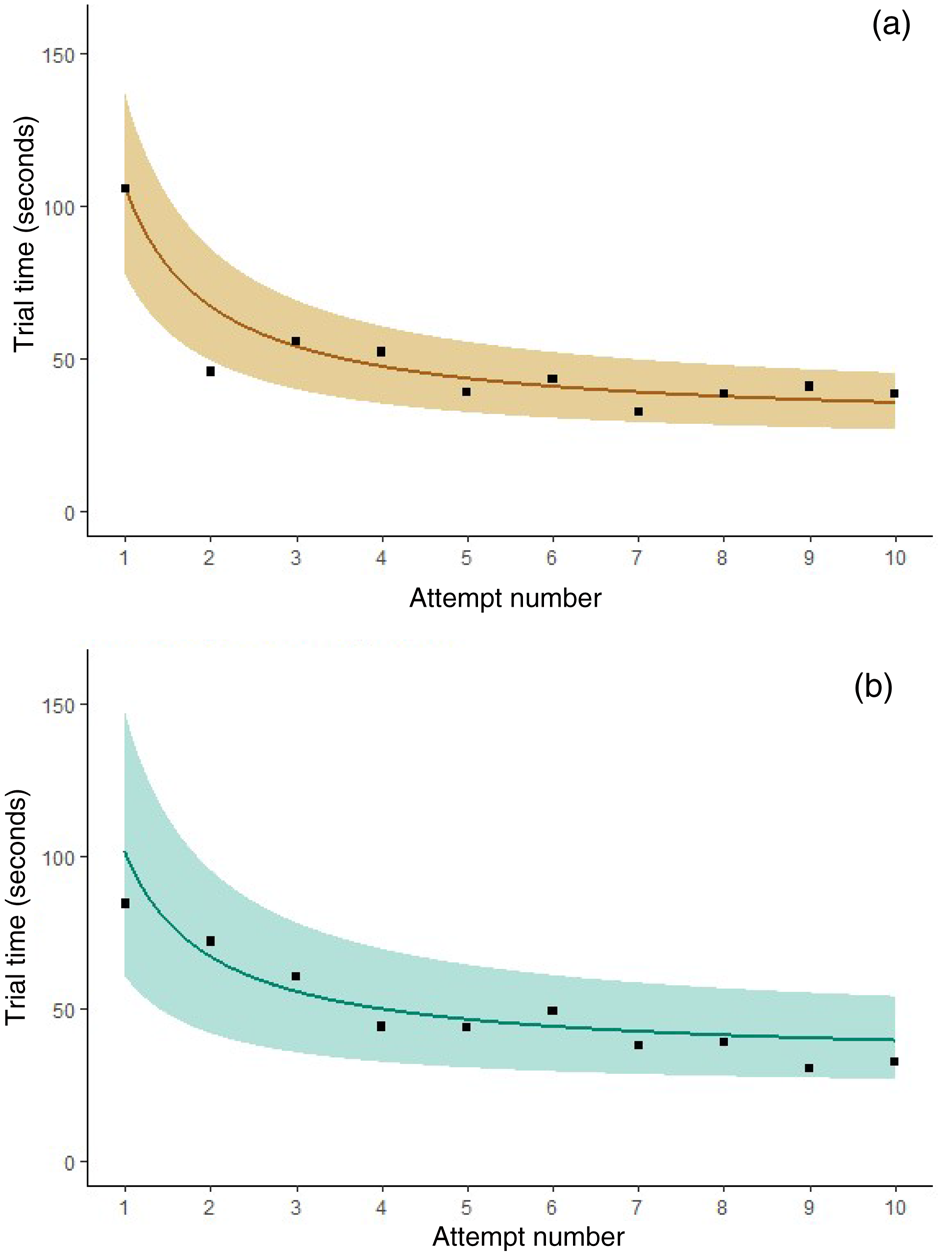
The inverse curves fitted to the mean times for both groups are displayed in Figure 2. The R2 value was 0.41, where 1 indicates a perfect fit where the model explains all variability of data around its mean.
Non-linear regression inverse learning curves for (a) endoscope group (learning rate value of 78.71 (95 per cent confidence interval (CI) = 56.46–101.86); asymptotic time of 27.87 seconds (95 per cent CI = 21.25–35.23)) and (b) microscope group (learning rate value of 68.62 (95 per cent CI = 37.49–103.62); asymptotic time of 32.83 seconds (95 per cent CI = 23.28–43.79)). A greater learning rate value indicates a slower rate of learning. Asymptotic time represents the best potential time after infinite attempts and, by extension, the time at which the learning curve plateaus. The coloured areas indicate approximate 95 per cent confidence intervals for the learning curve.

There was no significant difference in learning rate (p = 0.41) or best potential time (p > 0.05) between the two groups. There was also no significant difference in the mean number of ventilation tube drops (p > 0.05).
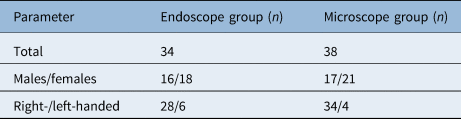
Participant demographics are displayed in Table 1. Gender and handedness were roughly evenly distributed across both groups. All years of the Cardiff University School of Medicine (years 1–5, plus intercalating students) and Swansea University Medical School (post-graduate only, years 1–4) were represented. No participants reported formal training in either the endoscopic approach or microscopic technique.
Participant demographics

Discussion
Research question one
How does the rate of learning differ when a novice surgeon is trained to perform a middle-ear surgical procedure using an endoscope as opposed to a microscope? The lack of a significant difference suggests that the two methods have statistically indistinguishable rates of learning.
Research question two
Is there any difference in final proficiency when performing middle-ear surgery using an endoscope or a microscope? No significant difference in the best potential procedure time, or number of drops per participant, could be found between the two experimental groups. This suggests that final proficiency is similar when performing myringotomy and ventilation tube insertion using an endoscope or a microscope.
Research question three
Is the learning curve a justifiable reason for resistance in the adoption of an endoscopic approach for middle-ear surgery? The lack of a significant difference in rates of learning between the two groups does not support resistance in the adoption of endoscopic ear surgery on the basis of a learning curve alone. This is corroborated by the findings of Martellucci et al., who carried out a pilot study comparing the feasibility and outcomes of myringotomy and ventilation tube insertion with an endoscope versus a microscope.Reference Martellucci, Pagliuca, de Vincentiis, De Virgilio, Fusconi and Gallipoli7 Those authors found no significant difference in operative times or complication rates, and concluded that an endoscopic approach is a viable alternative to the operating microscope.Reference Martellucci, Pagliuca, de Vincentiis, De Virgilio, Fusconi and Gallipoli7 Similar findings have been reported in studies assessing the endoscopic approach in more complex middle-ear surgical procedures, with many concluding that the endoscope in fact improves optimal proficiency.Reference Patel, Aiyer, Gajjar, Gupta, Raval and Suthar4,Reference Huang, Ho, Wang, Chien and Wang15
Operative time may not be a suitable marker for rates of learning. Iannella et al. assessed operative times and learning curve in 20 endoscopic and 20 microscopic stapedectomies over 12 months.Reference Iannella and Magliulo8 Although average operative time was significantly longer in the endoscopic group, the length of the procedure decreased as the surgeon gained experience. When only comparing the operative times from the last 10 patients in each group, there was no significant difference in procedure times. However, Iannella et al. assessed the endoscopic learning curve in microscopically trained surgeons.Reference Iannella and Magliulo8 This study is unique in that it used novice surgeons, and is therefore more relevant to informing surgical curricula.
Our study findings have potential limitations. In using the Bradford Grommet Trainer, we eliminated factors that can give the microscope an advantage over the endoscope, such as anatomical variation and haemorrhage.Reference Kozin and Lee2,Reference Bakshi16,Reference Musbahi, Aydin, Al Omran, Skilbeck and Ahmed17 This provides an abnormally clear endoscopic view of the tympanic membrane. Maintaining adequate haemostasis without suction represents one of the major challenges of endoscopic ear surgery.Reference Akyigit, Sakallıoglu and Karlidag3,Reference Tseng, Lai, Wu, Yuan and Ding10 Conversely, the simulator also presents a simplified version of ear canal anatomy, which gives an unrealistically broad microscopic view of the middle ear. Alternative simulators could be considered for future research; for instance, an ovine ear model for fully endoscopic stapedectomy training has been validated.Reference Cordero, Benitez, Reyes, Vaca, Polo and Pérez18 Staff variation across multiple sites is likely to diminish the effect of collection biases. Participants experience an altered angle of approach and view of the middle ear depending on handedness.Reference Kozin and Lee2 Separately, video-gaming experience has been reported to improve endoscopic performance, with early studies suggesting superior hand–eye co-ordination, visualisation skills and faster reaction times.Reference van Dongen, Verleisdonk, Schijven and Broeders19 These factors were not controlled.
The best potential times rely on statistical estimates of a learning curve plateau based on 10 ventilation tube insertions. Whilst not directly comparable to this study, Dogan and Bayraktar found that mastering endoscopic tympanoplasty takes approximately 60 operations for a surgeon already trained in the microscopic technique.Reference Doğan and Bayraktar9 In addition, Tseng et al. described operative time plateauing only after 150 tympanic membrane perforation repairs.Reference Tseng, Lai, Wu, Yuan and Ding10 Other studies that investigated the learning curves of surgical procedures, such as that by Feldman et al., also used more than 10 repetitions of a task.Reference Feldman, Cao, Andalib, Fraser and Fried11 Operating theatre availability restricted the number of repetitions possible per participant in this study. Ten insertions do, however, yield sufficient data to demonstrate a learning curve and calculate an asymptote, which is a statistical prediction of a learning curve plateau.
• Rate of learning is often cited as a deterrent in the use of endoscopic ear surgery
• Assessments of the endoscopic ear surgery learning curve have not directly compared the endoscopic approach with the microscopic technique
• Little research has assessed overall rate of learning to estimate the point of curve plateau
• This multi-centre, prospective, randomised study assessed endoscopic and microscopic learning curves in 72 students simulating myringotomy and ventilation tube insertion
• Clarification of this perceived deterrent should influence surgical training programmes, and would impact expected surgical outcomes
Whilst the learning curve must not be the only consideration when determining the benefits and drawbacks of endoscopic middle-ear surgery, the suggestion that rate of learning is comparable in novice surgeons is valuable. If there is no difference in rate of learning, fewer arguments remain in support of favouring the traditional microscopic approach for middle-ear surgery. This should influence surgical training programmes, and would impact expected surgical outcomes.
Acknowledgements
The authors would like to thank the following people for assisting in data collection at the four study sites: Dan Edwards, Aneurin Bevan University Health Board, Newport; Jake Ahmed, Betsi Cadwaladr University Health Board, Wrexham; David Snow, Betsi Cadwaladr University Health Board, Wrexham; Ameeth Sanu, Swansea Bay University Health Board; David Smith, Cwm Taf Morgannwg University Health Board, Ynysmaerdy; Senthil Rajamanickan, Betsi Cadwaladr University Health Board, Bangor; and David Hill, Betsi Cadwaladr University Health Board, Bangor, Wales, UK.
Competing interests
None declared