Studies of children and adolescents indicate that waist circumference/height is a better predictor of cardiovascular risk factors than body mass index.Reference Savva, Tornaritis and Savva 1 Waist circumference/height is more convenient than waist circumference alone for clinical use, as it does not require age, gender, and race reference points.Reference Maffeis, Banzato and Talamini 2 Initial adult and paediatric studies have proposed a value for waist circumference/height <0.5 as an ideal ratio to maintain for a normal waist circumference.Reference Hsieh and Muto 3 , Reference McCarthy and Ashwell 4 A recent publication also supports the use of waist circumference/height <0.5. In addition, the study supports using waist circumference/height between ⩾0.5 and <0.55 to identify borderline or at risk individuals for central obesity and the use of waist circumference/height ⩾0.55 to identify central obesity with a high probability.Reference Mehta 5
Left ventricular mass predicts cardiovascular risk in adultsReference Bluemke, Kronmal and Lima 6 and it probably has similar predictive value in children. With increasing left ventricular mass, there is an increasing risk for death and cardiovascular disease in adults.Reference Barbieri, Bursi and Mantovani 7 Among the general population, obesity and hypertension, the two foremost contributors to left ventricular mass, begin their influence in childhood.Reference Lai, Sun and Cen 8 In a recent study of 6- to 16-year-old 105 obese and 105 morbidly obese patients, as defined by body mass index, authors reported waist circumference/height had the highest area under the curve on receiver operating characteristic curve analysis than body mass index or waist circumference in relation to left ventricular hypertrophy with an optimal cut-point of 0.58.Reference Di Bonito, Moio and Sibilio 9 The present study was carried out to evaluate left ventricular mass in patients with central obesity as defined by waist circumference/height.
Materials and methods
A total of 715 patients were evaluated by a paediatric cardiologist at a community hospital between August, 2005 and September, 2014. Referral diagnoses in studied patients included heart murmur, chest pain, palpitations, and dizziness. After evaluation, all of the presenting symptoms were found to be non-cardiac in origin. Heart murmurs were innocent murmurs. Children who had documented or suspected cardiac pathology based on history, clinical evaluation, electrocardiograms, and two-dimensional and Doppler echocardiography were excluded. Every effort was made to include only patients with normal hearts.
Among 715 clinically normal patients between 2 and 20 years of age with structurally normal hearts, 119 patients had central obesity (waist circumference/height ⩾0.55), 165 patients were at risk for central obesity (waist circumference/height between ⩾0.5 and <0.55), and 431 patients had no central obesity (waist circumference/height <0.5). As the left ventricular mass is related to age and gender, patients with central obesity were matched randomly by software to match for age and gender with patients at risk for central obesity and patients with no central obesity. Among 119 patients with central obesity, 52 (Group 1) had age and gender that could be matched with 52 patients who were at risk for central obesity (Group 2) and 52 patients who had no central obesity (Group 3). Only three patients, one in each group, were >18 years old. Primary referral diagnoses in the studied patients (n=156; 52 from each three groups) included heart murmur (n=36), chest pain (n=28), dizziness and syncope (n=33), palpitations (n=23), family history of heart disease (n=6), abnormal heart rate or abnormal electrocardiogram (n=14), and miscellaneous other reasons (n=22).
Despite their normal clinical examination results and normal complete echocardiograms, additional steps were taken to evaluate their Z scores of left ventricular mass as an initial step. All 156 patients had Z scores of their left ventricular mass <2, except for one patient from Group 1 with central obesity who had a Z score of 2.01. In addition, only 13 of the 156 patients had systolic blood pressures ⩾95th percentile:Reference Kuczmarski, Ogden and Guo 10 six patients with central obesity (6.2±3.9 mmHg); six at risk for central obesity (1.2±1.8 mmHg); and one patient with no central obesity (3 mmHg). None of the 156 patients had diastolic blood pressures ⩾95th percentile. These blood pressures values were noted at the time of their initial visit and may not necessarily imply the presence of hypertension. This study was approved by the Institutional Review Board.
Patient measures
All patients had their body weight in kilograms, height in centimetres, heart rate, respiratory rate, and blood pressure measured by a cardiac nurse. Each patient underwent clinical evaluation by a single paediatric cardiologist. Resting blood pressures were measured using a sphygmomanometer (Welch Allyn Inc., New York, United States of America) in the right arm with the patients comfortably seated, their legs hanging, and their right arm at heart level with the appropriate size cuff as described by The Fourth Report on the Diagnosis, Evaluation, and Treatment of High Blood Pressure in Children and Adolescents. 11
Based on the Center of Disease Control Prevention Guidelines, waist circumference was measured to the nearest 0.1 cm with the patient in a standing position. The measurements were made using a standard measuring tape just above the supero-lateral border of the right and left iliac crests, and were obtained during exhalation while keeping the measuring tape parallel to the floor on all sides. The tape was then tightened slightly to make it snug without compressing the skin and the underlying subcutaneous tissues. 12
Echocardiographic measures
Echocardiograms included standard two-dimensional and Doppler studies of the left-sided heart structures. All the studies were carried out using a commercially available ultrasound system (Sonos 5500 or IEE 33 Philips Medical System, Andover, Massachusetts and Bothell, Washington, United States of America), with the patient in supine and in the left lateral decubitus position. All patients underwent a complete two-dimensional, color flow Doppler, and spectral Doppler examination and all the other measurements were carried out according to the standard recommended laboratory protocol. Furthermore, two-dimensionally guided motion-mode measurements were carried out for the interventricular septum in end diastole and end systole, the left ventricular posterior wall in end diastole and end systole, and the left ventricular dimension in end diastole and end systole from a parasternal long-axis view at the level of the tips of the papillary muscles using the leading edge-to-leading edge technique.
Left ventricular mass was indexed to body surface area, height in meters raised to the 2.7th power, and height in meters raised to the 1.7th power. Z scores, based on left ventricular mass-for-height percentile curves, were calculated according to the data published by Foster et al.Reference Foster, Mackie, Mitsnefes, Ali, Mamber and Colan 13 Absolute left ventricular mass was calculated during diastole based on the recommendations for Chamber Quantification Writing Group of the American Society of Echocardiography’s Guidelines and Standards Committee and the European Association of Echocardiography.Reference Lang, Bierig and Devereux 14
Statistical analysis
The primary independent variable was considered to be waist circumference/height. The dependent variables in this study were left ventricular mass, left ventricular mass/height1.7, left ventricular mass/height2.7, left ventricular mass/body surface area, and Z scores for left ventricular mass calculated from echocardiographic measures. Systolic blood pressure, diastolic blood pressure, body mass index, and waist circumference were considered as potential confounders of the associations of interest. The dependent variables were compared across the three groups using analysis of variance. As patients with central obesity in Group 1 had significantly higher systolic blood pressures compared with patients with no central obesity in Group 3, the data were analysed with multiple regression analysis between left ventricular mass and body mass index, waist circumference, waist circumference/height, systolic and diastolic blood pressures. Statistical significance was defined a priori as p<0.05. The data are presented as means and standard deviation.
Results
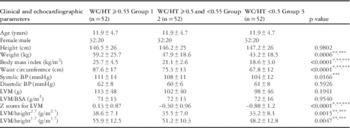
Table 1 shows the demographic data and left ventricular mass parameters as measured by echocardiography in 156 patients, 52 patients each in Group 1 with central obesity, Group 2 with at risk for central obesity, and Group 3 with no central obesity, respectively, matched for age and gender. Significantly higher left ventricular mass parameters were noted in patients with central obesity (waist circumference/height ⩾0.55) compared with age- and gender-matched controls who were at risk for central obesity (waist circumference/height ⩾0.5 to <0.55) and who had no central obesity (waist circumference/height <0.5). In addition to significantly higher body mass index and waist circumference in patients with central obesity (Group 1) than patients at risk for central obesity (Group 2) and patients with no central obesity (Group 3), Group 1 patients with central obesity also had significantly higher systolic blood pressures than Group 3 with no central obesity. A multiple regression analysis between left ventricular mass and body mass index, waist circumference, waist circumference/height, and systolic and diastolic blood pressures showed a significant (p<0.0001) contribution to left ventricular mass by body mass index, waist circumference, and waist circumference/height, but not by the systolic (p=0.85) or diastolic blood pressure (p=0.66).
Patient demographics and LVM parameters as measured by echocardiography.

BP=blood pressure; BSA=body surface area; HT=height; LVM=left ventricular mass; WC=waist circumference
* Significant difference between Groups 2 and 3
** Significant difference between Groups 1 and 2
*** Significant difference between Groups 1 and 3
Discussion
The presence of significantly higher left ventricular mass parameters in patients with central obesity (waist circumference/height ⩾0.55) compared with age- and gender-matched controls who were at risk for central obesity (waist circumference/height ⩾0.5 to <0.55) and who had no central obesity (waist circumference/height <0.5) support the use of waist circumference/height ⩾0.55 to define central obesity. In the present study, left ventricular mass correlated significantly to body mass index, waist circumference, and waist circumference/height, but not to blood pressure.
The present study does not address the question whether higher left ventricular mass parameters in patients with central obesity as defined by waist circumference/height were primarily the result of higher body mass index; however, it is unlikely that higher body mass index alone in the absence of increased waist circumference could have contributed significantly to left ventricular mass, as young patients with elevated body mass index who have normal waist circumference had a left ventricular mass profile similar to patients with normal body mass index with normal waist circumference.Reference Mehta 15 Lean body mass, waist circumference, and body surface area were the best predictors of left ventricular mass in the same study.Reference Mehta 15 In addition, 55% of overweight children and adolescents who have no central obesity have a normal metabolic risk profile.Reference Khoury, Manlhiot and McCrindle 16 Therefore, measurement of waist circumference is important for proper cardiovascular risk assessment. According to one study, body mass index appears to have similar ability to predict cardiovascular risk as waist circumference/height. The authors of this study preferred waist circumference/height because of its simplicity.Reference Freedman, Kahn and Mei 17 In children and adolescents, body mass index interpretation based on percentiles requires age- and gender-related reference values.
A recent analysis indicated that waist circumference/height was a better predictor of mortality risk than body mass index among patients between 30 and 70 years of age. In addition, these authors quantified years of life lost with increasing waist circumference/height. The waist circumference/height of 0.5 had minimum mortality risk. A slight increase in mortality started with waist circumference/height between 0.5 and 0.6, whereas it increased markedly beyond waist circumference/height ⩾0.6.Reference Ashwell, Mayhew, Richardson and Rickayzen 18
Based on the European anthropometric body composition indices in European children between the ages of 2 and 11 years, the reference values for waist circumference/height at the 97th percentile among boys and girls were between 0.48 and 0.58.Reference Nagy, Kovacs and Moreno 19 In a cohort of 46,651 European men and women aged between 24 and 99 years, a threshold value for cardiovascular and all-cause mortality was 0.57 in men and 0.6 in women. It appears that significant cardiovascular risk in young patients starts beyond waist circumference/height >0.55. The left ventricular mass data from the present study indirectly support this concept. In the absence of long-term follow-up studies, it is reasonable to use left ventricular mass as a surrogate for cardiovascular risk assessment in children based on adult data.
This study suffers from limitations inherent to any retrospective analysis. A potential weakness of this study is the inclusion of patients who were referred to a paediatric cardiac sub-specialist. During inclusion, substantial efforts were made to exclude patients with any cardiac pathology. As mentioned above, all 156 patients had Z scores of left ventricular mass <2, except for one patient from Group 1 with central obesity who had a Z score of 2.01. It is also likely that these aggressive efforts resulted in exclusion of patients with obesity-related hypertension that contributes to an increase in left ventricular mass. Only six of the 52 patients with central obesity had systolic blood pressures ⩾95th percentile. In addition, none of the patients had diastolic blood pressures ⩾95th percentile. The lack of significant correlation between blood pressures and left ventricular mass is likely the result of this selection process.
As compared with fasting blood lipids and glucose panels, anthropometric markers such as body mass index, waist circumference, and waist circumference/height may not be the ideal markers of metabolic co-morbidity among obese children and adolescents;Reference Morandi, Miraglia Del Giudice, Martino, Martino, Bozzola and Maffeis 20 however, a simple anthropometric measure such as waist circumference/height would be valuable and extremely economical to monitor progression and progress of children and adolescents to reduce adiposity and to modify behaviour interventions by providers, patients, and their families.Reference McCrindle 21
To lower their cardiovascular risk, it is crucial that children and adolescents keep their waist circumference/height <0.5. It is reasonable that a waist circumference/height ⩾0.5 and <0.55, classified as “at risk” for central obesity, should be managed similarly to currently classified overweight children and adolescents with body mass index ⩾85th percentile but <95th percentile. Children and adolescents with waist circumference/height >0.55 require aggressive management of their central obesity with the principal goal of preventing future cardiovascular risk.
The foremost goal remains the early identification of overweight and obese children with central obesity in the general population independent of age, gender, and ethnicity. The use of waist circumference/height offers substantial benefits over the use of body mass index and waist circumference, as this ratio is easy to communicate when educating about cardiovascular risks to children, their families, and for mass screening and public health campaigns without the need for any reference values. This is particularly important for many national or international communities where reference values for body mass index or waist circumference are not readily available or not applicable for certain ethnic populations. In addition, these waist circumference/height threshold values appear to be valid, as the children become adults.
Acknowledgement
The author is deeply indebted to Irwin Jacobs, MD, for providing his valuable criticisms and suggestions to improve the manuscript.
Financial Support
This research received no specific grant from any funding agency, commercial, or not-for-profit sectors.
Conflicts of Interest
None.
Ethical Standards
The author asserts that all procedures contributing to this work comply with the ethical standards of the United States national guidelines on human experimentation and with the Helsinki Declaration of 1975, as revised in 2008, and has been approved by the institutional review board of the Cleveland Clinic Enterprise.