Introduction
Food legumes, source of proteins, are one of the best and the least expensive solution for quality food supply in tropical African countries (Olakojo et al., Reference Olakojo, Ayanwole and Obasemola2007; Adam & Baidoo, Reference Adam and Baidoo2008; Lephale et al., Reference Lephale, Addo-Bediako and Ayodele2012), and are therefore valued as a nutritional supplement to cereals and an extender of animal proteins (Modu et al., Reference Modu, Laminu and Abba Sanda2010; Bamishaiye et al., Reference Bamishaiye, Bamshaiye and Adegbola2011). Seeds of legumes are however very susceptible to different species of beetles of the family Chrysomelidae in storage (Nyamador, Reference Nyamador2009; Swella & Mushobozy, Reference Swella and Mushobozy2009). Among these insect pests, Callosobruchus maculatus F. is a cosmopolitan pest that mainly attacks almost all varieties of cowpea [Vigna unguiculata (L.) Walp.] (Nalini et al., Reference Nalini, Kumari, Rajavel and Baskaran2012; Badii et al., Reference Badii, Asante and Sowley2013; Castro et al., Reference Castro, Baldin, Cruz, Souza and Silva2013). C. maculatus causes substantial quantitative and qualitative loses making the seeds unfit either for planting or for human consumption (IITA, 1989; Ali et al., Reference Ali, Mahgoub, Hamed and Gharib2004). The control of this pest is crucial to the sustainable production and availability of seeds of legumes in developing countries.
Seeds with resistance represent an attractive pest management strategy during storage because they provide an efficient, economical, and environmental-friendly approach for effectively managing pests. The susceptibility of some varieties of cowpea to infestation and damage by C. maculatus with the aim to select those with inherent resistance for inclusion in breeding programs was successfuly carried out worldwide (Addo-Bediako et al., Reference Addo-Bediako, Lephale and Ayodele2012; Badii et al., Reference Badii, Asante and Sowley2013; Castro et al., Reference Castro, Baldin, Cruz, Souza and Silva2013). Unfortunately, a resistant variety to insect attack in a given locality may be susceptible in another due to the interaction between the genotype and the environment as well as the reproductive performance of the pest which may vary according to environmental factors (Khaliq et al., Reference Khaliq, Javed, Sohail and Sagheer2014). So far, no study reports the findings of screened local cowpea genotypes against C. maculatus in an effort to select local or breeding varieties with high resistance to post harvest insect pests, especially C. maculatus for cultivation and breeding purposes in Northern Cameroon. The present study was therefore undertaken to evaluate the susceptibility of genotypes of cowpea to infestation by C. maculatus with the aim of selecting those with inherent resistance for cultivation or inclusion in breeding programs under the conditions of Sudano-Sahelian (SS) and Sudano-Guinean agroecological zones (SG) of Cameroon.
Materials and methods
Experimental localities
The research work was conducted in the Laboratory of Applied Zoology of the Department of Biological Sciences, University of Ngaoundere in the Adamawa region of Cameroon and in the Laboratory of Entomology of the same institution at Maroua in the Far North Region of Cameroon. Maroua (latitude 10.44°N, longitude 14.25°E, elevation 422 m above sea level) belongs to the SS of Cameroon characterized by unimodal rainfall (Tingem et al., Reference Tingem, Rivington, Bellocchi, Azam-Ali and Colls2008). The rainy season lasts 4 months from June to September with two intermediate months of unreliable rainfall in May and October. Mean total annual rainfall is approximately 834 mm and the mean annual temperature is 34.5°C. Ngaoundere (latitude 7.34°N, longitude 13.57°E, elevation 1104 m above sea level) in the SG of Cameroon is also characterized by unimodal rainfall. The rainy season lasts 6 months from May to October and the annual average rainfall is 1514 mm. The average annual temperature is 29.0°C (Tingem et al., Reference Tingem, Rivington, Bellocchi, Azam-Ali and Colls2008).
Experimental conditions
Experiments were carried out under ambient conditions in the Laboratory of Entomology [27.83 ± 2.06°C (22.00–32.00°C), 80.65 ± 6.13% relative humidity (r.h.) (61.00–94.50% r.h.), and 12/12 photoperiod] and the Laboratory of Applied Zoology [22.57 ± 1.43°C (19.50–32.00°C), 82.01 ± 3.03% r.h. (55.50–88.50% r.h.), and 12/12 photoperiod], respectively, under conditions of SS and SG of Cameroon.
Collection and characterization of cowpea genotypes
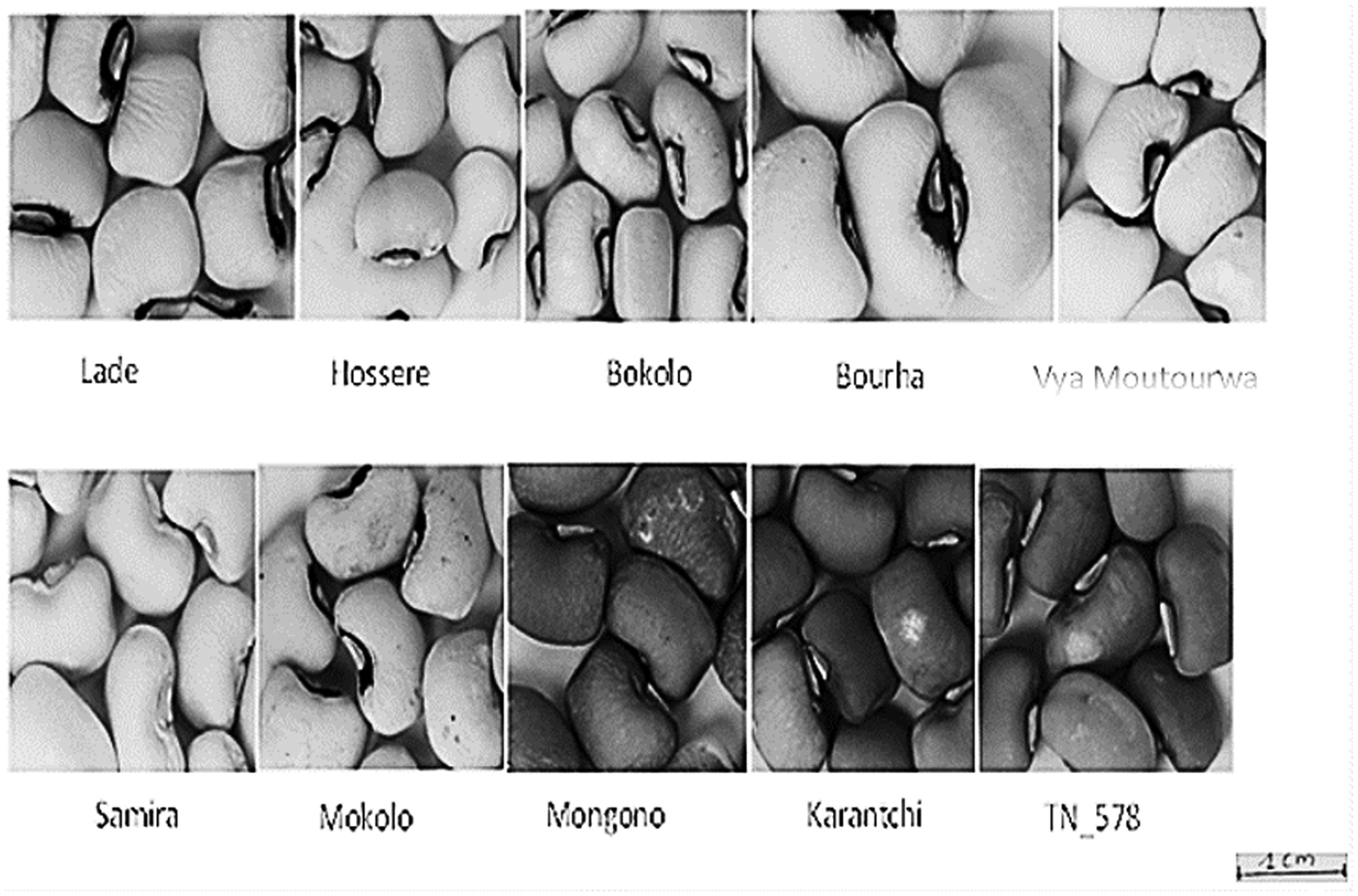
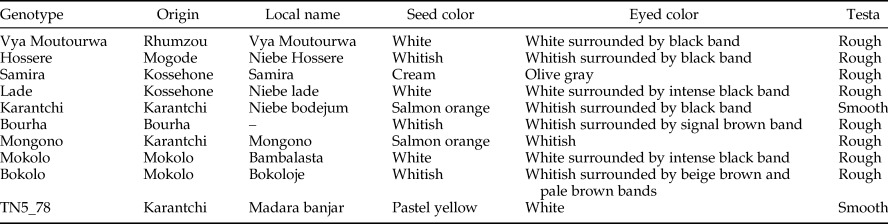
Cowpea genotypes used in these experiments consisted of nine local widely cultivated lines and one improved variety of IITA (TN5_78). The tested genotypes are presented in table 1. Seeds were collected from farmers in the Far North Region of Cameroon in six localities, and were identified and named at the Department of Annual Crops, Institute of Agricultural Research for Development (IRAD) of Maroua station, Far North Region of Cameroon on the basis of their locality of production, local name, and testa or eye color (fig. 1).
Flowchart of study selection process.

Origin and description of cowpea genotypes.

Seed disinfestations
The seeds were cleaned to remove all foreign matter such as dust, dirt, and chaff as well as immature and damaged seeds and then disinfested in order to eliminate the potential forms of any living organism by keeping them in a freezer at −18°C for 21 days prior to the bio-assays. The seeds were then kept under the experimental conditions for at least 2 weeks before use.
Determination of physical properties of cowpea seeds
Seed weight (g per 100 seeds) was measured by selecting randomly 100 seeds and weighing them in an electronic balance (Kern & Sohn GmbH, D-72336 Balingen, Germany) to an accuracy of 0.001 g (Mohammad et al., Reference Mohammad, Reza, Akram and Abbas2010). The length, width, and thickness of each genotype were determined using a vernier calliper with 0.05 mm accuracy. Fifty seeds were randomly selected from each sample of about 2500 seeds. The three principal dimensions of the selected seeds were measured and their averages were recorded. The average diameter (Dg), surface area (S), the sphericity (Sp), and seed volume were determined using, respectively, the methods described by Unal et al. (Reference Unal, Isik and Alpsoy2006), Noubissié et al. (Reference Noubissié, Bell, Ngakeu, Njintang and Youmbi2011), Mohsenin (Reference Mohsenin1986), and Jain & Bal (Reference Jain and Bal1997). The color of the seed was determined by using a color chat, and the curvature or smoothness on a visual basis.
Chemical analyses
Proximate analyses were performed on two resistant, two moderately susceptible, and two susceptible genotypes under Sudano-Guinean conditions, i.e. in the SG. The air-dried seeds (100 g) of each genotype were powdered separately on a Wiley Mill (Scientific Equipment Works, Delhi, India) to 150 µm mesh size. The fine seed powders obtained were stored hermetically separately in polyethylene bags in a refrigerator at about 4°C until needed for chemical analyses.
The moisture and crush ash contents of the seeds were determined according to AFNOR (1981, 1982) methods. Carbohydrates and soluble sugars were determined by using the method of Dubois et al. (Reference Dubois, Gilles, Hamilton, Roberts and Smith1956); total proteins determination was done according to the Kjeldahl (AFNOR, 1984) and Devani et al. (Reference Devani, Shishoo, Shal and Suhagia1989) methods, while lipids were determined according to UICPA (1979). Crude fiber content of samples was determined by the method of Weende (Wolff, Reference Wolff1968), total polyphenolics by using Folin–Ciocalteu reagent as described by Makkar et al. (Reference Makkar, Blummel, Borowy and Becker1993) and saponins content was determined by using Harborne (Reference Harborne1973) method. Phytates, tannins, flavonoids, alkaloids, steroids, and triterpenoids were phytochemically screened as described by Adeniyi et al. (Reference Adeniyi, Orjiekwe, Ehiagbonare and Arimah2010).
Insect rearing
Insects used were originally collected in Mokolo market, Mayo-Tsanaga division in Far North Cameroon and subsequently cultured in the laboratory on cowpea, the most suitable host plant for the C. maculatus development. Twenty glass jars (900 ml) at each experimental locality in which 30 adults were placed on 250 g cowpea were used for the insect rearing. Cowpea seeds were renewed after four generations of C. maculatus and infested with adults from different jars to avoid cost of inbreeding (Edvardsson et al., Reference Edvardsson, Tregenza and Rodriguez-Munoz2008) and polymorphism induction in culture (Taylor, Reference Taylor1974), since only the flightless forms were used in our study.
Assessment of susceptibility
Fifty grams of seeds of each genotype were individually placed in small glass jars (500 ml) before ten pairs (♂/♀) of the newly emerged (not more than 24 h old) adults of C. maculatus were introduced. The jars were then covered with gauze cloth and perforated metal lids to allow the weevils to breathe and avoid any external contamination (Erler et al., Reference Erler, Ceylan, Erdemir and Toker2009; Eker et al., Reference Eker, Erler, Adak, Imrek, Guven, Tosun, Sari, Sari, Upadhyaya, Toker and Ikten2018). The experiment was arranged in a completely randomized design with five replications. Six days after the infestation, the adults were removed, while observations for emergence started 3 weeks after infestation. The seeds were observed daily for adult emergence till the end when in three consecutive days no adult emerged. Data on number of emerged adults and the median developmental periods were recorded. The Dobie susceptibility index (SI) was used as the criterion to separate genotypes into different resistance groups (Dobie, Reference Dobie1974). The SI is calculated using following formula:
 $$SI = \displaystyle{{{\rm Loge}F_1} \over {MDP}},$$
where F 1 was the total number of emerging adults and MDP was the median developmental period (in days), which was calculated as the time from mid-oviposition period to 50% emergence of F 1 generation.
The Dobie Index (Dobie, Reference Dobie1974) was used to classify the genotypes into groups following the scales as follows: SI ≤ 4 was classified as resistant; SI = 4.1–6.0 as moderately resistant; SI = 6.1–8.0 as moderately susceptible; SI = 8.1–10 as susceptible; and SI > 10 was classified as highly susceptible.
Data analysis
All data collected were subjected to analysis of variance (ANOVA) procedures (SAS Institute, 2003). In order to ensure assumptions of ANOVA before analysis, data on adult emergence, mean developmental period, and SI were tested for normality and heterogeneity of variance (Nguyen et al., Reference Nguyen, Pham, Rodriguez de Gil, Hicks, Wang, Li, Bellara, Romano, Kim, Holmes, Chen and Kromrey2014). The number of F1 insect progeny was log transformed for harmonization of the data. Then, the transformed data were analyzed using one-way ANOVA. Tukey standardized ‘Honestly Significant Difference’ (HSD) tests were used to differentiate statistically different means at 5% level of significance. Correlation and regression analysis was also performed to evaluate the strength of a relationship between biological parameters and environmental conditions, as well as between the physico-chemical characteristics of cowpea genotypes and their level of resistance to insect attack.
Results
Physical properties
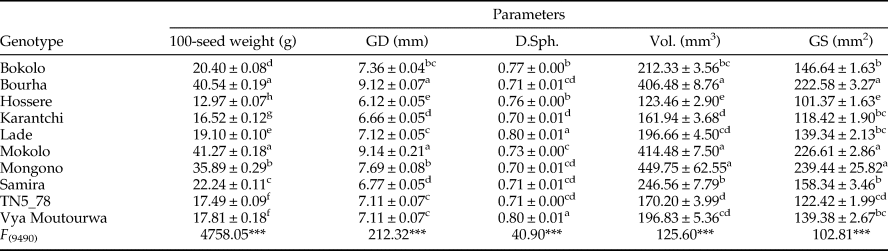
The average values of geometric diameters, sphericities, volumes, and geometric surface areas were established and varied from 6.12 to 9.14 mm, 0.71 to 0.80, 123.46 to 449.75 mm3, and 101.37 to 239.44 mm2, respectively. The 100-seed weight varied from 12.97 to 41.27 g. Mokolo, Bourha, and Mongono had the highest values for these parameters except sphericity, while Hossere had the lowest values. For all parameters studied, there were statistically significant differences among genotypes (F = 40.90–4758.05; P < 0.001) (table 2).
Physical proprieties of cowpea genotypes.

GD, geometric diameter; D.Sph., degree of sphericity; Vol., volume; GS, geometric surface.
***P < 0.001.
Means within the column followed by the same small letter(s) did not differ significantly at 5% level by Tukey test.
Chemical composition
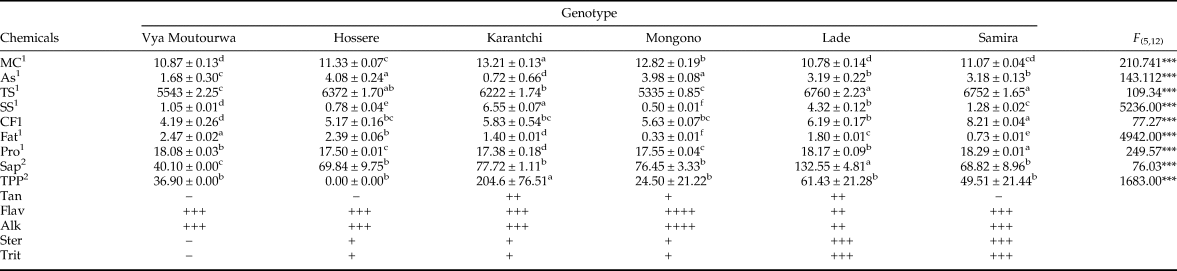
The proximate composition (table 3) showed significant differences among cowpea genotypes for all biochemical constituents analyzed (P < 0.001). Karantchi (13.21% moisture content) was the moistest variety while Lade, Vya Moutourwa, and Samira (10.78, 10.87 and 11.07% moisture contents, respectively) were the driest. Ash content was found to be highest in Hossere (4.08%) and Mongono (3.98%) followed by Samira (3.18%) and Lade (3.19%), while Karantchi (0.72%) and Vya Moutourwa (1.68%) were found to be very poor for ash. All genotypes tested contained high percentage of carbohydrates (53.35–67.60%); Lade (67.60%) and Samira (67.52%) had the highest value, while Vya (55.43%) and Mongono (53.35%) had the least. Karantchi followed by Lade were found to have very high concentrations of soluble sugars compared with the other genotypes especially Mongono and Hossere with contents <1% on dried matter basis. Samira (8.21%) and Lade (6.19%) had the highest content of crude fiber, while Vya Moutourwa had the lowest content (4.19%) compared with all other genotypes. Vya Moutourwa and Mongono were, respectively, the richest (2.47%) and the poorest (0.33%) genotypes for fat content. Protein contents varied from 17.38% (Karantchi) to 18.29% (Samira). The abundance of secondary metabolites such as saponins, total polyphenols, tannins, flavonoids, alkaloids, steroids, and triterpenoids varied among all cowpea genotypes. Steroids and triterpenoids were not detected in Vya Moutourwa but were detected though at low levels in Karantchi, Hossere, and Mongono. These metabolites were found to be abundant in Lade and Samira.
Chemical profiles (mean ± SE) of resistant (Samira, Lade), susceptible (Mongono, Hossere), and very susceptible (Vya, Karantchi) cowpea genotypes to Callosobruchus maculatus attack under Cameroon Sudano-Guinean conditions.

MC, moisture content; As, ash; TS, total sugar; SS, soluble sugar; CF, crud fiber; Pro, protein; Sap, saponins; TPP, total polyphenolic compounds; Tan, tannins; Flav, flavonoids; Alk, alkaloids; Ster, steroids; Trit, triterpenoids.
Qualitative test: –, absent; +, present but not abundant; ++, moderately abundant; +++, abundant; ++++, very abundant.
***P < 0.001.
Means in a line followed by the same letter(s) do not differ significantly at the 5% level by Tukey test.
1 In g/100 g dried matter.
2 In mg/100 g dried matter.
Adult emergence
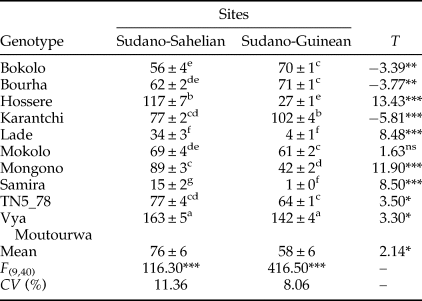
The genotypes showed significant difference (F = 4.09–597.04; P < 0.001) with respect to the number of emerged C. maculatus from the seeds under conditions of both SS and SG. Adult emergence was generally higher under conditions of the SS (15–163) than those of the SG (1–142) (table 4). Vya Moutourwa genotype had the highest number of emerged adults followed by Hossere (117) in the SS, whereas Karantchi (102 emerged adults) was far more infested than Hossere (27 emerged adults) in the SG. The lowest number of emerged adults was recorded for Samira followed by Lade under the conditions of both agro-ecological zones. The influence of environment on progeny production varied among genotypes and the means obtained from the different experimental localities were overall positively and significantly correlated (r = 0.69; P > 0.05). However, the ability of cowpea weevils to produce its progeny on Mokolo variety was statistically the same (T = 1.63; P > 0.05) under the conditions of the two agro-ecological zones. It was slightly affected by environmental conditions (P < 0.05) on Vya Moutourwa (T = 3.30) and TN5_78 (T = 3.50); moderately affected (P < 0.01) on Bokolo (T = 3.39) and Bourha (T = 3.77) and highly affected on Hossere, Mongono, Samira, Lade, and Karantchi (T = 5.81–13.43; P < 0.001).
Mean number (±SE) of emerged adults of Callosobruchus maculatus infesting cowpea under conditions of Sudano-Sahelian and Sudano-Guinean of Cameroon.

ns, not significant.
*P < 0.05; **P < 0.01; ***P < 0.001.
Means in a column followed by the same letter(s) do not differ significantly at the 5% level by Tukey test.
Median developmental period
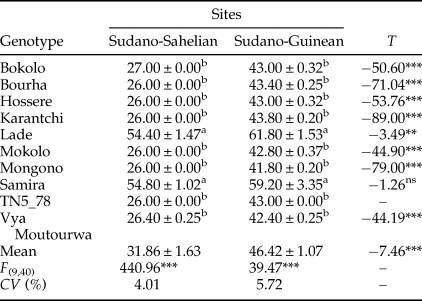
Developmental period (days) of C. maculatus on seeds of the different cowpea genotypes showed a significant difference under conditions of SS (F = 440.96; P < 0.001) ranging from 26 to 54.80 days, and under conditions of SG (F = 39.47; P < 0.001) ranging from 41.80 to 61.80 days (table 5). The longest development was on Samira and Lade under conditions of both agro-ecological zones, while on the rest of the genotypes, development lasted shortest and did not differ significantly, ranging from 26 to 27 days under conditions of SS and from 41.80 to 43.80 under conditions of SG. Mean developmental periods of C. maculatus were strongly influenced by environmental conditions (T = 44.19–89.00; P < 0.001). It was moderately influenced on Lade (T = 3.49; P < 0.01) and was the same under conditions of these two different experimental localities (T = 1.26; P = 0.2447) when insects were reared on Samira. The correlation between mean developmental periods under conditions of both agro-ecological zones was positive (r = 0.99) and significant (P < 0.001).
Mean developmental period (±SE) of Callosobruchus maculatus infesting cowpea under Sudano-Sahelian and Sudano-Guinean zones of Cameroon.

ns, not significant.
**P < 0.01; ***P < 0.001.
Means in a column followed by the same letter(s) do not differ significantly at the 5% level by Tukey test.
Susceptibility index
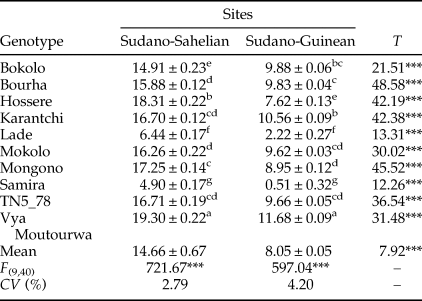
SI (table 6) ranged from 4.90 for Samira to 19.30 for Vya Moutourwa under conditions of SS and from 0.51 to 11.68 under conditions of SG. ANOVA indicated significant differences among genotypes (P < 0.05) both under conditions of SS (F = 721.67) and SG (F = 597.04). Overall, SI was lower for Samira and Lade and higher for the other genotypes either in the SS or SG with significant differences (P < 0.001) between means from these two sites, which in addition, were positively and significantly correlated (r = 0.81; P < 0.001). Under conditions of SS, out of the ten genotypes tested against C. maculatus for resistance, only one cowpea genotype (Samira) had SI < 6 and was considered as moderately resistant to weevil attack. One genotype (Lade) had SI = 6.44 and was regarded as moderately susceptible. However, most of the genotypes namely Vya Moutourwa, Hossere, Mongono, TN5_78, Karantchi, Mokolo, Bourha, and Bokolo had each SI > 10 and were regarded as highly susceptible. Under conditions of SG, among all tested genotypes, Samira and Lade, that were more resistant under conditions of SS had SI = 0.51 and 2.22, respectively, and were considered as resistant to C. maculatus attack. Hossere, one of the more susceptible genotypes under SS had SI = 7.62 and was considered as moderately susceptible to C. maculatus attack. However, most of the genotypes, namely Mongono, Mokolo, TN_578, Bourha, and Bokolo, were regarded as susceptible (SI = 8.95, 9.62, 9.66, 9.83, and 9.88, respectively) to C. maculatus attack. Two genotypes (Karantchi and Vya Moutourwa) had SI = 10.56 and 11.68, respectively, and were regarded as highly susceptible genotypes to C. maculatus attack.
Mean susceptibility index (SI) (±SE) of Callosobruchus maculatus infesting cowpea under Sudano-Sahelian and Sudano-Guinean zones of Cameroon.

***P < 0.001.
Means in a column followed by the same letter(s) do not differ significantly at the 5% level by Tukey test.
This biological parameter that indicates the developmental performance of the insect reared on seeds of various cowpea genotypes was negatively and significantly (P = 0.001–0.05) correlated with total carbohydrates (r = −0.74 and −0.76), crude proteins (r = −0.64 and −0.71), crude fibers (r = −0.83 and −0.84) and saponins (r = −0.56 and −0.58), under conditions of both agro-ecological zones (table 7).
Correlation between biochemical constituents of cowpea genotypes and susceptibility index (SI) of Callosobruchus maculatus.

SS, Sudano-Sahelian zone; SG, Sudano-Guinean zone; MC, moisture content; TC, total carbohydrates; SS, soluble sugar; Prot, proteins; CF, crud fibers; Sap, saponins; TPP, total polyphenol.
ns, not significative.
***P < 0.001.
*P < 0.05.
Discussion
The suitability of legume seeds species for infestation by insect pests varies among the genotypes (Sarwar, Reference Sarwar2012; Badii et al., Reference Badii, Asante and Sowley2013), and variables such as adult emergence, developmental period, and SI are the most reliable indicators of host plant resistance to damage by pests during storage (Redden & McGuire, Reference Redden and McGuire1983; Jackai & Asante, Reference Jackai and Asante2003).
The least infested cowpea genotypes (Samira and Lade) termed as resistant to C. maculatus attack may have inherent factors with adverse effect on the biology of insects that resulted in less emerged C. maculatus adults than other (the very susceptible one) such as Vya Moutourwa, which might lack these factors. The differences in the number of adults that emerged were probably related to the number of eggs laid, the number of eggs aborted and the rate of larvae that survived to adulthood. It has been suggested that genotypes that express resistance have physical or biochemical attributes that modify behavioral responses (xenobiosis) or that adversely affect development or survival of the pest insect species through metabolic aberrations (antibiosis) (Ignacimuthu et al., Reference Ignacimuthu, Janarthanan and Balachandran2000; Sarwar, Reference Sarwar2012). The impact of physical characteristics of grain such as wrinkle or smoothness, the seed color and size conditions on oviposition of C. maculatus were controversially reported (Edde & Amatobi, Reference Edde and Amatobi2003; Sarwar, Reference Sarwar2012; Badii et al., Reference Badii, Asante and Sowley2013). In the present study, physical characteristics such as volume, surface area, sphericity, smoothness or curvature, and color which varied among varieties were neither correlated with seed infestation under conditions of SG nor SS. The number of eggs deposited was not probably equally distributed among seeds of the different cowpea genotypes as reported by Badii et al. (Reference Badii, Asante and Sowley2013). Certainly, the presence of seeds increases fecundity and ovarian reproduction, but they are rather chemical stimulations originated from the seed compounds which may display a significant role in the induction of reproductive activity in C. maculatus as reported by Demeure (Reference Demeure1985).
The percentage of eggs that hatched and the percentage of larvae that survive to adulthood may be different among genotypes. Crude fibers which include cellulose, hemi-cellulose, and lignin, the complex polymers in plant cell walls that give the plant rigidity and strength, were negatively correlated with insect performance and this strongly suggested resistant genotypes may have a thick and hard seed coat that constitutes a mechanical and chemical barrier, preventing the larva from penetrating into the seed when they are hatched as reported by Lephale et al. (Reference Lephale, Addo-Bediako and Ayodele2012).
The probably higher capacity of water absorption by some cowpea genotypes (Bokolo, Bourha, and Karantchi) under humid conditions might decrease the seed hardness and consequently increase the biological performance of the pest, and this might explain why these genotypes were more suitable for C. maculatus development under humid weather conditions of the SS than under dryer conditions of the SS, in contrast with the other genotypes. It is also plausible to speculate that the differences in the number of C. maculatus observed among these cowpea genotypes are perhaps due mainly to differences in their genetic or biochemical characteristics. This contention is supported by the results of quantitative and qualitative analyses of primary and secondary metabolites from two very susceptible (Vya Moutourwa and Karantchi), two susceptible (Mongono and Hossere), and two resistant (Samira and Lade) genotypes under SG conditions. Total polysaccharides and crud proteins, two primary metabolites and saponins, and a secondary metabolite demonstrated a significant harmful effect to pest biological performance. Indeed, the non-digested oligosaccharides such as raffinose, stachyose, and verbascose were reported to have negative effect on herbivores (Phillips et al., Reference Phillips, McWatters, Chinnan, Hung, Beuchat, Sefa-Dedeh, Sakyi-Dawson, Ngoddy, Nnanyelugo, Enwere, Komey, Liu, Mensa-Wilmat, Nnanna, Okeke, Prinyawiwatkul and Saalia2003) and their quantity might increase as the quantity of sugars increased in seeds. Consumption of secondary metabolite such as saponins by insects may result in decreased food palatability. Saponins have been reported to inhibit trypsin and chymotrypsin and are also known to inhibit degradation by forming saponin–protein complexes (Harinder et al., Reference Harinder, Makkar and Siddhuraju2007). In addition, the resistant genotypes (Samira and Lade) contained, at high rates, chemical compounds such as steroids and triterpenoids, which the other genotypes may contain in smaller quantities. Literature data report that triterpenoids are well documented anti-feedants (Adeyemi, Reference Adeyemi2010). Previous authors (Ignacimuthu et al., Reference Ignacimuthu, Janarthanan and Balachandran2000; Venugopal et al., Reference Venugopal, Janarthanan and Ignacimuthu2000; Gbaye et al., Reference Gbaye, Millard and Holloway2012; Mogbo et al., Reference Mogbo, Okeke and Akunne2014) suggested that the presence of anti-metabolic compounds in seeds have been associated with resistance to insect attack.
As previously mentioned, a long developmental period in Samira and Lade cowpea varieties may be attributed to their cotyledon that might be unpalatable or of poor nutritive quality for larvae. Also, the longer developmental period may have resulted from perturbation of mitosis by some chemicals, which is in line with the report by Sodipo & Ayalogu (Reference Sodipo and Ayalogu1999), which stated that the presence of some phytochemicals such as saponins displayed a significant anti-mitotic activity.
The longer period of insect development under conditions of the SG than those of the SS may be explained by both differences in temperature and relative humidity between the two zones. Previous studies (Ouedraogo et al., Reference Ouedraogo, Sou, Sanon, Monge, Huignard, Tran and Credland1996; Lale & Vidal, Reference Lale and Vidal2003) indicate that temperature and relative humidity are the most important variables influencing generation times (egg to adult) when beetles are raised on preferred host and a temperature of 35°C is optimum for egg-laying and progeny development in C. maculatus (Lale & Vidal, Reference Lale and Vidal2003). Thus, within a limited range, increasing temperature will decrease the generation time.
The susceptibility of food legumes to insect pest attack is associated with the success of insect growth and duration from egg to adult (generation time). Genotypes that allow higher percentage adult emergence and short developmental period as Vya Moutourwa may be more susceptible and those that allow less adult emergence and long developmental period, like Samira, may be less susceptible.
Conclusion
Resistant genotypes can be utilized as an environmental-friendly way to reduce damage by C. maculatus under traditional storage conditions. Of the ten genotypes tested under the conditions of the SS, only Samira was resistant to C. maculatus attack. Under the conditions of the SG, Samira and Lade were resistant. Thus, the SS conditions of Cameroon may be more prone to higher levels of infestation of cowpea seeds by C. maculatus during storage than the SG conditions. Resistant genotypes of cowpea may be recommended for relatively longer storage period to achieve the goal of long-term and sustainable pest management strategies in Northern Cameroon in general. This study is the first report concerning the screening of local cowpea genotypes against C. maculatus in an effort to select local genotypes with high resistance to post harvest insect pests under conditions of two prominent agro-ecological zones of Northern Cameroon.
Acknowledgements
The authors are indebted to Alexander-von-Humboldt Foundation, Bonn, Germany, for Equipment Grant (no. 3.4 – B151/11 016) to E.N. Nukenine.