Introduction
Dizziness and vertigo can be seen after cochlear implant surgery, especially in adults. The incidence of dizziness after cochlear implant surgery is in the range of 30–60 per cent.Reference van den Broek, Huygen, Mens, Admiraal and Spies1–Reference Huygen and van den Broek4 This is more frequent than in the general population (incidence range 2.2–13.8 per cent).Reference Limb, Francis, Lustig, Niparko and Jammal5, Reference Fina, Skinner, Goebel, Piccirillo, Neely and Black6 In addition, benign paroxysmal positional vertigo and vertigo caused by perilymphatic fistula, vestibular cross-coupling stimulation and non-specific vestibulopathy can occur after cochlear implant surgery.Reference Limb, Francis, Lustig, Niparko and Jammal5, Reference Kusuma, Liou and Haynes7, Reference Bance, O'Driscoll, Giles and Ramsden8 We report a case of incapacitating vertigo after cochlear implant surgery, which was treated with transmastoid labyrinthectomy.
Case report
A 58-year-old man with profound bilateral sensorineural hearing loss was admitted to hospital. He had a history of profound hearing loss in the left ear since a head trauma at age six years. Otoscopic examination findings in the left ear were normal. He had had canal wall down tympanoplasty in the right ear 15 years previously to treat cholesteatoma. Since then, he had used a conventional hearing aid in the right ear. He had progressive sensorineural hearing loss in the right ear, which had become profound one year ago. Otoscopic examination of the right ear showed otorrhoea, tympanic membrane graft perforation and recurrent cholesteatoma in the mastoidectomy cavity.
There was bilateral profound sensorineural hearing loss on pure tone and speech audiometry, and an absence of wave V on auditory brain stem response testing with 95 dB HL rarefaction polarity. Magnetic resonance imaging of the temporal bone revealed soft tissue intensities, with peripheral contrast enhancement in the right mastoid cavity. Computed tomography of the temporal bone showed normal vestibule, semicircular canals and cochlea in both ears.
Cochlear implantation with a Pulsar Med-El device (Med-El, Innsbruck, Austria) was performed on the right ear in October 2007. During surgery, the cholesteatoma was cleaned from the middle ear and mastoid, all remaining mastoid air cells were opened. The middle ear mucosa was then pealed, the supratubal recess was drilled, the eustachian tube was sealed and the cochlear implant electrode was inserted via the round window with full insertion. Blind sac closure of the ear was then performed with fat obliteration of the radical mastoidectomy cavity. The peri-operative period was uneventful, and the patient was discharged one day after surgery.
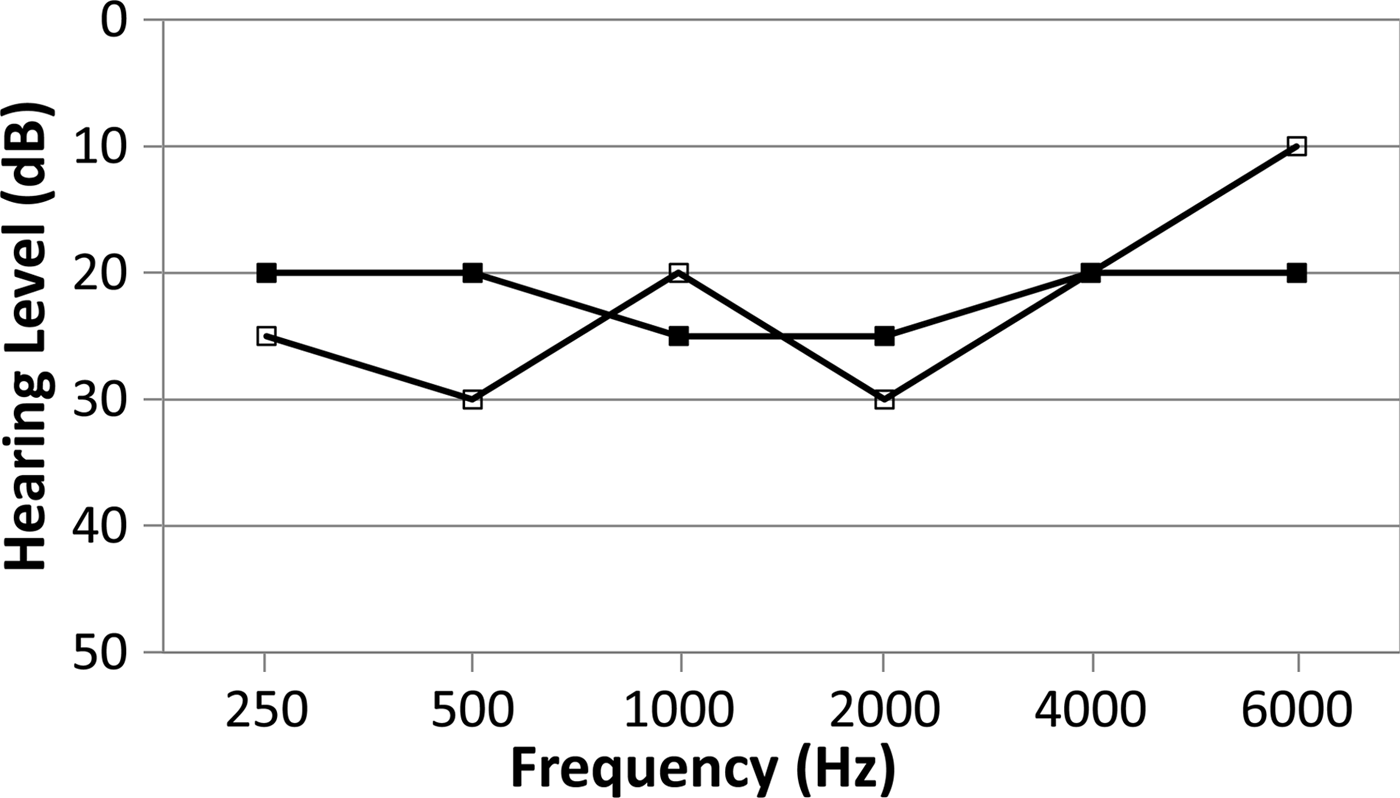
Three months after the surgery, the patient started to complain of severe vertigo attacks lasting from minutes to hours. These vertigo attacks were exacerbated by walking and changes in head position. A physical examination was normal. No nystagmus was observed with head thrusts or shaking. A Dix–Hallpike test was negative. Neurological examination excluded a central vestibular disorder. Post-operative temporal bone computed tomography was unremarkable. Hearing restoration with the implant was successful (Figure 1).
Hearing thresholds before labyrinthectomy (open squares) and three years after labyrinthectomy (filled squares) with a cochlear implant.

In an attempt to treat vertigo, successive medications including betahistine, cinnarizine and piracetam were given, and vestibular rehabilitation was performed. Since these treatments failed, the ear was operated on to explore possible cholesteatoma recurrence and perform labyrinthectomy. During surgery, the cochlear implant and its electrode were not disturbed. There was no cholesteatoma recurrence, infection or fistula in the mastoid cavity. Transmastoid labyrinthectomy was also performed.
After surgery, the patient's symptoms resolved completely. The level of speech discrimination was 88 per cent after labyrinthectomy. Impedance in all electrodes ranged from 3.5 to 6.89 kΩ. Ground path impedance was 1.19 kΩ, and integrity, coupling and voltage parameters were normal. Audiological evaluation of the patient before labyrinthectomy and three years after labyrinthectomy is shown in Figure 1.
Discussion
Although vestibular problems can occur after cochlear implantation, they usually recover spontaneously with or without additional medical therapy and vestibular rehabilitation.Reference Kubo, Yamamoto, Iwaki, Doi and Tamura9 The vestibular problems can be caused by traumatic electrode insertion, fistula formation, trauma created by the vibrations during drilling, bone dust entering the cochlea, microruptures of the basilar membrane or a triggering effect of the first fitting procedure.Reference Limb, Francis, Lustig, Niparko and Jammal5, Reference Di Girolamo, Fetoni, Di Nardo and Paludetti10 In the absence of spontaneous recovery of vestibular problems after implantation, vestibular rehabilitation or surgical intervention is needed. Kusuma et al. reported the case of a patient who experienced vertigo after cochlear implant surgery.Reference Kusuma, Liou and Haynes7 The patient did not respond to medical treatment and vestibular rehabilitation. During surgical exploration, the authors found mild atrophy of the previously placed muscle at the cochleostomy site. Its replacement with a piece of cartilage resulted in complete recovery of the vestibular symptoms. However, plugging the round window to treat a possible peri-lymphatic fistula is not effective in all cases. In another case report by Heidenreich et al., transcanal labyrinthectomy performed to treat disabling vertigo after unilateral cochlear implantation resulted in the immediate relief of symptoms.Reference Heidenreich, Basura, Zwolan, El-Kashian and Telian11
Transcanal labyrinthectomy can be supplemented by filling the vestibule with gentamicin-soaked Gelfoam®.Reference Heidenreich, Basura, Zwolan, El-Kashian and Telian11 This transcanal procedure was not applicable in our case because of previous blind sac closure of the external ear canal. For the same reason, a transtympanic gentamycin injection was not performed. In addition, gentamycin instillation into the middle ear would not be effective in the presence of a cochlear implant, which is inserted through the round window.
Opening the previous radical cavity by retroauricular incision was considered the best option for our patient. After entering the radical cavity, one option was to drill between the round and oval windows. However, this procedure could damage the cochlear implant electrode as a result of direct drill trauma or the heat generated by drilling. Another option was to remove the stapes footplate and fill the vestibule with gentamycin-soaked Gelfoam. Since the radical cavity had already been entered and to guarantee almost complete labyrinthine ablation, the authors chose to perform transmastoid labyrinthectomy. This procedure enabled radical cavity inspection for cholesteatoma recurrence.
A potential risk of labyrinthectomy is damage to the spiral ganglion cells. However, temporal bone histopathology suggests that these cells are undamaged after labyrinthectomy.Reference Chen, Linthicum and Rizer12 Kartush et al. performed transtympanic electric promontory stimulation in six patients who had previously undergone labyrinthectomy.Reference Kartush, Linstrom, Graham, Kulick and Bouchard13 All patients perceived a definite auditory sensation in the labyrinthectomised ear during stimulation. The results of threshold, dynamic range and difference limen testing were similar to those obtained during pre-operative stimulation of cochlear implant candidates in whom treatment was successful.
• Dizziness and vertigo occur in 30–60 per cent of adult cochlear implant patients
• Vestibular problems usually recover spontaneously with or without additional medical treatment or vestibular rehabilitation
• In the absence of spontaneous recovery, vestibular rehabilitation or surgical intervention is needed
• Transmastoid labyrinthectomy is effective, especially in the presence of a radical mastoidectomy cavity with blind sac closure of the ear
Conclusion
Transmastoid labyrinthectomy is an effective procedure for the treatment of incapacitating vestibular problems after cochlear implantation, especially in the presence of a radical mastoidectomy cavity with blind sac closure of the ear.