





Introduction
In this literature synthesis of over 200 articles, chapters, and books, we summarise and provide conceptual distinctions to evaluate the evidence on the role of political elites in influencing public opinion about immigration. Until recently, research on immigration attitudes predominantly focused on understanding their economic and cultural drivers, such as concerns about labour market competition or perceived threats to national identity (see Hainmueller and Hopkins Reference Hainmueller and Hopkins2014). While political elites were generally seen as shaping attitudes indirectly through policy, their direct influence through rhetoric received little attention. In this review, we focus on the growing evidence for the opposite causal direction to the dominant ‘bottom-up’ sociological assumptions. Drawing on the well-established literature on the role of elite rhetoric in shaping public opinion (Chong and Druckman Reference Chong and Druckman2007; Zaller Reference Zaller1992), we offer a new evaluation, collation, and synthesis of research that examines immigration attitudes from this less-emphasised, ‘top-down’ perspective.
We propose that public preferences regarding immigration are best summarised and distinguished by assessing three dimensions of public opinion: attitude extremity, attitude importance, and attitude expression. These distinctions help us assess the potential for political elites to have different kinds of influence on attitudes. Our aim is not to compare the size or durability of elite effects across the three attitudinal dimensions. Rather, our review asks (a) where the literature most consistently detects elite influence and (b) where such influence is likely to be most substantively consequential. From a review of existing scholarship, we find that political elites generally have a limited effect on the extremity of immigration attitudes. This is because immigration is perceived as an ‘easy’ issue: it seems straightforward to understand because it resonates intuitively with people’s existing belief or underlying value systems (Carmines and Stimson Reference Carmines and Stimson1980). Unlike ‘hard’ issues, which are new to the political agenda and require voters to engage with nuanced details and technical considerations, ‘easy’ issues are long-standing, focus on policy ends rather than means, and elicit gut-level and emotional responses. Political elites therefore have relatively limited scope to influence the extremity of immigration attitudes, which are formed early in life and tend to be deeply entrenched and resistant to change (Kustov, Laaker and Reller Reference Kustov, Laaker and Reller2021). This does not imply, however, that political elites have no role in shaping public opinion about immigration. They may, under certain conditions, influence the importance people assign to immigration – although these conditions remain poorly understood due to limited research. In the existing literature, the most consistent evidence of elite influence appears in relation to how immigration attitudes are expressed – either personally, at the ballot box, or interpersonally, through behaviours and prejudice. While not necessarily larger in statistical terms, this influence on attitude expression carries greater downstream political and social consequences because it shapes how people vote, participate, and engage with one another.
In assessing the literature, we define the scope as follows. We use the term political elites to refer to both elected and unelected politicians, acknowledging that these actors use the media – which both affects and reflects public opinion (Wlezien Reference Wlezien2024; Wlezien and Soroka Reference Wlezien and Soroka2024) – as a channel for political communication. Our focus is on elite rhetoric as a potentially direct tool for influencing attitudes about immigration, rather than on elites’ indirect influence through policy outcomes.Footnote 1 It is important to recognise, however, that the relationship between public attitudes and elite rhetoric is not unidirectional. While we engage with this literature, we do not seek to explain the independent effect of public opinion upon elites. Instead, we concentrate on examining the effects of elites’ discourse on public perceptions of immigration, while recognising that this relationship does not exist in a vacuum. We conceptualise elite discourse as comprising both the content of immigration rhetoric (how immigration is discussed) and the extent of elite attention to immigration (how much immigration is discussed). We therefore include studies that assess party-level rhetoric (eg through manifesto data), individual speeches or statements by political leaders, experimental manipulations of rhetorical frames, and measures of elite dissensus (eg party polarisation on immigration). Relevant studies were selected through targeted keyword searches and by cross-referencing citations in relevant studies, consistent with a concept-driven approach rather than a meta-analytic search. While they were not purposely limited to any geographic focus, there is an inherent bias towards research from Western Europe and North America where the bulk of the academic literature in this field is produced.
Three dimensions of public opinion about immigration
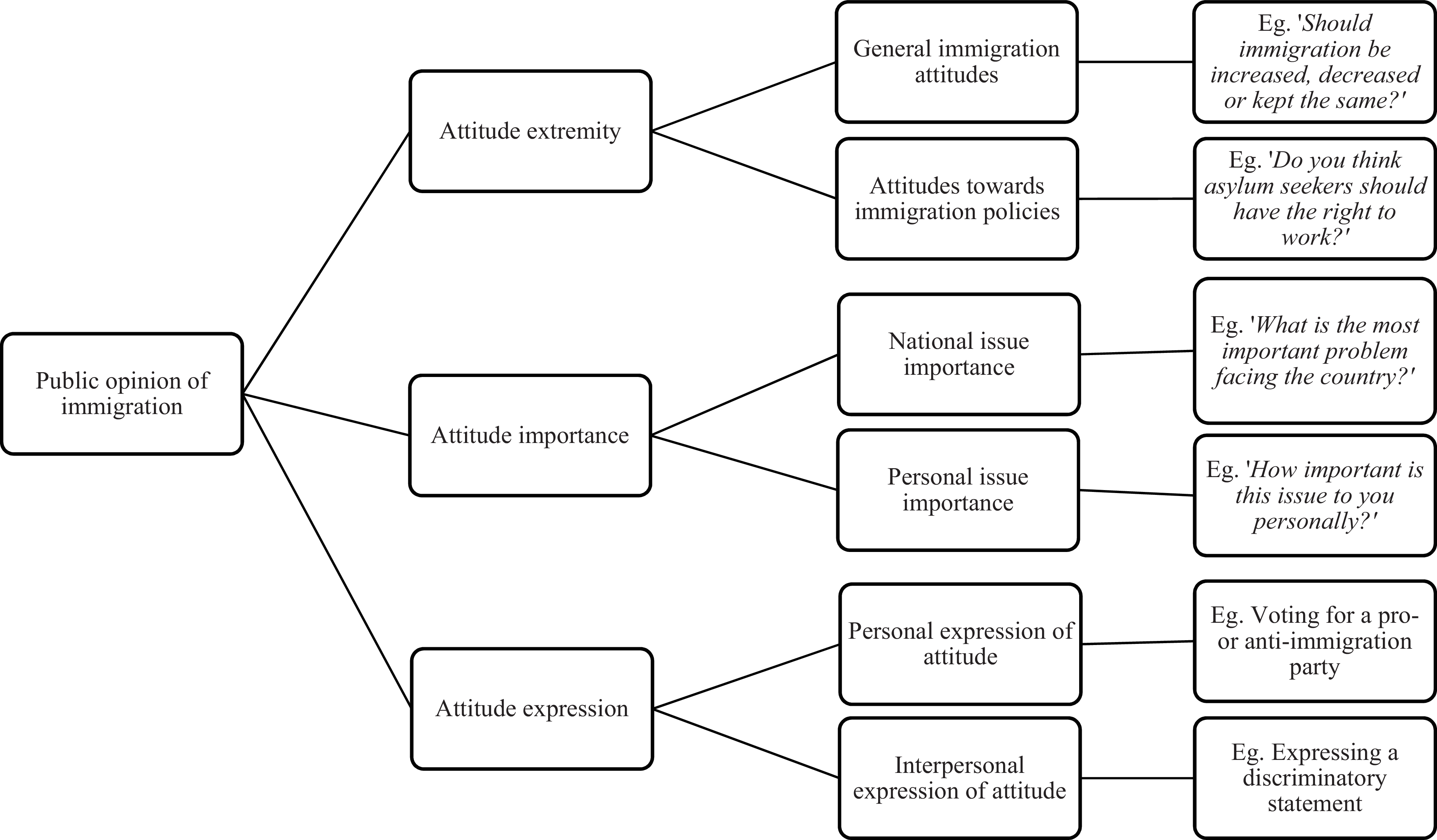
To understand individual attitudes to immigration, political scientists have tended to analyse attitude extremity, which captures the direction of someone’s attitudes – whether they are in favour of or against immigration. However, attitude extremity represents only one dimension of public opinion. To gain a more comprehensive understanding of immigration attitudes and how they might be shaped, three dimensions of public opinion can be identified in the literature: attitude extremity, attitude importance, and attitude expression.Footnote 2 These dimensions, along with their typical operationalisations in surveys, are illustrated in Figure 1.
Conceptual framework highlighting the three dimensions of public opinion about immigration.

Figure 1. Long description
The diagram illustrates a conceptual framework for understanding public opinion on immigration, focusing on three key dimensions: attitude extremity, attitude importance, and attitude expression. Attitude extremity is further divided into general immigration attitudes and attitudes towards immigration policies, with examples such as questions about increasing or decreasing immigration and the rights of asylum seekers to work. Attitude importance includes national issue importance and personal issue importance, exemplified by questions about the most important problem facing the country and the personal importance of the issue. Attitude expression is broken down into personal expression of attitude and interpersonal expression of attitude, with examples like voting for pro- or anti-immigration parties and expressing discriminatory statements. The diagram shows how these dimensions interact and are influenced by political elites, highlighting where elite influence is most consistently detected and where it is likely to be most consequential.
Attitude extremity
Attitude extremity refers to ‘the degree of favourableness or unfavourableness of an individual’s evaluation of a given object’ (Krosnick and Abelson Reference Krosnick, Abelson and Tanur1991: 179). To capture extremity, surveys typically ask respondents whether they think the number of immigrants to their country should be increased, decreased, or stay the same. Such measures offer insights into individuals’ broad immigration preferences, although respondents also have particular immigrants in mind when answering surveys (Blinder Reference Blinder2015), tend to exhibit pronounced preferences for certain types of immigrants over others (Bansak, Hainmueller and Hangartner Reference Bansak, Hainmueller and Hangartner2016; Ford Reference Ford2011; Hainmueller and Hangartner Reference Hainmueller and Hangartner2013; Moise, Dennison and Kriesi Reference Moise, Dennison and Kriesi2023), and feel differently towards immigrants who are already in their country and those eager to settle in their country (Margalit and Solodoch Reference Margalit and Solodoch2022). Since immigration policies are multidimensional (Jeannet, Heidland and Ruhs Reference Jeannet, Heidland and Ruhs2021; Le Corre and Tilley Reference Le Corre and Tilley2024), other survey questions attempt to capture people’s attitudes about specific immigration policies, such as whether immigrants should receive welfare benefits. Answers to policy-specific questions are not merely granular reflections of more abstract questions: Levy, Wright M and Citrin (Reference Levy, Wright and Citrin2016) show that responses to questions about immigration levels can significantly differ from those asking about specific immigration policies.
Attitude importance
A careful understanding of public attitudes requires the consideration of both attitude extremity and importance (Krosnick and Abelson Reference Krosnick, Abelson and Tanur1991; Krosnick and Petty Reference Krosnick and Petty1995). Consider two individuals, voters A and B, who both respond to a survey that they think immigration should be reduced. However, suppose that voter A’s attitude about immigration levels is weakly held, while voter B feels strongly about this issue. Voter B will be significantly more likely than voter A to consider immigration a major issue at the ballot box, to hold on to existing beliefs in the face of contradictory information, and to behave in ways that align with their attitudes.
Attitude importance can be characterised as a dimension of attitude strength. Krosnick and Petty described an attitude as strong ‘to the extent that it manifests either durability or impactfulness or both’ (Reference Krosnick and Petty1995: 3; see also Howe and Krosnick Reference Howe and Krosnick2017). Since then, scholars have conceptualised different sub-dimensions of attitude strength, including importance for the country as a whole and personal importance (Miller and Peterson Reference Miller and Peterson2004), which are distinct (Miller, Krosnick and Fabrigar Reference Miller, Krosnick, Fabrigar, Krosnick, Chiang and Stark2016). National issue salience is measured by asking respondents about the ‘most important problem(s)’ or ‘most important issue(s)’ facing their country (Jennings and Wlezien Reference Jennings and Wlezien2011). Personal issue importance is captured by asking respondents how important an issue is to them personally (Krosnick Reference Krosnick1988), how much they care about an issue, (Barber and Pope Reference Barber and Pope2023) or a combination of the above (Jacks and Devine Reference Jacks and Devine2000). Recent work has pointed to the importance of taking both immigration attitude extremity and importance into account (Dennison Reference Dennison2020; Hatton Reference Hatton2021; Kustov Reference Kustov2023; Schnaudt and Stecker Reference Schnaudt and Stecker2022). Hatton (Reference Hatton2021) shows, for instance, that immigration attitude extremity is distinct from national issue salience – and that both have a bearing on support for immigration policy restrictiveness. Kustov (Reference Kustov2023) also highlights the ‘issue importance asymmetry’ of immigration attitudes, finding that anti-immigration voters care much more about immigration than their pro-immigration counterparts.
Attitude expression
Understanding of immigration opinion should, importantly, focus on how attitudes manifest themselves behaviourally. Relying solely on self-reported attitudes (extremity or importance) to predict behaviour is likely to yield erroneous inferences about people’s observed preferences. Research in psychology and sociology has long pointed to the ‘attitude-behaviour consistency problem’ to refer to the observed mismatch between what individuals say they believe in and what they actually do (Gross and Niman Reference Gross and Niman1975; Jerolmack and Khan Reference Jerolmack and Khan2014; LaPiere Reference LaPiere1934; Pager and Quillian Reference Pager and Quillian2005). This inconsistency is likely to be especially pronounced in sensitive domains where people are susceptible to social desirability pressures.
Attitudes can be expressed personally or interpersonally. While voting behaviour is a key focus of research, expressions of immigration attitudes beyond those demonstrated personally at the ballot box have received little scrutiny. To adequately understand how public opinion about immigration plays out in wider society – and the extent to which elites can influence behaviour – it is instructive to investigate citizens’ everyday interactions with immigrants and to evaluate research on this dimension of immigration opinion.
Can elites influence the extremity of immigration attitudes?
The question scholars have been most concerned with is the following: Can elites noticeably make people more or less favourable towards immigration? The conclusion, so far, is that evidence for this influence is relatively weak.
Elite rhetoric on immigration and public immigration attitudes are – unsurprisingly – highly correlated. This has been evidenced by cross-sectional designs in European countries, for example, that employ manifesto data as a proxy for elite rhetoric and survey items to capture immigration attitudes (Bohman Reference Bohman2011; Czymara Reference Czymara2020; Hjerm Reference Hjerm2007). These studies convincingly establish a correlation between elite discourse and public attitudes, but they are unable to demonstrate that this correlation is indicative of a causal effect in either direction. To assess whether elite discourse shapes immigration attitudes, scholars have used temporal variation in elite rhetoric and its effects on public attitudes. Typically using manifesto data to capture elite rhetoric, most have found limited evidence of elite influence on immigration attitude extremity. For instance, Schmidt-Catran and Czymara (Reference Schmidt-Catran and Czymara2022) observe that anti-immigration attitudes increase when elites express more exclusionary sentiments and decrease when elites express more inclusionary sentiments – but the effects, while statistically significant, are small. Other longitudinal studies have similarly suggested that political parties’ positions on immigration exert a modest influence on their supporters’ immigration attitude extremity (Harteveld, Kokkonen and Dahlberg Reference Harteveld, Kokkonen and Dahlberg2017; Vrânceanu and Lachat Reference Vrânceanu and Lachat2021).
Studies relying on a variety of other research designs, including cross-sectional, experimental, and quasi-experimental research, have similarly found that political elites play a small role in shaping the extremity of public immigration attitudes (Flores Reference Flores2018; Ivarsflaten Reference Ivarsflaten2005; Knoll, Redlawsk and Sanborn Reference Knoll, Redlawsk and Sanborn2011; McLaren Reference McLaren2001; Schleiter, Tavits and Ward Reference Schleiter, Tavits and Ward2022). In one of the only studies looking at the effects of pro-immigration rhetoric, Schleiter, Tavits and Ward (Reference Schleiter, Tavits and Ward2022) show that elite discourse can generate small attitudinal effects (see also Frese Reference Frese2025; Simonsen Reference Simonsen2024). In another study, Flores (Reference Flores2018) finds that respondents surveyed after Trump’s 2016 announcement speech – during which he infamously referred to Mexican immigrants as ‘rapists’ – were more likely to express a preference for immigration restrictionism. A further panel survey experiment, however, revealed that such effects dissipated entirely after four weeks. This short-term effect of elite influence is also suggested by Dekeyser and Freedman (Reference Dekeyser and Freedman2023), who find that immigration attitudes are noticeably more negative around election times.
Other scholars have attempted to understand whether elite framing of immigration – that is, the terms they employ to discuss immigration – influences public attitudes. Knoll, Redlawsk and Sanborn (Reference Knoll, Redlawsk and Sanborn2011) observe that elite framing of immigrants as ‘illegal’ or ‘undocumented’ generally did not affect the policy preferences of Iowa caucus-goers in 2008. Merolla, Ramakrishnan and Haynes (Reference Merolla, Ramakrishnan and Haynes2013) also report that immigrant labels exhibit no influence on immigration policy preferences.
Thus far, this suggests that elites play at most a small role in shaping public immigration attitudes in the aggregate. However, this may vary by sub-group and by context. The studies reviewed above were all conducted in environments where immigration has long been politicised. Other contextual factors, such as the growth rate of the immigrant population in a local area (Jones and Martin Reference Jones and Martin2017) and the degree of elite polarisation (Druckman, Peterson and Slothuus Reference Druckman, Peterson and Slothuus2013) may also influence the extent to which elites can shift attitudes. Unsurprisingly, individuals also vary in their susceptibility to elite cues. Highly educated people, for instance, are more likely to rely on elite messaging about immigration (Hellwig and Kweon Reference Hellwig and Kweon2016; Vrânceanu and Lachat Reference Vrânceanu and Lachat2021). Existing research also suggests that party identification matters in conditioning the effects of elites’ influence on public immigration preferences (Bechtel, Hainmueller, Hangartner et al. Reference Bechtel, Hainmueller, Hangartner and Helbling2015; Knoll, Redlawsk and Sanborn Reference Knoll, Redlawsk and Sanborn2011). While more work is needed to understand how elites could influence people’s immigration preferences,Footnote 3 particularly across a broader range of countries, existing evidence overall suggests that their impact is likely minimal and short-lived.
Should we expect elite cues to shape public opinion, in general?
At first glance, findings of limited elite influence on immigration preferences appear to be at odds with classic work arguing that political elites influence people’s attitudes (Boudreau and MacKenzie Reference Boudreau and MacKenzie2014; Zaller Reference Zaller1992). Most of this research has been experimental: respondents are typically exposed to a policy proposal, with those in the control group receiving no additional information, while those in the treatment groups receive information about party endorsements. Some studies also compare the effect of receiving additional information about a policy. These survey experiments typically find that elite cues influence public attitudes (Bolsen, Druckman and Cook Reference Bolsen, Druckman and Cook2014; Boudreau and MacKenzie Reference Boudreau and MacKenzie2014; Cohen Reference Cohen2003; Slothuus and De Vreese Reference Slothuus and De Vreese2010).
However, other studies highlight the limits of elite influence. Bullock (Reference Bullock2011) finds that survey participants are responsive to party cues, but their responses are at least equally – and sometimes more – influenced by policy considerations. Similarly, Nicholson (Reference Nicholson2011) shows that source cues are more influential for complex policies, whereas policy cues matter more for straightforward issues. It is useful to consider, then, whether immigration attitudes (their extremity) might be the type of attitudes that are susceptible to elite influence, or whether they are an unlikely case.
Immigration as an unlikely case for elite influence on attitude extremity
We can add some clarification to whether elites can influence immigration attitude extremity by distinguishing between ‘hard’ and ‘easy’ issues (Carmines and Stimson Reference Carmines and Stimson1980). ‘Hard’ issues are complex, means-oriented, and typically new to the political agenda. They demand high levels of political sophistication, requiring voters to engage with nuanced and technical details. In contrast, ‘easy’ issues are long-standing and easier to grasp for most voters. They resonate deeply with voters on an instinctive and emotional level, eliciting ‘gut responses’ that are shaped by pre-existing beliefs and values. As Carmines and Stimson (Reference Carmines and Stimson1980: 78) explain, easy issues are ‘so ingrained over a long period that (they) structure voters’ “gut responses”’, requiring little cognitive effort for individuals to form opinions or take positions.
Many studies suggest that elites have a larger impact on public attitudes that concern ‘hard’ issues (Barber and Pope Reference Barber and Pope2023; Boudreau and MacKenzie Reference Boudreau and MacKenzie2014; Ciuk and Yost Reference Ciuk and Yost2016; Jacks and Devine Reference Jacks and Devine2000; Jerit and Barabas Reference Jerit and Barabas2012; Mummolo, Peterson and Westwood Reference Mummolo, Peterson and Westwood2021; Nicholson Reference Nicholson2011). Boudreau and MacKenzie (Reference Boudreau and MacKenzie2014) find that respondents are more responsive to policy information on issues where they have weak prior attitudes. Ciuk and Yost (Reference Ciuk and Yost2016) also find that respondents asked about a high-salience issue incorporate policy information more than respondents asked about a low-salience issue, who rely more on party cues. Other studies have consistently found that the influence of elite cues wanes on issues that are personally salient to voters (Barber and Pope Reference Barber and Pope2023; Jacks and Devine Reference Jacks and Devine2000; Mummolo, Peterson and Westwood Reference Mummolo, Peterson and Westwood2021).
Existing literature suggests that immigration represents an ‘easy’ issue for many voters: it is long-standing, symbolic, emotionally charged, and attitudes towards it are typically rooted in deeply held values. This does not mean that immigration preferences are uniformly consistent or devoid of nuance (Raffaelli Reference Raffaelli2025) – individuals may express seemingly contradictory policy stances (Levy and Wright Reference Levy and Wright2020), demonstrate an openness to compromise on certain measures (Helbling, Maxwell and Traunmüller Reference Helbling, Maxwell and Traunmüller2023), and express preferences for certain immigrants over others (eg Hainmueller and Hopkins Reference Hainmueller and Hopkins2015; Margalit and Solodoch Reference Margalit and Solodoch2022). Despite these expressions of nuance in policy preferences, people who feel threatened by one type of immigrants tend to feel threatened by others (Ruedin Reference Ruedin2020).
However, immigration attitudes tend to be deeply entrenched and resistant to change (Hooghe and Wilkenfeld Reference Hooghe and Wilkenfeld2008; Kustov, Laaker and Reller Reference Kustov, Laaker and Reller2021; Lancaster Reference Lancaster2022; Mader and Schoen Reference Mader and Schoen2019). This is because people’s immigration attitudes tie into existing and ingrained belief systems. They are strongly associated with ethnocentrism (Kinder Reference Kinder, Mackuen and Rabinowitz2003), deeply held orientations to ‘out-groups’ and associated stereotypes (Citrin, Green, Muste et al. Reference Citrin, Green, Muste and Wong1997; Kinder and Kam Reference Kinder and Kam2009; Valentino, Brader and Jardina Reference Valentino, Brader and Jardina2013), and align closely with nationalist ideologies or values (Blank and Schmidt Reference Blank and Schmidt2003; De Figueiredo and Elkins Reference De Figueiredo and Elkins2003; Pehrson, Brown and Zagefka Reference Pehrson, Brown and Zagefka2009). They are shaped during early periods of political socialisation, leading to distinct cohort and generational differences (Ford Reference Ford2008, Reference Ford2011; Gorodzeisky and Semyonov Reference Gorodzeisky and Semyonov2018; Jeannet and Dražanová Reference Jeannet and Dražanová2023).
Relying on panel surveys from the United States and Western Europe, Kustov, Laaker and Reller (Reference Kustov, Laaker and Reller2021) find that immigration attitudes are largely stable within individuals over time. Somewhat surprisingly, most people fail to update their immigration preferences – even in light of major political and economic shocks like the so-called refugee crisis, the Brexit referendum (Kustov, Laaker and Reller Reference Kustov, Laaker and Reller2021), or the Covid-19 pandemic (Dennison, Kustov and Geddes Reference Dennison, Kustov and Geddes2023). In Germany, immigration attitudes were more stable than party identification during the 2015–2016 period characterised by Angela Merkel’s decision to allow refugees to enter the country (Mader and Schoen Reference Mader and Schoen2019). This suggests that immigration attitudes (extremity) tend to be robust and enduring (see also Bansak, Hainmueller and Hangartner Reference Bansak, Hainmueller and Hangartner2023; Goldstein and Peters Reference Goldstein and Peters2014; Lancaster Reference Lancaster2022; Maxwell Reference Maxwell2019).
The observation that immigration attitudes tend to be stable aligns with research showing that attempts to change people’s immigration attitudes with informational cues usually fall short (Barrera, Guriev, Henry et al. Reference Barrera, Guriev, Henry and Zhuravskaya2020; Hopkins, Sides and Citrin Reference Hopkins, Sides and Citrin2019; Jørgensen and Osmundsen Reference Jørgensen and Osmundsen2022; Lawrence and Sides Reference Lawrence and Sides2014). Studies from the United States suggest that providing factually correct information about the size of the immigrant population or racial composition does not usually lead people to update their immigration attitudes – even though it reduces the perceived size of the immigrant population (Hopkins, Sides and Citrin Reference Hopkins, Sides and Citrin2019; Lawrence and Sides Reference Lawrence and Sides2014). In a Danish survey, Jørgensen and Osmundsen (Reference Jørgensen and Osmundsen2022) also show that correcting information about immigrants’ crime rate and welfare dependency rate updates respondents’ factual beliefs but fails to change their immigration policy preferences. Although a few studies have found evidence that information campaigns can shift immigration attitudes in a more favourable direction (Facchini, Margalit and Nakata Reference Facchini, Margalit and Nakata2016; Grigorieff, Roth and Ubfal Reference Grigorieff, Roth and Ubfal2020), most research indicates that they are difficult to shift in a lasting and meaningful manner.
Elites are more likely to influence attitude formation, rather than attitude change
While political elites possess limited influence on overall public preferences (extremity), individuals still forming their views – typically during early political socialisation – are more likely to be receptive to elite cues. Research on socialisation has long underscored the formative role of adolescent years and early adulthood in shaping longer-term political attitudes (Niemi and Jennings Reference Niemi and Jennings1991; Sears and Valentino Reference Sears and Valentino1997). The ‘impressionable years hypothesis’ posits that individuals hold volatile and malleable attitudes during their youth (Alwin and Krosnick Reference Alwin and Krosnick1991; Jennings and Niemi Reference Jennings and Niemi1978) and are especially sensitive and responsive to environmental influences. With age, these political attitudes formed in early years crystallise and remain largely consistent over time.
In support of the ‘impressionable years hypothesis’, research indicates that prejudiced attitudes acquired in early life tend to be enduring and resistant to change (see Sears and Brown Reference Sears, Brown and Huddy2013 for a review). Researchers have shown that early-life exposure to racial diversity can have a lasting impact on individuals’ political affiliations and prejudice levels in adulthood (Billings, Chyn and Haggag Reference Billings, Chyn and Haggag2021; Brown, Enos, Feigenbaum et al. Reference Brown, Enos, Feigenbaum and Mazumder2021; Goldman and Hopkins Reference Goldman and Hopkins2020). Laaker (Reference Laaker2023) also finds that experiencing a recession during formative years leads to a lasting increase in anti-immigration attitudes (see also Hooghe and Wilkenfeld Reference Hooghe and Wilkenfeld2008), suggesting that anti-immigration rhetoric emerging during recessions likely explains this effect.
The malleability of young people’s attitudes and their enhanced receptiveness to contextual influence suggest that they could be more responsive to elite cues than their older counterparts. We know, for instance, that young people experience considerably more variation in their immigration attitudes than older people (Kustov, Laaker and Reller Reference Kustov, Laaker and Reller2021). We might therefore expect young people to absorb and appropriate claims they hear from prominent pro- or anti-immigration political elites – although the extent of this influence will depend on their political engagement, and lower rates of youth political engagement (Bartle Reference Bartle2000) may now mean that smaller groups of young people can be influenced by political elites.
Few studies, however, have directly investigated the effect of elite cues on young people’s immigration attitudes. An important exception is a study conducted by McLaren and Paterson (Reference McLaren and Paterson2020) which found that younger cohorts were most opposed to immigration in areas where the radical right had been the strongest during their formative years and more favourable to immigration in areas where the radical right had been less powerful. Jeannet and Dražanová (Reference Jeannet and Dražanová2023) also find that cohorts who grew up in contexts where political elites emphasised equality were significantly more likely to adopt positive immigration attitudes later in life than those who grew up in countries where political elites embraced traditional values.
Can elites influence the rated importance of immigration?
While we conclude that attitudes about immigration are mostly stable, the importance citizens assign to immigration is volatile (Dennison and Geddes Reference Dennison and Geddes2022; Dennison, Kustov and Geddes Reference Dennison, Kustov and Geddes2023; Gomez-Aguinaga, Morín and Sanchez Reference Gomez-Aguinaga, Morín and Sanchez2023; Morales, Pardos-Prado and Ros Reference Morales, Pardos-Prado and Ros2015) and susceptible to influence from new information (Kustov Reference Kustov2024). More generally, perceptions of the most important problem facing the country fluctuate far more than policy preferences (Dennison Reference Dennison2019; Page and Shapiro Reference Page and Shapiro1992). Distinguishing between immigration attitude extremity and importance is therefore essential insofar as political elites could influence (and be influenced by) both.
Demonstrating the significance of this distinction, Ford, Jennings and Somerville (Reference Ford, Jennings and Somerville2015) argue that migration flows had a larger impact on British citizens’ perception of the most important issue facing their country than on the extremity of their immigration attitudes. Dennison and Geddes (Reference Dennison and Geddes2019) also show that the rise of anti-immigration parties in Europe is not rooted in changing anti-immigration attitudes but is an effect of increased issue importance amongst people with pre-existing dispositions against immigration.
Although we know that attitude extremity and importance on key issues can be distinct (Jennings and Wlezien Reference Jennings and Wlezien2015) including on immigration (Hatton Reference Hatton2021; Jin Reference Jin2024), addressing the question of whether elite discourse exerts an independent influence on public issue salience presents significant challenges.
One major obstacle is that few studies clearly distinguish between the different dimensions of salience. In the immigration scholarship alone, salience has been used to refer to the extent to which an issue is emphasised by politicians (eg Gessler and Hunger Reference Gessler and Hunger2022; Hutter and Kriesi Reference Hutter and Kriesi2022), featured in media discourse (Givens and Luedtke Reference Givens and Luedtke2005; Hopkins Reference Hopkins2010; Spirig Reference Spirig2023), or rated as important by citizens (eg Dennison, Kustov and Geddes Reference Dennison, Kustov and Geddes2023; Gomez-Aguinaga, Morín and Sanchez Reference Gomez-Aguinaga, Morín and Sanchez2023). These different dimensions can be respectively categorised as party salience (the degree to which parties publicly discuss an issue), media salience (the extent to which an issue receives media coverage), and public issue salience (citizens’ rated importance of an issue). In this review, we focus on public issue salience, which is often correlated with, potentially caused by, and a possible cause of, party and media salience. This presents a methodological challenge. When the media discusses an issue at length, it also tends to feature prominently in the discourse of political parties and to be rated as important by citizens (eg Morales, Pardos-Prado and Ros Reference Morales, Pardos-Prado and Ros2015). The issue, then, lies in identifying what is driving variation in salience – and of particular interest to us, whether party salience is driving public issue salience.
Isolating the effect of party salience on public issue salience is further complicated by the potentially confounding influence of exogenous factors or ‘real-world conditions’ (Behr and Iyengar Reference Behr and Iyengar1985). These conditions can simultaneously motivate both political elites to emphasise an issue more and citizens to perceive it as more important. A notable example of such conditions is ‘focusing events’ (Birkland Reference Birkland1998; Kingdon Reference Kingdon1995) which are ‘sudden; relatively uncommon; can be reasonably defined as harmful or revealing the possibility of potentially greater future harms; (have) harms that are concentrated in a particular geographical area or community of interest; and (are) known to policymakers and the public simultaneously’ (Birkland Reference Birkland1998: 54). For example, Böhmelt, Bove and Nussio (Reference Böhmelt, Bove and Nussio2019) find that terrorist attacks influence the public issue salience of immigration within but also across European countries. In addition to focusing events, broader trends such as rising immigration numbers or economic crises could also simultaneously prompt heightened media coverage, elite discourse, and public concern.Footnote 4 However, these exogenous events and real-world conditions do not tell us about the extent of political parties’ rhetoric on public issue importance.Footnote 5 It is quite likely that political elites, media sources, and public concerns respond to focusing events and exogenous factors but, to date, we cannot tell whether political elites exert any additional force on public issue importance in light of them. Disentangling these causal processes remains elusive.
To our knowledge, existing research has not specifically examined the impact of party salience on public issue salience of immigration. In general, we know that the relationship between parties and voters is reciprocal when it comes to salience: political parties influence which issues are deemed important by voters, who themselves also influence the issues that parties choose to emphasise (Neundorf and Adams Reference Neundorf and Adams2018). Previous studies have also demonstrated that, under certain conditions, the media salience of immigration can affect public issue salience (Czymara and Dochow Reference Czymara and Dochow2018; Dunaway, Branton and Abrajano Reference Dunaway, Branton and Abrajano2010, Reference Dunaway, Goidel, Kirzinger and Wilkinson2011; McLaren, Boomgaarden and Vliegenthart Reference McLaren, Boomgaarden and Vliegenthart2018; Van Klingeren, Boomgaarden, Vliegenthart et al. Reference Van Klingeren, Boomgaarden, Vliegenthart and De Vreese2015; although, see Boomgaarden and Vliegenthart Reference Boomgaarden and Vliegenthart2009). However, since media salience and party salience measure different underlying constructs (Helbling and Tresch Reference Helbling and Tresch2011), media salience may be an unreliable proxy for party salience. This underscores the need for future research to explicitly explore the relationship between parties’ emphasis on immigration and citizens’ perceived importance of the issue.
Can political elites influence the expression of immigration attitudes?
Politicising immigration: elites’ influence on vote choice
Having examined how elites shape both the extremity and importance of attitudes, we turn to a related, but distinct, dimension: their influence on how these attitudes are expressed behaviourally. We begin by considering how elites influence private expressions of immigration attitudes through voting, before examining their influence on more public and interpersonal expressions of these attitudes.
Conceptually, it is important to distinguish between elites increasing the importance of an issue in the minds of voters and elites influencing whether that issue becomes a basis for vote choice. While voters tend to place more weight on issues that are important to them when voting (Krosnick Reference Krosnick1990), issue importance alone is not sufficient to influence vote choice. For an issue to matter electorally, political elites must offer distinct positions and make it an object of party competition (Ansolabehere and Puy Reference Ansolabehere and Puy2018; Moniz and Wlezien Reference Moniz, Wlezien and Hannah2020; Wlezien Reference Wlezien2005). For instance, abortion was an important issue to some American voters in 1980, but it did not influence their vote choice because they did not perceive clear differences between the parties on that issue (Krosnick Reference Krosnick1990: 84). Political elites can therefore influence whether attitudes translate into electoral behaviour by politicising certain issues or ‘expanding the scope of conflict’ (Hutter and Grande Reference Hutter and Grande2014: 1003).
This does not mean that politicians directly manipulate people’s immigration attitudes or their ratings of the national importance of immigration. However, by competing and offering distinct positions on immigration, they influence its relevance to vote choice. This builds on a large body of research on political competition explaining how elites frame issues and prime voters to cast a vote on issues that benefit parties, such as on an ‘owned issue’ (Petrocik Reference Petrocik1996), and make different issues relevant to vote choice through distinctive positions, polarisation, and emphasis (see Butler and Stokes Reference Butler and Stokes1971 for an early articulation of these arguments).
As argued by Fieldhouse et al., major shocks like rapid immigration growth do not inherently carry fixed outcomes. Instead, they ‘create political opportunities, and their consequences depend on how politicians react to them and compete around them, and how they are politicised in the wider media environment’ (Fieldhouse, Green, Evans et al. Reference Fieldhouse, Green, Evans, Mellon, Prosser, Schmitt and van der Eijk2019: 27). This is consistent with Hopkins’ (Reference Hopkins2010) ‘politicised places hypothesis’. Exploiting geocoded survey data from the United States, he finds that changes in local demographics do not automatically increase hostility to immigration. Rather, ‘local encounters are not political unless available frames help make them so’ (Hopkins Reference Hopkins2010: 56). Using a difference-in-differences design in Switzerland, Alrababah, Beerli, Hangartner et al. (Reference Alrababah, Beerli, Hangartner and Ward2025) show that increased immigration exposure led to substantial electoral gains for anti-immigrant parties despite no corresponding rise in economic, cultural, or security concerns and suggest that elite rhetoric helped translate immigration exposure into anti-immigrant voting.
According to scholars of politicisation, the process of ‘making previously unpolitical matters political’ (Zürn Reference Zürn2019: 978) is largely top-down. Immigration alone does not lead to politicisation: rather, immigration becomes politicised when political elites mobilise and compete around the issue (Grande, Schwarzbözl and Fatke Reference Grande, Schwarzbözl and Fatke2019; Hutter and Kriesi Reference Hutter and Kriesi2022; Karapin Reference Karapin, Schain, Zolberg and Hossay2002a; Van der Brug, Amato, Berkhout et al. Reference Van der Brug, D’Amato, Berkhout and Ruedin2015). The drivers of politicisation, however, remain a contested issue. The politicisation literature attributes a critical role to political parties (Hooghe and Marks Reference Hooghe and Marks2009), but there is considerable debate about which parties are chiefly responsible for politicisation. While some studies find that the politicisation of immigration is driven by the radical right (Gessler and Hunger Reference Gessler and Hunger2022; Grande, Schwarzbözl and Fatke Reference Grande, Schwarzbözl and Fatke2019; Hutter and Kriesi Reference Hutter and Kriesi2022; see also Arndt Reference Arndt2016), others emphasise that mainstream parties are instrumental in politicising immigration (Bale Reference Bale2003, Reference Bale2008; Green-Pedersen and Otjes Reference Green-Pedersen and Otjes2019; Karapin Reference Karapin, Schain, Zolberg and Hossay2002a; Meyer and Rosenberger Reference Meyer and Rosenberger2015; Van der Brug, Amato, Berkhout et al. Reference Van der Brug, D’Amato, Berkhout and Ruedin2015).
The key point about politicisation is that political elites influence private expressions of immigration attitudes through voting. By making immigration an object of party competition and priming the issue in public discourse, they shape its political significance and, most notably, its relevance to vote choice. While more work is needed to causally identify and quantify the role of elites’ immigration rhetoric in shaping vote choice, existing studies show that party competition conditions whether immigration attitudes become electorally consequential. Many studies suggest that mainstream parties have responded to the electoral rise of the radical right by adopting more anti-immigration positions of their own (Abou-Chadi Reference Abou-Chadi2016; Abou-Chadi and Krause Reference Abou-Chadi and Krause2018; Han Reference Han2015).Footnote 6 In the hopes of gaining back electoral ground, they have attempted to undermine the radical right’s ownership of the issue of immigration by emphasising and espousing similar views. The effects of this ‘accommodative strategy’ (Meguid Reference Meguid2005) remain contested. Several studies have reported that adopting and emphasising hard-line positions on immigration could increase the electoral gains of mainstream parties (Downes, Loveless and Lam Reference Downes, Loveless and Lam2021; Downes and Loveless Reference Downes and Loveless2018; Spoon and Klüver Reference Spoon and Klüver2020). Yet others find no evidence that accommodative strategies reduce support for the radical right (Dahlström and Sundell Reference Dahlström and Sundell2012; Hutter and Kriesi Reference Hutter and Kriesi2022; Krause, Cohen and Abou-Chadi Reference Krause, Cohen and Abou-Chadi2023; Van Spanje and De Graaf Reference Van Spanje and De Graaf2018). Taken together, these studies indicate that mainstream parties’ mirroring of radical right parties’ immigration discourse is unlikely to have a uniform electoral effect. Rather, the electoral consequences of accommodative strategies differ depending on the nature of party systems (Hjorth and Larsen Reference Hjorth and Larsen2022), the political orientation of the mainstream parties (Dahlström and Sundell Reference Dahlström and Sundell2012; Downes, Loveless and Lam Reference Downes, Loveless and Lam2021; Spoon and Klüver Reference Spoon and Klüver2020), the perceived issue competence of the radical right party (Down and Han Reference Down and Han2020), and the willingness of mainstream parties to cooperate with the radical right party (Van Spanje and De Graaf Reference Van Spanje and De Graaf2018). Overall, as both mainstream and radical right parties attempt to politicise immigration and prime voters to assess their candidates and parties through their stance on the issue, they significantly influence how immigration attitudes are privately expressed at the ballot box.
Elites’ ‘emboldening effect’ on the expression of prejudice
Recent research has expanded to investigate elite influence on public and interpersonal forms of attitude expression (Bursztyn, Egorov and Fiorin Reference Bursztyn, Egorov and Fiorin2020; Newman, Merolla, Shah et al. Reference Newman, Merolla, Shah, Lemi, Collingwood and Ramakrishnan2021; Schaffner Reference Schaffner2020; Valentim, Dinas and Ziblatt Reference Valentim, Dinas and Ziblatt2023). This line of research does not argue that political elites change the extremity of individuals’ immigration attitudes. Rather, these scholars emphasise that elites can shape the extent to which individuals express their existing underlying attitudes. By publicly articulating prejudiced views, political elites can signal a shift in social norms (Álvarez-Benjumea Reference Álvarez-Benjumea2025; Bursztyn, Egorov and Fiorin Reference Bursztyn, Egorov and Fiorin2020; Valentim Reference Valentim2024).Footnote 7 This, in turn, can activate peoples’ latent attitudes and empower them to vocalise prejudiced inclinations they had previously concealed.
In the United States, scholars have shown that Trump’s xenophobic rhetoric encouraged prejudiced individuals to openly reveal their discriminatory attitudes (Bursztyn, Egorov and Fiorin Reference Bursztyn, Egorov and Fiorin2020; Crandall, Miller and White Reference Crandall, Miller and White2018; Newman, Merolla, Shah et al. Reference Newman, Merolla, Shah, Lemi, Collingwood and Ramakrishnan2021; Schaffner Reference Schaffner2020; see also Giani and Méon Reference Giani and Méon2021). Newman, Merolla, Shah et al.’s (Reference Newman, Merolla, Shah, Lemi, Collingwood and Ramakrishnan2021) experimental study, for instance, finds that Trump’s discourse had an ‘emboldening effect’ which encouraged prejudiced individuals to express and act upon their latent biases. Schaffner (Reference Schaffner2020) also argues that Trump shifted social norms and activated latent prejudiced attitudes among his supporters who felt encouraged to express them openly. It remains unclear, however, whether these emboldening effects are long-lasting once activated or whether they require repeated reinforcement through continued elite signalling. Other studies have also reported that Trump’s first election was associated with increased racial discrimination in the labour market (Goldstein and Hamilton Reference Goldstein and Hamilton2022; Gorzig and Rho Reference Gorzig and Rho2022).
The ‘emboldening effects’ of elite cues (Newman, Merolla, Shah et al. Reference Newman, Merolla, Shah, Lemi, Collingwood and Ramakrishnan2021) extend beyond the figure of Trump.Footnote 8 Schaffner (Reference Schaffner2020) also finds that being exposed to a prejudiced statement from an unnamed politician can have a notable impact on people’s willingness to support norms that discourage the expression of prejudice. This echoes recent findings demonstrating that radical right politicians are not the only ones who can influence the expression of prejudiced attitudes. Valentim, Dinas and Ziblatt (Reference Valentim, Dinas and Ziblatt2023) highlight that anti-immigration statements made by mainstream politicians may be more likely to impact expressions of prejudice than those made by radical right politicians.
Importantly, existing evidence suggests that elite influence on the expression of prejudice is conditional on baseline levels of prejudice and partisanship. While exposure to Trump’s rhetoric has been shown to embolden some individuals – particularly prejudiced co-partisans – to express views they might otherwise have suppressed (Schaffner Reference Schaffner2020), aggregate panel evidence also points to declining self-reported racial prejudice among White Americans following Trump’s emergence (Hopkins and Washington Reference Hopkins and Washington2020). This is likely because elites do not have uniform effects on attitude expression. Trump’s rhetoric appears to have licensed more explicit expressions of prejudice among a subset of already-prejudiced supporters, while simultaneously provoking a backlash among Democrats, who responded by reaffirming egalitarian norms and reporting more inclusive attitudes (Schaffner Reference Schaffner2020; Sides, Tesler and Vavreck Reference Sides, Tesler and Vavreck2018).
Elite rhetoric and violent behaviour
In some cases, immigration attitudes can be expressed behaviourally through acts of interpersonal violence. An essential question therefore remains about the role of political elites: can their rhetoric incite such violence against immigrants? In other words, do political elites ever bear responsibility in instances of anti-immigrant hate crimes?Footnote 9
Unsurprisingly, the factors underlying the perpetration of hate crimes are manifold (see Green, McFalls and Smith Reference Green, McFalls and Smith2001 for a review). They are also very challenging to research, not least because few people admit to committing violent and hateful acts. In addition, the occurrence of hate crimes is notoriously difficult to measure, as many crimes go unreported or are inadequately logged. Multiple accounts, however, indicate that hate crimes and far-right violence directed against immigrants are on the rise in the United States (eg Iwama Reference Iwama2018) and the United Kingdom (eg State of Hate 2022).
As we have already highlighted, immigration attitudes do not dictate behaviour towards immigrants: individuals can harbour reservations about immigration without resorting to or endorsing violent and discriminatory behaviour. This was recently emphasised by a study conducted in Germany, where over a quarter of survey respondents who had professed a strong opposition to hate crimes against refugees also held negative views about refugees (Dancygier Reference Dancygier2023). Attempts to identify whether such crimes can be attributed, in part, to the hostile and inflammatory rhetoric employed by certain political elites have garnered some empirical support. Among aggressive individuals, exposure to violent metaphors can increase support for political violence against leaders and government (Kalmoe Reference Kalmoe2014). In another study, however, Clayton, Davis, Nyhan et al. (Reference Clayton, Davis, Nyhan, Porter, Ryan and Wood2021) found no evidence that exposure to Trump’s tweets increased support for political violence. While the extent to which elites influence both support for and perpetration of violence against immigrants specifically remains a matter of debate, many studies suggest that elites can play a role in the perpetration of violent xenophobic behaviour (Devine Reference Devine2021; Edwards and Rushin Reference Edwards and Rushin2018; Feinberg, Branton and Martinez-Ebers Reference Feinberg, Branton and Martinez-Ebers2022; Jäckle and König Reference Jäckle and König2017, Reference Jäckle and König2018; Karapin Reference Karapin2002b; Müller and Schwarz Reference Müller and Schwarz2023). Müller and Schwarz (Reference Müller and Schwarz2023), for instance, suggest that Trump’s tweets about Muslims predicted an increase in anti-Muslim hate crimes. In Germany, Jäckle and König (Reference Jäckle and König2018) similarly find that hostile statements about refugees from anti-immigration politicians led to a short-term increase in hate crimes committed against refugees.
Several studies have also shown that Trump’s candidacy and election, marked by his offensive rhetoric against minorities and political opponents, increased the occurrence of hate crimes in the United States (Edwards and Rushin Reference Edwards and Rushin2018; Feinberg, Branton and Martinez-Ebers Reference Feinberg, Branton and Martinez-Ebers2022). In the United Kingdom, a study found that the Brexit referendum resulted in a 19% to 23% short-term increase in the occurrence of racial and religious hate crimes (Devine Reference Devine2021). Although these studies do not test the specific causal mechanism at play, they suggest that political elites could galvanise some of their supporters (whether intentionally or unintentionally) into committing violent crimes.
Finally, the mere electoral success of anti-immigration political elites could influence the frequency of violent behaviour towards immigrants. On the one hand, some studies find that the presence of anti-immigration parties leads to less racist and xenophobic violence (Braun and Koopmans Reference Braun and Koopmans2010; Koopmans Reference Koopmans1996). The assumption is that anti-immigration parties, by legitimising and channelling voters’ prejudice towards immigrants, reduce their inclination to commit violent xenophobic acts. On the other hand, other scholars suggest that anti-immigration parties contribute to violent behaviour against immigrants by normalising prejudice (Jäckle and König Reference Jäckle and König2017).
Overall, the claim that elites can significantly influence the expression of underlying prejudice has garnered strong empirical support. The emboldening effect of such rhetoric can lead to increased public expressions of prejudice and discrimination in the labour market. While prejudiced rhetoric has also been linked to increased perpetrations of hate crimes, more work is needed to isolate the extent of elites’ influence in that regard.
Avenues for future research
Before concluding, we underscore key gaps we identified, in the course of this review, in the literature on elites’ influence on public opinion about immigration.
As we emphasise, any effect of political elites on the extremity of immigration attitudes is likely to be small. While elites have an opportunity to influence young people’s attitudes when they are malleable and receptive to their information environments, these opportunities will narrow as individuals age and their attitudes crystallise. Nonetheless, the literature has overwhelmingly focused on assessing the attitudinal effects of anti-immigration elite rhetoric. This imbalance is understandable considering the restrictive shift adopted by both centre-left and centre-right parties (Dancygier and Margalit Reference Dancygier and Margalit2020), but probing whether elite rhetoric can foster more favourable attitudes and behaviour towards immigration constitutes an important step for future research, especially in a person’s formative years. Recent works suggest that exposure to empathetic or pro-immigrant speech (Hangartner, Gennaro, Alasiri et al. Reference Hangartner, Gennaro, Alasiri, Bahrich, Bornhoft, Boucher, Demirci, Derksen, Hall, Jochum, Munoz, Richter, Vogel, Wittwer, Wüthrich, Gilardi and Donnay2021; Schleiter, Tavits and Ward Reference Schleiter, Tavits and Ward2022; Simonsen Reference Simonsen2024) and interventions encouraging individuals to adopt the perspective of immigrants and out-groups (Simonovits, Kézdi and Kardos Reference Simonovits, Kézdi and Kardos2018; see also Adida, Lo and Platas Reference Adida, Lo and Platas2018) can mitigate prejudice and increase pro-immigrant policy support.Footnote 10 Understanding whether and how such rhetoric can shape attitude extremity, importance and expression beyond experimental settings is a promising avenue for future work.
Arguably one of the foremost blind spots in our understanding of elite influence on public opinion of immigration concerns elites’ capacity to de-politicise the issue. Can elites both drive down the salience of immigration and make the public debate less contentious? We currently know little about elites’ ability to lower the salience of immigration through their discourse. The degree of attention that parties have dedicated to the issue of immigration has been growing over time and been largely congruent across party families (Dancygier and Margalit Reference Dancygier and Margalit2020), so we lack observational data to investigate its relative absence. Many scholars have argued that mainstream parties’ past failure to address immigration amounted to a ‘rule of silence’ which did little to limit its salience but rather created opportunities for the radical right to seize the issue to electoral advantage (Messina Reference Messina2007: 75). It is thus unclear whether mainstream political elites could decrease the salience of immigration by de-emphasising the issue. There is recent evidence, however, that the absence of prejudiced elite speech deters individuals from expressing prejudice themselves (Newman, Merolla, Shah et al. Reference Newman, Merolla, Shah, Lemi, Collingwood and Ramakrishnan2021).
Many studies have attempted to understand the short- to medium-term electoral effects of mainstream parties adopting accommodative strategies in the face of radical right success. The longer-term ramifications of mainstream parties mirroring radical right parties’ stance on immigration, however, remain underexplored. First, has the normalisation and legitimisation of the radical right (Valentim Reference Valentim2021) been accompanied by a normalisation of xenophobic anti-immigration rhetoric? This descriptive question has been difficult to answer because elite rhetoric on immigration tends to be loosely captured through manifesto data (eg Bohman Reference Bohman2011; Czymara Reference Czymara2020) which has limitations as a proxy for elite rhetoric on immigration (see Dancygier and Margalit Reference Dancygier and Margalit2020). Party manifestos, which few voters read (Kriesi, Grande, Lachat et al. Reference Kriesi, Grande, Lachat, Dolezal, Bornschier and Frey2008), often significantly depart in tone and emphasis from elite rhetoric displayed on TV sets, social media accounts, and political rallies. To understand the influence of the radical right on mainstream parties’ rhetoric on immigration, more fine-grained measures of elite discourse are needed, which might become easier with the current expansion, for example, of large language models. Second, have social norms against prejudice – once believed to be deeply entrenched in the political culture of liberal democracies and electorally costly to violate (Mendelberg Reference Mendelberg2001) – significantly eroded? While the electoral effects of mainstream parties’ accommodative strategies have been the subject of much attention, more work is needed to scrutinise the long-term attitudinal and behavioural ramifications of this discursive shift.
Conclusion
In this review, we draw attention to the top-down effects of elite rhetoric on immigration by investigating how elite discourse can shape public opinion. To that end, we assess elites’ influence on the extremity, importance, and expression of immigration attitudes and argue that these distinctions are important because they lead to distinctive and useful conclusions.
First, we highlighted that elites have limited influence on immigration attitudes’ extremity. This is because elites cannot easily manipulate people’s preferences on ‘easy issues’ that are symbolic and deeply ingrained. Any effect of elite rhetoric on attitude extremity is thus likely to be short-lived and small in magnitude. While there exists a window during which young people may be more susceptible to elite cues, this window gradually closes as attitudes solidify and become resistant to change.
Second, we identified the challenges in assessing whether elites can influence the public issue salience of immigration. These stem from the fact that elites, media, and citizens all respond to ‘real-world conditions’, such as focusing events which likely influence variations in the salience of immigration. However, these conditions have primarily been examined as potential drivers of attitude extremity.
Third, we highlighted the ways in which political elites politicise the issue of immigration. While this might not directly change people’s attitude extremity or public issue salience, voters are subjected to political frames and primed to cast a vote on the basis of their existing views. In other words, political elites, by mobilising and competing on the issue of immigration, can influence how voters interpret the relevance of immigration and its association with other societal issues. This, in turn, makes voters more likely to express their attitudes about immigration at the ballot box.
Finally, in addition to their often-discussed influence on voting behaviour, elites’ rhetoric on immigration also affects the expression of prejudiced behaviour. This is because elites can act as norm-setters: when they publicly express prejudiced attitudes, they signal a shift in social norms. Worryingly, this can embolden people with latent prejudiced attitudes to give voice to inclinations they had previously concealed. Some recent findings also suggest that this influence extends to extreme acts of hateful violence, although more research is needed to isolate the effects of elite rhetoric on hate crime.
Overall, this review has emphasised the importance of thinking about immigration attitudes as something that politicians can activate and mobilise. However, much of this political influence is indirect. Parties and political leaders are unlikely to have a direct impact on the extremity of most voters’ attitudes about immigration – which otherwise tend to be stable over the life course and quite impervious to disruption by major political events. It remains true, then, that people’s immigration attitudes are largely the product of ‘bottom-up’ influences, but political elites, through ‘top-down’ processes, can shape their relevance, as well as their expression in politics and in wider society.
Data availability statement
No datasets were generated or analysed.
Acknowledgements
The authors thank participants at the British Academy conference ‘Comparative Perspectives on Migration Attitudes and Behaviours’ for their helpful feedback and especially Alexander Kustov for his thoughtful comments on an earlier version of the paper.
Funding statement
This work was supported by the Nuffield Politics Research Centre.
Competing interests
The authors report no conflict of interest.

 Open access

