One of the many contributions of the eminent interdisciplinary scholar James Clifford’s influential text, Routes (1997), is that it brings the notion of travel to the fore.Footnote 1 Instead of focusing on what happens after reaching a research destination, with its implied place of stasis, his work raises awareness of the theoretical implications of both ‘ethnographers’ and ‘informants’ who make journeys.Footnote 2 Contrary to the entrenched belief that only the ethnographer is a traveller to faraway places, Clifford observes that the local people and communities are also travellers.Footnote 3 This article takes his notion as its point of departure and investigates the implications of travel within the context of my research among the members of three church congregations of coloured people in Kroonvale, South Africa, where I undertook fieldwork in 2004 and 2005.
Mohamed Adhikari states that ‘in southern Africa, the term “coloured” has a specialised meaning in that it denotes a person of mixed racial ancestry rather than one who is black, as it does in most other parts of the world’.Footnote 4 In the South African context, Zimitri Erasmus specifies that
coloured identities were formed in the colonial encounter between colonists (Dutch and British), slaves from South and East India and from East Africa and conquered indigenous peoples, the Khoi and San … . The result has been a highly specific and instantly recognizable cultural formation – not just ‘a mixture’ but a very particular ‘mixture’ comprising elements of Dutch, British, Malaysian, Khoi and other forms of African culture appropriated, translated and articulated in complex and subtle ways.Footnote 5
Adhikari notes that there were approximately three and a half million coloured people in South Africa around the end of the twentieth century; this figure amounts to approximately nine per cent of the overall population. Both during apartheid and since the regime ended in 1994, they have remained a marginal group.Footnote 6
Coloured people’s congregational music in Kroonvale formed as a result of historical encounters facilitated by long journeys which primarily took place during the nineteenth century. Since that time, and for over 200 years, countless small journeys such as those taken by mobile ministers, church members travelling between denominations and these members’ movements from place to place in and around Kroonvale ensured the maintenance of this religious tradition. Perhaps most poignantly, the congregations’ forced move from the main town of Graaff-Reinet to Kroonvale, in the mid-1960s, constitutes a short but very significant journey. In this article, I examine Clifford’s theories in conjunction with notions of music and place in order to argue that these short journeys have made an important contribution to the sound and style of congregational music in Kroonvale. After discussing the background history of these churches, I outline Clifford’s theory of travel in relation to the Kroonvale case study. Following this I introduce the nineteenth-century historical encounters and discuss the formation of this musical style in more detail. I then provide examples of the shorter journeys that have since characterized this tradition. Finally, I relate these findings to theories of music and place before presenting my concluding remarks.
A Brief History of Three Kroonvale Congregations
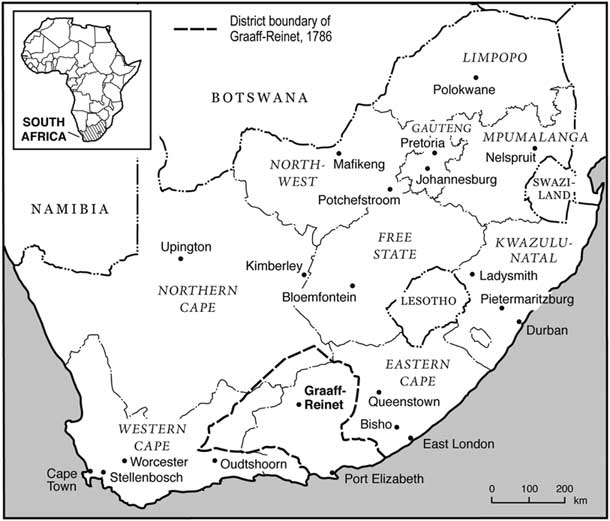
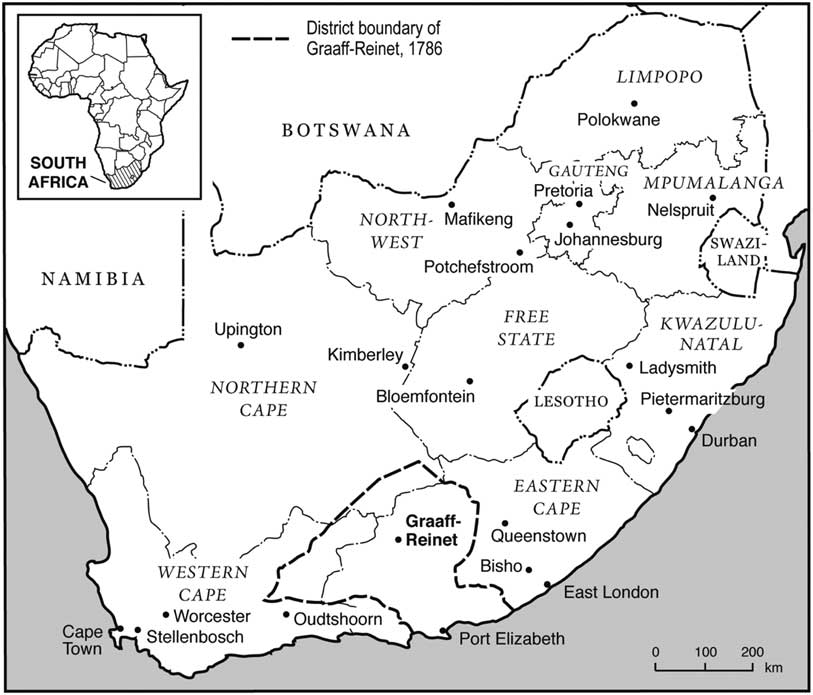
Graaff-Reinet and Kroonvale are uniquely located in the semi-desert Karoo region of the Eastern Cape Province (see Figure 1). Established in 1786 as a frontier outpost, Graaff-Reinet was the fourth oldest settlement in colonial South Africa. Today, with an approximate population of 26,585 (according to 2011 Census figures), it is a busy market town that serves the surrounding farming community. Although coloured people form the majority population of the town (with approximately 14,654 people living in Kroonvale), written records of their lives, histories and cultural identities are conspicuously absent from the general historical accounts of this area.Footnote 7 Thus, my methodology included conducting interviews and using a participant observation approach in order to establish a sense of the oral histories of these congregations and to generate data for further analysis.
Map of South Africa, showing the Graaff-Reinet district’s colonial boundary (1786). Figure 2.1 by Wendy Job from Sonic Spaces of the Karoo: The Sacred Music of a South African Coloured Community by Marie Jorritsma. Used by permission of Temple University Press. © 2011 by Temple University. All Rights Reserved.
The official designation of the coloured racial category in 1950 as an individual who was ‘not a white person or a native’ entrenched a negative discourse about this population group.Footnote 8 This discourse emphasized a categorization or description of coloured people only in terms of the black and white racial groups and not as an independent, individual designation. This led to the assumption that coloured people had no authentic cultural identity and/or history. One of the less obvious side effects of this categorization in terms of music studies was that researchers did not regard coloured people’s music as sufficiently different from either black or white people’s music to warrant independent study. As a result, the music suffered from a lack of acknowledgement from researchers due to the direct mapping of the prejudice surrounding coloured people’s status onto their music.Footnote 9 My study on the sacred music of three church congregations of coloured people in Kroonvale therefore offers a counter-narrative to challenge these assumptions.Footnote 10
The churches where I undertook research, namely, the Parsonage Street Congregational Church (hereafter PSCC), the East Street Congregational Church (ESCC) and the Dutch Reformed Mission Church (now known as the Uniting Reformed Church) (DRMC/URC) constitute the oldest denominations with coloured people’s membership in the area. The early history of the two Congregational churches began with London Missionary Society (LMS) activity. The Dutch missionary, Johannes Theodorus van der Kemp (1747–1811) established what is now known as the PSCC on his arrival in Graaff-Reinet in May 1801, in a time of great upheaval due to the Third Frontier War (1799–1803). Van der Kemp initially held services at the town church but then moved them to his home due to settler resistance toward sharing the town’s religious venue with the indigenous Khoisan people. Van der Kemp’s overall attitude toward the equal rights of Khoisan people also manifested in his refusal to baptize settler children because he believed that they had not shown sufficient remorse for their sins. This stance added insult to injury because frontier farmers usually struggled to find ministers to baptize their children so far away from Cape Town; thus Van der Kemp quickly fell from favour.Footnote 11 In February 1802, less than a year after his arrival, the missionary left the Graaff-Reinet area with about 300 Khoisan people. It is fair to say that Christian services among the remaining Khoisan were disrupted for a few years after this, due to the continuation and aftermath of the Third Frontier War. After the arrival and departure of various ministers in the first half of the nineteenth century, the PSCC consecrated its first church building in 1850.Footnote 12
The East Street Congregational Church (ESCC) originally formed from a small group of members who split from the Middle Street Basotho Mission Church, another London Missionary Society-affiliated congregation active since the 1850s. As some of the Middle Street congregation members only spoke Afrikaans, while others only spoke Sotho, language differences constituted the reason for this move. This new congregation briefly joined the PSCC, but split from this congregation in 1938 (this time most likely due to class differences) and began holding services in an old wool shed in East Street, Cypress Grove (a Graaff-Reinet suburb). Both the PSCC and the ESCC subsequently moved to Kroonvale from the main town in accordance with the Group Areas Act; the PSCC consecrated a new church building there in 1972 while the ESCC moved to Kroonvale in 1964.
Unlike the PSCC and the ESCC with their LMS origins, the third church where I conducted my fieldwork research was established locally. Town officials, concerned about the lack of religious stability among the Khoisan in the period after the Third Frontier War, formed the Graaff-Reinet Missionary Organisation (Graaff-Reynetsche Zendelings Genootschap) in 1819. Albert van Lingen became the first minister of this missionary congregation, which became affiliated with the Dutch Reformed Mission Church (DRMC) in 1881. The newly built church for this denomination became known as the Oefeningshuis (Practising house), which referred to the practice of religion without using the word ‘church’. Thus, it disguised the fact that this building (directly across the street from the main Dutch Reformed Church building in the town) was used for church services. This avoided overt violation of a colonial law of the time which stated that church buildings had to be at least a three-day horse ride apart.Footnote 13 This congregation held services continually in the Oefeningshuis building until it was forced to move to Kroonvale in 1964. By the time of my fieldwork, both the PSCC and the ESCC had retained their names but, due to the joining of the previously segregated Dutch Reformed Mission Church and the Dutch Reformed Church in Africa denominations in 1994, the DRMC had become known as the Uniting Reformed Church (URC).
Kroonvale: A Site of Travel and Dwelling
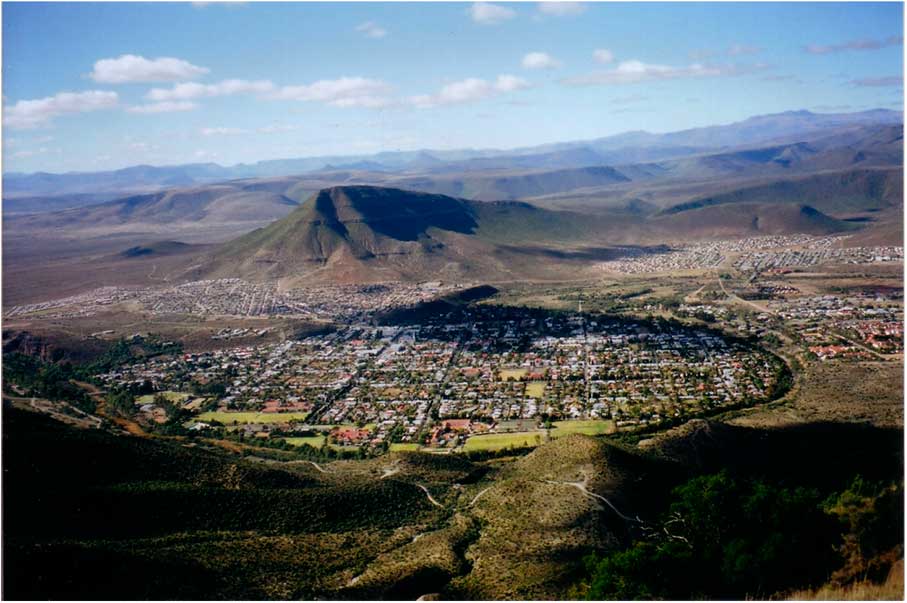
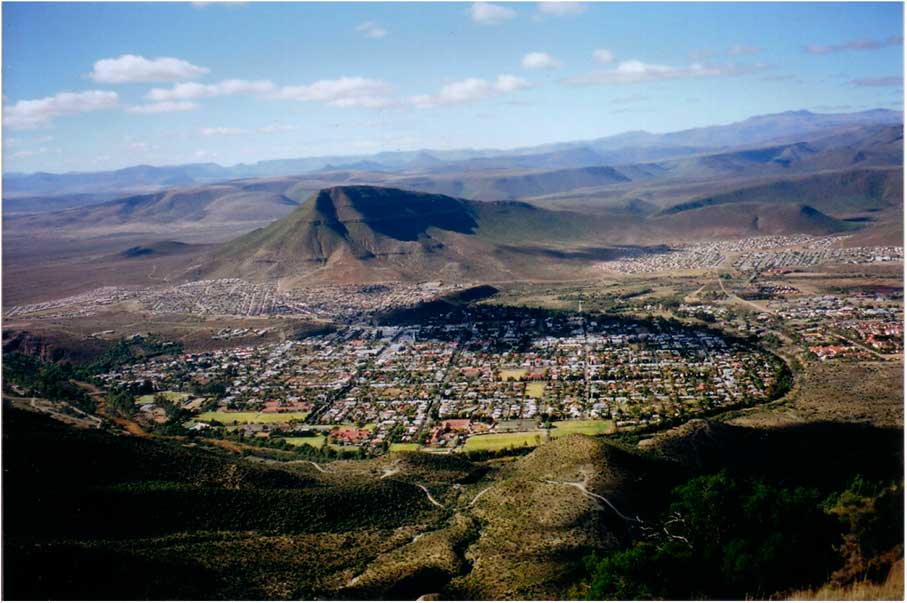
At first glance, the Graaff-Reinet district appears very contained; it is rural, isolated, and no other towns can be seen for miles. Additionally, one can see the scars of segregation, with Umasizakhe, the apartheid-era residential area for black people, to the left, Kroonvale to the right, and the main part of town (previously reserved for white residents only) in the middle (see Figure 2). Beyond the town outskirts lies the great Karoo, populated mostly by white farmers and their (mainly coloured) workers. Many coloured people also occupy a variety of careers in the town, for example, within the service, education, healthcare and tourism industries. These areas do not work in isolation from each other, as farmers regularly visit the town and, using their farm vehicles, transport their workers there for shopping and other errands; townspeople also have relatives on the farms and vice versa. Thus, the configuration of both the town and its surrounding district contributes to a concept of this place as a site of travel and movement.
View of Umasizakhe, Graaff-Reinet and Kroonvale. Photograph by author
Anthropologist Margaret Rodman advocates for interrogating the notion of ‘place’ as thoroughly as that of ‘culture’. She states that ‘places are not inert containers. They are politicized, culturally relative, historically specific, local and multiple constructions … . It is time to recognize that places, like voices, are local and multiple’.Footnote 14 This approach confirms a view of fieldwork sites as more open than the previous more bounded conception of these places. Clifford approaches this issue by suggesting that we think in terms of travel, saying, ‘A location … is an itinerary rather than a bounded site – a series of encounters and translations’.Footnote 15 Following this approach, I interpret Kroonvale as part of a multi-sited place within the Graaff-Reinet district, as it is physically linked to both Umasizakhe and the ‘main’ town itself. The close proximity of these areas is typical of a small town, and it is a particular distinction of the Kroonvale context that people cross relatively easily between them. To apply Clifford’s view, Kroonvale forms part of an itinerary, along with Graaff-Reinet and Umasizakhe. It also became a site of displacement, as unwilling travellers were forced to move from Graaff-Reinet and live in Kroonvale when apartheid segregation laws were implemented. The coerced nature of coloured people’s travel between Graaff-Reinet and Kroonvale in the 1960s indicates a set of power dynamics that needs to be uncovered when one invokes the term, ‘travel’.
Clifford uses travel as a ‘translation term’ which he defines as ‘a word of apparently general application used for comparison in a strategic and contingent way’. He continues, ‘“Travel” has an inextinguishable taint of location by class, gender, race, and a certain literariness’. He therefore makes us aware that the label of ‘traveller’ has often been synonymous with the domain of the powerful, for example, men, missionaries, colonists, western explorers, and so on, whereas female travellers and those journeys of people of colour in many cases have to be raised to the level of ‘travel’ after the fact.Footnote 16 This idea is also applicable in the context of my research, which observes the privileging of missionary and colonial voices in the record with the simultaneous minimizing of the travels of coloured people and their forebears.
The connotations of power associated with the term ‘traveller’ are disrupted, however, when one contrasts the term ‘traveller’ with that of ‘dweller’. Here, the traveller can be regarded as an outsider with limited agency. An example from the Karoo area of Colesberg, north of Graaff-Reinet, is the Karretjie (Cart) People who travel by donkey cart between camping places and survive perilously in the margins between town and farm.Footnote 17 Michael de Jongh, an anthropologist whose work has focused on the Karretjie People since the early 1990s, explains that ‘although they have, for generations, contributed to the agricultural economy of the sheep-farming Karoo, they have remained at best, socioeconomically largely “invisible” to the local population’.Footnote 18 By all accounts, Karretjie People are part and parcel of Karoo life, and yet, because they travel as part of a nomadic lifestyle, they are generally regarded as outsiders. This is perhaps typical of small towns in rural areas; for example, one type of outsider to Graaff-Reinet encompassed the South Africans from the interior of the country who travel through the town every year to spend their summer holidays at coastal cities such as Port Elizabeth, Durban and Cape Town. Graaff-Reinet sees thousands of visitors at this time of year who use the town as a place to stop for fuel, food, perhaps a quick visit to the local museum or an overnight stay before continuing onwards with their journeys. From a local perspective, therefore, outsiders are often those who travel. In contrast, those who dwell in the Karoo for generations are considered as insiders. To be accepted as an insider requires a certain amount of dwelling; membership of this group can be accelerated if extended family has already been dwelling in the Karoo for many years. For example, when a church deacon asked for my name and surname, he seemed disappointed that that my surname was not familiar to him. When I mentioned that I had relatives in the Rubidge and McNaughton families he immediately became animated and told me that he had known my grandfather and his brothers.Footnote 19
These oppositions of outsiders as travellers and insiders as dwellers are precisely the kinds of categories that Clifford is questioning in his work. He advocates regarding an ethnographer as a dweller because he/she lives with the society. A member of this society can be regarded as a traveller when he/she travels in search of employment or education. Clifford is careful to say, however, that he is not replacing one set of parameters with another, for example replacing a so-called ‘native informant’ with an ‘intercultural traveller’, but rather
the task is to focus on concrete mediations of the two, in specific cases of historical tension and relationship. I am recommending not that we make the margin a new center … but that specific dynamics of dwelling/travelling be understood comparatively.Footnote 20
Following from this, I am advocating here for a more nuanced perspective which views local dwellers in Graaff-Reinet as simultaneously travellers and insiders. Many of the Kroonvale congregation members who taught in the local schools, for example, obtained their teacher training certificates in Port Elizabeth, Kimberley or Oudtshoorn.Footnote 21 As Clifford states, we need to ‘rethink cultures as sites of dwelling and travel’.Footnote 22 I believe that the shorter journeys between Graaff-Reinet, Kroonvale, Umasizakhe, the surrounding farms and other Karoo towns are largely responsible for the sound and style of congregational singing I heard in 2004 and 2005. The discussion that follows below examines the notion of travel in this congregational music, beginning with its ‘roots’ in the nineteenth century colonial period.
Global ‘Roots’
This congregational music formed as a result of the long journeys of colonists, European missionaries, slaves from the Cape and Xhosa-speaking peoples and their subsequent encounters with the indigenous Khoisan people. Before the 1760s, the indigenous pastoral and hunter-gatherer groups of the Khoekhoe and San occupied what would become the Graaff-Reinet district.Footnote 23 The colonists and travel writers perceived the Khoekhoe and the San as two separate ethnic groups, yet a great deal of assimilation had already taken place by the time of the early colonial phase. Since the 1970s, historians have generally applied the term ‘Khoisan’ to these indigenous peoples of the southern Cape, a usage I continue here.Footnote 24 All-night singing gatherings and the legacy of a capella vocal performance became one source of what would become the Kroonvale congregational singing tradition.Footnote 25
The majority of Europeans in the area during the eighteenth century came from Germany and the Netherlands. Arriving as destitute people forced into being soldiers or sailors for the Dutch East India Company, these men found more lucrative occupations by taking leave of the company and finding their way into the interior. Although many of these men became farm overseers (knechts) for wealthier, more established settlers, some also became veeboers or trekboers, who arrived in the Graaff-Reinet district in the late 1760s.Footnote 26 Musically, these people brought with them the tradition of Afrikaans liederwysies, which are alternative hymn melodies, the use of the voorsinger (lead singer), and of course, psalm and hymn singing, all of which are discussed further below. After the British occupied the Cape from 1795 to 1803 and again from 1806, many settlers of British origin arrived; the first large group of 4,000 people arrived in 1820. These settlers also became farmers and tradesmen.Footnote 27
Although the majority of the slave population lived in Cape Town and its surrounding farming districts, this discussion would be incomplete without consideration of the slaves’ presence in the Graaff-Reinet area.Footnote 28 These people generally worked as shepherds and herders for farmers’ livestock or provided domestic help in the kitchens of colonial farmhouses.Footnote 29 In addition to their lower numbers in the eastern Cape, slaves’ work and living circumstances made it difficult for them to develop a culture of their own.Footnote 30 However, we do know that slaves formed a significant proportion of the early DRMC school classes, with an 1820 report mentioning attendance of ‘52 slaves and 90 Khoi’.Footnote 31 As those attending school lessons would most likely be expected to attend church services, this suggests that slaves joined the converted Khoisan people in the DRMC congregation. This information does not provide any insights on the possible musical contribution by the slaves, but it is most likely that they assimilated the existing musical and religious traditions of the settlers and Khoisan people.
Associations between Khoekhoe and Xhosa occurred mainly on the fringes of Xhosa territory, a large distance away from what would become Graaff-Reinet. As the colonists pushed the Khoekhoe further towards this territory, some groups sought the protection of the Xhosa chiefdoms and became herders in their service. As colonial expansion increased, Khoisan servants and slaves often escaped the colonists to live with the Xhosa.Footnote 32 Their hosts usually protected them and refused to hand them back to their former masters.Footnote 33 Only after the cattle killing of 1857 did the community of Xhosa people in Graaff-Reinet become properly established; over 3,000 Xhosa people arrived in the town at this time.Footnote 34 Both Khoisan and Xhosa people, therefore, can be viewed as having refugee status during this period of the town’s history.
Throughout the town’s early years, its coloured and black population lived in hire rooms (or huurkamers) situated on property owned by white townspeople and, by the 1850s, in an area known as the ‘location’ on the outskirts of Graaff-Reinet.Footnote 35 Due to geographic proximity, there was much interaction between these groups, and I believe that these interactions also resulted in an extensive dialogue between African musical aesthetics and the coloured community’s church music. In the following section I elaborate on the various musical encounters that resulted in the formation of this congregational music tradition.
Hearing Nineteenth-Century Musical Legacies in the Kroonvale Congregational Sound
Well before the time of the establishment of these churches and the formation of their congregations in Graaff-Reinet, psalms comprised the main religious music sung on the South African frontier. Barry Smith reports that the official hymnbook of the Dutch Reformed Church in South Africa was based on the one used by the Reformed Churches of the Netherlands, which in turn was a translation of the French Genevan Psalter of 1562. This South African version was published in 1775 and remained in use for more than 150 years.Footnote 36
Books of this nature no doubt accompanied trekboers on their journey away from the Cape. The nineteenth-century revivalist trend in the United States and the United Kingdom, however, supplemented the psalm singing in South Africa with two volumes of devotional songs set to secular tunes. By the 1860s, a thin volume called De Kinderharp containing Dutch translations of American and English sacred songs was circulated, and Hallelujah! (1883), a volume printed in Holland, followed thereafter.
Many of these tunes also appeared in the hymnbooks used by the coloured people’s mission congregations. These groups had their own book, published in the mid-nineteenth century by the Rhenish Missionary Society as Geestelijke gezangen ten gebruike van Evangelische gemeenten uit de heidenen in Zuid-Afrika (Spiritual songs for use by the Evangelical congregations formed from the heathen in South Africa), but it is unclear whether the early coloured Graaff-Reinet congregations used this book. We do know, however, that the DRMC, the PSCC and the ESCC used the Afrikaans edition of a book containing older psalm melodies, German and Dutch tunes entitled Evangeliese gesange. The DRMC records only mention this book in 1934, although it is likely that the congregation used the earlier Dutch edition (known as Evangelische gezangboek) before this time.Footnote 37
It is thus fair to say that the missionary hymn legacy is a powerful presence in the sound of these congregations, but by the time of my research during 2004 and 2005, choir performance and choruses existed alongside performances from the hymnbook. Usually, church members sang hymns or gesange and choruses or koortjies in Afrikaans, although the choirs often sang in English. In general, the minister presiding over the service announced the hymns or requested that the congregation sing a koortjie. After this, the congregation members stood up, found the relevant hymn number in their books and then waited for the lead singer or organist to begin before joining in. Many congregation members of all three churches clapped or (more commonly) tapped their hymnbooks or special leather cushions in time to the music. These cushions had elastic sewn across the middle on one side so that a person’s left hand could be held in position while the church member used his/her right hand to tap the other side of the cushion. The percussive sounds provided a solid rhythmic base for the singing. Some churchgoers stepped from side to side or swayed in time to the music, while others remained completely still.
From close listening during my research period, I discerned three particular influences of nineteenth century colonial and missionary presence that remained audible in this repertoire’s melody and harmony. First, the role of the voorsinger (lead singer) remains prominent; this person (male or female) provided the opening line of the hymn and guided the congregational singing. The phenomenon of a song leader is mentioned in scholarly work on the ‘Old Way of Singing’, a style of unaccompanied hymn performance prevalent in Protestant worship between the seventeenth and nineteenth centuries.Footnote 38 Linking this tradition to its Calvinist and Lutheran origins, Gawie Cillié states that the voorsinger in the Afrikaans religious tradition was originally associated with the role of the teacher, but later referred to a person who knew the hymnbook very well and had a strong and confident voice.Footnote 39 The voorsingers I encountered during 2004 and 2005 not only provided the initial melodic line for the congregation to follow, but also filled the spaces between phrases with brief improvised embellishments.
The second legacy of the colonial period which manifests in the contemporary music tradition is the practice of using alternative hymn tunes (liederwysies). These could be melodies of other psalm or hymn tunes used instead of the official melody for that specific text, or melodies from oral sources. Both Willem van Warmelo and Gawie Cillié have written books on this subject, tracing the predominant melodic sources of various South African liederwysies to psalm melodies and popular nineteenth-century hymnbooks.Footnote 40 In Kroonvale, I believe that the heritage of liederwysies combined with the use of hymnbooks containing text only (and no music notation) contributed towards the use of unofficial melodies for church hymns. For example, Gawie Basson reported to me that when he first arrived as the new minister of the Dutch Reformed Mission Church in the 1980s, a few congregation members approached him to inform him that they did not sing Psalm 100 (‘Rejoice Earth, Rejoice’) to the official Dutch Reformed Church melody. Some congregation members could sing this hymn to six different tunes.Footnote 41
The third feature attributed to colonial origins is the use of voice parts roughly based on the soprano, alto, tenor and bass ranges.Footnote 42 A closer inspection of the type of voice parts featured in the Kroonvale religious singing, however, reveals an unconventional approach to the harmonization. There is a particular focus on close intervals (often of a third) and the occurrence of parallel chords. The unconventional choice of doubling certain chord notes and omitting others completely as well as the reliance on chords in first inversion, is typical of congregational singing in Kroonvale. According to P.J. Nhlapho and Sibongile Khumalo, this harmonic structure with its reliance on parallel intervals was originally formed in the encounter between indigenous music and missionary hymns with their strict four-part harmony and ‘prescriptive dominant melody line’.Footnote 43
The sonic effect of this approach to harmonization in Kroonvale is difficult to represent in description and/or transcription, as it constitutes only a fraction of the complete sound of the hymn at that particular Sunday service.Footnote 44 In fact, a congregation member or visitor to the church would gain the impression of a solid block of sound which reverberates around the building, making it possible for even the most reserved of singers to contribute vocally. This effect is due to two additional characteristics of the singing style. First, a purposeful covering of all possible silences took place so that there were no significant pauses between any of the hymn’s textual phrases. This was ensured by the voorsinger’s singing, which covers these pauses and/or by congregation members who sustain the final notes of phrases until the beginning note of the next phrase has been sung. The second characteristic is that congregation members improvised their own melodic ways through the hymn. They would change register and harmonization as they wished, according to the range of their own voices and their individual experiences of having sung the song many times before. Thus, while the basic voice parts are represented, the reality of the live performance meant that congregation members added passing notes while others sustained notes. The rendition of the hymns and choruses therefore sounded different depending on where one was seated in the church and, overall, this resulted in a very thick texture and timbre in which the original melodic line of the piece became difficult to isolate.
In addition to the indigenization of the way in which congregations harmonize hymn melodies, the sound of the Kroonvale congregations featured certain African musical characteristics, which included call-and-response and cyclic forms as well as the use of percussive sounds.Footnote 45 Although these characteristics could be discerned in hymn performance, these were far more pronounced when congregations sang koortjies. According to community members, koortjies became part of the sacred song repertoire in the later twentieth century and were originally drawn from American gospel tune books or earlier hymnbooks used by the congregations.Footnote 46 Possibly due to their more recent addition to the repertoire, congregations generally adopted a more informal approach to koortjie performance. These pieces featured particularly in the time before the minister entered the church to preside over the Sunday service and, although one or two koortjies were usually sung during the actual church service itself, the association of this type of music with the ‘unofficial’ section of the service persisted. Koortjies usually consisted of only one verse repeated several times using the same melody.Footnote 47 This format allowed for a cyclical structure to develop, particularly when, as mentioned earlier, the congregational singers covered all silences and thus this resulted in one repetition of the koortjie melody leading immediately into the next. This cyclical structure, which is typical of an African musical aesthetic, also provided an opportunity to enhance the voorsinger’s existing contribution of melodic guidance and rhythmic momentum both at the start of and during each song. In koortjie performance, in particular, the song leader’s contribution can be heard as a kind of ‘call’ to which the congregation ‘responds’ and therefore interpreted as an instance of the African call-and-response format. The integration of the voorsinger’s role with this African aesthetic provides a fascinating glimpse into the interaction between nineteenth-century missionary/colonial and indigenous musical influences in these congregations. The third musical influence attributed to an indigenous African aesthetic includes the percussive sounds such as clapping, foot stamping and beating of leather cushions that comprised a standard characteristic of koortjie performance. In contrast to the vocal covering of all silences, these rhythmic additions did not occur on every beat; instead, the spaces between claps served to enhance the sense of forward momentum as well as introduce a sense of syncopation and/or cross-rhythm. Thus, through close listening it is possible to hear encounters within this music, based on its origins in the long journeys of colonists, settlers, slaves, missionaries and Xhosa people and their subsequent interactions with Khoisan people. After this early period of arrival and dwelling, smaller journeys also became a vital part of this music’s history.
Local ‘Routes’
Shorter journeys between farm and town, and within various districts of the town, constitute a significant way in which this congregational singing style was established during the nineteenth century and maintained for 200 years thereafter. Ministers and congregation members were very accustomed to this mode; for example, by the time of my fieldwork, ministers travelled often, both to different churches as guest speakers for their jaarfees (anniversary) celebrations and also to the outlying stations at farms in the region (called buitewyke, ‘outside wards’) where they administered the sacraments and carried out the services of baptism and marriage.
Although many Kroonvale residents remained loyal to one church for most of their lives and self-identified as Congregationalists or Uniting Reformed members, the shared missionary origins, Reformed denominational tradition, and language (Afrikaans) of the churches made it possible for many congregation members to attend services other than those of their chosen denominations. Family members moved between churches for a variety of reasons, for example easier mobility and transport options between home and church, special occasions, and church celebrations. When women’s and men’s societies of the various churches held their anniversary service each year, many community members attended these events as well as members of women’s and men’s societies from beyond Graaff-Reinet, in the eastern Cape region. Another important reason for congregation members to change churches was marriage to people from different denominations. In this society, the wives are expected to become members of their husbands’ churches after their marriage, and thus simultaneously make a transition between travelling to the old church with their family members and the new church with their husbands. Thus, Kroonvale churchgoers often attended events at other church denominations in the area.
In 1966, the implementation of the Group Areas Act (1950) forced all coloured people living in Graaff-Reinet to move to Kroonvale. As all three congregations I studied held services in the main town of Graaff-Reinet until the mid-1960s, not only did they have to move, they also had to erect new church buildings. In addition to the personal hardship experienced by residents forced to move from their homes in the town, congregation members inherited a burden of financial debt on behalf of their respective churches. Although the town municipality bought their former church buildings, the money earned did not fully subsidize the building of new churches, and the meeting records from the 1960s show a continuous dedication to organizing fundraising events in order to settle the resulting mortgage debts.
Several stories told to me by community members demonstrate the huge impact of the rupture of merely moving down the road. Virginia Christoffels told me of an incident she remembered from her childhood. Soon after her family moved to Kroonvale, her sister attended the PSCC School in the town as usual one morning as she came from a family of Congregationalists (children usually attended the school attached to their respective church). All schoolchildren living in Kroonvale were requested to put up their hands and were thereafter sent to the Dutch Reformed Mission Church School, which had already moved to Kroonvale. Virginia vividly recalled how upset her father was that day at the fact that Congregational Church children had been sent to the incorrect school with no regard for their parents’ wishes or their chosen church denomination.Footnote 48
June Bosch, a retired organist of the PSCC, now in her 70s, reminisced about watering the rose plants for her grandmother when her family lived in a house on Caroline Street, in Graaff-Reinet, and talks about her little ‘matchbox house’ in Kroonvale where she lived with her husband after her marriage and still lives today.Footnote 49 Almost two decades after apartheid ended, the connection between long-established Kroonvale residents and where they lived during their childhoods in Graaff-Reinet still remained fresh in peoples’ minds. On 24 September 2012, the public holiday known as Heritage Day in South Africa, several ex-residents of Caroline Street gathered outside the buildings that used to be their homes and spent some time with current residents in an act of reconciliation. The group photograph taken that day is displayed proudly in June Bosch’s living room.
Another story about the changing way people move within the town and Kroonvale involves the Acacia Street tradition, which celebrated its ten-year anniversary in the 2009/2010 festive season. Each year the residents of this street in Kroonvale decorate their houses and street with hundreds of lights to create a Christmas/New Year spectacle. Volunteers in the street request visitors to donate a small amount to charity; the residents give the amount collected to the local cancer organization. At first, June Bosch told me, curious townspeople from Graaff-Reinet would drive to Kroonvale to see the lights, but keep their windows tightly closed as they drove from one end of the street to the other. For the past few years, however, this pattern has been changing, much to the satisfaction of those running the display. Visitors now park their cars at the bottom of the street, get out with their children and walk to see the lights.Footnote 50 In countries that have not experienced segregation, this may seem insignificant at best and, at worst, indicative of an ongoing prejudice in society long after apartheid. Yet, this also shows that people feel safe to walk in the neighbourhood, safe to walk outside the ‘main’ area of town, and ultimately, that residents have begun to recognize Kroonvale as a part of the town itself. It is thus this small journey up and down Acacia Street that is highly important to the festival organizers.
Movement and Place: The Kroonvale Case Study
How have these journeys impacted on the congregational song tradition in Kroonvale? My explanation here utilizes the theory of Edward Casey, whose seminal work on place is often referred to in relation to music and landscape. Casey asserts that one of the most important characteristics of places is that they gather things, people, experiences, memories, and histories. Bodies also carry culture into a place.Footnote 51 Following this, I interpret sound as one of these items and believe that bodies carry sound with them into places. Places also have the ability to keep these items within their designated area, and this collection of items as well as its nature and constitution becomes distinctive of that place.Footnote 52
If one integrates Casey’s theory with Clifford’s, the first aspect to be aware of is that the ability of places to hold certain items does not preclude those items from moving around within that place. For example, let us focus on the overwhelming amount of small journeys undertaken by Kroonvale congregation members over the years. Trips between home and church on Sundays and other days for church work, women’s or men’s society meetings and choir rehearsals, visits to other church denominations in the area, and the travels of ministers have all made a contribution to the sound and style of this music in this place. Many members would have learned new tunes, revitalized old ones, and introduced koortjies all as a result of short journeys undertaken regularly in the spirit of congregation and community membership. With the rich history of travelling and movement within and around Kroonvale, it becomes clear that this tradition of congregational song is clearly held there as a significant sound and style belonging to this place. Whether travellers or dwellers or, as Clifford searches for, a mediation between the two, every time Kroonvale residents make that short journey between home and church, they continue contributing to the development and maintenance of this musical tradition.
The work of Casey and Clifford also provides ways of thinking about movement through and beyond places. To begin with Clifford, he reminds us that travel ‘can [also] involve forces that pass powerfully through’ (his emphasis). He mentions ‘television, radio, tourists, commodities, armies’ as examples.Footnote 53 In the Kroonvale context, the implementation of the Group Areas Act and the displacement of people as a result of this form an important application of this idea.Footnote 54 This period was thus one of forced travel where the short physical distance travelled from Graaff-Reinet to Kroonvale was in painful juxtaposition to the immense emotional displacement and rupture experienced by the many communities in the same situation all over the country.Footnote 55 What is intriguing about this example is that despite its deliberate and in many ways successful attempt to impose boundaries on and within place (one is reminded here of the scars of segregation on the physical layout of the town and its surrounding areas), it was not possible to restrict every single movement, especially in a small rural town. Congregation members could move between denominations for shared services that crossed Umasizakhe and Kroonvale boundaries.Footnote 56 A degree of geographical agency could also be maintained. For example, Rev. B.B. Botha, the minister of the ESCC at the time of the church’s move to Kroonvale, petitioned for permission to name the new street where the church would be relocated ‘East Street’ as well, therefore ensuring that the church could retain its original name from its Cypress Grove beginnings.Footnote 57 This example suggests that although the Group Areas Act was a particularly powerful force that moved through this area, boundaries, although much more restricted, could be permeable in certain contexts and situations. Casey explains this characteristic as essential to place. He states that ‘a place could not gather bodies in the diverse spatiotemporal ways it does without the permeability of its own limits. The sievelike character of places might well be regarded as another essential structure of place, one that could be called “elasticity”’.Footnote 58 Thus, this characteristic of place remained despite the height of the apartheid regime’s attempts to enforce separate development policy along spatial lines.
From movement within place to movement beyond and through place, my last point here is to focus on the few steps it takes to cross over the threshold into a church building, in other words, travel on a micro level. This small movement represents a significant crossover from profane to sacred and yet the aural blurring of this boundary is also apparent as the singing reaches one from outside the church, before one even steps inside to join the congregation members who are already seated and waiting for the service to begin. Drawing on Arnold van Gennep’s work on rites of passage, in which van Gennep makes the connection between social rites of passage and the physical movement from one place to another, Casey theorizes the threshold as ‘the concrete interplace of an important transition … only as this place can it serve as the support for a rite of passage’.Footnote 59 Clifford doesn’t particularly focus on the threshold per se, as his work concentrates more on travel in broad sweeps of the inter-continental, the international, the foreign and colonial. However, I believe that he does keep the idea of movement in fieldwork a priority if one takes into account his appeal to consider fieldwork in terms of travel and, to reiterate, as an itinerary rather than a bounded site. Here I would extend this to the need to remain aware of how people move within a site and think particularly of those pre-service moments beginning with groups of people gathered outside the church chatting, their regular movement over the church threshold into the building where the singing can be heard and then the (relatively stationary) presence of the people within the building itself. Here we find an example of what Clifford is searching for, a concrete mediation between dwelling and travelling, in the small movement the churchgoers make when they walk from their houses and over the threshold into the church building.
Conclusion
In conclusion, this article considers how Clifford’s concept of ‘travel’ assists in a better understanding of music making in the Kroonvale context. First, by examining Kroonvale as a site of travel and movement instead of a bounded space, we can appreciate the many encounters between various people that gave rise to this music over time. This is particularly significant in the South African context with its segregated past; as Ingrid Byerly reminds us, musical osmosis was always a possibility even at the height of apartheid separation.Footnote 60 Second, talking about travel in this way should always be accompanied by awareness of how power and domination influence and control movement. If we think of the Group Areas Act as an example of a powerful force that moved through this area, there is no doubt of its resultant influence on the layout of the town as well as the ways in which people’s movements in this place became fundamentally altered. Music-making would not have escaped the effects of this force; similar to the experience of a listener changing according to their position in the church space, the Graaff-Reinet soundscape was changed irrevocably by the silencing of coloured people’s congregational voices in the main town and the subsequent reappearance of these voices in Kroonvale.Footnote 61 Finally, Clifford’s work on complicating the binary of dweller versus traveller allows us to be more open to a fluid concept of these seemingly static terms and remain aware of the power dynamics and perhaps even stereotypical formulations with which they are associated. In order to develop a richer and deeper understanding of church music in this place, therefore, it is important to consider both the rooted and the routed nature of sacred song in Kroonvale.