

[Johnson’s Dictionary] is my seventh novel, and it is the last novel I will write on the colonial or postcolonial condition. I’ve finished that now; no more Jews, no more blacks, no more Indians, no more masters.
—David Dabydeen, “Word People”Footnote 1
While other postcolonial authors have “written back” to Shakespeare and Charlotte Brontë, it is William Hogarth who figures most centrally in David Dabydeen’s creative as well as academic writing.Footnote 2 In particular, plate 2 of Hogarth’s 1732 series A Harlot’s Progress is a key site of the Guyanese writer’s creative engagement with the eighteenth-century English artist. In the 1980s, Dabydeen’s academic studies Hogarth’s Blacks: Images of Blacks in Eighteenth Century English Art (1985) and Hogarth, Walpole and Commercial Britain (1987) drew attention to the persistent but neglected presence of blacks in Hogarth’s corpus.Footnote 3 More recently, Dabydeen’s fiction has reappropriated those black subjects in a complex and ambivalent act of postcolonial ekphrasis that combines homage and critique. In an interview, Dabydeen describes Hogarth as a “friend” to whom he owes a debt, but provocatively suggests that the eighteenth-century satirist is in turn indebted to Dabydeen, who “brought out his black people which nobody before had done. . . . So we have also rescued him from being dead. And he, in return, has given my imagination characters who become live on the page: it’s a mutuality.”Footnote 4 This reciprocal relationship is powerfully expressed in Dabydeen’s novels A Harlot’s Progress (1999) and Johnson’s Dictionary (2013), which bring to life the figures of the slave boy, harlot, and Jew who make up the central grouping in Hogarth’s plate 2. Strikingly, then, Dabydeen populates his Hogarth novels not only with Hogarth’s blacks but also with Hogarth’s Jews.
Why does Dabydeen return repeatedly—one might say obsessively—to plate 2 of Hogarth’s A Harlot’s Progress and to the figure of the Jew in particular? Why is it that for him, as notably indicated in the previous epigraph, to write about the colonial or postcolonial condition is to write about Jews? Dabydeen is part of a generation of Caribbean and Caribbean diaspora writers that has tended to advance a sympathetic reading of Jewishness. In contrast to the dynamic of interethnic competition that shapes the discourse surrounding black-Jewish relations in the United States, invocations of Jewishness and Jewish historical experience in postwar Caribbean literature are generally identificatory in their orientation, as reflects the impact of the Holocaust on these writers, as well as their awareness of the deep historical presence of Jews in the Caribbean since the seventeenth century. For the generation of Caribbean and Caribbean diaspora writers who came of age in the early postwar period when a public discourse about slavery was not available, Jewish historical trauma has often served as a surrogate site of identification and memorialization.
The most prominent example of this pattern of cross-cultural identification with Jewishness in Caribbean literature is that of St. Kitts–born British writer Caryl Phillips. Phillips’s Holocaust novel The Nature of Blood (1997) and his essays on Anne Frank and the Venice ghetto are frequently cited as unique instances of Caribbean-Jewish intersectionality. Yet Jewish themes can also be traced in the work of a number of other Caribbean writers. Dabydeen’s engagement with Jewishness, for example, is as sustained and worthy of analysis as is that of Phillips. Moreover, unlike Phillips, Dabydeen addresses Jewishness, not primarily in the context of the Holocaust, but instead against the more distant historical landscape of eighteenth-century Britain and its colonial possessions, thereby recalling the significant presence of Sephardic port and plantation Jews in Caribbean colonies such as Suriname, Curaçao, Barbados, and Jamaica. Dabydeen’s Hogarth novels thus extend the dialogue between postcolonial and Jewish studies beyond the question of Holocaust memory that has been the focus of such discussions, as well as beyond narrative and into the visual realm. The secondary literature has understood Dabydeen’s concern with Jewishness in terms of Holocaust/slavery analogies, and in interviews Dabydeen himself has pointed to the influence of the Holocaust on his work.Footnote 5 His novels and scholarship, however, reveal a more multifaceted and historically informed interest in “the Jew” as a sign of difference in eighteenth-century European textual and visual discourses, as well as in the relationship between Sephardic Jews and the colonial economy.
As I have argued elsewhere,Footnote 6 although an analysis of the global circulation of Holocaust memory offers one important means of effecting a rapprochement between postcolonial and Jewish studies, another such avenue is the phenomenon of Caribbean literary sephardism, or the invocation in Caribbean literature of the Sephardic Caribbean diaspora and Sephardic historical experiences of expulsion and conversion. Dabydeen is among a number of Caribbean writers, including Maryse Condé, Derek Walcott, and Cynthia McLeod, who recall the Sephardic communities established in the Caribbean in the seventeenth century in the aftermath of the Iberian expulsion that built some of the oldest synagogues and Jewish cemeteries in the hemisphere.Footnote 7 The fiction and poetry of these writers complements the emerging historiography of the Jewish Atlantic, which has drawn attention to the widespread presence of Sephardic trade networks in the Atlantic world—a presence also highlighted by a recent exhibition on Dutch Caribbean Jewry at the Jewish Historical Museum in Amsterdam.Footnote 8 Although Dabydeen is not alone among Caribbean writers in invoking the Sephardic Caribbean, what distinguishes his postcolonial engagement with Jewishness is its visual dimension.Footnote 9 His Hogarth novels challenge racialized representations of Jewish difference by establishing discrepant relationships between word and image.Footnote 10
Postcolonial Ekphrasis
One of the hallmarks of Dabydeen’s fiction and poetry are their intermedial reworking of visual intertexts. Reconfiguring artworks in literary form, Dabydeen develops a specifically postcolonial form of ekphrasis.Footnote 11 Preeminently in his poem Turner (1995), he resuscitates the drowned slave in J. M. W. Turner’s 1840 painting Slave Ship in a corrective strategy that refocuses the eye to ensure that what had been relegated to a footnote in John Ruskin’s famous defense of the painting now becomes central to our understanding of the work. In his preface to Turner, Dabydeen explains that he “focuses on the submerged head of the African in the foreground of Turner’s painting. It has been drowned in Turner’s (and other artists’) sea for centuries. When it awakens, it can only partially recall the sources of its life, so it invents a body, a biography, and peoples an imagined landscape.”Footnote 12 In this way, as Mary Lou Emery observes, Dabydeen’s Turner redefines ekphrasis as a verbal account “of what cannot be fully seen in the painting, but only imaginatively envisioned through words.”Footnote 13 Similarly, Dabydeen’s Hogarth novels supplement Hogarth’s graphic art by inventively restoring life to its black figures. In this regard, the images came first and the text second, for as Dabydeen explains, “Before I even wrote [Johnson’s Dictionary] I had the illustrations in mind, the figures in mind.” Deeply familiar to Dabydeen after decades of study, Hogarth’s blacks are “like my neighbours, or members of my family”: “So you just bring the family together and let them get on with it and let them talk and just write about it.”Footnote 14 Perhaps less expectedly, in the course of refashioning Hogarth’s graphic art into text, Dabydeen also rescues the figure of the cuckolded Jewish merchant from plate 2 of A Harlot’s Progress. Dabydeen’s postcolonial revision of Hogarth thus entails a comparative analysis of the construction of black and Jewish Others in eighteenth-century British and colonial culture.
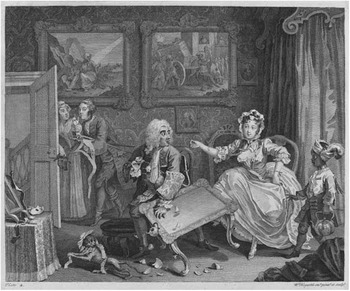
In plate 2 of Hogarth’s series of six engravings (originally paintings) about a young country woman who falls into prostitution in London [figure 1], the harlot Moll has become the mistress of a Jewish merchant, whom she is deceiving with a secret lover who escapes in the background. Moll is situated in between the figure of the cuckolded Jewish merchant and a turbaned slave boy. The Jew and the slave boy, who stare at each other across a table and tea service that is in the midst of being overturned, wear matching expressions of surprise that are echoed in the monkey’s visage in the bottom left corner of the engraving. While elsewhere in Hogarth’s work, bearded and swarthy Jewish peddler and musician figures are relegated to the margins of the image, in plate 2 the Jewish merchant is positioned at the center.Footnote 15 Meanwhile, the orientalized, turbaned slave boy is situated off to the side, serving as the shocked spectator who observes the debauched behavior of the Europeans. The slave boy thus functions much like other black figures in Hogarth’s art in which, as Peter Wagner observes, “The satirical frame contrasts alleged African primitiveness with real English behavior that can hardly be distinguished from that of animals.”Footnote 16 In the case of plate 2, the behavior in question is the prostitute’s duplicity as well as the materialism that is signaled by the overturned tea set, an emblem of colonial wealth. Also targeted by Hogarth’s satire in plate 2—anticipating the debates surrounding the Jewish Naturalization Bill of 1753—is the unsuccessful assimilation of the clean-shaven Jew, whose fashionable dress and ill-fitting wig fail to disguise his decidedly un-English physical features.Footnote 17
William Hogarth, A Harlot’s Progress, Plate 2 (1732). Courtesy of the National Gallery of Art, Washington, D.C., Rosenwald Collection.

Dabydeen’s eponymous novel takes up both the figure of the slave boy and that of the Jewish merchant, recontextualizing them to highlight the discursive traditions and colonial power structures that govern Hogarth’s racialized caricatures. In Dabydeen’s A Harlot’s Progress, the slave boy from Hogarth’s engraving becomes the protagonist Mungo, the author of an eighteenth-century slave narrative who narrates the story of his enslavement to the abolitionist Thomas Pringle (a character inspired by the editor of Mary Prince’s slave narrative). Meanwhile, Hogarth’s Jewish merchant becomes Sampson Gideon, a name Dabydeen borrows from the prominent eighteenth-century Sephardic English banker who may have inspired Hogarth’s caricature. In Dabydeen’s rendering, Sampson is not a financier but a quack doctor who encounters Mungo at the house of his master, Lord Montague. A visual detail from one of the engravings in A Harlot’s Progress introduces each section of the novel, thereby inviting the reader to reconsider the meaning of particular figures and creating a new sequencing of images that responds to Hogarth’s original series.
In his more recent novel, Johnson’s Dictionary, Dabydeen adopts a different visual strategy, inserting plate 2 in its entirety as part of a sequence of eleven works of European art, including a number by Hogarth, as well as by Dürer, Blake, and others. Like Dabydeen’s first Hogarth novel, Johnson’s Dictionary is populated largely by figures pulled from Hogarth’s engravings—in particular slaves, harlots, and Jews. Moving back and forth between the colony of Demerara and eighteenth-century London, the novel follows the harlot Elizabeth as she journeys to the colonies, seduces a Scottish doctor, and reinvents herself as a woman “of elevated character.”Footnote 18 Resisting linear plotlines and traditional characterization, Johnson’s Dictionary presents us with a variety of black and Jewish figures who speak back to Hogarth’s pictorial representations. Word-image correspondence is established through the periodic insertion into the novel of European artworks, among them a number of Hogarth’s most significant portrayals of blacks. As with his introduction of visual details in A Harlot’s Progress, Dabydeen’s sequencing of artworks in Johnson’s Dictionary can be understood as a play on the seriality for which Hogarth is known. Hogarth’s narrative, theatrical approach to his graphic art brings word and image closer together and encourages the intermedial approach of Dabydeen’s novels. Wagner has described Hogarth’s engravings as iconotexts, “work[s] of art made up of visual and verbal signs . . . in which text and image form a whole (or union) that cannot be dissolved.”Footnote 19 Dabydeen’s fiction, in which the textual becomes inextricably bound up with the visual, echoes this interpenetration of word and image in Hogarth’s work.
But why Hogarth rather than, for instance, the Italian and French painters that have inspired some of Walcott’s poetry? Hogarth’s works are resonant for Dabydeen in part because their status as iconotexts makes them an especially rich site for a consideration of racial stereotypes as they are articulated through the interplay of word and image. The satirical mode that Hogarth favored and the more accessible medium of engraving that he helped to popularize express these racial stereotypes in a heightened fashion and point to the role of print culture in their dissemination. In Hogarth’s Blacks, Dabydeen suggests that in exploiting racialized myths for satirical purposes, Hogarth risked validating and perpetuating them, particularly among those consumers who may not have been sophisticated enough to register their satirical intent. Yet he also maintains (in a rather charitable account) that sympathy underlies Hogarth’s caricatures, arguing that “compassion for the fate of the common people . . . is the distinguishing feature of his art.”Footnote 20 More broadly, then, Hogarth is significant for Dabydeen as a visual artist who portrayed ordinary people who had seldom been illustrated. Among those subjects Hogarth deemed worthy of representation are blacks, whose longstanding presence in England Hogarth’s art documents. Crucial for Dabydeen’s purposes is the way in which Hogarth, as Wagner notes, “draw[s] our attention to the stereotyped depiction of Africans while boosting their seemingly peripheral role in art and life.”Footnote 21
If Hogarth is important to Dabydeen thematically, he is equally important to the Guyanese writer in formal terms. Hogarth’s highly intricate graphic art requires the viewer to read on multiple levels simultaneously. His crowded scenes are puzzles for the viewer to decipher; almost always his images present not a single story but multiple stories and backstories unfolding. Thus Dabydeen describes how “Hogarth himself challenges us to speculate and to indulge in a hectic chase after meaning. He invites us to unlock his narrative puzzles and sees this as providing essential intellectual fun for the interpreter of his work.”Footnote 22 Somewhat paradoxically, Hogarth’s sequential, realist art helps to inspire Dabydeen’s departure from realism and the linear emplotment favored by the slave narrative:
Within one frame of a picture you get stories that multiply and teem, and other stories; every detail triggers off a story that then connects up with another detail, which then connects up to another story. . . . It seems to be some kind of social realism, but then it can be endlessly complicated in terms of being a narrative that changes upon itself, turns upon itself, sets up other narratives, etc., within the one frame. So what I tried to do in A Harlot’s Progress was also to destroy the surface realism of a story by complicating it, by making it almost unreadable—in a sense replicating what Hogarth was doing in terms of endless, complex narratives.Footnote 23
Dabydeen’s unsettling, often bewildering postmodern slavery fiction makes significant demands on the reader to decipher the text and interpret the relationship between word and image. Even more so than Hogarth’s engravings, Dabydeen’s Hogarth novels are digressive, excessive, and multilayered. Especially in Johnson’s Dictionary, the insertion of images disrupts the linear progression of the narrative and distracts the reader from the text. The visual elements in both novels function somewhat like the paintings that hang in the background of Hogarth’s works, offering the reader clues regarding how to interpret what is unfolding in the narrative foreground. Dabydeen’s Hogarth-inspired strategy of interrupting his novels with visual works that bear a sometimes-oblique relationship to the plot ultimately encourages the reader to reflect on the nature of representation and in particular racial representation.Footnote 24
Also important from a hermeneutic perspective is the way in which Hogarth’s graphic art encourages a relational understanding of difference by presenting a system of signs that are defined against one another. Bernadette Fort and Angela Rosenthal observe in their introduction to The Other Hogarth: Aesthetics of Difference that Hogarth’s scenes work by establishing a series of relationships among the figures represented:
The identities in this picture do not exist prior to representation, nor do they emerge sui generis; rather, they are brought into being through a complex iconographic orchestration based on alterity. The interlacing of references and meaningful juxtapositions make sense within a system of differences. Not marked as fixed, unchanging, or essential, this assortment of peculiar characters and the objects that scaffold their virtual space come into being through complex visual markings that work with and against one another, producing significance.Footnote 25
Strikingly, whereas Fort and Rosenthal’s collection gives little attention to how Jewish difference contributes to the production of meaning in Hogarth’s work, Dabydeen understands Jewishness as central to Hogarth’s “aesthetics of difference.”Footnote 26 Thus he resists both the tendency Michael Galchinsky identifies to isolate the Jewish question from a larger “discourse of marginality”Footnote 27 and the tendency of postcolonial studies to neglect Jewishness altogether.
In his scholarship and fiction, Dabydeen shows himself to be acutely conscious of the literary and visual traditions of depicting the Jew’s physical and moral character that Hogarth both drew upon and consolidated.Footnote 28 In the eighteenth century, the figure of “the Jew” carried a range of associations including materialism, untrustworthiness, and deicideFootnote 29 as well as sexual perversion, boorishness, and criminality.Footnote 30 In Hogarth, Walpole and Commercial Britain, Dabydeen argues that Hogarth’s Jewish merchant in plate 2 needs to be situated more specifically with respect to portrayals of Jews in the South Sea Bubble prints, poetry, and drama of the 1720s. Dabydeen points to the trope of the “stockjobbing Jew” and the dandified, deceived Jewish merchant as rooted in this tradition of associating Jews with stock market speculation and a questionable colonial trade. As part of his larger argument for a political rather than moral reading of Hogarth’s series, Dabydeen discusses contemporary literary, visual, and journalistic discourses about Jews, who had only recently been allowed to return to England:
Jews were a traditional target of Christian hostility and their situation had not altered much in eighteenth century Britain in so far as they were still liable to be bashed about by the mob at the slightest excuse. Hogarth is shamelessly and greedily capitalizing on popular prejudice against the Jew by depicting him in a contemptuous light: he is the type of image that would boost sales among the populace, both among its hooligan as well as its respectable classes. The situation of the Jew and his Christian mistress in Plate 2 of A Harlot’s Progress is an immediately recognisable one to the spectator accustomed to reading saucy literature about English courtesans bubbling their Jewish keepers. There was a popular belief that Jews were licentious creatures much addicted to patronage of Christian whores whom they attracted by their ready commercial wealth, although there was an anti-semite law expressedly prohibiting such contact.Footnote 31
As Dabydeen is aware, Hogarth’s Jewish merchant simultaneously drew on the popular iconography of the Jew and distilled it, inspiring the emergence of a new stage Jew, “Beau Mordecai.” Variations on this new Jewish type, a more unequivocally negative rendering of the oversexed, wealthy Jewish dandy who patronizes brothels and exploits naive country girls, appeared in such plays as Cibber’s Harlot’s Progress (1733), Fielding’s Miss Lucy in Town (1742), and Macklin’s Love à la Mode (1759).Footnote 32 By writing a novel that carries the same name as Hogarth’s series, Dabydeen extends this tradition of textual adaptation of Hogarth. Yet unlike the eighteenth-century dramatists, rather than intensifying Hogarth’s caricatured portrayal of the cuckolded, lecherous Jew, Dabydeen’s novels challenge it as part of his larger critique of colonial regimes of representation.
A Harlot’s Progress
Dabydeen’s A Harlot’s Progress advances a corrective reading of the Jew along with other elements from Hogarth’s series by generating discordant relationships between word and image. Late in the novel, we learn that Hogarth’s inspiration for his engraving had come from a visit made to a London clinic for harlots where the slave Mungo assists the Jewish quack doctor, Sampson Gideon. Hogarth’s misrepresentation in plate 2 of the individuals he encounters at the clinic parallels the abolitionist Thomas Pringle’s misrepresentation of the slave Mungo, whose life story Pringle invents. In a circular fashion characteristic of the novel, Pringle’s fabricated narrative of Mungo’s life proves to be itself inspired by Hogarth’s engraving. Just as the falseness of plate 2 is exposed in part through Hogarth’s mischaracterization of the Jewish doctor as a corrupter of harlots, the falseness of the slave narrative that Pringle constructs is revealed through his persistent casting of Jews as a threat to “the moral intactness of the nation.”Footnote 33 In a scene that thematizes the intermedial adaptation and shaping influence of Hogarth’s engraving on subsequent literary production about the Jew, Pringle invents for Mungo’s biography a figure he identifies as “the notorious Jewish trickster Mr Gideon.”Footnote 34 Dabydeen’s slavery novel problematizes the editorial function of abolitionists such as Pringle in part by suggesting that his antislavery campaign is motivated by anti-Jewish (as well as anti-French and anti-Catholic) xenophobia:
Jews and Jacobites and Papists and their spies are everywhere, threatening the stability of England. . . . They’re all thieves together, great and small, their joint actions eroding the foundation of the country. True, the Jew is worse, his money-making scheme being part of a conspiracy with Papists and Jacobites to create chaos. He finances their plots to overthrow King and Parliament and the commercial system on which the security of the nation depends. The Jew will profit from England’s demise, buying up enterprises cheaply and stripping them of their assets.Footnote 35
Taking control of Mungo’s narrative, Pringle infuses it with virulent anti-Jewish rhetoric that Mungo in turn inculcates, so that the slave later recalls: “From the time I land in England all I hear is curse, but after a while I too believe: vile Jew, rich Jew, rob—and—cheat Jew, Jew carpenter who shave and plane the wood into Christ’s Cross, then charge extra for the nails.”Footnote 36 Part V of the novel is replete with references to the Jew as foreign contaminant, as lecherous, as exploiting Christian girls. Orientalist imagery also features in the washerwoman Betty’s account of the Jew as a seductive, dangerous, and untrustworthy foreigner who is “[d]ark, fine-boned, exotic in manner.”Footnote 37 Thus in Part V, Dabydeen presents the reader with an invented Jew or “the Jew” as sign.
When Dabydeen subsequently introduces an actual Jew into the novel, he upsets the correspondence of word and image by presenting him not as a Hogarthian Jew but as a sympathetic ally of the slave and harlot. Part VII of the novel is prefaced by a detail from plate 2 showing the Jewish merchant, signaling to the reader that we should now focus our eye on the Jew at the center of Hogarth’s engraving and reconsider the meaning of this figure. In this section of the novel, Lord Montague has purchased Mungo to replace Lady Montague’s dead monkey. Here Mungo becomes the figure of the turbaned slave boy who features not only in plate 2 but also (as Dabydeen shows in Hogarth’s Blacks) repeatedly in European painting as a foil to the European subjects whose superiority and civility the slave contrastively highlights. Displaced from London to the Montague household, Mungo (now renamed Perseus) embodies the alienation and humiliation that Dabydeen suggests slaves used for such decorative purposes must have experienced.Footnote 38 Mungo’s isolation is eventually alleviated, however, by the arrival of the Jewish doctor, Sampson Gideon, who ministers to Lady Montague’s ailing health with his “Amazing Eastern Cordial.”Footnote 39 The expressions of surprise worn by the Jew and slave boy in plate 2 are recast in a scene in which Mungo/Perseus answers the Montagues’ door to Sampson:
Perseus opens the door expecting to find a crooked-back and bearded Jew, hook-nosed, darkly complexioned, his hands worn by a lifetime of counting money. . . . Instead, he is confronted by a fresh-faced man, dark-haired, handsome, in his mid-twenties. He beholds Perseus with momentary alarm, as if the door had opened to an inevitable fate. Recovering his composure, he attempts a benign smile and announces himself modestly as Mr Sampson Gideon. He waits politely for Perseus to stop gaping.Footnote 40
As fellow aliens, the black slave and the Jewish doctor quickly become aligned, vilified as coconspirators by Lady Montague’s servants and by Lady Montague herself as parasites who feed on her decay. Initially evoking associations with sexual perversion, disease, and degeneration, Sampson instead emerges in Part VII as a gentle, gracious, and sympathetic figure who facilitates Mungo’s escape from slavery. When Mungo absconds from the Montague household and joins Sampson in London, Sampson is cast in an exaggeratedly positive light as the slave’s savior, as well as that of the prostitutes to whom he tends. Some ambiguity remains, however, as Mungo experiences lingering doubts regarding the Jew’s character.
As Lars Eckstein comments, Dabydeen’s Jew in A Harlot’s Progress is perhaps the most pronounced example of how his “free imaginative transformation” of visual models challenges the xenophobic popular stereotypes to which Hogarth’s engravings appealed.Footnote 41 In this respect, it is useful to consider James Heffernan’s account of how ekphrasis “stages a contest between rival modes of representation” and “evokes the power of the silent image even as it subjects that power to the rival authority of language.”Footnote 42 Heffernan’s account illuminates Dabydeen’s novel, which simultaneously draws attention to the potency of Hogarth’s images and seeks to displace them through alternative textual representations. Dramatizing the contest between word and image is a scene in which the harlot Moll violently disfigures a painting and damages a bust that Mungo had stolen from the Montagues. Yet the novel also suggests that Dabydeen’s art may be no match for Hogarth’s. Toward the end of the novel, Mungo abandons his narrative of Moll’s decline, saying: “Go to Mr Hogarth’s prints on Moll to sate your curiosity, for he has fixed her for all time on the point of his burin. How can my halting feeble art release her from such agony?”Footnote 43 Frank Felsenstein has noted the lasting impact of Hogarth’s Jewish merchant, who with his sharp features, prominent nose, goggle eyes and dark complexion, was “the earliest widely known graphic representation of the Jew.”Footnote 44 Moreover, another Jewish type established by Hogarth was that of the bearded, swarthy Jewish peddler who appears in his Election series in Canvassing for Votes (1757) and which remained culturally entrenched until at least the mid-nineteenth century.Footnote 45 Hogarth thus popularized not one but two enduring pictorial Jewish types. Mungo is right, then, to worry that he “will forever be associated with the indecencies of merchants and whores, for Mr Hogarth’s prints will last forever.”Footnote 46 The power of Hogarth’s popular series seems inescapable to Mungo, for the prints “sold uncommonly well, spreading the message of me throughout the realm.”Footnote 47
Johnson’s Dictionary
In Johnson’s Dictionary, Dabydeen deepens his engagement with Jewishness as well as the ekphrastic strategy of his first Hogarth novel by situating the Jew (as well as Hogarth himself) not only in the European metropole but also in the colonial West Indies and by integrating the visual still more extensively into the text. In Dabydeen’s A Harlot’s Progress, Jews are briefly linked to the colonies through the figure of a Jewish slave ship doctor who is thrown overboard alongside a number of slaves in an incident that recalls the Zong massacre. This alignment of Jews and slaves as fellow victims of one of the most notorious incidents in the history of the Atlantic slave trade contrasts with the association of Jewishness with the forces of enslavement and corrupt colonial wealth that Hogarth’s original engraving and the South Sea Bubble cards promoted. Dabydeen notes that Hogarth’s Jewish merchant “who patronises whores does so from wealth derived from colonial trade (the black boy with his tea-kettle, the monkey, and the mahogany table indicate this much).” Thus in Dabydeen’s analysis of plate 2, “The Jewish merchant is a slave dealer in two ways: he is the polite keeper of courtesans like Moll who are slaves to his pleasure, and he also deals in Africans, who are slaves for his profit, either shipping them to the colonies for sale or working them in his West Indian plantations or trading in the products of their labour (tobacco, sugar, rum, brandy, tea, et cetera).”Footnote 48
In his novel A Harlot’s Progress, Dabydeen hints at this association between Jews and an unsavory colonial trade by naming his Jewish protagonist after a Sephardic Jewish banker whose father, Rowland Gideon (né Rehiel Abundiente), was a merchant from a Portuguese converso family and who lived, in classic port Jew fashion, in Barbados, Boston, Nevis, and London.Footnote 49 In Johnson’s Dictionary, Dabydeen makes this historical connection between Sephardic Jews and the colonial Caribbean more explicit by locating his key Jewish protagonist, Theodore, in the colony of Demerara, where he works as the accountant on a plantation. Accordingly, Theodore is also a more ambivalent figure than is A Harlot’s Progress’s Sampson Gideon. I would argue, however, that this ambivalence speaks less to a historical argument that Dabydeen wants to make about the role of Jews in the colonial economy than to his interest in “the Jew” as an overdetermined sign that problematizes the truth claims of realist representations of the Other.
In Johnson’s Dictionary, colonial and metropolitan spaces become still more deeply imbricated than in Dabydeen’s first Hogarth novel, and by extension, British art becomes more deeply implicated in colonial relations. Dabydeen’s insertion into his novel of a series of works of European art, including a number by Hogarth, serves to resituate these works against the background of colonial-metropolitan relations. Having made a brief appearance in A Harlot’s Progress, in Johnson’s Dictionary Hogarth now resurfaces in the colonies, where he is the master of the slave Cato and the “Official Artist of the Colony of Demerara and Contiguous Territories.” Hogarth is thus triply present in the novel as a protagonist, as the primary inspiration for the novel’s characters, and as the creator of artworks periodically inserted into the text. In Dabydeen’s unflattering portrayal, Hogarth is a drunken artist whose task as part of the machinery of empire is to “make record of the factories and the fields and the whitefolk who run the colony.”Footnote 50 As in A Harlot’s Progress, here Hogarth’s art is exposed as misrepresentation:
Oh so much more pretty to see your life in paint, because Massa don’t bother to put in the Negro sweat and the hate. Canvas is a special cloth: you can’t spoil it with too much real life. Canvas is Christ’s miracle. On canvas the lame walk, the hungry get fish and loaves, water turn into wine, work make a man free.Footnote 51
In Johnson’s Dictionary, Dabydeen dramatizes the power of genres of painting such as the colonial picturesque to distort and excise “real life.” Underscoring the political nature of painting as an expression of colonial power, the slave Cato “dream[s] that the paintbrush in my hand is a torch that will burn down canefield and factory.”Footnote 52 Driving home the connection between European art and the brutally exploitative conditions of the plantation that supports its production, Cato at one point rubs sugar directly into one of his master’s canvases.
If resituating Hogarth in Demerara exposes the ideological underpinnings of European art, relocating the Jew to the Caribbean colony would appear to implicate the Jew in the plantation economy. In Part Two of Johnson’s Dictionary, which takes place in London, we are presented once again with the triangulation of harlot, Jew, and slave boy that structures plate 2 of Hogarth’s original series. The first image of the Jew that confronts the reader in the novel is that of the Jew as patron of prostitutes. We are told that the harlot Elizabeth “specialized in Jews, liking the brushstroke of their beards which she plucked, voided her rheum into, play-acting a child’s anger at the lewd assaults. Afterwards they paid her a shilling more than the normal rate and hobbled off to be purified in their special home-wells.”Footnote 53 Quickly, however, we move from this pictorial image of generalized Jews (underlined by the reference to the “brushstroke of their beards”) to an individual Jewish figure who overturns the first image. Employing a similar strategy of inversion to that of his first Hogarth novel, Dabydeen here presents his London Jew as the harlot’s benefactor rather than seducer: “Folk said all Jews were mean, hoarding their lot, but their Jew seemed to be bent not on saving but on salvation.”Footnote 54 The unnamed London Jew of Part Two is a parodically benevolent figure who, like Sampson Gideon in A Harlot’s Progress, has made it his life’s mission to provide sanctuary to harlots: “ ‘I am here to protect her and you. I have wandered the earth, guided by the light of stars and comets, and my journey has brought me here,’ the Jew said.”Footnote 55 With his elevated, poetic language and messianic tone, the London Jew seems drawn from the Scriptures. Accordingly, seeking to solve the mystery of the Jew’s true motives, Elizabeth searches for clues in a painting of the golden calf that features a bearded Jew, whom she mistakes to be “a portrait of their Jew when he was young.”Footnote 56 This ekphrastic passage suggests the difficulty of disentangling contemporary Jews from biblical Jews as well as individuals from typological graphic representations.
Soon tiring of the Jew’s benevolence, Elizabeth flees and becomes associated with a black man, Francis, thereby completing Hogarth’s triangle of Jew, harlot, and slave. As in Hogarth’s engraving, in Johnson’s Dictionary black and Jew are paralleled with each other. Both Francis and the London Jew are mysterious figures who inexplicably single out Elizabeth and whose dialogue, actions, and sense of mission echo one another. Elizabeth’s affiliation with Francis anticipates her eventual move to the colony of Demerara, where she seduces a hapless Scottish doctor and acquires a plantation. In the colony, Elizabeth makes the acquaintance of a still more intriguing Jew, Theodore, who appears in Part Three as a guest in her salon.
In both of his Hogarth novels, Dabydeen resists linear emplotment and conventional characterization by generating proliferating versions of a given narrative thread or figure. Thus between the two novels, we are confronted with multiple incarnations of the harlot, the slave, and the Jew. Alongside Sampson Gideon in A Harlot’s Progress and the London Jew who appears in Part Two of Johnson’s Dictionary, Theodore represents yet another reworking of Hogarth’s Jewish merchant. Significantly, Theodore’s appearance follows closely after the insertion into the novel of plate 2, which is recontextualized through its enfolding within the narrative of the harlot Elizabeth’s rise (or “progress”) in the colonial society of Demerara. As in Dabydeen’s first Hogarth novel, here the relationship between image and text is an ambivalent one. Plate 2 both helps to inspire the novel and at the same time disrupts the flow of the narrative in a manner that threatens to supplant it. The visual image of Hogarth’s Jew introduces a set of powerful associations that will overdetermine Theodore and make it difficult to discern his true nature.
Working as an accountant for the Catholic overseer Mr Basnett on a plantation with three hundred slaves, Theodore manifests a series of recognizably “Jewish” traits. As with the unnamed London Jew in Part Two, he is a shadowy figure of mysterious origins: “Theodore divulged nothing of his past to Mr Basnett (me being his sole confessor). Mr Basnett took him to be English, but a hint of darkness of skin and accent suggested some foreign infusion, possibly from Portugal.”Footnote 57 Repeatedly linked to the idea of impure blood, Theodore’s Jewishness connotes foreignness as well as miscegenation, in keeping with the fear of sexual contact between Jews and gentiles expressed in Hogarth’s plate 2.Footnote 58 Although some details of Theodore’s biography, including his Portuguese appearance, the fact that he is Dutch speaking, and his movement from Holland to France and Demerara, strongly suggest a Sephardic lineage, the slave Francis later discovers that Theodore “was from Eastern Europe, a scion of privilege, a relative of the Czar no less, his family owning several estates in Russia and Poland.”Footnote 59 Theodore represents a peculiar conflation of the Sephardic and Ashkenazi diasporas that dispersed across the Caribbean, a composite of these histories.Footnote 60
Conforming to the image of the crafty Jew that appears in one of the South Sea Bubble cards that Dabydeen reproduces in Hogarth, Walpole,Footnote 61 Theodore is a trickster, possessed of linguistic skills as well as the “dexterity of a cardsharp.”Footnote 62 Like Hogarth’s Jewish merchant, Theodore affects the “refined manners” of a gentleman: “He was versed in all the arts of refinement, an accomplished gambler, violinist, fencer, equestrian and linguist.”Footnote 63 He is also a libertine and a rake, envisaged at one point as lasciviously clutching Elizabeth in a “gross clasp”Footnote 64 that recalls the clawlike hand of Hogarth’s Jew. Associated with sexual corruption and lechery, Theodore is equally perceived as a force of economic corruption who “sow[s] and reap[s] figures” rather than sugarcane.Footnote 65 Depicted as “poring over the ledger books,”Footnote 66 he appears obsessed with figures and calculations. The moral and economic danger that Theodore represents is manifested in his “thin and wily-looking” physiognomy.Footnote 67
As with his other Jewish protagonists, however, Dabydeen soon undermines these stereotypes and breaks the word-image correspondence between the novel and plate 2 by disclosing Theodore’s motivation to be one of reforming rather than profiting from the plantation. Theodore uses his gift for trickery to confound the overseer Basnett and to impose various reforms that benefit the slaves including longer lunch breaks, improved diet, payment of a monthly bonus, additional holidays, and reading lessons. “So you are an abolitionist at heart; is that your dirty secret?” charges Mr Basnett. “A foreigner with dark complexion, a tincture of the Jew in him.”Footnote 68 Theodore is revealed to be the redeemer of slaves rather than the enslaver of Hogarth’s engraving, just as Sampson Gideon and the London Jew are the redeemers of prostitutes.
Profoundly enigmatic and mysterious, Dabydeen’s Jews in A Harlot’s Progress and especially Johnson’s Dictionary are figures of questionable loyalty. Yet in Dabydeen’s fiction, the untrustworthiness traditionally ascribed to the Jew raises concerns not so much about the Jew’s moral character as about the reliability of representation itself. The contest between word and image that Dabydeen’s Hogarth novels stage, in which the visual stereotypes threaten to overwhelm his textual revisions, points to the difficulty of escaping the discursive traditions that surround racialized Others. Dabydeen’s Jews are enigmatic not because Jews are deceitful, treacherous creatures but because “the Jew” as a sign is so overdetermined that the reader cannot escape its excessive signification, its profusion of meanings, to uncover a “real Jew” underneath. Moreover, by encouraging the reader to understand his Jewish protagonists not as characters but as discursively produced visual and textual signs, Dabydeen draws attention to the related status of “the black” as a widely disseminated emblem in eighteenth-century England. Accordingly, the London scenes in Johnson’s Dictionary present the metropole as saturated by shop-sign images of blacks: “The painted Negroes held up sheaves of tobacco, bottles of liquor, sugar loaves and other goods shipped from across the seas. They grinned stupidly; most were half-naked.”Footnote 69
More broadly, then, Dabydeen’s enigmatic, ambivalent Jewish figures serve to foreground and problematize colonial symbolic economies. Eckstein observes of Dabydeen’s A Harlot’s Progress that “The novel hardly ever proposes any valid, alternative accounts. Instead of claiming ‘truth,’ it continually contradicts itself, sheds doubt on its own narrative postulations, and suggests an inevitable plurality of meaning.”Footnote 70 My argument is that in his postmodern Hogarth novels, Dabydeen resists the truth claims of realist forms such as the slave narrative in part by exploiting the excessive and contradictory quality of figure of the Jew, or what Bryan Cheyette refers to as “the protean instability of ‘the Jew’ as signifier.”Footnote 71 Proposing an understanding of “the Jew” not as a fixed, unchanging stereotype but as an expression of ambivalence and incoherence, Cheyette maintains that “it is the very slipperiness and indeterminacy of ‘the Jew’ . . . that enables an uncertain literary text to explore the limits of its own foundations.”Footnote 72 It is precisely this questioning of the text’s foundations—in particular the colonial text’s—that is Dabydeen’s project in his Hogarth novels.
As Cheyette points out, “In a post-modern context, ‘semitic confusion’ is not only a virtue but a prototype for the lack of fixity in language as a whole.”Footnote 73 He cautions, however, against a dehistoricized embrace of this emblematic reading of Jewishness that fails to confront the “particular European cultural history” that generated a semitic discourse.Footnote 74 In his scholarship and fiction, Dabydeen avoids such a danger by pursuing a detailed and penetrating analysis of eighteenth-century constructions of the Jew. As I have suggested, this historicizing drive in Dabydeen’s writing usefully opens up alternative channels for thinking about the relationship between Jewishness and postcolonial writing. In particular, by returning us to the eighteenth century, Dabydeen recalls the presence of Sephardic port Jews such as Sampson Gideon’s father in the colonial Caribbean, one that has recently been recovered by historians of the Jewish Atlantic such as Jonathan Schorsch, Aviva Ben-Ur, and Natalie Zemon Davis.Footnote 75 This is not to suggest that the Holocaust does not also contribute to Dabydeen’s interest in Jewishness, but rather that Holocaust memory and sephardism often become intertwined in Caribbean invocations of Jewishness.
The relational and intermedial reading of representations of slaves and Jews that Dabydeen develops in his Hogarth novels generates a more complex, historically nuanced understanding of the relevance of Jewishness to black historical experience than is captured by the more familiar Holocaust/slavery analogies. Jonathan Boyarin has identified a tendency in postcolonial studies to neglect Jews because their travails as Europe’s internal Others significantly predated the age of imperialism.Footnote 76 Dabydeen’s historical fiction redresses this lacuna in postcolonial studies by revisiting a period of English history in which Jews occupied a subaltern position. By addressing graphic representations of both Jewish and black bodies, he is able to analyze more fully how racial signs operate, are disseminated, and how they build on and play off of one another. Dabydeen’s Hogarth novels are doubly comparative, engaging both blacks and Jews, text and image. His ekphrastic fiction thus suggests how a postcolonial critique of regimes of representation can be deepened through a comparative engagement with a variety of racialized and religious Others and through an examination of multiple struggles for emancipation.