Introduction
Life expectancy at birth has increased substantially around the world, and China is no exception. Life expectancy rose from 67.9 years in 1981 to 76.5 years in 2010 in China due to improvements in living conditions and socio-economic development (Zeng and George, Reference Zeng and George2002; Phillips and Feng, Reference Phillips and Feng2015; An, 2017). However, longer life does not mean ageing well. It could also link with age-related loss of resources, such as functional impairment, personal role transition and experiences of losing family members (i.e. transferring from being married to being widowed) that could reduce the quality of life of older people. Indeed, with worldwide increasing population ageing, to guarantee how people age well would be a challenge for most ageing societies. A better understanding of the ageing process is important in meeting this challenge and could improve the quality of life of older people. Previous studies found that preserving a positive attitude towards ageing, functioning as a self-enhancing strategy, can contribute to the health and wellbeing of older adults living in cultures that stigmatise being old (Westerhof and Barrett, Reference Westerhof and Barrett2005; Levy et al., Reference Levy, Ferrucci, Zonderman, Slade, Troncoso and Resnick2016). When people have the consciousness of ‘I am old’, their attitude and behaviour will be old, and they lose the enthusiasm for life, leaving no hope for the future.
Since the 20th century, the starting point of older adults has been defined by chronological age. The United Nations (2019) generally uses 60+ years to refer to the older population; most developed countries adopt the age of 65 years as a starting point of older adults and developing countries usually use the age of 60 years as a starting point of older adults. However, the rigid definition on being old based on chronological age (as a static and homogeneous point) ignores the individual differences within older adults, which may no longer meet the practical needs of social and economic development (Sanderson and Scherbov, Reference Sanderson and Scherbov2010). The age at which people consider themselves as older people was considered to be a measure of individual ageing, because it provides a view of the ageing process and encompasses more social, psychological and personal meaning than chronological age (Montepare, Reference Montepare2009).
In recent decades, measures of (individual) ageing have received increased attention. However, previous studies mainly focused on subjective age in the sense of feelings of age and ideal age or self-perception of ageing in the sense of whether feeling old in Western countries (e.g. Barrett and Montepare, Reference Barrett and Montepare2015; Diehl et al., Reference Diehl, Wahl, Brothers and Miche2015; Bordone et al., Reference Bordone, Arpino and Rosina2020). A few studies also paid attention to the perceived start of old age at the end of middle age (Kaufman and Elder, Reference Kaufman and Elder2002; Demakakos et al., Reference Demakakos, Gjonca and Nazroo2007; Barrett and Toothman, Reference Barrett and Toothman2014; Chopik et al., Reference Chopik, Bremner, Johnson and Giasson2018). However, few studies have attempted to identify perceived old age and its potential predictors in China, a country that has the largest ageing population in the world. Different from Western countries, where youth is given more cultural value, it is unclear whether people in China will be more willing to accept the older status, due to the prevalence of Confucian culture and long history of respecting older people (Sung, Reference Sung2001). Although previous findings show that older Chinese who were widowed or in poorer health, had lower levels of education and less income were found to be more likely to think of themselves as older people (Liang, Reference Liang2014), what factors of age-related loss of resources that shape one's perception of the beginning of old age in contemporary China is still not clear.
Theory and reality of age-related loss of resources and perceived old age
The lifecourse theory proposed by Elder (Reference Elder1985) provides a perspective for the research of age-related loss of resources and perceived old age. It emphasises the accumulation of individual resources over one's lifecourse, especially the difference in accessibility and availability of resources, and highlights the importance of this difference in one's later life. Resources are multifaceted: they can be physical and economic resources from individuals; or they also can be visible or invisible resources that individuals obtain from society, such as support resources from social networks and resources given by virtue of their social roles. This article, thus, explores five aspects of age-related loss of resources – early cumulative factors; the decline and loss of health resources; the reduction and loss of economic resources; the weakening and loss of social support resources; and personal role transition and experiences of losing family members – and their associations with perceived old age.
Early cumulative factors
Early cumulative factors, such as gender, ethnicity, location of birth and area of residence, which often associate with the structures of opportunity and historical environment at birth, may be important predictors of perceived old age. For example, men and women who have different life domains and play different roles in family and work at different points in their lifecycle, may be given different meanings to age-related roles (Logan et al., Reference Logan, Ward and Spitze1992; Hubley and Russell, Reference Hubley and Russell2009). Economic situation or economic security (pension) in the later life of older adults may also be determined by the accumulation of economic resources during their early years. Therefore, education and occupation type are treated as early cumulative factors in China. These factors will continue to affect individual resources accumulated during their lifecourse (Hu, Reference Hu2009). The view of accumulating disadvantages is strongly linked to the impact of early cumulative factors on the accessibility of resources throughout a person's life (Elder, Reference Elder1985). Some studies are concerned the associations between gender, chronological age, education and subjective ages and the findings are inconsistent (i.e. Ward, Reference Ward1977; Bultena and Powers, Reference Bultena and Powers1978; Markides and Ray, Reference Markides and Ray1988; Rozario and Derienzis, Reference Rozario and Derienzis2009; Bergland et al., Reference Bergland, Nicolaisen and Thorsen2014). Only two studies examined the difference in perceived old age varied by social location, and found that men and older adults perceived old age beginning at an older age (Chopik et al., Reference Chopik, Bremner, Johnson and Giasson2018) than women and younger adults, and lower level of educational attainment was also correlated to an earlier end of middle age (Barrett and Toothman, Reference Barrett and Toothman2014).
Decline and loss of health resources
As people grow older, their physical functions are more likely to decline, and health-related problems gradually appear. Decline of physical functions and worsening health are the signals of being old and they are the most broadly accepted reasons for beginning to feel old (Hubley and Russell, Reference Hubley and Russell2009). Knoll et al. (Reference Knoll, Rieckmann, Scholz and Schwarzer2004) suggested that functional limitations could be more important to the construction of subjective age than other underlying health-related causes; while, Hubley and Russell (Reference Hubley and Russell2009) suggested that the relative importance of different dimensions of health to subjective age should be evaluated and they found that certain combinations of health dimensions (Medical Outcomes Study Short Form) and satisfaction with health accounted for relatively large proportions of the variance in subjective age and satisfaction with age, while subjective age and satisfaction with age were explained by different combinations of health dimensions. Only one study has found that poor health was associated with an earlier beginning and end of middle age (Barrett and Toothman, Reference Barrett and Toothman2014).
Reduction and loss of economic resources
When people become older, they gradually lose their ability to get remuneration from the labour market, and will face reduction and loss of their economic resources. Previous literature found that people with poor social and economic conditions were more likely to classify themselves as older people (George et al., Reference George, Mutran and Pennybacker1980; Mutran and George, Reference Mutran and George1982), and people with higher socio-economic status generally thought that old age starts relatively late (Drevenstedt, Reference Drevenstedt1976). However, a study concluded that income has little impact on subjective age (Rubin and Berntsen, Reference Rubin and Berntsen2006). In Rubin and Berntsen's (Reference Rubin and Berntsen2006) study, subjective age was defined as ‘the age people think of themselves as being’. Inconsistent findings could be due to different measures of subjective ageing. This suggests that more evidence is needed for the association between reduction or loss of economic resources and subjective views of ageing, especially in perceived old age.
Weakening and loss of social support resources
Coleman (Reference Coleman2008) notes that older people can access various social support resources through different social networks; however, with their gradual increase in age and the weakening of their physical functions, older people are constantly withdrawing from the work field. In addition, it has been found that older age was associated with being more likely to be excluded from social activities (Feng et al., Reference Feng, Phillips and Jones2018). Older people's social networks are getting smaller and smaller, and the support they receive from their networks could also decrease (Morgan, Reference Morgan1988; Cornwell et al., Reference Cornwell, Laumann and Schumm2008; Wrzus et al., Reference Wrzus, Hanel, Wagner and Neyer2013). A large number of studies from China have shown that social support resources have a significant positive impact on levels of depression and subjective wellbeing among older people (i.e. Hu et al., Reference Hu, Liu, Dai, Gui and Kou2018), and these weakening and loss of social support resources may affect people's perception of old age.
Personal role transitions and experiences of losing family members
The role a person assumes essentially means the resources that they possess, and the transformation of roles can cause changes in the resources assigned by their role (Elder, Reference Elder1985). Retirement is the main transition in personal role which older people experience that results in the loss of resources in terms of power, social status and economic benefits from their work. Previous studies have found that retirement was positively related to self-identification as being old (Mutran and George, Reference Mutran and George1982). However, others found that retirement had no impact on subjective age after controlling for other variables (Logan et al., Reference Logan, Ward and Spitze1992). From the related perspective of lifecourse theory, some other life events could also change the roles of older people (e.g. the death of a spouse, the death of children, children getting married, and so on) in ways that are associated with subjective ageing. A study found that feeling old was significantly associated with retirement and death of loved ones (Bordone et al., Reference Bordone, Arpino and Rosina2020). However, no study examined whether role transition and experience of losing family members was associated with perceived old age.
In addition, Chinese older people who usually take care of their family members, such as their older parents and grandchildren, are expected to receive financial or other support from their children (Feng et al., Reference Feng, Jones and Wang2015), which may shape their perception of being old. Although grandparenting is expected to be beneficial to subjective ageing, mainly because of having a sense of purpose and a form of daily activity (Kivnick, Reference Kivnick1983), it is argued that grandparenting can be a risk factor since the demands and pressures are intrinsic to care-giving (Burn and Szoeke, Reference Burn and Szoeke2015). Empirical evidence confirmed the negative association between care of grandchildren and subjective age (Bordone and Arpino, Reference Bordone and Arpino2016).
In sum, results from previous studies are inconsistent and evidence on the associations between early cumulative factors, loss of health and perceived old age tends to be very limited. In addition, the impact of economic resources, weakening and loss of social support resources, and personal role transitions and experiences of losing family members on perceived old age have also not been well investigated. Based on the perspective of lifecourse theory, this article intends to explore perceived old age of older people, and its association with five lifecourse perspectives, in the context of Chinese culture.
We hypothesise that:
(1) Perceived old age would differ significantly between men and women due to their different life domains, and different roles in the family and at work at different stages in their lifecycle; and older people who had a higher level of education and occupational status would perceive old age starting at a later age due to accumulation of beneficial effects in their later life.
(2) Older people with poorer health status would perceive old age starting at a younger age than those with better health status (decline and loss of health resources).
(3) Older people who were engaged in work and have higher income would perceive old age starting at an older age than those who were not engaged in work and have lower income (reduction and loss of economic resources).
(4) Perceived old age would decrease with less social support resources for older people (weakening and loss of social support resources).
(5) Older people who experienced loss of family members and personal role transition would perceive old age starting at an earlier age than those who did not experience such incidents (personal role transitions and experiences of losing family members).
(6) All five lifecourse perspectives would have both short-term and long-term associations with perceived old age.
Methods
Data
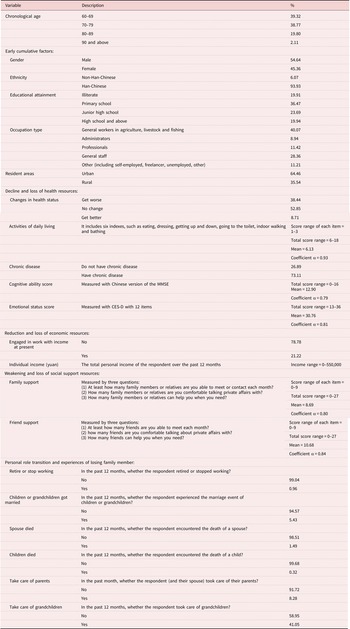
The data used in this article are from the two waves of the Chinese Longitudinal Ageing Social Survey (CLASS), which is a nationwide survey implemented by Renmin University of China and academic institutions in 2014 and 2016. The survey covers 476 village/residential committees in 30 provinces/autonomous regions/municipalities across the country, and use a stratified multi-stage probability sampling method.Footnote 1 There were 6,244 individuals aged 60 and above with sufficient data in the 2014 baseline survey (who provided completed information on perceived old age and all independent variables) and 2,989 cases followed up in 2016 are used in this study. Descriptive characteristics for baseline variables are reported in Table 1.
Summary of variables

Notes: MMSE: Mini-Mental State Examination. CES-D: Center for Epidemiologic Studies Depression Scale.
Dependent variable
Perceived boundaries of middle and old age are expected to reflect one's personal model of ageing (Furstenberg, Reference Furstenberg1989), and a youthful subjective age (considering being old at an older age) is an indicator of successful ageing (Uotinen et al., Reference Uotinen, Suutama and Ruoppila2003). In this study, perceived old age is measured from the question: ‘At what age do you think you become an older person?’ This measure is shaped by both Chinese culture norms and their personal experience and it could distinguish the age of perceived old age from retirement age (Liu et al., Reference Liu, Wu and Feng2020). This variable is a numerical variable; a higher value indicates a higher age is considered to be old.
Independent variables
Five aspects of age-related loss of resources are considered as independent variables in this study, and chronological age is used as the control variable. The measures of the independent variables are presented in Table 1.
Early cumulative factors include gender, ethnicity, educational attainment, occupation type (general workers in agriculture, livestock and fishing, administrators, professionals, general staff, other (self-employed/freelacer/unemployed/other), and area of residence (urban or rural). Decline and poorer health outcomes include changes in health status, activities of daily living (ADLs), presence of any chronic disease,Footnote 2 cognitive ability score and emotional status score. Reduction and loss of economic resources include whether respondents are engaged in work with income at present, and their income status. Weakening and loss of social support resources include support from family and friends. Personal role transition and experiences of losing family members include retirement, whether their children or grandchildren got married in the past 12 months, whether they experienced the death of a spouse in the past 12 months, whether they experienced the death of a child in the past 12 months, and taking care of their older parents and grandchildren. All these variables are measured in 2014.
Data analysis
Descriptive statistics analysis is used to present the perceived old age for different age groups. Then, ordinary least squares (OLS) regression models are used to test the associations between five aspects of age-related loss of resources and perceived old age in 2014, by comparing a series of nested linear regression models. Model 1 focuses on the impact of early cumulative factors on perceived old age after controlling for chronological age. For Models 2–5, the variables of decline and loss of health resources, reduction and loss of economic resources, weakening and loss of social support resources, and personal role transition and experiences of losing a family member are added step by step. Lastly, within the follow-up sample, we examine the associations between baseline age-related loss of resources and perceived old age both in 2014 and 2016. This helps to understand whether age-related loss of resources has short-term or long-term effects on perceived old age.
In addition, in order to eliminate the influence of observation heterogeneity and compare the importance of different independent variables between the different models or in the same model, this article carries out dimensionless processing of regression coefficients (Yang, Reference Yang2012). Therefore, a standardised coefficient is used when comparing the data results in the models. The potential multicollinearity among variables were conducted, variance inflation factor values of all variables are between 1.01 and 2.60, which means that there is no multicollinearity in these variables. All data analysis in are conducted using the software Stata 13.
Results
Distribution of perceived old age across chronological age groups
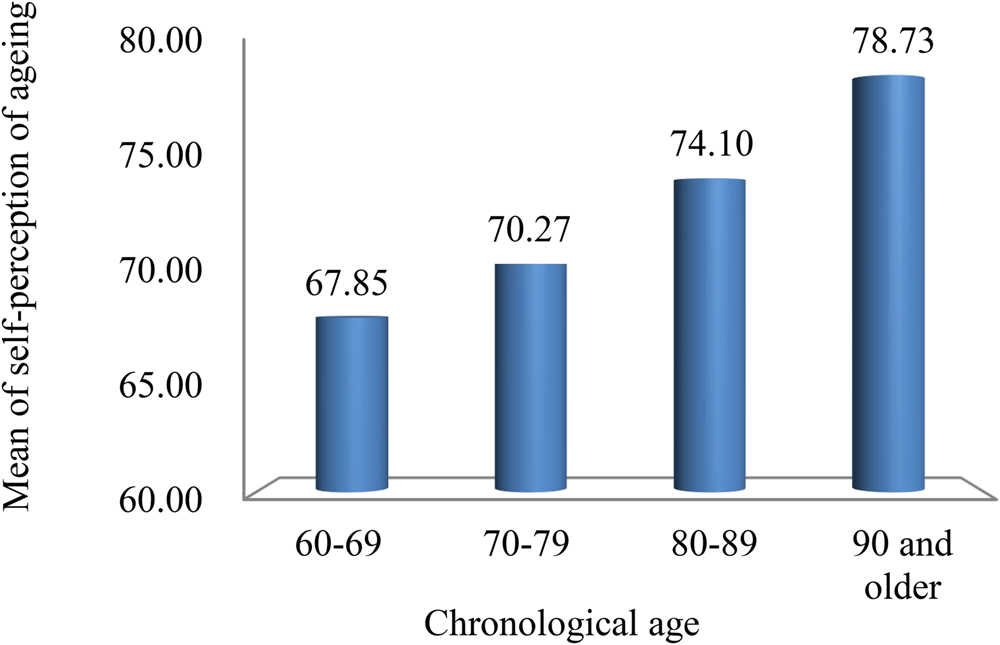
Comparing the perceived old age and chronological age, the mean of perceived old age is around 70 years, and varies significantly by different age groups of older adults. Figure 1 shows that the mean of perceived old age among people aged 90 and above is 78.7, much higher than that of people aged between 60 and 69 (mean = 67.9). This suggests that the perceived start of old age increases with the chronological age of the respondents. Although the Chinese government sets age 60 years as a starting point to classify an older person, most people do not consider themselves as an older adult at age 60.
Distribution of self-perceptions of ageing.

OLS results for the associations between age-based loss of resources and perceived old age at baseline (2014)
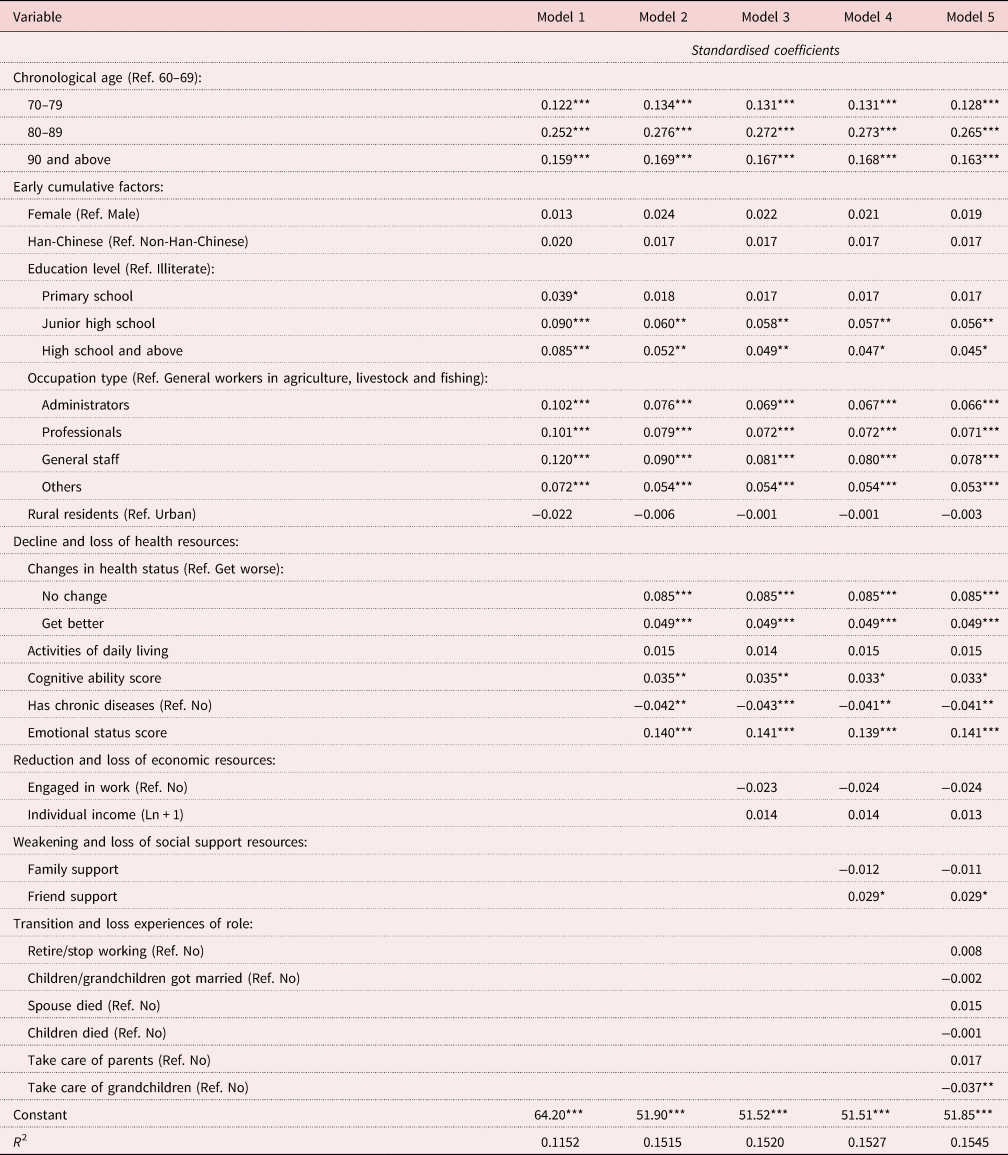
The results of Models 1–5 in Table 2 show that there was no significant difference for the estimates of five aspects of age-related loss of resources when they were added step by step. Therefore, the results illustrated here are based on the final model (Model 5). Results of Model 5 show that there was significantly positive association between higher chronological age and higher perceived old age. Among early accumulative factors, higher educational attainment (high school and above, junior high school, primary school comparing to illiterate) and better occupational status (administrators, professionals, general staff and others comparing to general workers in agriculture, livestock and fishing) were also significantly positively associated with higher perceived old age; however, the associations between gender, ethnicity, area of residence and perceived old age were not statistically significant.
Multiple linear regression results of the associations between age-based loss of resources and self-perceptions of ageing at baseline

Notes: N = 6,244. Ref.: reference item.
Significance levels: *p < 0.05, **p < 0.01, ***p < 0.001.
In terms of the loss of health or economic resources, people who reported their health had not changed or had improved reported higher perceived old age than those older adults who reported that their health had worsened. Older adults with chronic diseases reported lower perceived old age than those without chronic diseases. In addition, older people who had a higher cognitive ability score and better positive emotional status were significantly associated with higher perceived old age. Older people who were engaged in work reported higher perceived old age than those were not working.
For social support resources and role transition, only receiving support from friends and taking care of grandchildren were significantly associated with perceived old age. Results suggest that the more support older people received from friends, the higher perceived old age they reported; however, older adults who took care of grandchildren reported a lower perceived old age than their counterparts.
OLS results for the associations between age-based loss of resources and perceived old age at both 2014 and 2016 among those who were in both waves of CLASS
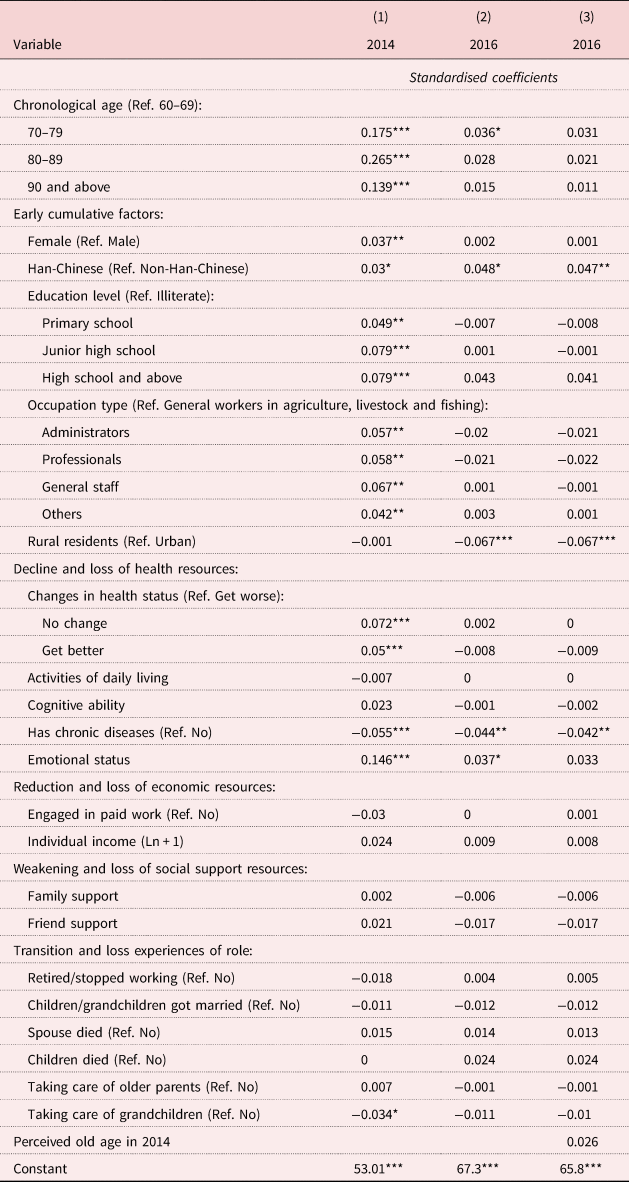
In order to examine whether age-based loss of resources has short-term or long-term association with perceived old age, we further used the perceived old age in 2016 as the dependent variable to examine the associations between baseline age-related loss of resources and perceived old age at follow-up wave. Since nearly 40 per cent of respondents were lost to follow-up in 2016, which may cause bias of estimates, we also re-ran the final model in Table 2 by restricting the sample to those who were followed up in 2016 (see Table 3) (We also tested whether there were differences between those who mainly participated at baseline assessment and those who participated at both assessments; the results are shown in the online supplementary material.) Similar to the final model with 6,244 respondents in Table 2, the associations between chronological age, educational attainment, occupational status, changes in health status, chronic disease, emotional status, taking care of grandchildren and perceived old age in 2014 among 2,989 respondents (who were in both waves) remain significant and show similar patterns (see Table 3). However, the associations between receiving support from friends, cognitive ability and perceived old age were no longer significant, while gender and ethnicity became significantly associated with perceived old age in 2014 in Table 3. In terms of the impact of age-based loss of resources on perceived old age in 2016, there was no substantial difference between models with and without controlledfor perceived old age in 2014 (in columns 2 and 3, respectively). Estimates show that Han-Chinese respondents reported significantly higher perceived old age than non-Han-Chinese respondents; rural residents reported significantly lower perceived old age than urban residents; while older adults with chronic diseases reported significantly lower perceived old age than those without chronic diseases.
Multiple linear regression results of the association between age-based loss of resources and self-perceptions of ageing among follow-ups

Notes: N = 2,989. Ref.: reference item. All the independent variables are from 2014. Perceived old age in 2014 was further controlled in the second model of 2016 (column 3).
Discussion
Our findings suggest that chronological age plays a predominant role in perceived old age in the short term (only at baseline); but such an effect becomes not significant in the long term after controlled-for perceived old age at baseline. Older adults’ perception of an older adult is around 70 years. In addition, the perception of old age increases with one's chronological age. This implies that most Chinese older people do not regard that they are an older adult at aged 60 even though the Chinese government sets the age of 60 years as the start of old age. Similar to people in Western countries with youth-oriented cultures, Chinese older people also tend to reject their old-age status, despite the fact that China has a profound culture of respect and admiration for older adults (Choi et al., Reference Choi, DiNitto and Kim2014). This result may also indicate that it is out of date to define older adults at 60 years, and that the age standard of older adults should be adjusted dynamically in response to social development and longevity (Sanderson and Scherbov, Reference Sanderson and Scherbov2010).
Consistent with the previous finding that a lower level of education was correlated to an earlier end of middle age (Barrett and Toothman, Reference Barrett and Toothman2014), our results show that higher levels of education and occupational status as early cumulative factors were significantly related to the perception that old age begins at an older age in 2014, though their coefficients are no longer significant in 2016. This is partly aligned with Hypothesis 1. In addition, Barrett and Toothman (Reference Barrett and Toothman2014) also found weaker evidence for a longitudinal association between education and the perceived end of middle age. While the impact of residency on perceived old age in 2016 becomes significant in our study, these results may suggest that the short-time impact of socio-economic status on perceived old age is finally replaced by that of rural–urban division in the long term. Individuals’ socio-economic status is highly associated with where they grow up or live, and rural–urban division caused the greatest differences in education and occupational status of older people. Additionally, ethnicity is significantly associated with perceived old age in both the short and long term. Our findings highlight that the individual's ageing process is not only reflected in old age, but also shaped by their early life. That is to say, the ageing phenomenon is a process that accumulates through an individual's life, and inequality in accessibility to economic resources due to socio-economic status or rural–urban division in China cause health inequalities in early life and lead to different ageing processes by accumulation of disadvantage in later life.
In line with a previous study that poor health was associated with the earlier start of old age and end of middle age (Barrett and Toothman, Reference Barrett and Toothman2014), this article also found that the decline and poorer health outcomes were important factors that affect perceived old age, which supports Hypothesis 2. However, ADL ability and cognitive function have no effect on perceived old age, and the association between self-perceived health decline and perceived old age remains in the short term in this study. These findings do not support the statement of Knoll et al. (Reference Knoll, Rieckmann, Scholz and Schwarzer2004) showing that functional limitations could be more important to the construction of subjective age than other underlying health-related causes; while we used different dimensions of health, as Hubley and Russell (Reference Hubley and Russell2009) suggested, and found that only chronic diseases play an important role in shaping perceived old age in both the short and long term.
Our results suggest that the reduction and loss of economic resources, and social support resources, had no impact on perceived old age, which rejects Hypotheses 3 and 4. Among the variables of role transition and loss experience, only the negative impact of providing care for grandchildren on perceived old age is significant in the short term, which suggests that older people who provide care for their grandchildren report an older age from the start of being old in China. This partly supports Hypothesis 5. Our findings extend previous study in that care of grandchildren is not only negatively associated with subjective age (Bordone and Arpino, Reference Bordone and Arpino2016), but also negatively correlated to perceived old age in China, though the negative effect no longer exists in the long term. A possible explanation is that the growth of the third generation makes people feel that their age is gradually increasing. In addition, taking care of grandchildren, which is usually physically and mentally demanding, may become a challenge or burden for older people and even cause harm to their health when this responsibility is beyond older people's affordability (Feng et al., Reference Feng, Jones and Wang2015). The theory of role strain (Goode, Reference Goode1960) also provides a reasonable explanation in that taking care of grandchildren takes up a lot of time and reduces opportunities for social interaction or enjoying free time. When older people are asked to perform certain roles, they may feel coerced or perplexed about the expectations of the role, resulting in stress in their later lives (Hinterlong et al., Reference Hinterlong, Morrow-Howell and Rozario2007; Hayslip et al., Reference Hayslip, Blumenthal and Garner2014), even creating a negative status at the physiological, psychological and spiritual level (Mehta and Leng, Reference Mehta and Leng2012; Hayslip et al., Reference Hayslip, Blumenthal and Garner2014).
This study also has some limitations. Although we used two-wave national representative data to explore the associations between age-related loss of resources and perceived old age, a large percentage of respondents could not be followed up, which limited us to precisely estimating the causal relationships between age-related loss of resources, especially health condition and perceived old age. Some observations were excluded, due to missing values in core variables, which may create bias for the estimations. Secondly, perceived old age will undoubtedly be influenced by the personality traits of openness and extroversion (Hubley and Hultsci, Reference Hubley and Hultsci1994). However, the CLASS data lack information on personality traits. In this study, we only focused on the causal direction leading from health status to perceived old age. In fact, perceived old age is also considered to be an important indicator for health outcomes (Demakakos et al., Reference Demakakos, Gjonca and Nazroo2007; Barrett and Toothman, Reference Barrett and Toothman2014). To examine the potential reciprocal relationship between health status and perceived old age of older adults could be a research direction in future. Finally, perceived old age was only measured with a single item which may not fully capture the complicated meanings of perceiving being old, therefore, more elaborate assessment is needed in future studies.
Despite these limitations, we believe that our analyses significantly contribute to previous studies on age-related loss of resources and self-perception of ageing using a two-wave study. The results highlight the need to weaken the social age norm at the policy level, such as separating pension eligibility from mandatory retirement and separating retirement age from the definition of older adults based on chronological age; this could help to adjust the age standard of older adults in response to social development and longevity. More health promotion programmes targeting older adults should be initiated to construct older adults’ self-perception of ageing by preventing the onset of chronic diseases or active intervention in depression.
Supplementary material
The supplementary material for this article can be found at https://doi.org/10.1017/S0144686X20001440.
Acknowledgements
Data analysed in this paper were collected by the research project “China Longitudinal Aging Social Survey (CLASS),” sponsored by Renmin University of China. The CLASS research project was conducted by the Institute of Gerontology and National Survey Research Center of Renmin University. The authors acknowledge the assistance of the institutes and individuals aforementioned in providing data. The views expressed in this paper are the authors' own.