Individual differences in social-emotional competence emerge early, are relatively stable after the first year of life, and are associated with current and future adaptive functioning (Eisenberg, Spinrad, & Eggum, Reference Eisenberg, Spinrad and Eggum2010; Halligan et al., Reference Halligan, Cooper, Fearon, Wheeler, Crosby and Murray2013). Clinically significant social-emotional delays and behavioral difficulties often emerge by age 3 years (Dougherty et al., Reference Dougherty, Leppert, Merwin, Smith, Bufferd and Kushner2015) and persist from childhood and adolescence into adulthood (Bosquet & Egeland, Reference Bosquet and Egeland2006; Campbell, Spieker, Burchinal, Poe, & NICHD Early Child Care Research Network, Reference Campbell, Spieker, Burchinal and Poe2006; Dekker et al., Reference Dekker, Ferdinand, van Lang, Bongers, van der Ende and Verhulst2007; Mesman, Bongers, & Koot, Reference Mesman, Bongers and Koot2001; Mesman & Koot, Reference Mesman and Koot2001). With as many as one in five children affected, with anxiety disorders being most common, prevalence rates of clinical disorders in preschool-aged children are similar to those in school-aged children (Dougherty et al., Reference Dougherty, Tolep, Bufferd, Olino, Dyson, Traditi and Klein2013, Reference Dougherty, Leppert, Merwin, Smith, Bufferd and Kushner2015). Subclinical difficulties may also increase risk for later psychopathology (Briggs-Gowan et al., Reference Briggs-Gowan, Owens, Schwab-Stone, Leventhal, Leaf and Horwitz2003; Rutter, Reference Rutter2003). Moreover, early difficulties increase the likelihood of poorer school adjustment and academic achievement (Montroy, Bowles, Skibbe, & Foster, Reference Montroy, Bowles, Skibbe and Foster2014). Thus, identifying specific early indicators of risk for poorer social-emotional functioning will inform efforts to maximize children's developmental and academic competencies and mental health (Graziano & Hart, Reference Graziano and Hart2016).
Temperament—that is, inherent individual differences in reactivity and regulation along the dimensions of activity, affect, and attention—manifests early in life and is relatively stable across time and context (De Pauw & Mervielde, Reference De Pauw and Mervielde2010; Gartstein & Rothbart, Reference Gartstein and Rothbart2003; Shiner et al., Reference Shiner, Buss, McClowry, Putnam, Saudino and Zentner2012). Certain temperament characteristics may predispose children to later emotional and behavior difficulties (Abulizi et al., Reference Abulizi, Pryor, Michel, Melchior and Van Der Waerden2017) and externalizing or internalizing disorders (Sayal, Heron, Maughan, Rowe, & Ramchandani, Reference Sayal, Heron, Maughan, Rowe and Ramchandani2014). To date, most studies have examined associations between isolated temperament dimensions and social-emotional outcomes (Diener & Kim, Reference Diener and Kim2004). These studies have not adequately accounted for the stability, covariance, and transactional associations among temperament dimensions both within and across time in predicting outcomes, such as internalizing and externalizing behaviors (Carter, Briggs-Gowan, Jones, & Little, Reference Carter, Briggs-Gowan, Jones and Little2003). This presents a serious challenge to understanding how specific temperament dimensions contribute to different domains of social-emotional functioning. It remains unclear whether previous findings would replicate while analyzing all temperament dimensions simultaneously to demonstrate specificity.
Maternal emotional functioning has also been shown to influence children's social-emotional development, beginning in early life (Morris, Silk, Steinberg, Myers, & Robinson, Reference Morris, Silk, Steinberg, Myers and Robinson2007). The first 2 years of life are considered the most plastic and critical period of postnatal brain development in humans (Knickmeyer et al., Reference Knickmeyer, Gouttard, Kang, Evans, Wilber, Smith and Gilmore2008). During this period, the developing brain is especially responsive to environmental and experiential input, particularly to dyadic social interactions (Bernier, Calkins, & Bell, Reference Bernier, Calkins and Bell2016; Bick & Nelson, Reference Bick and Nelson2016; Perry, Blair, & Sullivan, Reference Perry, Blair and Sullivan2017). Infants are born with limited capacity to regulate their behavior or their physiological and emotional states (Eisenberg et al., Reference Eisenberg, Spinrad and Eggum2010; Tronick, Als, Adamson, Wise, & Brazelton, Reference Tronick, Als, Adamson, Wise and Brazelton1978) and thus must develop the capacity for self-regulation over time. This social-emotional development is deeply embedded in the quality of the early dyadic interaction with their primary caregiver(s), often the mother (Bell & Ainsworth, Reference Bell and Ainsworth1972; Bowlby, Reference Bowlby1982/1969; McElwain & Booth-LaForce, Reference McElwain and Booth-LaForce2006). More specifically, early in life, sensitive mothers coregulate their infant's stress responses by attending promptly, appropriately, and contingently to their infant's distress signals (Ainsworth, Reference Ainsworth1979; Biringen, Derscheid, Vliegen, Closson, & Easterbrooks, Reference Biringen, Derscheid, Vliegen, Closson and Easterbrooks2014). In so doing, they support their infant, via emotional coregulation, toward developing social-emotional competencies, including emotion self-regulation (see also the biobehavioral synchrony model; Feldman, Reference Feldman2007, Reference Feldman2015, Reference Feldman2017). There is an extensive literature showing that high-quality early mother–child interactions may scaffold positive child development, facilitating more optimal outcomes related to emotion regulation and stress reactivity (Coppola, Ponzetti, Aureli, & Vaughn, Reference Coppola, Ponzetti, Aureli and Vaughn2015; Easterbrooks, Bureau, & Lyons-Ruth, Reference Easterbrooks, Bureau and Lyons-Ruth2012; Garvin, Tarullo, Van Ryzin, & Gunnar, Reference Garvin, Tarullo, Van Ryzin and Gunnar2012; Landry, Smith, & Swank, Reference Landry, Smith and Swank2006), and lay the biobehavioral foundation for adaptive psychosocial functioning and emotional well-being across the life span (Englund, Kuo, Puig, & Collins, Reference Englund, Kuo, Puig and Collins2011). However, although infant distress signals such as crying function to elicit maternal caregiving responses and secure infant survival, they also may elicit strong, negative affect in mothers (Murray, Reference Murray1979; Soltis, Reference Soltis2004). Mothers who have emotion regulation difficulties may struggle to regulate their own emotional response when faced with infant distress, which, in turn, can negatively impact the quality of early dyadic interactions (Crandall, Deater-Deckard, & Riley, Reference Crandall, Deater-Deckard and Riley2015; Rutherford, Wallace, Laurent, & Mayes, Reference Rutherford, Wallace, Laurent and Mayes2015) and may predispose the infant to difficulties in emotion regulation in later childhood (Sanders & Mazzucchelli, Reference Sanders and Mazzucchelli2013). This has been shown especially to be the case among mothers experiencing psychopathology (Graham, Blissett, Antoniou, Zeegers, & McCleery, Reference Graham, Blissett, Antoniou, Zeegers and McCleery2018; Reck, Tietz, Muller, Seibold, & Tronick, Reference Reck, Tietz, Muller, Seibold and Tronick2018). For instance, maternal depression (Sherman, Vousoura, Wickramaratne, Warner, & Verdeli, Reference Sherman, Vousoura, Wickramaratne, Warner and Verdeli2016) and distress (Essex, Klein, Slattery, Goldsmith, & Kalin, Reference Essex, Klein, Slattery, Goldsmith and Kalin2010) have been identified as important risk factors, directly and indirectly predicting children's emotional and behavior difficulties (Goodman et al., Reference Goodman, Rouse, Connell, Broth, Hall and Heyward2011) and increasing risk for psychopathology across the life span (Murray et al., Reference Murray, Arteche, Fearon, Halligan, Goodyer and Cooper2011). According to a recent meta-analysis, an estimated 8.5% of postpartum women experience one or more anxiety disorders (Goodman, Watson, & Stubbs, Reference Goodman, Watson and Stubbs2016), and prevalence rates of postnatal anxiety symptoms range up to 43% (Glasheen, Richardson, & Fabio, Reference Glasheen, Richardson and Fabio2010; Matthey, Barnett, Howie, & Kavanagh, Reference Matthey, Barnett, Howie and Kavanagh2003). Nonetheless, relatively few studies have focused on maternal anxiety as a putative risk factor (Glasheen et al., Reference Glasheen, Richardson and Fabio2010; Mughal et al., Reference Mughal, Giallo, Arnold, Benzies, Kehler, Bright and Kingston2018), and no study has examined how specific dimensions of child temperament and postnatal maternal anxiety jointly contribute to child social-emotional outcomes at multiple waves of data collection over the first 3 years of life.
The overall goal of the current study was to examine developmental precursors to a range of preschool social-emotional and behavioral outcomes. Specifically, we simultaneously examined multiple temperament dimensions (surgency, negative affectivity, and orienting/regulation) and maternal anxiety in infancy as predictors of child externalizing, internalizing, dysregulation, and competence behaviors at age 3 years. By incorporating measures of child temperament and maternal anxiety at ages 2 and 3 years, we were able to account for stability effects and examine pathways through these same factors over time (i.e., cross-lagged effects) to demonstrate specificity of early risk factors. We also examined pathways to several domains of social-emotional functioning, estimated simultaneously to account for within-time associations among constructs. A secondary goal was to test for sex differences in the longitudinal pathways from infant temperament and maternal anxiety in infancy to later social-emotional functioning. Previous findings suggest sex differences in particular temperament domains (Else-Quest, Hyde, Goldsmith, & Van Hulle, Reference Else-Quest, Hyde, Goldsmith and Van Hulle2006), in emotional and behavioral difficulties (Bosquet & Egeland, Reference Bosquet and Egeland2006; Briggs-Gowan et al., Reference Briggs-Gowan, Owens, Schwab-Stone, Leventhal, Leaf and Horwitz2003; Carter et al., Reference Carter, Wagmiller, Gray, McCarthy, Horwitz and Briggs-Gowan2010; Crick & Zahn-Waxler, Reference Crick and Zahn-Waxler2003; Lavigne, Lebailly, Hopkins, Gouze, & Binns, Reference Lavigne, Lebailly, Hopkins, Gouze and Binns2009; Mesman & Koot, Reference Mesman and Koot2001; Wade, Cairney, & Pevalin, Reference Wade, Cairney and Pevalin2002), and in developmental pathways to psychopathology (Abulizi et al., Reference Abulizi, Pryor, Michel, Melchior and Van Der Waerden2017; Karevold, Roysamb, Ystrom, & Mathiesen, Reference Karevold, Roysamb, Ystrom and Mathiesen2009; Mesman et al., Reference Mesman, Bongers and Koot2001; Sayal et al., Reference Sayal, Heron, Maughan, Rowe and Ramchandani2014). This is the first study to examine sex differences in the longitudinal pathways connecting multiple dimensions of child temperament and maternal anxiety in infancy to a range of later social-emotional and behavioral outcomes in the preschool period.
Method
Participants, procedures, and ethical considerations
Participants were recruited from a registry of local births composed of families who had indicated willingness to participate in developmental research. Families for the current analyses participated in a prospective study to examine the early development of emotion processing. Exclusion criteria included known prenatal or perinatal complications, developmental delay, uncorrected vision difficulties, neurological disorder or trauma, and premature or postterm birth (±3 weeks from due date). Families were enrolled when the children were 5, 7, or 12 months old (Time 1 [T1]; laboratory visit and questionnaires) and followed when the child was 2 years (Time 2 [T2]; questionnaires) and 3 years (Time 3 [T3]; laboratory visit and questionnaires) of age. Study procedures were approved by the relevant institutional review board, and caregivers provided written informed consent.
The current analyses were conducted after all T1 assessments (N = 807) were concluded. At the time of the current analyses, 648 children had aged into the T3 assessment. Among this subsample, participants were excluded from the current analyses due to child diagnosis of autism spectrum disorder (n = 11) or Turner syndrome (n = 1); maternal report of opioid or antipsychotic medication use during pregnancy (n = 9); teenage parenthood (n = 1); father completing the caregiver anxiety measure at T1 (n = 9); and absence of essential T1 data (maternal anxiety or infant temperament data; n = 76), leaving a final sample size of N = 541 families for inclusion in analyses. No differences were found between participants with and without T2 and T3 data on infant temperament or maternal anxiety scores at T1 or on sociodemographics except that missingness negatively related to maternal education.
Measures
All measures were completed by mothers via online survey or tablet during a laboratory visit.
Infant and child temperament
Infant temperament was assessed at T1 using the short form of the Infant Behavior Questionnaire-Revised (IBQ-R; Forman et al., Reference Forman, O'Hara, Larsen, Coy, Gorman and Stuart2003; Gartstein & Rothbart, Reference Gartstein and Rothbart2003; Parade & Leerkes, Reference Parade and Leerkes2008), which provides composite measures for the dimensions of surgency/extraversion (α = .92), negative affectivity (α = .86), and orienting/regulation (α = .82). Child temperament was assessed at T2 and T3 using the Early Childhood Behavior Questionnaire—Short Form (ECBQ). The ECBQ (Putnam, Gartstein, & Rothbart, Reference Putnam, Gartstein and Rothbart2006; Putnam, Rothbart, & Gartstein, Reference Putnam, Rothbart and Gartstein2008) is an age-upward extension of the IBQ-R, providing composite measures for the dimensions of surgency (T2 α = .85, T3 α = .88), negative affectivity (T2 α = .87, T3 α = .88), and effortful control (upward extension of infant orienting/regulation; T2 α = .88, T3 α = .85). For both the IBQ-R and the ECBQ, scores are calculated as means that range from 1 to 7 (scores close to 1 indicate that almost all items were rated as never/very rarely; scores close to 7 indicate that almost all items were rated as almost always/always). Clinical cutoff scores are not used for these scales.
Maternal anxiety
Maternal anxiety symptomatology at all time points was measured by the total score of the trait scale (T1 α = .89, T2 α = .89, T3 α = .89) of the State–Trait Anxiety Inventory (Spielberger, Gorsuch, Lushene, Vagg, & Jacobs, Reference Spielberger, Gorsuch, Lushene, Vagg and Jacobs1983). The total score is calculated as the item sum score, with possible scores ranging from 0 to 80 and a recommended clinical cutoff score of ≥40 (e.g., Grant, McMahon, & Austin, Reference Grant, McMahon and Austin2008).
Child social-emotional functioning
Child social-emotional functioning was assessed at T3 using the Infant–Toddler Social and Emotional Assessment (ITSEA; Carter et al., Reference Carter, Briggs-Gowan, Jones and Little2003), which provides composite measures of externalizing behaviors (activity/impulsivity, aggression/defiance, and peer aggression; α = .81), internalizing behaviors (depression/withdrawal, general anxiety, separation distress, and inhibition to novelty; α = .84), dysregulation (negative emotionality, sensory sensitivity, sleep, and eating; α = .83), and competence (compliance, attention, imitation/ play, mastery motivation, empathy, and prosocial peer relations; α = .86). Raw scores are calculated as means that range from 0 to 2 (scores close to 0 indicate that almost all items were rated as not true/rarely; scores close to 2 indicate that almost all items were rated as very true/often). Mean scores can be used to calculate T scores. T scores (M = 50, SD = 10) indicate the extent to which a child's raw mean score is higher or lower than the same age and sex peers’ raw mean scores. Recommended clinical cutoff T scores of ≥63 and ≤37 for problem and competence domains, respectively, identify children in the extreme 10th percentile, who are considered to be at risk for social-emotional delays (Carter et al., Reference Carter, Briggs-Gowan, Jones and Little2003). In analyses, we used the raw scores. We present T scores for descriptive purposes.
Data analysis plan
Analyses were conducted using Mplus Version 7. There were variable amounts of missing data due to attrition over time (no missing data at T1, ≤38% at T2, and ≤40% at T3). Because missingness was negatively related to maternal education, maternal education was included in analyses as an auxiliary variable, thereby justifying the missing at random assumption and supporting the use of full information maximum likelihood estimation to address missing data. A maximum-likelihood with robust standard errors estimator was utilized, which generates parameter estimates with standard errors and a chi-square that are robust to nonnormality with missing data (Yuan & Bentler, Reference Yuan and Bentler2000). We age adjusted the manifest variables at all time points to account for within-time variance in infant age of assessment.
Multigroup path analysis assessed the associations between child temperament factors and maternal anxiety in infancy and social-emotional outcomes at age 3 years by child sex. Stability coefficients from infancy, through age 2, to age 3 were modeled for all temperament and maternal anxiety variables. Within-time covariance terms were also modeled, thus providing a very conservative model wherein the cross-lagged parameters can be interpreted as directional effects. The model was estimated conditioned on all of the predictors; thus, each parameter is a unique estimate. Indicators of model fit included root mean square error of approximation (RMSEA), comparative fit index (CFI), and the standardized root mean square residual (SRMR).
We report total, direct, and indirect effects, which were estimated simultaneously. Indirect effects were estimated using the delta method (Sobel, Reference Sobel1982), which calculates the standard error of the product of two variables that are used to determine the significance of the indirect path. We replicated the results using bootstrapping across 5,000 bootstrap draws. As the substantive results were not different, we present results from the maximum-likelihood with robust standard errors-based analysis, which allows for the incorporation of auxiliary variables related to missingness (i.e., maternal education).
Results
Descriptive statistics
Sociodemographic characteristics are presented in Appendix A. Overall, families reported high levels of education and socioeconomic status (92.8% of mothers with college degree or higher; 60.1% with annual household income ≥$100,000). The majority of children were White (79.7%) or multiracial (13.3%). Using the recommended clinical cutoff State–Trait Anxiety Inventory score of ≥40, 21.1% of mothers had elevated anxiety symptoms at T1, 16.2% at T2, and 15.3% at T3. Using recommended clinical cutoff ITSEA T scores of ≥63 and ≤37 for problem and competence domains, respectively, at T3, children scored in the clinical range (extreme 10th percentile) as follows: externalizing symptoms, 3.7%; internalizing symptoms, 9.2%; dysregulation, 6.5%; and competence delays, 6.4%. Social-emotional and sociodemographic characteristics by child sex are reported in Appendix A. Briefly, on the ITSEA, boys scored in the clinical range as follows: externalizing symptoms, 5.1%; internalizing symptoms, 9.4%; dysregulation, 6.0%; and competence delays, 2.8%; girls scored in the clinical range as follows: externalizing symptoms, 2.0%; internalizing symptoms, 8.9%; dysregulation, 7.0%; and competence delays, 10.5%. In t tests uncorrected for multiple comparisons, boys had higher mean birthweight and T2 and T3 surgency scores, and girls had greater mean T3 internalizing scores; there were no sex differences on any other temperament scores, the remaining ITSEA scores, maternal anxiety scores, or sociodemographic variables. Bivariate correlations between study variables are presented in Appendix A.
Model fit and comparison of nested path models
We first fit a multigroup model with all paths fully constrained between sexes. This model offered a good fit to the data: RMSEA = .023, CFI = .99, SRMR = .040. For empirically derived differences in parameters between sexes, we examined modification indices that suggested freeing certain parameters to improve model fit. Parameters were freed sequentially in order of magnitude until no others were suggested or theoretically plausible. This partially free model offered a good fit to the data: RMSEA < .001, CFI = 1.00, SRMR = .039. Chi-square difference testing using the Satorra–Bentler scaling correction factor indicated that the partially free model fit better than the fully constrained model, Δχ2 (Δdf) = 43.60 (5), p < .001. Thus, the results presented below focus on this partially free model.
Total, direct, and indirect effects similar between sexes
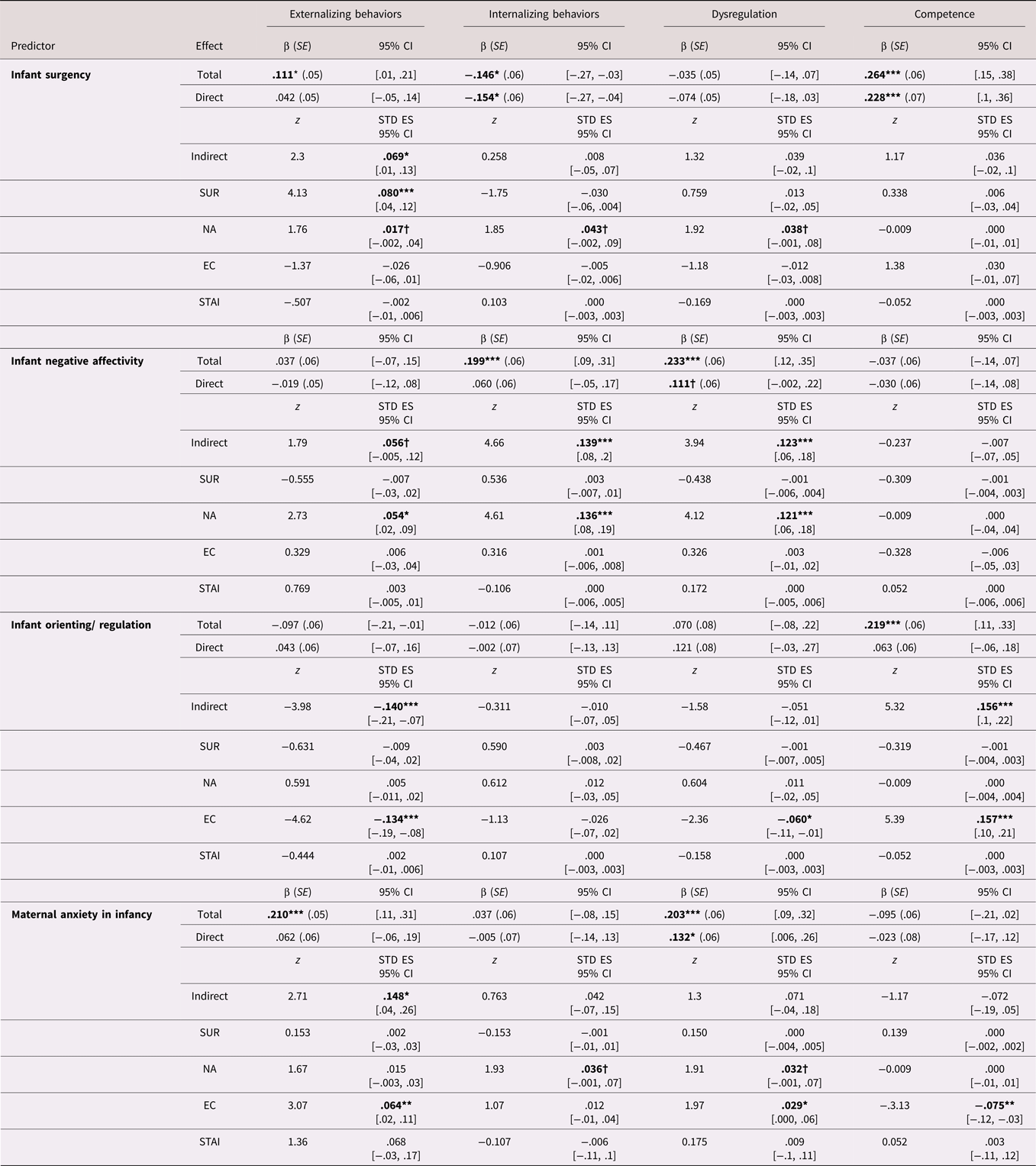
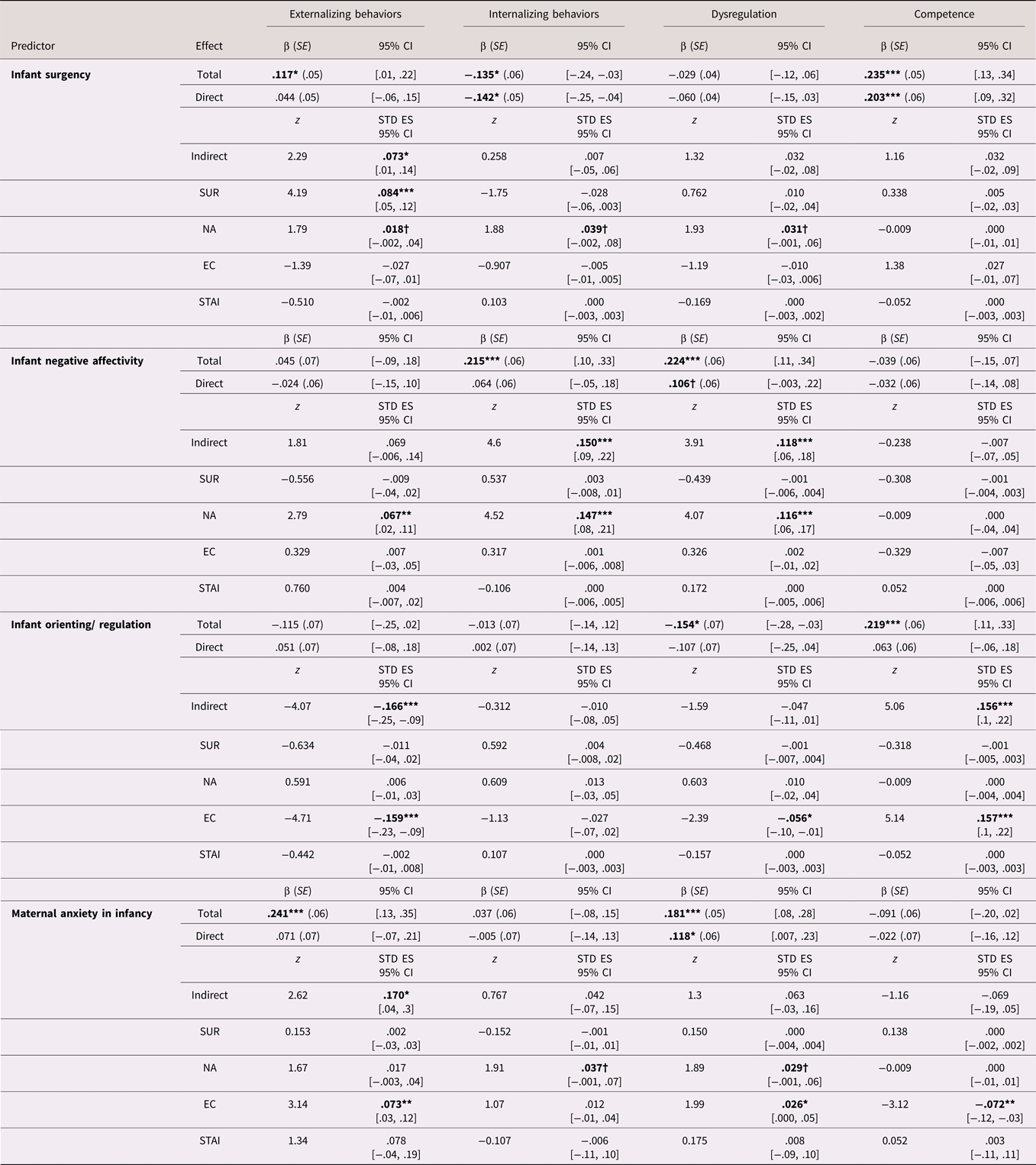
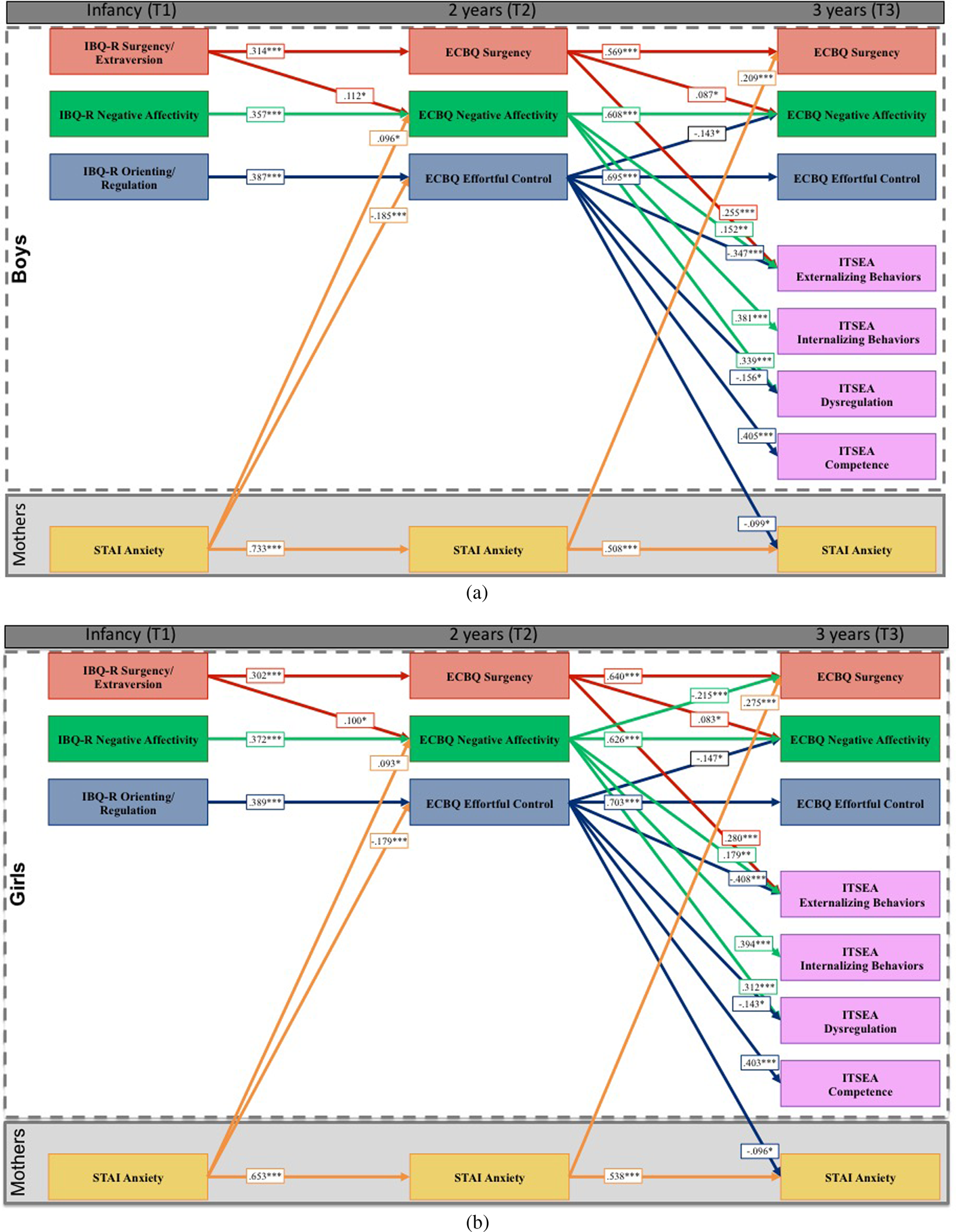
We organize this section by T3 social-emotional outcomes. Tables 1 and 2 present the coefficients for each outcome by predictor and mediator variable for boys and girls, respectively. Figure 1 presents the significant paths for all outcomes for (a) boys and (b) girls, respectively. Results for temperament factors and maternal anxiety as outcomes at T3 are presented in Appendix A. All within-construct stability coefficients were significant from T1 to T2 and from T2 to T3, for both boys and girls. Within-time covariances between constructs and residual variances for each outcome (dependent variables and mediators) are presented in Appendix A. Below, we present results common between boys and girls, followed by a section highlighting differences between sexes. Only statistically significant (p < .050) and modest (nonsignificant trend, p = .050–.079) effects are reported in the text.
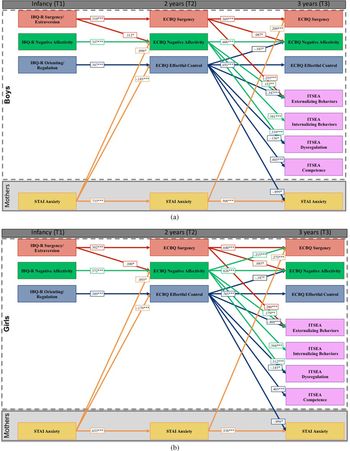
Final model for (a) boys and (b) girls. All paths between all variables were tested simultaneously, and all within-time covariances were included (not shown for clarity purposes). Only significant paths between contiguous time points are shown (solid lines). Standardized beta coefficients are presented in boxes on the relevant path. IBQ-R, Infant Behavior Questionnaire—Revised. ECBQ, Early Childhood Behavior Questionnaire—Short Form. STAI, State–Trait Anxiety Inventory, trait scale. ITSEA, Infant–Toddler Social and Emotional Assessment. *p < .05. **p < .005. ***p < .001.
Total, direct, and indirect effects of infant temperament and maternal anxiety on children's social-emotional and behavioral outcomes at age 3 years: Boys only
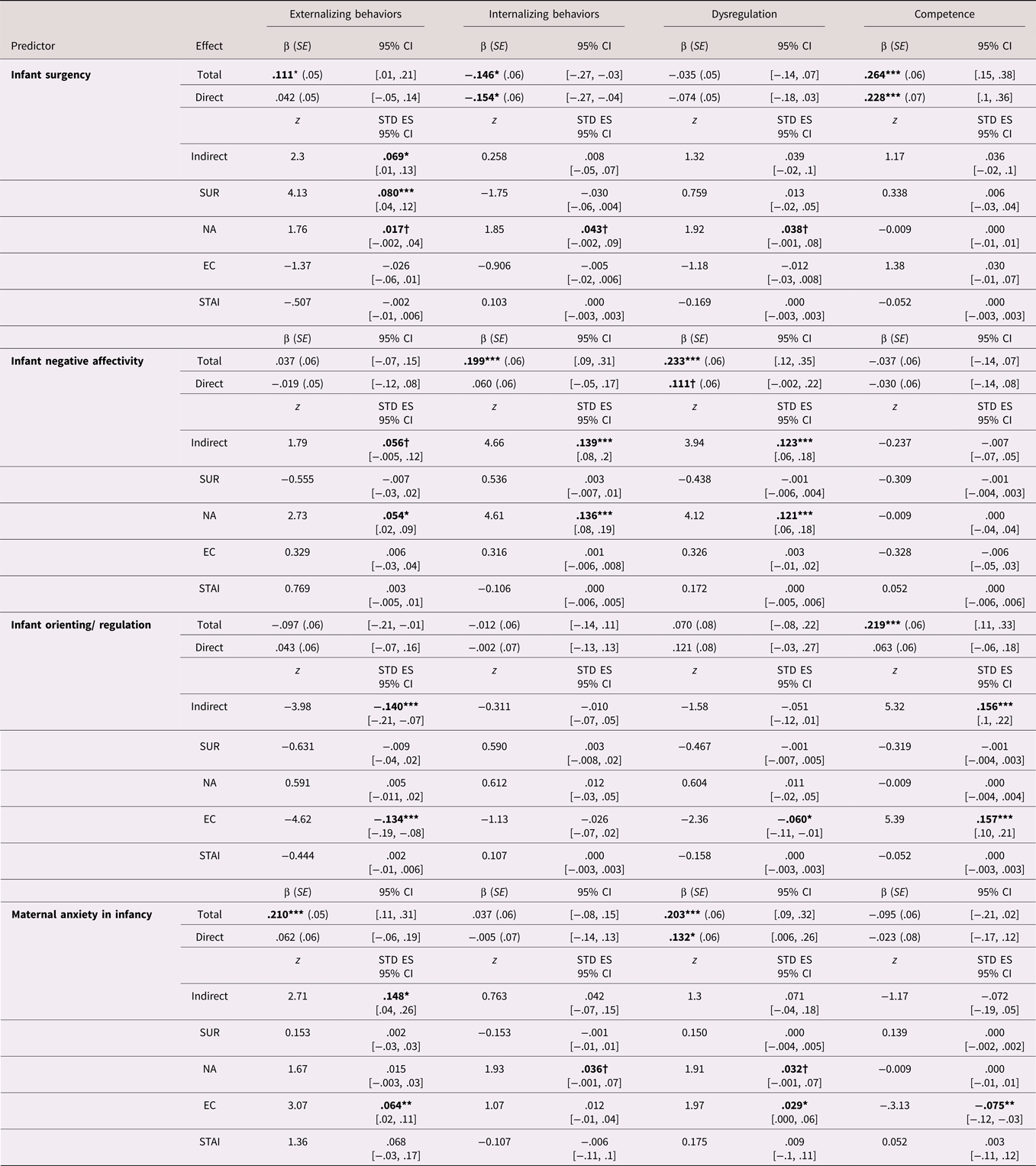
Note: β, beta coefficient. SE, standard error. 95% CI, confidence interval at .05 level. z, standardized estimate/SE (estimate). STD ES, standardized effect size (a*b) for the indirect effect. SUR, surgency. NA, negative affectivity. EC, effortful control. STAI, State–Trait Anxiety Inventory. †p = .050–.079. *p < .05. **p ≤ .005. ***p ≤ .001.
Total, direct, and indirect effects of infant temperament and maternal anxiety on children's social-emotional and behavioral outcomes at age 3 years: Girls only.
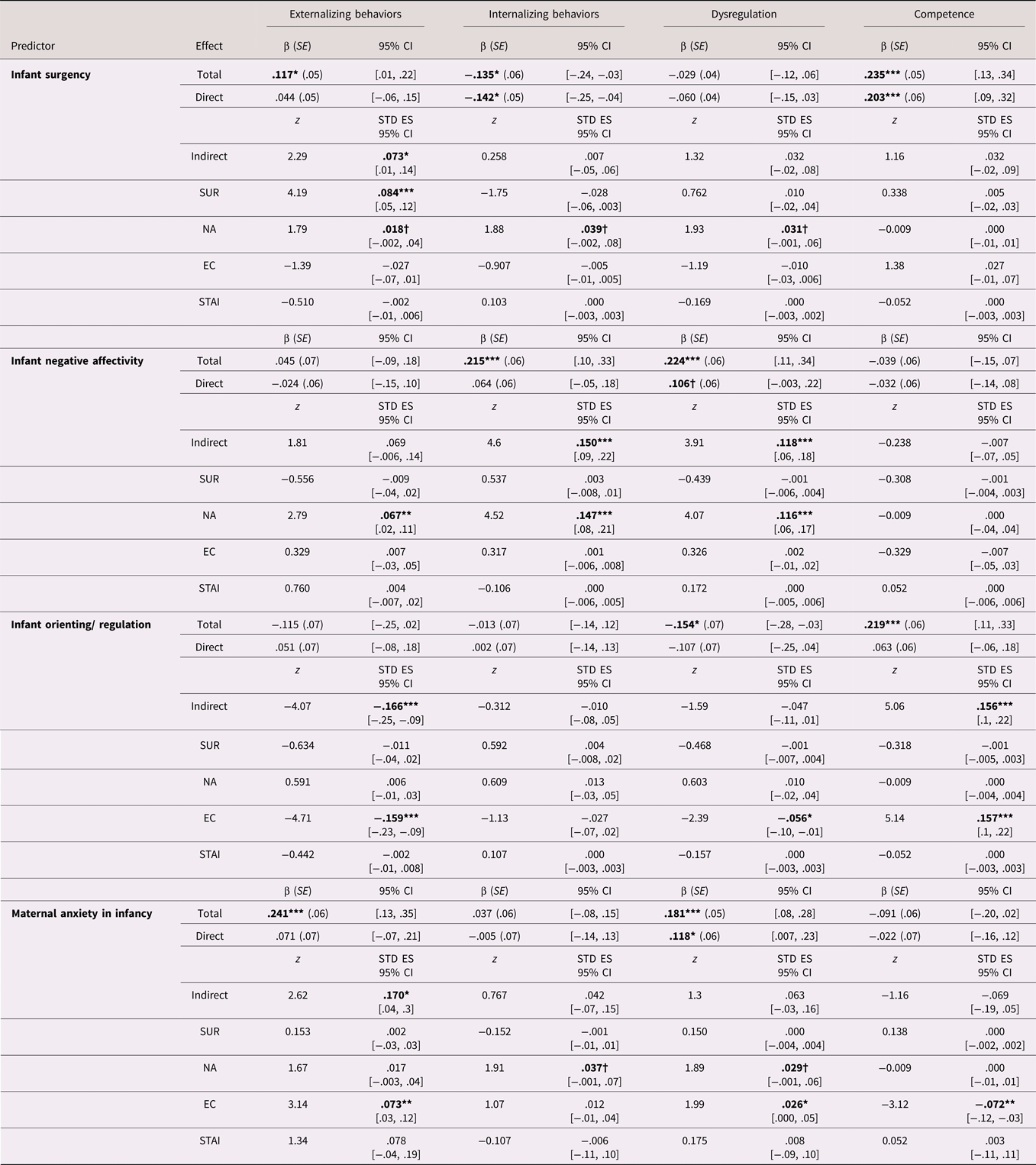
Note: β, beta coefficient. SE, standard error. 95% CI, confidence interval at .05 level. z, standardized estimate/SE (estimate). STD ES, standardized effect size (a*b) for the indirect effect. SUR, surgency. NA, negative affectivity. EC, effortful control. STAI, State–Trait Anxiety Inventory. †p = .050–.079. *p < .05. **p ≤ .005. ***p ≤ .001.
Externalizing behaviors
Surgency
The total effect of T1 surgency on T3 externalizing behaviors was significant: higher surgency predicted more externalizing behaviors. This effect operated indirectly through higher T2 surgency and, modestly, through higher T2 negative affectivity.
Negative affectivity
The total effect of T1 negative affectivity on T3 externalizing behaviors was not significant. However, there was an indirect effect of higher T1 negative affectivity on greater T3 externalizing behaviors through higher T2 negative affectivity.
Orienting/regulation
The total effect of T1 orienting/regulation on T3 externalizing behaviors was not significant. However, there was a significant indirect effect of lower T1 orienting/regulation on greater T3 externalizing behaviors through lower T2 effortful control.
Maternal anxiety
The total effect of T1 maternal anxiety on T3 externalizing behaviors was significant: higher maternal anxiety predicted greater externalizing behaviors. This effect operated indirectly through lower T2 effortful control.
Internalizing behaviors
Surgency
The total effect of T1 surgency on T3 internalizing behaviors was significant: lower surgency predicted greater internalizing behaviors. There was a modest indirect effect through higher T2 negative affectivity. There was also a residual direct effect of T1 surgency on T3 internalizing behaviors unaccounted for by the observed mediators, suggesting unmeasured variables are additional mediators in this pathway.
Negative affectivity
The total effect of T1 negative affectivity on T3 internalizing behaviors was significant: higher negative affectivity predicted greater internalizing behaviors. This effect operated indirectly through higher T2 negative affectivity.
Orienting/regulation
There were no total or indirect effects of T1 orienting/regulation on T3 internalizing behaviors.
Maternal anxiety
Although the total effect of T1 maternal anxiety on T3 internalizing behaviors was not significant, there was a modest indirect effect of higher maternal anxiety on greater internalizing behaviors through higher T2 negative affectivity.
Dysregulation
Surgency
The total effect of T1 surgency on T3 dysregulation was not significant. However, there was a modest indirect effect of higher surgency on greater dysregulation through higher T2 negative affectivity.
Negative affectivity
The total effect of T1 negative affectivity on T3 dysregulation was significant: higher negative affectivity predicted greater dysregulation. This effect operated indirectly through higher T2 negative affectivity. There was also a modest residual direct effect of T1 negative affectivity on T3 dysregulation unaccounted for by the observed mediators, suggesting unmeasured variables are additional mediators in this pathway.
Orienting/regulation
There was a significant total effect of T1 orienting/regulation on T3 dysregulation in girls, but not boys: lower orienting/regulation predicted greater dysregulation in girls. In both girls and boys, there was a significant indirect effect of lower T1 orienting/regulation on greater T3 dysregulation through lower T2 effortful control.
Maternal anxiety
The total effect of T1 maternal anxiety on T3 dysregulation was significant: higher maternal anxiety predicted greater dysregulation. This effect operated indirectly through lower T2 effortful control and, modestly, through higher T2 negative affectivity. There was also a residual direct effect of T1 maternal anxiety on T3 dysregulation unaccounted for by the observed mediators, suggesting unmeasured variables are additional mediators in this pathway.
Competence
Surgency
The total effect of T1 surgency on T3 competence was significant: higher surgency predicted greater competence. There were no indirect effects. There was a residual direct effect of T1 surgency on T3 competence unaccounted for by the observed mediators, suggesting unmeasured variables are additional mediators in this pathway.
Negative affectivity
There were no total or indirect effects of T1 negative affectivity on T3 competence.
Orienting/regulation
There was a significant total effect of T1 orienting/regulation on T3 competence: higher orienting/regulation predicted greater competence. This effect operated indirectly through higher T2 effortful control.
Maternal anxiety
Although the total effect of T1 maternal anxiety on T3 competence was not significant, there was a significant indirect effect of higher maternal anxiety on lower competence through lower T2 effortful control.
Sex differences in pathways
No indirect effects differed by sex. One total effect differed: the effect of T1 orienting/regulation on T3 dysregulation was significant in girls only. Modification indices suggested five individual parameters (three regression coefficients and two residual covariance terms) differed by sex. First, higher T2 negative affectivity predicted lower T3 surgency among girls, β (SE) = –.22 (.06), p = .001, but not boys, β (SE) = .04 (.06), p = .54. Second, the direct effect of T1 orienting/regulation on T3 dysregulation was in opposite directions for boys, β (SE) = .12 (.08), p = .11, versus girls, β (SE) = –.12 (.07), p = .14, but was not significant among either. Third, higher T1 surgency predicted higher T3 surgency among boys, β (SE) = .22 (.05), p < .001, but not girls, β (SE) = .06 (.06), p = .34. Fourth, higher T3 surgency was associated with lower T3 effortful control in girls, r = –.22, p = .003, but not boys, r = .017, p = .82. Fifth, higher T3 surgency was associated with greater T3 externalizing behaviors in boys, r = .31, p < .001, but not girls, r = .011, p = .09.
Discussion
The overall goal of this study was to examine longitudinal pathways from infant temperament and maternal anxiety in infancy to several social-emotional and behavioral outcomes at age 3. This was accomplished using a rigorous model that accounted for within-construct stabilities and cross-construct covariances over three waves of data collection, thus helping to explicate specific pathways from infant temperament and maternal anxiety in infancy to later social-emotional outcomes. Four primary patterns emerged. First, there was stability in temperament dimensions and maternal anxiety from infancy to age 3. Second, negative affectivity was implicated in internalizing problems and surgency in externalizing problems. Third, effortful control at age 2 was a potent mediator of maternal anxiety in infancy on age 3 outcomes. Fourth, there was suggestive evidence for transactional effects between maternal anxiety and child effortful control. Most pathways operated similarly for boys and girls, with some differences, particularly for surgency. Overall, the findings contribute to our understanding of temperamental stability in early life and the influence of different temperament dimensions in infancy and toddlerhood on a range of social-emotional outcomes in the preschool period. The findings also highlight similarities and differences by child sex in early developmental pathways from temperament to social-emotional functioning. Finally, this study considered the joint impact of child (i.e., temperament) and environmental (i.e., postnatal maternal anxiety) characteristics in predicting outcomes at age 3 years, highlighting parent-, child-, and parent–child specific pathways to preschool social-emotional functioning.
Our results indicated considerable stability in dimensions of temperament over the first 3 years, even controlling for child age and associations with other temperament dimensions within time, which expands recent findings on the relative stability of temperament in early childhood (Bornstein, Hahn, Putnick, & Pearson, Reference Bornstein, Hahn, Putnick and Pearson2018). Infant surgency, negative affectivity, and orienting/regulation independently predicted children's social-emotional and behavioral outcomes at age 3 years through stability in these dimensions from infancy to age 2 years. These findings are consistent with literature suggesting that individual differences in temperament dimensions arise early in development and are relatively stable precursors to later developmental competencies and social-emotional functioning (De Pauw & Mervielde, Reference De Pauw and Mervielde2010; Gartstein & Rothbart, Reference Gartstein and Rothbart2003).
We also identified specific longitudinal pathways from infant temperament to different preschool social-emotional outcomes. Specifically, greater externalizing behaviors were predicted by consistently higher surgency and negative affectivity and lower orienting/regulation/effortful control. The latter two are well-established risk factors for externalizing problems (Edwards & Hans, Reference Edwards and Hans2015; Pitzer, Esser, Schmidt, & Laucht, Reference Pitzer, Esser, Schmidt and Laucht2009). The finding that infant surgency predicted later externalizing behaviors is somewhat novel, but consistent with emerging data suggesting that high approach-related traits may underpin susceptibility to, and explain the overlap of, externalizing disorders such as attention-deficit/ hyperactivity disorder, oppositional defiant disorder, and conduct disorder (Ahmad & Hinshaw, Reference Ahmad and Hinshaw2017; Beauchaine, Zisner, & Sauder, Reference Beauchaine, Zisner and Sauder2017).
In contrast, the primary pathway to preschool internalizing behaviors was through stably high negative affectivity. In addition, there were trend-level effects for higher maternal anxiety and surgency in infancy predicting greater internalizing behaviors at age 3 through higher negative affectivity at age 2. Previous studies have identified early emotionality as an important risk factor for later internalizing psychopathology (Edwards, Rapee, & Kennedy, Reference Edwards, Rapee and Kennedy2010; Karevold et al., Reference Karevold, Roysamb, Ystrom and Mathiesen2009). Our results are consistent with these findings and further suggest that negative affectivity is a key trait connecting both early environmental risk (e.g., postnatal maternal anxiety) and other temperament dimensions (e.g., surgency) to later internalizing problems.
Two other pathways emerged that were common for multiple preschool outcomes. The first was a trend-level indirect effect from higher surgency in infancy to greater internalizing, externalizing, and dysregulation behaviors at age 3 via higher negative affectivity at age 2. Thus, in addition to serving as a robust predictor of internalizing behaviors, higher negative affectivity may connect higher surgency in infancy to other preschool social-emotional domains. Second, lower effortful control at age 2 was a key mediator between both infant orienting/regulation and maternal anxiety with later externalizing, dysregulation, and competence behaviors. Thus, effortful control in toddlerhood appears to have cross-cutting relevance for several domains of social-emotional functioning, linking both infant and maternal factors to later child outcomes. These findings dovetail with the notion that early self-regulation is foundational for later social and emotional development (Rhoades, Greenberg, & Domitrovich, Reference Rhoades, Greenberg and Domitrovich2009; Rhoades, Warren, Domitrovich, & Greenberg, Reference Rhoades, Warren, Domitrovich and Greenberg2011). We also found that stably lower child self-regulation from infancy to age 2 predicted maternal anxiety outcomes, with lower orienting/regulation in infancy predicting lower effortful control at age 2, which in turn predicted higher maternal anxiety symptomatology at age 3. Moreover, there was trend-level support for a transactional path from higher maternal anxiety in infancy to lower child effortful control at age 2 to higher maternal anxiety at age 3. Together, these findings raise the possibility of bidirectional, transactional associations between maternal anxiety and child self-regulation over the first 3 years of life. It is well established that mothers and their children reciprocally influence early dyadic interactions (e.g., Bakermans-Kranenburg & van IJzendoorn, Reference Bakermans-Kranenburg and van IJzendoorn2007; Belsky, Reference Belsky1984); however, transactional effects over time are poorly understood. Transactional models of development postulate bidirectional effects of the individual and social contexts on development (Sameroff & Mackenzie, Reference Sameroff and Mackenzie2003). At least two previous studies found support for transactional effects of maternal/parenting stress and child temperament (Pesonen et al., Reference Pesonen, Räikkönen, Heinonen, Komsi, Järvenpää and Strandberg2008) and child behavior problems (Neece, Green, & Baker, Reference Neece, Green and Baker2012). Our findings also suggest that not only may mothers impact their children's early self-regulation development but also children may impact their mother's adjustment (i.e., levels of anxiety). However, it remains unclear when in development these transactional effects emerge and whether sensitive periods could be identified during which the mother or child may be most influential or most susceptible to change (Sameroff & Mackenzie, Reference Sameroff and Mackenzie2003). Putative bidirectional, transactional pathways to multiple measures of social-emotional functioning or developmental psychopathology should be tested in future studies using a fully cross-lagged model at multiple waves of data collection, allowing conclusions with respect to the directionality of effects.
Few sex differences were found in the longitudinal pathways connecting child temperament and maternal anxiety in infancy to child social-emotional outcomes at age 3. Most of the sex differences that were observed involved surgency. For example, there were differences in mean surgency levels between boys and girls that emerged by age 2 and persisted through age 3, favoring boys. There were also sex-specific concurrent associations between surgency and social-emotional outcomes at age 3. Specifically, although lower levels of surgency at age 3 were concurrently associated with greater internalizing behaviors for both sexes, higher levels of surgency were concurrently associated with more externalizing behaviors for boys only. In addition, there was a significant female-specific cross-temperament path from higher infant negative affectivity to lower surgency at age 3 that was mediated through higher negative affectivity at age 2.
It is interesting to note that surgency was the only temperament dimension that was predicted by stability in maternal anxiety from infancy to age 2, with higher maternal anxiety predicting higher surgency at age 3 for both sexes. Possibly, surgency is the temperament dimension most susceptible to change over development, with emergent sex differences in surgency—perhaps as a function of environmental influence—contributing to later behavioral differences between boys and girls. More broadly, the limited sex differences in the longitudinal pathways from infancy to preschool may have been due to the lack of sex differences in mean temperament scores in infancy. Sex differences in these longitudinal pathways may require a particular degree of development or environmental scaffolding before they fully manifest, not appearing until middle childhood (Panayiotou & Humphrey, Reference Panayiotou and Humphrey2018). This process may involve increased social exposures, including entry into formal schooling, where gender-role socialization and peer interactions may reinforce and magnify subtle, preexisting sex differences in behavior (Else-Quest et al., Reference Else-Quest, Hyde, Goldsmith and Van Hulle2006). Thus, replication and expansion of the current results at later developmental periods is warranted.
This study has several limitations. First, although we employed a more robust analysis than many existing studies in the field, we were not able to test a fully cross-lagged model, as we did not have measures of social-emotional functioning before age 3, thus limiting conclusions with respect to the directionality of effects. Second, residual direct effects from infancy to age 3 outcomes suggest that additional mediators need to be considered in future studies. These mediators could be child-based traits and competencies (e.g., social cognition, language, and memory processes) and/or environmental/experiential factors (e.g., maternal responsiveness/sensitivity, paternal factors, household dysfunction/chaos, and daycare/preschool experiences). Third, we used mothers as the sole informants, which increases the risk of rater bias and shared-method variance. Future studies should consider including other informants (e.g., fathers or teachers) and observational measures. The sample was skewed toward higher socioeconomic families, which may have contributed to relatively constrained ranges in predictor and outcome variables. The reported pathways may vary in samples with greater psychosocial risk or more clinically significant levels of psychopathology. Of note, our findings align with recent models on the latent structure of psychopathology that have identified specific temperament dimensions in relation to internalizing and externalizing problems, both in community (Hankin et al., Reference Hankin, Davis, Snyder, Young, Glynn and Sandman2017; Olino et al., Reference Olino, Bufferd, Dougherty, Dyson, Carlson and Klein2018) and clinic-referred (Scheper et al., Reference Scheper, Majdandzic, van de Ven, Jansen, Doreleijers, Schuengel and de Vries2017) samples. This provides some degree of external validation for the current findings. Nevertheless, given the high socioeconomic as well as educational status of the families in our study sample, generalizability is limited. Finally, postnatal maternal anxiety may have served as a proxy for other forms of psychological distress (e.g., depression, stress, or general psychopathology) following childbirth. In addition, prenatal maternal anxiety may have distinct/joint effects from/with postnatal maternal anxiety on the outcomes of interest (Barker, Jaffee, Uher, & Maughan, Reference Barker, Jaffee, Uher and Maughan2011); measures of prenatal anxiety were not available in this study. Because postnatal anxiety correlates with prenatal anxiety (e.g., Grant et al., Reference Grant, McMahon and Austin2008), some of the effects observed here may be the result of fetal programming of prenatal anxiety on child temperament (e.g., Van den Bergh, Mulder, Mennes, & Glover, Reference Van den Bergh, Mulder, Mennes and Glover2005); we cannot distinguish between pre- versus postnatal effects in this study. Moreover, we were unable to examine the role of fathers in the analyzed pathways, as influencing either child risk (e.g., via paternal psychopathology/distress) or resilience (e.g., by offering positive caregiving that may buffer negative maternal effects; Pruett, Cowan, Cowan, Gillette, & Pruett, Reference Pruett, Cowan, Cowan, Gillette and Pruett2019). The role of fathers in early child development has been understudied (Cabrera, Volling, & Barr, Reference Cabrera, Volling and Barr2018) and should be addressed in future research. Further, distinguishing shared and discrete pathways of different domains of risk and resilience to child social-emotional and behavioral outcomes is an important next step for research in this field.
Conclusions
These findings suggest that efforts to enhance child emotional control and self-regulation skills in early development may optimize preschool social-emotional functioning, increasing the likelihood of school adjustment and reducing risk for later psychopathology. The findings also highlight the potential utility of routine screening of clinical and subclinical anxiety by clinicians (e.g., obstetricians, gynecologists, primary care physicians, and pediatricians) following childbirth and perhaps throughout the prenatal period, as even modest levels of symptoms may increase risk for emotional difficulties of both mothers and their children.
Intervention programs that focus on the mother–child dyad might be most helpful, given the role of early dyadic interactions specifically and parenting in general in the development of children's self-regulation competencies. Programs promoting early emotional and behavioral regulation skills may facilitate achievement of developmental competencies and reduce risk for later psychopathology. To date, data on the effectiveness of early parenting interventions are limited, primarily because available interventions seldom directly target and measure self-regulation competencies and outcomes of both mother and child (Morawska, Dittman, & Rusby, Reference Morawska, Dittman and Rusby2019; Sanders & Mazzucchelli, Reference Sanders and Mazzucchelli2013). To the best of our knowledge, for infants ages 0–2 years, no universal self-regulation based intervention is available (Pandey et al., Reference Pandey, Hale, Das, Goddings, Blakemore and Viner2018). Interventions in risk groups (e.g., preterm infants, Feldman, Weller, Sirota, & Eidelman, Reference Feldman, Weller, Sirota and Eidelman2002; Wu et al., Reference Wu, Hsieh, Hsu, Chang, Chou, Hsu and Jeng2016; infants in foster care, Dozier, Peloso, Lewis, Laurenceau, & Levine, Reference Dozier, Peloso, Lewis, Laurenceau and Levine2008; Lewis-Morrarty, Dozier, Bernard, Terracciano, & Moore, Reference Lewis-Morrarty, Dozier, Bernard, Terracciano and Moore2012) that mainly targeted sensitive parenting have produced positive effects on infant and child self-regulation competency development. In infancy, parental sensitivity in dyadic interactions may be key to the development of children's adaptive self-regulation competencies (Mihelic, Morawska, & Filus, Reference Mihelic, Morawska and Filus2017). The evidence for such effects, however, appears inconclusive for toddlers and/or preschool-aged children ages 2–5 years (Morawska et al., Reference Morawska, Dittman and Rusby2019). More recently, social-cognitive aspects of parenting (e.g., mentalization abilities), in addition to emotional and behavioral aspects of parenting (e.g., sensitivity), have been considered foundational to the early development of children's self-regulation competencies (Senehi, Brophy-Herb, & Vallotton, Reference Senehi, Brophy-Herb and Vallotton2018). The mother's mentalization abilities (Fonagy & Target, Reference Fonagy and Target1997) may play a particularly strong role in toddlerhood, when children transition from parent-dependent coregulation to more autonomous self-regulation of their behavior and physiological and emotional states (Senehi et al., Reference Senehi, Brophy-Herb and Vallotton2018). Thus, interventions targeting children in the toddler/preschool age range may be most successful if they promote the development of parental social-cognitive as well as emotional and behavioral regulation skills. Uncovering how these different dimensions of parenting independently and jointly contribute to children's early self-regulatory abilities, and the resultant impact on social-emotional functioning in the preschool period, is an important area of inquiry for future studies.
Supplementary material
The supplementary material for this article can be found at https://doi.org/10.1017/S0954579419000853.
Acknowledgments
We thank the infants and their families for their participation. Study data were collected and managed using Research Electronic Data Capture (REDCap) tools hosted at Boston Children's Hospital (Harris et al., 2009). Assistance with data collection was provided by Lindsay Bowman, Dana Bullister, Julia Cataldo, Anna Fasman, Sarah McCormick, Lina Montoya, Ross Vanderwert, Alissa Westerlund, and Anna Zhou. Assistance with data management was provided by Ann-Marie Barrett.
Financial Support
This work was supported by the National Institute of Mental Health Grant R01 MH078829 and by the Tommy Fuss Center for Neuropsychiatric Disease Research and the Program for Behavioral Science, Department of Psychiatry, Boston Children's Hospital. Dr. Wade was supported by a Banting Postdoctoral Fellowship.
Conflicts of Interest
None.