Introduction
This research examines “Salām Farmāndeh” (Salute, Commander), a contemporary, Iranian state-sponsored song of the sorud genre, and its role in promoting ideological narratives of the Islamic Republic and maintaining cultural hegemony.
It has been forty-five years since the Islamic Revolution in Iran in 1979, following decades of political repression, uneven modernization, and episodes of unrest under Pahlavi rule. The revolutionaries of that time are now middle-aged or older, and media produced by or for the state faces challenges addressing Iran’s young audiences, who, by sheer numbers alone, will inherit the nation. The state and parastatal agencies, as well as those that produce media for the state, face a generational challenge in reproducing Iran’s revolutionary spirit and commitment to the Islamic Republic.Footnote 1 Such institutions view the youth with ambivalence, seeing them both as potentially dangerous agents of reform, active in protests such as the 2009 Green Uprising, the 2022 “Woman, Life, Freedom” movement, and others, and as misunderstood by those in power and alienated from the state.Footnote 2 In the latter view, the state risks alienating youth even further than it is seen to have done thus far. Bajoghli has identified the ways in which producers of state media, primarily filmmakers, have critiqued how such media is failing to engage youth, quoting the viewpoint of one such producer:
These kids don’t care about the revolutionary stories we’ve told them the past thirty years, and it’s our own fault. We can’t blame them. We haven’t properly communicated our stories to them. We need to bring them back to our side by telling better stories.Footnote 3
Bajoghli notes that the solidly pro-regime filmmaker Masoud Dehnamaki, who has enjoyed great box-office success in Iran, “gained notoriety for inspiring a ‘new entertainment’ that communicated pro-regime messages to young audiences by appropriating forms of banned popular culture, such as music.”Footnote 4 Bajoghli asks:
[w]hat does it mean to have the commanders of Iran’s most powerful military apparatus, the very force in charge of defending the revolution, admit that the majority of the population no longer understands the regime’s revolutionary stories? … The guardians of the Islamic Republic now face the classic paradox of any successful revolutionary movement: namely, how to transmit the commitment to their revolutionary project from one generation to the next? Footnote 5
“Salām Farmāndeh” is a sorud, a genre that Siamdoust explains as a “marchlike anthem genre informed by Western military music.”Footnote 6 While the sorud already existed before 1979, it was after the revolution that the genre emerged as a dominant, state-approved one.Footnote 7 Yet, in the pre-revolutionary and early post-revolutionary years, it was the leftist movement that produced the most influential soruds, such as “Sar umad zemestun” and “Āftābkārān,” which articulated the aspirations of the opposition before being sidelined by the state’s own revolutionary repertoire.Footnote 8 Islamic governments are not unique in exercising the long-standing practice of political institutions using music as a means of influencing the outside world.Footnote 9 The significance of “Salām Farmāndeh” is its illustration of how the Iranian government deploys music as a mechanism of soft power to shape and manipulate public sentiment—a role that has also made the song controversial, both within Iran (between conservatives and non-conservatives) and abroad, with performances from London to Paris raising questions.Footnote 10 Given the song’s production in an environment of strict governmental control over cultural production, “Salām Farmāndeh” is both an ideological artifact and a means of social mobilization.Footnote 11 In this sorud, elements of anthems, hymns, maddāhi (religious ceremonial singing), and (new) elements of Western rock music blend to align with the government’s ideological and religious values in an attempt to appeal not only to the younger Generation A, who appear as performers in the inaugural video, but also Generation Z.Footnote 12 Indeed, appeal to Generation Z seems to be of paramount importance, as this group has played a significant role in recent protests.Footnote 13 The official discourse often pairs Generation Z with Generation A—especially around the video’s release and subsequent calls for youth to participate in chanting events.Footnote 14 It is worth noting, however, that it is not just soruds that have changed; Western pop and rock influences also show up in other state-backed music, such as Amir Tataloo’s Energy-ye Haste’i (2015) or the emergence of the “pop maddāḥi” style.Footnote 15
This study employs a qualitative approach to examining “Salām Farmāndeh,” scrutinizing aspects of contemporary Iranian sociopolitical discourse. I undertook a combination of library studies, web research, and analysis of the song’s musical elements, lyrics, and reception; distance obliges me to rely on others’ writings for the last endeavor. This research reveals how the Iranian state apparatus is adapting cultural strategies in response to shifting generational attitudes and sociopolitical dynamics. The intersection of music and power in Iran has been delineated in studies of propaganda, nationalism, and ideological control. While scholars such as Nooshin and Siamdoust have examined the role of music in ideological control in contemporary Iran, including revolutionary genres, the evolution of contemporary soruds—particularly their adaptation to modern musical trends and digital media—has yet to receive adequate scholarly attention.Footnote 16
Scholars have long debated the political functions of music and performance culture, especially in societies in which religious and political authority intertwine.Footnote 17 Iranian scholars, notably Bajoghli and Karami, have examined a large spectrum of cultural production in Iran, including regime-sponsored performance art and music.Footnote 18 I see the Iranian regime’s use of soruds aligning with Gramsci’s theory of cultural hegemony, which suggests that dominant ideologies are maintained not only through coercion but also controlled cultural production, such as music.Footnote 19 Bates, explicating Gramsci, argues that the exercise of hegemony within a given regime is typically characterized by a balance between force and consensus. This equilibrium ensures that coercion does not excessively undermine voluntary agreement, thereby maintaining the appearance of majority consent to authority rather than being subject to coercion.Footnote 20 Apropos coercion, Althusser notes an “[i]mportant idea of Gramsci: that the state is not reducible to the state apparatus, but includes all kinds of other forms of pressure etc. that the state is political society + civil society = armored hegemony of coercion.”Footnote 21 In this reading, in the Iranian case, music and the other art form part of the “armored hegemony of coercion,” what Althusser terms ideological state apparatuses.
Gramsci’s analysis distinguishes between two fundamental components of the superstructure: civil society and political society. Civil society comprises private institutions, such as schools, religious organizations, clubs, media outlets, and political parties, that contribute incrementally to shaping social and political consciousness. In contrast, political society consists of public institutions, including the government, judiciary, police, and military, which exert direct authority and are synonymous with the state.Footnote 22 The ruling class exercises its power through both civil and political society, but employs different mechanisms in each. Civil society functions as a marketplace of ideas in which intellectuals act as intermediaries propagating competing ideologies. Intellectuals’ effectiveness in establishing hegemony depends on their ability to extend the ruling class’s worldview to the broader population, thereby securing voluntary compliance with societal norms and governance structures. However, when intellectuals fail to cultivate this ideological dominance, the ruling class resorts to coercive state institutions to enforce discipline. These mechanisms are designed to maintain control, particularly during periods of crisis, when spontaneous consensus erodes.Footnote 23
Althusser’s concept of the ideological state apparatus (ISA) is apposite, as he argues that there is “a plurality of Ideological State Apparatuses”: religious, educational, family, political, trade union, communications, and cultural ISAs. The arts are among those ISAs that “function [primarily] ‘by ideology,’” as means to normalize state authority.Footnote 24 Althusser anticipates the argument that ISAs cannot be ideological state apparatuses because they operate in the private sphere, countering by contending that the state is “neither public nor private; on the contrary, it is the precondition for any distinction between public and private.”Footnote 25 Furthermore, the Iranian state regulates the permissible in music and the arts, and, as I show here, produces and deploys music and music videos to reach young audiences and influence their ideology.
From a textual semiotic perspective, the lyrics and performance of “Salām Farmāndeh” reinforce themes of religious devotion, nationalism, militarism, and martyrdom. References to Ali Khamenei (the Supreme Leader of the Islamic Republic), Imām al-Mahdī (the twelfth and last Imām of Twelver Shi’a Islam), and Qassem Soleimani (an important Iranian general assassnated in 2020 in a US drone strike, an operation authorized by senior military officials) function as semiotic markers, embedding obedience to the supreme leader within a broader eschatological and nationalist framework. The anthemic structure and emotional delivery of the sorud contribute to a collective, almost ritual experience, amplifying the the song’s ideological force.Footnote 26
Given the interdisciplinary nature of this study and the restrictive conditions surrounding the publication of political materials in Iran, many references are not to peer-reviewed academic sources. Still, these sources provide crucial, contribubatory insights and constitute a significant portion of the references. Additionally, due to the topic’s connection to Shi’a Islam, relevant religious and doctrinal information is integrated into the text as necessary.
Soruds in post-revolutionary Iran
After the 1979 Islamic Revolution, the trajectory of music in Iran shifted dramatically from that of the Pahlavi era. Under Mohammad Reza Pahlavi (1919–1980), Iran pursued a Western-oriented and cosmopolitan cultural identity, exemplified by projects such as the Tehran Museum of Contemporary Art and the Shiraz Festival. From 1967–1977, the Shiraz Festival hosted many fine performers of Western art and avant-garde music as well as Persian and Indian traditional musicians. In dance and theater, too, outstanding directors and actors from the West, Africa, and Asia presented their work.Footnote 27
After the revolution, however, the new regime led by Ayatollah Khomeini (1902–1989) condemned music, likening it to a “drug.”Footnote 28 As a result, popular music was banned for nearly two decades, while other genres were suppressed or ignored. Classical Persian music was a notable exception, though even traditional Persian instruments were banned from public television, as was the transportion of instruments without official authorization.Footnote 29 The Iran-Iraq War (1980–1988) witnessed the further marginalization of music, although religious music genres such as the sorud and nowheh-khāni (eulogizing) gained prominence under state sponsorship.Footnote 30 The presence of soruds—referring to hymns, anthems, or simply “songs”—dates to a time well before the Islamic Revolution of 1979, occurring even in the eleventh-century Shāhnāmeh.Footnote 31 After the revolution, with Khomeini’s permission, these music genres were widely broadcast on radio and television, reinforcing religious and revolutionary narratives in public culture. Footnote 32
Among Iranian music genres, soruds—unlike “songs,” a term carrying negative connotations in official discourse—were regarded positively and featured exclusively in state-controlled media.Footnote 33 These compositions shared distinct characteristics: marching rhythms, male choirs, percussion accompaniment, and themes glorifying the Islamic Revolution.Footnote 34 Revolutionary messages were disseminated through state radio and television, with Fereydun Khoshnud’s “Iran Iran”—inspired by the rooftop slogan allāh-o akbar during the revolution—becoming the first post-revolutionary sorud aired on public television and radio. Other influential pieces, such as “In bāng-e āzādi” (This Call of Freedom), “Barkhizid” (Rise), and “Khomeini ey emām” (Khomeini, O Leader), came to dominate the airwaves, as they were exempt from Khomeini’s general prohibition on music.Footnote 35
Further official sensitivity to music after the revolution is seen in the government’s two revisions of the national anthem. The first came immediately after the revolution and the second when Ali Khamenei, the former president, assumed the role of supreme leader in 1989. Khamenei took an interest in official music, insisting that the “new sorud must be concise, heroic, rooted in Persian classical music, and reference Khomeini and the martyrs.”Footnote 36 In the aftermath of the revolution, soruds evolved into powerful tools of collective ideological expression.Footnote 37 Pre-revolutionary soruds, especially those of the Chāvūsh circle, retained the distinct stylistic signatures of their individual composers through recognizable melodic inventions, modal choices, and instrumentation, while post-revolutionary soruds minimized individual artistry in favor of collective ideological expression aligned with the new regime.Footnote 38 Characterized by steady march pulses, syllabic melodies, two-beat cadences, and ceaseless refrains, these later works were instantly repeatable and thus well suited to what Gramsci calls “the manufacture of consent.”Footnote 39 As Jack Halberstam observes, the hypnotic loop of repetition and the swell of massed voices can “smuggle” politics into everyday life.Footnote 40 “Salām Farmāndeh” extends this logic, turning stadium-scale sing-alongs into lived rehearsals that entrench the cultural hegemony of velāyat-e faqīh (guardianship of the Islamic jurist) among Generations Z and A. Deeply embedded in national ceremonies and the public scene, revolutionary soruds fused spiritual devotion with themes of sacrifice and resistance. However, while this standardized form reinforced unity and mass appeal, it also constrained artistic innovation in favor of ideological consistency. This trend explains soruds’ dual role as cultural artifacts and tools for reinforcing the regime’s desired ideology in post-revolutionary Iran.Footnote 41
In an interview with BBC Persian, the sociologist Hossein Ghazian noted that “some religious lamentations (nowḥahs) in recent years have become more like metal or rock music. The regime controls these trends and adapts them based on its needs.”Footnote 42 Soruds have also undergone significant changes, incorporating new musical influences while maintaining their ideological function. For instance, the electric guitar—once a symbol of Western rock music and widely contested in Iran after the revolution—now appears in contemporary soruds such as “Kod-hā-ye Fath” (Victory Codes) sung by the Basir sorud group.Footnote 43 These soruds differ significantly in musical style while maintaining the same ideological and thematic approach in their lyrics. “Salām Farmāndeh” is the most well-known sorud today. A notable shift in these soruds is the prominent presence of younger generations, particularly Generations A and Z, both as performers and as an audience engaging with the ideology and message. Additionally, the promotion of children as performers and video extras represents a trend so widespread that some children’s rights activists have accused the regime of manipulation, while others interpret “Salām Farmāndeh” as a rhetorical narrative that, through the innocence of children’s voices and themes of faith, unity, and righteous action, moves audiences emotionally.Footnote 44 Others, such as Esfandiari, argue that such planned displays aim to normalize the conflation of childhood with political devotion, embedding loyalty to the state within the very formation of generational identity.Footnote 45
Ideologies
To understand this song and its current relevance, it is necessary to consider the ideologies that informed and shaped post-revolutionary Iran.
Among the diverse interpretations of Islam that shaped the broad coalition behind the 1979 Iranian revolution, three major currents stood out: Ali Shariati’s (1933–1977) Islamic-leftist ideology, Mehdi Bazargan’s (1907–1995) liberal-democratic Islam, and Ayatollah Khomeini’s theocratic vision. While the first two schools of thought played significant roles in the revolutionary discourse, it was Khomeini’s vision that emerged as dominant during and after the revolution, forming the backbone of the Islamic Republic’s ideology.Footnote 46 Khomeini’s ideological framework laid the foundation for the concept of velāyat-e faqīh (guardianship of the Islamic jurist).Footnote 47 Although his earlier works did not explicitly address the idea of an Islamic republic, the Najaf lectures delivered in 1970 marked the first systematic defense of this political model. From these ideas, Khomeini developed his doctrine of velāyat-e motlaqeh faqīh (absolute guardianship of the jurist), which became the cornerstone of the Islamic Republic’s governance structure.
Central to Khomeini’s theory is the non-separation of religion and politics. In his view, governance is a divine trust, and Islamic jurists (faqīh)—as heirs to the Prophet and Imāms— are uniquely qualified to administer justice, interpret Islamic law, and lead the state.Footnote 48 Khomeini argued that secular governance and popular sovereignty without clerical oversight were illegitimate, proposing instead a theocratic system in which political authority is vested in a supreme leader (rahbar) who derives his legitimacy from his religious expertise and moral integrity. This vision was codified in the 1979 Constitution of the Islamic Republic of Iran, wherein velāyat-e faqīh became the central pillar of the state.Footnote 49
The ideology of the Islamic republic extends beyond political governance to embrace a comprehensive cultural and moral vision, which is evident in state policies, official rhetoric, and public life. A defining characteristic of this ideology is its emphasis on visible expressions of piety and loyalty to the revolution. Central to this framework are devotion to Islam, the Prophet Muhammad, and a strong reverence for the twelfth Imām, al-Mahdī, the last of the twelve Imāms of Shiite eschatology, who has been living in occultation since 941 and is a key element of Shi’a theology.Footnote 50 As stated on the Islamic Revolution Documents Center website:
After the death of ʿAlī ibn Muḥammad al-Samarī, the fourth special deputy (nā’ib khāṣṣ) of Imām al-Mahdī, in mid-Sha’bān of the year 329 AH (approximately May 25, 941 CE), the Major Occultation (ghaybat-e kobrā) began. This period of occultation will continue until the reappearance of the Imām of the Age [Imām-i Zamān]. During this era, the Imām no longer has a special deputy, and the affairs of the people have been entrusted to qualified jurists (fuqahā’)—a concept known as Velāyat-e Faqīh.Footnote 51
In this context, obedience to the supreme leader is viewed as equivalent to obedience to Imām al-Mahdī.
Another noteworthy belief apparent in “Salām Farmāndeh” is captured in the concepts of ummah and imāmat, explored in a book of the same name, a compilation of speeches Shariati delivered in 1969 at Hosseiniyeh Ershad. In these speeches, Shariati defines the term ummah as:
[a] human society is one in which individuals, united by a shared purpose, come together under common leadership to move toward their collective ideal. In this society, the bond between people is not based on land, blood, or ancestry, but rather on shared values, a sense of destiny, and mutual effort toward a common goal. This unity is built on shared beliefs and a collective commitment to follow a single,conscious leadership, guiding them all toward a shared direction. It is a community where individuals are united and dedicated, with a knowledgeable leader who is unanimously accepted by all.Footnote 52
Shariati defines imāmat as:
[t]he heavy responsibility of leading and guiding society and individuals from “what is” toward “what ought to be,” at any cost. However, this is not based on the personal desires of the Imām, but rather on a fixed ideology to which the Imām is as much bound and accountable as anyone else. It is from this principle that Imāmat is distinguished from dictatorship, and revolutionary intellectual leadership contrasts sharply with authoritarian individual rule.Footnote 53
These intertwined ideas uphold the principle of velāyat-e faqīh (imāmat) while seeking to expand the influence of the Islamic Republic among other Muslims (the ummah). These ideas have significantly shaped the Islamic Republic’s approach across various domains, from military strategy to artistic expression.Footnote 54
The official institutionalization of velāyat-e motlaqeh faqīh within the Islamic Republic, coupled with the informal promotion of ideas such as ummah and imāmat, reflects a deliberate post-revolutionary strategy to embed these principles in society.Footnote 55 With the arts’ potential to play a particularly important role, these peculiarly Iranian institutions are actively promoted and spread through a variety of cultural channels. This is entirely consistent with Louis Althusser’s theory of ISAs, which contends that the state uses cultural institutions to maintain its ideological domination.Footnote 56 In the Iranian context, music is seen as a tool for influencing public opinion and quietly incorporating religious and political narratives into daily life. Music is thus a powerful medium to reflect, legitimize, and propagate the values of velāyat-e faqīh, advancing an ideological narrative while embodying the ideals of unity and collective identity envisioned in Shariati’s concept of ummah, transcending national, ethnic, and ancestral boundaries.
“Salām Farmāndeh” (Salute, Commander)
“Salām Farmāndeh” premeired in a live performance on March 18, 2022, at the Shrine of Fātimā Masumeh (Haram-e Fāteme-ye Masumeh) in Qom, the second holiest site for Shi’a Muslims in Iran. Fāṭemeh Maʿṣūmeh was the sister of the eighth Twelver Shi’a Imām, Rezā, and the daughter of the seventh Imām, Musā Kāẓem. The music video of “Salām Farmāndeh” was officially released two days later, on the eve of the Persian new year, Nowruz, March 20, 2022.Footnote 57 Seyyed Mahdi Bani-Hashemi wrote the sorud’s lyrics, Mahyar Talebi composed the music, and Abuzar Rouhi gave the vocal performance. Before releasing this song, Rouhi was known as a maddāh (singer for Shi’a Muslim religious rituals).
Unlike earlier songs that primarily featured adult male choirs with military-style compositions, “Salām Farmāndeh” strategically incorporates children’s voices and contemporary musical elements to appeal to young people, particularly Generations Z and A. The lyrics are a kind of ventriloquism, speaking as if in the voice of children and proclaiming: “Qosse-ye sarbāzo nakhor Aghā, sarbāzāt hezār o chahārsadi-and” (Don’t worry about your army, my lord; your army is born in the 1390s [post 2011 CE]). The inaugural performance involved 313 children from Generation A (Dahe-ye Navadi), symbolically addressing the Muslim community on the occasion of Shab-e-Barāt.Footnote 58
Islamic historical and spiritual narratives
Following its initial release, the video was broadcast widely and strategically aired immediately after Khamenei’s 2022 new year’s speech.Footnote 59 It quickly gained popularity among religious families, leading state media to label it the “foremost music video in the century.” The national television network (IRIB) launched a campaign to “promote this national piece,” encouraging teenagers and youth choirs to perform the “student sorud.” In the days that followed, the campaign received over 5,000 video submissions from across Iran.Footnote 60
Over the next two months, promotional and religious organizations in cities such as Tehran, Shiraz, Isfahan, Hamedan, and Bandar Abbas organized events for groups of children and teenagers to gather and perform the song collectively in major squares and streets. The regime’s media carried out extensive promotional campaigns, ensuring widespread coverage of these events. Adding to this effort, “a circular was issued, prompting an intense and, at times, redundant competition among cultural institutions and organizations to promote and reproduce the song.”Footnote 61 The producers claim that the song’s appeal has transcended Iran’s borders, reaching France and prompting requests from Lebanon and Syria for subtitled versions of the video.Footnote 62 The producers assert that this sorud has been performed and translated into multiple languages, including French, English, Arabic, and Urdu, thereby garnering significant international attention.Footnote 63
The sorud was also performed at Azadi Stadium, the largest football stadium in Iran, on Thursday, May 26, 2022. The event attracted a capacity crowd of 100,000 men, women, and children.Footnote 64 Notably, in this a rare instance, women were allowed to attend the event at the stadium, even though they are typically prohibited from attending football matches or allowed only under exceptional circumstances, usually seated in segregated sections. As a result, “Salām Farmāndeh” has become arguably the most widely performed and promoted sorud of the past decade. It not only reflects the state’s evolving approach to music but also represents a turn in the form and style of sorud. At the same time, outside these official frameworks, the sorud also generated a wave of memes on social media platforms such as Instagram, Twitter/X, Telegram, and TikTok. These digital appropriations have been especially popular among younger audiences, who turned to humor, parody, and satire as ways of responding to the sorud. Holly Dagres notes that youth even “spoof[ed] the song [sorud] and, in some instances, [danced] to mock its lyrics,” showing how “Salām Farmāndeh” circulated beyond its intended context and took on new, often ironic, meanings.Footnote 65
Musiqi-ye pāp (popular music) reflected in “Salām Farmāndeh”
Since 1979, any music intended for distribution in Iran—whether for sale or live performance—has needed official permission to ensure compliance with specific cultural and ideological criteria.Footnote 66 Consequently, many songs lack creativity and stimulation in order to adhere to these regulatory constraints, adopting similar aesthetics. This trend is observed in soruds released officially and can be attributable partly to many of the singers coming from the madāhi community, whose members do not receive musical training beyond learning the marsiyeh repertoire of religious lamentation texts.
The musical structure of “Salām Farmāndeh,” like many contemporary soruds, follows a straightforward verse-refrain format, with clear harmonic progressions, consistent rhythms, and standard instrumentation. Because of ongoing negative perceptions of musicianship in official discourse, the actual composition of music is often treated as secondary to the lyrics, visuals, and ideological messaging. In this analysis, I use the term “popular music” as defined by Nikaeen: “Musiqi-ye pāp is the local term for popular music, characterized by a westernized style featuring short music which is vocal, with metered songs.”Footnote 67
From a musical perspective, the chord progression of “Salām Farmāndeh” follows a descending pattern, commonly referred to as the Andalusian cadence. It begins with Em—from the E Eolian mode—followed by D, C, Bm, and Am. This progression is popular in flamenco and rock music and, because of its frequent use, holds particular cultural resonance in Iran, where it features prominently in iconic songs such as “Age Ye Rooz Beri Safar” (If One Day You Travel) by Faramarz Aslani and “Bi Eḥsās” (Without Emotion) by Shadmehr Aghili. The progression also appears in many works of Tehrangeles stars—émigré musicians who live in exile due to the heavy repression of music after 1979—such as Siavash Ghomeishi, Hassan Shamaeizadeh, Ebi (Ebrahim Hamedi), and Dariush Eghbali.Footnote 68 As exiled artists, their music serves as a counter-narrative to the Islamic Republic’s official discourse, particularly in terms of the themes of love, longing, and personal freedom, which stand in stark contrast to the ideological and religious messaging found in state-sanctioned music.Footnote 69
In contrast to earlier soruds, such as “Allāh-o Akbar,” composed within the framework of Persian dastgāh such as Dashti, Shur, and Māhur, contemporary soruds increasingly favor Western modal systems over traditional Persian modal structures.
Apart from the vocal style and tone, which reflect the singer’s background and influences as a maddāḥ, the only element of Persian classical music present in the composition is the use of the santur (hammered dulcimer). However, the santur here deviates from its traditional role, as it does not employ the characteristic Persian classical music modes. Instead, the santur provides occasional, short countermelodies when not doubling the main melody.Footnote 70 In summary, it becomes clear that, beyond the lyrics and video elements, the sorud’s musical components are largely influenced by Western and Iranian popular music traditions.Footnote 71 I classify such compositions as sorud-e pāp: soruds in which the musical aspects do not have primary significance and incorporate stylistic elements commonly found in popular music.Footnote 72 Over the past decade, the Islamic regime appears to have progressively loosened restrictions on sorud composers. This is likely to garner support and reinforce its legitimacy among young people, particularly Generations Z and A. As mentioned above, this shift is also evident in other state-sponsored musical productions, in genres such as nowhahs.Footnote 73
Reading “Salām Farmāndeh”: ideology and lyrics
The text of “Salām Farmāndeh” is particularly noteworthy, as it encapsulates the full spectrum of ideologies discussed in the preceding sections. To facilitate a deeper analysis of the text and engagement with its musical and video elements, I have inserted the relevant portions of the text in the discussion, with translations. The full text and translation is also presented at the end of this article.
While the first two verses are in Arabic, the rest of the lyrics are primarily in Persian. Three verses make up the refrain, which, for the sake of brevity, is not repeated in the text but merely indicated.
The lyrics of “Salām Farmāndeh” are peppered with ideological signifiers, ranging from Ali Khamenei, the current supreme leader, to Imām al-Mahdī. These references function as semiotic markers, reinforcing the central pillars of the Islamic Republic’s ideology: velāyat-e faqīh and the ummah-imāmat (collective leadership and devotion). Reading the song’s lyrics shows how the sorud operates as a state-sponsored cultural tool that strategically blends religious authority, political allegiance, and nationalistic sentiment to reinforce ideological conformity.
“I'll sacrifice my life for you”
In reading this sorud, I trace its contours as a musical production combining words and music that are then presented as a music video. The lyrics reflect the ideology and framework of ummah-imāmat, conveying a message of unity and solidarity (ummah) aimed at Twelver Shi’a Muslims globally. The Iranian government has actively sought to amplify the perceived success of this sorud by exaggerating its impact, particularly by disseminating news about it and its translations and performances in various countries as evidence of the resonance and reach of the government’s ideological narrative. Official media outlets, including IRNA, Fars News, Hamshahri Online, and Tasnim News, have prominently highlighted these performances and versions in translation, portraying the sorud as more influential and widely embraced than its actual reception might suggest.Footnote 74
The original video opens with the recitation of two Arabic verses derived from the supplication “Allāhumma kun li-waliyyi” (Table 1).Footnote 75 The imagery in these verses is intensely devotional, and the singer conveys this intensity with the support of a synthesizer. The brief performance creates an ethereal, devotional effect, which the video supports with aerial shots floating above the beautiful Sāḥib al-Zamān (or Jamkarān) Mosque. The video situates the singer, hand on heart, in the center of the boys and girls, all clad in black and white and standing in military array, in front of the Jamkarān Mosque. We also see them singing inside the mosque and out in a field beneath verdant hills, a space that reinforces the image of spring. The children’s appearance is carefully coded: even at an early age, the girls wear a uniform hijab, while boys and girls are placed in separate formations. These visuals show the intended emphasis on gender segregation and the inculcation of Islamic dress norms from childhood—an emphasis that has become increasingly contested in recent years.Footnote 76
English translation and Arabic transcription of the Duʿā-ye Faraj from the “Salām Farmāndeh” prelude

Source: Asr-e Zohoor, “Namāhang-e Salām Farmāndeh bā Kafiyat-e HD,” 0:01.
This supplication, first documented in Majmaʿ al-Bayān by Fazl ibn Hasan al-Tabarsi, is traditionally recited for the wellbeing and protection of Imām al-Mahdī, the savior destined to liberate the world from injustice.Footnote 77 The supplication reflects the ideology and framework of ummah-imāmat and conveys a message of unity and solidarity (ummah) aimed at Twelver Shi’a Muslims throughout the world. The lines contain repetitions of the line “Eshq-e jānam, Emām-e Zamānam,” with its internal rhymes, followed by a partial repetition of “Eshq-e jānam.” The following four lines end in the rhyming -āre, with lines alternating “nadāre” and “bahāre.” Such use of euphony—rooted in Arabic prosodic traditions but also central to classical Persian verse—enhances the song’s appeal and memorability.Footnote 78
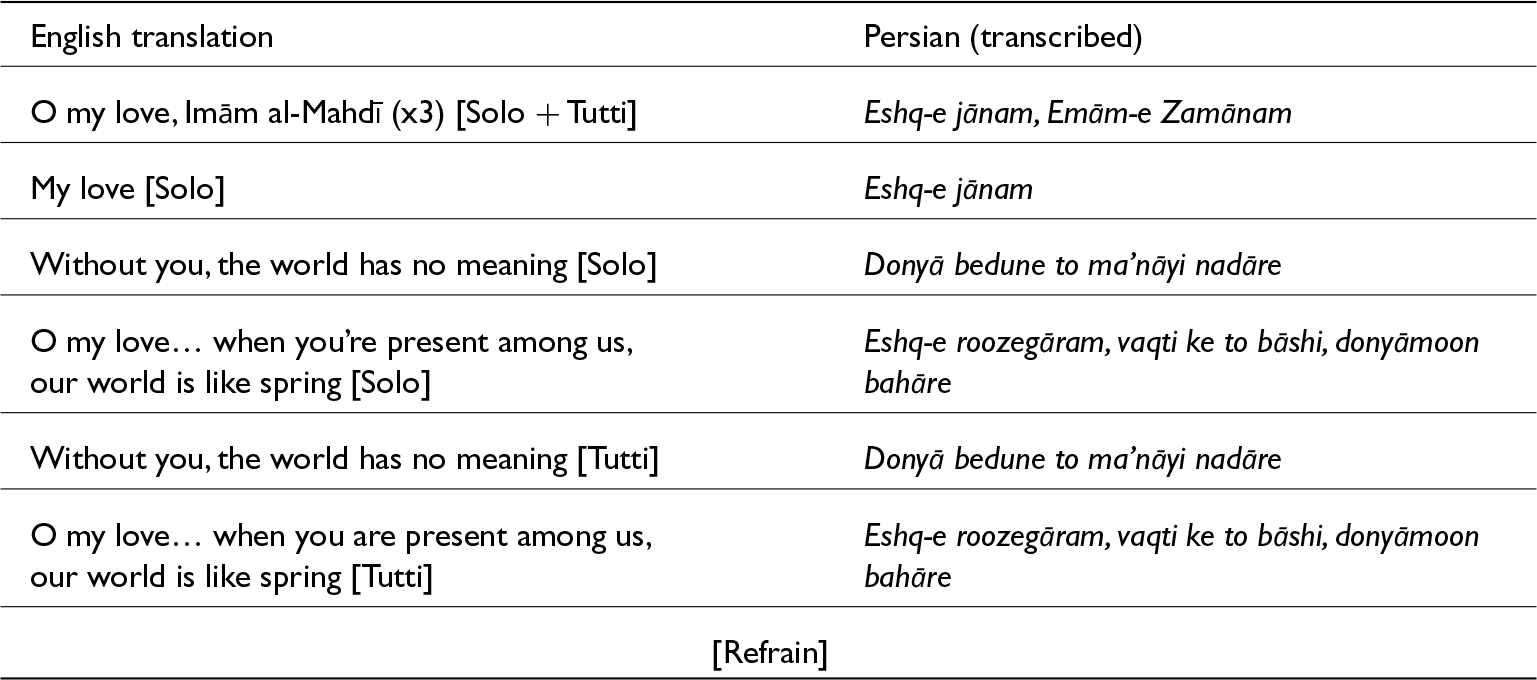
The sorud proper opens with a prelude featuring a flute and classical guitar—both classified as Western instruments—which, like all musical instruments regardless of origin, are prohibited from visual depiction on the official channels of the government-sanctioned network, the Islamic Republic of Iran Broadcasting (IRIB).Footnote 79 Rather than showing instrumentalists, which would be problematic, the video shows children from different parts of Iran and their elders walking towards the camera. The message of this interlude is that the children of Iran are mustering. After the prelude, the drum kit enters with a short fill, driving the music into the first verse (Table 2).
English translation and Persian transcription of the first verse of “Salām Farmāndeh”

Source: Asr-e Zohoor, “Namāhang-e Salām Farmāndeh bā Kafiyat-e HD,” 0:50.
The lyrics are intimate and lyrical, yearning for the presence of Imām al-Mahdī in an otherwise meaningless world; his arrival will bring a new spring. The drum kit, played in rock style, lays down a steady beat without much variation, except for other short fills marking transitions in the song. Unlike earlier soruds, which predominantly used drums to evoke a militaristic atmosphere or marching beat, the rhythmic approach here is heavily influenced by popular music, characterized by what de Clercq refers to as the “standard or normal rock beat.”Footnote 80 The other instruments are a synthesizer, guitar, and santur. The vocal style and tone reflect the singer’s background as a maddāḥ, but the addition of light echo at the end of some lines subtly modernizes the mix. This production technique recalls popular global recordings from the 1990s, notably those of The Fugees, where layered vocals and reverb created a more contemporary and accessible sound.Footnote 81 The children sing many of the lines, repeating what the vocalist has sung. Even in the first verse, it is clear that the only element of Persian classical music present in the composition is the sound of the santur.
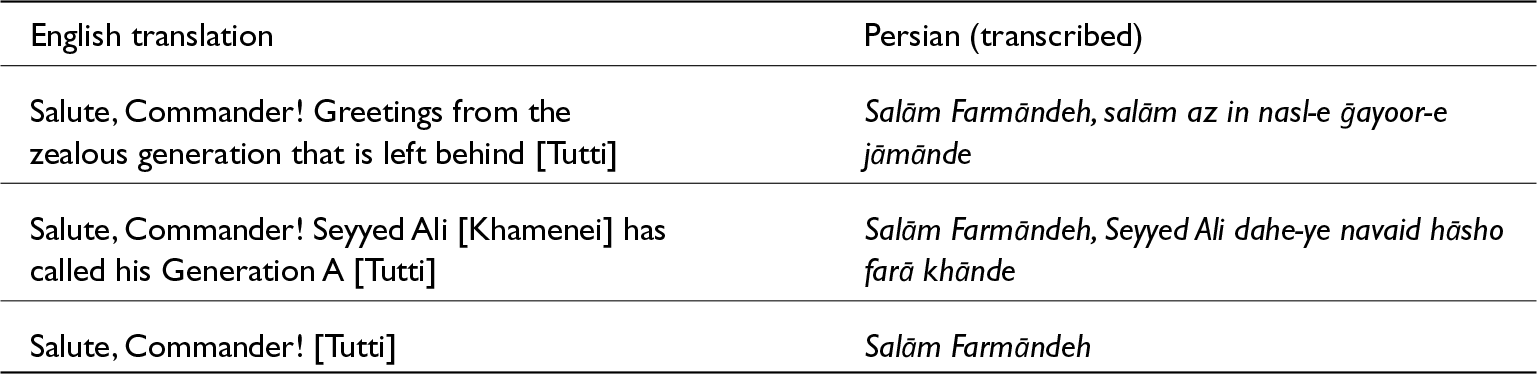
The refrain of the sorud (Table 3), hailing the “Commander,” has been the subject of significant debate since its release.
English translation and Persian transcription of the refrain of “Salām Farmāndeh”

Source: Asr-e Zohoor, “Namāhang-e Salām Farmāndeh bā Kafiyat-e HD,” 2:02.
While many commentators interpret the “Commander” as referring to Imām al-Mahdī, others—particularly critics of the regime—argue that this appellation alludes to Ayatollah Khamenei.Footnote 82 The term “Commander” is ambiguous, and this very ambiguity engages the listeners’ attention. It could refer to any one of three figures central in the lyrics: the supreme leader, who assumed the role of commander-in-chief following the dismissal of Abolhassan Bani-Sadr during the Iran-Iraq War; Qasem Soleimani, who served as the second commander of the Quds Force of the Islamic Revolutionary Guard Corps (IRGC); and Imām al-Mahdī himself, whom Shi’a Muslims believe will reappear from Mecca with his companions to restore justice when oppression prevails in the world.Footnote 83 Beyond the term’s broad applicability to all three figures, there could be further interpretations. Given that Ali Khamenei currently occupies the position of supreme leader, effectively serving as a representative of Imām al-Mahdī during his second occultation, veneration directed toward Imām al-Mahdī also extends to Khamenei. This ideological connection suggests that the true referent of “Commander” in the sorud is likely the supreme leader, specifically Ali Khamenei. The verses also express admiration for Qasem Soleimani and conveys a desire to serve both the “Commander” and the regime like Soleimani did. Notably, this section reinforces and again praises the ideology of ummah-imāmat underpinning and legitimizing the Islamic Republic.
Whomever the children hail in the refrain, the intention is clear: the children singing for all they are worth are the generation Seyyed Ali Khamenei is calling upon, his generation. This audience’s commitment to the ideology of the Islamic Republic is what is at stake. In recent years, amid an increasing number of protests, new generations have emerged as a significant presence speaking out against the regime.Footnote 84 These groupings of youth, commonly referred to in Iran as Generations Z and A, have demonstrated an unexpected level of activism and engagement in opposing the regime during recent protests.Footnote 85 The sorud’s refrain, repeated four times, presents children of Generation A responding to a direct appeal from Khamenei. Each time they sing the refrain, both girls and boys raise their right hands to their foreheads in a military salute, a gesture demonstrating allegiance, respect, and nationalism.Footnote 86 This kind of portrayal is further reinforced by Iran’s official news outlets, which consistently highlight the participation of Generations Z and A in Islamic and state-sponsored programs, underscoring a wished-for youth commitment to the Islamic Revolution’s values.Footnote 87
Another instrumental interlude, with guitar, drums, and santur, follows the refrain. The video for this section locates children within the domestic realm; though we do not hear their voices, they are shown singing to their elders. This—read with the images in the first interlude of parents (or caregivers) leading the children to muster—establishes the elders’ support and blessings for the commitments the children make in the sorud. These shots in the interlude situate and domesticate the children’s commitment to religious and nationalist devotion within the family. All the other shots present the children inside and around the Tejakan mosque.
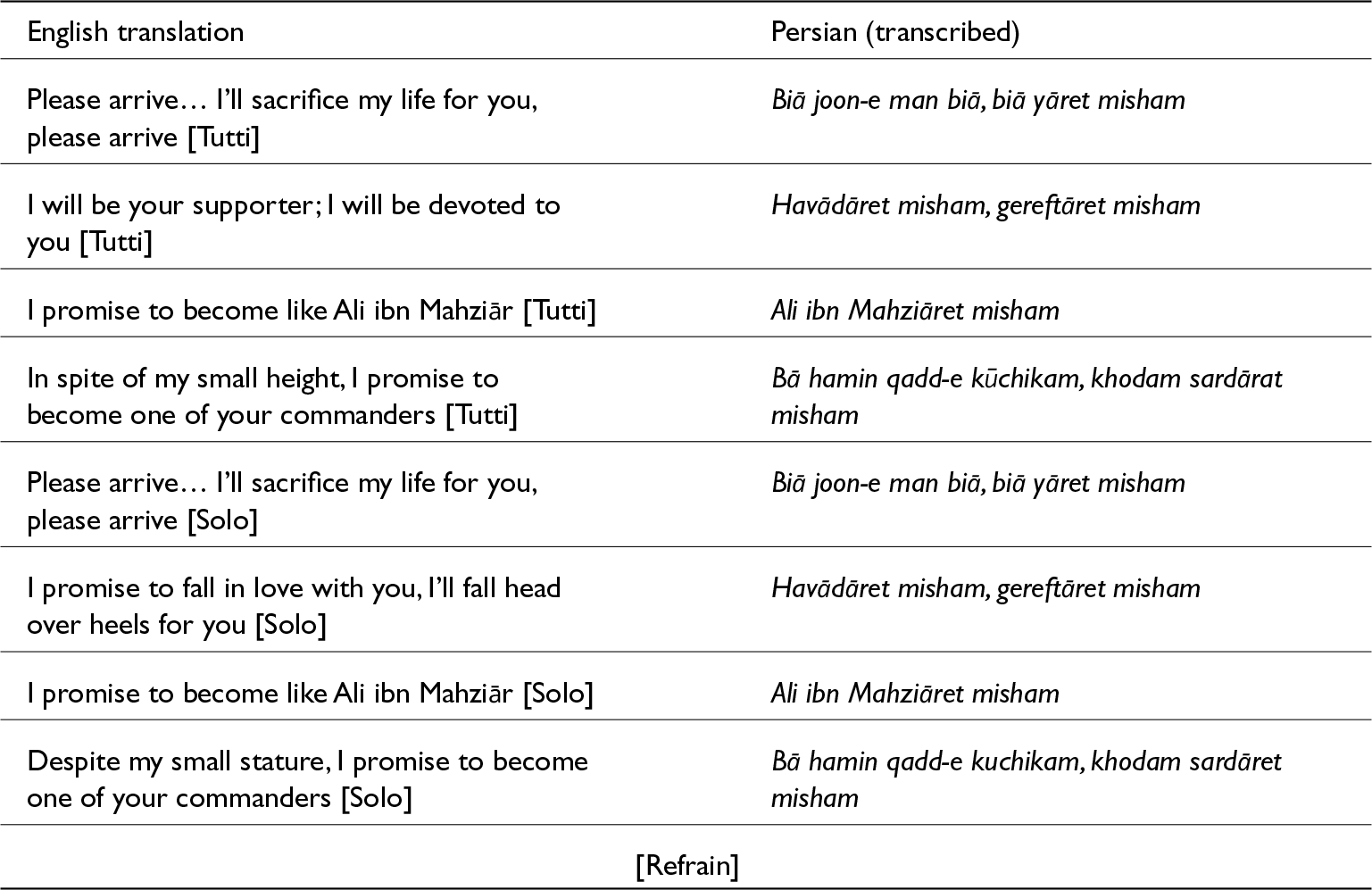
The next section recalls Ali ibn Mahziār, one of the faithful followers of Imām al-Mahdī. Initially a Christian, Ali ibn Mahziār converted to Islam and is known to have witnessed Imām al-Mahdī during his first occultation, which lasted for sixty-nine years.Footnote 88
The verse in Table 4 is marked by lines ending with the rhyming word misham and internal rhymes (bia… bia as well as yāret…, havādāret…, gereftāret…, sardāret), and again emerges from the mouths of the children. The drumming drops out for the first statement of this section, then retuns for the repetition. This has the effect of focusing attention on the sung lyrics, then, when the driving rock rhythm returns, it raises the energy and excitement.
English translation and Persian transcription of the second verse of “Salām Farmāndeh”

Source: Asr-e Zohoor, “Namāhang-e Salām Farmāndeh bā Kafiyat-e HD,” 2:42.
This section comprises a series of supplications, total commitments, and promises to Imām Mahdi: “Please arrive… I’ll sacrifice my life for you, please arrive.” Here, for the first time, we explicitly hear children, small in stature, committing to martyrdom, pledging to sacrifice their lives out of sheer love. They promise to aspire to be like Ali ibn Mahziār, the great ninth-century scholar and companion of four of the Shi’a Imāms, who was close to Imām al-Mahdī before his occultation. This is a lofty aspiration for children to make, given Ali ibn Mahziār’s attainments, recalling how ritual devotion has historically generated affective orientations for political action.Footnote 89 Mahziār’s intimacy with the Imāms as well as his sound, highly regarded scholarly theological works are what would appeal to children. These deal with the return of the twelfth Imām from occultation and various aspects of social and religious life, including writing on martyrdom. These children, the song avers, will become commanders in Farmāndeh’s army.
There are also references to other venerated figures, including Qasem Soleimani and Mirza Kuchak Khān, a leader of the Persian Constitutional Revolution in 1905, who was eventually executed. Both men are proclaimed as martyrs in official government discourse.Footnote 90
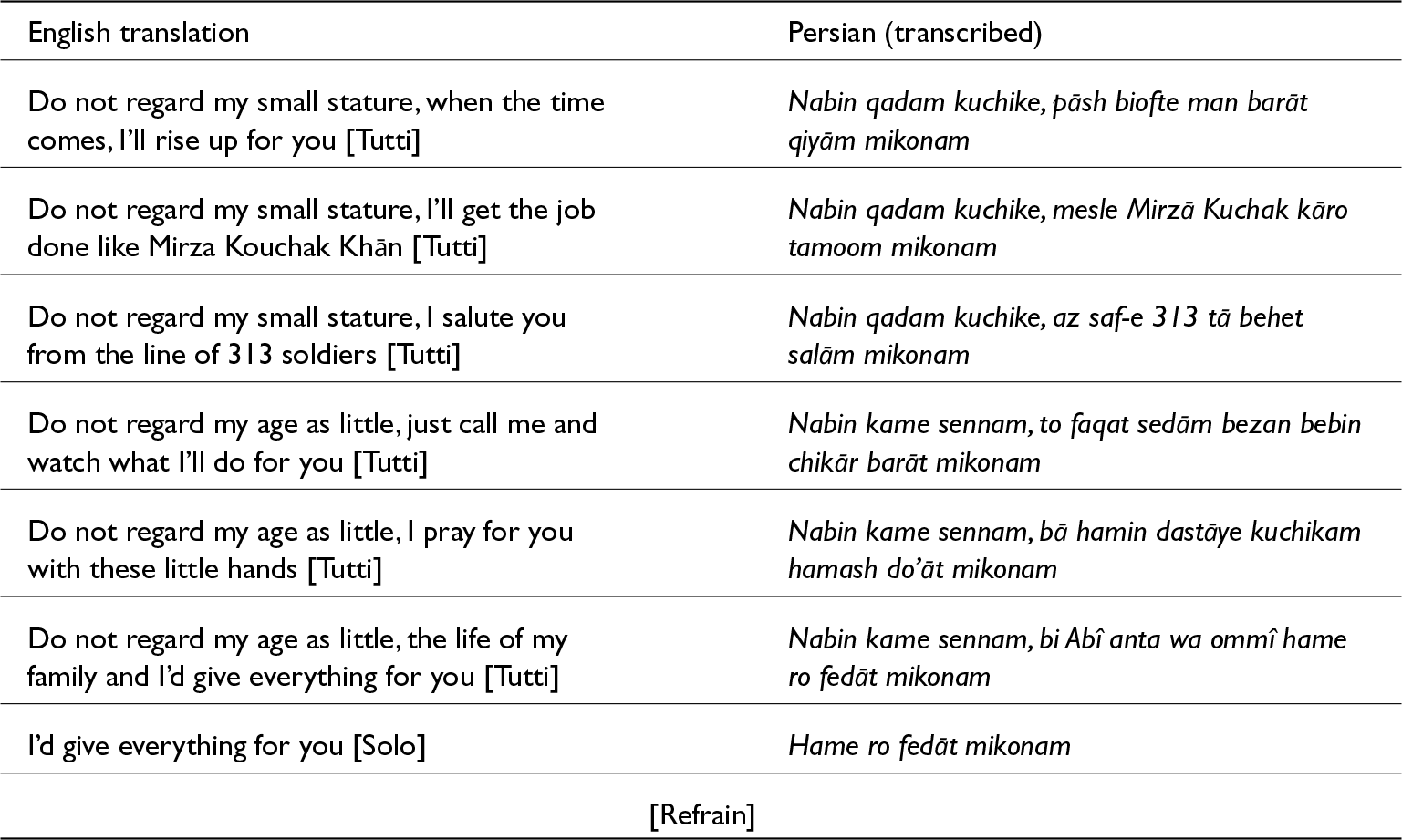
Martyrdom, rooted in Shi’a Islam and embedded in the nation’s collective memory, holds a profound place in Iranian culture. Martyrdom’s significance grew during the Iran-Iraq War (1980–1988), which was marked by the extensive loss of soldiers and civilians. This period fostered a lasting culture of martyrdom, which is reflected in ongoing commemorations and rituals.Footnote 91 References to these figures in “Salām Farmāndeh” continue this Islamic tradition by encouraging the younger generation to embrace the ideals of self-sacrifice and martyrdom in devotion to velāyat-e faqīh and the values of the Islamic Republic (Table 5).
English translation and Persian transcription of the third verse of “Salām Farmāndeh”

Source: Asr-e Zohoor, “Namāhang-e Salām Farmāndeh bā Kafiyat-e HD,” 4:25.
This portrayal is reinforced and disseminated through official news outlets, which consistently and repeatedly highlight the participation of Generations Z and A in Islamic and state-sponsored programs, underscoring their supposed commitment to the values of the Islamic Revolution.Footnote 92
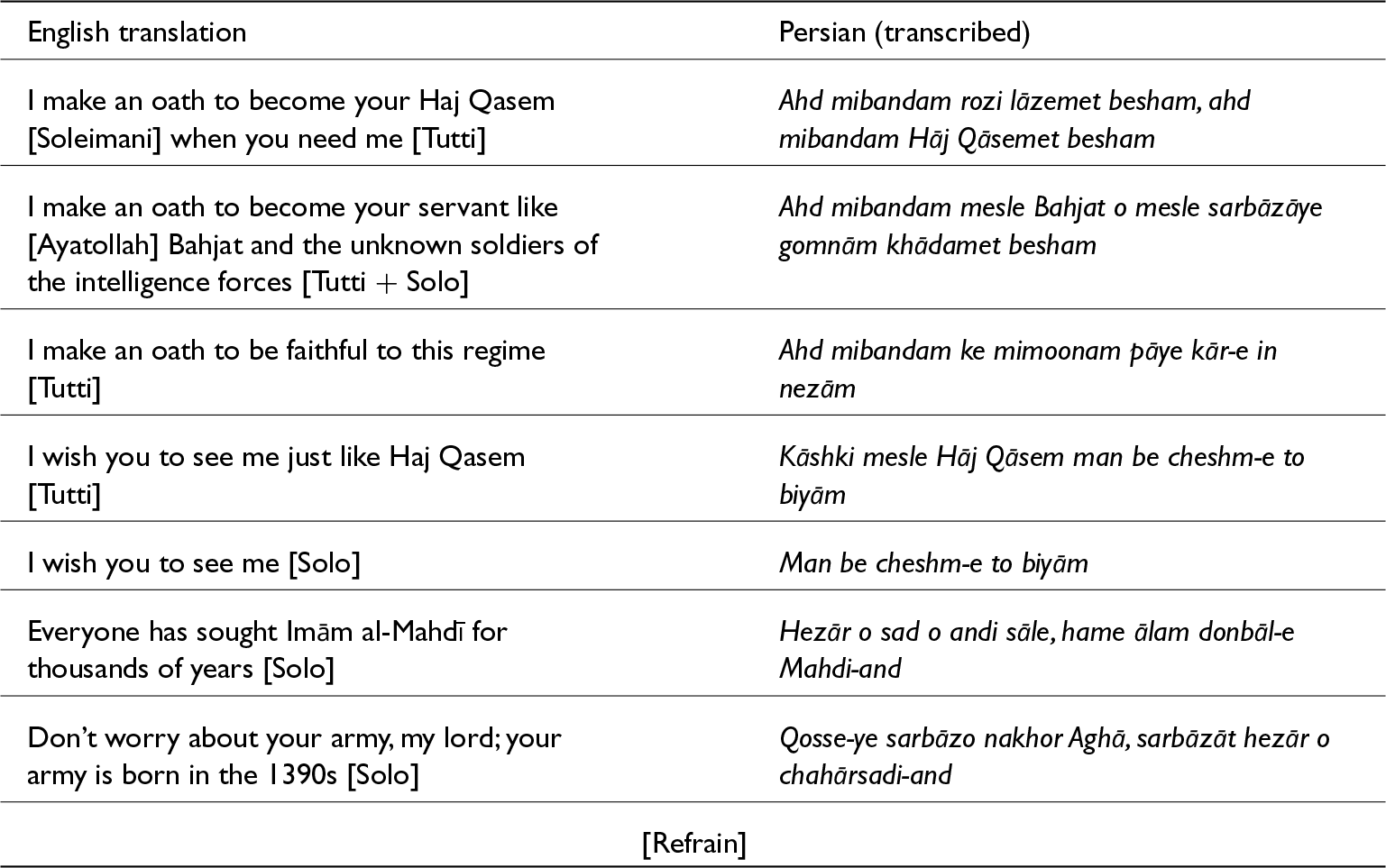
This section has the end rhymes -am and -and. The children swear an oath to emulate the iconic military leader of the Quds Force (Iran Revolutionary Guards), Qasem Soleimani (1957–2020), who played a significant role in both the Iran-Iraq War and the Syrian civil war. He was a very influential political figure in Iran, closely allied to Ayatollah Khamenei, and was sanctioned by the United Nations and European Union and declared a terrorist by the US. In 2020, Soleimani was assassinated by the US in a targeted drone strike, an operation authorized by senior military officials. In the Iranian government’s narrative, Qasem Soleimani was “terrored” by the US military; he is portrayed not only as a martyr (shahid) but also a divinely chosen figure granted the sacred opportunity to sacrifice his life for a higher cause.Footnote 93 Following his death, Soleimani became a symbol of resistance against Western sanctions and a central figure in the ideological narrative of the Islamic Republic, with his legacy now incorporated into school curricula. The Iranian government considers his assassination a terrorist attack and regards Soleimani as a martyr, a status of profound significance in Shi’a Islam. The lyrics express the children’s desire to be noticed and become martyrs as well (see Tables 5 and 6).
English translation and Persian transcription of the fourth verse of “Salām Farmāndeh”

Source: Asr-e Zohoor, “Namāhang-e Salām Farmāndeh bā Kafiyat-e HD,” 6:00.
In recalling the highly regarded Islamic scholar Ayatollah Bahjat (1916–2009), he is, somewhat ominously, linked to the children’s oath to become like “the unknown soldiers of the intelligence forces,” who are portrayed as working for the country’s good.Footnote 94
“Don’t worry about your army, my lord; your army is born in the 1390s” establishes a personal relationship between an imagined children’s army and the leader, addressed as “my lord.” The ambiguity here is telling: the lyrics reference Imām al-Mahdī but may also seem to address Khamenei. This ambiguity is rather like two-tone silk woven with two colors of yarn so that the fabric appears in either shade, depending on the angle of sight. This address to the leader is projected as emerging from the collective voice of Generation A proclaiming itself as “your army [that] is born in the 1390s” (2011 CE). While ambiguous, the lyrics point to Khamenei, as the children form a new cadre born during his leadership. The children wish to be “seen” or chosen for the army. An alternative reading, however, is that this is a direct address to the occluded Imām Mahdi—whose long-anticipated return is mentioned in the second line. The children confidently assure him that they will form his predicted 313-strong army. “I wish you [to] see me” gains poignancy when considering the many generations since the Imām’s occultation.
Mulling over these lines and the sorud’s entire presentation and music video, it seems that children’s rights activists’ concerns are not unreasonable. Considering the tender ages of the children represented in the video, the Iranian state, in its concern to enlist Iranian youth as patriots in the present post-revolutionary moment, is, at least, treading a fine line between patriotic propaganda and abuse.
Conclusion
This article has examined how “Salām Farmāndeh” reflects the ideological foundations of the Islamic Republic, particularly velāyat-e faqīh and ummah-imāmat. In analyzing the sorud’s musical and lyrical elements, instrumentation, lyrics, and promotional strategies, I have demonstrated that “Salām Farmāndeh” is not merely a pop-infused, religious sorud but also a state-sanctioned cultural artifact aiming to reinforce political legitimacy, and an ISA in Althusserian terms. The Iranian state has strategically deployed “Salām Farmāndeh” as an emotive, soft-power means of mobilizing Generations Z and A, blending elements of popular music and video with ideological messaging to ensure its widespread appeal. This fusion shows a calculated reconsideration of the regime’s long-standing regulatory approach to music; elements of genres historically subject to censorship have been selectively deployed to present the regime’s narratives in a new garb. The promotion of “Salām Farmāndeh” among youth, particularly those from Generations Z and A, is a key aspect of this phenomenon. As soruds of this type are gaining sanctioned prevalence, I have coined the term sorud-e pāp to identify and categorize them, as I think the term suggests a useful approach for researchers and critics analyzing this emergent musical phenomenon.
While the Iranian government has historically portrayed young people as rebellious—especially in the context of recent protests—this sorud seeks to counter such perceptions and enlist youngsters in the ranks of righteous, regime-aligned patriots by depicting them as devoted supporters of the Islamic Republic, supported by their elders. This represents an attempt to reshape public attitudes and is a significant strategic shift in state propaganda production. Rather than relying solely on coercion, the regime deploys cultural participation as a means of ideological reinforcement and is prepared to overstep hitherto rigidly policed musical boundaries.
Finally, this article primarily examines the explicit and deliberate nexus between regime ideology and music in the mass media, specifically the sorud. I have focused on the most evident ideological concepts by teasing out the ways cultural artifacts such as “Salām Farmāndeh” are strategically deployed to reinforce regime narratives. At the same time, further concepts merit deeper exploration, particularly those forming the ideological foundations of the Islamic Republic. The ideological concepts discussed here form part of a broad and intricate system. The theme of martyrdom and the evolution of nowhahs, for example, are only briefly addressed here and warrant further study.
Acknowledgements
I am grateful to Behrang Nikaeen for his insights, which helped refine the theoretical framework of this article. I also wish to thank Aria Tari, Michael Nixon, Ameneh Yousefzadeh, and Hamed Asadi for their thoughtful input. My thanks extend to Nasrin Rahimieh and the anonymous reviewers for their valuable comments and suggestions, which greatly improved the clarity and rigor of this study. Finally, I am deeply indebted to my companion, Bita Garshasbi, whose steadfast encouragement was essential to the completion of this work.
Arash Ahmadzadeh is a researcher, translator, and classical guitar and music history lecturer at the Conservatoire of Breuillet, France. Since completing his master’s degree, Ahmadzadeh’s research has focused on the intersection of power and music in the Baroque era and in post-revolutionary Iran. He is also interested in language, translation, and the cultural and theoretical issues surrounding them.