Introduction
The food system is beset by numerous ethical problems and challenges across the supply chain, including concerns over sustainability, the rights and welfare of animals, labor conditions, public health, and food safety. The social and environmental risks that arise from the global agri-food system are particularly difficult to address because they can be difficult to trace, the consequences of certain practices may not emerge for years or even generations and scientific knowledge about the various impacts of the global agri-food system are often unclear and contested (Godard and Aruldhas, Reference Godard and Aruldhas2014). As a result, when there are potentially multiple causes for a phenomenon like obesity or natural resource depletion, the social responsibility for these phenomena is ambiguous. Examining the fundamental ethical questions that characterize these thorny issues is critical to resolving them, since ethically engaged research can help to illuminate the different types of practical solutions that might be pursued (Thompson, Reference Thompson2015).
Investors and consumers are increasingly demanding that agri-food firms spend a portion of their profits to address social and environmental issues, and corporations that derive much of their value from a positive brand image have often used these critiques as a pathway for new branding opportunities. Many agri-food companies that are dependent on global commodities have responded to demands for corporate social responsibility (CSR) by focusing on the farmers who serve as their raw material suppliers (Konefal et al., Reference Konefal, Hatanaka and Constance2014; Jones et al., Reference Jones, Comfort and Hillier2017). For example, many agri-food firms seek to incorporate small farmers into production processes that are said to be able to elevate those farmers out of poverty, to create new sustainability standards, and subsequently, to educate those farmers accordingly (Konefal et al., Reference Konefal, Hatanaka and Constance2014; Jones et al., Reference Jones, Comfort and Hillier2017).
Although it is possible for a company to make insincere and superficial gestures toward CSR, making CSR pledges can also lead companies to be held accountable for them, upon which time a company may eventually be pressured to follow through with their stated commitments or face the consequences. Volkswagen's public relations debacle over the eco-friendliness of their diesel automobiles is a recent illustration of this point (Gelles, Reference Gelles2015). However, in the event that this type of negative publicity is not seen as a compelling sanction, firms are likely to continue greenwashing, which highlights the inherent fragility of firms' voluntary obligations. Critical questions thus remain as to the adequacy and democratic legitimacy of these types of CSR.
In the area of food and agriculture, much of the work on CSR concerns the implementation of private governance schemes and the institutionalization of value commitments. This includes, for example, the ethical dimensions of supply chain management (Barham, Reference Barham2003; Konefal et al., Reference Konefal, Mascarenhas and Hatanaka2005), third-party certification (Hatanaka et al., Reference Hatanaka, Carmen and Lawrence2005), transparency initiatives (Barham, Reference Barham2002; Fuchs et al., Reference Fuchs, Kalfagianni and Havinga2011a), codes of conduct (Konefal et al., Reference Konefal, Mascarenhas and Hatanaka2005; Fuchs et al., Reference Fuchs, Kalfagianni and Havinga2011a) and privatized standard setting for agri-food firm products and processes (Busch, Reference Busch2000; Fuchs et al., Reference Fuchs, Kalfagianni and Havinga2011a, Reference Fuchs, Kalfagianni, Clapp and Busch2011b; Konefal et al., Reference Konefal, Hatanaka and Constance2014).
Since CSR refers to voluntary actions on the part of capitalist firms that exceed legal and regulatory requirements, there is a need for strong legal and regulatory requirements to establish a solid foundation upon which CSR practitioners can strive to exceed. However, this shift toward private governance strategies indicates that the state seems to be withdrawing from the establishment of strong legal and regulatory requirements. Furthermore, the globalization of agri-food firms means that firms can move to nation-states with weaker legal and regulatory frameworks (Bonanno and Constance, Reference Bonanno and Constance2008). Therefore, although these issues of the state are important, we seek to extend consideration to other actors in the institutional context that are also framing agri-food CSR. Specifically, we explore the role of universities, where a substantial amount of the publicly funded agricultural and food research and development is conducted. Although universities have a critical role to play in helping to untangle and clarify the ethical concerns pertaining to food and agriculture, academic institutions are themselves embroiled in difficult ethical dilemmas with respect to their own science commercialization practices and their engagement with industry actors (Glenna et al., Reference Glenna, Welsh, Ervin, Lacy and Biscotti2011; Glenna, Reference Glenna2017).
The purpose of this paper is to add conceptual clarity to debate over the types of social and ethical responsibilities that agri-food firms and universities have to each other and to the public. We pay particularly close attention to the ethical challenges that have surrounded these organizations in recent years, specifically with respect to university–industry collaborations. We argue that agri-food firms have a unique set of obligations and challenges with respect to CSR as compared with other profit-based corporations because food is a primary good, i.e., a good that is necessary for basic human subsistence and the development of full human potential (Thompson, Reference Thompson2015). It is because of this that controlling access to food lends itself to political economic power. We moreover argue that the university also has a unique role in engaging with agri-food firms because universities have ethical and legal responsibilities to enlighten society and solve practical problems for the public good.
Furthermore, as institutions that partner with agri-food firms, universities may serve to elevate the CSR commitments that agri-food firms set for themselves and the expectations that the public has for those firms. Studying the ethical obligations of universities is important because the university's numerous institutional objectives can appear to be somewhat contradictory—particularly when there is widespread disagreement as to whether the public interest is distinct from various private interests. Social expectations about food and higher education thus add an additional layer of complexity to ongoing debates about the meaning of CSR with respect to agri-food firms.
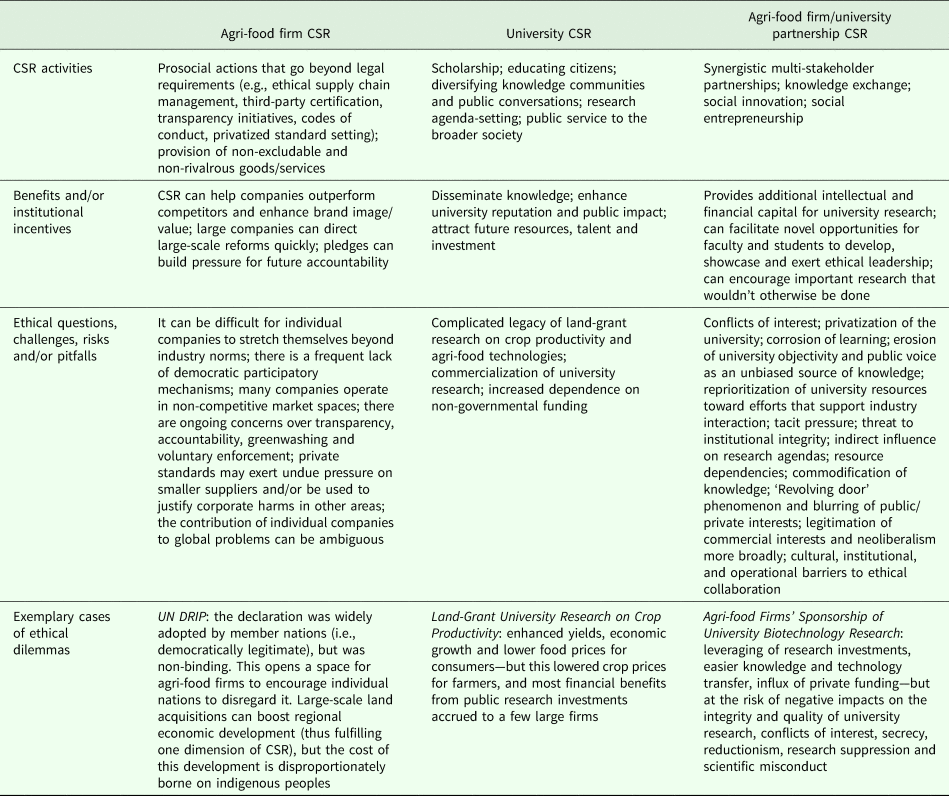
In what follows, we first clarify what it means for a company to engage in CSR. Next, we consider the cultural associations that have taken root between popular notions of social responsibility and the provisioning of food. After reflecting upon how the legal and social standing of agri-food firms further complicate the ethical expectations that are placed on these entities, we look at the types of CSR initiatives that agri-food firms have launched in an effort to fulfill the public's ethical expectations. We pay particularly close attention to the democratic legitimacy of the process through which these initiatives are pursued. Here, we examine the UN Declaration of the Rights of Indigenous Peoples (UN DRIP) as a case study in the tension between CSR as defined by agri-food firms vs multilateral organizations. Although the university would ideally play a critical participatory role in resolving these types of conflicts by virtue of its public commitments, as we explain, the historical relationship between the university and agri-food firms has deeply complicated the university's standing as an independent producer of scholarship for the public good. We evaluate this problem by considering the case study of land grant university research on crop productivity. Upon looking more carefully at the pathways and pitfalls associated with university–agri-food firm partnerships, we then consider several suggestions as to how universities may enhance their ethical leadership in these types of relationships. To this end, we examine agri-food firm sponsorship of university biotechnology research as a case study in the controversies that can arise from these types of partnerships. While the intended contribution of our paper is primarily conceptual, we refer to the aforementioned exemplary cases of CSR activities for descriptive purposes. These exemplars moreover provide concrete examples by which to compare and contrast the benefits and/or institutional incentives and ethical challenges that agri-food firms, universities, and agri-food firm/university collaborations face when engaging in CSR (see Table 1).
CSR in the contemporary agri-food system amidst diminishing state oversight

Defining CSR
Research indicates that companies pursuing CSR often outperform other companies, leading some to question if there is an optimal amount that companies should spend on these types of activities (McWilliams and Siegel, Reference McWilliams and Siegel2001). The implication of this suggestion is that a firm's well-developed CSR program merely supplements its advertising budget. Furthermore, because some firms may use these programs for cynical purposes, it is important to clarify what the concept of CSR is, why it is relevant today, and what its limitations are.
Some dismiss CSR as an attempt by companies to improve their images and enhance brand recognition while reinforcing the trend toward private governance (Shamir, Reference Shamir2011). However, this assertion privileges only one dimension of the concept, since it overlooks the historical trend toward increasing transnational corporate power and the demise of state capacity to manage it. Recent efforts to push for CSR thus include efforts by various people and groups to hold firms accountable for more than just their commitment to enhancing shareholder value.
First, in order to engage in CSR, companies must do more than what the law requires and they must do more than use it for a cynical advertising gimmick (McWilliams and Siegel, Reference McWilliams and Siegel2001). This emphasis on going beyond legal requirements implies that CSR brings about a certain amount of risk for a company. Although some claim that companies are legally obligated to increase shareholder profits by maximizing stock prices, there is nothing in the legal system that specifies this (Mohr and Webb, Reference Mohr and Webb2005). Still, publicly traded companies do face market sanctions if they do not maximize profits, as shareholders may sell off poorly performing stocks while some economic actors seek to raid underperforming companies (McWilliams and Siegel, Reference McWilliams and Siegel2001). In considering these significant risks to engaging in CSR, we must recognize that companies involved in this activity must be doing so with the long-term interests of the company at stake.
A company engaging in CSR must also consider stakeholders, not just shareholders (Mohr and Webb, Reference Mohr and Webb2005). Stakeholders typically include customers, employees, suppliers, local communities, individual citizens, animals and the environment, in addition to shareholders. In order for companies to engage in CSR, then, obeying the law is necessary but not sufficient. Companies must also balance the risk of market sanctions with the need to address the interests and standpoints of their broader stakeholders.
Corporations and the public interest
A useful starting point in the discussion about agri-food firms’ ethical responsibilities is the work of Korten (Reference Korten1995, p. 53), who observes that ‘the corporate charter is a social invention created to aggregate private financial resources in the service of a public purpose.’ We would add to this that public goods are non-excludable and non-rivalrous. This means that they have qualities about them that make it difficult to exclude others from accessing them and that they are not diminished by being used (Brandl and Glenna, Reference Brandl and Glenna2016). Examples of public goods include knowledge, air, and road signs. Agri-food firms often argue that they are fulfilling their public purpose by making their goods available to customers. However, because these items are only available through marketplace exchange, corporate products are perhaps more accurately defined as private goods because they are excludable and rivalrous. This means that there are qualities about them that make it possible to prevent people from using them without first paying a charge and that the use of them diminishes their accessibility to others (Brandl and Glenna, Reference Brandl and Glenna2016).
Korten (Reference Korten1995, p. 53) further notes that the corporate charter ‘also allows one or more individuals to leverage massive economic and public resources behind clearly focused private agendas and to protect themselves from legal liability for the public consequences.’ In effect, corporate charters—which were originally founded for the purpose of expanding agricultural trade—have institutionally distanced these organizations from the constraint of public mores by creating legal barriers that reduce corporations’ culpabilities. One would need to go back to the earliest years of US history to find a case where a firm was held accountable for its corporate charter (Blake, Reference Blake1956; Weidner, Reference Weidner1974).
In addition to receiving legal protections, global agri-food firms have been further bolstered by the valorization of science, technology, increased production, and economic growth as synonyms of social progress. These discourses have served as both excuses as well as justifications for many of the costs and harms inflicted by global agri-food firms throughout the course of modern history—slave labor, air and water pollution, land dispossession, soil degradation, deforestation, and countless others. There are also practical downsides that agri-food firms face when they don't fully engage with public criticism, since it can result in their losing touch with other views and ideas (Charles, Reference Charles2013).
Scholarship in ethics education shows that the awareness that comes from self-reflexivity is a critical step toward the cultivation of moral agency. For contemporary agri-food firm actors, heightened levels of awareness about competing perspectives are only the beginning of a longer process of ethical engagement that does not have clear-cut answers or endings.
CSR and democratic legitimacy: the process is the product
The process that generates agri-food firms’ CSR activities may be just as important as the actual outcome, potentially even more so. This is particularly important when a company is providing a primary good (e.g., food) that the public is dependent upon. Evaluating the democratic legitimacy of agri-food firm CSR initiatives thus involves looking at participation (i.e., ‘access of all relevant actors in the development of standards and equality among the actors in the decision-making procedures’), transparency (being ‘open to public scrutiny’) and accountability (Fuchs et al., Reference Fuchs, Kalfagianni and Havinga2011a, p. 339). Moreover, for Fuchs et al. (Reference Fuchs, Kalfagianni, Clapp and Busch2011b), private standards typically only address a small handful of the demands placed on companies for CSR (e.g., improving food safety through traceability, eco-efficiency and recycling), to the detriment of principles which do less to help the bottom line (including improved labor practices, farmer livelihoods, food justice, biodiversity and animal rights).
Private governance standards that lack democratic participatory mechanisms make companies particularly vulnerable to concerns about transparency and verifiability. Even in the best of circumstances, information provided on food labels is essentially a monologue—a one-way communication from the company to the consumer. When consumers are unable to engage in a dialogue with producers, consumers’ trust in agri-food firms’ CSR initiatives is tenuous and fragile (Busch, Reference Busch2011).
Fuchs et al. (Reference Fuchs, Kalfagianni, Clapp and Busch2011b) further note that transparency in private standards is often minimal, and civil society is often excluded from monitoring and implementation in the certification process. This problem is exacerbated by resource inequalities between small farmers and civil society organizations vs major producers.
To be sure, there are also many instances where agri-food firms have been effectively nudged to engage in pro-social behavior by non-government agencies (NGOs) to improve their social and environment performance. In 2013, for example, Oxfam assessed the social and environmental policies of the world's ten largest food and beverage companies and then challenged them to create a more just food system (Behind the Brands briefing paper, Oxfam, February 2013). The campaign evaluated companies’ social and environmental policies across seven themes: land use, women, small farmers, farm workers, climate change, water rights, and transparency. Three years later, improvements were seen from all companies in several of Oxfam's targeted areas (The Journey to Sustainable Food briefing paper, Oxfam, April 2016). New commitments were made by companies to improve social and environmental standards in their complex supply chains. To continue this progress, Oxfam recognized that companies must adopt new business models in their supply chains to ensure farmers and workers receive much more of the value generated by their products. Oxfam has also partnered with universities to gain additional insight into what can be done to improve company practices associated with issues such as land use, climate change, and water rights. Again, democratic participation, transparency, and accountability (Fuchs et al., Reference Fuchs, Kalfagianni and Havinga2011a) are critical to the lasting success of these types of efforts.
Case study: agri-food firms, CSR and the UN declaration of the rights of indigenous peoples
Another important question with respect to democratic participation in agri-food firms’ CSR practices concerns the tension between private governance mechanisms and multilateral organizations like the United Nations. An exemplary case in the need for clarity and consistency between these very different types of decision-making entities concerns global agricultural supply chains and the land rights of indigenous peoples. For example, after 25 years of negotiation, discussion, and collaboration among 370 million indigenous peoples around the globe, the General Assembly of the United Nations adopted UN DRIP. On September 13, 2007, 144 countries voted ‘Yes’ and four countries voted ‘No’. Although not legally binding, UN DRIP contains 42 articles that countries have, by virtue of adopting the Declaration, agreed to uphold in its relationships with indigenous peoples. Among the most important principles in UN DRIP is the Article 10 statement on free, prior, and informed consent, which reads:
‘Indigenous peoples shall not be forcibly removed from their lands or territories. No relocation shall take place without the free, prior and informed consent of the Indigenous Peoples concerned and after agreement on just and fair compensation and where possible with the option of return (UN, 2008:6).’
Nonetheless, if a country is eager to have agri-food firms located in an area currently occupied by its indigenous peoples, there is little reason for the government to expect that a national or international agri-food firm will feel compelled to incorporate UN DRIP as a part of the negotiation. As noted by Kleinfeld (Reference Kleinfeld2016:1763),
‘Protection of investors requires states to act to remove barriers to investment, and to avoid erecting new ones that undermine the value of an investment; protection of indigenous peoples requires the erection of barriers that, if faithfully implemented, could undermine or destroy that value by preventing meaningful resource exploitation… The incentive structure surrounding this tension makes the subordination of indigenous rights a frequent and foreseeable outcome of conflict.’
It is also important to recognize that by the time UN DRIP was adopted in 2007, large-scale acquisitions of indigenous farmland (i.e., ‘land grabs’) in Africa, Latin America, Central Asia and Southeast Asia were already taking place. By large-scale acquisitions of farmland, we're referring to the purchase or lease of large-scale government-controlled land for the production of food crops, generation of biofuel and, increasingly, the control of water. Each of these purposes has been undertaken by agri-food firms in poverty-stricken countries, and these purchases frequently involve coercing marginalized farmers and herders to move to urban areas. This is a classic instance of the need to recognize non-economic interests in CSR policies, as indigenous peoples’ traditional foods and medicines—as well as important cultural sites—are often found in forests, rivers, streams, and other locations that are either within or proximate to the acquired areas.
Many countries, despite having adopted UN DRIP, do not have in place legal or procedural mechanisms to protect local rights and to take account of indigenous and local peoples’ interests, livelihoods and welfare (Cotula et al., Reference Cotula, Vermeulen, Leonard and Keeley2009:7). This observation suggests that the social responsibility of agri-food firms should include not only development opportunities but also the recognition of how the proposed acquisition of lands and waters are related to local and indigenous cultures.
Without including the voices and participation of indigenous peoples and other marginalized groups in enforceable governance structures, CSR initiatives in the aftermath of large-scale land and water acquisitions will lack democratic legitimacy, and will thus be viewed by many with skepticism at best or outright hostility at worst.
Agri-food firms and the commercialization of the university
One might hope and expect that university partnerships with agri-food firms would invariably provide a public-interest voice that contributes to ethical solutions for the aforementioned conflicts, through research agenda setting, development strategies, standard setting, and other decision-making and policy processes. In many instances, academics do strive to fulfill this role. At the same time, university research has also played a very important role in innovation and economic growth, and these intellectual breakthroughs are often harnessed by private firms (Block and Keller, Reference Block and Keller2011). This is true in manufacturing, pharmaceuticals and agri-food (Busch, Reference Busch2014). Although the university would ideally help to better inform all of these conversations, the historical relationship between the university and agri-food firms has been and continues to be complex. This is for three key reasons: the historic legacy of public agricultural and food research and development, trends in the commercialization of university research, and the increasing dependence of the university on non-governmental sources of research funding.
First, the rise of global agri-food firms—and by extension, private governance schemes and other CSR initiatives—would not have been possible without the technologies provided by agricultural research and disseminated by extension programs. It is primarily for this reason that universities have played such an important role in shaping the contours of the global agri-food system as we know it today.
Second, in addition to assessing the moral obligations that universities have with respect to their historical contribution to the global agri-food system, a comprehensive ethical analysis of universities must also consider the role of the university as a corporate institution in its own right. Glenna (Reference Glenna2017) has noted that, as federal and state support for university research has declined in relation to other funding, universities have become more reliant on their own revenues to support research. This raises concerns that universities are ‘increasingly being influenced by the goals of economic efficiency and monetary returns on investment’ rather than broader public interests (Glenna, Reference Glenna2017). Welsh and Glenna (Reference Welsh and Glenna2006) similarly found that during the first decade after the commercialization of genetically engineered crops, universities tended to conduct biotechnology research on major crops and major traits rather than minor crops and minor traits. This indicates that university research agendas are becoming more like private-sector research agendas.
It is important to distinguish between a university's internal obligations to CSR vs their external obligations, such as their investment portfolios and partnerships with for-profit firms. With respect to the former, one way that a university might fulfill its CSR obligations is through its broader mission to educate. However, the university also has other formal obligations beyond training students and disseminating research findings. Quite often, universities are criticized for being too corporate. Although universities are not publicly traded corporations, they are inherently corporate entities which require revenue streams in order to sustain themselves. And as the public support for these universities declines, it should not be a surprise to see them turn to private-sector activities to generate revenues. Societal expectations as to what CSR means for private firms as opposed to public universities have yet to fully crystallize, and the emerging partnerships between universities and agri-food firms seem to be making it even more difficult to disentangle the respective obligations of these entities.
Third, universities have become increasingly dependent upon agri-food firms and other industries for research funding. It is for this reason that the integration of ethics into partnerships between universities and agri-food firms is particularly challenging. Such collaborations can be simultaneously beneficial and problematic, perhaps inherently so. For universities, the upside of these relationships is that it further secures access to major sources of financial and intellectual capital in an era of dwindling public resources for higher education (Owen-Smith, Reference Owen-Smith2006; Busch, Reference Busch2014). The problem here is that current rules and regulations designed to curtail conflicts of interests among university employees do little to engage the more subtle institutional and non-monetary risks that the partnerships between universities and agri-food firms raise (Marks, Reference Marks2014). Examples of firms’ indirect influence on universities include agenda-setting practices (i.e., industry standards on biocontrol), the existence of corporate-derived knowledge bases that guide future inquiry (as with the billions of dollars that have been invested into chemical industry research), and the provision of otherwise unavailable equipment and services, which can create resource dependencies (Kleinman, Reference Kleinman2003).
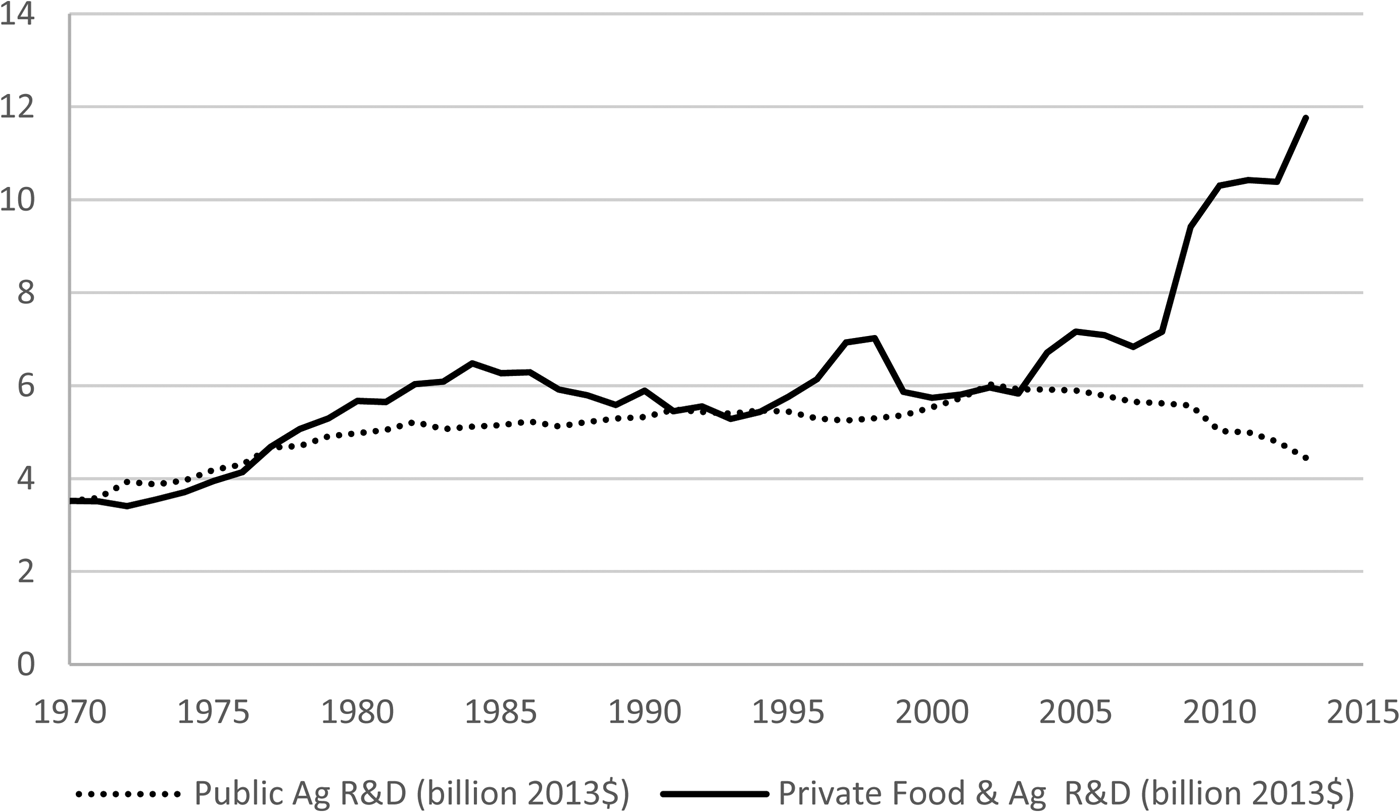
The decline in the proportion of public support for food and agricultural research and development is another important influence on university science. The relative contribution of the public and private sectors to university research was similar through much of the latter decades of the 20th century (see Fig. 1). However, in the early 2000s, private investments in agricultural and food research and development rose dramatically, and the public investments began to decline. This means that the private sector is playing a significant role in driving the research and development agenda, while university scientists are increasingly reacting to it.
Overall Trends in Ag & Food R&D Funding in Constant 2013 US$, billions.

Agri-food firms’ subtle influence on research agendas is a significant form of indirect corporate influence on university scholarship (Hess, Reference Hess2007). Government and industry have their own commitments and their own goals, which may or may not coincide with those of the university or the broader public. At the same time, however, there can be advantages to working with the right corporate partners, and gifts with strings attached can also encourage universities to engage in important work that might not get done otherwise. The key question here is why the strings are being attached, who the strings benefit, what the benefit consists of, and who should get to decide the answers to all of these potential problems.
Increasingly, we are witnessing a revolving door between university, industry, and state, whereby the same scientist may in his or her lifetime serve as a faculty member, as a member of a corporate board of directors, and as a government official. The democratic state itself is but a hodgepodge of various interests from the greater society. With the increasingly permeable boundaries between these social institutions, it is sometimes hard to tell the difference between commercial and non-commercial, academic and non-academic, public and non-public (Kleinman, Reference Kleinman1998).
Although private stakeholder interests shape policy and research agendas, both directly and indirectly, it is not easy to decipher how the interests of various actors comingle, compete with and influence one another (Owen-Smith, Reference Owen-Smith2006). Within the commercial, academic and government sectors, one can recognize a multitude of competing ideas about just how science ought to be pursued. The net result of this is that it is becoming increasingly difficult to identify both the distinctive voice and the public mission of the university.
Although institutional arrangements and hierarchies vary from school to school, and also depend upon leadership styles, universities tend to have more distributed, pluralistic voices as compared to for-profit corporations. Nonetheless, while this pluralism is one of the university's strengths, it also makes it even more difficult to influence decisions about the role that the university as a whole should play in advancing the public interest. For example, if a grant application states the importance of the proposed research to economic development, some might argue that this type of research would promote the public interest, while others might assert that the research primarily benefits private interests. Ultimately, this is a value judgment, and not all university departments are necessarily interested in forcing a distinction between academic and private sector-oriented research.
This lack of clarity and consensus as to the boundary between the public and private sphere calls for more public deliberation and more public investment with respect to university research. Regrettably, we are getting less of both.
Case study: land grant university research on crop productivity
Land-grant researchers have been at the forefront of both agricultural research, extension, and the expansion of agri-food firms since the inception of the land-grant system at the turn of the century. The land grant system itself originated as the result of a compromise among various groups that advocated and resisted various designs for public agricultural research system. One of the chief objectives of this new public research and educational system was to boost agricultural production in order to increase economic growth (Buttel, Reference Buttel2005).
Arguably, however, crop productivity is not the best measure of social welfare. Although it can lead to lower food prices for consumers, it can also lead to lower crop prices for farmers, which can lead in turn to a decline in farm numbers. Moreover, research indicates that a substantial portion of crop productivity gains has resulted from the public funding of research in public institutions that has been built-up over many decades. An analysis of the total investment in agricultural research in the United States from 1850 to 1995 found that the stock of agricultural knowledge in the United States in 1995 was 11 times higher than the actual agricultural output for that year. That is, every $100 of agricultural output was developed by drawing on $1100 in stock of knowledge (Pardey and Beintema, Reference Pardey and Beintema2001). These calculations demonstrate that scientific knowledge is cumulative and that many years of public investment in scientific research are drawn on in each year of agricultural development, especially because new crop varieties typically take 7–10 yr to develop. In the case of genetically engineered crops, research indicates that universities tend to do the basic research, start-up companies apply the findings and large companies intervene to move the applications to commercialization (McMillan et al., Reference McMillan, Narin and Deeds2000; Graff et al., Reference Graff, Cullen, Bradford, Zilberman and Bennett2003). US university scientists have also written nearly three-fourths of the papers cited in agricultural-biotechnology patents (Xia and Buccola, Reference Xia and Buccola2005). Studies like these demonstrate how important publicly funded scientific research is for agricultural innovation (Mowery and Sampat, Reference Mowery and Sampat2004; Vanloqueren and Baret, Reference Vanloqueren and Baret2009).
It is important to clarify that increasing agricultural production is not inherently counter to the public interest. Rather, our concern is that the aforementioned public–private alliances have often served to promote the narrow economic interests of a small number of firms and other industry groups at the exclusion of broader public interests, such as social equity and community and ecologic wellbeing. The longstanding contribution of public science to private profit only reaffirms that universities have a critically important historical obligation to engage agri-food firms on these issues.
Enhancing the university's ethical leadership in partnering with agri-food firms
There is little doubt that partnerships between agri-food firms and universities can create value for companies (Hanel and St-Pierre, Reference Hanel and St-Pierre2006; Perkmann and West, 2015). Although there are numerous potential pitfalls embedded within these collaborations (Sterckx, Reference Sterckx2011), they might also provide academics with novel opportunities to develop, showcase and exert ethical leadership. If so, the benefits of such interactions are significant, and could stretch far beyond the short-term outcomes of any single research project. Typically, such collaborations involve graduate students (Siegel et al., Reference Siegel, Waldman, Atwater and Link2003), but they may also include undergraduate students. The collaboration process thus provides an opportunity for students to not only learn from the research project but also from the interactions that take place between the agri-food industry leaders and academics. The question, then, is how these interactions can be enhanced such that there is a heightened attentiveness to the ethical issues associated with the partnerships between universities and agri-food firms. In what follows, we provide further clarity on the practical ethics of agri-food firm/university collaborations by utilizing the literature on principal–agent (P–A) relationships (Ross, Reference Ross1973; Poyago-Theotoky et al., Reference Poyago-Theotoky, Beath and Siegel2002).
In P–A relationships, the principal is usually the one who controls the funding in a contractual relationship, and it hires the agents to represent the interests of the principal. P–A relationships generally go sour or lead to problems (also called an agency problem) when there is a misalignment between the respective objectives of the principal and the agent. Despite the recent convergence between industry and university research cultures (Kleinman, Reference Kleinman2003), such misalignments are not uncommon and in fact happen quite frequently in P–A relationships.
Hayashi (Reference Hayashi2003) articulates the connection between private industry funders and university research and development groups as one of a P–A relationship. Here, the P–A problem seems to arise due to knowledge asymmetries between the two parties with respect to their common incentives. Therefore, such collaborations must establish open and clear communication, especially in the early stages of the project, in order to identify these common incentives. Should the incentives, motivations or intended contributions of either respective party change, this needs to be explicitly recognized through clear communication between the stakeholders (Hanel and St-Pierre, Reference Hanel and St-Pierre2006). For instance, universities have not traditionally had financial interests in such collaborations. Now, however, universities often seek to enhance their revenue streams through industry partnerships. Agri-food firms and universities in P–A relationships also need to clarify their respective expectations with regard to researchers’ productivity (Powers and Campbell, Reference Powers and Campbell2011) and knowledge dissemination practices, which can vary between public and private universities. Here, important considerations include granting agency guidelines, available infrastructure, pay incentives for faculty, teaching obligations, and outreach activities (Sellenthin, Reference Sellenthin2009).
Addressing potential ethical challenges in P–A relationships begins with a careful formulation of the contractual agreement itself, particularly with respect to outlining each party's respective goals, incentives, and disincentives. Explicitly incorporating ethical standards in P–A relationships enhances and improves the external and internal validity of these relationships (Stevens and Thevaranjan, Reference Stevens and Thevaranjan2005). Of course, this is easier said than done. Here, perhaps the three most significant obstacles that inhibit broader ethical considerations from being fully integrated into P–A contractual agreements are cultural barriers, institutional barriers and operational barriers (Rohrbeck and Arnold, Reference Rohrbeck and Arnold2006).
Cultural barriers between agri-food firms and the university can emerge from divergent missions and goals (Link and Siegel, Reference Link and Siegel2005), conflicting interests concerning secrecy and intellectual property rights, the use of different languages and competing assumptions as to what constitutes research and how it should be performed. For example, many discussions between industry and the university start with a shared interest in a technical topic. Although subsequent discussions between the two parties may address the scope of the collaboration, such as intellectual property agreements, little exchange may occur on the ethical issues or the social implications of the interaction beyond publication rights and ownership. If ethical issues do arise, they typically emerge after the working relationship has already progressed. Early, increased, and frequent dialogue about the ethics of the partnership between the two parties can potentially reduce these types of cultural misunderstandings and incongruences (Nurhadi and Wu, Reference Nurhadi and Wu2016). Industry's understanding of academic research is also not consistent across various sectors of the economy. Therefore, clarifying the role of theory and different methodological strategies in the research process can require significant time, effort and patience for all of the collaborators.
Institutional barriers to ethical collaborations between agri-food firms and universities can include different types of work expectations, divergent perceptions of what a product is, a dissimilar understanding about the role of research and development in the organization, and different types of structural responsibilities for each party. Again, clarifying what the outcomes of the research would mean for both collaborators early on in the project—with explicitly stated expectations—is an absolute must (Nikulainen, Reference Nikulainen2010). Key issues for both parties to consider include whether the results will be published in an academic journal, who becomes a co-author, which journals will be targeted, publishing timelines, and author order. Academics also need to take time to explain to industry actors how the Institutional Review Board (IRB) functions and what their respective roles will be in securing IRB approval.
Other factors to consider when integrating ethics into university–industry relations include operational barriers. Research outcomes are never 100% certain, and for academics, this uncertainty is the whole purpose for investigating, discovering, and creating new knowledge. Academics are therefore trained to respect the integrity of the process first and foremost (Siegel et al., Reference Siegel, Waldman, Atwater and Link2003). Industry does not always understand this principle on face value, and this can create differences in expectations. Furthermore, insufficient investments in coordination, project management and communication at each stage of the process can further create misunderstandings as to why research needs to follow through certain steps in order to ensure the integrity of the process. Perhaps the most significant challenge in this area can occur if one of the partners is unwilling to accept the results of the research. In order to ensure clarity of communication between the collaborators, university researchers need to ensure that agri-food firms develop an understanding of both the research process and the anticipated (and unanticipated) outcomes.
Although there are no simple answers to the potential P–A problems that confront the partnerships between universities and agri-food firms, processes that facilitate effective communication and a deeper understanding of the university's missions can be implemented to help overcome these barriers. A first step on the part of the university is to continually engage and educate faculty, staff, and students on ethical issues surrounding university interactions with industry and other organizations. Objectives here include improving moral understanding and awareness, cultivating individual ethical fitness and moral agency, establishing and maintaining a university culture of ethical behavior surrounding these interactions, and inserting language clarifying ethical conduct into contractual agreements. Finally, periodic interaction needs to occur on ethical conduct and outcomes between faculty, staff, and students who are engaged in industry relationships, and these meetings should also include others at the university. If such ethical processes and principles can be further incorporated into these types of collaborations, then the partnerships between universities and agri-food firms may yield longer-term benefits for future opportunities. The interaction between the agri-food industry leaders and university researchers in such relationships could also become a valuable example of ethical leadership for students.
The continued pressure on universities to solicit industry funding for university research (Block and Keller, Reference Block and Keller2011; Busch, Reference Busch2014; Glenna, Reference Glenna2017) and emphasize the economic potential of their work (Sterckx, Reference Sterckx2011) could leave a casual observer to become discouraged about the prospects of universities influencing CSR among agri-food firms. However, such assessments tend to be focused on administrators and biophysical scientists who are directly involved in university–industry research collaborations. That focus is too narrow. Maloni and Brown (Reference Maloni and Brown2006) point out that there are many stages along the food supply chain, from the laborers and growers who produce the food to the processors, distributors, grocery stores, and restaurants who deliver it to consumers. Their point is that at each stage of this supply chain, there are concerns pertaining to social and economic justice, environmental protection, health and safety, animal rights and welfare, and other issues that could be studied and highlighted. Therefore, social scientists and scholars in the humanities—in addition to biophysical scientists—can and should conduct research that would inform the public and government regulators about the relevant ethical issues at each stage. Furthermore, universities very often educate the professionals who go on to work for agri-food firms. The need to establish the social, political, and ethical standards that these professionals will use in those jobs should not be minimized or ignored. In sum, the role of the university in holding agri-food firms accountable is much broader than typically envisioned.
Case study: agri-food firms’ sponsorship of university biotechnology research
Although university–industry research relationships existed through much of the 20th century, they expanded significantly with the emergence of the biotechnology field of the 1980s. The application of biotechnology in agriculture led to a sharp increase in industry collaborations with agricultural colleges in US Land-Grant Universities (Curry and Kenney Reference Curry and Kenney1990). These relationships were encouraged through the passage of the 1980 Bayh-Dole Act and subsequent policies (Eisenberg, Reference Eisenberg1996). Allowing universities to hold patents meant that private sector firms could invest in university research with the understanding that the research results would have patent protection. This enabled companies to leverage their investments, even when the research was being conducted in a publicly funded university laboratory (McSherry, Reference McSherry2001; Glenna et al., Reference Glenna, Lacy, Welsh and Biscotti2007).
During the 1980s and 1990s, many emphasized the benefits of these partnerships, such as easier knowledge and technology transfer between companies and universities, a greater network of scientists, and an influx of private funding for university research (Curry and Kenney, Reference Curry and Kenney1990). However, others raised concerns about negative impacts on the integrity and quality of university research. Those concerns included an erosion in the trustworthiness of university science, the limiting of knowledge sharing among scientists, the emergence of conflicts of interest, secrecy, and a more basic concern that it would boost reductionist perspectives in science research (Curry and Kenney, Reference Curry and Kenney1990; Busch et al., Reference Busch, Lacy, Burkhardt and Lacy1991). Other concerns included research suppression (Martin, Reference Martin1999) and even scientific misconduct (Campbell and Slaughter, Reference Campbell and Slaughter1999).
There are indeed examples of outright research suppression. Although Tyrone Hayes was not conducting biotechnology research, his case is illustrative of how industry partners can suppress research findings when they do not like the outcomes. In collaboration with Syngenta, Hayes was studying the effects of atrazine on amphibians at the University of California, Berkeley. When Hayes's research indicated that atrazine had detrimental effects on amphibians, Syngenta intervened by seeking to expose his research as shoddy (Aviv, Reference Aviv2014). In another case, Gilles-Eric Séralini and his collaborators studied the impacts of genetically modified maize on mice and published an article claiming that it was cancer causing. After the paper was published in Food and Chemical Toxicology, a wave of industry-driven opposition led to the paper's retraction. It was later revised and resubmitted to Environmental Sciences Europe, where it was published again in 2014. Many independent scientists agree that the Séralini paper had substantial flaws (Casassus, Reference Casassus2014). However, flawed papers are regularly published and subsequent research exposes the flaws, which scientists then disregard. What is troubling about the Hayes and Séralini cases is that industry intervened to disrupt the capacity of science to self-correct, leaving many to wonder if flawed science or business interests drove the outcome.
Although these cases are examples of industry's power to intervene in the science process, research suppression is typically far more subtle. In fact, intellectual property protections and confidential business information policies make it legal to suppress research. When a seed is patented, farmers must pay for the right to plant it and scientists must secure permission for the right to conduct research on it. Some studies indicate that intellectual property protections may be hindering research and innovation (Lei et al., Reference Lei, Juneja and Wright2009) because a firm or university holding a crop patent on germplasm may legally block research on that crop. Research shows that patent protections limit scientists’ ability to publish research findings, constrain university research freedom, inhibit research that might be useful in evaluating the efficacy and environmental impacts of a GE crop, and, in the long term, may reduce innovation (Wright, Reference Wright and Kesan2007; Waltz, Reference Waltz2009; Glenna et al., Reference Glenna, Tooker, Rick Welsh and Ervin2015). It is for this reason that 26 public sector scientists sent a letter to the US Environmental Protection Agency in 2009 claiming that ‘No truly independent research can be legally conducted on many critical questions involving these crops [because of company-imposed restrictions]’ (Waltz, Reference Waltz2009:880).
Arguably, the suppression of research findings at universities is rooted in the current model of higher education as an institution that has something to offer for everyone. As noted by Jongbloed et al. (Reference Jongbloed, Enders and Salerno2008), universities everywhere are experiencing mission overload—they work with innumerable distinct (yet overlapping) stakeholder groups and constituencies, each with their own complex sets of needs, interests, and demands.
Conclusion
We laid the foundation for this paper with the core assertion that food is a primary good. For better or worse, society's gatekeepers to this good have thus been blessed with political-economic power and burdened with increasingly demanding sociocultural expectations.
In an era of diminishing state oversight, the consolidation and concentration of corporate power and an increasingly globalized agri-food system (Howard, Reference Howard2016), CSR has emerged as a critical inflection point in the struggle over how food is produced. We argue that, for an agri-food firm to sincerely and substantively engage in CSR, it must do more than simply obey the law—it must make a sustained investment in stakeholder participation, transparency, and accountability, as evidenced by the cautionary tale of the UN DRIP. Although universities would ideally play a crucial leadership role in this process, the history of land grant university research on crop productivity demonstrates how this moral standing has been complicated by three key factors: the historic contribution of public research, to private profit, the commercialization of public research and the continued dependence of public researchers on corporate funding. Lastly, as shown in the case of agri-food firms’ sponsorship of university biotechnology research, navigating the cultural, institutional, and operational barriers to ethical partnerships between universities and agri-food firms remains a daunting challenge.
Nonetheless, perhaps more than any other institution, universities are in a unique position to cultivate ethical leadership, literacy, and decision-making with respect to CSR in the agri-food system. The legitimacy, integrity and independence of the university must therefore be held sacrosanct. Although ethical questions can never be fully and definitively resolved, providing agri-food system stakeholders with the tools and resources by which to make more informed and reasoned ethical decisions is essential.
It is necessary but not sufficient for academics to educate future agri-food firms’ professionals to follow best practices. A more comprehensive CSR agenda will also investigate how to effectively influence and engage agri-food firms from the standpoint of the outsider. This type of scholarship would show how agri-food firms can be held responsible for their actions, either through shareholder activism, negotiation, legal action, or other means. Further research in this area might also investigate how an agri-food firm's institutional culture can shape the ethical and political opportunity structure for both insiders and outsiders. Moreover, actively disseminating and translating these findings is of the utmost necessity if academics are to successfully cultivate ethical practices within agri-food firms and the broader society.
Despite the quite understandable temptation that many may have to eschew partnerships between universities and agri-food firms altogether, doing so could be a critical missed opportunity for socially and environmentally conscious academics. Perhaps more than ever, agri-food firms are listening closely to consumers and critics. New formulas and ingredients are being rolled out daily and agri-food firms are furiously competing to establish their legitimacy as good corporate citizens. A more holistic conception of CSR must also consider the societal constraints and institutional requirements which shift the locus of responsibility and volition from private companies to deliberative public entities (Thompson, Reference Thompson2015).
The extent to which the partnerships between universities and agri-food firms help or hinder the effort to create a more ethical food system and more engaged publics may be the ultimate standard by which such collaborations ought to be judged.
Acknowledgements
The authors would like to thank Don Thompson, Jonathan Marks, Paul Thompson, Leslie Pillen and Michael Burroughs for their very useful feedback and contributions to our group discussions. Any errors or omissions are the authors’ alone. This work was supported by the USDA National Institute of Food and Agriculture Federal Appropriations under Project PEN04437 and accession number 1012188.