 values strongly depended on the LiF content. As a result, the highest
 value of 282,230 GHz was obtained at x = 0.04. From these results, it is determined that the LiF addition is effective in reducing the sintering temperature of MgO without any detrimental effect on the microwave dielectric properties of MgO ceramics.
I. INTRODUCTION
A variety of microwave dielectric ceramics is widely used for the communication systems such as antenna, filter, substrate, etc. For the application to the devices operated at high frequencies such as millimeter wave, the microwave dielectric ceramics with low dielectric constant (εr) and high quality factor  are especially required, though the temperature coefficient of resonant frequency (TCF) of the ceramics must be near zero. As the size reduction of devices is also important as much as the microwave dielectric properties, many attempts have been carried out for the characterization of low temperature co-fired ceramics (LTCCs) to miniaturize the multilayer integrated circuit components (MICCs). For the LTCCs, it is necessary to lower the sintering temperature of the dielectric ceramics because the dielectric ceramics and electrode metals such as Ag and Cu should be co-fired in the MICCs.
As for the LTCCs with a low dielectric constant, the microwave dielectric properties of Al2O3 based LTCCs have been reported in the literatures.Reference Byeon, Park, Shin, Yoon and Oh1–Reference Dai, Haung and Wilcox4 For example, temperature-stable LTCC which consists of Al2O3, TiO2, and glass has been reported by Dai et al.,Reference Dai, Haung and Wilcox4 and the glass as a sintering aid reacts with Al2O3 to form the high-Q crystalline phase to prevent the decrease in the  of ceramics by the glass addition. Although the LTCC has a low εr and a near-zero TCF, the
 value of the ceramics (Q = 1000–1200 at 0.5 GHz)Reference Dai, Haung and Wilcox4 is considered to be low for the application to the microwave devices operated at high frequencies.
On the other hand, the MgO ceramic is also one of the materials with low dielectric loss. Recently, many attempts have been made to lower the sintering temperature of MgO ceramic for the LTCC applications.Reference Shin, Shin, Cho and Hong5–Reference Choi and Cho7 Although the addition of the sintering aids is effective when reducing the sintering temperature of the dielectric materials, these sintering aids generally have a detrimental effect on the microwave dielectric properties as well as the Al2O3-based LTCCs. An appropriate sintering aid, which lowers the sintering temperature of MgO without any detrimental effects on the microwave dielectric properties, is necessary for the fabrication of MgO-based LTCCs.
In the MgO–LiF system, CarnallReference Carnall8 reported the densification of MgO using the hot press with the addition of a small amount of LiF. The result suggested that the MgO–LiF ceramics form the LiF compound that melts in the temperature range of 840–860 °C to form the liquid phase in the MgO–LiF ceramics, and the shrinkage of the ceramics takes place at approximately 950 °C. Thus, the LiF compound is considered to be an appropriate sintering aid to lower the sintering temperature of MgO ceramics, though the details on the influence of LiF addition on the microwave dielectric properties and the low-temperature sintering of MgO have not been clarified to date. The (1−x)MgO–xLiF (x = 0.02–0.08) ceramics were synthesized, and the microwave dielectric properties of the ceramics were characterized in this study.
II. EXPERIMENTAL
The (1−x)MgO–xLiF (x = 0.02–0.08) ceramics were prepared by the conventional solid-state reaction method. The starting materials were MgO (99.99%) and LiF (99.9%), and these powders were weighed on the basis of the stoichiometric compositions of (1−x)MgO–xLiF (x = 0.02–0.08) ceramics. These powders were mixed with ethanol, and after adding the polyvinyl alcohol solutions, these powders were uniaxially pressed into pellets (12 mm diameter and 7 mm thickness) under a pressure of 98 MPa. Subsequently, these pellets were sintered at 900–1050 °C for 4 h in covered crucible to avoid the evaporation of Li, and surface on the sintered pellet was polished.
The crystalline phase of the sintered samples was identified, using x-ray powder diffraction (XRPD; RINT-2200, Rigaku Corporation, Tokyo, Japan) with Cu Kα radiation, and the lattice parameters of the ceramics were refined by least squares method. The differential thermal analysis (DTA) and thermogravimetric (TG) analysis were also performed to clarify the effect of LiF addition on sinterability of MgO by using differential thermal analyzer (TG-8120 thermo plus, Rigaku Corporation, Tokyo, Japan). The dielectric constant (εr) and the  of the samples at microwave frequency were evaluated by the Hakki and Coleman method,Reference Hakki and Coleman9, Reference Kobayashi and Katoh10 using vector network analyzer (8720ES, Agilent Technology, Inc., Santa Clara, CA). The TCF of the samples was determined from the resonant frequencies at 20 and 80 °C, respectively. The bulk conductivity (
 ) of the (1−x)MgO–xLiF ceramic sintered at 950 °C for 4 h in covered crucible was also measured by the complex impedance spectroscopy (Agilent 4294A) in the temperature range of 300–700 °C. The microstructure of (1−x)MgO–xLiF (x = 0.02–0.08) ceramics was investigated using the field emission scanning electron microscopy (JSM-6330F, JEOL Ltd., Tokyo, Japan), and the apparent density of the samples was also measured in terms of the Archimedes method. To clarify the influence of LiF addition on the electric states of the MgO, those of the ceramics were calculated, using the discrete variable Xα (DV-Xα) method,Reference Adachi, Tsukada and Satoko11, Reference Tsukada, Satoko and Adachi12 which is one of the molecular orbital calculation methods; the cluster models of (Mg13O43)−60 and (Mg11Li2O42)−58 were used to determine the density of state (DOS), the energy level diagram, and the bond order in this study.
III. RESULTS AND DISCUSSION
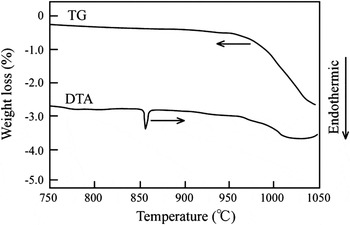
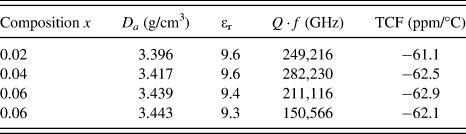
Figure 1 shows the differential thermal analysis and thermogravimetric analysis (DTA and TG) curves of (1−x)MgO–xLiF (x = 0.08) ceramic measured in the covered alumina pan. The DTA curve indicated a small endothermic peak of the ceramic at a temperature of approximately 850 °C. Such an endothermic peak of the ceramic implies the formation of liquid phase in this system because it is known that the Li doping leads to the formation of liquid phase.Reference Carnall8, Reference Itzhak, Kornblit and Grill13, Reference Andersen and Norby14 According to the thermal analysis of MgO–LiF system reported by Carnall,Reference Carnall8 the melting of LiF compound takes place in the temperature range of 840–860 °C. Thus, the formation of liquid phase by the LiF addition may enhance the sinterability of MgO ceramic. Moreover, the TG curve showed weight loss of the ceramics at temperatures higher than 950 °C, and the decrease in the TG curve may be attributed to the evaporation of Li. The effects of LiF addition on the apparent density of (1−x)MgO–xLiF (x = 0.02–0.08) ceramics are listed in Table 1. The apparent densities of (1−x)MgO–xLiF ceramics were extremely increased by the LiF additions up to x = 0.04 and almost saturated above x = 0.04. These saturated apparent densities of the (1−x)MgO–xLiF ceramic are higher than 3.40 g/cm3, whereas the theoretical density of MgO is 3.585 g/cm3 (JCPDS No. 45-0946). The LiF addition may be effective in improving the apparent density of MgO ceramic at the temperature of 950 °C.
DTA–TG curves of 0.92MgO–0.08LiF ceramics measured in covered pan.

Apparent density and microwave dielectric properties of (1−x)MgO–xLiF (x = 0.02–0.08) ceramics sintered at 950°C for 4h in covered crucible.
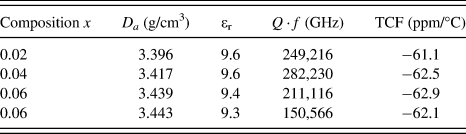
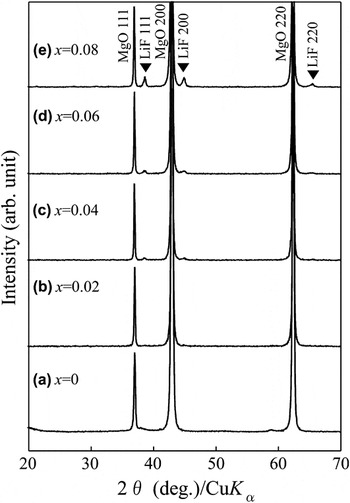
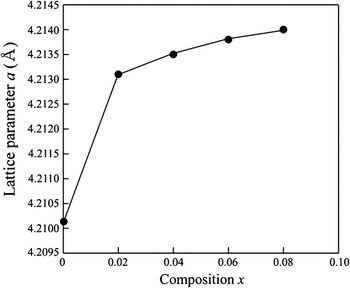
Figure 2 shows the XRPD patterns of MgO and (1−x)MgO–xLiF (x = 0.02–0.08) ceramics sintered at 950 °C for 4 h in covered crucible. The MgO and LiF compounds were detected as the secondary phase at composition higher than x = 0.04. Slight diffraction peak shifts were also observed by LiF doping as shown in Fig. 2. Although the possibility of Li substitution for Mg in the MgO–LiF system is suggested, the solubility limit has not been clarified in the literature.Reference Itzhak, Kornblit and Grill13, Reference Andersen and Norby14 Thus, to confirm the Li substitution for Mg, the lattice parameters of (1−x)MgO–xLiF (x = 0–0.08) ceramics were determined, and the results were shown in Fig. 3. The lattice parameter of MgO refined in this study was similar to the reported value of a = 4.2112 Å (JCPDS No. 45-0946). The lattice parameters of (1−x)MgO–xLiF ceramics slightly increased with increasing the compositions in the range of 0.02–0.08; therefore, such an increase in the lattice parameters of (1−x)MgO–xLiF ceramics is due to the Li substitution for Mg since the ionic radius of Li+ cation [r = 0.76 Å, coordination number (C.N.) = 6] is larger than that of Mg2+ (r = 0.72 Å, C.N. = 6) cation.Reference Shannon15 The difference in the valence between Mg2+ and Li+ cations leads to the formation of oxygen vacancy, and the process can be described using the Kröger–Vink notationReference Kröger and Vink16:

XRPD patterns of MgO and (1−x)MgO–xLiF (x = 0.02–0.08) ceramics sintered at 950 °C for 4 h in covered crucible.

Variation in lattice parameters of (1−x)MgO–xLiF (x = 0–0.08) ceramics as a function of composition x.

Since the formation of oxygen vacancy was suggested by the Li substitution for Mg, the complex impedance measurements were performed to clarify the relationship between the Li substitution for Mg and the conductivity of (1−x)MgO–xLiF (x = 0–0.08) ceramics. The ac conductivity (σ′) of the sample can be calculated from the complex impedance data using the following equation:
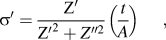
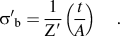
where Z′ and Z″ represent the real and imaginary parts of impedance, respectively. Moreover, the t and A are thickness and area of the samples, respectively. The bulk conductivity ( ) of the ceramics is determined from the Z′, which corresponded to the bulk conductivity using the equation:
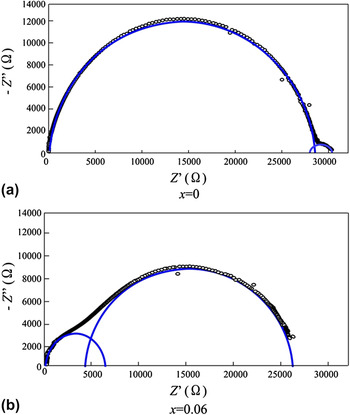
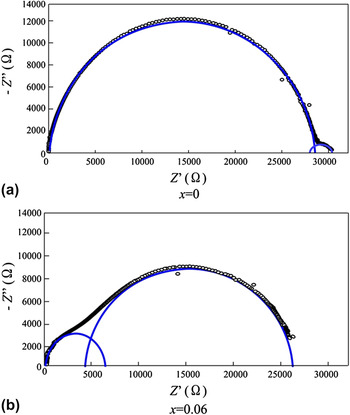
The complex impedance measurements of the (1−x)MgO–xLiF (x = 0–0.08) ceramics sintered at 950 °C for 4 h in covered crucible were performed in the temperature range of 100–800 °C. The complex impedance plane plots for the MgO (x = 0) and 0.96MgO–0.04LiF (x = 0.04) ceramics measured at 700 °C are shown in Fig. 4 where the MgO ceramic sintered at 1600 °C was used for the measurement of bulk conductivity of the ceramic at x = 0. The first semicircle of MgO ceramic in the range of 0–28 kΩ corresponds to the bulk conductivity, and the second small semicircle is related to the conductivity of grain boundary. By the LiF additions, the first semicircle of 0.96MgO–0.04LiF was small in comparison with that of the MgO ceramic, while that of grain boundary for the 0.96MgO–0.04LiF ceramic became large. The variations in the first semicircle corresponding to the bulk conductivities implied that the bulk conductivities of the ceramics are increased by the LiF additions.
Complex impedance plane plots for (a) MgO and (b) 0.96MgO–0.04LiF (x = 0.04) ceramics measured at 700 °C. (color online)
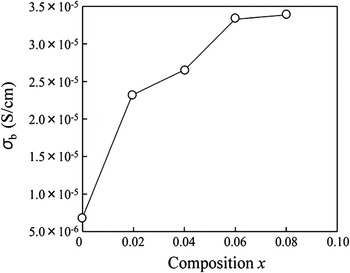
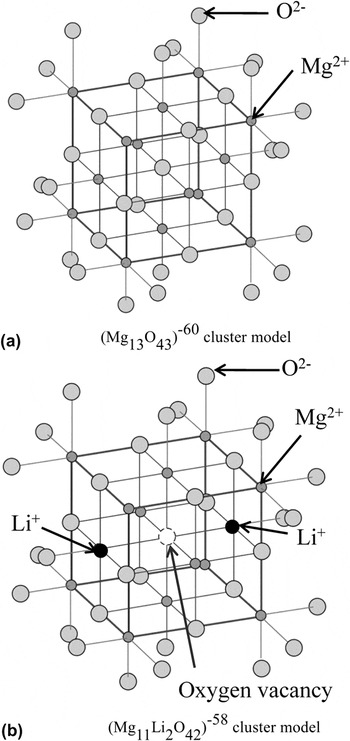
The variation in bulk conductivity ( ) of (1−x)MgO–xLiF (x = 0–0.08) ceramics at 700 °C is shown in Fig. 5. The bulk conductivity of the ceramics increased from 6.0 × 10⁻⁶ to 3.45 × 10⁻⁵ S/cm. Itzhak et al.Reference Itzhak, Kornblit and Grill13 also reported the electrical conductivity of the hot-pressed MgO–LiF ceramics prepared under various sintering conditions and found that the electrical conductivity of the hot-pressed ceramics also increased, depending on the amount of LiF addition. Similar result is also obtained in this study as shown in Fig. 5; therefore, such an increase in the electrical conductivity of the ceramics is attributed to the formation of oxygen vacancy induced by the Li substitution for Mg. To characterize the relationship between bulk conductivity and oxygen vacancy arising out of the Li substitution for Mg, the electric states of the pure MgO ceramic and the Li-substituted MgO ceramic that has an oxygen vacancy in the center of the cluster model were calculated using the DV-Xα method. The cluster models of (Mg13O43)−60 and (Mg11Li2O42)−58 are shown in Fig. 6. The oxygen atom is located in the center of (Mg13O43)−60 cluster model, whereas the center of the (Mg11Li2O42)−58 cluster model is oxygen vacancy.
Influence of LiF addition on bulk conductivity ( ) of (1−x)MgO–xLiF (x = 0–0.08) ceramics at 700 °C.

Schematic diagram on (Mg13O43)−60 and (Mg11Li2O42)−58 cluster models.

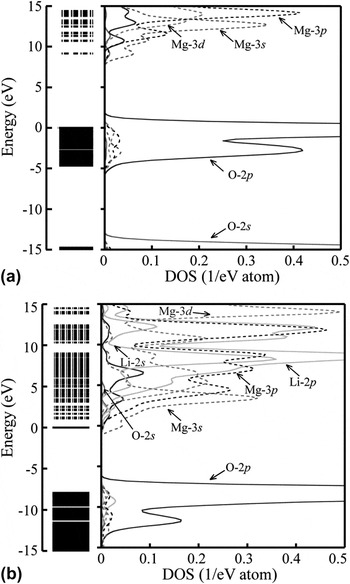
The energy levels and the partial DOSs of (Mg13O43)−60 and (Mg11Li2O42)−58 are shown in Fig. 7. The energy gap of the (Mg13O43)−60 model is approximately 9.1 eV, and this value is similar to that of experimental value (8.7 eV).Reference Reiling and Hensley17 The difference in the energy gap between the experimental and calculated values is due to the size of the cluster model. The highest occupied molecular orbital level lies on the top of the O-2s valence band in the (Mg13O43)−60 cluster model. The occupied band ranging from 0 to −5 eV is mainly composed of O-2p orbital; the energy band located at −15 eV corresponds to the O-2p orbital. Slight overlap of Mg-3d and O-2p is also observed, implying weak covalent Mg–O bond. By the Li substitution for Mg and the formation of oxygen vacancy, the significant variation in the DOS was observed from the results calculated using the (Mg11Li2O42)−58 cluster model. The narrow band gap of 1.6 eV was obtained as shown in Fig. 7(b). From the DOS of the (Mg11Li2O42)−58 cluster model, such a narrow gap is attributed to the O-2p orbital, which is related to the oxygen vacancy. Since the overlap of Li-2p and O-2p orbitals is negligibly small in the valence band, the covalent interaction of Li-2p and O-2p orbitals may be small. The net charges of Mg and O ion in the (Mg13O43)−60 cluster model are calculated to be 1.41 and −1.80, respectively; the deviation of the calculated net charge of Mg ion from the theoretical value (+2) is attributed to the covalent interaction, which relates with the overlap of the Mg-3d and O-2p orbitals as shown in Fig. 7(a). On the other hand, the net charges of the Mg, Li, and O ions in the (Mg11Li2O42)−58 cluster model were estimated to be 1.38, 0.81, and −1.83; therefore, it is considered that the Li cation is almost ionized in the cluster model. From the calculation of net charge of the ions, the net charges of Mg ion in both the cluster models deviated from the theoretical value due to the overlap of the Mg-3d and O-2p orbitals as described above. However, it is considered that the local differences in the valance of cations caused by Li substitution for Mg may exert a detrimental effect on the microwave dielectric properties of the (1−x)MgO–xLiF ceramics in comparison with pure MgO ceramics.
Energy levels and the partial DOSs of (a) (Mg13O43)−60 and (b) (Mg11Li2O42)−58 cluster models.

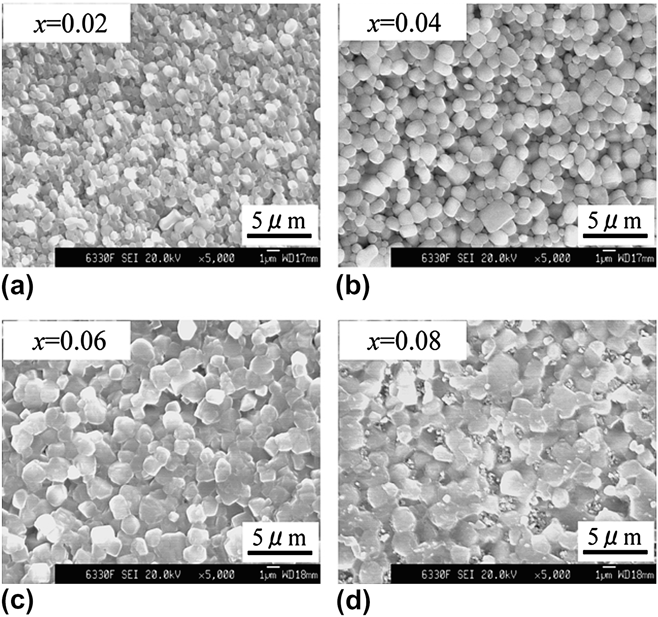
The microstructures of (1−x)MgO–xLiF (x = 0.02–0.08) ceramics sintered at 950 °C for 4 h in covered crucible are shown in Fig. 8. The grain growth in the ceramics was recognized by the LiF addition, and at compositions higher than x = 0.04, the partially melted microstructures were obtained and this result was considered to be due to the formation of liquid phase as described above. The microstructure observation of the ceramics revealed that the LiF addition is effective in the densification of MgO ceramics as well as the hot-pressed MgO–LiF ceramics.Reference Carnall8
Field emission scanning electron microscopy photographs of (1−x)MgO–xLiF ceramics sintered at 950 °C for 4 h in covered crucible.
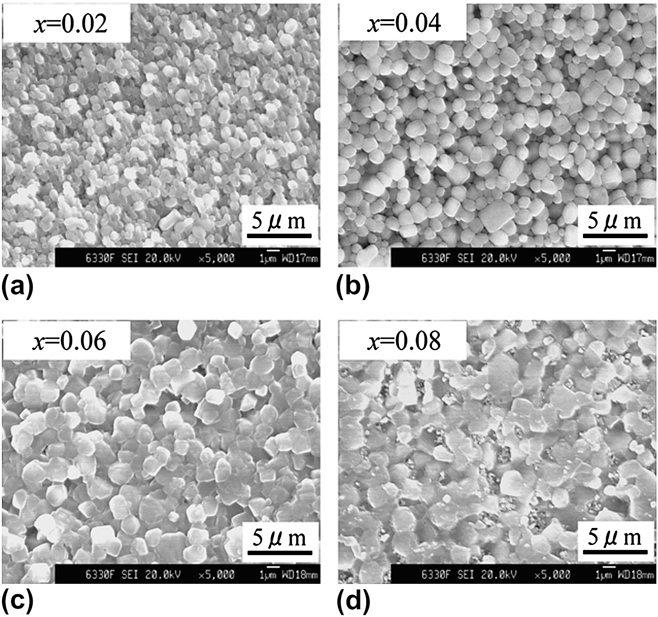
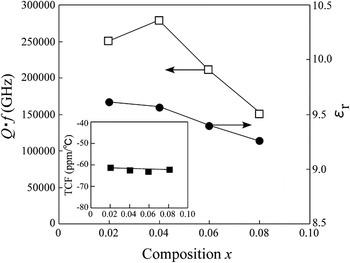
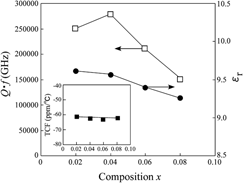
Figure 9 shows the microwave dielectric properties of (1−x)MgO–xLiF (x = 0.02–0.08) ceramics sintered at 950 °C for 4 h in covered crucible. The details on the microwave dielectric properties and apparent density of the ceramics are also summarized in Table1. The dielectric constants of the ceramic ranged from 9.6 to 9.3; therefore, remarkable variation in the dielectric constant was not observed by the LiF addition. The  values of the ceramics increased from 249,216 to 282,230 GHz up to x = 0.04, whereas the
 values of the ceramics decreased at compositions higher than x = 0.04. The increase in the
 value of the ceramics in the composition range of 0.02–0.04 is attributed to the improvement in the crystallinity of the MgO ceramics enhanced by the LiF addition since the grain growth of the ceramics in such the composition range was observed without the partially melted microstructure, which arises from the presence of excess LiF compound as shown in Fig. 8. The decrease in the
 value of the ceramics in the composition range of 0.04–0.08 may be attributed to the presence of LiF compound, which is detected in the XRPD profiles. As a result, the highest
 value of 282,230 GHz was obtained at x = 0.04. Thus, small amount of LiF addition is effective in reducing the sintering temperature and enhancing the
 value of the ceramics. The highest
 value of the (1−x)MgO–xLiF ceramic is lower than that of sintered MgO ceramic; therefore, the formation of oxygen vacancy induced by the Li substitution for Mg may have a detrimental effect on the
 value. The εr and
 values of the (1−x)MgO–xLiF ceramic, however, are considered to be suitable for the commercial applications at high frequency. The TCF values of the ceramics were independent of the LiF concentration, and these values were approximately −62 ppm/°C. An improvement in TCF of the ceramic was not recognized by the LiF addition. From these results, improvement in TCF values close to 0 ppm/°C is required for the commercial applications, though the LiF addition is effective in reducing the sintering temperature of MgO ceramics.
Microwave dielectric properties of (1−x)MgO–xLiF (x = 0.02–0.08) ceramics sintered at 950 °C for 4 h in covered crucible.

IV. CONCLUSIONS
The LiF-added (1−x)MgO–xLiF ceramics were synthesized, and the effects of LiF addition on microwave dielectric properties of the ceramics were characterized in this study. By the addition of LiF, the sintering temperature of MgO ceramics was significantly reduced, and the (1−x)MgO-xLiF ceramics were sintered at 950 °C in covered crucible. The remarkable variations in the εr and TCF of the ceramics were not recognized in the composition range of 0.02–0.08, while the  value of the ceramics significantly depended on the LiF content. The
 values higher than 150,000 GHz were obtained such the composition range; the highest
 value of 282,230 GHz (εr = 9.6 and TCF = −62.5 ppm/°C) was obtained for the 0.96MgO–0.04LiF (x = 0.04) ceramics. From the crystal structure analysis, the Li substitution for Mg was recognized in the (1−x)MgO–xLiF ceramics on the basis of the variations in the lattice parameters, and the formation of oxygen vacancy in the MgO ceramic was also suggested based on the results of impedance analysis and the calculation of electric state for the (Mg13O43)−60 and (Mg11Li2O42)−59 cluster models. A narrow band gap (E g = 1.6 eV) of (Mg11Li2O42)−59 cluster model is attributed to the overlap of Mg-3s and O-2s orbitals.