One Saturday afternoon in late 2006, when I was travelling on Accra's arterial road to the north, the minibus I had boarded got into a tailback that had built up in Ofankor, at the capital's outskirts. My fellow passengers and I stretched our necks to spot what was causing this annoying traffic jam – just a few hundred metres in front of the new, usually fast dual carriageway. ‘Akwanhyia wɔ hɔ anaa? Is there an accident?’ the man sitting next to me wondered. Yet there was no accident. What kept us from moving on the Accra–Kumasi road was a gathering of chiefs and their entourage. Their presence was made manifest by ornamented royal umbrellas that we could see from where our vehicle had come to a halt. One of my fellow travellers murmured that the ‘traditionalists’ were doing amammerε:Footnote 1 they were performing a customary ritual.
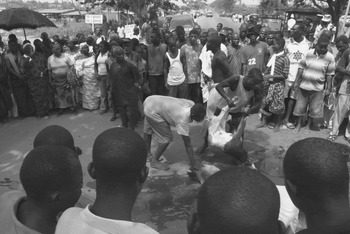
Eager to find out more, some of us alighted and got closer. Right in the middle of the arterial road, among a crowd of curious pedestrians, street hawkers and drivers, stood a group of palace functionaries wearing red and black cloth. They witnessed how several akomfoɔ (so-called ‘fetish priests’) and their helpers were performing a large-scale sacrificial ritual. When I arrived at the scene, they had already killed a black fowl and a full-grown bull. Their next sacrifice was a sheep whose blood was poured on the asphalt, mixed with water and leaves, then sprinkled all over the place (Figure 1). After pouring schnapps on the ground, the chiefs and their entourage left the scene. All they left behind was a large pool of blood.
Road cleansing ritual in Ofankor

Back on the road again, my fellow travellers were discussing the incident vividly. It was obvious to all that the ritual had been performed because of the fatal accidents that had recently occurred at Ofankor and on the dual carriageway behind the capital's gateway. One asserted that most of the accidents in fact had a ‘spiritual’ source. ‘The witches are there,’ he said, while someone else claimed that it was the souls of accident victims that were still around, a danger to travellers and those living and working alongside the road.Footnote 2 This circumstance must have necessitated the performing of a cleansing ritual. Others suggested that it was rather careless driving and ‘overspeeding’ that had caused the fatal accidents, meaning that the ritual was unnecessary. What everybody seemed to wonder, however, was why the chiefs had not held their performance a day later, on a quieter Sunday, when the ritual roadblock would have affected fewer travellers.
The Ofankor road ritual is one of the numerous road and roadside situations that I witnessed during my fieldwork in Kyebi and Suhum, two towns crossed by the Accra–Kumasi road (AKR), and during my travels, including (often involuntary) halts, on this arterial road in southern Ghana.Footnote 3 These situations regularly provided insights into the ways in which residents living near the AKR make use of the roadside at their doorsteps, and at times of the road itself, through their everyday, routine practices, but also through exceptional and at times staged performances. In this article, I shed light on these usages by examining some of the dwellers' roadside routines, performances and rituals. With this focus, I draw from the observation that the AKR and its vicinity, not unlike many other roads in Africa (and in fact beyond), forms a ‘heterotopic space’. Edensor employs this term to describe how places adjacent to roads accommodate ‘a host of dwellings, industries and activities' (Reference Edensor2004: 110) and thus emerge as sites for social interaction and enterprise. For motorists, such spaces constitute a source of service and entertainment, at times also of potential hazard, and thus ‘form part of the habitual motorscape’ (ibid.).Footnote 4 For roadside dwellers, I argue, these spaces are appropriated through, but also give rise to, an array of activities and tactical practices, in the de Certeauian sense, that are frequently marked by distinct engagements with the motorscape, with its traffic and travellers, with non-motorized road users and with the road's materiality. As I shall demonstrate, these tactical engagements provide roadside dwellers with the spatial contexts and means for pedestrian locomotion; for convivial gatherings and entertainment; and for the dissemination of both claims to power and statements of protest.Footnote 5
The following ethnographic observations and encounters reveal the ways in which roadside dwellers conceptualize – and spatialize – the road and its roadside through distinct movements, localized storytelling and narratives, and self-reflection – as well as through disruptive and vigilante actions, as in the (infrequent) cases of erecting roadblocks on the AKR. All these can be regarded as ‘certain ways of making’ (de Certeau Reference de Certeau1984: xv), as people's engagement in practices of the everyday that are ‘tactical in character’ (ibid.: xix). De Certeau further describes these as ‘ways of operating’, constituting ‘innumerable practices by means of which users reappropriate the space organized by techniques of sociocultural production’ (ibid.: xiv). In this sense, spatial practices are at the core of the dwellers' ‘anthropological’ experience of the road and its roadside, a space that is continuously domesticated, appropriated and, thus, implicated in the mundane and everyday. It will also become clear, throughout this article, that these everyday practices – including the exceptional performances oriented to the road – are closely intertwined with the liveliness, socialities and opportunities the road affords, and yet also with its dangers and potential for destruction and death, as in the case of the Ofankor ritual. Thus, the ‘ambivalent nature of road experiences’ (Masquelier Reference Masquelier2002: 836), namely the experience of the road as a space of both perils and possibilities, is crucial to how the AKR's dwellers socially produce this space.Footnote 6
ROUTINES AT THE ROADSIDE
The Accra–Kumasi road, which is at the centre of this article, has often been experienced by the historian Richard Rathbone, though he probably knows it better as a road traveller than as a roadside dweller. Obviously impressed by the AKR, he describes at great length the journey to the town of Kyebi, the capital of the Akyem Abuakwa Kingdom, where he did archival research for his book on chieftaincy in colonial Ghana (Rathbone Reference Rathbone1993), almost two decades before I went there for my own research.Footnote 7 His description could apply to a recent journey I made to the Akan Kingdom, which the AKR enters when crossing the River Densu at Nsawam, just north of Accra: ‘From Nsawam onwards you are in the rainforest [where] small towns are scattered along either side of the road's length’ (ibid.: 7). Rathbone observes women at the roadside who trade from small stalls, selling a range of goods ‘to cater to the needs of the regular passenger and freight transport that trundles up and down this, probably the most frequently used interregional road in Ghana’. The traveller's attention is attracted by hunters who offer their surplus prey for sale at the roadside. As he continues through rural areas, Rathbone sees ‘large numbers of children in yellow and brown uniforms … walking considerable distances to and from their local schools’, as well as ‘the most ancient inhabitants [sitting] patiently absorbed watching the road traffic’ (ibid.). Then he describes how, at the town of Apedwa, the main road
dives sharply to the left and now begins to follow the lush valley of the River Birim. On either side of the road, the valley's sides become steeper and steeper; … then the valley broadens out and the scenery becomes even more impressive … . To the right of the road, in the middle of the valley floor, the royal capital is sited. Few people in transit between the great cities of Accra and Kumasi would take much notice of it. From the road, Kyebi is no more than a small, dusty lorry park and a cluster of market stalls serving travellers. (Rathbone Reference Rathbone1993: 8–9)
Not much seems to have changed along this road; it continues to accommodate, up to today, the practices and activities of its residents as described by Rathbone. Yet one crucial difference consists in the fact that, today, hardly any long-distance travellers pass through Kyebi, the royal capital. The reason for this is that a bypass was built in 2004, starting from the Apedwa junction and avoiding Kyebi and its neighbouring communities.Footnote 8 Thus, since the opening of the bypass, the great majority of vehicles have been spared the longer, and also more dangerous, road through Kyebi, now commonly known as the ‘old road’.
I was a (temporary) roadside dweller in Kyebi both before and after the bypass was built. During my stays, it was my friend Eric, an electrician in his early thirties, who put me up in his small house, located about twenty metres away from the edge of the lorε kwan (literally ‘lorry road’), on the northern outskirts of town. At that time Eric was also accommodating Wesby and Shigo, two of his ‘brothers’ (his junior matrilineal cousins), who were in charge of most household chores, including the upkeep of the small pathway leading from the porch to the roadside.
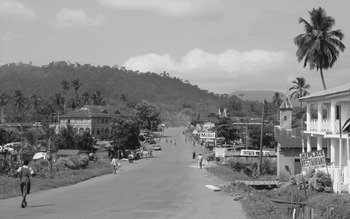
Initially, the nights in Eric's house were not very peaceful. Before the new bypass was built, our sleep would be disrupted regularly by the noise of heavy vehicles speeding down the dark road and rumbling over the deteriorated patches of asphalt. I wasn't the only one complaining about the road's disturbing soundscape;Footnote 9 Eric and the others admitted that, when startled by noise at night, they often feared that a vehicle might leave the road – perhaps when trying to dodge a pothole in the dark – and plunge down the light scarp before crashing into their house. They recalled how many dwellers on the AKR had been killed in this way, while sleeping innocently in their beds. After the opening of the bypass, things changed significantly. Now the nights were calm, and residents slept more peacefully in houses close by the road, and felt at ease when sitting, standing, waiting, watching or walking by the roadside (Figure 2).
The ‘old’ Accra–Kumasi road traversing Kyebi

Walking alongside the road
Many people in Kyebi use the through road principally for walking, as a line connecting one place to another.Footnote 10 For instance, children pass Eric's house every morning, heading to their schools on the other side of town, and return on the same road in the early afternoon. Others walking on it are mobile vendors selling to pedestrians, or at people's porches. I know of many farmers who cultivate their lands in the forests, quite a long walk from their home in town. For them, the road constitutes the first (and, on returning, the last) and easiest section of their long march. With rubber boots and machetes, and sometimes accompanied by dogs, they leave their houses early in the morning, often before dawn, and follow the main road until they have left the last settlements behind. Then they continue on the narrow footpaths that have been worn over time into the green, sometimes overgrown verge by the villagers, many of whom are Ewe and Krobo settlers. Eventually, they branch off onto a bush trail, often hardly perceptible from the main road, and head for their farmlands.
Ordinary pedestrians use the road in order to go to specific places – to work, to shop in town, or to visit a friend's house – and to transport all kinds of items. Unlike in other parts of the country, people are less keen on using bicycles or motorcycles and prefer to use their feet and carry things on their heads.Footnote 11 People are also on the road in order to ‘pick a car’, as Ghanaians put it, that is to find a means of transport: either they walk to a specific spot, most often a junction or a more open road section, where they try to hail a passing taxi or trotro; or they walk straight to the lorry station where they might find a more convenient mode of transport. In both cases, the physical act of walking on the road denotes the beginning (or ending) of a journey and thereby becomes part of the complex issue of human locomotion and transport. The body moving alongside the pavement is often engaged in a greater activity, or event, that becomes perceptible through the very way pedestrians carry themselves and through their ‘ways of walking’ (Ingold and Vergunst Reference Ingold and Vergunst2008).Footnote 12 Such is the case with groups of people walking to churches, mosques, weddings and funerals. Every Sunday morning, for instance, individuals or groups of people walk past Eric's house, leaving roadside observers in no doubt where they are going.Footnote 13 Dressed impeccably, perhaps with their children in tow, and carrying a bible or hymn book, they stride in a resolute, purposeful manner towards church – whereas, after the service, they appear more relaxed, strolling and chatting on their way back home.
Walking on the road is convenient and efficient, and stands even more clearly for a tactic of the everyday, as a ‘way of operating’, when it involves pragmatic considerations. For instance, when Eric and his brothers walk to the Kyebi town centre, which they do several times a day, they either take the small bush pathways behind their house, or they walk on the main road. Depending where they are going, the former may be the shorter route. Yet they usually prefer the road: it is more comfortable to walk on as it allows less obstructed movement, especially when the backyard shortcuts become muddy and slippery from the rains, or have not been weeded. The road becomes particularly attractive in darkness, since it is more populated and better illuminated, at least in some sections. Still, they often take along a torch so as to avoid stepping into potholes and puddles, or stumbling over cracked road kerbs – and, most importantly, to be more easily spotted by drivers. Obviously, cars are the greatest hazard when walking to town on the road, at any hour. Not only do they blind pedestrians with their ‘high lights’ (local expression for full beam), which everyone finds disturbing. They also become dangerous where gravelled or grassy soft shoulders are absent, thus compelling pedestrians to walk on the asphalt. When human and vehicular road users compete for the same space, pedestrians intuitively walk in single file. But when they see that vehicles are approaching dangerously – dodging potholes, ‘overspeeding’, and overtaking others, or even just blowing their horn – they have no choice but to jump to the roadside. Such moves thus become part of many dwellers' corporeal roadside experience and are regularly followed by emotive – angry, astonished or jovial – reactions. These reactions stem from the close entanglement of movements and emotion (Sheets-Johnstone Reference Sheets-Johnstone1999), a phenomenon that I have regularly experienced with roadside vendors who sell to, and run along with, passengers in moving traffic (Klaeger Reference Klaeger, Hahn and Kastner2012a, Reference Klaeger2012b).
Today, the threat of passing vehicles is less of an issue on Kyebi's ‘old road’. Residents perceive the road as less risky, both because of the smaller number of vehicles, and because the predominantly local drivers are more familiar with the road's layout, more aware of human activities and, supposedly, more vigilant about pedestrians. Yet the new sense of relative safety may backfire, as it makes people less vigilant about passing vehicles: pedestrians indeed behave in an increasingly careless manner. When driving myself, I frequently saw residents from ‘old road’ settlements around Kyebi either walk halfway into the traffic lane, hardly bothering to step aside when vehicles approached, or even walk right across the road without looking. My driver informants confirmed my observations: they perceive the roadside settlements as particularly hazardous and are extra-cautious at night, making excessive use of their horns and headlights when passing. Eric once told me that these villagers were now so used to having the calm road to themselves that it would not surprise him if some even slept on it.
The roadside dwellers' carefree behaviour is not only a result of decreased traffic and their trust in local drivers. I would argue that it also stems from a perception of ‘their’ road as an intimate place. It emerges as such precisely because it becomes an intrinsic part of their routine corporeality of walking and strolling, yet also because of their hanging out there with others. This forms another distinct (though related) social, sociable and spatial practice of roadside dwelling.
Hanging out by the roadside
‘Megya wo kwan. Let me see you off,’ Eric normally tells his visitors when they are about to depart.Footnote 14 He then escorts them from his house to the main road and walks with them for a little while, maybe to the next junction or to the bus station. This task might also be delegated to one of his brothers, especially when it is mainly a matter of helping the visitors ‘pick’ a car. Seeing visitors off is one of the rituals of the highly praised ‘Ghanaian hospitality’. My friends also agreed that this is not just an obligatory gesture, part of etiquette, but quite often a welcomed occasion to enjoy the company of certain visitors for a bit longer and to continue conversing while strolling down the road.
These roadside walks seem particularly suitable for discussing matters not intended to reach the ears of the many present in the house or in the courtyard. The conversations – the gossip, secrets and laughter they involve – at times become so intense that the strollers slow down, even stop. Yet walks may be interrupted countless times, too, as when people encounter other familiar faces, exchange greetings, or answer (at times reluctantly) the questions of those who are curious to find out where they are going. In semi-urban communities like Kyebi, where social networks are closely knit and controlled, moving in public spaces unavoidably involves encounters, communication and scrutiny, and thus defies most attempts at privacy.
The roadside is also appropriated through socializing while sitting and standing in its vicinity. The young men who hosted me in Kyebi do that every day. In the early morning, they regularly hang out in front of the house, under the ficus tree near the road, and chat among themselves, sometimes eating the day's first meal, or simply waiting for time to pass. They also socialize with passers-by. There is, for instance, the joking relationship that Eric maintains with Yaw Kwakye who regularly passes in front of the house. He is a distant neighbour and known by all to have a weakness for the locally brewed akpeteshie gin, and also for women. In the morning, Yaw Kwakye can often be seen staggering down the road, heading towards the nearby ‘drinking spot’ (local bar) in order to take his first few tots, though, of course, he would never admit that this is the purpose of his stroll. When he approaches, Eric always challenges him about his ambiguous morning walk, questions him teasingly about his partner the night before, and calls him suggestive names. In return, Yaw Kwakye demands money from Eric for having been ‘insulted’ in public – money that would obviously be spent on akpeteshie, as Eric argues back. So the two end up in an affected quarrel that amuses all those who are present at the roadside hang-out.
Late afternoon is often the time for a similarly sociable roadside gathering. Shortly before sunset, my hosts and their neighbour friends bring a wooden bench closer to the roadside, sit down and often share some food, just behind one of the huge royal palm trees that line the road. A frequent guest is Osmane, a young trader from Niger, who stops there on his way home to the Muslim Zongo quarters at the outskirts of town. Osmane always has interesting goods in his bags, such as DVD movies, or shoes and jeans imported from Togo. The others like to look through his goods, assess their quality and, eventually, try to strike a good bargain. They occasionally tease Osmane about his foreign accent and jokingly call him ‘cattle boy’, knowing that the bride-price in his home country is paid in cows.
These situations turn the roadside into a venue for relaxation and joviality; other exchanges bring out arguments and even fights, as the same setting often invites people to express anger and other emotions. The roadside thus appears as a very lively and public place, with a distinctive appeal to its dwellers; it facilitates not only kinetic tactics, and thus locomotion, but also various forms of interaction and sociability.Footnote 15 The roadside is, and probably has always been, highly attractive in particular to dwellers in smaller communities along the AKR, given the lack of communal places and other focal points for gathering. In the next section, I explore in more detail how road and roadside are appropriated to provide a source of, and space for, entertainment in the course of the roadside dwellers' everyday.
ENTERTAINING TARMAC
One late afternoon, when I returned home after a day at the bus station, I met Eric in front of his house, sweating and with a shovel in his hand. He was taking fresh soil from the pavement to fill a nearby pothole that we had seen growing considerably with the recent heavy rainfalls. I assumed that Eric was sealing the pothole for the sake of passing vehicles whose tyres and chassis it might damage. What I learned, instead, was that he was fixing the pothole for his own protection. ‘What if a driver hits that pothole and gets a blast tire [sic]?’ he said. ‘If he can't control the car, maybe it will run to our side, and it will hit us where we sit.’ Very obviously, Eric does not want to get killed in front of his house, where he and his mates like sitting in order to get some fresh air (gye mframa). I regularly joined them there to take advantage of the roadside as ‘a venue for conversation, a place to wait, to watch, to talk’ (Weiss Reference Weiss, De Boeck and Honwana2005: 109) or, as they say, to watch the road (hwε kwan) and to chat (bɔ nkɔmmɔ) and gossip (di nseku).
Watching the road
As we sat around with some friends, one late evening, sharing a few bottles of beer and enjoying the fresh breeze from the nearby forest, Wesby suddenly paused and looked intently into the pitch-dark. ‘Hwε! Look at that!’ he said and drew our attention to two people he had spotted on the other side of the road. All were amazed: the couple we could see disappearing into the night were Bolo, one of Eric's work colleagues, with a young girl who had moved to our neighbourhood only a few months earlier. Bolo must have met up with the girl at some place for ‘romancing’ and now had to escort her back home, the guys whispered. ‘I'm going to tell his wife,’ Wesby said jokingly, and they went on gossiping about him and other men in town who were known to go after ‘small girls’.
I have learned a great deal about Kyebi, its people, their relationships and daily concerns from watching the road and its activities and, most crucially, from listening to commentaries made by the curious onlookers by my side. They check on the girls, laugh about drunkards, comment on the attire of churchgoers, or ask themselves where those waiting for a bus intend to travel. They also comment critically on who walks with whom; they disclose who is friendly, who is a stranger, who is to be pitied, and whom you can (and cannot) trust. The roadside gives rise to gossip, perpetuating and often embellishing rumours, both to inform and entertain. More precisely, it is the movements of passers-by that the onlookers get to ‘read’ and that feed into their narrative practices, where gossiping and rumouring are turned into a form of storytelling.
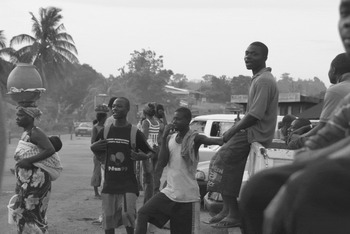
Yet, these instances of gossip and rumour are not just triggered by passers-by to whom onlookers often relate personally, but also by those who appear more ephemerally on the asphalted scene, namely people passing in vehicles. ‘People are inquisitive! Always we want to know who is driving and who else is sitting inside the car,’ one of my friends explained. Certainly, the sharply reduced vehicular traffic traversing Kyebi is now less informative than it was in previous years, when hanging out, waiting, and what seems like doing nothing by the roadside used to be more entertaining. Now, maybe more than ever before, roadside dwellers scrutinize the few passing vehicles and travellers very closely, routinely turn around to watch them, and follow them with their gaze. When they spot familiar faces, they usually greet them; they wave and shout, at times ask where the travellers are going, and get a response in the form of hooting or other expressive gestures (Figure 3).Footnote 16
Watching the road and traffic

Road observers, males in particular, are eager not only to spot travellers, maybe even someone famous and ‘big’, but also to identify their vehicles. These are scrutinized in terms of makes, models, design, condition and roadworthiness. While old and dilapidated cars (as well as their owners) are not spared mockery and laughter, cars that are considered ‘nice’ become a matter of discussion, even admiration. ‘One day if I get money I will buy one like this,’ the young men often dream out loud. A typical eyecatcher might be a new (or seemingly new) VW Golf with chromed wheel caps and tinted windows.Footnote 17 Particularly admired is the Chrysler C300 sedan, a luxury sports model now very popular among Ghana's nouveaux riches. One day, a Chrysler passed and started a lengthy debate about ‘nice’ cars on the country's rugged roads. One of Eric's friends, a tailor by profession, went so far as to find the phone number of a well-known car dealer in Accra and to call him up. ‘Good afternoon,’ he said in his best English, ‘please, the Chrysler C300, how much is the price for the brand-new one?’ The staggering amount of several hundred million Ghanaian cedis left everybody amazed. Who could afford such a vehicle, they asked themselves, and what must one do to get all that money?Footnote 18
One admired Chrysler that comes to Kyebi along the AKR on a regular basis (not many others get lost on the ‘old road’ these days) belongs to a famous lawyer who is based in Accra but also serves as one of the town's chiefs. He was counsel for an alleged drug baron on trial in a major court case at the time of my fieldwork. This explains why some of the critical observers called his Chrysler the ‘cocaine car’.Footnote 19 Yet big and new cars are not associated exclusively with the illicit accumulation of wealth among drug dealers, armed robbers and some politicians. They are also markers for the country's social, economic and political elites. I listened to countless debates about how their owners must have ‘done well’ in life, were successful in the city or, even more impressively, travelled abroad (abrokyire) or are still living ‘outside’, meaning in Europe or North America.Footnote 20 My friends' and many other road observers' regular pastime, and source of entertainment, is thus their assessment of travellers in terms of social status and class affiliation, and their narratives about vehicles as signs of progress and success. As Chalfin observes, ‘Ghanaians notice cars and make much of the possibilities and distinctions they represent’ (Reference Chalfin2008: 428); they function as a commodity of modernity and as status markers, while distinctively embodying an ‘elsewhere’.Footnote 21 Yet my friends' narratives about modern consumption, as well as the imaginaries of admired wealth and lifestyles different from their own, are also ways of questioning their own social and material advancement. The dreams and desires triggered by passing cars, such as aspirations to travel ‘outside’ one day, are commentaries about their identity and everyday life as young men facing various constraints and uncertainties – commentaries that form what Archambault (Reference Archambault2012: 393) describes as the articulation of ‘everyday frustrations in the idiom of mobility’.
The juncture of the local and personal with the distant and often unreachable also emerges when roadside dwellers watch travellers and vehicles that carry with them indications of remote events. In the pre-bypass era, for instance, numerous vehicles filled with passengers wearing black could regularly be seen rushing through Kyebi on Saturday morning. Many cars meant big funerals, mostly in the Ashanti region or in the Kwahu mountains, where funerals are known to turn into important community events attended by large numbers of people, many of them coming in from the capital. Football team supporters equally left their traces on the then busy road when they were seen rushing to important matches. Eric commented particularly on the posh cars of the Asante Kotoko supporters and on their crazy, yet also impressive ‘overspeeding’. When Ghana's President, or government ministers, passed in front of the house in a state convoy, the onlookers often knew about their trips long before they were announced on national television. In other cases, when an event of national interest had already been announced, they were able to conclude who exactly was escorted in the convoy, and where he or she was heading.
Another trigger for the imaginations and narratives of roadside dwellers who observe traffic are other and often distant places. For instance, a speedy presidential convoy or a fleet of posh vehicles hints at politics, power and prosperity in the country's urban centres. In a similar manner, very slow, overloaded trucks reveal something about their place of origin or destination. Trucks carrying tubers of yam, boxes with tomatoes, or heavy container loads of live cattle evoke the conditions of work, climate and vegetation in northern Ghana, Burkina Faso and Mali, but also the markets and trading in Accra where some of the goods are being taken.
The fleeting presence of road users, both familiar faces and strangers, right on the doorstep of roadside dwellers thus shapes conversations, imaginaries and storytelling. Their presence and movements, apart from being informative and entertaining, provide onlookers with an opportunity to ‘travel while sitting down’ (Archambault Reference Archambault2012), creating a certain sense of participating in, and integrating into, worlds beyond their own. To the stationary onlookers, engaging with travellers, events and places means connecting transregionally, nationally and even internationally – at the same time as it allows them to occupy and (re)position themselves in the local and familiar.Footnote 22 In this sense, the visual and narrative engagements form part of the dwellers' spatial practices. I thus agree with Porath (Reference Porath and Colombijn2002: 770) that ‘[f]or roadside-dwelling people, the road is a major part of their landscape, spatial-temporal experiences, geographical positioning, and sense of direction. In short, it has become part of their way of life.’ The road not only connects places; it also has ‘the capacity to occupy a place in the world-view and history of any social group’ (Pandya Reference Pandya and Colombijn2002: 801).
Having fun: mobilizing local youths
One aspect of the AKR dwellers' ‘roadside lifestyle’ (Pandya Reference Pandya and Colombijn2002: 811) is their entertaining engagement with what happens, and passes, on ‘their’ road – and beyond – through the mundane practices that I have just described. A not so regular, more deliberate, form of appropriating the road consists in ludic community-centred activities, some of which I briefly describe here. In Kyebi, most of them are in the hands of the local youths. For instance, there are the young shoemakers who have erected their little workshop (actually nothing more than a roadside stall) close to the bus station. During my main stay in Kyebi, they periodically revived the now ‘old’ road – attempting to counter its relative post-bypass dullness, a source of economic concern for them and other roadside entrepreneurs who used to do business with passing travellers.Footnote 23 On major holidays, as well as for the traditional Ohum festival, the shoemakers organized big parties, ‘street jams’, in front of their stall. The main ingredients were a huge sound system erected on the tarmac, the latest Highlife and Hiplife tunes, and lots of booze. Dancing in the middle of the road, the lively crowd of teenagers and young adults parted only for the most insistent passing cars, horns at full blast. Kyebi's youth thus took advantage of the road's altered condition in a creative and entertaining way. In the past, partying on the tarmac would have been unthinkable, since it was unsafe. Today, the bypass works for Kyebi as a sort of traffic-calming measure, yet works ambivalently, too, since it also prevents vehicles and customers from coming to town. This ambivalence towards the new calm is hinted at through the street jams. From the shoemakers' perspective, the ability to use and, to some extent, revive the once busy road is not just about entertainment, but also articulates a measure of protest.
Many of the orchestrated (as opposed to spontaneous) road and street events in Kyebi are ridden by a particular, even if only implicit agenda. For instance, in late 2007, young people organized a street jam with a dancing competition. Meant to honour Nana Akufo-Addo, the then local MP and former foreign minister, who had just become the NPP's flag bearer for the impending presidential elections, the event was sponsored by a supporters' association backing his candidacy. Similar local youth activities are the so-called ‘keep fit exercises’: a combination of ‘fun run’ and political rally, organized by local politicians standing for re-election, or by their supporter ‘clubs’. Sporty youths, often more than a hundred in number, meet somewhere in town on a Sunday before sunrise. They jog through the sidestreets first, then up and down the main road. Equipped with all kinds of noisy instruments, and singing and clapping all the way, they make themselves piercingly audible, abruptly ending the night's rest of less-sporty roadside dwellers, including the present writer. At the end of their exhausting circuit, they are rewarded with food and drink provided by the keep-fit club's sponsor, whose personal and political agenda is publicized during this dubiously entertaining event in the town's most extended public spaces, namely its through road and surrounding streets.
ROADBLOCKS
Having shown roadside dwellers to be predominantly concerned with movements on the AKR and with vehicular flows, either constituting or giving rise to distinct everyday practices, I now turn to the ways in which dwellers occasionally disturb – and successfully block – vehicular flows on their road. Such incidents reveal how the road, its space, and even its motorized users become appropriated by dwellers. The previously explored practices can in part be perceived as ‘the microbe-like operations proliferating within technocratic structures and deflecting their functioning by means of a multitude of “tactics” articulated in the details of everyday life’ (de Certeau Reference de Certeau1984: xiv). However, setting up roadblocks – and thus halting traffic – represents more than a minor operation and tactic, merging in the flow of the road's everyday life. Rather, it appears as an intervention whose purpose is crucially, if temporarily, to deflect the road's routine functioning.
Rituals for Olila: manifesting power and authority
One of the two spectacular roadblock incidents that I witnessed during fieldwork was the already invoked large-scale sacrificial ritual performed by the Ofankor ‘traditionalists’. As it turned out, it was driven by a rather complex agenda that had taken the protagonists to the streets, quite literally, and motivated them to take advantage of the road as public space.
I noted at the beginning of this article that the Ofankor ritual, performed in the midst of a busy road on a Saturday afternoon, was believed by onlookers to be linked to the recent motor accidents on the southern section of the AKR and in Ofankor. Not surprisingly, this was confirmed by the main chief of Ofankor. He explained to me how he and his people had become involved in the ritual roadblock: Olila, a deity residing on the Ofankor road and in charge of its safety, had initiated the ritual by informing her caretakers, the akomfoɔ, through an oracle that sacrifices were urgently needed to exorcise the spirits (or ‘souls’) of accident victims. These spirits were lingering on the roadside and constituted a source of danger to travellers and roadside dwellers.
The more I inquired, the more I understood that the cleansing ritual was not driven only by concerns for a safer road. What first became clear was that the chiefs' agenda arose in the delicate context of institutional pluralism.Footnote 24 Various state institutions and agencies, such as the Accra Metropolitan Assembly (AMA), the Ghana Highway Authority (GHA) and several ministries, are in charge of the Ofankor road in legal and engineering terms. At the same time, the chief of Ofankor, in his function as the ‘traditional’ custodian of the land, also has authority over the road passing through his territory. He claimed that the other stakeholders had not solicited him and his elders at the palace when plans were made to redesign ‘their’ road and, later, when construction works started. This had not only aggrieved the ‘traditionalists’, but also Olila, since she should have been consulted by her caretakers over such road issues. This lack of ritual attention provoked the spirits to take hold of the road, leading to fatal accidents and making ritual compensation necessary. For the local leaders, the ritual performance meant more than just fulfilling ritual obligations. It also meant taking a clear stand, and showing presence, in a contest between multiple stakeholders. Their agenda for claiming (or, at least, signalling) institutional recognition was also revealed when they asked the regional Minister and the local District Chief Executive (DCE) for financial support towards the costly cleansing ritual. According to the chief, none of those approached was willing to assist.Footnote 25
Later, I came to understand that there was a further background dimension to the staging of the ritual, one that makes it even clearer why the ‘traditionalists’ tried to stand their ground. It turned out that a group of charismatic Christians had shown equal concern for the road's safety, so constituting a challenge to the ‘traditionalists’. Roadside hawkers whom I met told me that members of the Mount Zion Action and Power Ministry in Ofankor had reported to the chief's palace, prior to the ritual, in order to discuss the alarming accident cases. Also, a church delegation had been sent to the roadside, where they prayed against the ‘powers’ assumed to be behind the accidents. This was confirmed by one of the church pastors. He emphasized that his church did not believe in gods or spirits, as the ‘traditionalists’ did, but in demons and other evil forces. Thus it had to take appropriate measures.
For the chief and his people, the Christian prayer session was a clear provocation to their institution, including their religious beliefs and practices. It had led to a ritual–religious competition that was reminiscent of the conflicts surrounding the Homowo festival in past years. During this festival, which involves a ban imposed by ‘traditionalists’ on noise making (including at church services), Christian groups and chieftaincy followers had come to blows, at times very violently. They were competing to capture the capital's public arenas by asserting their respective beliefs, dogmatic stances and practices (see van Dijk Reference van Dijk2001).Footnote 26 Now, by performing the road ritual for Olila, the Ofankor chief and his people fell back on the same unresolved pattern: they made use of the road as a platform for openly displaying the beliefs and practices that are central to, and partially legitimate, the institutions of chiefship. In doing so, they demonstrated their presence as ritually capable actors in a multi-religious urban environment. They also exploited the ritual demanded by Olila in order to assert their authority vis-à-vis those institutions that had sought to challenge and undermine it.
Their agenda – securing greater public presence and institutional recognition – ultimately explains why the ‘traditionalists’ had not only chosen the road as a venue for their performance, but also the particular timing, namely a busy Saturday afternoon. A roadblock leading to a serious traffic jam – which is what the public ritual created, to the annoyance of some travellers – was simply more effective: it turned the road into a stage, and the stuck travellers (like myself and fellow passengers) into an involuntary audience for the staged performance of power. I would even argue that the temporarily blocked traffic, with its capacity to move on again after the performance ended, was itself part of this public performance. What the travellers witnessed was going to travel down the road with them, possibly be passed on and, thus, become even more public.
The roadblock thus involves the creative appropriation of the everyday of the road; more precisely, it involves the deliberate tactic of disrupting the flow of vehicular traffic. Indeed, all roadblocks are ways of manipulating the intrinsic rhythm of roads – the movement, arrest and eventual restored flow of vehicles (Lefebvre Reference Lefebvre2004) – by enforcing a radical suspension. Such stoppages often form means to control access, to force travellers to get down and show their papers or pay bribes, or to make them wait in order to exercise power (and, again, to extort money). In Ofankor, however, the halted travellers were made to witness the display of power and authority before continuing their journey and, thus, spreading the roadblockers' concerns beyond the limits of the asphalt. Hence, roadblocks may be seen as a means of communication: provoking a particular kind of ‘ritual of roadside contact’ (Pandya Reference Pandya and Colombijn2002: 811) that aims at confronting road travellers with roadside dwellers, and at displaying and, ultimately, disseminating a particular stance.
The ‘Suhum riot’: displaying emotions and vigilante efforts
This agenda of confrontation, display and dissemination was made particularly explicit in an incident that took place in January 2007, only a few weeks after the Ofankor ritual. By then, I had moved from my initial place of residence in Kyebi to the commercial town of Suhum, a major junction further south on the AKR. ‘They are killing people in Suhum!’ my friends had warned me before my move. What they meant was that, for some time, a series of mysterious murder cases in and around Suhum had been fuelling fear and anger among the town's residents. Four people had been found dead over the past two months, attacked and killed with machetes in the night. Since allegedly all the bodies had been mutilated – their private parts cut off – rumour had it that ‘ritual killers’ were haunting the residents in order to take their body parts for juju (black magic) practices aimed at the rapid attainment of wealth and power (cf. Meyer Reference Meyer1998b; Smith Reference Smith2001 for Nigeria). It was suspected that these killers were either operating from within the town or, more probably, coming and going by the various roads that merge in the town. In order to appease the fearful residents and intensify criminal investigations, additional police personnel were deployed in Suhum. By the time I moved there, however, not a single suspect had been arrested. It was rather ironic, people felt, that the local District Chief Executive (DCE) had stated on an FM radio station that people should not worry, and that it was all under control.
Then, one morning, another body was found: only metres away from the AKR, a dead man was lying face-down in an overgrown ditch. In no time, hundreds of sensation seekers rushed to the site to get a glimpse of the partially decomposed body. People reacted with uproar. ‘They are killing us!’ some shouted angrily, and called on the police to do their job properly. Others called on the DCE to come and see ‘with his naked eyes’ what atrocities continued to be committed in their town. Now people called him a traitor and were clearly determined to let the world know that Suhum had a very serious problem.
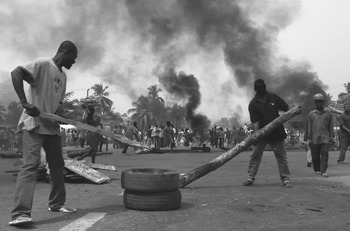
‘Y'ani abere! We are angry!’ they shouted towards drivers and passengers who were passing the place of discovery. Some young men tried to slow down the approaching vehicles by waving at them with their T-shirts and palm branches. At one point, a government convoy coming from Kumasi announced itself with sirens and dispatch riders. This was when people decided to take more direct action. ‘Gyina ha! Stop here!’ they yelled, while others added: ‘Come and see this, and tell your government people about it.’ In order to force the official (apparently a minister) to stop and get out of his car, people threw branches and used tyres on the road. But the speedy convoy found its way around the obstacles and through the yelling crowd, and moved on. After that, more debris was pulled onto the asphalt and set on fire. The same happened at all the major junctions and entrance points in town, from where thick pillars of smoke started rising. Now the AKR and its through traffic were completely blocked (Figure 4).
Suhum residents erecting roadblocks

For some of the Suhum residents involved in this emotionally charged incident, the roadblock was a means of shutting off the access roads by which, many assumed, the perpetrators were entering their town. Their assumption was partially fuelled by the presence of the additional police personnel who, as mentioned above, were patrolling the main roads to stop and search vehicles at night. Obviously, their measures had not been effective. Some thus demonstrated their intention to take their own protective measures, among them a group of young men who, equipped with metal rods and sticks, ran up and down the now vehicle-free AKR section while chanting war songs. The youths attacked vehicles that tried to go around the burning barricades, without causing any damage – although stones were actually thrown at the riot police who had been rushed to Suhum, hitting their vehicles.Footnote 27
Obviously, as during the Ofankor ritual, the roadblock was intended to turn the road travellers into involuntary eye-witnesses of the residents' fear and frustration. People kept emphasizing that they wanted passers-by to see their emotional state and what was going on in Suhum, referring to the incident as a ‘demonstration’ and not as the ‘Suhum riot’, a term applied by the media afterwards. They were keen to have their burning concerns not only displayed, but also disseminated. Some encouraged me to take more photographs of their demonstration: ‘Show this to your people,’ I was told, ‘so that they know what's happening to us here.’ They also hoped that the media, especially the FM stations that had already reported on the Suhum killings, would now broadcast the residents' frustrations expressed in the burning barricades.Footnote 28 Finally, they were hopeful that their concerns would be transported by the road, its traffic and travellers – ideally, even by a passing government minister.
Underlying both roadblock incidents, however, was not only the actors' agenda of display and dissemination, but their vigilante efforts in addressing the dangers, and actual deaths, that come by or linger on the road. In Ofankor, the ‘traditionalists’ saw themselves obliged to take their own ritual measures to protect and restore safety on ‘their’ road section, given that the state authorities had failed to cooperate with the chieftaincy institution, to respect the local deity and, ultimately, to provide road safety. In Suhum, it was the town youths who took safety measures, at least symbolically, in view of the security forces' inability to protect their community from further killings. With their spontaneous formation of a vigilante patrol, the youths provided an alternative to the police patrols and engaged in a practice that can be read as the ‘mobilization of power’ (Pratten Reference Pratten2008b: 66). Each group of actors thus provided their very own response to the (at least partial) failure of state agencies, a circumstance that often contributes to the emergence and legitimation of vigilantes (Pratten Reference Pratten2008a: 8).
As in many such cases, the vigilante efforts on the AKR had a strong performative dimension and entailed what Kirsch and Grätz (Reference Kirsch, Grätz, Kirsch and Grätz2010b: 3) discuss as a ‘choreography’ involving a stage (in the described cases: the road), protagonists (chiefs, residents) and a projected audience (passing travellers). The vigilante ‘spectacles’ considered here were either well-planned, as in the case of the Ofankor ritual that required thorough preparations, or spontaneous and volatile, as with the ‘Suhum riot’. Yet both groups had recourse to ‘long-standing symbolic repertoires’ (ibid.). This is perhaps best seen in the use of red and black cloth, which the Ofankor chiefs wore just as they would for funerals or when court cases are being settled (di asεm). This type of cloth was also tied around their heads and wrists by young Suhum residents, just as mourners or marchers do in demonstrations to express anger (y'ani abere, ‘our eyes are red’).Footnote 29
Nevertheless, the vigilante efforts of AKR dwellers described here differ significantly from the often violent and long-established forms of vigilantism set up for the policing and protection of villages, neighbourhoods, streets or markets in many parts of Africa and beyond.Footnote 30 The ‘roadblock vigilantism’ I encountered on the AKR was nothing more than a short-lived and fleeting measure taken by roadside residents who performed a one-off cleansing ritual, or who gathered spontaneously merely to communicate their need for protection – instead of taking long-lasting actions noted elsewhere, such as setting up night guards and neighbourhood patrols (see, for example, Fourchard Reference Fourchard2008; Higazi Reference Higazi2008; Pratten Reference Pratten2008b). Also, the subversive and ‘violent’ aspect of their measures is limited to the disruption of traffic via the erection of roadblocks – a temporary and ephemeral effect, like their own performance as ritualists and protesters. Soon after, the road reopens to normality, allowing its motorized users and roadside dwellers to pursue their daily practices, movements and manoeuvres, in spite of the impending dangers and threats.
CONCLUSION
In this article, I have laid out some of the many practices by which dwellers on and along the Accra–Kumasi route shape and appropriate ‘their’ road, thus implicating it in their everyday as a space of movement, sociability and encounters. Furthermore, I have shed some light on how the practice of erecting roadblocks provides a means for residents to manipulate and disrupt the everyday of the road itself, with its intrinsic rhythms and vehicular movements, and thus to transform the road into a space of and stage for power, protest and vigilante efforts.
At the core of how dwellers appropriate and apprehend the AKR and its roadside are in fact various forms and modes of movement, some of which I would like to recall – given not only that movements are crucial to people's spatial experience of the road but also, as Masquelier (Reference Masquelier2002) notes, that they are key to understanding how people perceive the road in rather ambivalent terms. For instance, dwellers undertake corporeal movements when they walk, dance, campaign, demonstrate or simply come to sit down by the roadside. They also engage in the movements of vehicles when they admire speed, get frightened by careless driving, talk about travellers' destinations, envy car owners and manipulate the flow of traffic for various agendas.
Some movements, such as the routine practice of walking and hanging out, are regularly apprehended as risky or even potentially fatal, thus engendering further ‘ways of operating’. Still, walking by the roadside is most convenient, almost indispensable in the dwellers' daily routine, while hanging out there provides distraction and entertainment in the sometimes dull life of roadside communities. As shown above, the movements of passing vehicles and their travellers may provide opportunities for sociability, conviviality and imaginaries – phenomena that are thus not linked solely to the public nature of the road, but to the tangible, yet mostly fleeting presence of travellers in the everyday life of roadside dwellers. The road's perils and possibilities are equally hinted at by the more exceptional movements such as those of ritual killers who are assumed to come by the road, a danger that is paired with the opportunity for residents to disseminate their burning concerns via the very same route.
Yet, the ambivalent nature of the road is not just a daily concern to stationary roadside dwellers, but also to those road users who take advantage of the relative mobility afforded by transportation. Not surprisingly, my fieldwork among minibus drivers and their passengers from Kyebi and Suhum revealed how people experience, in Masquelier's words (Reference Masquelier2002: 832), ‘automotive travel as a process fraught with risky and contradictory possibilities’.Footnote 31 For instance, Eric and many other passenger-informants from Kyebi, with whom I frequently travelled to Accra and back home, regularly expressed their joy and excitement at being on the road. There are the instances of feeling ‘free’ while travelling, or the thrill of speed, especially among my younger interlocutors. But there is also the attractiveness of what awaits them at the end of their journey, such as a visit to a friend's place, a possible business opportunity, or exciting consumer goods in the capital's vibrant markets. This often, though not always, compensates for the usually harsh and tiring trip, for being stuck in a crammed vehicle and in the bottlenecks along the road, and for the occasional racing heart triggered by a frighteningly risky overtaking manoeuvre performed by one's own or an oncoming driver.
The road thus forms a critical means to an attractive end. To the travellers, some of the perils of the AKR are visibly hinted at in the shape of overturned trucks and mangled passenger cars left behind at accident scenes. Yet they remain invisible, since ‘spiritual’, at spots along the road where some people assume ‘souls’ or witches to be at work in destructive ways. Such ‘spirit dwellings’ (Masquelier Reference Masquelier2002: 839) are believed to linger in Ofankor and other notorious placesFootnote 32 where (human) roadside dwellers engage in (re)moving the road's inherent perils. Necessarily, the road requires its dwellers and travellers to remain vigilant, ready to encounter all sorts of dangers and threats; yet its space and movements equally allow people to live, spread out and move on – even if only from a stationary position, by following with one's eyes and mind the fleeting movements of others.
ACKNOWLEDGEMENTS
I am grateful to Julie Soleil Archambault, Richard Fardon, Patrik Meier and Michael Stasik for their comments on an earlier version of this work, as well as to two anonymous reviewers for their suggestions and criticism. Some of the issues presented here were discussed at the DGV conference (Frankfurt am Main, 2010) as well as with colleagues in the research project ‘Roadside and Travel Communities’ (University of Bayreuth). Doctoral research on which this article is based was supported by a Research Student Fellowship (SOAS) and grants from the Central Research Fund (University of London).